Germany is famous for its castles and cathedrals, but the country has been quietly building something far stranger and more exciting. Across its cities and countryside, architects have designed buildings that look like they belong in a science fiction film, a children’s storybook, or a fever dream.
Some spiral upward without a single straight line. Others seem to float above the ground, crash into sidewalks, or wear the shape of a giant cat.
These are not accidents of design. They are bold, deliberate statements about what architecture can be when creativity takes the wheel.
Whether you are planning a trip to Germany in 2026 or just love seeing what human imagination can produce, this list will take you on a tour of the country’s most jaw-dropping, mind-bending, and genuinely unforgettable structures. Get ready to question everything you thought you knew about buildings.
1. Elbphilharmonie, Hamburg
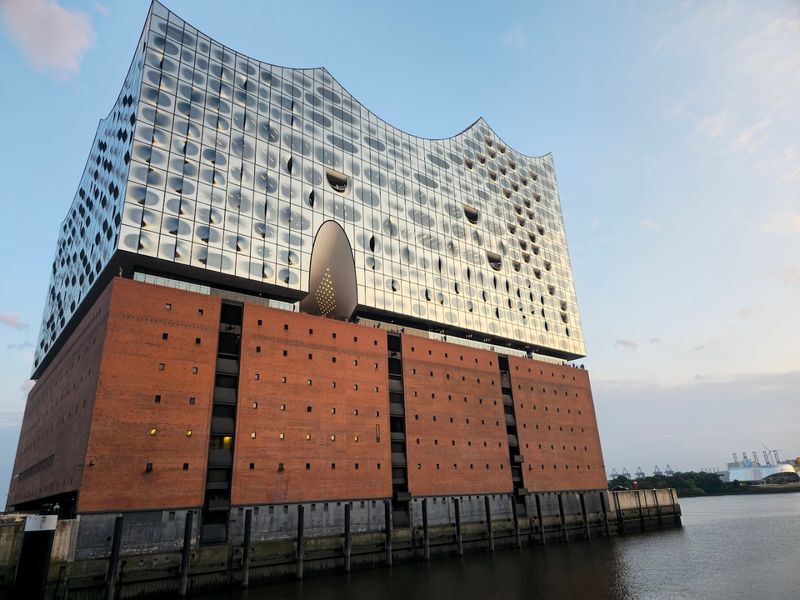
Hamburg’s harbor has seen plenty of impressive ships, but nothing quite prepared the city for what arrived on its waterfront in 2017. The Elbphilharmonie sits on top of a historic red-brick warehouse called the Kaispeicher B, and its upper section is an entirely different world of curved glass panels that ripple like a frozen ocean wave.
Architects Herzog and de Meuron spent years perfecting the design, which includes 1,000 individually curved glass panels on the facade. The building houses three concert halls, a hotel, apartments, and a public viewing platform called the Plaza, which wraps around the 37th floor and offers a panoramic view of Hamburg that is genuinely hard to beat.
Entry to the Plaza is free, though timed tickets are required and should be booked in advance online. The main concert hall inside is considered one of the finest in the world for acoustic design, with a central stage surrounded by seats on all sides.
2. Vitra Design Museum, Weil am Rhein
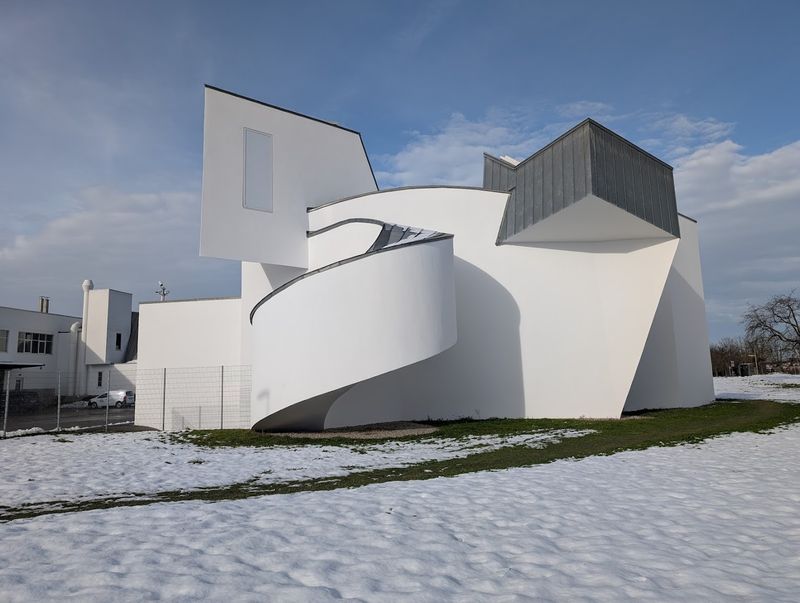
The Vitra Design Museum campus near the Swiss border is essentially a greatest hits collection of experimental architecture, and it all started with Frank Gehry’s explosive white building in 1989. Sharp angles jut out at unexpected directions, curved towers lean without apology, and the whole structure looks like geometry had an argument with itself and nobody won.
Gehry’s building was his first completed project in Europe, and it set the tone for everything that followed on the campus. Over the decades, Vitra added structures by Zaha Hadid, Tadao Ando, SANAA, and Alvaro Siza, turning a furniture company’s headquarters into one of the most architecturally ambitious sites on the continent.
Guided tours of the campus are available and highly recommended, as they walk visitors through each building with context about the architects and their intentions. The museum itself hosts rotating design exhibitions throughout the year.
Check the official Vitra website before visiting to confirm current shows and tour schedules for 2026.
3. BMW Welt, Munich
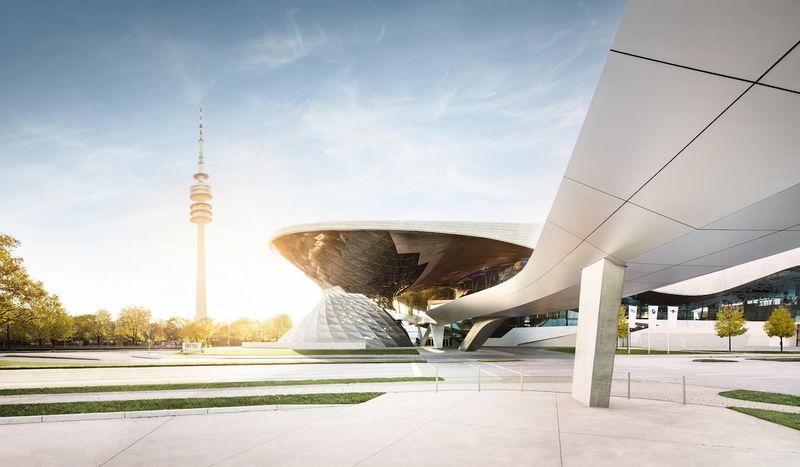
Car showrooms are not usually on architectural bucket lists, but BMW Welt in Munich is not a typical car showroom. Completed in 2007 and designed by the Viennese firm Coop Himmelblau, it features a massive double-cone roof structure that hovers above the main floor on a thin rim of supports, making it look like a spacecraft that landed and decided to stay.
The building connects directly to the historic BMW Museum next door and sits opposite the company’s iconic four-cylinder tower headquarters. Together, they form one of the most visually dramatic corporate campuses in Europe.
BMW Welt is free to enter, which makes it one of the best-value architectural experiences in Munich. Visitors can walk the full floor freely, watch car delivery ceremonies where new owners collect their vehicles, and explore the interactive exhibits about mobility and design.
It draws around 850,000 visitors per year, which tells you everything about how seriously people take a building that was meant to sell cars.
4. Waldspirale, Darmstadt
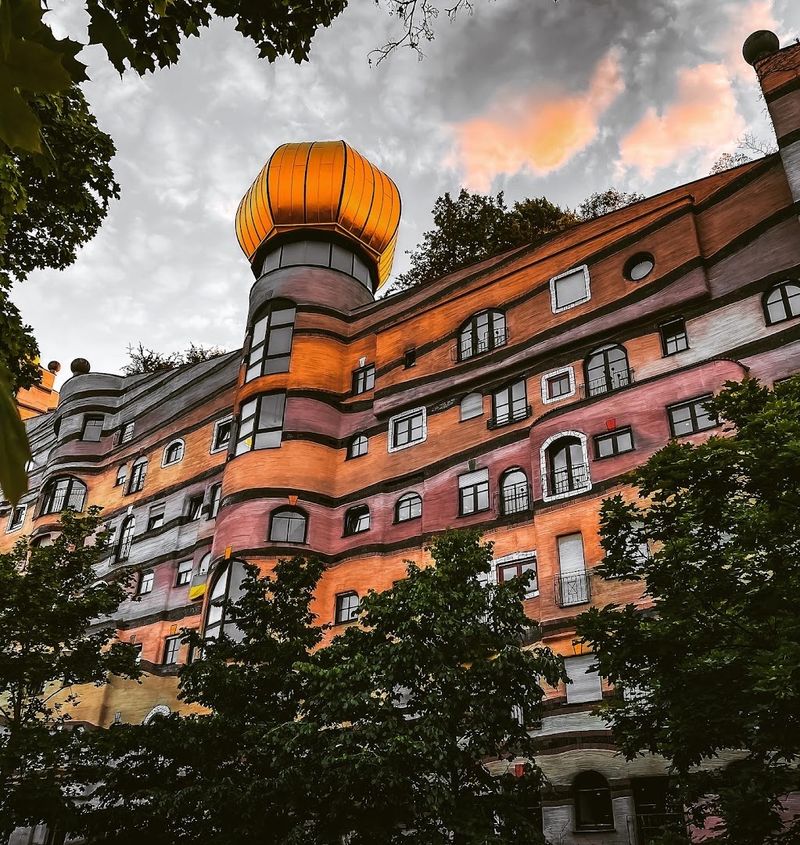
Hundertwasser makes a second appearance on this list because, honestly, the man earned it. The Waldspirale, or Forest Spiral, in Darmstadt is a residential apartment complex completed in 2000 that follows his philosophy with remarkable commitment.
The building curves in a U-shape around a central courtyard, and its roofline rises and falls in a continuous wave that ends in a golden onion dome.
More than 1,000 windows punctuate the facade, and no two are the same size, shape, or color. Some windows have small trees growing directly through them, a design feature Hundertwasser called tree tenants.
The exterior is painted in warm earth tones with ceramic columns and mosaic accents throughout.
Because the Waldspirale is a private residential building, visitors cannot enter the interior. However, the exterior and the surrounding paths are open to the public and well worth a walk around.
The courtyard area offers excellent angles for photography. Darmstadt is easily reached by train from Frankfurt in under 30 minutes.
5. Hundertwasserhaus, Magdeburg (Green Citadel)
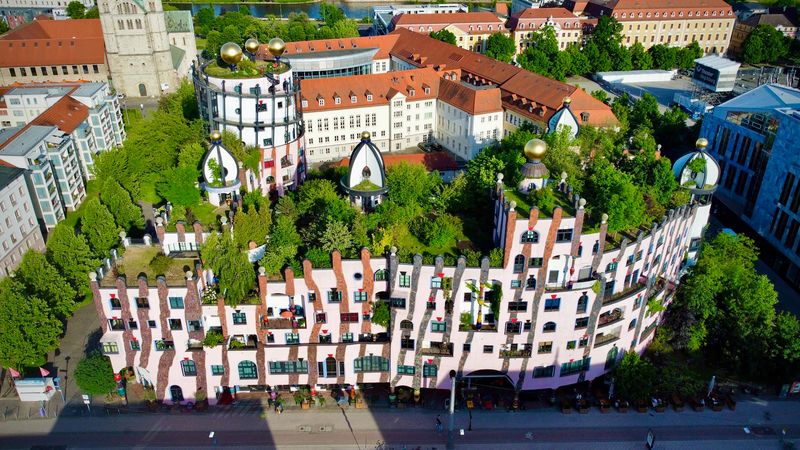
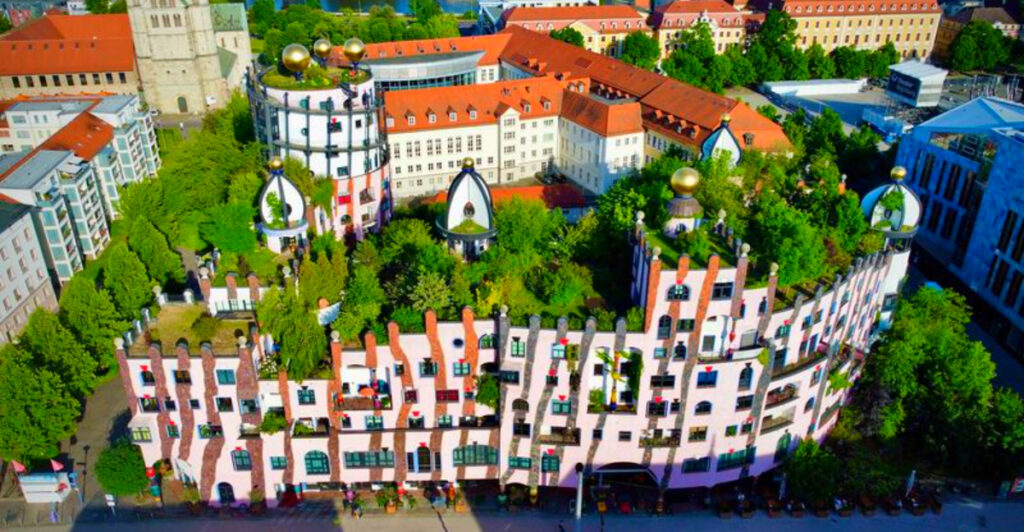
Few buildings in Germany stop people dead in their tracks the way the Green Citadel does. Designed by the legendary Austrian artist Friedensreich Hundertwasser, this rosy-pink complex in Magdeburg is packed with wavy lines, golden onion domes, and real trees growing straight out of the walls and rooftops.
Hundertwasser believed that nature and architecture should never be separated, so he literally built the outdoors into the indoors. The result is a structure that looks organic, almost alive, as if it grew from the ground rather than being constructed by workers with blueprints.
Completed in 2005, the building contains apartments, a hotel, shops, and a cafe, so visitors can actually spend the night inside this living artwork. The courtyard is open to the public and offers some of the best views of the exterior.
Plan to arrive on a weekday morning to avoid the weekend crowds that gather for photos.
6. Futurium, Berlin
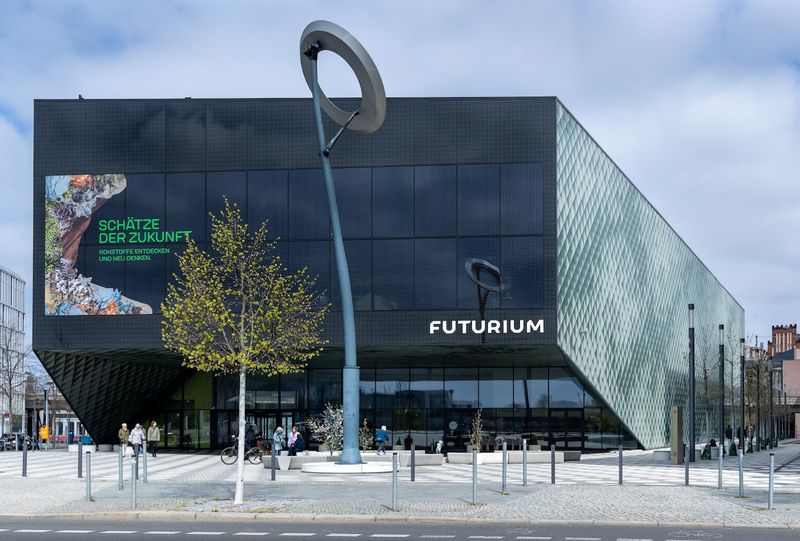
Berlin already has more than its share of striking buildings, but the Futurium, which opened in 2019, manages to stand out even in that competitive crowd. Its exterior is covered in a honeycomb pattern of reflective aluminum panels that shift in appearance depending on the angle and time of day, giving the building a constantly changing visual character.
The Futurium is not just a pretty shell. Inside, it functions as a public think tank and exhibition space dedicated to exploring possible futures for humanity in areas like technology, nature, and society.
The permanent exhibition is interactive, hands-on, and genuinely thought-provoking for visitors of all ages.
Admission to the main exhibition is free, which is a rare and welcome surprise for a Berlin attraction of this quality. The rooftop terrace is open to the public and provides a clear view across the government district toward the Reichstag.
Guided tours and special events run throughout the year, so checking the Futurium website before your visit is a smart move.
7. Zollverein School of Management and Design, Essen
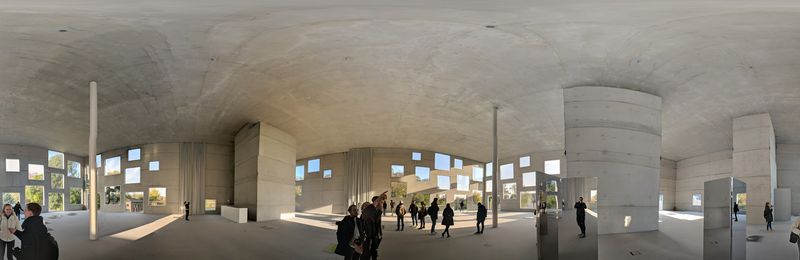
On a UNESCO World Heritage industrial site that once housed one of the world’s largest coal mines, a stark concrete cube sits with absolute confidence. The Zollverein School of Management and Design, completed in 2006 and designed by SANAA, is a perfect square in plan and almost completely blank on the outside, save for a scattering of windows placed in seemingly random positions.
That randomness is actually calculated. The window placement follows the interior layout of the building, where studios and classrooms are arranged without fixed corridors, giving students and faculty freedom to move through open, flexible spaces.
The building’s blunt geometry makes a direct and deliberate contrast with the ornate industrial infrastructure of the Zollverein complex around it.
The Zollverein campus as a whole is worth a full day of exploration. The former coal washing plant now houses the Ruhr Museum, and the entire site offers a fascinating look at how industrial heritage can be transformed into cultural space.
The school building can be viewed from the outside freely at any time.
8. Leipzig City Tunnel Stations
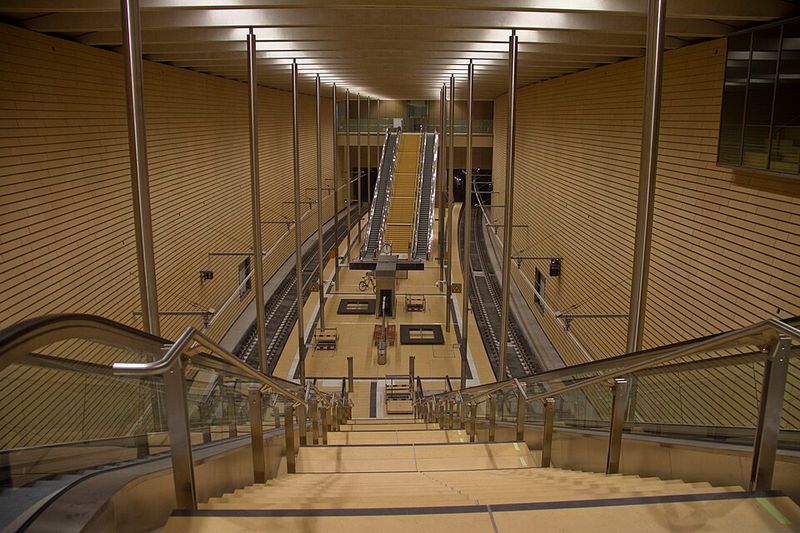
Underground train stations are usually forgettable by design, meant to move people efficiently rather than impress them. The stations of Leipzig’s City Tunnel, opened in 2013, had a different agenda entirely.
Each of the four main stations was designed by a different architectural team, and each has its own distinct visual character that transforms the daily commute into something genuinely worth looking at.
Wilhelm-Leuschner-Platz station features dramatic concrete forms that frame the platforms in bold geometric shapes. Bayerischer Bahnhof station incorporates the historic facade of a 19th-century terminus into its modern underground design, creating a layered conversation between old construction and new engineering.
Visitors do not need to ride the train to appreciate the architecture, though taking the S-Bahn through all four stations in sequence is an efficient way to see them all. A single transit ticket covers the journey.
Leipzig’s main station above ground is also one of the largest and most architecturally impressive terminal stations in Europe, making the city a solid destination for anyone interested in transport infrastructure design.
9. KfW Westarkade, Frankfurt
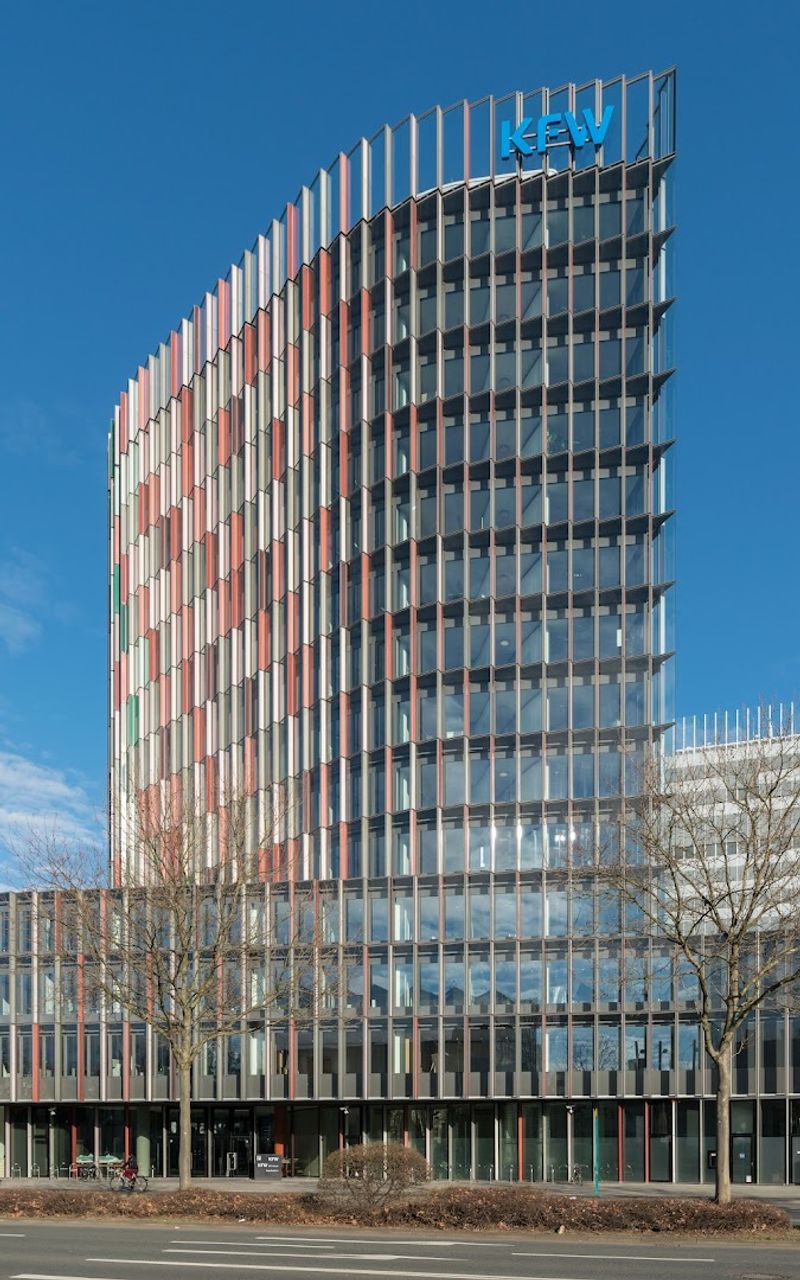
Most office buildings blend into their surroundings without much effort. The KfW Westarkade in Frankfurt, completed in 2010 and designed by Sauerbruch Hutton, refuses to do anything of the sort.
Its double-skin glass facade is layered with colored louvers that shift position throughout the day to regulate heat and light, giving the building a dynamic appearance that changes with the sun.
Beyond its good looks, the Westarkade is one of the most energy-efficient office buildings ever constructed. It uses roughly 80 percent less energy than a standard office building of comparable size, a figure that earned it multiple international awards for sustainable design.
The building serves as the headquarters extension of KfW, Germany’s state-owned development bank.
The exterior can be viewed freely from the street in Frankfurt’s banking district, and the building makes for an interesting stop on any architectural walking tour of the city center. Frankfurt’s skyline is unusual for Germany, full of high-rises that give it a distinctly international character, and the Westarkade holds its own comfortably among them.
10. Neues Museum, Berlin
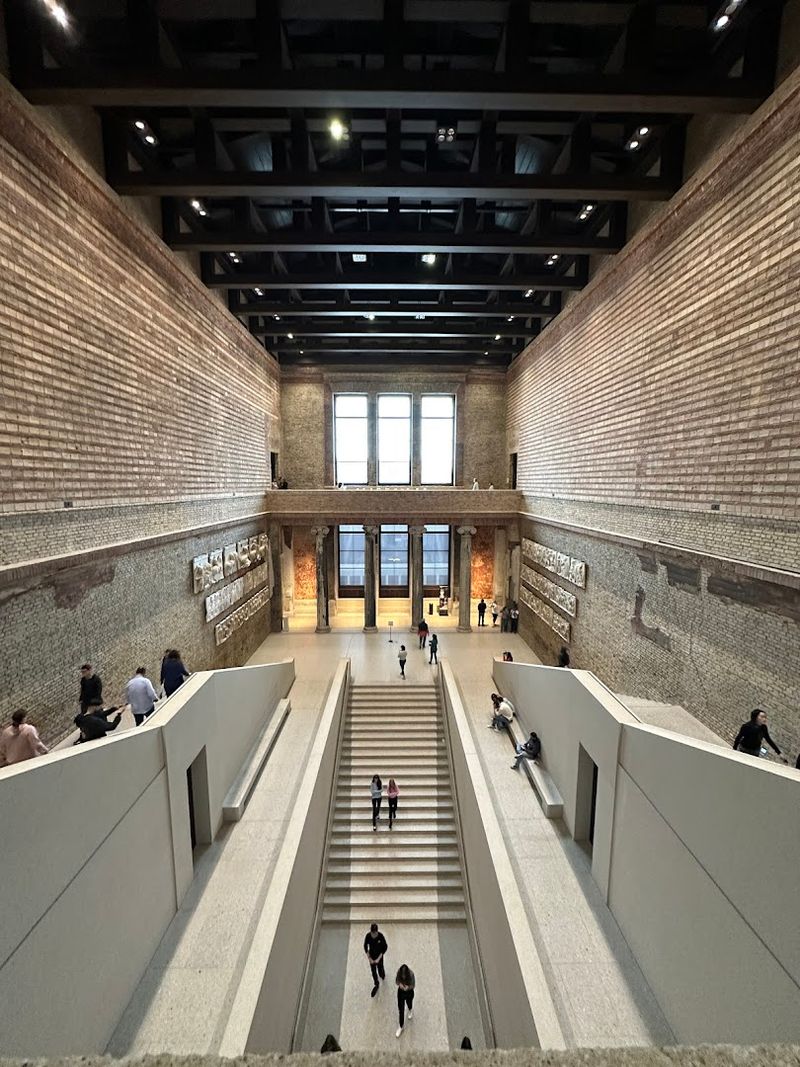
What happens when a historic building is badly damaged and architects have to decide how much of the original to restore? The Neues Museum on Berlin’s Museum Island answers that question in one of the most compelling ways in modern architecture.
British architect David Chipperfield led a reconstruction completed in 2009 that preserved every fragment of the 19th-century original while filling the gaps with raw concrete and new brick that makes no attempt to disguise itself as old.
The result is a building that reads like a visible timeline. Ornate neoclassical columns and painted ceilings sit directly beside stark modern surfaces, and the contrast between them is neither jarring nor apologetic.
It simply tells the truth about what happened to the building over its history.
The museum houses the Egyptian Museum collection, including the famous bust of Nefertiti, which draws visitors from around the world. Timed entry tickets are required and should be booked well in advance, especially for summer visits.
The museum is a core part of the Museum Island complex, which is itself a UNESCO World Heritage Site.
11. Phaeno Science Center, Wolfsburg
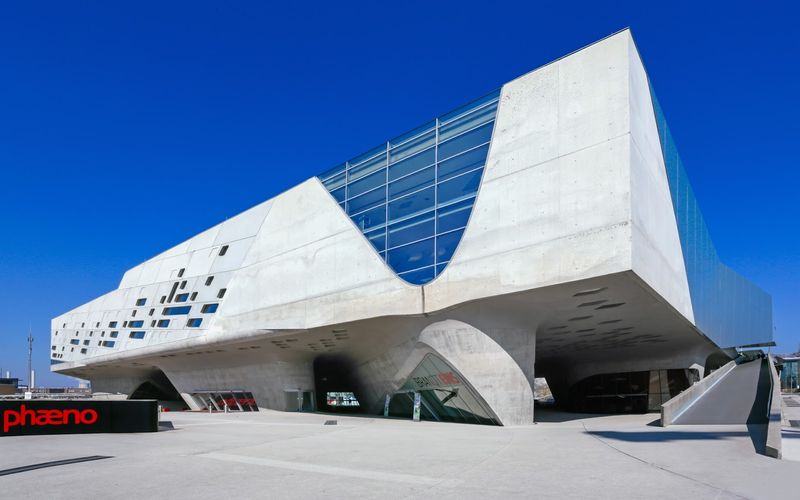
Zaha Hadid designed many remarkable buildings during her career, but the Phaeno Science Center in Wolfsburg has a particular trick up its sleeve. The entire building is elevated off the ground and supported by ten massive cone-shaped concrete structures called voids, leaving the space beneath the building open and passable.
From street level, it genuinely appears to float.
Completed in 2005, the Phaeno was Hadid’s first major public building in Germany and remains one of her most technically ambitious projects. The flowing concrete shell of the building contains no right angles, and the interior continues this logic with ramps, curves, and unexpected level changes throughout the exhibition spaces.
The science center is designed for hands-on exploration, with over 300 interactive experiments covering physics, mathematics, and natural science. It is well suited for visitors of all ages and particularly popular with school groups.
Wolfsburg is most commonly known as the home of Volkswagen, and combining a visit to the Phaeno with a tour of the Autostadt car museum next door makes for a full and rewarding day trip from Hannover or Berlin.
12. Rakotzbrücke (Devil’s Bridge), Kromlau
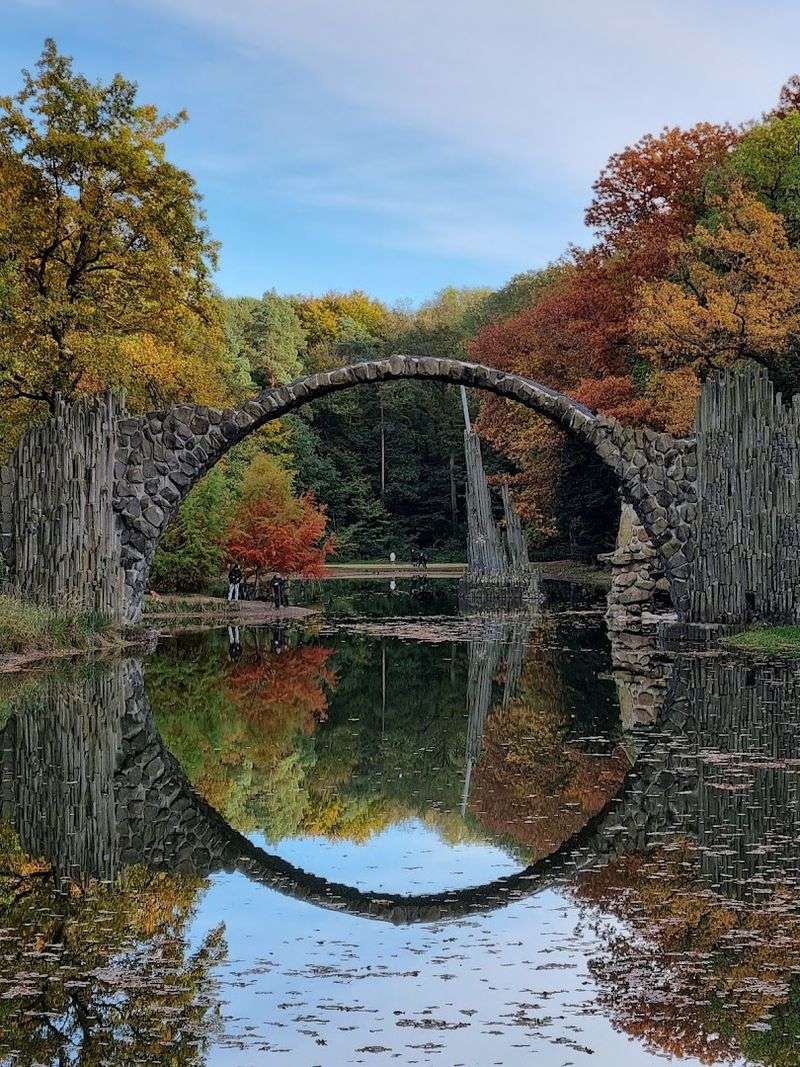
Built purely for the sake of beauty, the Rakotzbrücke in Kromlau, Saxony, is one of the strangest and most deliberate optical illusions in European landscape design. Constructed between 1860 and 1875 using natural basalt columns, the bridge forms a perfect semicircular arch that, when reflected in the still water of the lake below, creates an unbroken circle of stone.
The bridge was never intended for practical transport. Its sole purpose was to create this visual effect for the enjoyment of guests visiting the surrounding Rhododendronpark.
That single-minded commitment to aesthetics over function makes it one of the most unusual structures on this list.
The bridge is now closed to pedestrians to protect it from further wear, but visitors can view and photograph it freely from the surrounding paths. Autumn visits are particularly popular because falling leaves add color to the water’s surface without obscuring the reflection.
The park itself is free to enter and is located near the town of Gablenz, accessible by car from Cottbus or Görlitz.
Share this story