 Unearth The Voyage

The 1980s turned everyday conversation into a fast-moving collection of catchphrases, borrowed attitudes, and pop culture shorthand. A few lines came from surf slang, some from malls and sitcoms, and others from the growing power of movies, MTV, and teen media.
What makes these expressions interesting now is not just that they sound dated, but how clearly they map the habits and humor of the decade that made them popular. Keep reading, and you will see how these once-common sayings traveled from ordinary speech into the museum of cultural memory, where they still survive through reruns, memes, and the occasional wonderfully awkward comeback.
1. “Gag Me With a Spoon”

Few phrases captured 1980s exaggeration more neatly than “Gag Me With a Spoon.” It became shorthand for disgust, annoyance, or social embarrassment, delivered with maximum attitude and very little subtlety.
The line rose with the Valley Girl image that spread from Southern California into national media during the early 1980s. Frank Zappa and Moon Unit Zappa helped popularize that speech pattern in 1982, and films, television, and teen magazines quickly recycled it until the phrase became a national joke that teenagers sometimes used sincerely.
What makes it memorable is how specific it feels to that moment. It reflected a decade when slang was highly performative, and when identity was often built through catchphrases as much as clothes or music.
You still hear it in retro comedies or ironic throwback posts, but in everyday speech it sounds less like a natural reaction and more like a carefully chosen costume piece from the age of neon sarcasm.
2. “Totally Tubular”

Nothing says borrowed cool quite like “Totally Tubular.” The phrase came from surf culture, where “tube” referred to the hollow curve of a breaking wave, and “tubular” suggested something excellent or thrilling.
By the 1980s, that technical surfing word had jumped far beyond the beach. Television, teen movies, toy marketing, and skate culture helped turn it into a broad compliment, especially for kids and teens who wanted their language to sound upbeat, adventurous, and faintly Californian, even if they lived nowhere near the ocean.
Its decline makes sense once the culture around it shifted. As the decade ended, youth slang moved toward shorter, flatter terms that felt less theatrical and more flexible. “Totally tubular” became so tied to caricature that it started sounding like a parody of itself.
Today, you are more likely to hear it in a nostalgic joke than in real praise, which is fitting for a phrase that always sounded larger than ordinary life.
3. “Grody to the Max”

Some expressions were never built for subtlety, and “Grody to the Max” is one of the best examples. “Grody” had been around earlier as slang for gross or unpleasant, but the full phrase pushed the feeling into cartoonish overstatement.
The added “to the max” mattered because the 1980s loved verbal intensifiers. Ads, music television, and youth culture all rewarded speech that sounded bigger, faster, and more dramatic, so the phrase fit neatly into a decade that preferred its opinions in capital letters.
It often appeared in Valley Girl style slang lists, comedy sketches, and teen banter.
Its modern afterlife is mostly self-aware. People use it now to signal the 1980s instantly, the same way shoulder pads or giant mall bangs mark the period without explanation.
That is why the phrase faded from normal conversation but stayed in cultural storage. You may not say it seriously today, yet it remains a compact history lesson about how the decade turned everyday dislike into a performance.
4. “Barf Me Out”

If the decade had a medal for dramatic overreaction, “Barf Me Out” would at least make the podium. It was another flamboyant way to reject something as gross, annoying, or socially unacceptable, and it lived in the same neighborhood as Valley Girl sarcasm.
The phrase spread during an era when teen language was increasingly shaped by media feedback loops. Once a slang term appeared in a movie, on television, or in a magazine aimed at young readers, it could move quickly into school hallways across the country. “Barf Me Out” thrived because it was vivid, silly, and easy to perform.
It faded for the same reason many heavily stylized expressions do: trends changed, and the joke started wearing itself. Later generations preferred reactions that were drier, shorter, or more deadpan.
Even so, the phrase remains useful as evidence of how 1980s speech often treated disgust as a social routine rather than a private feeling. It was conversation with jazz hands, minus the jazz hands.
5. “What’s Your Damage?”

Sharp edges gave 1980s teen slang some of its staying power, and “What’s Your Damage?” had plenty of edge. Rather than simple disagreement, it questioned a person’s behavior with a dose of sarcasm that felt more cutting than outright rude.
The phrase is closely linked to the 1988 film Heathers, which helped cement it in pop culture memory. That movie did not invent sarcastic teen speech, but it packaged it in a way that influenced how people remembered the era.
Once a memorable line entered the high school quote machine, it often outlived the original scene.
Unlike some brighter, sillier expressions, this one survives because it can still sound clever in the right context. Still, you rarely hear it in everyday conversation now, partly because its tone is more confrontational than current casual slang usually prefers.
Today it feels like a line people borrow for flavor, not habit. When it appears, it instantly carries the posture of late 1980s teen culture, where wit often arrived wearing shoulder pads.
6. “Take a Chill Pill”
Before wellness language became polished and marketable, there was the much blunter “Take a Chill Pill.” The phrase existed before the 1980s, but the decade helped keep it visible in casual conversation, sitcom scripts, and schoolyard banter.
Its appeal came from efficiency. In four words, you could dismiss drama, urge someone to calm down, and sound mildly funny at the same time.
That combination fit a period when conversational slang often leaned on quick, punchy directives rather than elaborate explanations, especially in pop media aimed at teens and young adults.
The phrase never fully disappeared, which makes it different from some entries on this list. You still hear it now and then, but usually with a knowingly retro tone or in situations where the speaker wants to sound unserious.
Modern language tends to favor gentler or more precise ways of discussing stress, so “Take a Chill Pill” feels dated, if not extinct. Still, it remains one of those durable phrases that can time-stamp a conversation almost immediately.
7. “Don’t Have a Cow”
Playful scolding rarely came stranger than “Don’t Have a Cow.” The phrase meant stop overreacting, calm down, or quit making a scene, and its absurd wording helped soften what might otherwise sound too blunt.
Although the expression predates Bart Simpson, late 1980s pop culture gave it a major second life. The Simpsons helped move it from spoken slang into mass quotation, turning it into one of those lines people repeated because they had heard it on television as much as in real life.
That mattered in an era when TV catchphrases still traveled fast.
Its staying power comes from recognition, but its everyday usefulness has clearly shrunk. Younger speakers often know it as a reference rather than a normal response, and the phrase depends on a style of broad, goofy humor that now feels distinctly tied to its period.
Even so, it remains a neat example of how 1980s and early 1990s slang overlapped, with television acting as both amplifier and preservation device.
8. “Rad” / “Radical”
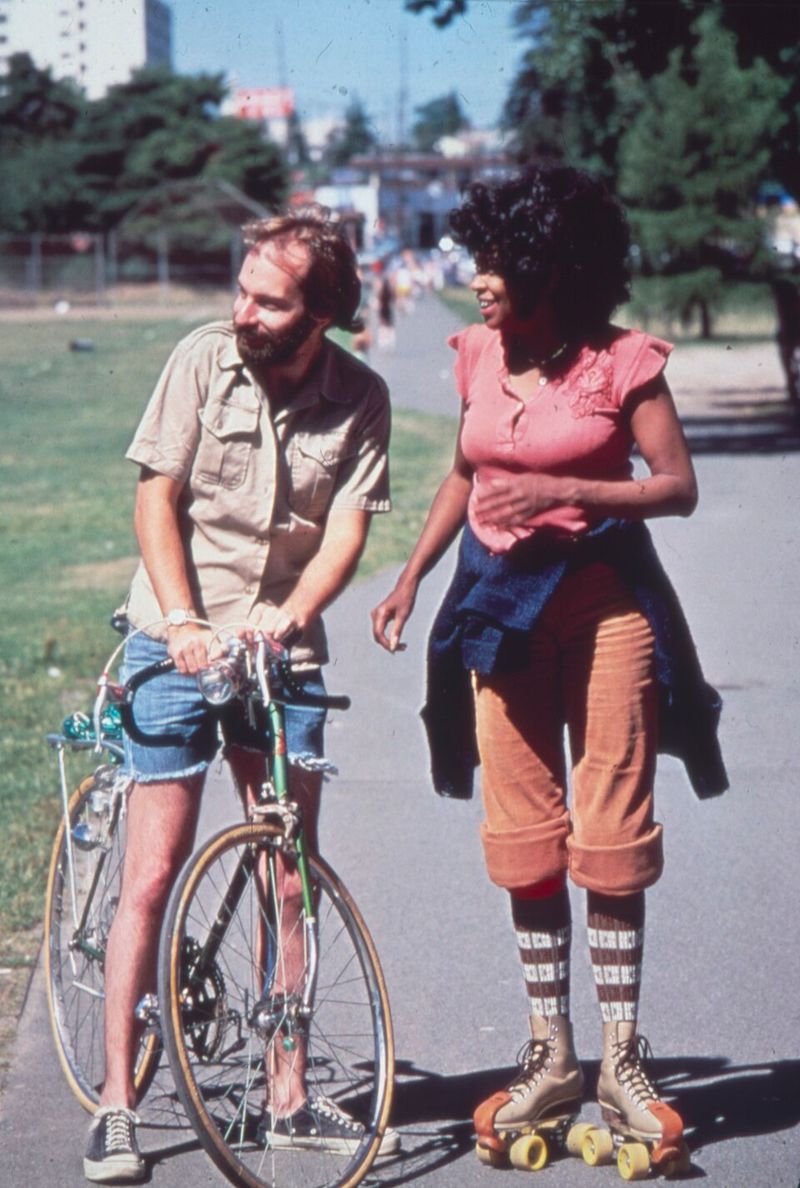
Short words often travel far, and “Rad” may be the most portable term on this list. Derived from “radical,” it moved from surf and skate communities into mainstream youth slang as a compact way to call something cool, impressive, or exciting.
The rise of action sports helped enormously. During the 1980s, BMX, skateboarding, and surf imagery became widely marketable, showing up in movies, commercials, cereal tie-ins, and clothing brands. “Radical” sounded active and daring, while “rad” trimmed that energy into a form anyone could use, whether discussing a trick, a song, or a new pair of high-tops.
Unlike many period phrases, “rad” never vanished completely. It still appears in modern speech, but usually with a wink that acknowledges its retro baggage.
That half-survival is what makes it interesting. The word remains useful, yet it also signals taste, age, or irony depending on who says it.
If a phrase can fade, linger, and re-enter culture as a style choice, “rad” has managed the trick better than most of its 1980s peers.
9. “Psych!”

For a quick fake-out, nothing landed faster than “Psych!” It was the verbal rug pull of 1980s and early 1990s youth culture, used after a joke or false claim to reveal that the speaker had been kidding all along.
The word worked because it was simple, easy to repeat, and tailor-made for teasing. Schoolyard humor rewarded small social tricks, and “Psych!” gave those tricks a crisp ending that everyone understood.
It also fit a broader period habit of turning short words into multipurpose social tools, especially among kids and teens who valued speed over explanation.
Its decline reflects a change in comedic rhythm. Contemporary humor often leans on irony, reaction images, or layered references rather than overt verbal fake-outs.
Saying “Psych!” now can sound charmingly old-school, which is exactly why it survives in nostalgic media. You may still hear it from people deliberately channeling playground energy, but it no longer sits at the center of casual joking.
Once common enough to end countless lunch-table pranks, it now lives mostly in memory and reruns.
10. “No Duh”
Some phrases survive by being useful, and “No Duh” had utility on its side. It offered a compact, mildly sarcastic way to point out that something was obvious, which made it perfect for siblings, classmates, and anybody with limited patience.
Though strongly associated with the 1980s, the phrase kept rolling into later decades more successfully than many flashier terms. Part of that durability comes from structure.
It is short, easy to understand, and less tied to a single subculture than expressions borrowed from surfers or Valley Girls. It can sound rude, playful, or affectionate depending on tone.
That flexibility helped it outlast more theatrical sayings, even if its peak belongs to the era of neon folders and after-school sitcoms. You can still hear variations of it today, though often softened or replaced by internet-era alternatives. “No Duh” is a reminder that not every 1980s phrase vanished completely.
Some simply stepped down from headline status and kept working quietly in the background, like reliable character actors in the long-running sitcom of American slang.
11. “Word Up”
Cool traveled differently when “Word Up” was in circulation. The phrase served as approval, agreement, or greeting, and it drew strength from Black urban slang traditions that shaped much of American popular language during the 1980s.
Mainstream exposure expanded when Cameo released “Word Up!” in 1986, helping push the phrase further into national awareness. But its roots are broader than one song.
Hip-hop culture, radio, street fashion, and neighborhood speech all contributed to its reach, and the phrase worked because it sounded confident without needing many extra words.
What changed over time is not the core meaning but the packaging. “Word up” gradually narrowed into the cleaner, simpler “word,” which still appears in conversation today. That evolution makes it one of the clearest examples on this list of a phrase fading without fully disappearing.
The original version now feels more period-specific, while its shortened descendant remains current enough to pass without comment. Few 1980s sayings demonstrate language adaptation so neatly, or prove that slang rarely vanishes all at once.
12. “Make It a Blockbuster Night”

A slogan can become a ritual, and “Make It a Blockbuster Night” did exactly that. More than advertising copy, it described a real weekly habit built around driving to a video store, browsing shelves, and negotiating what everyone would watch.
Blockbuster expanded rapidly after its 1985 founding, and by the late 1980s and 1990s it had become a defining feature of home entertainment. The phrase worked because it connected convenience, family routine, and the novelty of choosing from a large rental library.
In practical terms, it also reflected a time when watching a movie at home often required planning rather than tapping a screen.
Streaming ended both the ritual and the slogan’s everyday relevance. Once films and shows became instantly available, the shared trip to the store stopped being a regular part of the week.
That shift makes the phrase especially nostalgic, because it refers not just to language but to a vanished behavior. You are really remembering a system: late fees, plastic cases, membership cards, and the social choreography of the Friday night rental run.
13. “You Sound Like a Broken Record”
Technology quietly shaped slang, and “You Sound Like a Broken Record” is a perfect example. The phrase meant someone was repeating the same point over and over, borrowing its image from a vinyl record stuck in a groove.
By the 1980s, plenty of households still understood that reference firsthand, even as cassettes and compact discs gained ground. Records had not disappeared, and the metaphor remained instantly clear across generations.
It showed how older technologies can linger inside language long after newer devices start taking over the market.
What makes the phrase interesting today is not that it vanished completely, but that its underlying image is becoming less automatic for younger speakers. A person can understand the meaning without ever having handled a record player.
That creates a subtle distance between phrase and experience, which is often how sayings begin to age. You still hear it, especially from older adults, but it no longer feels universally grounded in daily life.
Like many analog metaphors, it survives on cultural memory even as the original object becomes more specialized.
14. “Catch You on the Flip Side”
Farewells used to carry their own little bits of technology, and “Catch You on the Flip Side” proves it. The phrase offered a casual goodbye while referencing the other side of a record or cassette, where more content waited after you flipped it over.
Its charm came from being relaxed and slightly clever. You could use it as a simple sign-off, but it also hinted at a media-saturated world where records, tapes, radio, and mixtapes shaped everyday habits.
In the 1980s, that connection still felt natural because physical formats structured how people listened, shared, and replayed music.
As digital media removed the need to turn anything over, the phrase lost some of its intuitive force. People still recognize it from movies, radio personalities, or nostalgic throwbacks, but it rarely appears as a spontaneous goodbye now.
That fading relevance makes it an excellent cultural marker. The line does more than date a conversation.
It preserves an ordinary physical action that younger listeners may understand only as a reference, not as part of daily routine.



