Beneath mountains, deserts, forests, and coastlines lies an astonishing underground world shaped over millions of years. These caves and grottoes feature glowing waters, colossal chambers, underground rivers, and surreal rock formations that seem almost impossible to believe.
For travelers seeking nature at its most dramatic, few places are more unforgettable. Get ready to explore fifteen of the most jaw-dropping caves on the planet.
Son Doong Cave — Vietnam
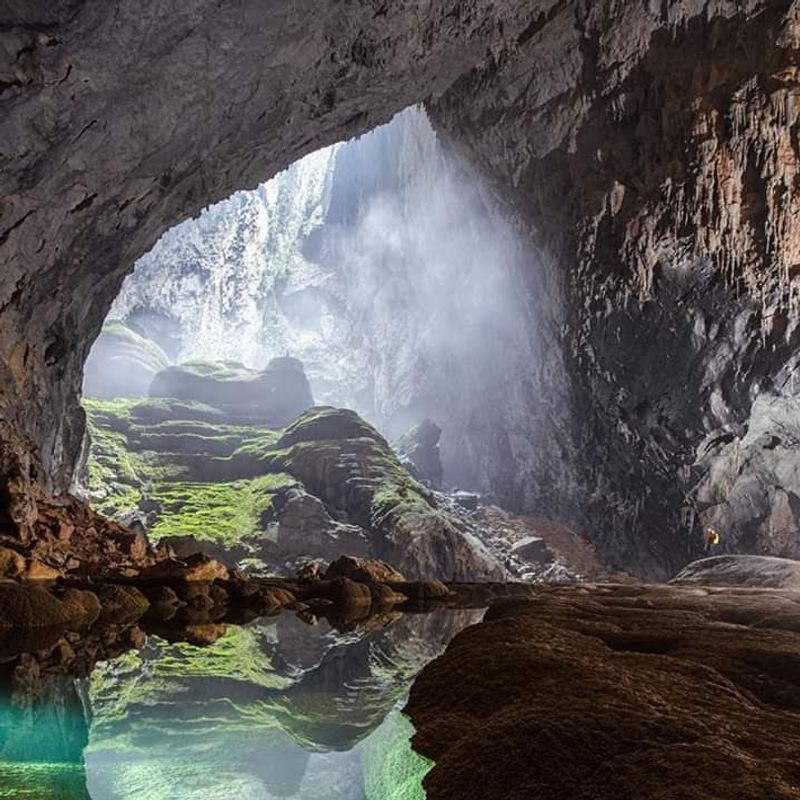
So enormous it has its own weather system, Son Doong Cave in Vietnam is the undisputed heavyweight champion of underground spaces. Hidden within Phong Nha-Ke Bang National Park, it was only discovered by a local farmer in 1990 and not fully explored until 2009.
That is a remarkably recent find for something so colossal.
The cave stretches over nine kilometers long and reaches heights of nearly 200 meters in places. Sunlight pours through two massive ceiling collapses called dolines, allowing entire jungles to grow inside.
Clouds actually form within the cave when temperatures shift, creating a misty, dreamlike atmosphere that photographers absolutely love.
Only a limited number of visitors are permitted each year, making a trip here genuinely exclusive. Expeditions last several days and involve camping underground beside a river that flows through the cave’s heart.
Guides from Oxalis Adventure lead every tour, ensuring the fragile ecosystem stays protected. If adventure had a final boss level, Son Doong would be it.
Mammoth Cave — Kentucky, United States
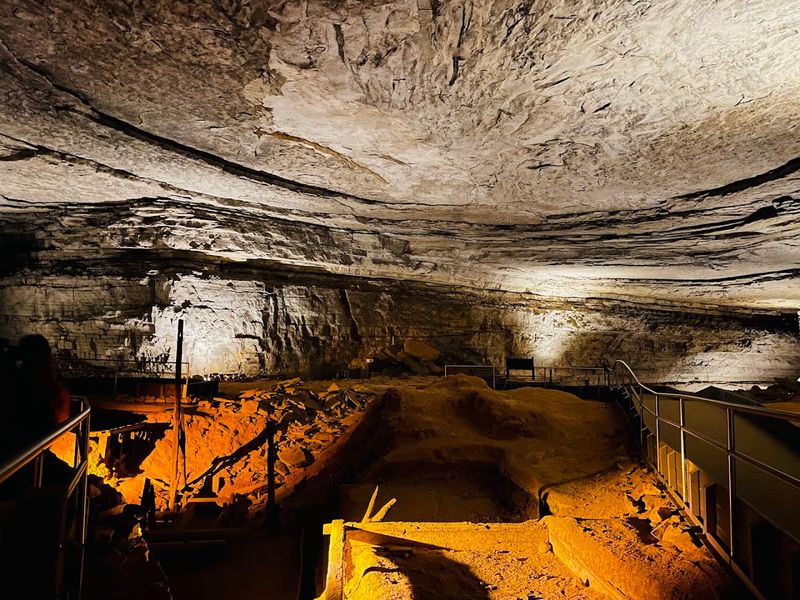
More than 680 kilometers of mapped passages wind beneath the hills of central Kentucky, making Mammoth Cave the longest known cave system on Earth. Scientists believe hundreds of additional kilometers remain undiscovered, quietly waiting beneath the surface.
That thought alone is enough to send a tingle down your spine.
The cave formed over millions of years as slightly acidic water dissolved the limestone bedrock, carving out tunnels, domes, and vast chambers. Indigenous peoples sheltered and explored here over 4,000 years ago, leaving behind sandal prints and torch marks still visible today.
Settlers later mined the cave for saltpeter, a key ingredient in gunpowder, during the War of 1812.
Today, the National Park Service offers tours ranging from easy strolls through grand lit chambers to wild caving adventures through tight, muddy passages. The Frozen Niagara section dazzles with flowing limestone formations that look exactly like a waterfall caught mid-motion.
Rare cave crickets, eyeless fish, and blind crayfish have adapted perfectly to life in permanent darkness here. Mammoth Cave is not just big in name.
Waitomo Glowworm Caves — New Zealand
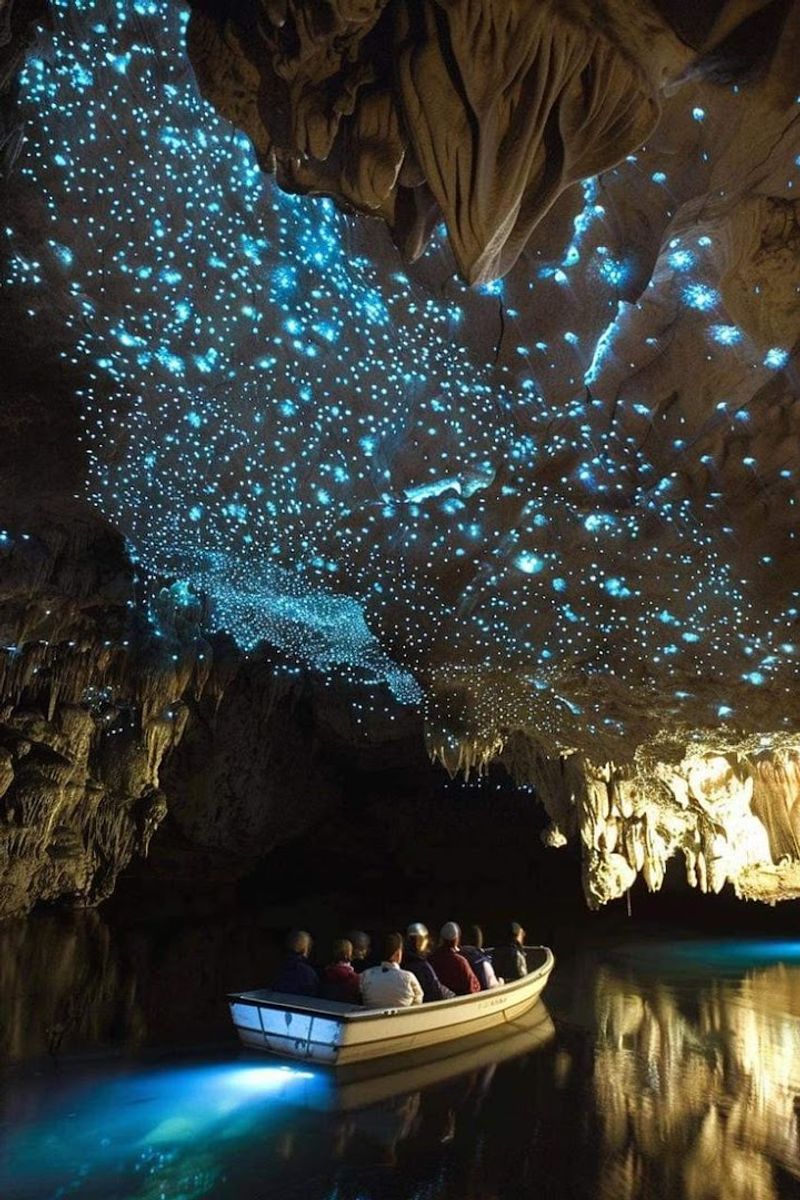
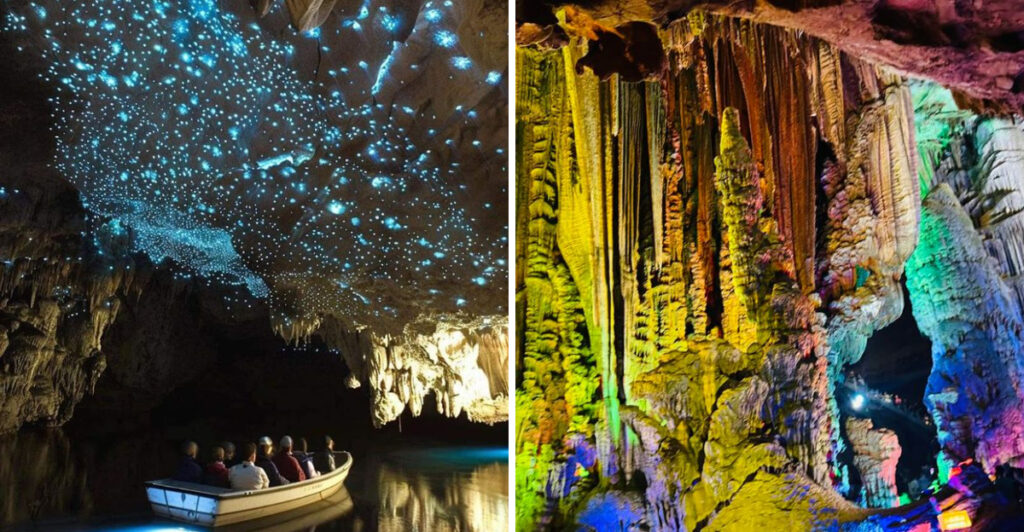
Look up inside the Waitomo Caves and you will swear someone pinned the night sky to the ceiling. Thousands of tiny bioluminescent creatures called Arachnocampa luminosa cling to the cave roof, each one glowing a cool, electric blue.
These are not worms at all but rather the larval stage of a fungus gnat found only in New Zealand.
The glowworms produce their light to attract small insects into sticky silk threads they hang from the ceiling. It is a beautiful trap.
Visitors float silently beneath this living light show on small boats, guided through the darkness by the glow alone, which makes the experience feel genuinely otherworldly.
The caves were formed in limestone about 30 million years ago and have been a tourist attraction since 1889. The Maori chief Tane Tinorau and English surveyor Fred Mace were among the first to explore the system by candlelight, floating on a raft.
Tours today are smooth, accessible, and suitable for all ages. A visit here takes around 45 minutes but leaves an impression that lasts considerably longer than that.
Škocjan Caves — Slovenia
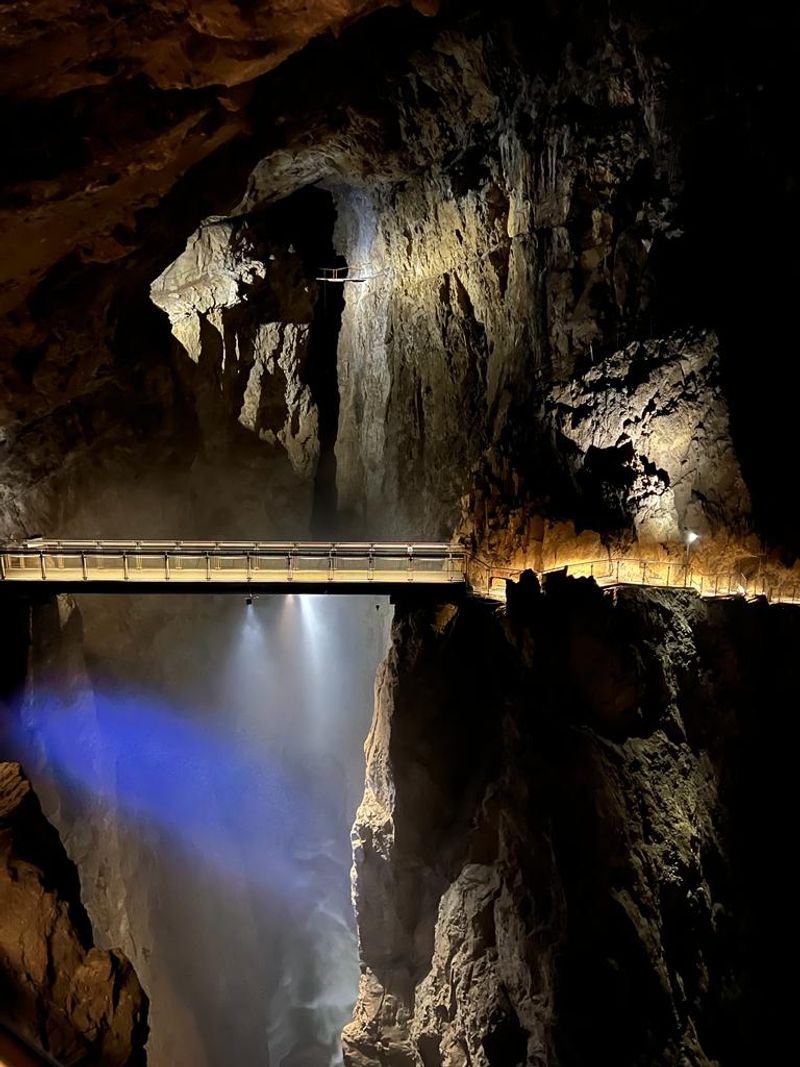
Few caves on Earth make you feel quite as small as Škocjan. This UNESCO World Heritage Site in southwestern Slovenia contains one of the largest underground canyons ever discovered, carved by the Reka River over millions of years.
Standing on a bridge above the roaring water, peering down into the abyss, is genuinely humbling.
The main chamber, called the Murmuring Cave, stretches over 300 meters long and soars more than 140 meters high in places. Waterfalls cascade down the canyon walls, and the sound of rushing water echoes through the stone corridors constantly.
The sheer scale makes most other European caves feel like hallways by comparison.
Škocjan has been a place of human significance for thousands of years. Archaeological evidence suggests people used the cave entrance as far back as the Bronze Age.
Today, guided tours cross dramatic bridges over the underground gorge and wind through chambers decorated with stalactites, stalagmites, and columns. The cave also supports rare bat populations and unique cave-adapted invertebrates.
Getting here is easy from the Slovenian coast, and the experience is absolutely worth the journey. Pack a light jacket because temperatures inside stay cool year-round.
Blue Grotto — Capri, Italy
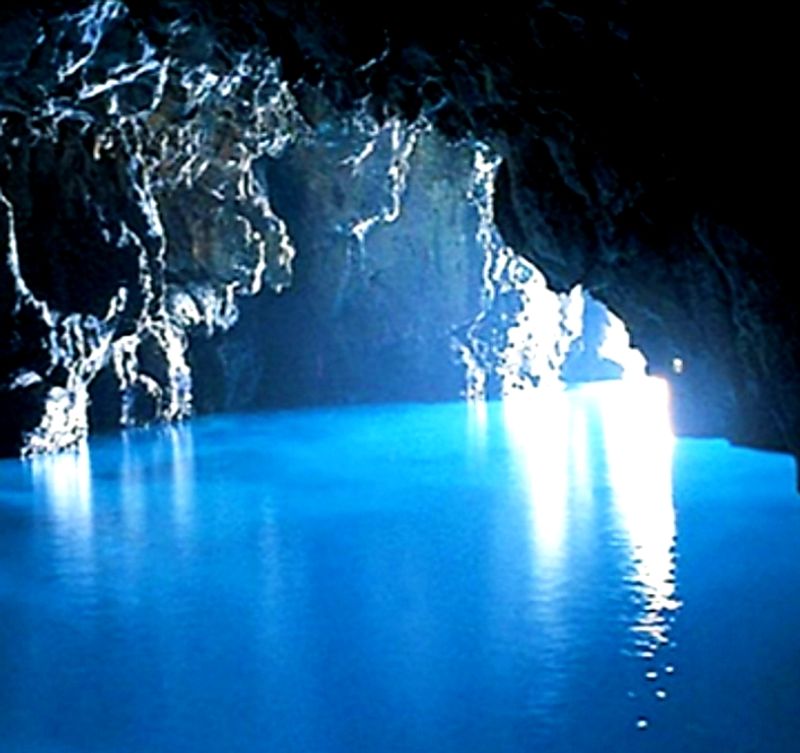
Electric blue does not even begin to cover it. The Blue Grotto on the island of Capri has been mesmerizing visitors since Roman Emperor Tiberius reportedly used it as a personal swimming spot around 2,000 years ago.
That is a very long track record for a sea cave.
The magic comes entirely from physics. Sunlight enters through an underwater opening roughly two meters wide and then filters upward through the water, scattering the blue wavelengths and making the entire cave glow from within.
The effect is so intense that swimmers appear to shimmer silver against the blue. No filters required.
Reaching the grotto requires a bit of adventure. Visitors transfer from larger boats into small wooden rowboats, then lie flat as the boatman pulls the craft through the low entrance using an iron chain fixed to the rock.
The cave is roughly 60 meters long and 25 meters wide, giving the boatmen just enough room to spin you around for the full effect. Entrance is only possible in calm seas, which adds an element of luck to the visit.
Morning light generally produces the most vivid colors, so arriving early is smart.
Cave of the Crystals — Chihuahua, Mexico
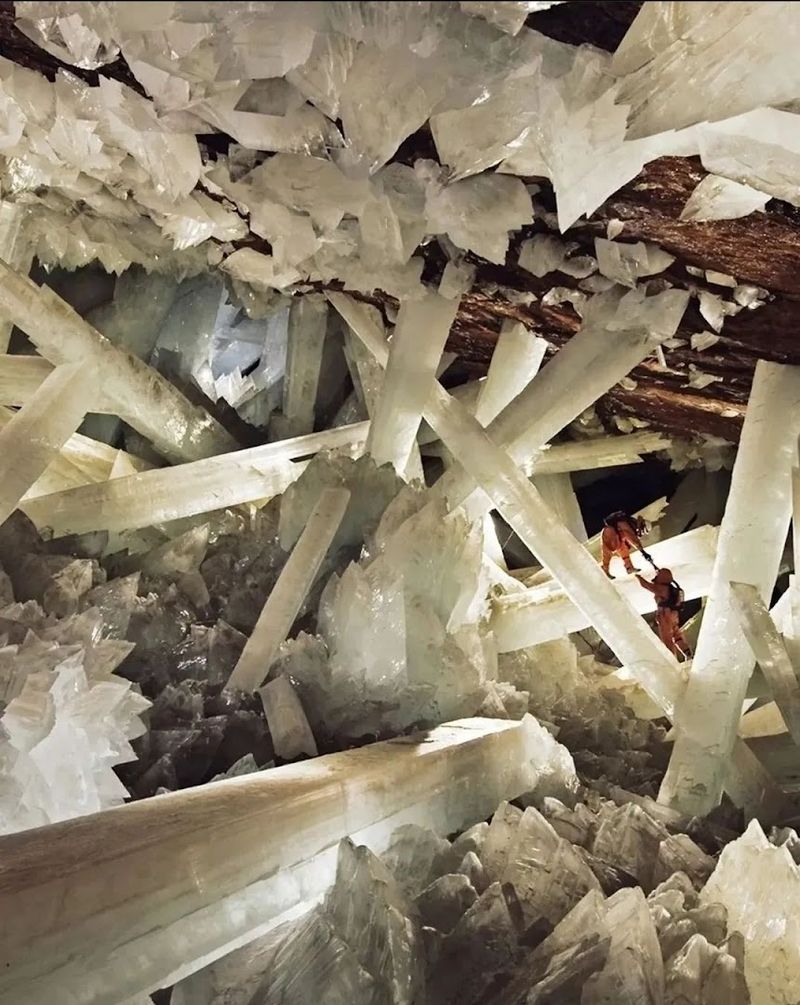
Imagine stumbling into a room filled with crystals the size of telephone poles. That is essentially what happened in 2000 when miners drilling beneath the Naica silver mine in Chihuahua broke through into a chamber unlike anything ever seen before.
The Cave of the Crystals was born, and geology collectively lost its mind.
The selenite crystals inside can reach up to 12 meters long and weigh as much as 55 tons. They grew over roughly 500,000 years while submerged in mineral-rich water held at a near-constant temperature of 58 degrees Celsius.
When the mine pumps drained the water, the crystals were exposed to air for the first time in half a million years.
Visiting is not for the casual tourist. The cave sits 300 meters underground and the air temperature can reach a deadly 70 degrees Celsius with high humidity.
Researchers who entered wore specially designed cooling suits and could only spend about 20 minutes inside at a time. The mine ceased operations in 2015 and the cave has since reflooded, preserving the crystals once more.
Scientists continue to study microbes found trapped inside the crystals, some possibly 50,000 years old.
Postojna Cave — Slovenia
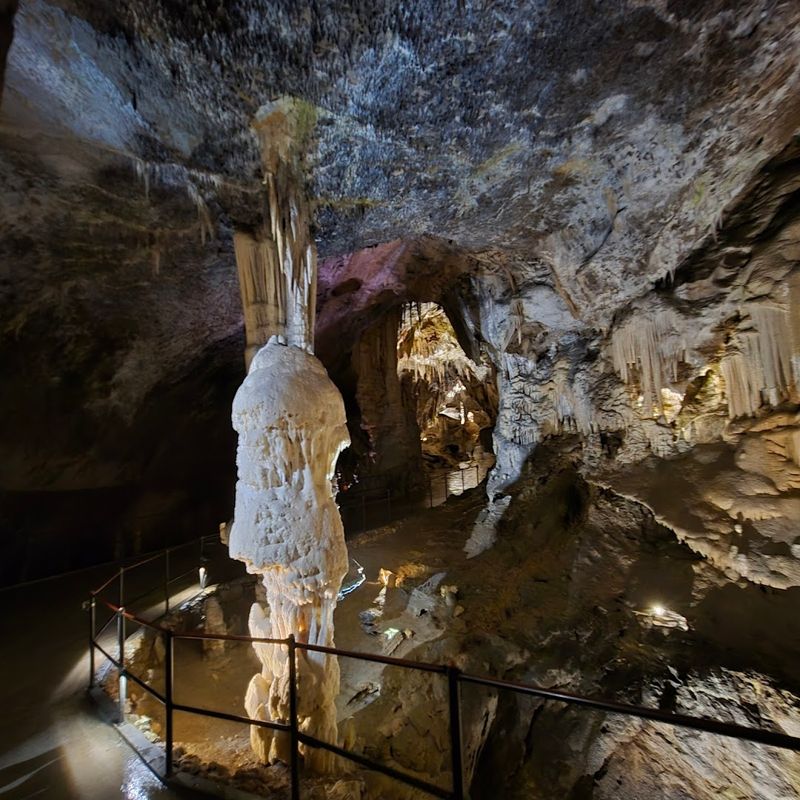
Riding a train underground through a cathedral of stalactites is not something most people have on their bucket list, but perhaps it should be. Postojna Cave in Slovenia has been welcoming visitors since 1819, making it one of the oldest show caves in the world.
The underground railway, added in 1872, remains one of its most beloved quirks.
The cave system stretches over 24 kilometers, though the tourist route covers around five kilometers of that. Chambers with names like the Concert Hall and the Winter Room hint at just how theatrical the formations inside can be.
The Concert Hall is so large it has hosted live musical performances with audiences seated underground.
Postojna is also home to the olm, a pale, blind, cave-adapted salamander sometimes called the human fish because of its pinkish skin tone. These remarkable creatures can live over 100 years and survive without food for a decade.
A vivarium near the cave exit lets visitors see them up close. The cave maintains a steady temperature of around 10 degrees Celsius year-round, so a warm layer is always a good idea.
Postojna draws well over half a million visitors annually and remains Slovenia’s most popular tourist attraction by a considerable margin.
Carlsbad Caverns — New Mexico, United States
At dusk each evening from late spring through autumn, a living tornado of nearly half a million Mexican free-tailed bats spirals out of the natural entrance to Carlsbad Caverns. The spectacle draws crowds who gather at the amphitheater above ground just to watch.
It is one of the most extraordinary wildlife events in North America, and it happens every single night.
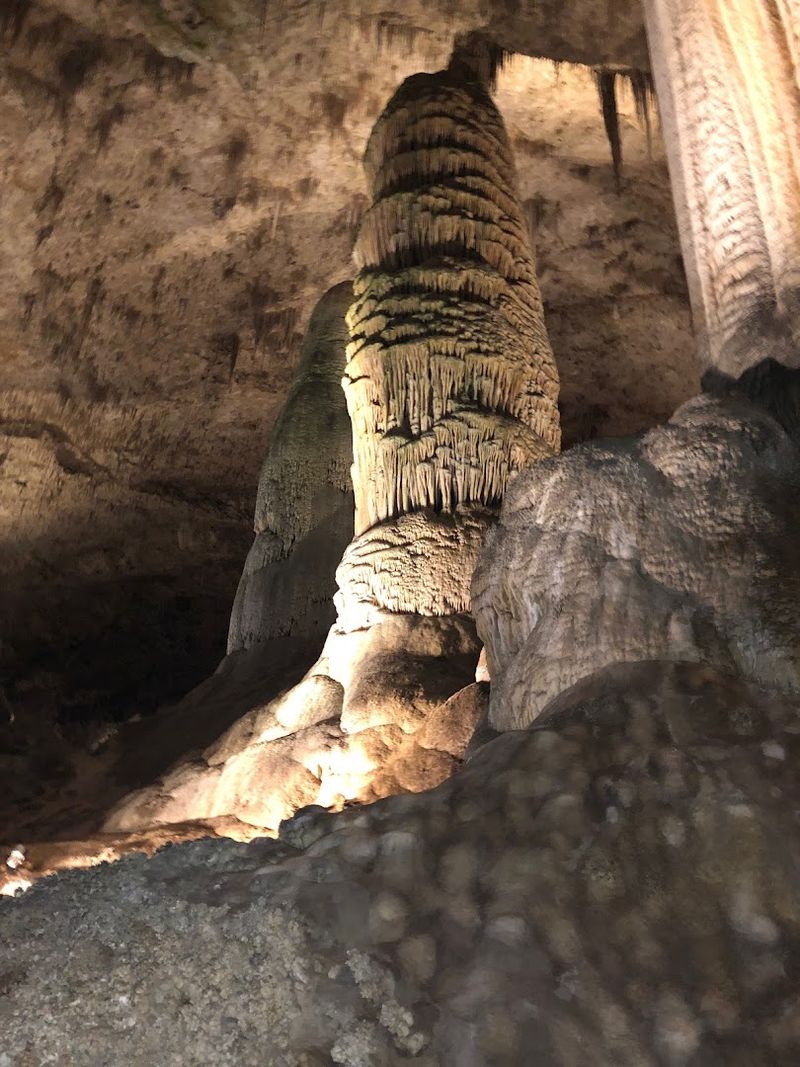
Below ground, the cave system is equally dramatic. The Big Room covers over 33,000 square meters, making it one of the largest single cave chambers in North America.
Formations with colorful names like the Bottomless Pit, the Totem Pole, and the Rock of Ages crowd every corner of the space. An easy paved trail loops through the entire chamber.
Carlsbad Caverns formed roughly 250 million years ago from an ancient inland sea. Sulfuric acid dissolved the limestone from below, which is unusual compared to most caves that form from above.
This gave the caverns their particularly dramatic and irregular shapes. Visitors can reach the Big Room either by hiking down the natural entrance trail or by taking an elevator 229 meters straight down.
The cave maintains a cool 13 degrees Celsius inside regardless of the scorching New Mexico heat above.
Fingal’s Cave — Scotland
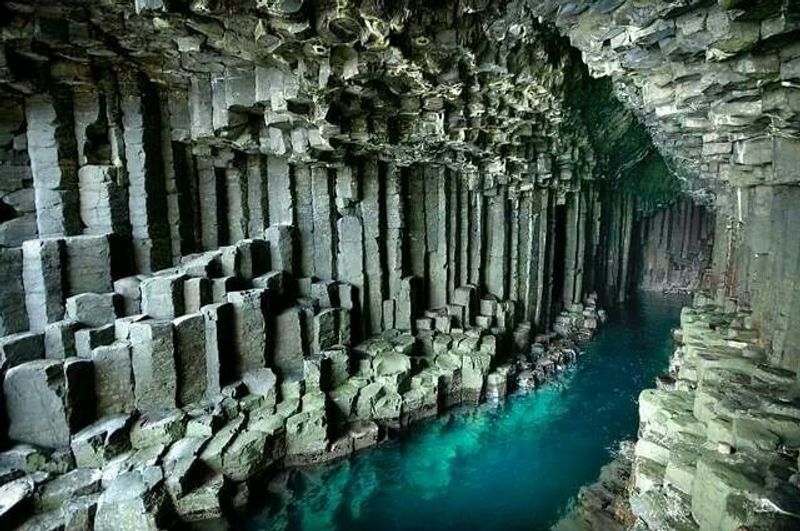
The ancient Celts believed Fingal’s Cave was built by giants, and honestly, looking at it, you can see their point. Located on the tiny uninhabited island of Staffa off the Scottish coast, the cave is formed entirely from perfectly hexagonal basalt columns stacked like honeycomb tiles.
Volcanic lava cooled so evenly 60 million years ago that it cracked into these geometric shapes with almost mathematical precision.
The cave stretches about 23 meters high and 82 meters deep into the cliff face. Waves roll in from the Atlantic and reverberate off the columned walls, creating haunting, resonant sounds that have inspired artists for centuries.
Composer Felix Mendelssohn visited in 1829 and was so moved that he wrote his famous Hebrides Overture, also known as Fingal’s Cave, in its honor.
Getting there requires a boat trip from the Isle of Mull or the mainland, and landings depend entirely on weather and sea conditions. When conditions allow, visitors can walk along a narrow basalt ledge into the cave itself.
The geological connection between Staffa and the Giant’s Causeway in Northern Ireland is well documented, as both were formed by the same ancient volcanic event. It is a short visit but an absolutely unforgettable one.
Puerto Princesa Underground River — Philippines
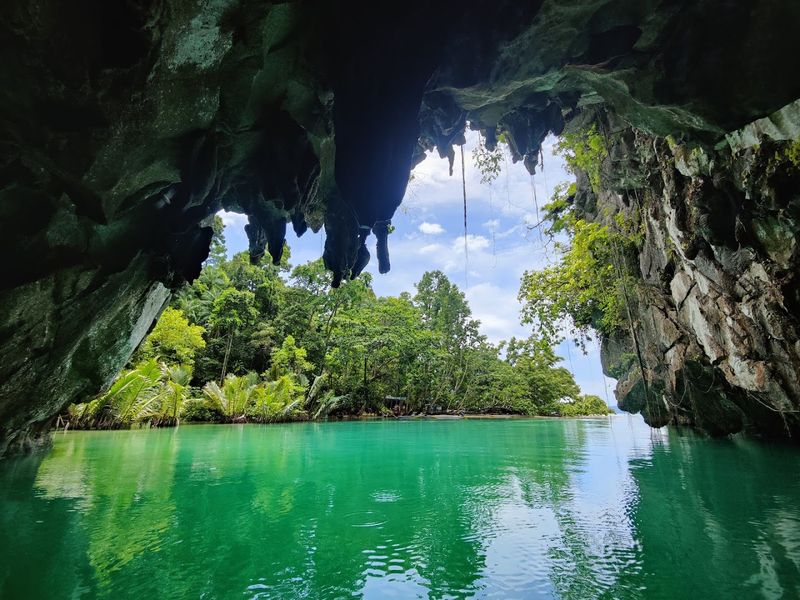
Somewhere beneath the jungle of Palawan Island, a river flows silently through eight kilometers of darkness before emptying directly into the South China Sea. The Puerto Princesa Underground River is one of the most impressive navigable underground rivers in the world, and it earned its UNESCO World Heritage status in 1999 without any argument.
Visitors board small paddle boats guided by local boatmen using helmet-mounted flashlights to illuminate the formations above. Massive chambers bear names like the Cathedral, the Italian Garden, and the Crowded Hall, each one packed with stalactites, stalagmites, and columns shaped by millions of years of water and mineral deposits.
Bats flutter overhead throughout the journey.
The surrounding St. Paul Mountain range shelters one of the most intact limestone karst landscapes in Asia. Monkeys, monitor lizards, and sea eagles are commonly spotted near the river entrance.
The site sits about 80 kilometers north of Puerto Princesa city, and day tours from the city are easy to arrange. Permits are required and visitor numbers are capped daily to protect the ecosystem.
The boat tour itself takes about 45 minutes and covers roughly 1.5 kilometers of the navigable section. The remaining stretch is closed to tourists to preserve its pristine condition.
Gunung Mulu Caves — Malaysia
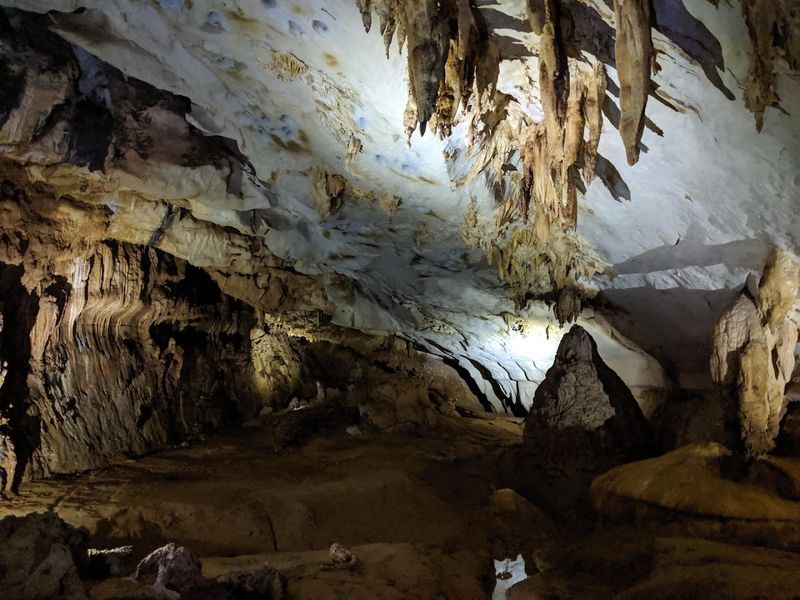
Tucked deep inside the rainforest of Sarawak on the island of Borneo, the Gunung Mulu cave system contains some of the most staggering underground spaces on the planet. The Sarawak Chamber alone is so enormous that it could swallow 40 Boeing 747s parked wing to wing.
That is not a figure of speech. Researchers have actually done that calculation.
The chamber stretches 600 meters long, 415 meters wide, and 80 meters high. It was discovered in 1981 during a Royal Geographical Society expedition and remains the largest known cave chamber in the world by area.
No artificial lighting has ever fully illuminated its entire interior at once.
Beyond the Sarawak Chamber, Mulu offers the Deer Cave, which has one of the largest cave passages in the world, and the Clearwater Cave system, one of Southeast Asia’s longest. Every evening, millions of wrinkle-lipped bats pour out of Deer Cave in a twisting black river that can last over an hour.
The sight draws visitors from across the globe. Gunung Mulu National Park is a UNESCO World Heritage Site and is accessible by small aircraft or longboat from Miri.
Boardwalk trails make many areas accessible without specialist caving experience.
Eisriesenwelt Ice Cave — Austria
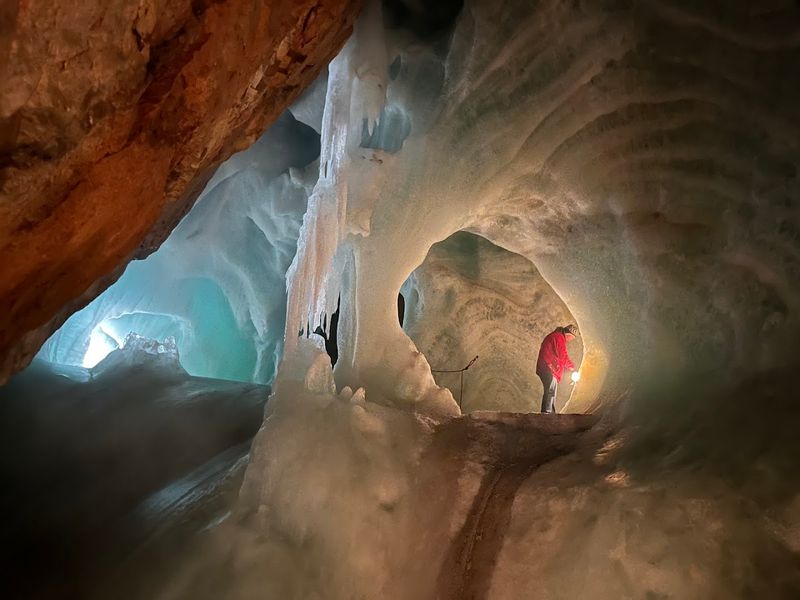
Welcome to the world’s largest accessible ice cave, buried inside the Tennengebirge Mountains of Austria. Eisriesenwelt translates to World of the Ice Giants, and once you step inside, you will immediately understand why someone chose that name.
The cave stretches over 42 kilometers in total, with the icy section covering the first kilometer from the entrance.
The ice formations here are not permanent glacial ice but rather dynamic seasonal structures. Cold air flowing through the cave during winter freezes meltwater into spectacular pillars, frozen waterfalls, and sculpted ice walls that can reach several meters thick.
The formations shift and change each year, meaning no two visits are ever quite the same.
The cave sits at about 1,641 meters above sea level on the Hochkogel mountain near Werfen, a small town about 40 kilometers south of Salzburg. Getting there involves a cable car ride followed by a 15-minute walk to the entrance.
Guided tours use magnesium torches and carbide lamps rather than electric lighting, which adds a wonderful old-fashioned atmosphere to the experience. The cave was first explored scientifically in 1879 and opened to the public in 1920.
Roughly 200,000 people visit each year, making it one of Austria’s most popular natural attractions.
Reed Flute Cave — Guilin, China
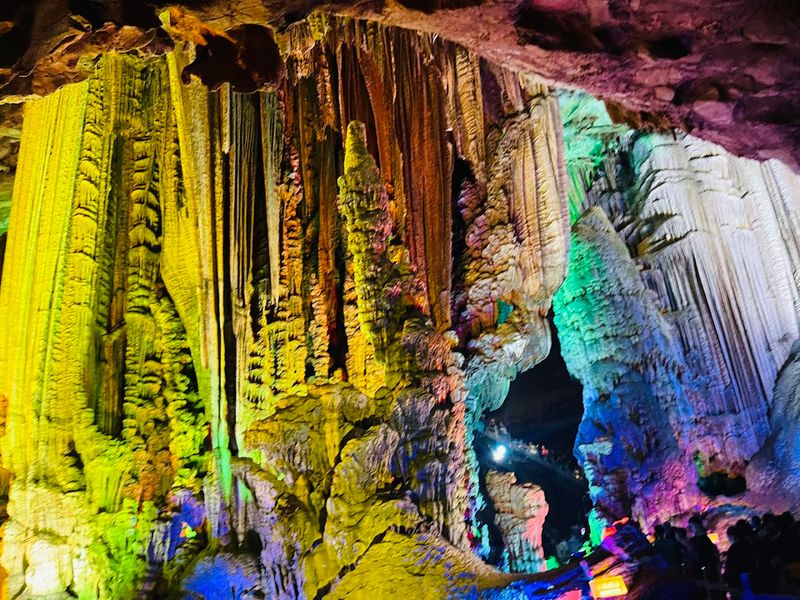
Nicknamed the Palace of Natural Arts, Reed Flute Cave near Guilin has been drawing visitors for over 1,200 years. Tang Dynasty inscriptions dating back to 792 AD still mark the cave walls, left by travelers who were apparently just as impressed as the millions who visit today.
History and geology rarely share a space this elegantly.
The cave gets its name from the reeds that once grew at its entrance, which locals harvested to make flutes. Inside, the formations are genuinely theatrical.
Stalactites hang like chandeliers, stalagmites rise like cathedral spires, and colored LED lighting transforms each chamber into something resembling an elaborate stage set.
The cave stretches about 240 meters deep and the guided tour loops through in roughly an hour. Highlights include the Crystal Palace of the Dragon King, a chamber with formations reflected in an underground pool, and the Primeval Forest, where densely packed stalagmites create the illusion of trees.
The cave formed in limestone about 180 million years ago. Guilin itself is a hub for cave tourism, surrounded by dramatic karst peaks and underground rivers.
Reed Flute Cave is just a short taxi ride from the city center, making it one of the most convenient natural wonders anywhere in China.
Benagil Sea Cave — Algarve, Portugal
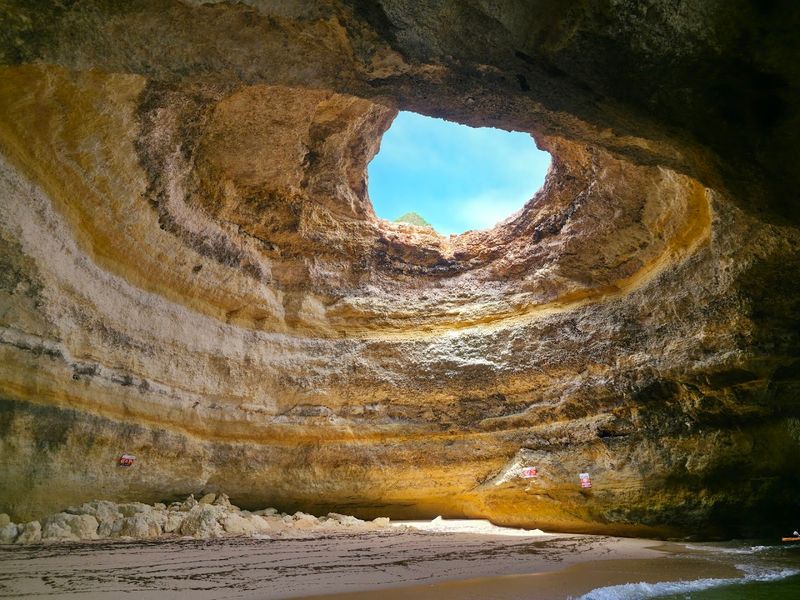
Sunlight falls through a perfect circular hole in the ceiling onto a tiny hidden beach below, and the effect is so cinematic it barely looks real. Benagil Sea Cave on Portugal’s Algarve coast has become one of the most photographed natural spaces in Europe, and the photos genuinely do not exaggerate.
The real thing is somehow even better.
The cave sits inside a golden sandstone cliff along the Algarve’s famous coastline and is only reachable by water. Kayaking, paddleboarding, or taking a small guided boat from Benagil beach are the main options.
Swimming directly into the cave is also possible for confident swimmers when seas are calm, though currents can be unpredictable.
The interior features two small sandy beaches, dramatic arched ceilings, and several sea-carved chambers connected by low passages. The main dome rises about 20 meters above the beach floor, and the light that enters shifts beautifully throughout the day.
Morning visits typically offer the calmest water and the most dramatic light angles. The cave is part of a stretch of coastline riddled with grottos, sea arches, and stacks, making a boat tour of the wider area well worthwhile.
Benagil village itself is tiny but has enough cafes and seafood restaurants to make a full day trip very satisfying.
Sistema Ox Bel Ha — Mexico
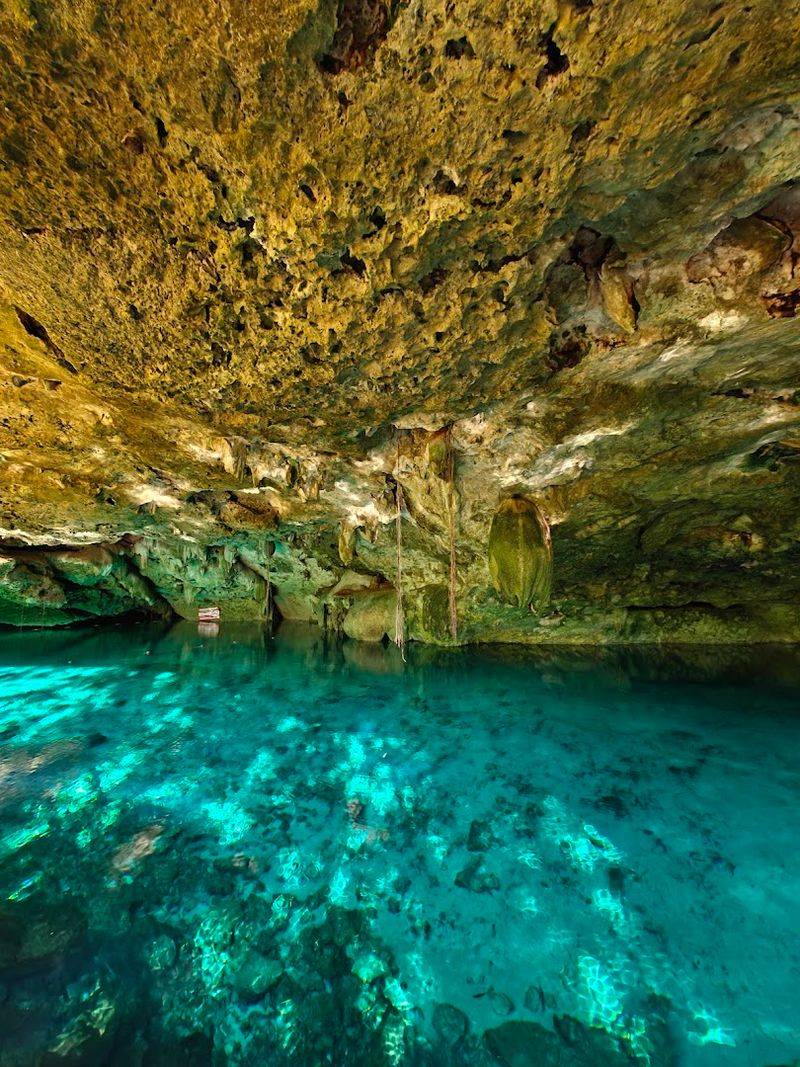
Stretching more than 500 kilometers beneath the flat limestone landscape of Mexico’s Yucatan Peninsula, Sistema Ox Bel Ha is the longest underwater cave system ever mapped on Earth. The name comes from the Mayan language and means Three Paths of Water, which feels entirely appropriate for a place this labyrinthine.
Cave divers have been exploring and mapping it since the 1990s and new passages are still being found.
The system connects to hundreds of cenotes, which are natural sinkholes that dot the Yucatan landscape. These cenotes served as sacred water sources and ceremonial sites for the ancient Maya, and archaeological discoveries within the cave system have revealed human remains and artifacts dating back thousands of years.
The bones of extinct megafauna including giant ground sloths have also been found here.
Only experienced cave divers with specialist training and equipment can explore the deeper sections. However, several connected cenotes are open to snorkelers and recreational divers, offering a glimpse into the crystal-clear underwater world above the main passages.
The visibility in these waters can exceed 60 meters on a calm day. The Yucatan’s entire freshwater supply depends on this underground network, making its protection critically important.
Ox Bel Ha is a reminder that some of Earth’s greatest discoveries are still waiting quietly underground.
Share this story