Germany has a habit of making even a simple walk across a bridge feel like a scene from a blockbuster movie. From rocky Saxon cliffs to spy-thriller riverbanks in Berlin, the country is packed with bridges that stop you mid-step and make you reach for your camera.
I took a road trip across Germany last summer, and honestly, the bridges stole the show more than once. Whether you love history, heights, or just really good photo opportunities, this list is for you.
Hohenzollern Bridge, Cologne, North Rhine-Westphalia
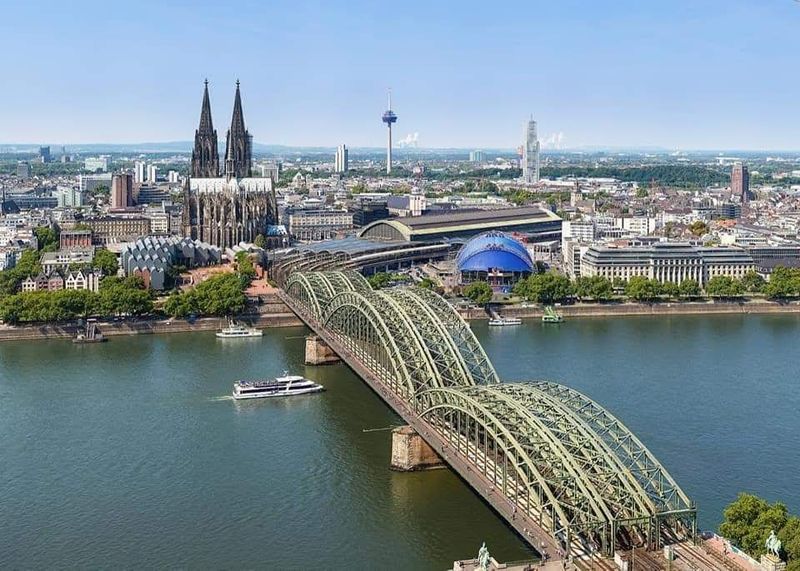
Over a million love locks cover the railings of this bridge, making it one of the most romantically chaotic structures in all of Europe.
The Hohenzollern Bridge in Cologne carries both trains and pedestrians across the Rhine, and it does so with serious style. The cathedral looming right behind it creates a backdrop so iconic it looks like a movie poster.
I crossed it on a rainy Tuesday and still managed to feel like I was in a romantic drama.
The bridge was originally built in 1911, blown up in 1945, and rebuilt afterward, so it has some serious history packed into its steel arches. At night, the lights reflecting off the Rhine are genuinely stunning.
Couples attach padlocks to the fence and toss the keys into the river, a tradition that sounds reckless but looks undeniably beautiful. Bring a lock, or just come to admire the ones already there.
Geierlay Suspension Bridge, Mörsdorf and Sosberg, Rhineland-Palatinate
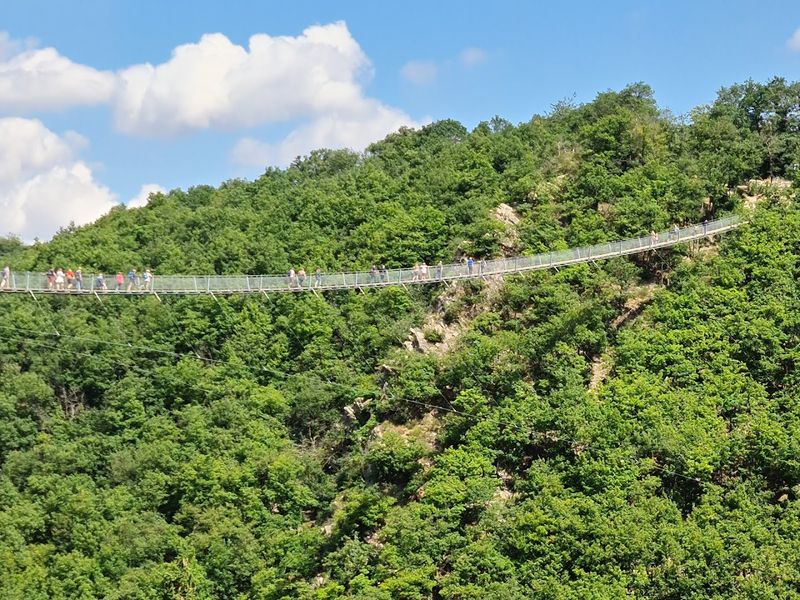
At 360 meters long, Geierlay was Germany’s longest suspension bridge when it opened in 2015, and it still delivers the kind of adrenaline rush that makes your legs go a little wobbly.
Stretched across the Hunsruck hills between two small villages, this bridge hangs above a valley so green and lush it looks digitally enhanced. The round trip hike takes about two hours and winds through beautiful forest trails.
You cross the bridge twice, which means two chances to panic quietly while pretending you are totally fine.
The bridge sways gently underfoot, which either thrills or terrifies depending on your relationship with heights. The engineering is impressive too: the ropes and wooden slats are designed to handle hundreds of visitors at once.
Early autumn is arguably the best time to visit, when the trees below turn orange and gold. It is free to visit, which feels almost suspiciously generous for something this spectacular.
Krämerbrücke, Erfurt, Thuringia
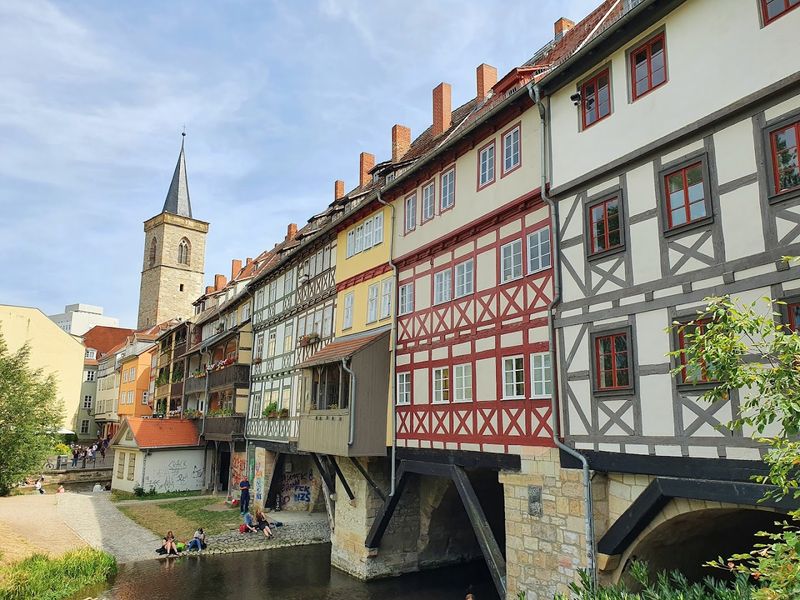
The Krämerbrücke is not just a bridge. It is a street, a shopping arcade, and a piece of medieval urban planning that somehow still works perfectly in the 21st century.
Stretching across the Gera River in Erfurt’s old town, this bridge is lined on both sides with half-timbered houses that date back to the Middle Ages. Merchants have been selling goods here since 1325, making it the oldest continuously inhabited bridge in northern Europe.
Walking across it feels like stepping into a fairy tale that never bothered to end.
Today the shops sell antiques, handmade jewelry, books, and local crafts. It is narrow, charming, and perpetually photogenic.
The best time to visit is during the annual Krämerbrücke Festival in June, when the whole street fills with music, fire performers, and general medieval merriment. Fun fact: the bridge has 32 houses on it.
Yes, actual houses. On a bridge.
Germany does not do things halfway.
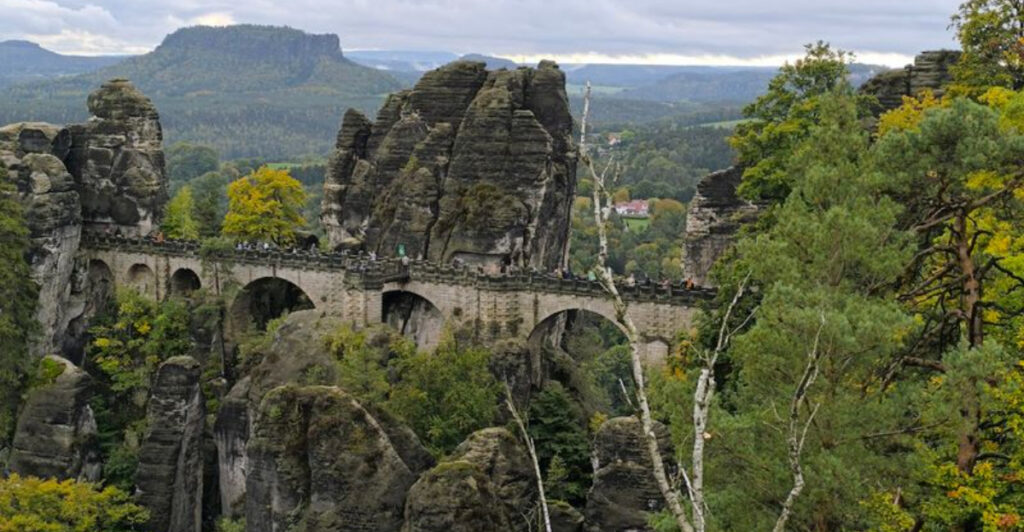
Bastei Bridge, Rathen and Lohmen, Saxony
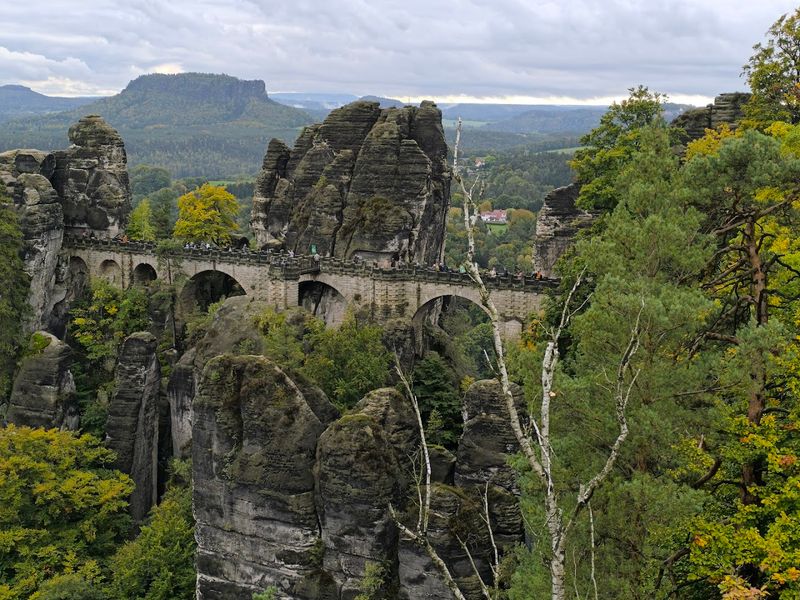
Perched on top of jagged sandstone pillars like something straight out of a fantasy novel, Bastei Bridge is one of those places that makes your jaw drop before you even reach it.
Built in 1851, this stone bridge sits about 194 meters above the Elbe River in Saxon Switzerland National Park. It connects several rock spires and offers views so dramatic they almost feel unfair.
German Romantic painter Caspar David Friedrich loved this landscape, and honestly, you will too.
The area gets busy in summer, so arriving early is a smart move. The hike up takes about 20 minutes from the village of Rathen, and every step is worth it.
Fog rolling through the valley below turns the whole scene into something almost mythical. This bridge has appeared in the movie “The Chronicles of Narnia” and several German films, which should tell you everything about its cinematic credentials.
Säckingen Rhine Bridge, Bad Säckingen, Baden-Württemberg and Stein, Switzerland
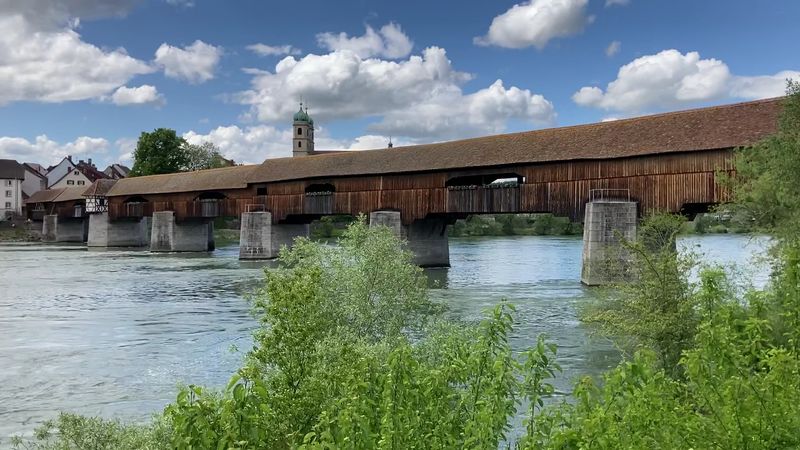
This bridge has the rare distinction of connecting two countries, which means you can technically walk from Germany to Switzerland in about 90 seconds.
The Säckingen Rhine Bridge is the longest covered wooden bridge in Europe, stretching 203 meters across the Rhine between Bad Säckingen in Germany and Stein in Switzerland. It was first built in the 16th century and has been rebuilt and repaired several times since.
The covered wooden structure protects it from the elements and gives the crossing a cozy, slightly time-traveling atmosphere.
The bridge is free to cross and open to pedestrians and cyclists. The town of Bad Säckingen is charming, with a lovely old town and a cathedral worth exploring nearby.
Joseph Victor von Scheffel wrote a famous poem about a trumpeter from Säckingen in the 19th century, and a statue commemorates the story near the bridge. It is quirky local lore that adds an extra layer of character to an already fascinating crossing.
Prerow Pier, Prerow, Mecklenburg-Vorpommern
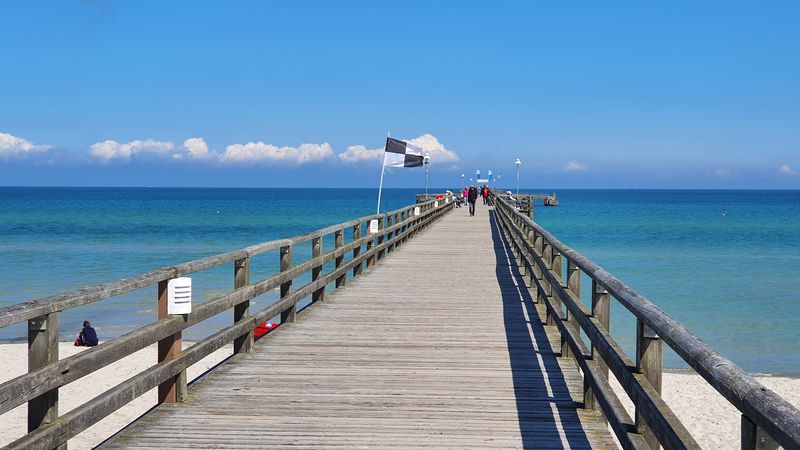
Technically a pier rather than a bridge, Prerow earns its spot on this list purely through sheer atmospheric drama over the Baltic Sea.
Located on the Darss Peninsula, the Prerow Pier stretches 700 meters out into the Baltic, ending in a small pavilion that sits right in the middle of nowhere and everything at the same time. The surrounding national park is one of Germany’s most pristine coastal areas, with ancient forests meeting wild sandy beaches.
Walking to the end of the pier on a blustery day feels genuinely cinematic.
The area is popular with birdwatchers, hikers, and people who enjoy staring meaningfully at the horizon. Sunsets from the pier are legitimately spectacular, all orange and purple and reflected in the shallow coastal waters.
The village of Prerow itself is small and unhurried, a welcome contrast to Germany’s busier tourist spots. Go in late spring or early autumn for fewer crowds and better light.
Rendsburg High Bridge, Rendsburg, Schleswig-Holstein
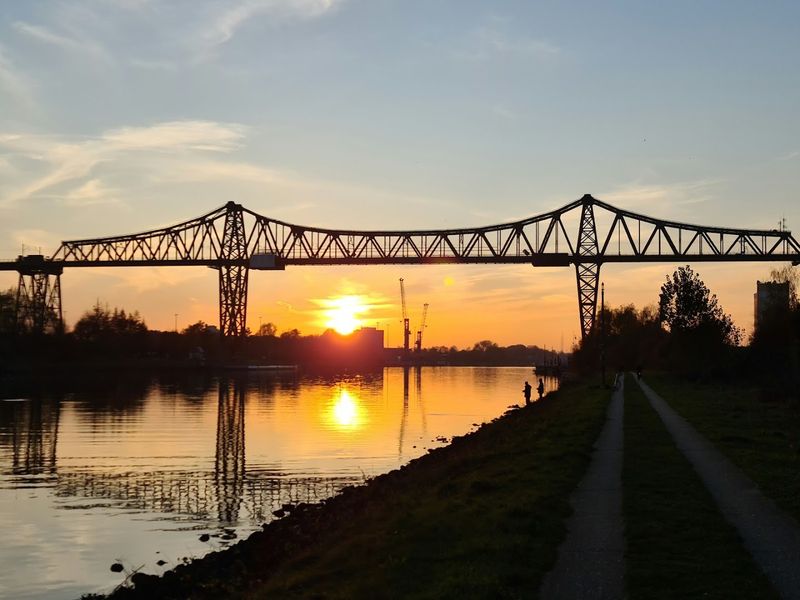
Few bridges in the world have a gondola hanging underneath them for passengers to ride across a canal, but the Rendsburg High Bridge is not interested in being ordinary.
Built in 1913, this massive railway viaduct crosses the Kiel Canal at a height of 42 meters. The main structure carries trains, but the real curiosity is the Schwebefähre, a transporter bridge that hangs below the main span and carries cars and pedestrians across the water like a floating ferry on a leash.
It is gloriously eccentric German engineering.
The bridge is 2,486 meters long, making it one of the longest railway bridges in Germany. The loop approach on the south side, where the railway spirals around to gain height, is a feat of early 20th-century ingenuity.
Train spotters love it, engineers admire it, and everyone else just stands there looking mildly baffled in the best possible way. Worth the detour absolutely.
Oberbaum Bridge, Berlin
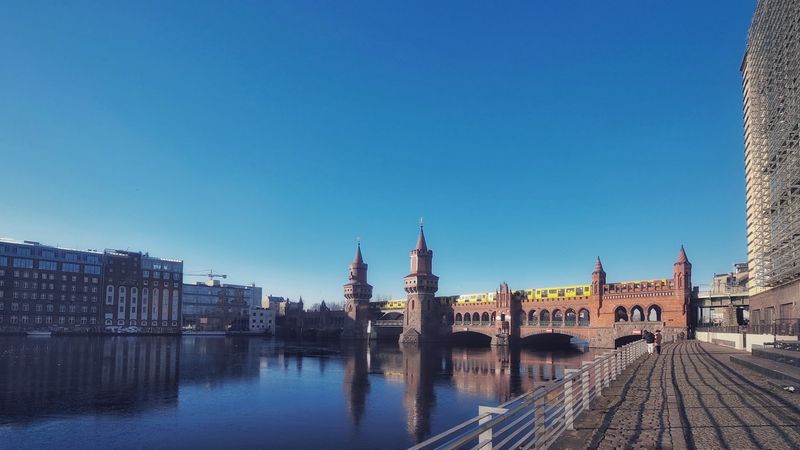
The Oberbaum Bridge is Berlin in architectural form: dramatic, layered with history, and impossible to walk past without stopping for a photo.
Crossing the Spree River between Friedrichshain and Kreuzberg, this double-deck bridge carries the U-Bahn on its upper level and pedestrians below. The Gothic brick towers and arched design make it look more like a medieval fortress than a public transit hub.
It was built in 1896, damaged in World War II, divided by the Berlin Wall, and reunified in 1995 after German reunification. That is a lot of history for one bridge to carry.
The bridge has appeared in countless films and music videos, most famously in the U2 music video for “Miss Sarajevo.” Every New Year’s Eve, a massive paint fight takes place on the bridge between residents of the two neighboring districts, which is chaotic and very Berlin. East Side Gallery is just a short walk away, making this whole area a must-visit stretch of the city.
Stone Bridge, Regensburg, Bavaria
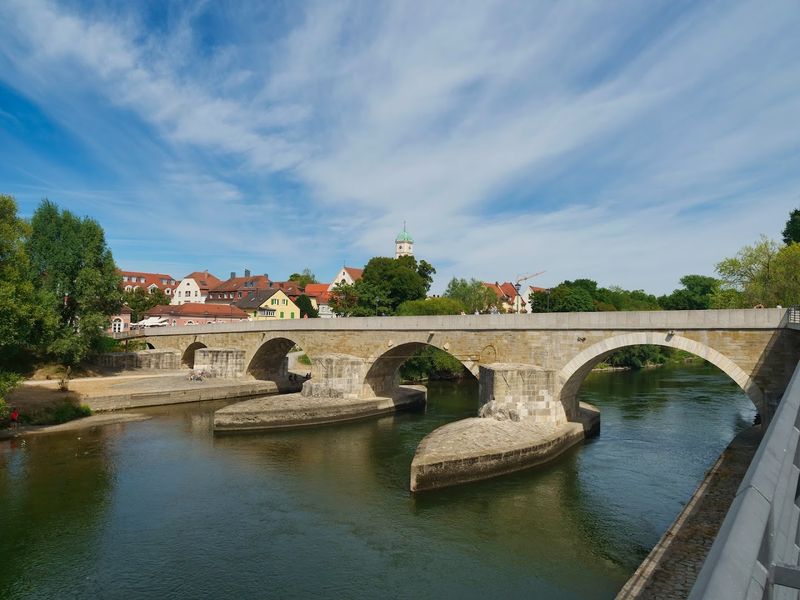
Built between 1135 and 1146, the Stone Bridge in Regensburg is nearly 900 years old and still carries foot traffic every single day, which is either impressive or slightly terrifying.
Spanning the Danube River, this 16-arch medieval masterpiece was the only bridge across the Danube for miles during the Middle Ages, making it a critical trade and military route. At the time of its construction, it was considered one of the greatest engineering achievements in Europe.
The nearby Regensburg Cathedral provides a stunning backdrop that photographers absolutely cannot resist.
The bridge is closed to cars, so it belongs entirely to pedestrians and cyclists now. There is a famous sausage kitchen nearby called the Historische Wurstkueche, which has been operating since the 12th century and claims to be the oldest sausage restaurant in the world.
Combining a medieval bridge with a 900-year-old sausage shop is the most Bavarian afternoon you could possibly have. Highly recommended.
Göltzschtal Bridge, Netzschkau and Reichenbach, Saxony
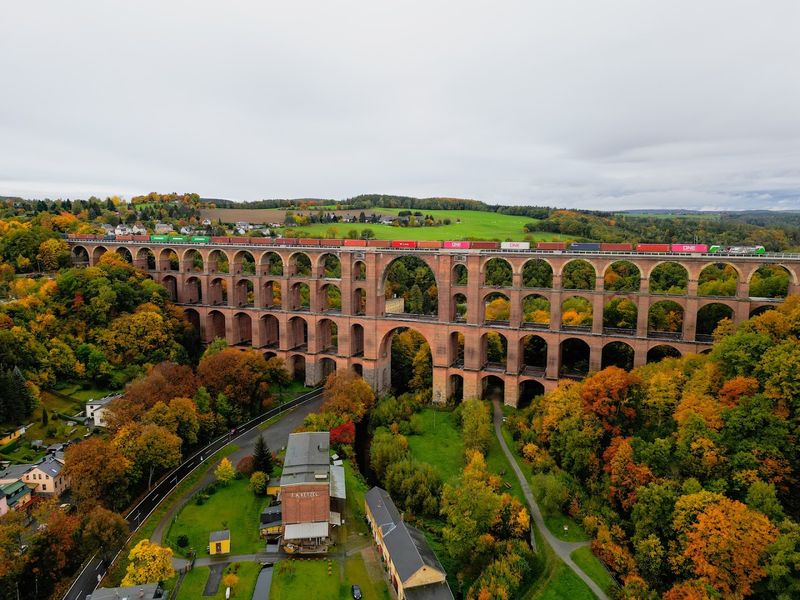
The Göltzschtal Bridge holds the title of the largest brick bridge in the world, and it earns that title with 26 million bricks and a presence that makes your neck crane back just to see the top.
Standing 78 meters tall and 574 meters long, this railway viaduct in the Vogtland region of Saxony was built between 1846 and 1851. It carries the railway line between Plauen and Zwickau and has been doing so without interruption for over 170 years.
Four tiers of arches stack on top of each other like an architectural layer cake.
The best view comes from the valley floor, where the full scale of the structure finally becomes clear. There is a viewing platform and a small museum nearby explaining the bridge’s construction history.
Trains still rumble across the top regularly, which adds a dynamic element to any photograph. Visiting in spring when the valley greenery is fresh makes the red brick pop even more dramatically against the landscape.
Titan RT Suspension Bridge, Rappbode Valley, Oberharz am Brocken, Saxony-Anhalt
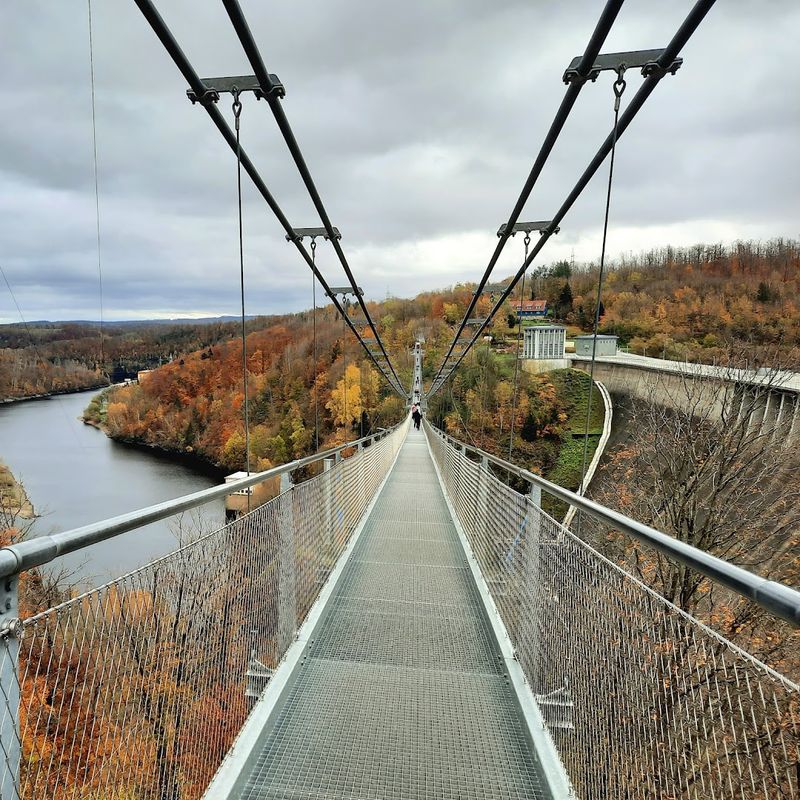
Swinging 483 meters across the Rappbode Valley at a height of 100 meters, the Titan RT is one of the longest walkable suspension bridges in the world, and it does not let you forget that for a single step.
Located in the Harz Mountains of Saxony-Anhalt, this bridge opened in 2017 and quickly became one of Germany’s most talked-about attractions. The name comes partly from the nearby Rappbode Dam, and partly because crossing it genuinely feels like a titan-sized challenge for anyone with a fear of heights.
The views of the forested valley are extraordinary.
The bridge is part of a larger adventure park called Seilgarten Rappbode, which also offers zip lines and climbing activities. Tickets are required and timed entry is recommended during busy periods.
I watched a man ahead of me freeze halfway across, turn around, and power through anyway, which felt like a genuinely moving act of personal courage. You will likely cheer yourself on too.
Skywalk Willingen, Willingen, Hesse
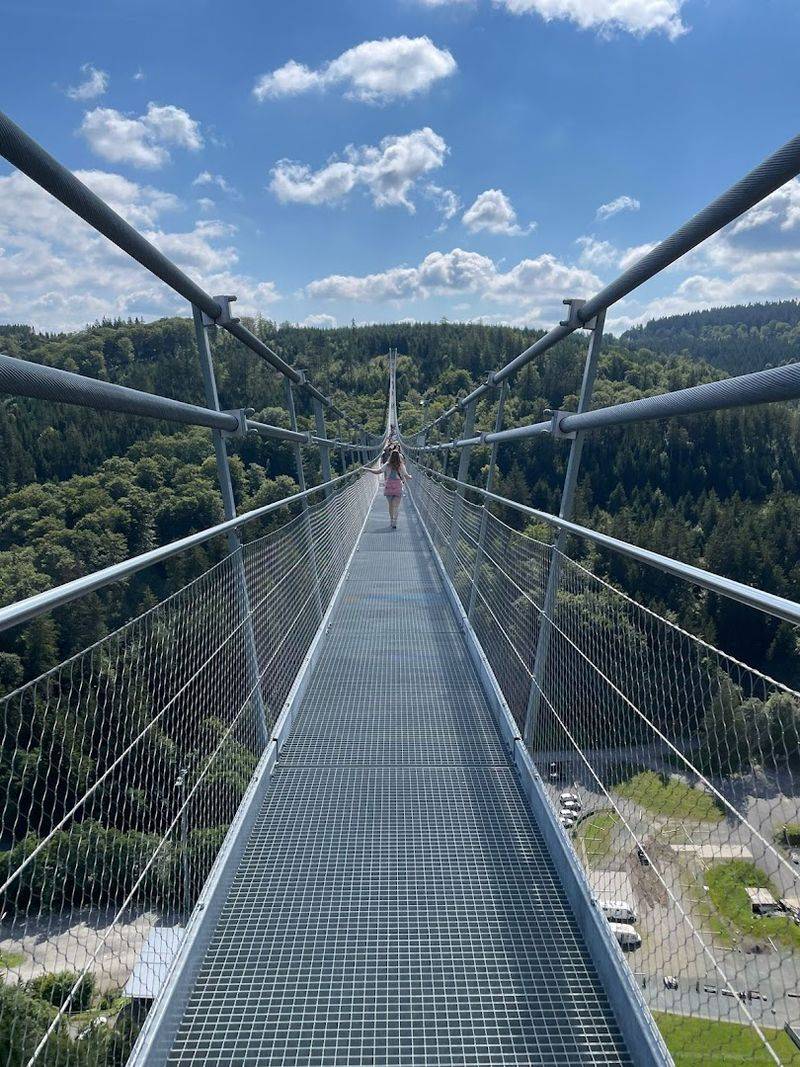
The Skywalk Willingen is not just a bridge. It is a glass-floored dare that juts out over the Upland hills and politely asks if you trust your own nerve.
Located near the ski resort town of Willingen in northern Hesse, this elevated walkway extends from a hilltop and features transparent floor sections that let you look straight down at the treetops below. The structure is 665 meters long and rises to about 800 meters above sea level, giving panoramic views across the Rothaargebirge mountain range.
It is the kind of view that makes you feel both very small and very lucky.
The Skywalk is open year-round and is particularly magical in winter when snow covers the surrounding forest. A gondola lift takes visitors up to the starting point, so you do not need to hike to earn the view.
Families with kids love it, thrill-seekers love it, and even the casually curious tend to leave with a serious smile plastered across their faces.
WILDLINE Suspension Bridge, Bad Wildbad, Baden-Württemberg
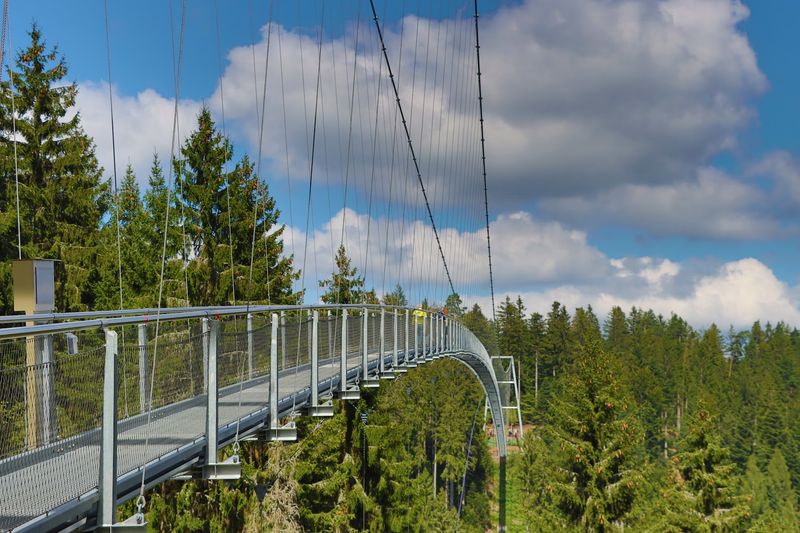
Bad Wildbad sounds like the name of a villain’s lair, but the WILDLINE suspension bridge hanging above its Black Forest valleys is anything but menacing. Well, mostly.
Opened in 2021, this suspension bridge stretches 1,075 meters along a ridge above the Enz Valley in Baden-Württemberg, making it one of the longest of its kind in Germany. The bridge is integrated into a scenic hiking trail and offers views across the dense Black Forest that are genuinely hard to describe without resorting to superlatives.
Dark green pine trees stretch out in every direction as far as you can see.
The starting point is accessible via a gondola from Bad Wildbad, a traditional spa town that has been welcoming visitors for centuries. The contrast between the old thermal baths in the valley and the modern suspension bridge above is delightfully unexpected.
Dogs are welcome on the bridge, which earns it extra points in my book. Bring good walking shoes and a decent camera.
Klausbach Valley Suspension Bridge, Ramsau bei Berchtesgaden, Bavaria
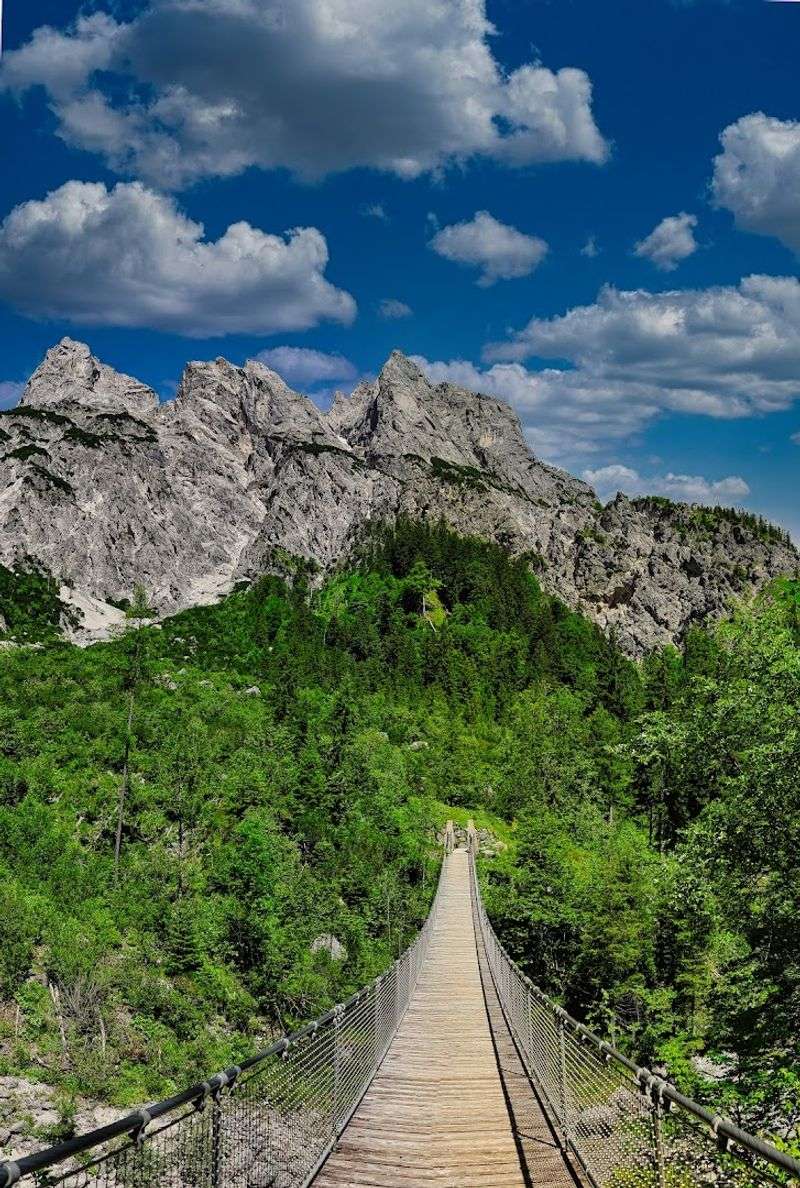
Tucked inside the Berchtesgaden National Park, the Klausbach Valley suspension bridge is the kind of secret that feels unfair to keep but almost too good to share.
Hanging above the crystal-clear Klausbach stream in the Bavarian Alps, this wooden suspension bridge offers a front-row seat to one of Germany’s most stunning mountain landscapes. The surrounding national park is home to chamois, golden eagles, and forests so pristine they practically glow.
The bridge itself is modest in size but enormous in setting, which is a winning combination.
The area around Ramsau bei Berchtesgaden is one of the most photographed spots in Bavaria, partly because of the famous church reflected in the Hintersee lake nearby. Adding the suspension bridge to a day hike in the valley turns a lovely walk into a genuinely memorable adventure.
Autumn is spectacular here, with the larch trees turning golden against the grey limestone peaks. Pack a picnic.
Seriously, do not skip the picnic.
Glienicke Bridge, Berlin and Potsdam, Brandenburg
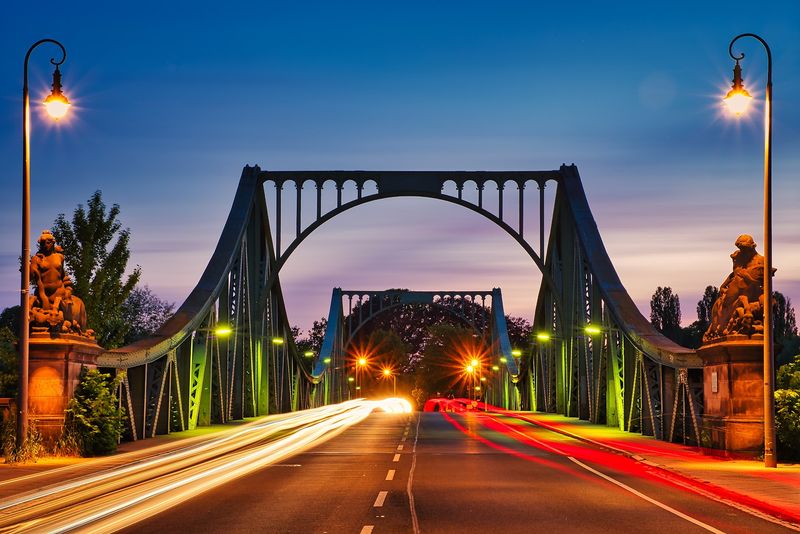
No bridge in Germany carries more Cold War atmosphere than the Glienicke Bridge, the real-life spy exchange point that inspired countless thrillers and one very good Steven Spielberg film.
Spanning the Havel River between Berlin and Potsdam, this pale blue iron bridge was used multiple times during the Cold War to swap captured spies between the East and West. The most famous exchange happened in 1962 when American U-2 pilot Francis Gary Powers was traded for Soviet spy Rudolf Abel.
The 2015 film “Bridge of Spies” brought the whole story back into the spotlight.
Today the bridge is open to pedestrians and cyclists, and the surrounding area is beautiful, with Glienicke Palace and Park on one side and the forests of Potsdam on the other. Standing in the middle of the bridge, you are literally standing on the former border between two worlds.
The history is palpable, and the setting is quietly magnificent. Go at dawn for maximum atmosphere.
Share this story