 Unearth The Voyage
Castles stand as monuments to human ambition, blending artistry with defense and grandeur with purpose. From towering fortresses that once guarded kingdoms to elegant palaces that housed royalty, these structures tell stories of battles won, dynasties built, and cultures shaped.
Exploring the world’s most remarkable castles means stepping into a past where beauty and power were inseparable.
Neuschwanstein Castle — Bavaria, Germany
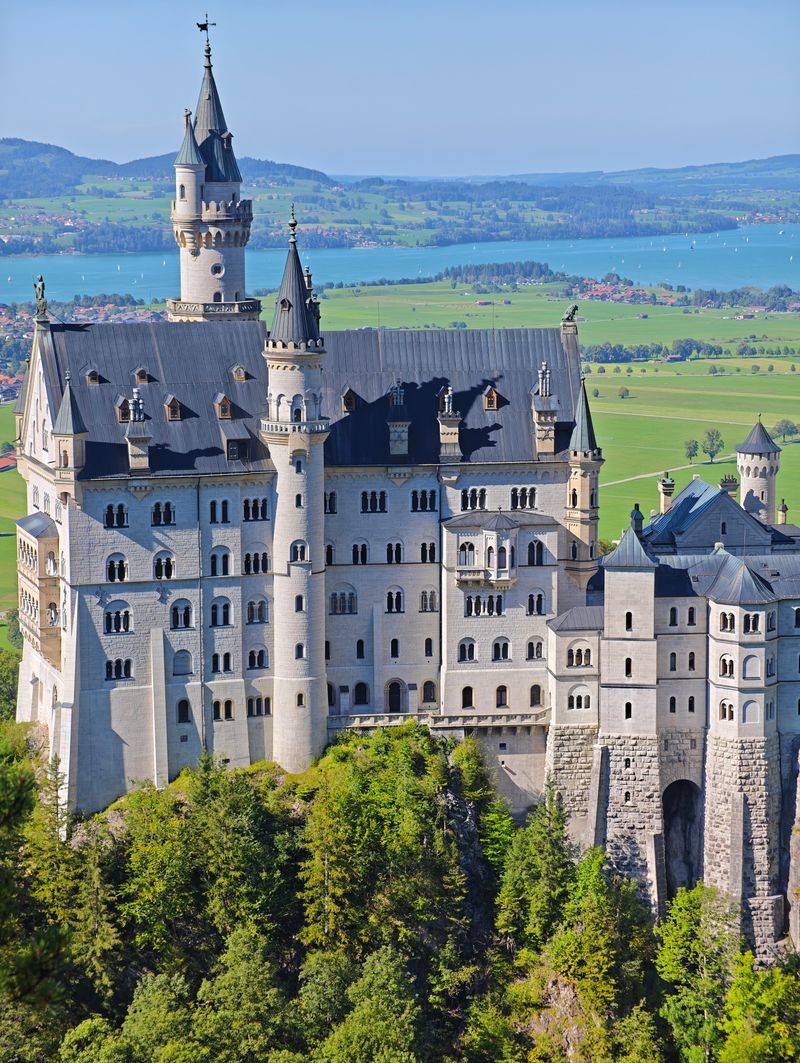
King Ludwig II didn’t just want a castle—he wanted a dream carved into stone. Neuschwanstein rises from the Bavarian Alps like something out of a storybook, with towers that pierce the clouds and walls that gleam against forested slopes.
Construction began in 1869, but Ludwig never saw it completed.
The castle’s interior is just as theatrical as its exterior. Rooms drip with murals depicting medieval legends, while the Throne Hall mimics Byzantine grandeur without ever holding a throne.
Ludwig’s obsession with fantasy and opera inspired every detail, from hidden passages to elaborate frescoes celebrating Germanic myths.
Today, over a million visitors trek up the mountain each year to witness this monument to royal imagination. Walt Disney himself drew inspiration from its silhouette when designing Cinderella’s castle.
Neuschwanstein remains a testament to how beauty can outlive the power that built it, standing as both architectural marvel and cultural icon in the heart of Europe.
Windsor Castle — Berkshire, England
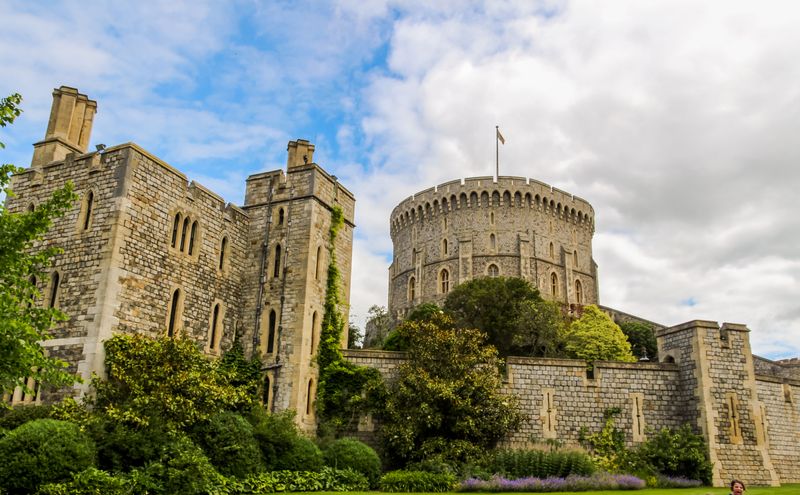
Nine centuries of British monarchy have called Windsor Castle home, making it the longest-occupied palace in Europe. William the Conqueror chose this strategic hilltop site in the 11th century, and every ruler since has left their mark on its sprawling grounds.
The castle has survived sieges, fires, and revolutions while remaining a working royal residence.
St. George’s Chapel anchors the castle’s spiritual life, where knights of the Order of the Garter gather beneath vaulted ceilings adorned with heraldic banners. The State Apartments showcase priceless art collections, including works by Rembrandt and Rubens, while the medieval Round Tower dominates the skyline for miles around.
Windsor isn’t just a museum frozen in time—it’s a living piece of history. The Queen uses it as a weekend retreat, and state banquets still fill the grand halls with dignitaries.
From its Norman origins to its role in modern ceremonies, Windsor Castle embodies the enduring connection between British identity and royal tradition.
Edinburgh Castle — Edinburgh, Scotland
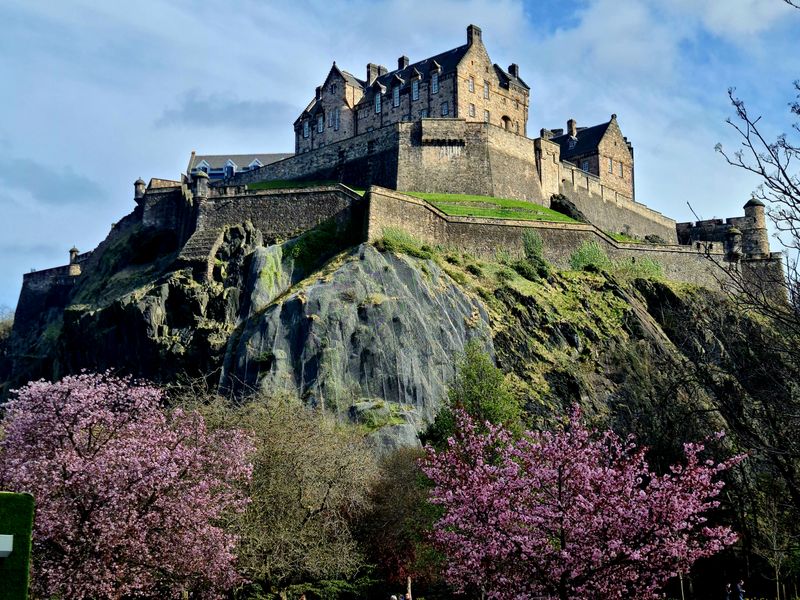
Volcanic rock thrust Edinburgh Castle into the sky long before humans arrived, but it was medieval Scots who turned that natural fortress into a symbol of national pride. The castle has witnessed more sieges than almost any other fortification in Britain, changing hands between English and Scottish forces repeatedly throughout the centuries.
Blood and stone are inseparable here.
Inside the ancient walls, the Scottish Crown Jewels glitter in their secure chamber—older than the English Crown Jewels and fiercely protected. The Stone of Destiny, used in the coronation of Scottish monarchs, rests nearby after centuries of English custody.
Military history comes alive in the National War Museum, where artifacts trace Scotland’s martial legacy from claymores to modern conflicts.
Every August, the castle becomes a stage for the world-famous Military Tattoo, as bagpipes echo off stone and fireworks light the night. Standing on the battlements with Edinburgh sprawling below, visitors understand why this fortress remains Scotland’s beating heart—a place where past and present collide with breathtaking force.
Château de Chambord — Loire Valley, France
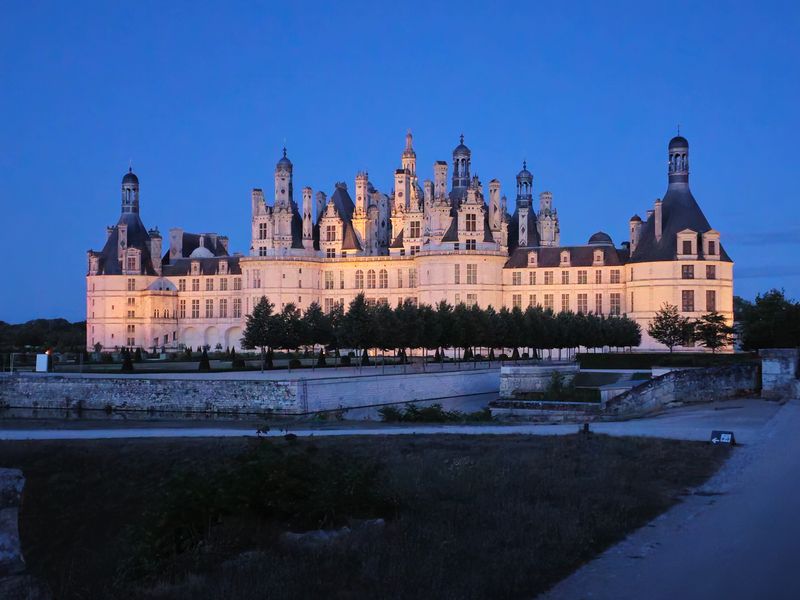
Francis I wanted the world to know France had arrived as a Renaissance power, so he built Chambord—a hunting lodge so extravagant it took 28 years and thousands of workers to complete. The result is a architectural fantasy with 440 rooms, 282 fireplaces, and a roofline so intricate it resembles a miniature city.
Leonardo da Vinci may have influenced the design before his death in 1519.
The famous double-helix staircase spirals through the castle’s heart, allowing two people to ascend or descend simultaneously without ever meeting. This engineering marvel reflects the mathematical precision and artistic ambition that defined French Renaissance thinking.
Each twist of the staircase reveals new perspectives on the building’s ornate interior.
Chambord’s surrounding estate spans over 13,000 acres of forest, making it Europe’s largest enclosed woodland park. Deer and wild boar still roam the grounds, much as they did when Francis and his court hunted here.
The castle stands as a monument to royal excess and artistic achievement, where beauty served as the ultimate display of power.
Prague Castle — Czech Republic
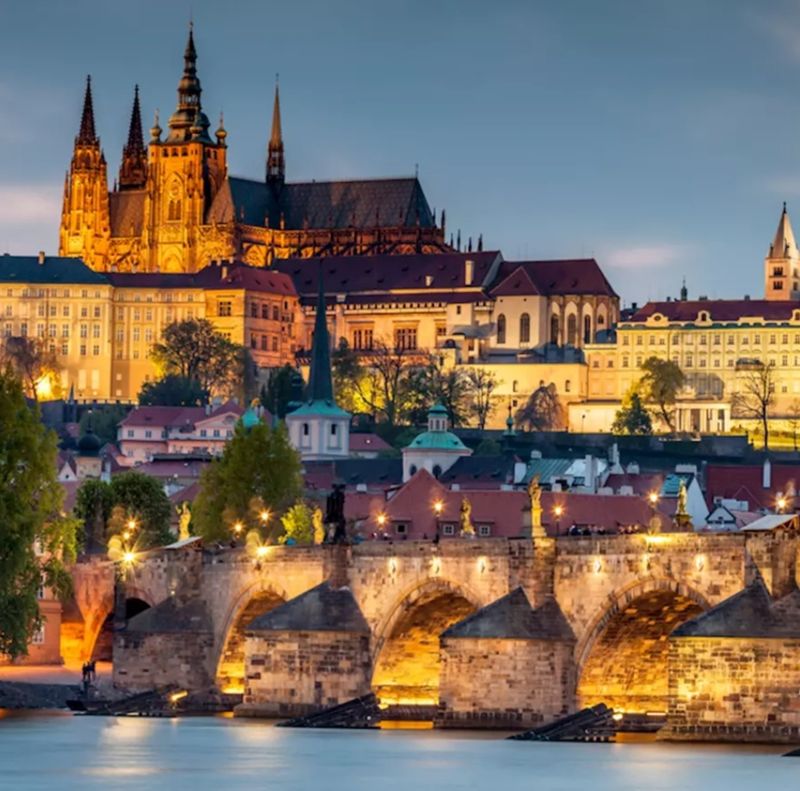
Covering 70,000 square meters, Prague Castle isn’t just one building—it’s an entire fortified city perched above the Vltava River. Founded in the 9th century, it has served as the seat of Czech kings, Holy Roman Emperors, and now the Czech president.
Walking through its gates means traversing over a millennium of European history compressed into courtyards and corridors.
St. Vitus Cathedral dominates the complex with Gothic spires that took nearly six centuries to complete. Its stained glass windows, including one by Art Nouveau master Alfons Mucha, bathe the interior in colored light.
The cathedral houses the tombs of Bohemian kings and the Czech crown jewels, locked behind seven different keys held by seven different officials.
Golden Lane, a street of tiny medieval houses built into the castle walls, once sheltered goldsmiths and later became home to artists and writers, including Franz Kafka. Each architectural layer—Romanesque foundations, Gothic towers, Baroque facades—tells a different chapter in Czech history, making Prague Castle a living textbook of Central European culture and power.
Malbork Castle — Poland
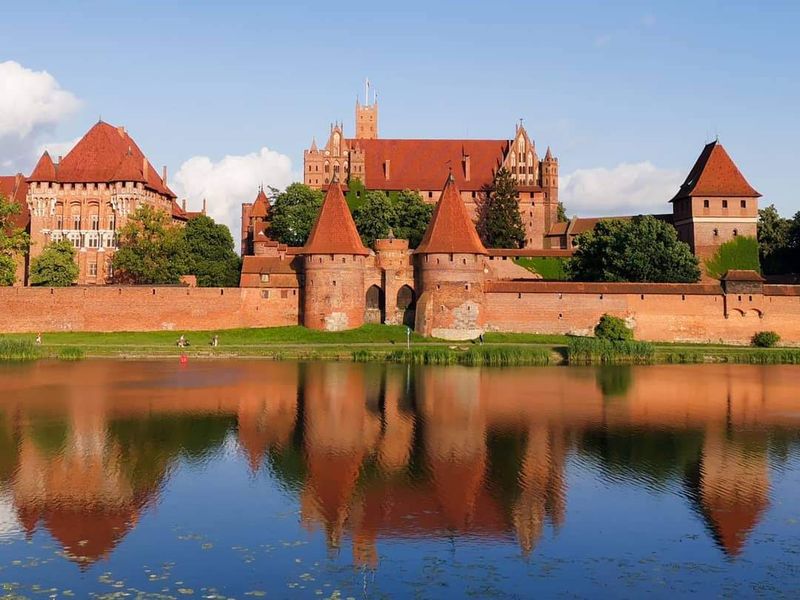
Brick by brick, the Teutonic Knights built an empire in the 13th century, and Malbork Castle became their crown jewel. Sprawling across 52 acres, it’s the largest castle in the world measured by land area—a city within walls that housed knights, craftsmen, and administrators.
Red brick walls rise in geometric precision, embodying the military order’s discipline and ambition.
The castle complex divides into three sections: the High Castle for religious life, the Middle Castle for administrative functions, and the Lower Castle for service areas. Gothic arches and vaulted chambers create a maze of corridors where knights once planned crusades into pagan territories.
The Grand Master’s Palace features ornate decorations that contrast sharply with the fortress’s military purpose.
World War II left Malbork in ruins, with over half the structure destroyed during the Soviet advance. Decades of painstaking restoration have returned much of its medieval grandeur, earning it UNESCO World Heritage status.
Today, visitors walk through reconstructed halls where the Teutonic Order wielded power over the Baltic region, a reminder of how military might shaped European borders.
Himeji Castle — Japan
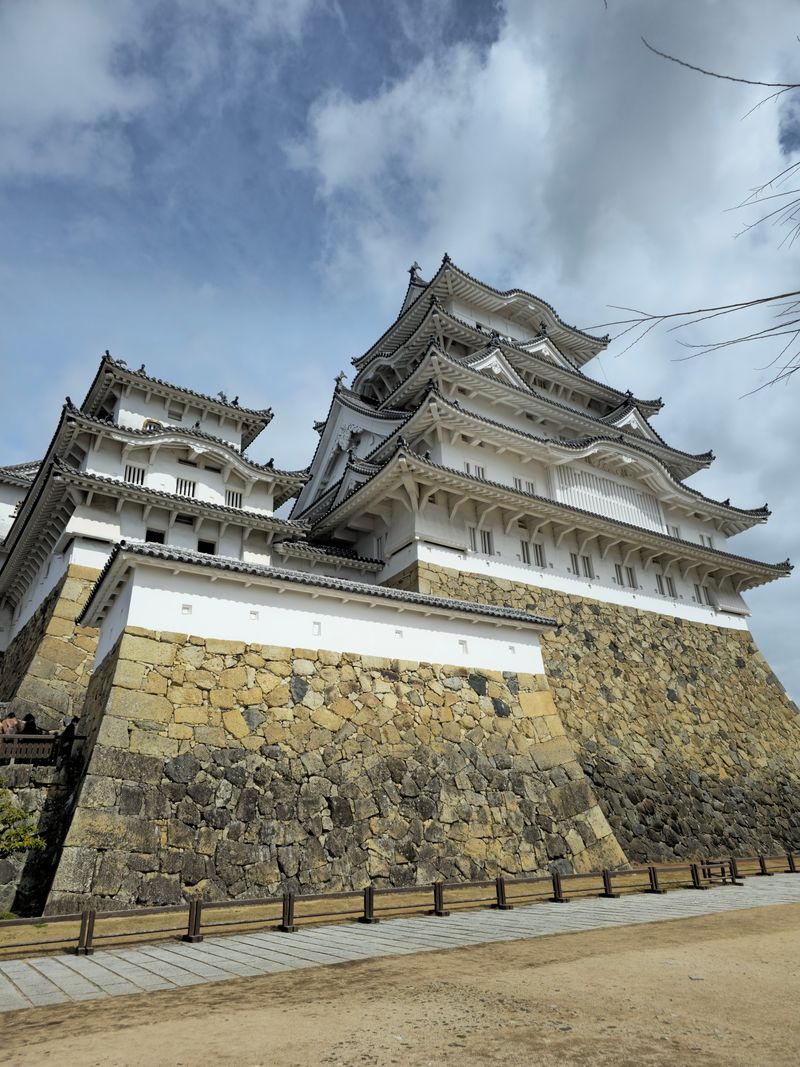
White plaster walls give Himeji Castle its nickname—the White Heron—and from a distance, it does seem to take flight above the city. Built in its current form in 1609, the castle represents the pinnacle of Japanese defensive architecture, with a maze-like layout designed to confuse invaders.
Multiple gates, dead ends, and hidden courtyards turn the approach to the main keep into a tactical nightmare for attackers.
The castle’s five-story main keep rises 46 meters, connected to three smaller keeps by covered corridors. Narrow windows allowed defenders to fire arrows or drop stones on enemies below, while the steep stone walls prevented scaling.
Despite its military design, the building achieves remarkable aesthetic harmony, with gracefully curved roofs that seem almost delicate.
Himeji survived World War II bombing raids that destroyed much of the surrounding city, emerging as Japan’s finest original castle. Unlike many reconstructions built with concrete, Himeji preserves its wooden structure and traditional construction methods.
Recognized as both a national treasure and UNESCO World Heritage site, it stands as living proof of samurai-era engineering and artistry.
Alcázar of Segovia — Spain
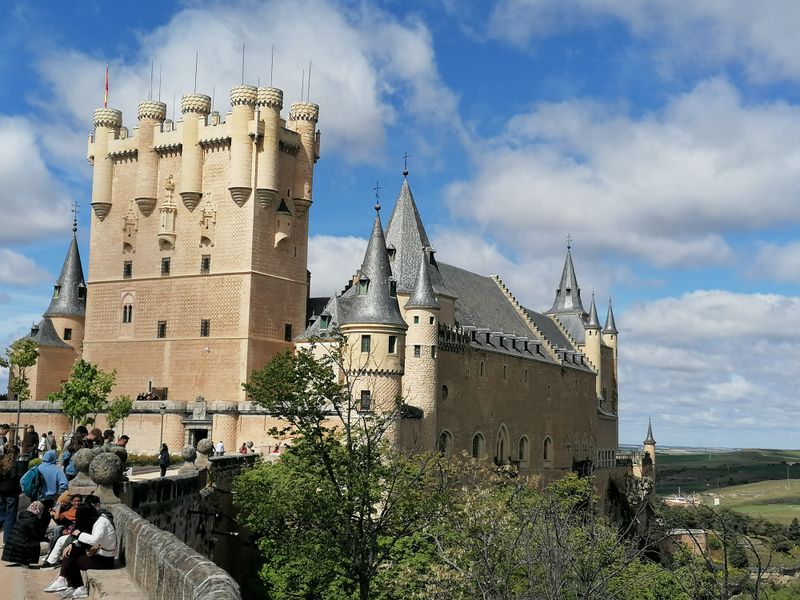
Jutting from a rocky ridge like the prow of a stone ship, the Alcázar of Segovia commands the meeting point of two rivers. Arab fortifications first occupied this strategic spot in the 12th century, but Spanish kings transformed it into a palace that blended military strength with royal luxury.
The distinctive cone-topped towers make it one of Spain’s most recognizable castles.
Inside, the Throne Room dazzles with a golden ceiling adorned with 392 carved pineapples and royal crests. The Hall of Kings features a frieze depicting all the monarchs of Asturias, Castile, and León, turning the walls into a visual history lesson.
These opulent interiors contrast sharply with the fortress’s defensive exterior, revealing the dual nature of medieval royal residences.
Isabella of Castile departed from the Alcázar in 1474 to be crowned queen, beginning a reign that would unite Spain and fund Columbus’s voyage to the Americas. A 1862 fire gutted much of the interior, but careful restoration returned the castle to its former glory.
Today it stands as both a monument to Spanish medieval power and an architectural bridge between Moorish and Christian traditions.
Heidelberg Castle — Germany
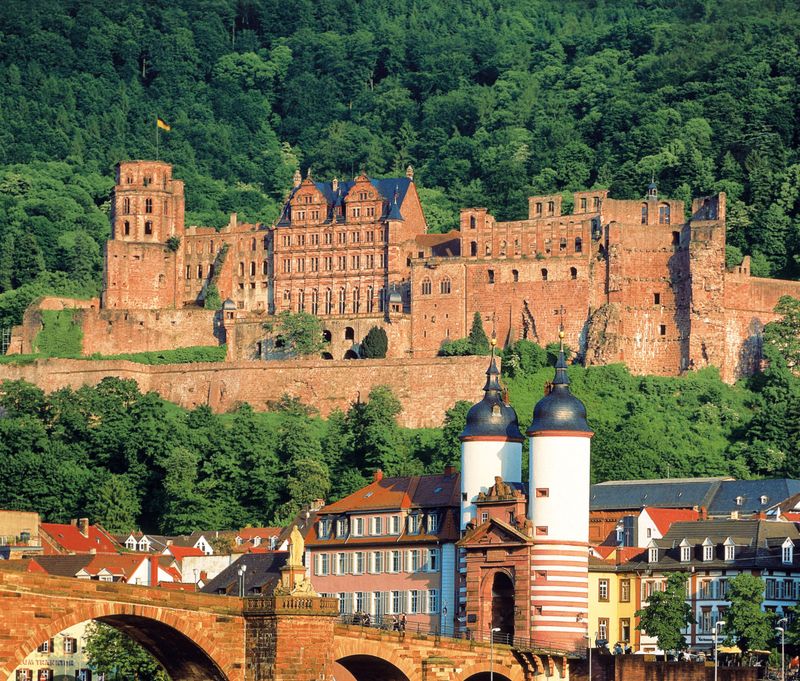
Lightning, war, and fire have all taken their turns destroying Heidelberg Castle, yet the ruins on the hillside remain more captivating than many intact fortresses. Built and rebuilt from the 13th century onward, the castle blends Gothic and Renaissance elements in a patchwork of architectural ambition.
French troops dynamited parts of it in the 17th century, and nature has slowly reclaimed what was never repaired.
The castle’s wine cellar houses the world’s largest wine barrel, built in 1751 and capable of holding 220,000 liters. Legend says the castle’s court jester drank 18 bottles of wine daily and lived to be 80.
Whether true or not, the story captures the castle’s reputation for grand celebrations and excess during its golden age.
Ivy creeps up sandstone walls that glow red in the sunset, creating a Romantic ruin that inspired poets and painters throughout the 19th century. From the terraced gardens, visitors look down on Heidelberg’s old town and the Neckar River winding through the valley.
The castle’s beauty lies not in perfection but in its weathered stones—a monument to resilience through destruction.
Château du Haut-Koenigsbourg — Alsace, France
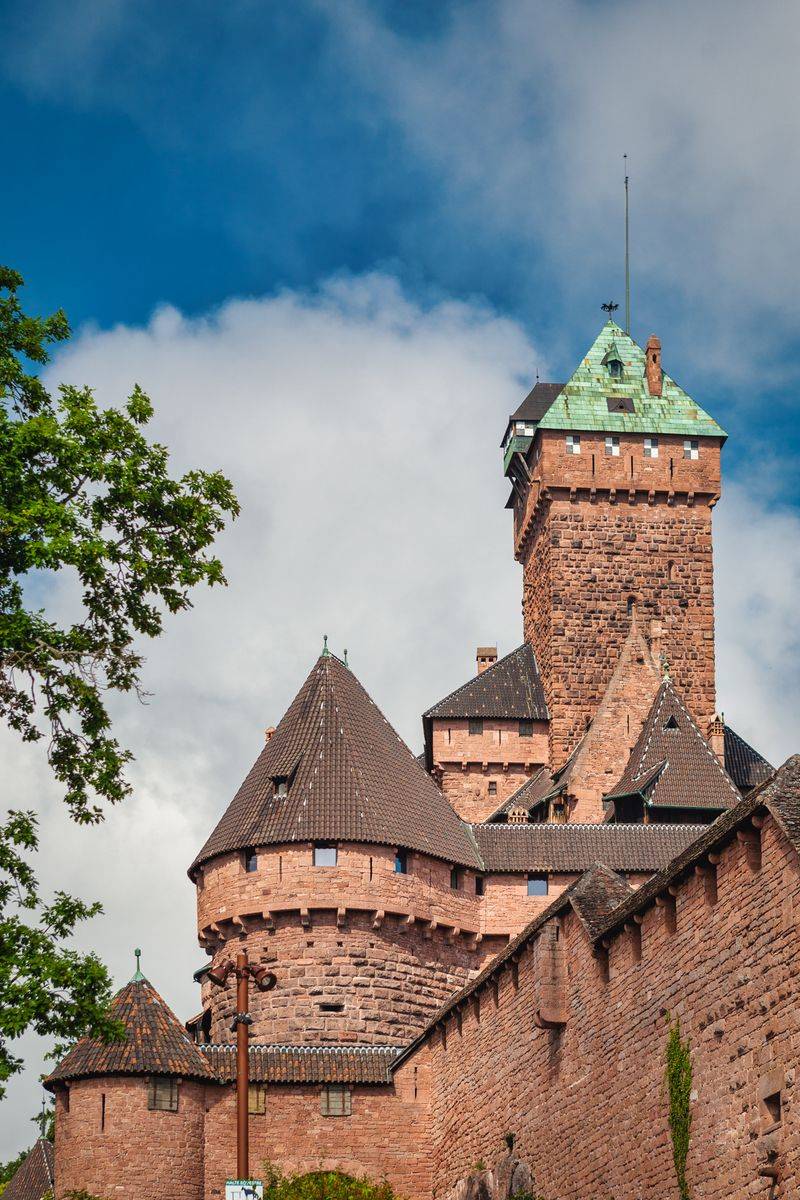
Perched 755 meters above the Alsatian plain, Château du Haut-Koenigsbourg has watched empires rise and fall for over 900 years. Medieval lords built it to control the lucrative trade routes linking the Rhine Valley to the rest of Europe, and its massive walls could withstand months of siege.
Swedish troops burned it during the Thirty Years’ War, leaving it abandoned for centuries.
German Kaiser Wilhelm II ordered a controversial restoration in the early 1900s, transforming the ruins into a romanticized vision of medieval might. Critics argued the reconstruction was too fanciful, but the result is undeniably impressive—furnished rooms, working drawbridges, and panoramic views that stretch to the Black Forest on clear days.
The armory displays weapons spanning centuries of warfare.
Alsace’s complicated history—passing between French and German control multiple times—is written into the castle’s stones. Today it stands as a monument to medieval strategic thinking and early 20th-century historic preservation efforts, however imperfect.
Visitors who climb its ramparts understand immediately why medieval lords fought so fiercely to control this commanding position above the valley.
Castel del Monte — Apulia, Italy
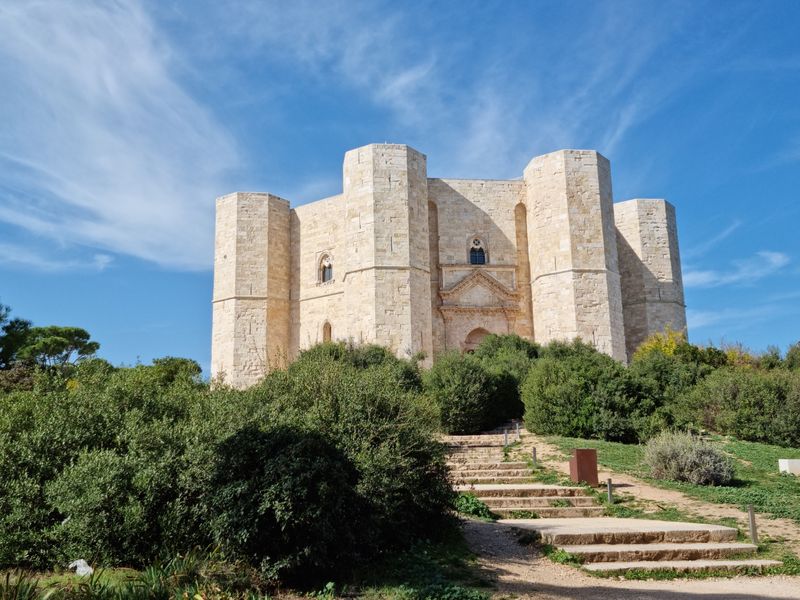
Emperor Frederick II built Castel del Monte in the 1240s, but scholars still debate why. The castle has no moat, no drawbridge, and no kitchen large enough to feed a garrison—suggesting it was never meant for defense or long-term habitation.
Instead, its perfect octagonal shape and mathematical precision point to a structure designed for symbolic or astronomical purposes, a stone embodiment of medieval philosophy.
Every element repeats the number eight: eight walls, eight towers, eight rooms per floor. The octagon held deep significance in medieval thought, representing the intersection of the square (earth) and the circle (heaven).
Frederick, a brilliant polymath who spoke six languages and corresponded with Islamic scholars, may have designed the castle as a meditation on geometry and power.
Pale limestone walls glow golden in the Apulian sun, rising from a lonely hilltop with views across the countryside. The castle’s austere beauty and mysterious purpose have earned it UNESCO recognition and a place on the Italian one-cent euro coin.
Castel del Monte proves that power doesn’t always roar—sometimes it speaks in whispers of mathematical perfection and architectural enigma.
Bojnice Castle — Slovakia
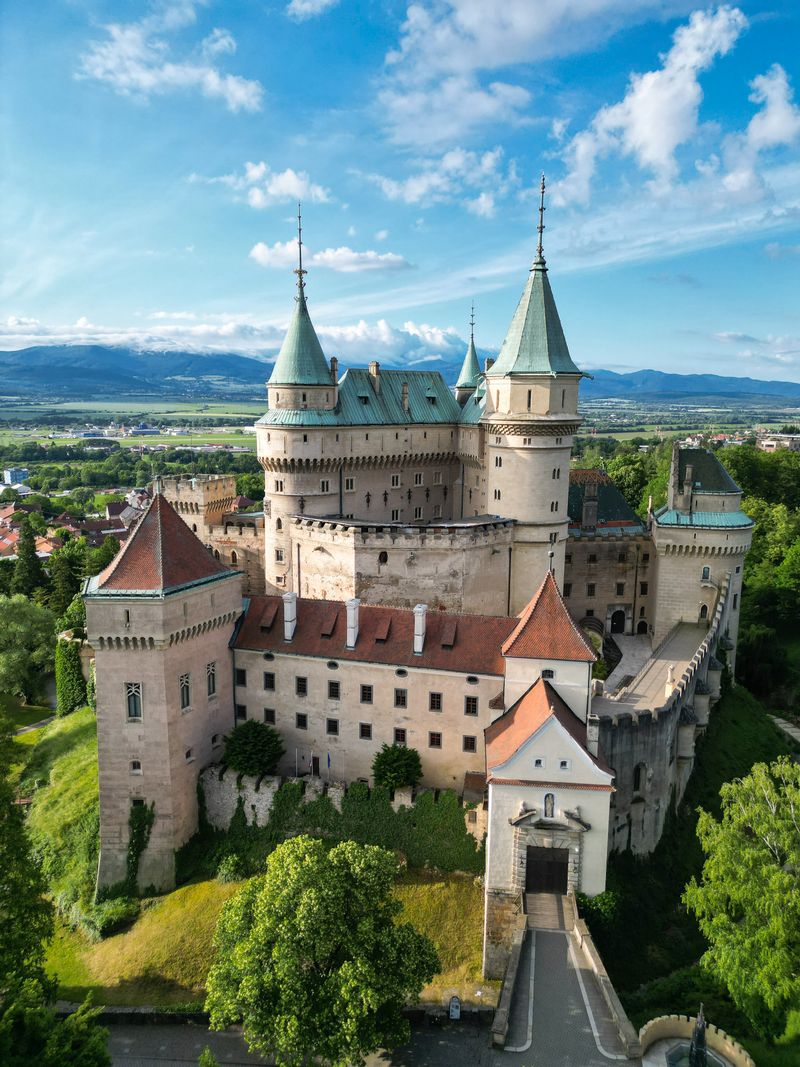
What began as a wooden fortress in the 12th century transformed over centuries into Slovakia’s most enchanting castle. Bojnice’s current appearance owes much to Count János Ferenc Pálffy, who spent 23 years in the late 1800s remodeling it into a Neo-Gothic fantasy inspired by French châteaux.
White towers topped with orange-tiled roofs rise from manicured gardens, creating a storybook silhouette that has made the castle a favorite filming location.
Inside, the castle’s rooms preserve Pálffy’s eclectic collections—Gothic altars, Renaissance furniture, and Baroque paintings crowd the chambers. A chapel built directly into the rock features a cave spring believed to have healing properties.
The count’s love of art and history transformed Bojnice from a military stronghold into a cultural treasure trove.
Each summer, the castle hosts an International Festival of Ghosts and Spirits, where costumed performers bring medieval legends to life. The castle’s romantic architecture and mysterious underground passages make it easy to believe in supernatural inhabitants.
Whether admiring the detailed woodwork or exploring the castle’s caves, visitors experience a place where history and fantasy intertwine beneath Central European skies.
Eilean Donan Castle — Scotland
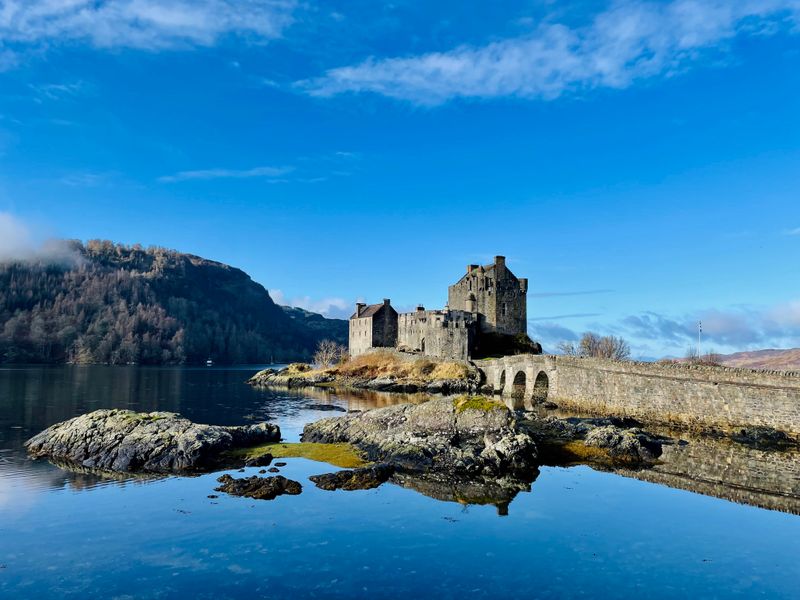
Three sea lochs converge at the point where Eilean Donan Castle rises from a rocky island, creating one of Scotland’s most photographed scenes. The castle’s name means “island of Donan,” referring to a 7th-century Irish saint, but its military history began much later.
Clan Mackenzie built the medieval fortress to defend against Viking raids, and it became a focal point in Highland clan warfare for centuries.
Government forces reduced the castle to ruins in 1719 after Jacobite supporters used it as a stronghold. It remained a picturesque shell until Lieutenant Colonel John MacRae-Gilstrap purchased the island in 1911 and spent 20 years rebuilding the castle using the original ground plans.
The restoration work was so thorough that today’s visitors see a faithful recreation of the medieval structure.
The castle’s position creates dramatic lighting conditions—morning mist clings to the lochs, afternoon sun illuminates the stone bridge, and sunset paints the mountains purple and gold. Inside, rooms display artifacts from clan history and Jacobite rebellions.
Eilean Donan has appeared in numerous films, but no camera fully captures the atmospheric power of standing where mountains, water, and history collide.
Matsumoto Castle — Japan
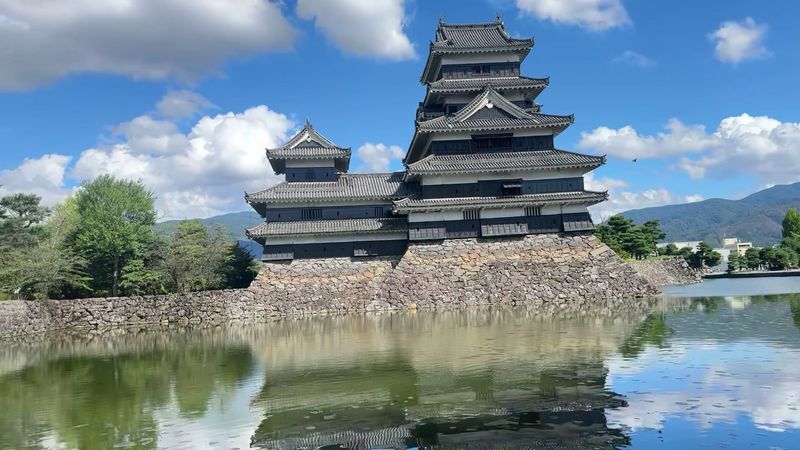
Black lacquered walls earned Matsumoto Castle its nickname—the Crow Castle—and give it a dramatically different appearance from Himeji’s white elegance. Built in the early 16th century during Japan’s Warring States period, the castle was designed for serious combat, with steep wooden stairs, low ceilings to hinder sword fighting, and openings for firing arrows and dropping stones on attackers below.
The castle’s six-story main keep includes a hidden floor invisible from the outside, providing defenders with a tactical surprise. Wooden construction allowed for quick repairs after battles, while the massive stone foundation could withstand earthquakes.
Red bridges spanning the moat create striking color contrasts against the black walls and reflect perfectly in the still water.
Unlike many Japanese castles destroyed by war or fire and rebuilt with concrete, Matsumoto preserves its original wooden structure from the 16th century. Climbing the steep interior staircases feels like stepping into a samurai film—narrow passages, low beams, and weapon racks line the walls.
The castle stands as one of Japan’s National Treasures, a rare survivor from an age when warlords battled for control and castles meant the difference between survival and defeat.
Corvin Castle — Hunedoara, Romania
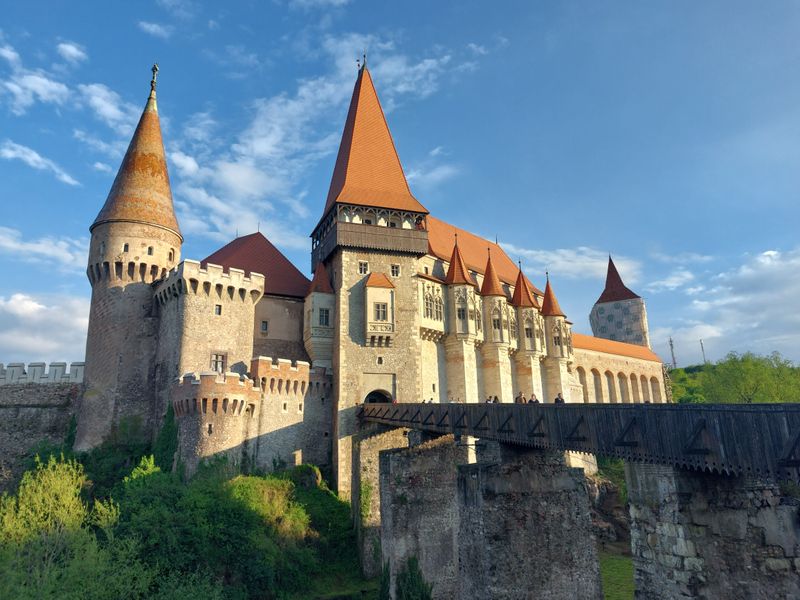
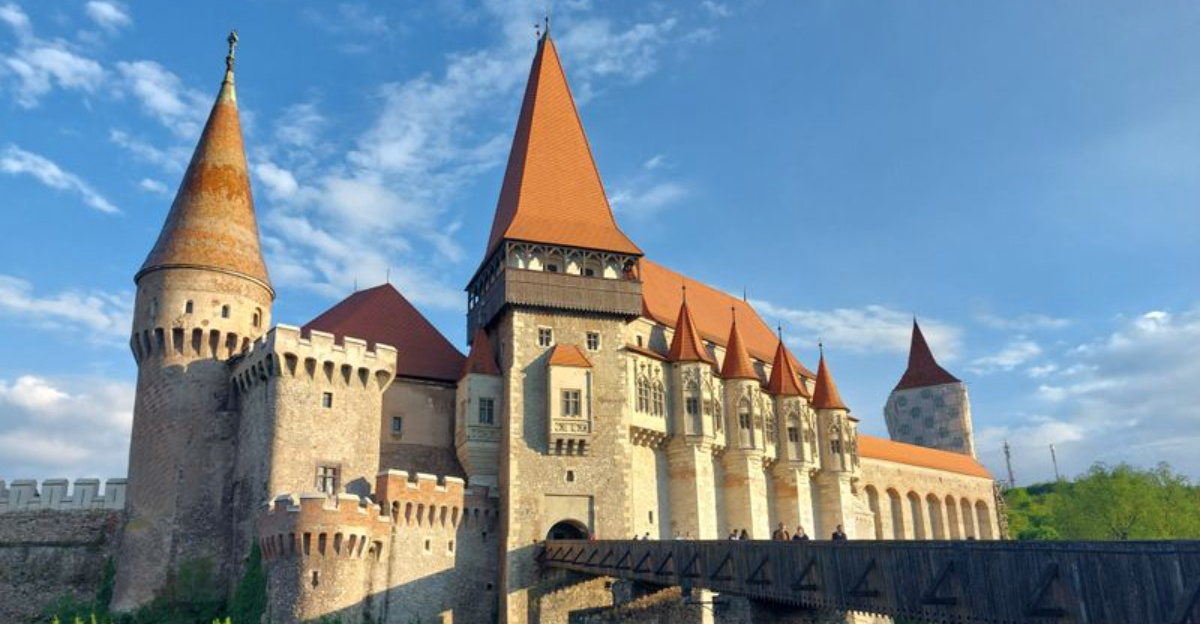
Towers thrust skyward from Corvin Castle like stone daggers, creating a silhouette that seems ripped from Gothic literature. Built in the 14th century on the site of an older fortification, the castle became the seat of Transylvanian power under ruler John Hunyadi, whose military victories against Ottoman forces made him a Hungarian legend.
The castle’s architecture reflects both defensive necessity and Renaissance artistic ambition.
Legend claims Vlad the Impaler—the historical Dracula—was imprisoned in Corvin’s dungeons for seven years, adding dark mystique to the already imposing fortress. Whether true or embellished, the story captures the castle’s reputation as a place of power and punishment.
The interior courtyard, surrounded by Gothic arches and adorned with Renaissance sculptures, creates an unexpectedly elegant space within the fortress walls.
Restoration efforts continue to preserve Corvin’s medieval character while making it accessible to visitors. The Knight’s Hall, with its massive columns and ornate decorations, showcases the wealth and sophistication of Transylvanian nobility.
Standing beneath Corvin’s towers, with ravens circling overhead and mountain mists rolling in, visitors understand why this castle has inspired countless tales of medieval intrigue and supernatural legends.



