 Unearth The Voyage
Europe is packed with monuments that have survived wars, revolutions, and centuries of change — and they still manage to leave visitors speechless. From ancient ruins to fairy-tale castles, each one tells a story that no textbook can fully capture.
Whether you’re a history buff, an architecture lover, or just someone who appreciates something jaw-droppingly cool, these 15 monuments are absolutely worth the trip. Pack your bags, charge your camera, and get ready to explore some of the most remarkable places on the planet.
Eiffel Tower — Paris, France
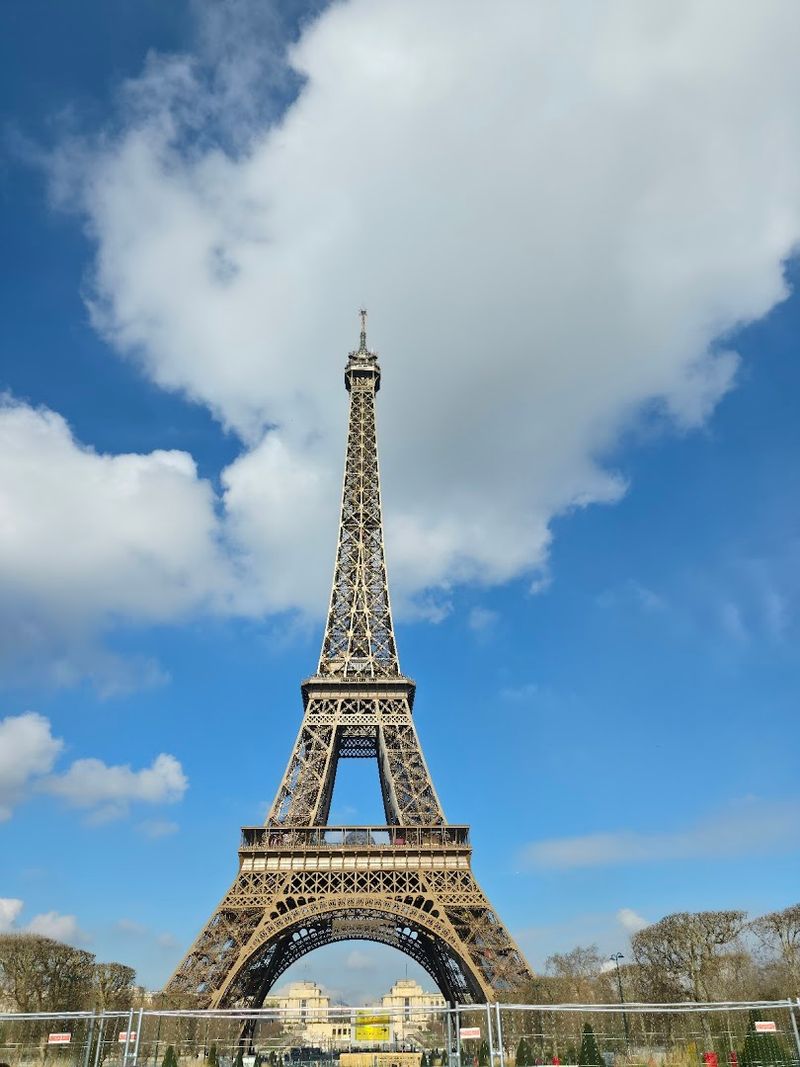
Few structures on Earth have inspired as many proposals, postcards, and Instagram posts as Paris’s iron lady — the Eiffel Tower. Built as a temporary exhibit for the 1889 World’s Fair, engineers originally planned to tear it down after 20 years.
Lucky for us, they changed their minds.
Standing over 300 meters tall, the tower was the world’s tallest structure for more than 40 years. Gustave Eiffel’s engineering team hammered in over 2.5 million rivets to hold the whole thing together.
That’s not construction — that’s dedication.
Visitors can ride elevators or climb stairs to three different levels, each offering stunning panoramic views of Paris. The second floor has a glass floor section for the brave-hearted.
At night, the tower sparkles for five minutes every hour — a light show that never gets old, no matter how many times you see it.
Book tickets online well in advance to skip long queues. The area around the tower, Champ de Mars, is perfect for a picnic with a view.
Seeing the Eiffel Tower in person genuinely feels like stepping inside a dream you didn’t know you had.
Colosseum — Rome, Italy
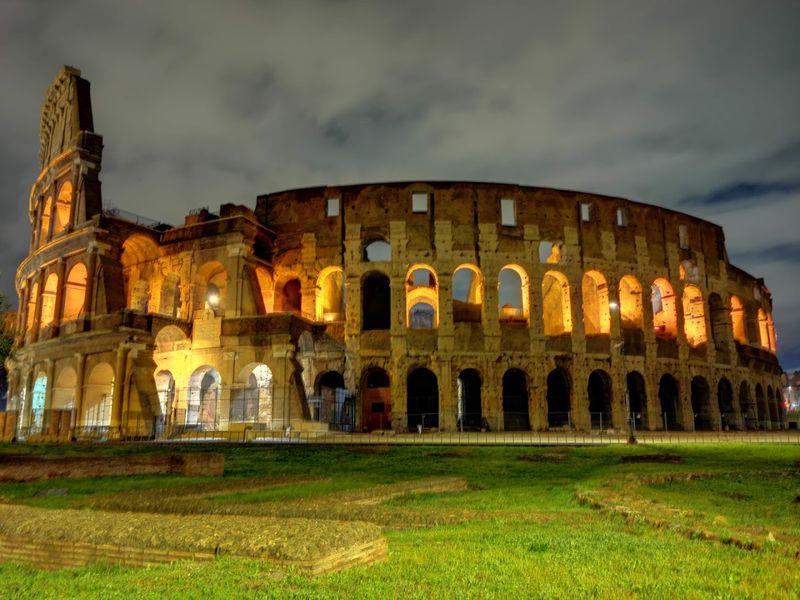
Stepping inside the Colosseum feels like the ground beneath your feet holds secrets — because it absolutely does. Built between 70 and 80 AD, this massive amphitheater once seated up to 80,000 roaring spectators who came to watch gladiatorial combat, animal hunts, and dramatic public spectacles.
The engineering is staggering even by today’s standards. Romans used a clever system of vaults, arches, and concrete to build something so large and durable that it has survived earthquakes, lightning strikes, and nearly 2,000 years of history.
About two-thirds of the original structure has been lost over centuries, yet what remains is breathtaking.
Walking through the arched corridors gives you a genuine sense of scale — this wasn’t just a building, it was a statement. The underground hypogeum, where gladiators and animals waited before entering the arena, is now open to visitors and adds a thrilling layer to the experience.
Book a guided tour to get the most out of your visit. The Roman Forum and Palatine Hill are right next door, making it easy to spend an entire day exploring ancient Rome.
Come early in the morning to beat the crowds and the summer heat.
Sagrada Família — Barcelona, Spain
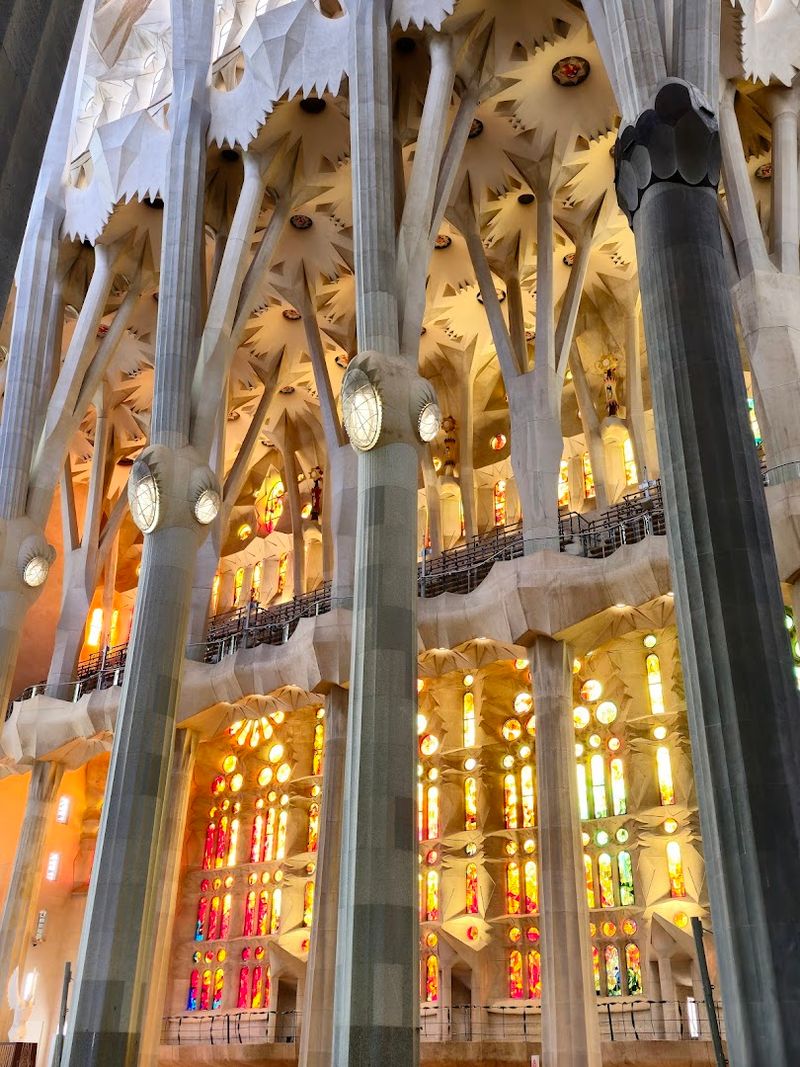
Antoni Gaudí began designing the Sagrada Família in 1883, and the building still isn’t finished — which somehow makes it even more fascinating. This isn’t your typical church.
The towers look like melting sandcastles sculpted by a genius, and the interior glows with a rainbow of light filtering through hundreds of stained glass windows.
Gaudí was so devoted to the project that he moved into the construction site during his final years. He was tragically hit by a tram in 1926 and died before seeing his masterpiece take real shape.
Today, architects continue his work using his original plans and modern technology.
The Nativity facade faces east to catch the morning sun, while the Passion facade faces west for dramatic afternoon shadows. Every detail is intentional — even the spiral staircases inside the towers were designed to feel like seashells.
The symbolism packed into every corner is almost impossible to fully absorb in one visit.
Pre-booking tickets is absolutely essential here — lines stretch for hours without them. Consider adding a tower access ticket for elevated views of Barcelona.
The Sagrada Família is expected to be completed around 2026, marking 100 years since Gaudí’s death.
Acropolis & Parthenon — Athens, Greece
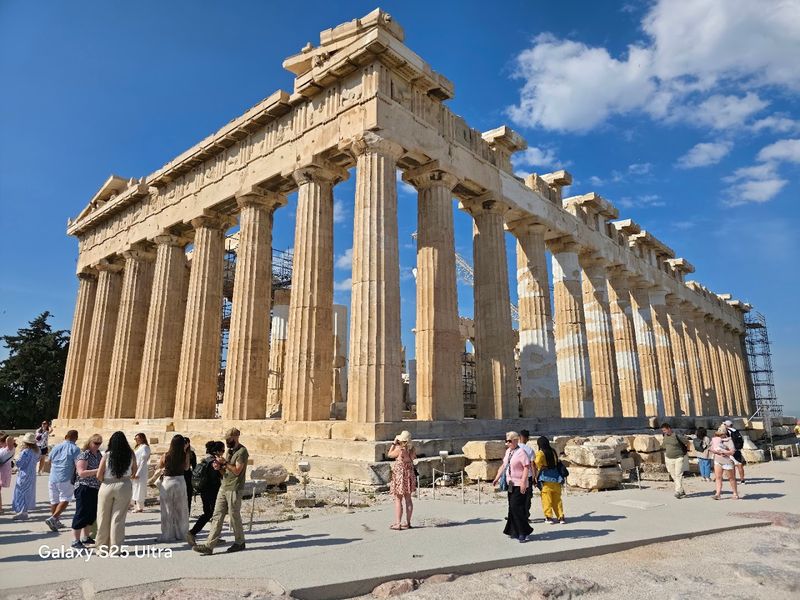
Perched on a rocky hill above Athens, the Acropolis has been watching over the city for over 2,500 years. The Parthenon, its crown jewel, was built between 447 and 432 BC as a temple dedicated to the goddess Athena — the city’s divine protector and namesake.
What makes the Parthenon especially remarkable is that its columns aren’t perfectly straight. Ancient Greek architects deliberately added subtle curves and tilts to make the building look perfectly balanced to the human eye.
That’s a level of optical engineering that still impresses architects today.
The climb to the top is worth every step. Once you reach the summit, the view stretches across Athens all the way to the sea on a clear day.
Sunrise visits are especially magical — the marble glows golden and the crowds haven’t arrived yet, giving you a rare moment of quiet with one of history’s greatest buildings.
Visit the nearby Acropolis Museum before or after your climb — it houses stunning original sculptures and artifacts removed for preservation. Wear comfortable shoes with good grip, as the ancient marble paths can be slippery.
The Acropolis is also beautifully lit at night and can be seen from many parts of Athens below.
St. Peter’s Basilica — Vatican City
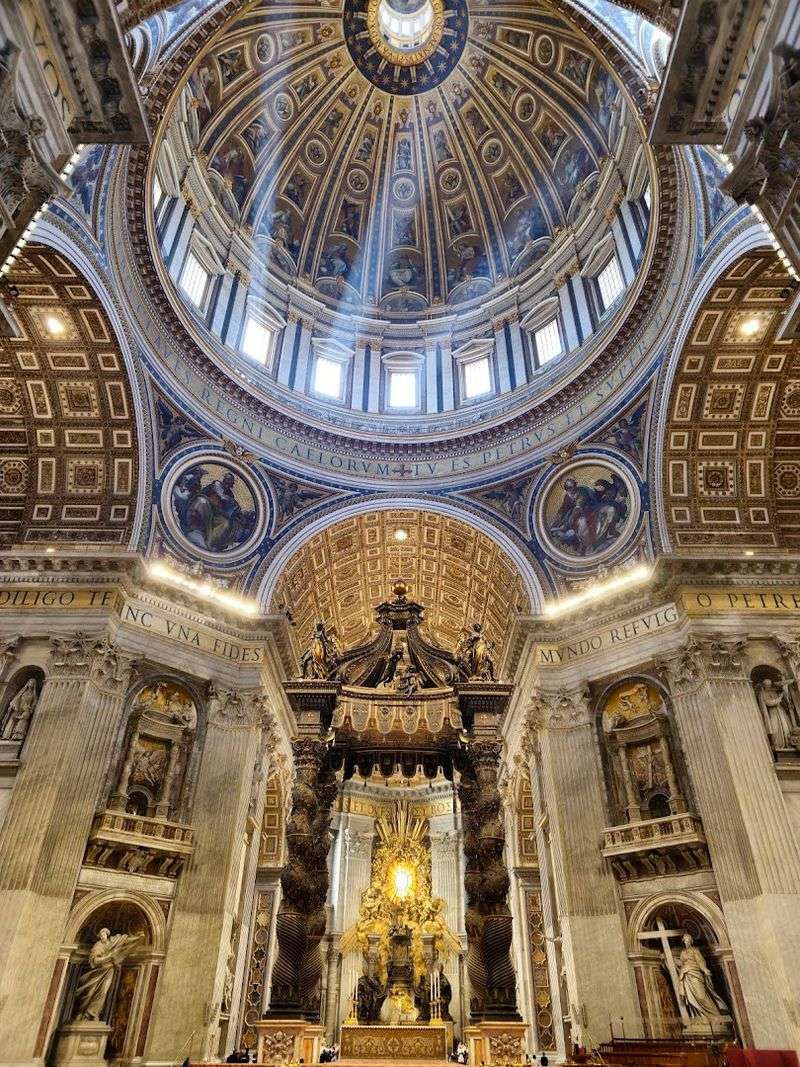
The numbers alone are enough to make your jaw drop — St. Peter’s Basilica covers over 23,000 square meters, can hold up to 60,000 people, and took more than 120 years to complete. And yet, standing inside, it somehow feels even bigger than those statistics suggest.
Michelangelo took over as chief architect at age 71 and spent the rest of his life working on the iconic dome. He never lived to see it finished, but his design was followed faithfully after his death.
The dome soars 136 meters above the floor and remains one of the greatest architectural achievements in human history.
Inside, the basilica is packed with extraordinary art. Michelangelo’s Pietà — a marble sculpture of Mary holding Jesus — is housed here behind glass and draws visitors from around the world.
The scale of everything inside makes even the largest artworks feel like they belong perfectly in place.
Climbing to the top of the dome is a must for the views over Rome and St. Peter’s Square. Dress modestly — covered shoulders and knees are required for entry.
Arrive early or late in the afternoon to avoid peak crowds. Entry to the basilica is free, though dome access costs a small fee.
Palace of Versailles — Versailles, France
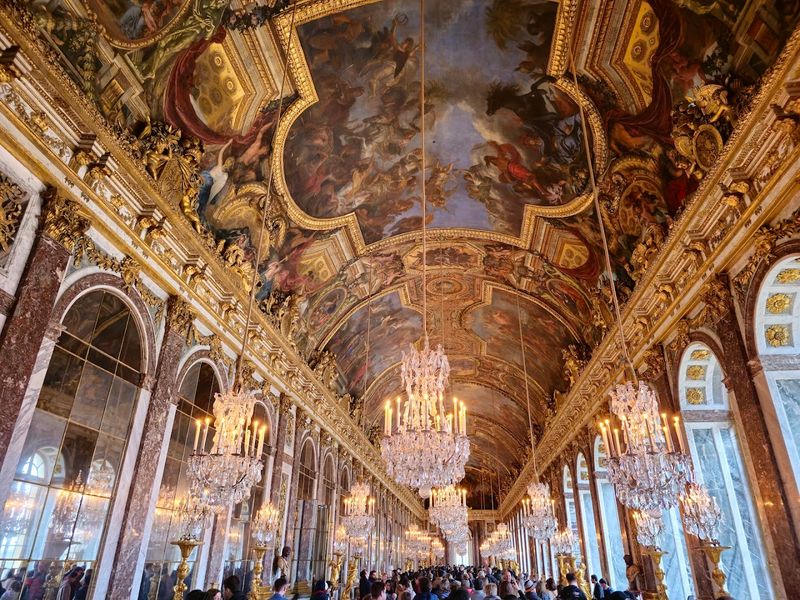
If you ever want to understand why the French Revolution happened, a walk through the Palace of Versailles will give you some very clear answers. Built as a symbol of absolute royal power, Versailles was home to King Louis XIV, who moved his entire court here in 1682 and basically ran France from a palace that never stopped getting bigger.
The Hall of Mirrors is the showstopper — a 73-meter-long gallery lined with 357 mirrors reflecting light from 17 arched windows overlooking the gardens. It was designed to dazzle foreign dignitaries and remind everyone exactly how powerful France was.
Mission accomplished, honestly.
Beyond the palace walls, the gardens stretch for nearly 800 hectares and include fountains, sculptures, canals, and perfectly trimmed hedges. On weekends from spring to autumn, the Musical Fountains show brings the gardens to life with classical music and synchronized water displays.
It’s a surprisingly emotional experience.
Book tickets well ahead, especially during summer when wait times can stretch for hours. Consider renting a bike or golf cart to explore the vast gardens — walking the whole thing is genuinely exhausting.
The Grand Trianon and Petit Trianon palaces on the grounds are quieter and equally gorgeous, often skipped by visitors in a rush.
Stonehenge — England, United Kingdom
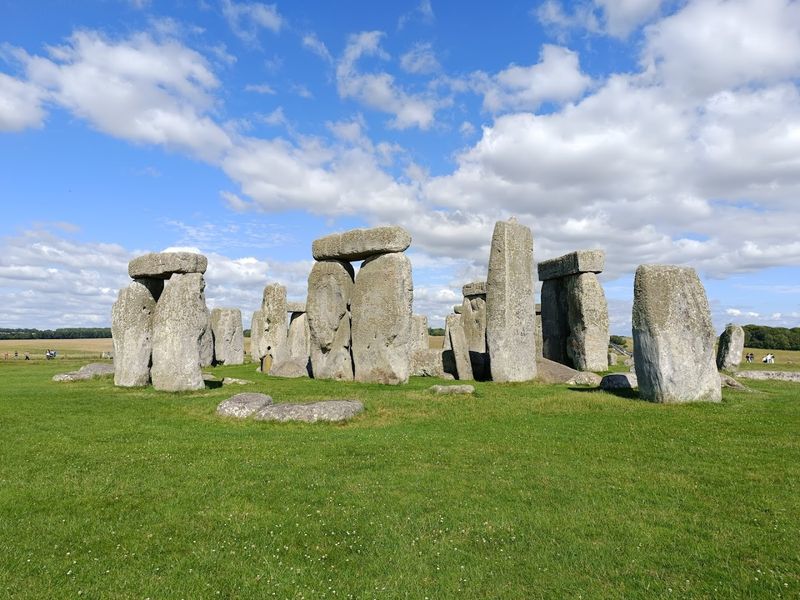
Nobody actually knows exactly why Stonehenge was built — and that mystery is a huge part of what makes it so captivating. These massive stones, some weighing up to 25 tons, were transported from Wales over 200 miles away roughly 4,500 years ago.
No wheels, no cranes, no blueprints. Just human determination on an almost unbelievable scale.
The monument is aligned with the movements of the sun, particularly the summer solstice sunrise and winter solstice sunset. Whether it was a calendar, a burial site, a place of healing, or something else entirely is still debated by researchers.
Every new archaeological dig seems to add more questions than answers.
Standing in front of Stonehenge for the first time hits differently than expected. It’s smaller than most people imagine from photos, but the atmosphere around it — the open Salisbury Plain, the wind, the sheer age of the stones — creates a feeling that’s hard to put into words.
It feels ancient in a way that gets under your skin.
The visitor center is excellent and well worth exploring before approaching the stones. Special access tickets allow visitors to walk among the stones at sunrise or sunset outside regular hours — a rare and deeply moving experience.
Nearby Avebury, another prehistoric stone circle, is also worth a visit on the same trip.
Hagia Sophia — Istanbul, Türkiye
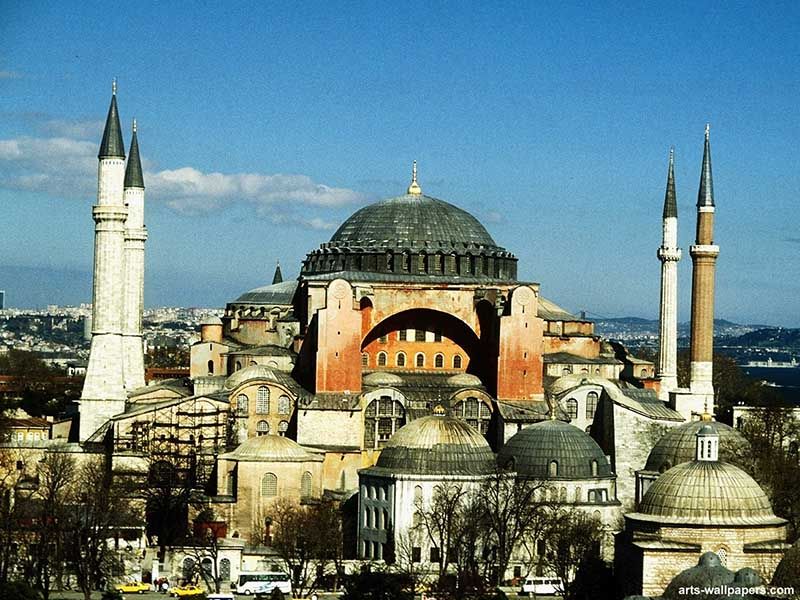
Built in just five years and completed in 537 AD, the Hagia Sophia was the largest cathedral in the world for nearly a thousand years. Emperor Justinian reportedly walked in on the day of its completion and said, ‘Solomon, I have surpassed you.’ Whether or not that’s exactly what happened, the confidence was clearly justified.
The dome seems to float above the building, an illusion created by a ring of 40 windows at its base that flood the interior with light. Byzantine architects achieved this effect using specially lightweight hollow bricks made in Rhodes — an engineering trick that puzzled builders for centuries after.
What makes Hagia Sophia uniquely layered is its history. It began as a Christian cathedral, was converted to a mosque after the Ottoman conquest in 1453, became a museum in 1934, and was reconverted to a mosque in 2020.
Inside, golden Byzantine mosaics of saints and emperors coexist with Islamic calligraphy medallions — centuries of history literally sharing the same walls.
Visitors are welcome outside of prayer times, and entry is free. Women should bring a scarf to cover their heads inside.
Arrive early to appreciate the interior in quieter morning light before tour groups fill the space. The Blue Mosque sits just across the square, making both easily combined in one morning visit.
Brandenburg Gate — Berlin, Germany
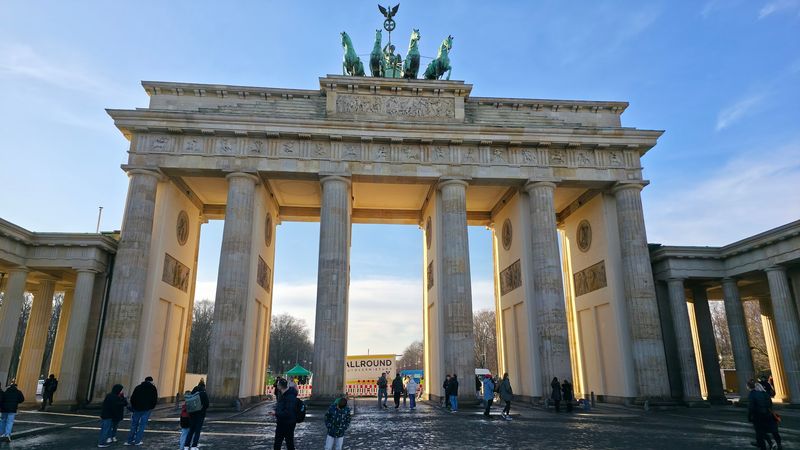
The Brandenburg Gate has had one of the most dramatic identity changes in architectural history. Completed in 1791 as a symbol of Prussian power, it later became the backdrop for Napoleon’s triumphal march, a Nazi propaganda backdrop, and then a chilling border marker during the Cold War when the Berlin Wall divided the city right beside it.
When the Wall fell on November 9, 1989, crowds flooded Pariser Platz and celebrated in front of the Gate in scenes that were broadcast around the world. That moment transformed it from a symbol of division into one of the most powerful symbols of freedom and reunification in modern history.
Very few monuments carry that kind of emotional weight.
The neoclassical design draws inspiration from the Propylaea gateway to the Acropolis in Athens. At the top stands the Quadriga — a sculpture of the goddess of victory driving a four-horse chariot.
Napoleon actually stole it and took it to Paris in 1806 before it was returned to Berlin eight years later.
The Gate is free to visit any time and sits at the heart of central Berlin, surrounded by major landmarks. The Holocaust Memorial is just a short walk away, as is the Reichstag building.
Evening visits are especially atmospheric when the Gate is beautifully lit up against the dark sky.
Neuschwanstein Castle — Bavaria, Germany
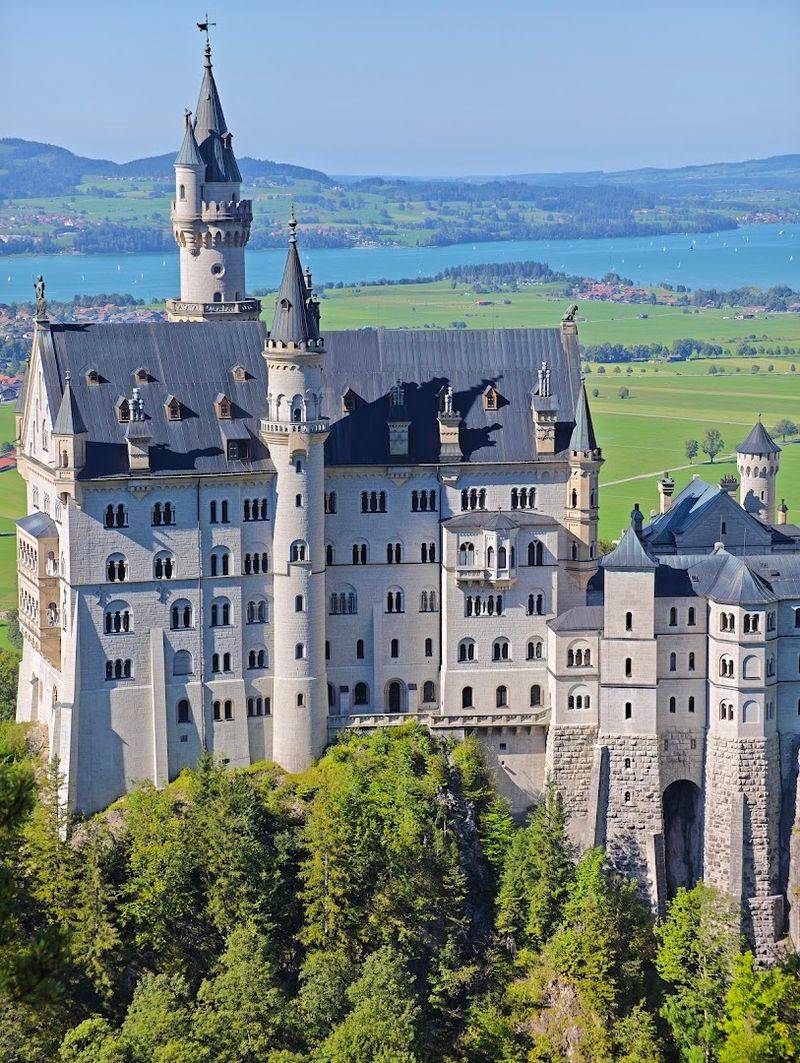
Walt Disney’s animators didn’t have to work very hard when designing Sleeping Beauty’s castle — they basically just drew Neuschwanstein. King Ludwig II of Bavaria commissioned this dreamy hilltop fortress in 1869 as a personal retreat inspired by medieval legends and the operas of Richard Wagner.
It was never meant to be a tourist attraction. Yet here we are.
Ludwig lived in the castle for only 172 days before dying under mysterious circumstances in 1886. Within weeks of his death, the unfinished castle was opened to the public to pay off his enormous construction debts.
The king would have absolutely hated that. Visitors have been streaming in ever since.
The interior is jaw-dropping in a theatrical, over-the-top way that somehow still works. Rooms are decorated with painted scenes from Wagner operas, intricate wood carvings, and mosaics that took years to complete.
The Throne Room features over two million mosaic tiles on the floor alone — and Ludwig never even got to sit on the throne, as it was never installed before his death.
The Marienbrücke bridge nearby offers the most iconic view of the castle — arrive early to beat the crowds for photos. Wear warm layers even in summer, as the mountain air gets cool quickly.
The nearby village of Hohenschwangau has good cafes for warming up after the uphill walk.
Charles Bridge — Prague, Czech Republic
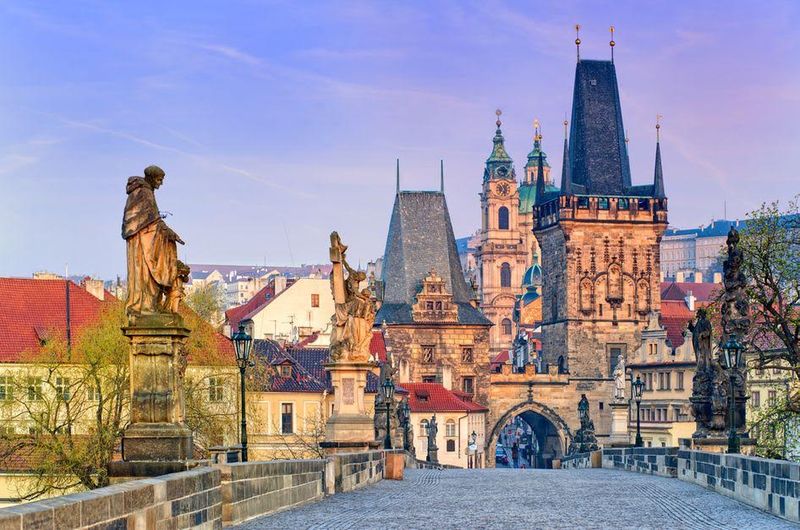
At 5 AM on a summer morning, Charles Bridge belongs to a handful of photographers, a few joggers, and the fog drifting off the Vltava River. By 10 AM, it’s one of the most crowded pedestrian bridges in Europe.
The moral of the story: set your alarm early.
Construction began in 1357 under King Charles IV, who reportedly chose 5:31 AM on July 9 as the exact moment to lay the first stone — the numbers 1-3-5-7-9-7-5-3-1 form a palindrome, which was believed to give the bridge magical strength. Whether it worked is debatable, but the bridge has stood for over 660 years, so maybe don’t argue with medieval numerology.
Lining both sides of the bridge are 30 Baroque statues of saints, installed between the late 1600s and early 1700s. The statue of St. John of Nepomuk is the most famous — locals say touching the bronze plaque brings good luck, and the polished shine on it proves that millions have tried.
The bridge connects the Old Town with Malá Strana and leads directly toward Prague Castle, making it a natural part of any city walk. Street musicians often perform on the bridge, adding a soundtrack to the views.
The bridge is free to cross at any time of day or night.
Leaning Tower of Pisa — Pisa, Italy
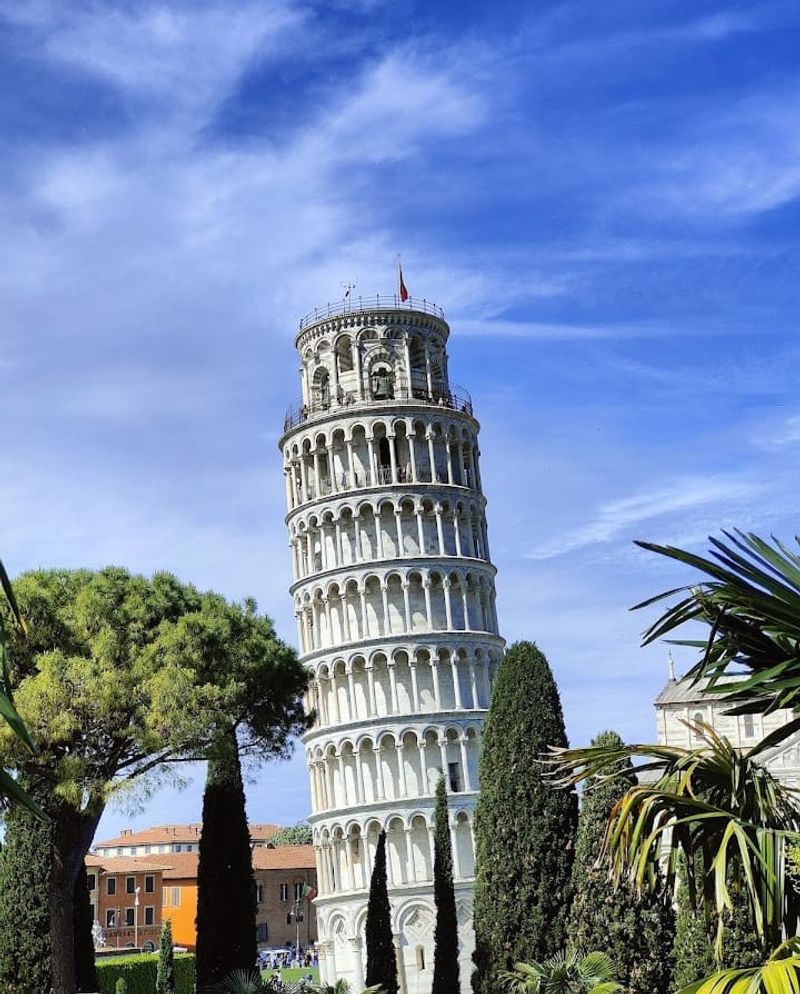
Here’s a fun piece of architectural irony: the Leaning Tower of Pisa started tilting during construction in 1173 — and the tilt is the only reason most people know it exists. Without that accidental lean, it would just be a fairly nice bell tower in a medium-sized Italian city.
The flaw became the fame.
The soft ground on one side caused the foundation to sink unevenly, and the tower has been leaning ever since. By the late 20th century, it was tilting so dramatically that engineers feared it would topple.
A major stabilization project in the 1990s actually straightened it slightly — from about 5.5 degrees to a safer 3.97 degrees. It now leans just enough to be iconic without being dangerous.
Climbing the 294 steps to the top is a wobbly, slightly dizzying experience that’s absolutely worth it. The spiral staircase curves in a way that makes you feel the lean with every step, which is equal parts unsettling and thrilling.
Views from the top stretch across Pisa’s rooftops toward the Arno River.
The tower sits within the Campo dei Miracoli, or Field of Miracles, alongside the stunning Pisa Cathedral and Baptistery — don’t rush past them just to get the classic tourist photo. Book tower tickets online in advance, as entry is timed and limited to small groups.
Arrive before 9 AM for the quietest experience.
Blue Mosque — Istanbul, Türkiye
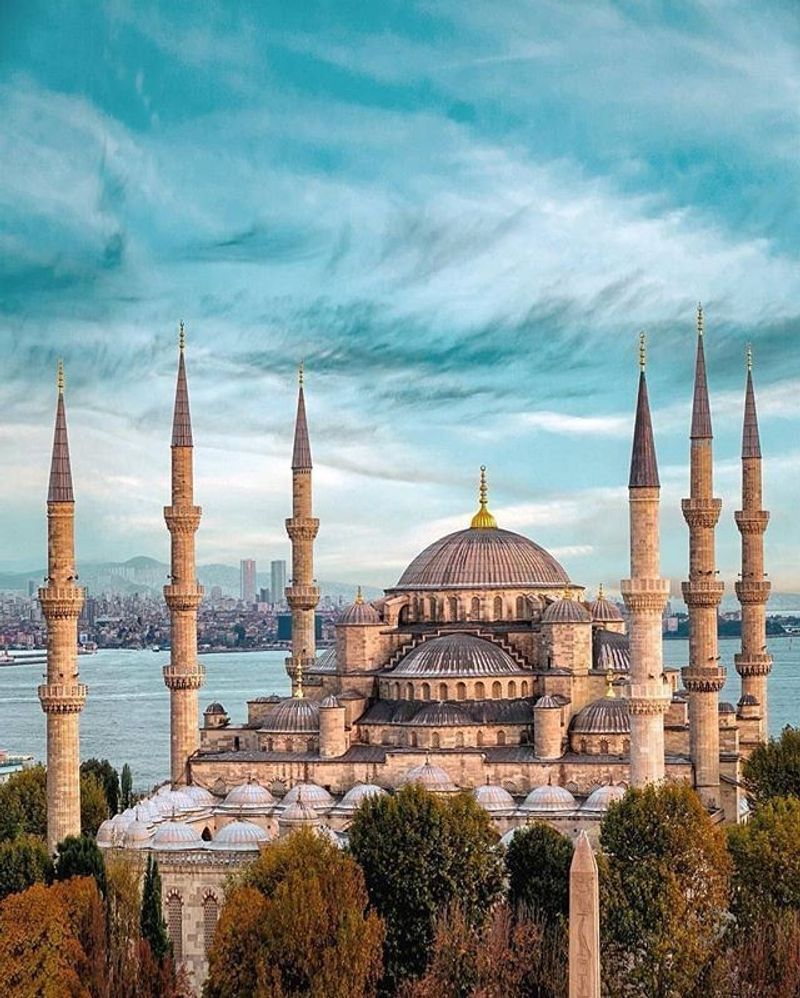
The story behind the Blue Mosque’s six minarets caused an actual diplomatic incident when it was built in the early 1600s. At the time, only the mosque in Mecca had six minarets — so Sultan Ahmed I’s decision to add a sixth was seen as an outrageous act of competition with Islam’s holiest site.
The solution was to add a seventh minaret to the Mecca mosque. Problem solved, awkwardly.
Inside, the walls are covered with more than 20,000 hand-painted Iznik tiles in shades of blue, green, and white — which gives the mosque its popular nickname. The natural light filtering through 260 windows shifts the color of the tiles throughout the day, making the interior look slightly different every hour.
It’s the kind of place that rewards patience.
The mosque’s architect, Sedefkar Mehmed Agha, was a student of the legendary Mimar Sinan, who also designed many of Istanbul’s greatest buildings. The cascading domes and half-domes stacked above each other create a sense of graceful upward movement that feels almost effortless from below.
The Blue Mosque is still an active place of worship and is closed to tourists during the five daily prayer times. Entry is free, but donations are appreciated.
Dress modestly — robes and scarves are available at the entrance for those who need them. Arrive outside prayer windows for the best experience.
Buckingham Palace — London, United Kingdom
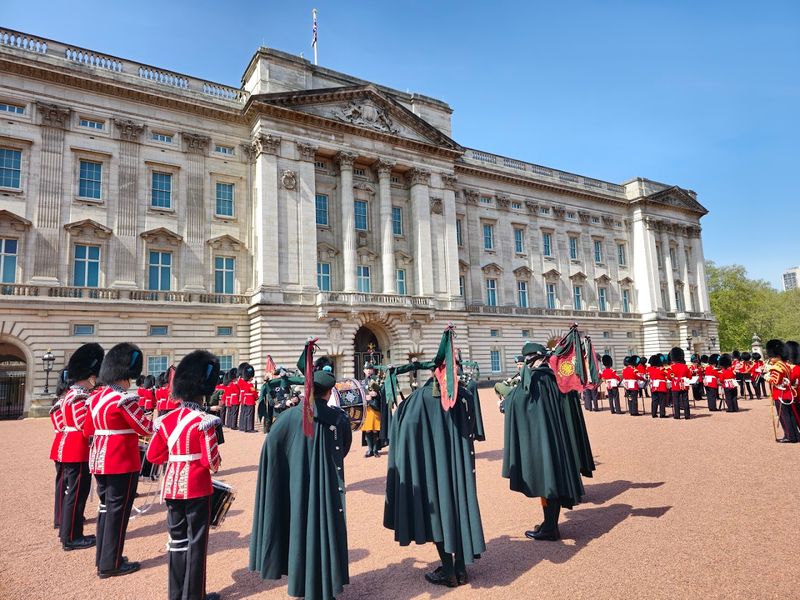
The flag flying above Buckingham Palace tells you something important before you even reach the gates — if the Royal Standard is up, the monarch is home. If the Union Jack is flying instead, the palace is empty.
Londoners and tourists have been reading this flag code for generations, which is a very British way of tracking royal whereabouts.
The palace has 775 rooms, including 19 state rooms, 52 royal and guest bedrooms, 188 staff bedrooms, 92 offices, and 78 bathrooms. It’s essentially a small town that happens to also be someone’s home.
The Queen’s Gallery and the Royal Mews are open year-round, while the State Rooms open to visitors during summer months.
The Changing of the Guard ceremony takes place in the palace forecourt and remains one of London’s most-watched traditions. The full ceremony lasts about 45 minutes and involves elaborate military pageantry, brass bands, and synchronized marching that’s genuinely impressive to watch.
Get there at least 30 minutes early for a good viewing spot.
The palace sits at the end of The Mall, a straight ceremonial route lined with trees and flags that leads from Trafalgar Square. St. James’s Park, right next door, is one of London’s most beautiful royal parks and perfect for a post-palace stroll.
The surrounding area of Westminster is packed with landmarks within easy walking distance.
Alhambra — Granada, Spain
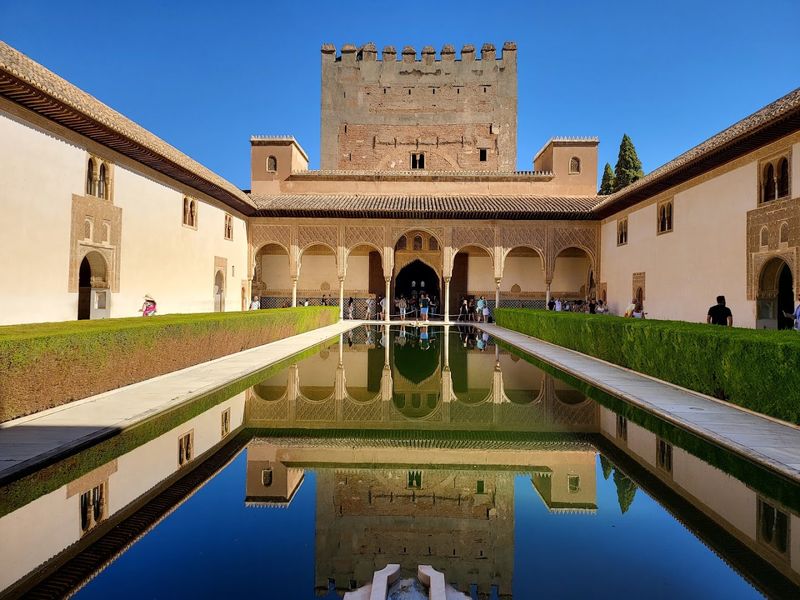
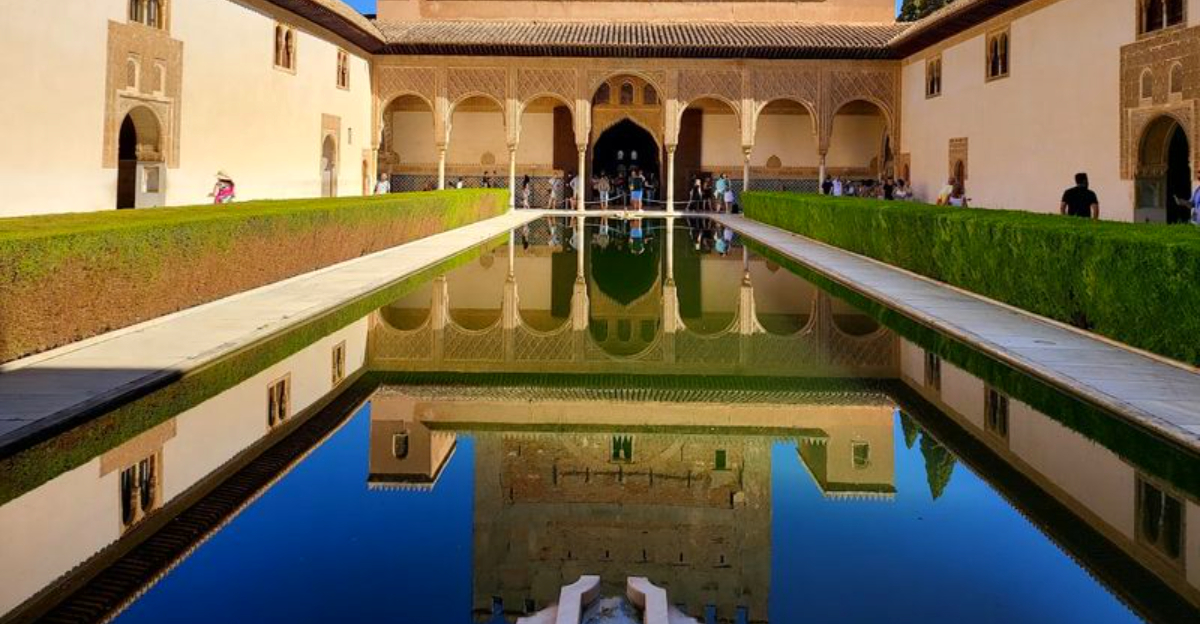
Carved plaster walls that look like frozen lace. Geometric tile patterns that tile mathematicians still study today.
Reflecting pools that turn the sky into a floor. The Alhambra in Granada is less a building and more a meditation on beauty — and it was built over 700 years ago.
The Nasrid dynasty began constructing the palace complex in the 13th century, and it became the last major stronghold of Moorish rule in Spain before falling to the Catholic Monarchs Ferdinand and Isabella in 1492. Columbus famously received royal approval for his voyage to the Americas from this very palace just months after that conquest.
History really did overlap here in remarkable ways.
The Nasrid Palaces are the undisputed highlight — room after room of mind-bending geometric ornamentation, delicate arched windows, and tranquil courtyard fountains. The Court of the Lions, with its famous alabaster fountain supported by 12 lion sculptures, is one of the most photographed spaces in all of Spain.
The Generalife gardens next door offer terraced flowerbeds and water channels that have been blooming for centuries.
Tickets sell out weeks in advance, especially in summer — booking early is not optional, it’s essential. Entry is timed and managed strictly to protect the delicate interiors.
An evening visit to the Mirador de San Nicolas nearby gives you the iconic view of the Alhambra glowing golden against the Sierra Nevada mountains at sunset.



