Verona is one of Italy’s most charming cities, blending Roman ruins, medieval streets, and Renaissance elegance into a compact and walkable destination. Often overshadowed by Venice and Milan, it offers equally rich history—without the overwhelming crowds.
Famous as the setting of Romeo and Juliet, Verona goes far beyond romance. From ancient amphitheaters to scenic viewpoints and vibrant piazzas, the city delivers a diverse and unforgettable experience.
Here are 17 unmissable things to do in Verona that capture its timeless appeal.
Visit the Verona Arena
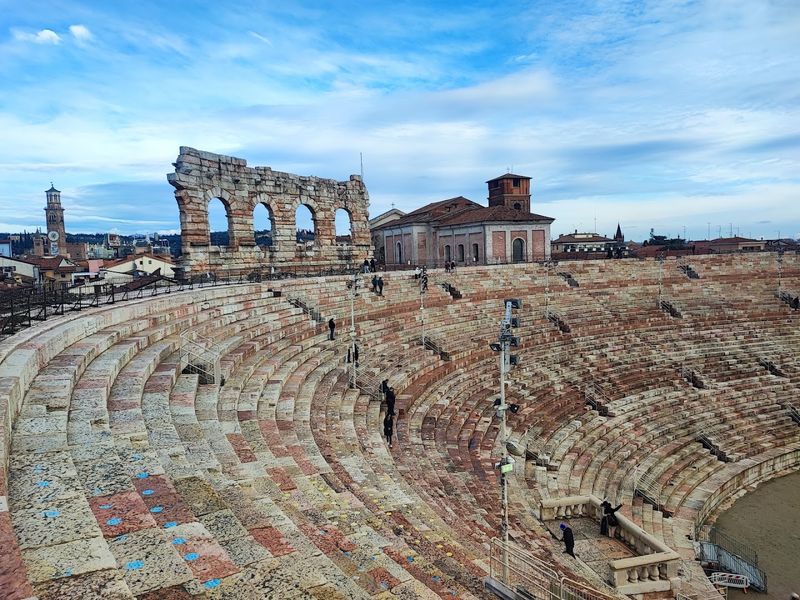
Two thousand years old and still hosting sold-out shows—the Verona Arena is genuinely one of a kind. Built in the 1st century AD, this Roman amphitheater originally seated around 30,000 spectators who came to watch gladiator battles and public spectacles.
Today, it draws opera fans from across the globe.
Every summer, the arena transforms into an open-air opera stage. The acoustics are surprisingly powerful, and watching a performance under the stars here is something most people describe as life-changing.
Even if opera isn’t your thing, attending any live event inside this ancient structure is worth every euro.
During the day, you can walk inside and explore the tiered stone seating, imagine the roaring crowds of ancient Rome, and take photos from the top rows for incredible city views. Entry fees are affordable, and audio guides are available for deeper context.
Arrive early in the morning to beat the midday rush. The arena sits right on Piazza Bra, so it’s easy to combine your visit with a coffee at one of the surrounding cafés before or after you explore.
Explore Piazza Bra
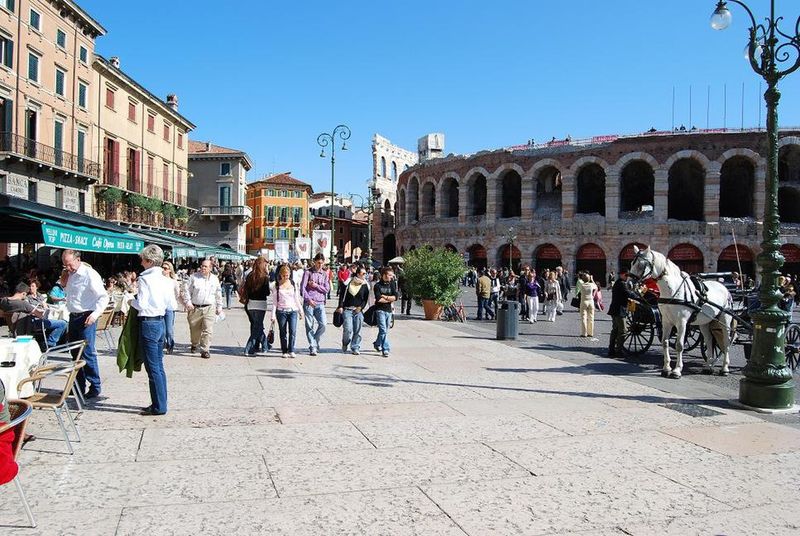
Step into Piazza Bra and you’ll immediately understand why Veronese locals treat it like their living room. This is the largest square in Verona, and it buzzes with energy at almost every hour of the day.
The long, tree-lined promenade called the Liston is perfect for a slow, leisurely stroll.
Cafés and restaurants line the western edge of the square, offering front-row seats to one of Italy’s most theatrical public spaces. Grab a cappuccino or an Aperol Spritz and watch the world go by—it’s basically a sport here.
The mix of tourists, locals, street performers, and pigeons creates a genuinely entertaining scene.
Architecturally, the square holds a few surprises too. The Palazzo della Gran Guardia and the neoclassical Palazzo Barbieri add a stately backdrop to the open space.
At night, the Arena is beautifully lit, making the square feel almost magical. Piazza Bra works as a natural starting point for any Verona itinerary since most major attractions are within walking distance.
Spend at least 30 minutes here just soaking in the atmosphere before heading deeper into the city’s historic center.
Walk Through Piazza delle Erbe
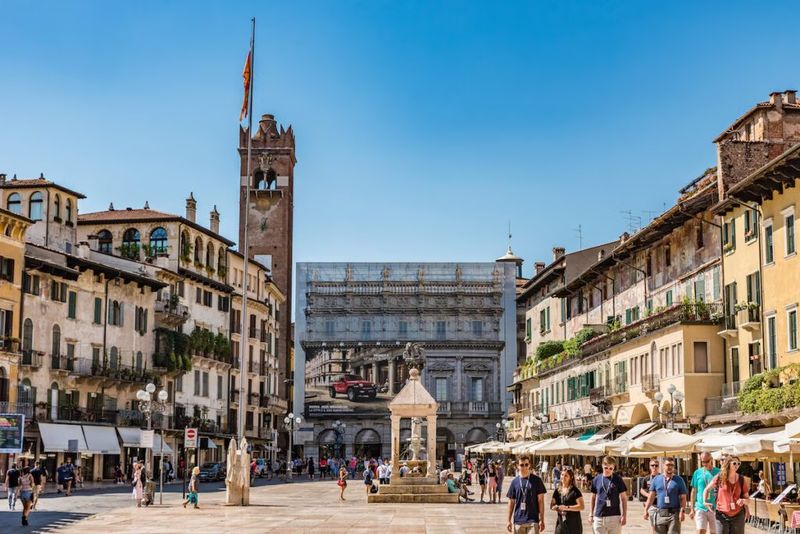
Piazza delle Erbe smells like fresh produce, aged stone, and centuries of stories all at once. This square has been the beating heart of Verona since Roman times, when it served as the city’s main forum.
Today, market stalls still fill the center, selling everything from souvenirs to local food.
Look up and you’ll notice the buildings surrounding the square are extraordinary. Faded frescoes cling to the facades of medieval palaces, and the Torre dei Lamberti towers above the roofline.
The Fontana di Madonna Verona, a Roman statue repurposed as a fountain, stands proudly at the center of it all.
Mornings are the best time to visit when the market is in full swing and the light hits the colorful buildings just right. Afternoon brings a lively café culture as visitors settle into the outdoor terraces.
The square connects directly to Piazza dei Signori through a small archway, making it easy to explore both in a single walk. Street food vendors near the edges of the square often sell local snacks worth trying.
Piazza delle Erbe is the kind of place you visit once and end up returning to every single day of your trip.
Visit Juliet’s House (Casa di Giulietta)
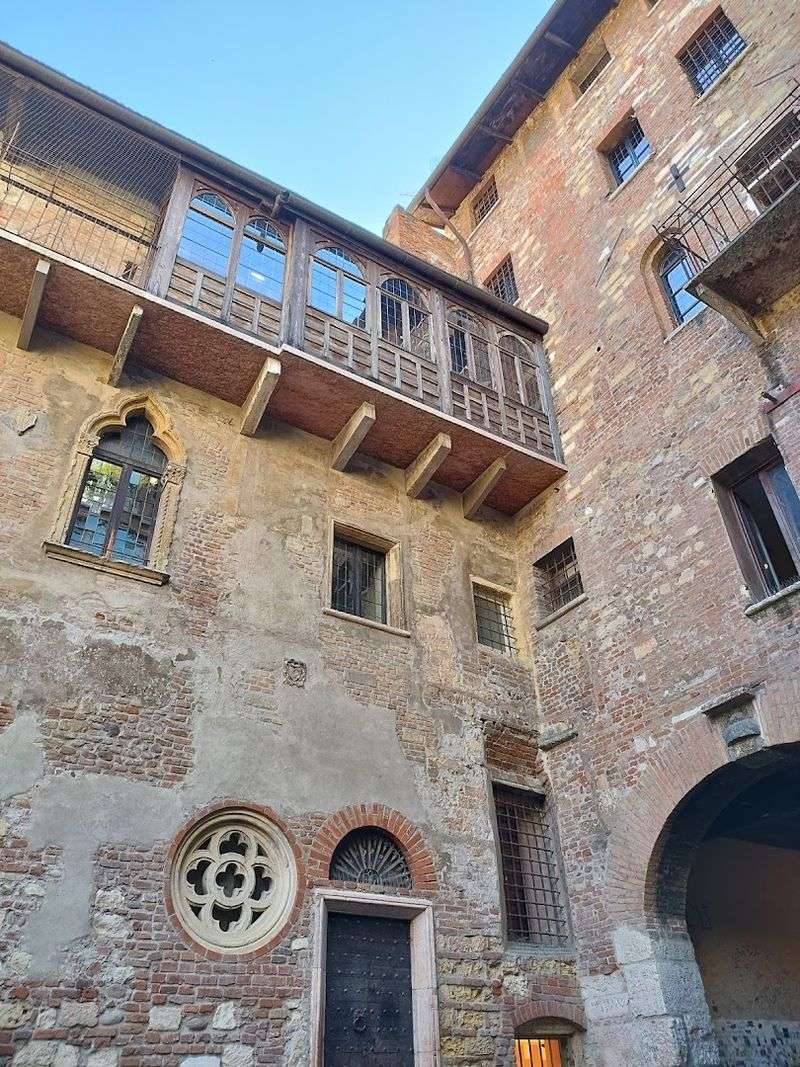
Technically, Juliet never lived here—but that hasn’t stopped millions of visitors from making this one of the most visited spots in all of Italy. Casa di Giulietta is a 13th-century house with a small marble balcony that inspired the famous scene from Shakespeare’s Romeo and Juliet.
The romantic myth is very much alive.
The courtyard below the balcony is where things get interesting. Visitors from around the world leave love notes, letters, and chewing gum (yes, really) on every available wall surface.
There’s also a bronze statue of Juliet, and rubbing her right shoulder is said to bring good luck in love—her shoulder is noticeably shinier than the rest of her.
You can pay to enter the house itself, which contains period furniture, costumes from various film adaptations, and exhibits about the Romeo and Juliet legend. The balcony is accessible from inside and makes for a great photo opportunity.
The courtyard is free to enter and is worth a visit even if you skip the interior. Lines can get long by mid-morning, so arriving early is a smart move.
Whether you’re a Shakespeare fan or just curious, this spot delivers a surprisingly fun and touching experience.
Climb Torre dei Lamberti
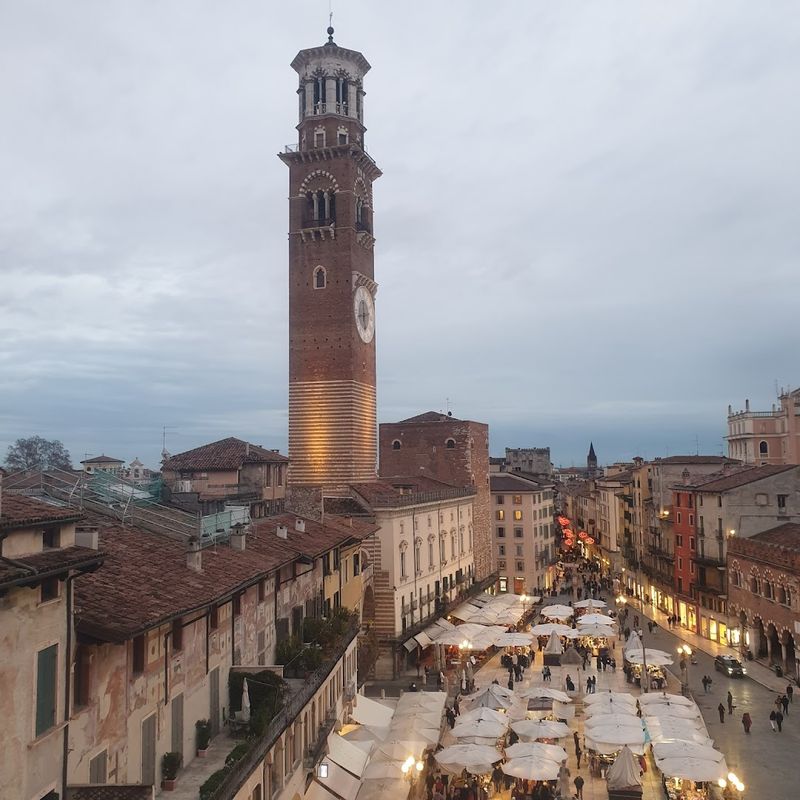
At 84 meters tall, Torre dei Lamberti has been watching over Verona since the 12th century—and the view from the top is absolutely worth the climb. The tower rises above Piazza delle Erbe and offers a 360-degree panorama of the city’s terracotta rooftops, the Adige River, and the surrounding hills.
You have two options for reaching the top: climb the 368 steps on foot or take the elevator. Most visitors opt for the elevator on the way up and walk down, which gives you a chance to appreciate the stone staircase and architectural details up close.
Either way, the summit view is the reward.
On clear days, you can spot the Dolomite mountains in the distance, which adds an unexpected wow factor to the experience. The tower is located inside the historic center, so combining it with a walk through Piazza delle Erbe and Piazza dei Signori makes perfect sense.
Entry fees are modest, and the tower is open most days of the week. Sunset visits are particularly popular, when the warm light turns the city’s buildings golden.
Go in the late afternoon if you want the best possible light for photos from the top.
Wander the Historic Center (Centro Storico)
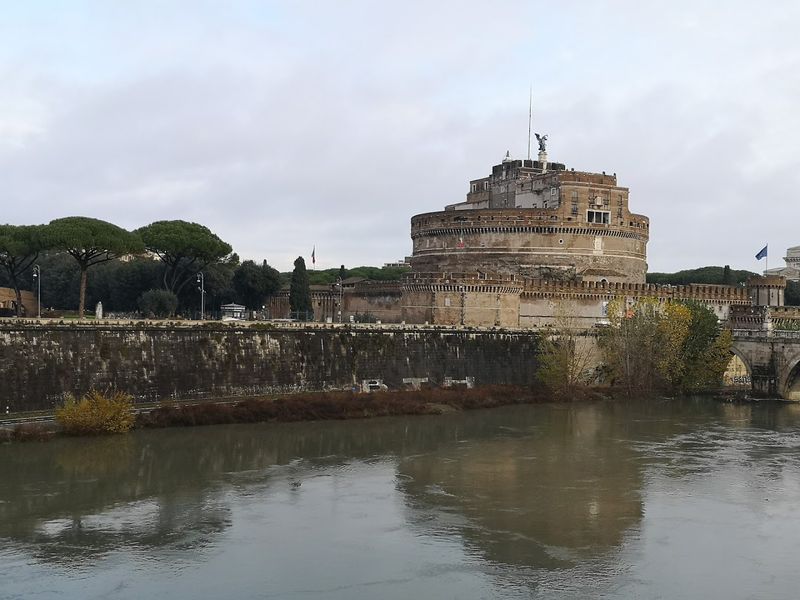
Getting deliberately lost in Verona’s historic center might be the best decision you make all trip. The Centro Storico is a UNESCO World Heritage Site, and wandering its narrow lanes without a fixed agenda reveals hidden courtyards, Romanesque churches, and centuries-old architecture at every turn.
The streets between Piazza Bra and Piazza delle Erbe are especially rewarding to explore on foot. Via Mazzini is the main pedestrian shopping street, lined with boutiques and gelato shops, but the real charm lies in the quieter alleys branching off from the main routes.
Peek through open doorways and you’ll often spot beautiful internal courtyards that most tourists walk right past.
What makes the centro storico special is how effortlessly it mixes the ancient with the everyday. Roman ruins sit next to modern cafés, and medieval towers loom above designer clothing stores.
The entire historic center is walkable in a few hours, but taking your time over a full day is far more satisfying. Comfortable shoes are a must since the cobblestones, while beautiful, are uneven underfoot.
Early mornings offer the most atmospheric experience when the streets are quiet and the light is soft. Bring a camera and no particular plan—that’s the winning formula here.
Cross Ponte Pietra
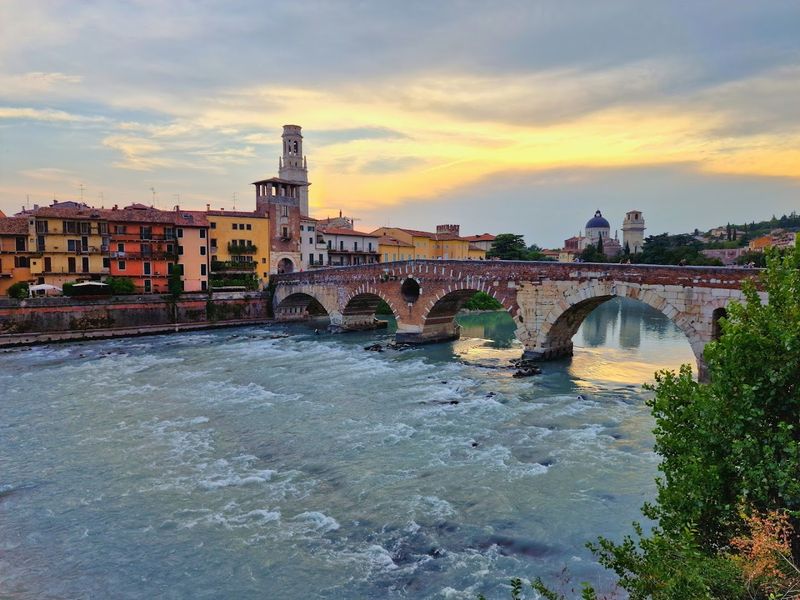
Ponte Pietra is the oldest bridge in Verona, and it has survived wars, floods, and centuries of foot traffic to remain one of the city’s most beloved landmarks. Built by the Romans in the 1st century BC, it spans the Adige River with five elegant arches that seem almost too graceful for something so ancient.
The bridge was partially destroyed during World War II, but the Veronese carefully recovered the original stones from the riverbed and rebuilt it stone by stone after the war. That act of dedication says everything about how much this city values its heritage.
Walking across it today, you’d never know it had ever been damaged.
The best time to cross Ponte Pietra is late afternoon when the sun begins to drop toward the hills. The warm light reflects off the Adige River and turns the entire scene into something that looks like a Renaissance painting.
From the bridge, you get excellent views toward Castel San Pietro on the hill above and back toward the city’s rooftops. The Roman Theater sits just on the other side, making this a natural part of any walking route through the historic center.
It’s a simple crossing, but one that stays with you long after you’ve left Verona.
Visit Castelvecchio and Its Museum
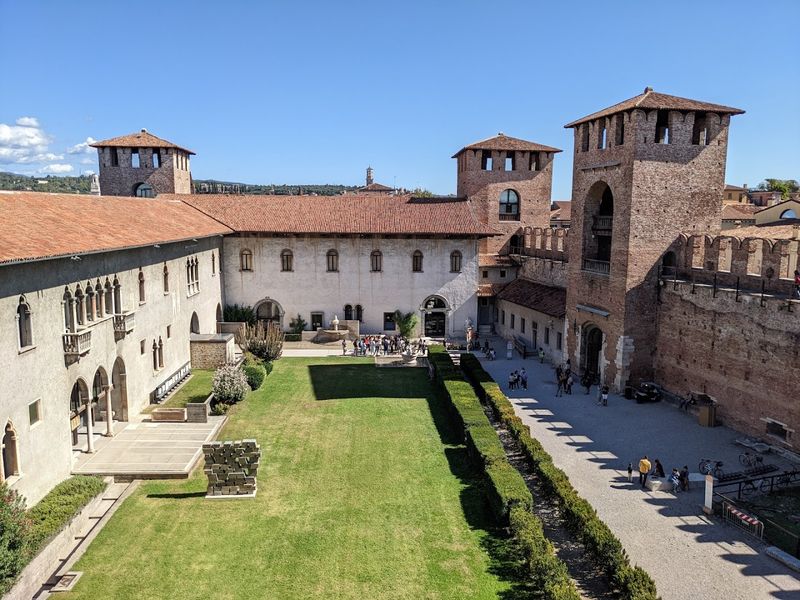
Built by the Scaligeri rulers in the 14th century, Castelvecchio looks exactly like what a medieval fortress should look like—thick red-brick walls, crenellated towers, and a moat that once kept enemies at bay. Today, it’s one of Verona’s most important museums and a genuinely fascinating place to spend a few hours.
The Museo di Castelvecchio houses an impressive collection of medieval and Renaissance art, including sculptures, paintings, and armor. The layout of the museum is itself a work of art—architect Carlo Scarpa redesigned the interior in the 1960s, creating a brilliant interplay between the ancient structure and modern exhibition design.
Art lovers and architecture enthusiasts both find plenty to admire here.
Beyond the collection, the castle offers great views of the Adige River from its upper walkways and towers. The internal courtyard is spacious and makes for a pleasant spot to pause and take in the scale of the building.
Entry is affordable, and the museum is well-labeled in multiple languages, so it’s easy to follow even without a guided tour. Allow at least two hours to do it justice.
Combining a visit here with a walk across the adjacent Castelvecchio Bridge makes for one of Verona’s most satisfying half-day itineraries.
Walk Across Castelvecchio Bridge
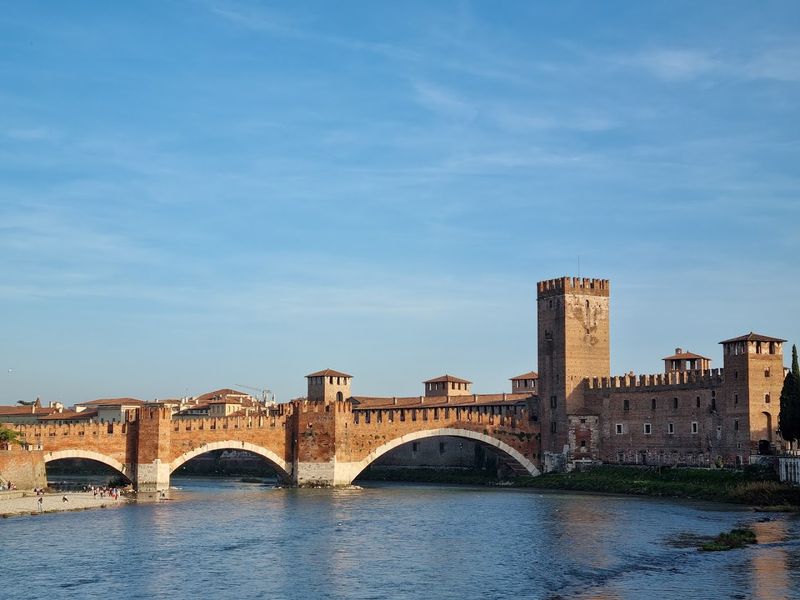
Few bridges in Europe feel as dramatically medieval as Castelvecchio Bridge, and walking across it is like stepping straight into a history book. Officially known as Ponte Scaligero, this fortified crossing was built in the 1350s as a private escape route for the ruling Scaligeri family—basically a very stylish emergency exit.
The bridge stretches across the Adige River with three wide arches, each slightly different in span, which gives it an asymmetrical charm that photographs beautifully from the riverbank below. The crenellated walkway along both sides adds to the fortress-like atmosphere.
It feels less like a bridge and more like a defensive wall that happens to cross a river.
Like Ponte Pietra, this bridge was destroyed in World War II and painstakingly reconstructed using the original stones. Standing on it today, looking back at the red-brick towers of Castelvecchio on one side and the curve of the Adige on the other, it’s hard not to feel a deep respect for the people who rebuilt it.
Sunset is the ideal time for a crossing, when the light turns the brick a rich amber color. The bridge is free to walk across, and it connects directly to the castle entrance, making the visit seamless.
Explore the Roman Theater
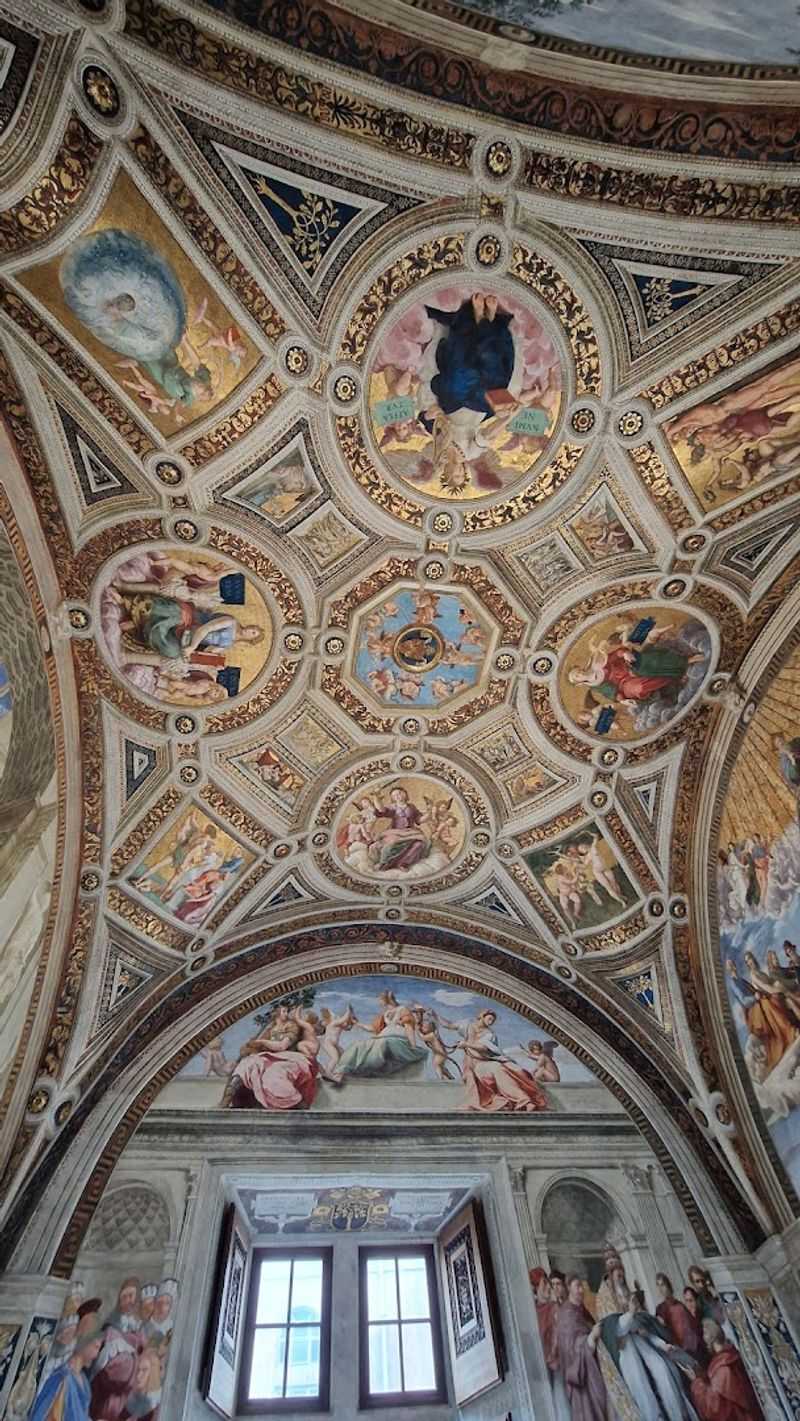
Carved directly into the hillside on the north bank of the Adige River, Verona’s Roman Theater is one of those places that quietly steals the show. Dating back to the 1st century BC, it predates the more famous Arena and offers a completely different kind of Roman experience—intimate, atmospheric, and far less crowded.
The theater is still used for performances during the summer, particularly for Shakespeare plays, which feels wonderfully appropriate given Verona’s literary connections. Sitting in the ancient stone seats watching a live performance as the sun sets over the city below is an experience that’s genuinely hard to beat.
Even outside of performance season, the site is well worth visiting. The Archaeological Museum built into the former monastery above the theater contains Roman artifacts including mosaics, bronze figures, and portrait busts.
The climb up through the theater to the museum levels gives you progressively better views over the rooftops of Verona and the Adige River below. Access is via a small entrance near Ponte Pietra, making it easy to combine with a walk across the bridge.
The site is often quieter than other major attractions, which makes exploring it feel like a genuine discovery rather than a tourist obligation.
Take in the View from Castel San Pietro
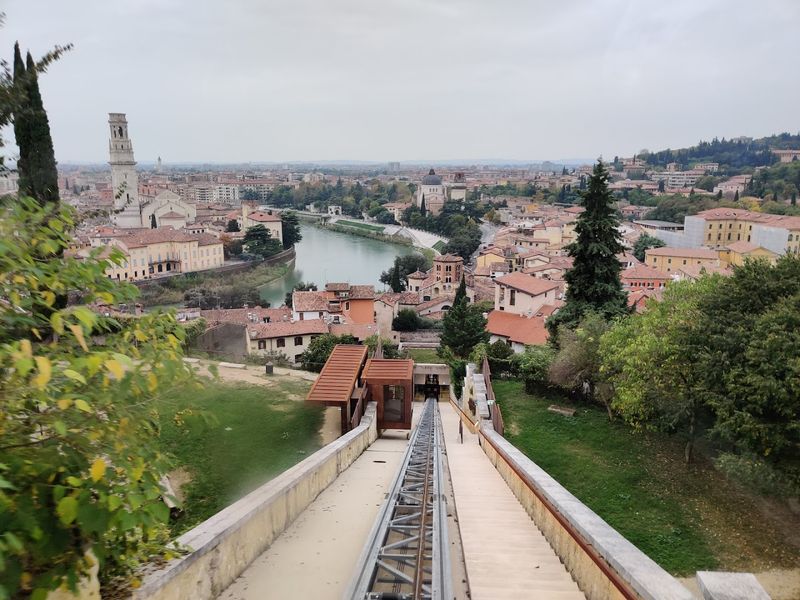
If Verona has one view that makes your jaw drop, this is it. Perched high on the hill above the Roman Theater, Castel San Pietro offers the most sweeping panorama of the entire city—and it’s completely free to enjoy.
The hilltop terrace looks directly over the Adige River bend, the historic center, and the Arena beyond.
Getting up there is half the fun. You can either tackle the steep staircase that winds up from near Ponte Pietra, or take the funicular (a small cable car) that runs from the street level below.
The funicular is a bargain and saves your legs for the rest of the day’s exploring. Either way, the views at the top make every step worthwhile.
The castle itself is a 19th-century Austrian military barracks and isn’t open to visitors, but the terrace and gardens around it are publicly accessible. Locals come up here in the evenings to relax, share drinks, and watch the city light up below—it has a genuinely social, laid-back atmosphere.
Sunset is peak time, and for good reason. The sky turns shades of pink and orange while the city below glows warmly.
Bring a snack, find a good spot on the terrace wall, and simply enjoy one of the most beautiful urban views in Italy.
Visit Basilica di San Zeno Maggiore
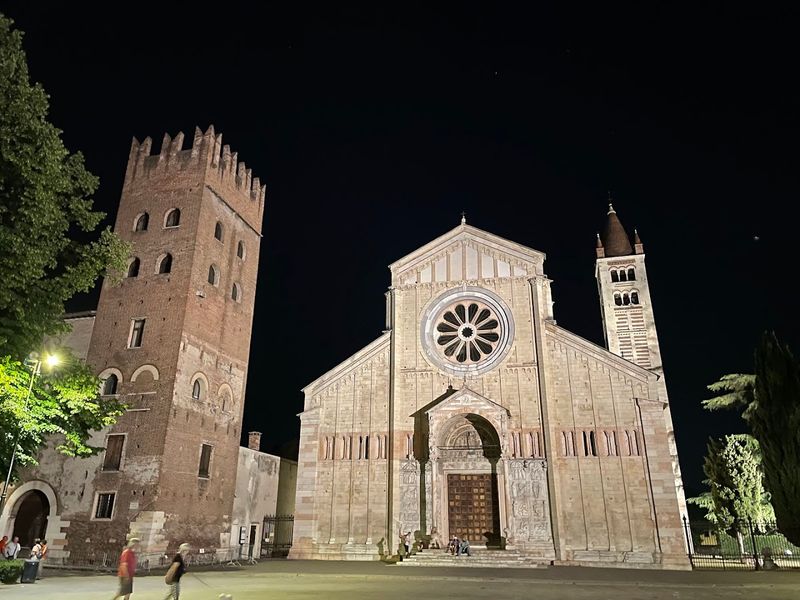
San Zeno Maggiore doesn’t get the same headlines as the Arena or Juliet’s House, but for anyone who appreciates architecture and religious art, it’s arguably the most stunning building in Verona. This Romanesque basilica was built between the 9th and 12th centuries and is considered one of the finest examples of Romanesque architecture in northern Italy.
The facade alone is worth the walk over. A magnificent rose window known as the Wheel of Fortune dominates the front, flanked by marble reliefs depicting biblical scenes.
The bronze doors—48 panels in total—are extraordinary works of medieval craftsmanship that tell stories from the Old and New Testaments in vivid, expressive detail. Art historians travel specifically to see them.
Inside, the church is cool, dim, and deeply atmospheric. The crypt below the main altar holds the remains of San Zeno, Verona’s patron saint, and draws a steady stream of quiet pilgrims.
The altarpiece by Andrea Mantegna, painted in the 15th century, is one of the highlights of the interior. The church sits in a quieter neighborhood slightly west of the main tourist circuit, which means it often feels refreshingly uncrowded.
A visit here pairs well with a walk along the nearby city walls or a stop at one of the local bakeries in the surrounding streets.
Relax in Giardino Giusti
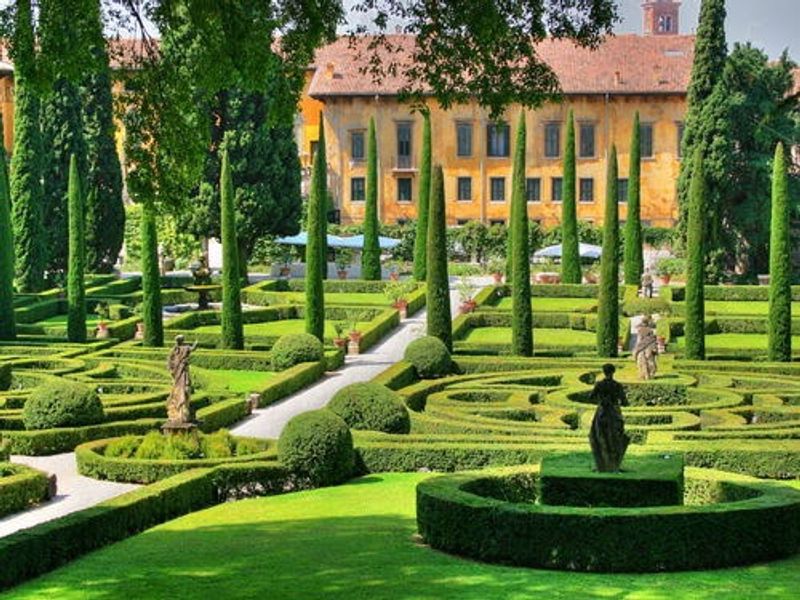
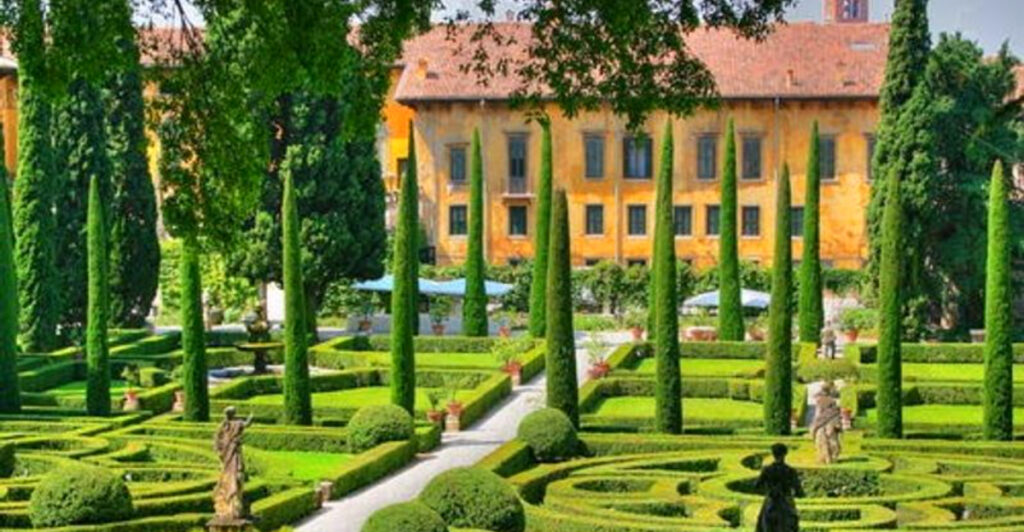
Giardino Giusti is Verona’s secret exhale—a beautifully preserved Renaissance garden where the noise of the city fades almost instantly once you step through the gates. Laid out in the late 16th century by the noble Giusti family, it’s been enchanting visitors ever since, including the likes of Goethe and Mozart who both reportedly visited and loved it.
The garden is divided into two distinct sections. The lower half features formal Italian garden design—symmetrical hedgerows, gravel paths, citrus trees, and classical statues arranged with careful precision.
The upper half is wilder and more naturalistic, climbing the hillside through cypress trees toward a terrace that offers excellent views over Verona’s rooftops.
Hidden grottos, a maze, and a small belvedere tower add a sense of discovery to the visit. The garden is compact enough to explore in about an hour, but it’s the kind of place where you naturally slow down and linger longer than planned.
Entry requires a small fee, and the garden is open most days year-round. Spring visits are particularly lovely when the roses and wisteria are in bloom.
It’s located just across the Adige River from the Roman Theater, making it a natural addition to any itinerary that includes that side of the city. Comfortable shoes are recommended for the hillside paths.
Discover the Scaliger Tombs
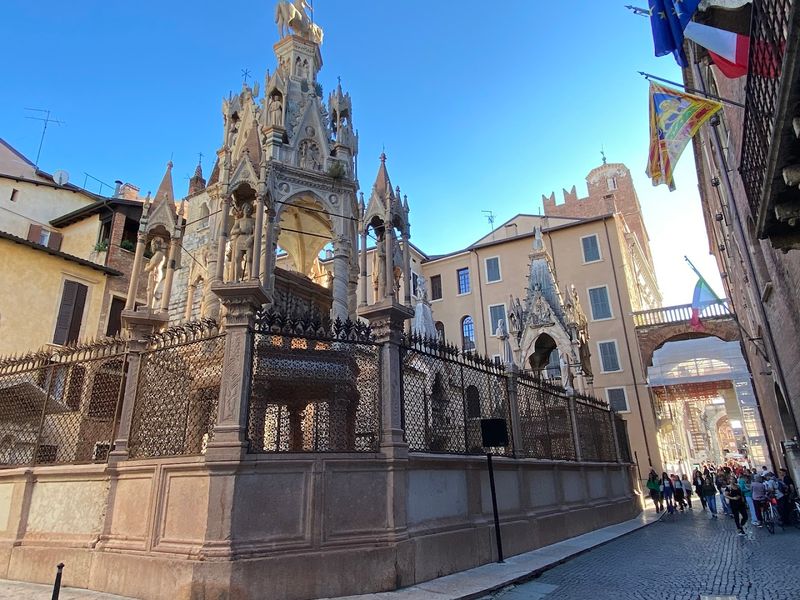
Tucked beside the church of Santa Maria Antica in the heart of Verona’s historic center, the Scaliger Tombs are the kind of monument that stops you mid-stride. These elaborate Gothic funerary monuments were built in the 14th century to honor the Scaligeri dynasty, the powerful family that ruled Verona for over a century.
What makes them visually spectacular is the sheer excess of their design. Each tomb is topped with an equestrian statue of the deceased ruler, armored and triumphant, elevated on a carved canopy decorated with pinnacles, heraldic symbols, and intricate Gothic stonework.
The largest tomb, that of Cangrande I, is particularly impressive—the original equestrian statue now lives in Castelvecchio Museum for preservation, and a copy stands in its place outdoors.
The tombs are enclosed within a decorative iron fence adorned with ladder motifs, the symbol of the Scaligeri family. You can view them clearly from outside the fence for free, though a small fee allows entry for closer inspection.
They’re located just steps from Piazza delle Erbe, making them easy to include in any walking tour of the center. Most visitors walk past without stopping, which is genuinely their loss.
Spend ten minutes here and you’ll come away with a much richer understanding of Verona’s medieval power and artistry.
Stroll Along the Adige River
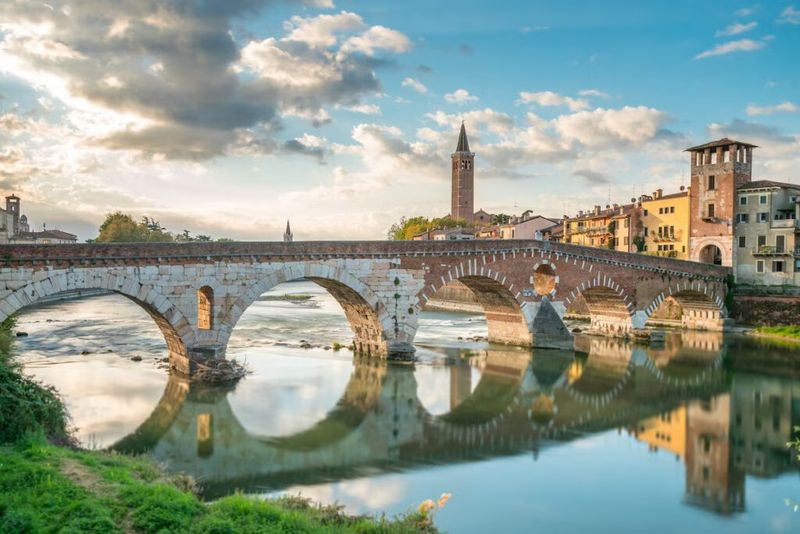
The Adige River is Verona’s quiet backbone, curving through the city in a broad arc that shapes the entire urban landscape. Walking along its banks offers a completely different perspective from the busy piazzas—one that’s calmer, greener, and surprisingly peaceful even in the middle of a busy tourist day.
The riverside paths on both banks are well-maintained and pleasant to walk at any time of day. In the morning, locals jog and cycle along the embankments while the river catches the early light.
By evening, the paths fill with couples and families enjoying the cooler air. The reflections of Ponte Pietra, Castelvecchio Bridge, and the hillside buildings shimmer on the water’s surface, creating scenes that feel almost too picturesque to be real.
Several benches along the route make it easy to sit and simply watch the river flow past. The stretch between Castelvecchio and Ponte Pietra is especially scenic and takes about 20 minutes to walk at a leisurely pace.
Connecting the two bridges on foot gives you a satisfying loop through some of the city’s most beautiful architecture. Stop at one of the small kiosks or riverside bars for a cold drink or a gelato along the way.
It’s one of those low-key Verona experiences that ends up being a highlight of the whole trip.
Enjoy a Wine Tasting in Valpolicella
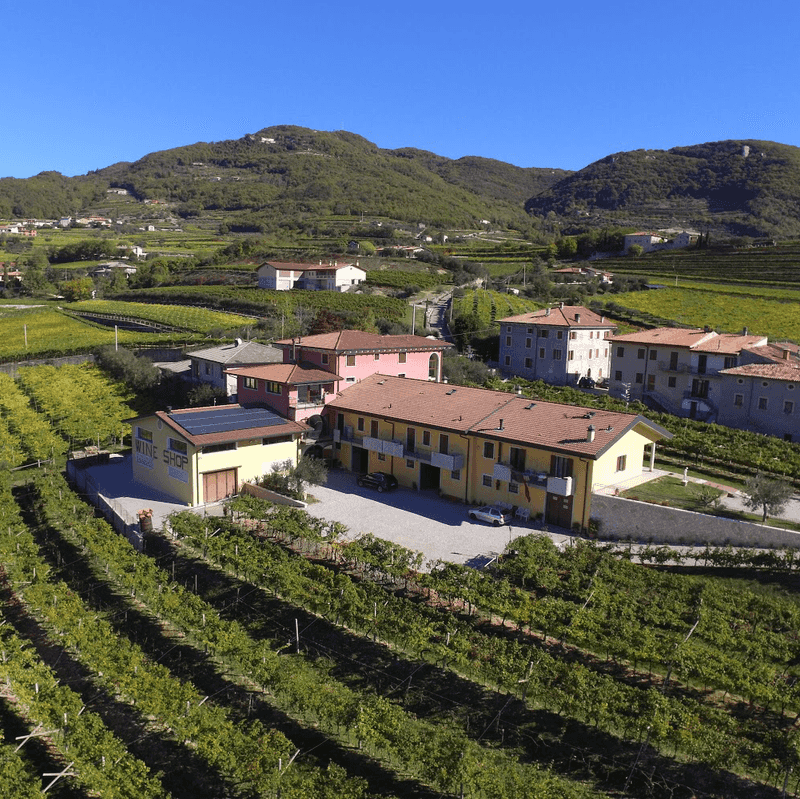
Just a short drive north of Verona, the Valpolicella wine region produces some of the most celebrated red wines in Italy—and tasting them at the source is an experience that food and wine lovers won’t want to skip. The rolling hills here are blanketed in vineyards that have been producing wine since Roman times, and the landscape alone is worth the trip.
Amarone della Valpolicella is the region’s crown jewel: a rich, full-bodied red wine made from partially dried grapes, giving it an intense depth of flavor that’s unlike almost anything else in the wine world. Ripasso and the lighter Valpolicella Classico are also excellent and more approachable for casual wine drinkers.
Most wineries in the region offer guided tastings with local snacks, often including cheese, salumi, and fresh bread.
Several tour operators in Verona run half-day and full-day wine tours to the region, which is a convenient option if you prefer not to drive. Alternatively, renting a bike and cycling through the vineyard-covered hills is a genuinely idyllic way to explore at your own pace.
The towns of Fumane and San Pietro in Cariano are good bases for winery visits. Booking ahead is recommended, especially during harvest season in September and October when the region is particularly lively and atmospheric.
Experience the Evening Passeggiata
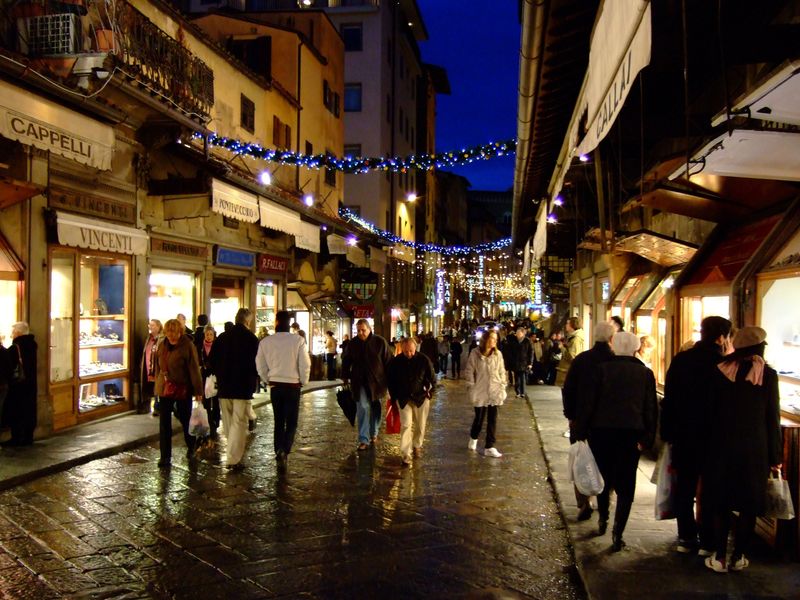
Every evening across Italy, something wonderful happens without any announcement or planning—people simply take to the streets. The passeggiata is a centuries-old tradition of the evening stroll, and in Verona, it reaches a particularly theatrical peak.
As the sun drops and the air cools, the piazzas fill with locals dressed smartly, moving slowly, and making the act of walking look like an art form.
Piazza Bra and the surrounding streets are the heart of Verona’s passeggiata scene. Between about 6pm and 8pm, the atmosphere shifts noticeably from tourist bustle to something more relaxed and authentically Italian.
Families push strollers, elderly couples walk arm in arm, teenagers gather on steps, and everyone seems to be enjoying an Aperol Spritz or a gelato.
The best way to join in is simply to slow down, dress comfortably but neatly, and resist the urge to rush anywhere. Stop for an aperitivo at one of the outdoor bars along the Liston—the long promenade beside the Arena—and let the city’s evening rhythm wash over you.
It costs nothing and requires no planning, yet it consistently ranks among travelers’ most cherished memories of Verona. The passeggiata is a reminder that sometimes the most meaningful travel experiences aren’t sights at all—they’re moments of simply being somewhere wonderful at exactly the right time.
Share this story