 Unearth The Voyage
Germany is famous for its bustling cities, but its real magic often hides in small towns and villages tucked between rivers, forests, and rolling hills. From fairy-tale medieval streets to lakeside promenades and vineyard-backed valleys, these places offer a slower, richer kind of travel.
Whether you are planning a road trip or looking for a weekend escape, these charming spots will surprise you at every turn. Pack your walking shoes and get ready to fall in love with a side of Germany most tourists never see.
Rothenburg ob der Tauber — Bavaria’s Storybook Gem
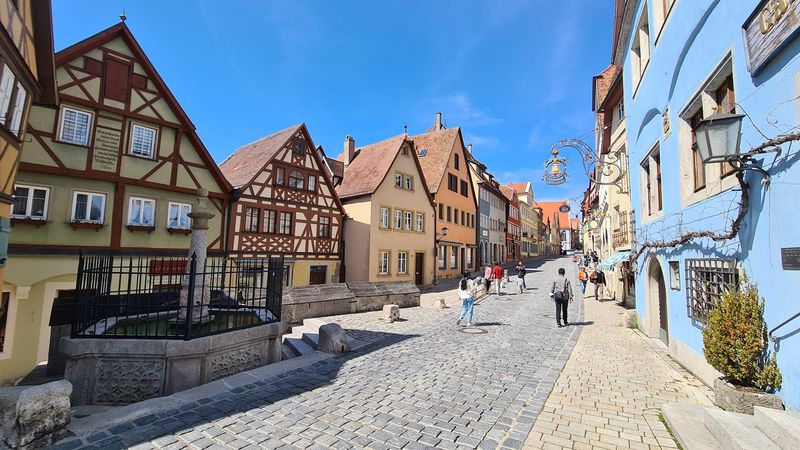
Stepping through Rothenburg ob der Tauber’s ancient gate feels less like arriving and more like tumbling into a storybook. The medieval walls here are not just decorations — they are fully walkable, offering sweeping views over red-tiled rooftops and flower-draped balconies.
Few towns in Europe have preserved their old-world layout this completely.
The Plonlein, a tiny fork in the road framed by half-timbered houses, is one of Germany’s most photographed corners. During the Christmas season, the market here transforms the already-magical streets into something almost unreal.
Mulled wine, handmade ornaments, and candlelight make it unforgettable.
Rothenburg is also home to the German Christmas Museum and the Medieval Crime Museum, two quirky attractions that keep history entertaining. The town’s bakeries sell Schneeballen, a local pastry shaped like a snowball, which you absolutely must try.
Arrive early in the morning to enjoy the cobblestone lanes before the crowds fill them up. This town rewards slow walkers and curious wanderers most generously.
Cochem — Moselle Wine Town with Castle Views
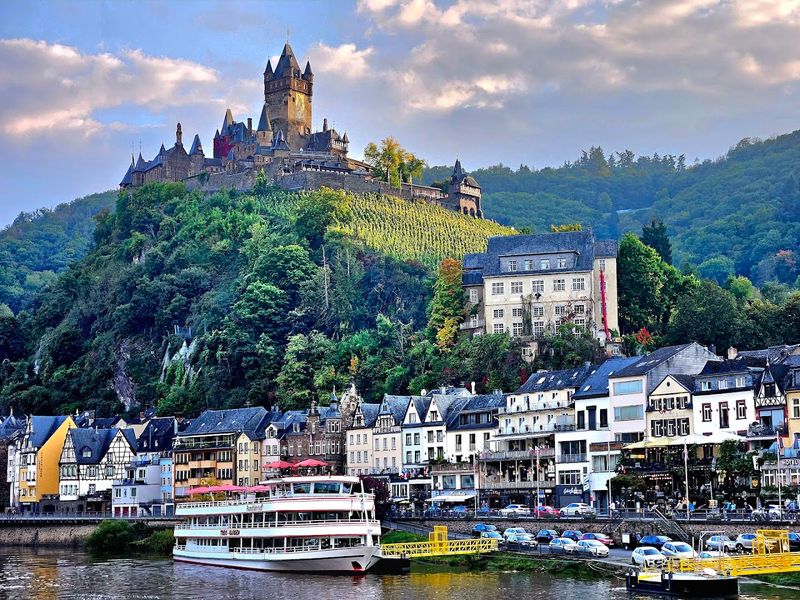
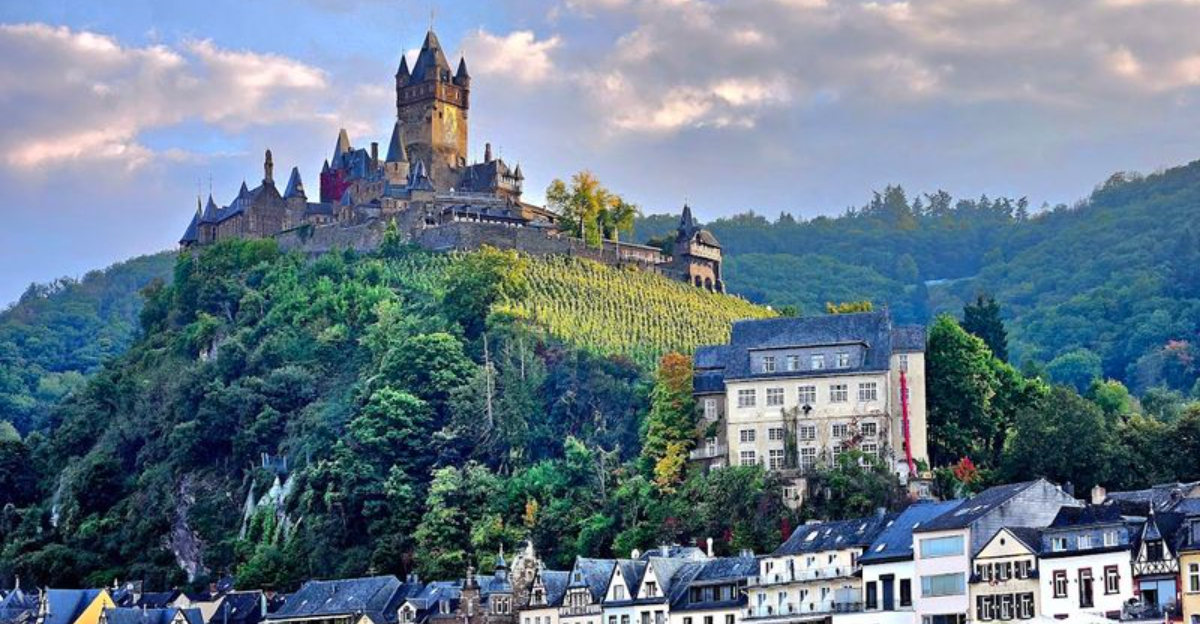
Reichsburg Cochem looms over the town like a proud guardian, its towers visible from almost every corner of this riverside gem. Built in the 11th century and dramatically restored in the 1800s, the castle is worth the uphill climb for its panoramic views alone.
Below, the Moselle River curves gently past colorful buildings and busy wine taverns.
Cochem is serious about its Riesling. The steep vineyard slopes surrounding the town produce some of the Moselle Valley’s finest whites, and local wine bars are happy to walk you through a tasting.
Pair a glass with a slice of Zwiebelkuchen, a savory onion tart, and you have got yourself a proper afternoon.
The riverside promenade is perfect for a leisurely stroll, especially as the sun sets and the castle lights up against the evening sky. Boat trips along the Moselle offer a completely different perspective of the valley’s beauty.
Cochem is small enough to explore in a day but charming enough to make you want to stay longer. It hits a sweet spot between scenic and genuinely relaxing.
Meersburg — Lakeside Beauty on Lake Constance
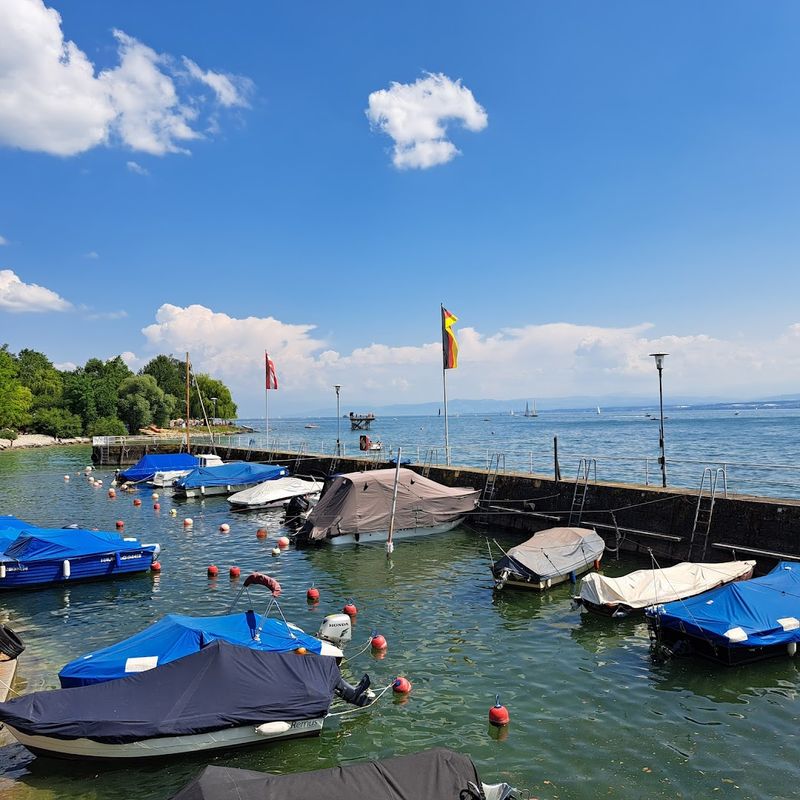
Meersburg has a trick up its sleeve: it holds the oldest inhabited castle in Germany, dating back to the 7th century, and it sits right in the middle of town like it owns the place. The Altes Schloss is not a ruin or a museum shell — people actually live there.
That detail alone makes Meersburg feel fascinatingly alive.
The terraced streets tumbling down toward Lake Constance are lined with wine shops, bakeries, and flower boxes bursting with color. From the lower promenade, the views across the lake toward the Swiss Alps on a clear day are genuinely breathtaking.
It is the kind of scenery that makes you stop mid-bite of your pretzel just to stare.
Meersburg produces its own wine from surrounding vineyards, and local restaurants take pride in pairing regional dishes with estate-grown bottles. The ferry connecting Meersburg to Konstanz runs frequently and makes for a fun short crossing.
Summer brings energy and open-air events, but spring and autumn offer quieter visits with softer light and fewer crowds. Every season here has something worth seeing.
Quedlinburg — UNESCO Medieval Treasure
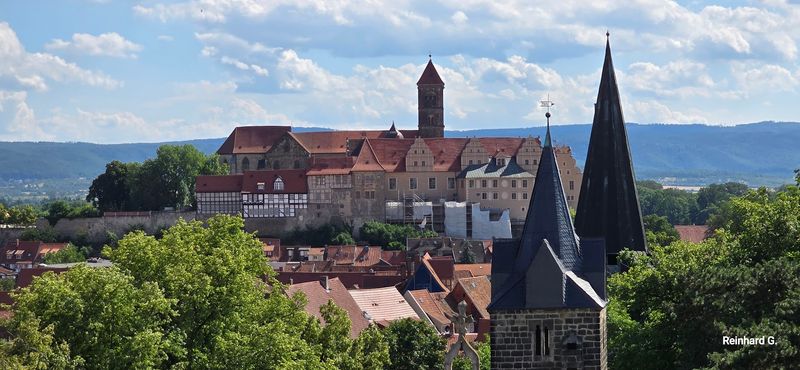
Over 1,300 timber-framed buildings packed into one small town — Quedlinburg does not mess around when it comes to architectural density. Recognized as a UNESCO World Heritage Site, this Saxony-Anhalt gem has preserved centuries of history so well that walking its lanes genuinely feels like flipping through a living history book.
The sheer variety of building styles, from Gothic to Baroque, is staggering.
Crowning the town is the Collegiate Church of St. Servatius, a Romanesque masterpiece sitting atop a sandstone hill. Below it, the Schlossberg area offers one of the best views over the sea of crooked rooftops and winding streets.
Historians, photographers, and architecture lovers all leave here slightly obsessed.
Quedlinburg also has a surprisingly vibrant café culture. Small coffee shops and regional restaurants fill the old market square, making it easy to take a break and watch the world drift by at a medieval pace.
The town is popular with German domestic tourists but remains refreshingly under the radar for international visitors. That means fewer crowds, more genuine interactions, and a much more relaxed experience overall.
Quedlinburg is quietly one of Germany’s best-kept secrets.
Bad Langensalza — Blossoming Gardens & Medieval Flair
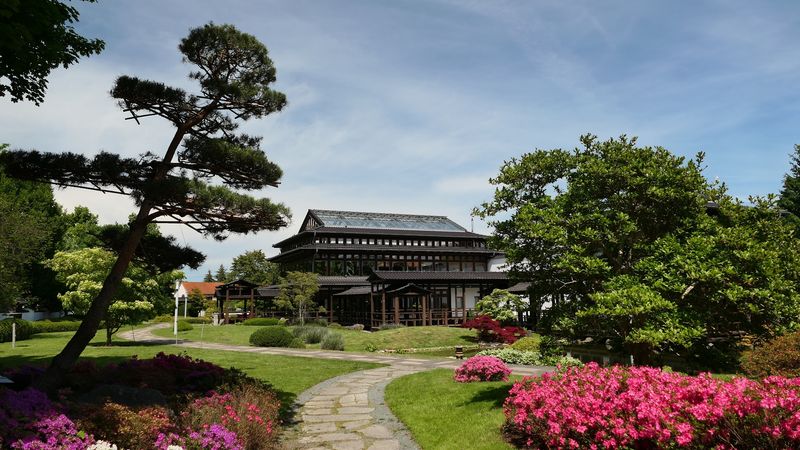
Bad Langensalza smells different from most German towns — in the best possible way. The town’s famous botanical gardens and rose paths perfume the air in spring and summer, turning a stroll through the historic center into something genuinely sensory.
It has won multiple national awards for its floral design, and the effort shows everywhere you look.
Beyond the blooms, Bad Langensalza has real medieval credentials. Ancient city walls, fortified towers, and half-timbered lanes tell stories stretching back to the 10th century.
The historic old town is compact and very walkable, making it easy to cover the highlights in a single afternoon without feeling rushed.
The town also carries a strong spa tradition, with mineral-rich springs that have drawn health-seekers for centuries. Local wellness facilities offer modern treatments rooted in this long therapeutic history.
Seasonal festivals celebrate everything from roses to regional food, giving each visit a different character depending on when you arrive. Bad Langensalza is the kind of place that rewards visitors who slow down and notice the small details — a carved doorway here, a blooming courtyard there.
It is unhurried and genuinely lovely.
Harburg — Castle Town on the Romantic Road
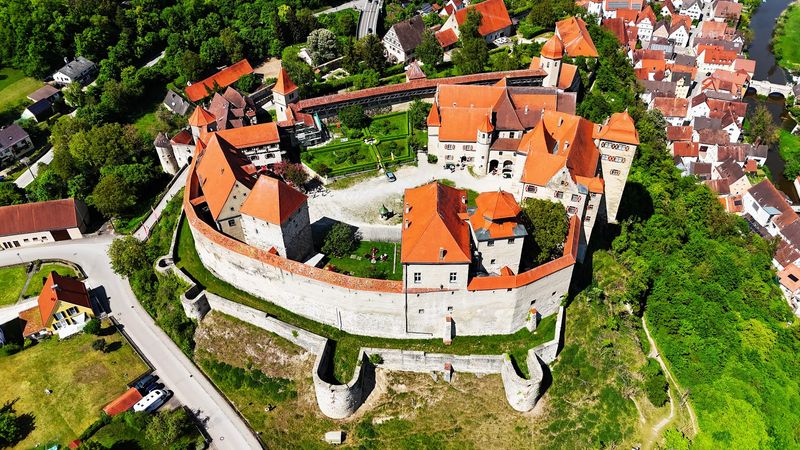
Harburg’s castle does not just overlook the town — it absolutely dominates it, sitting high on a rocky outcrop above the Wörnitz River like something straight out of a medieval manuscript. Burg Harburg is one of the best-preserved castles in southern Germany, and unlike many fortresses, it still contains original furnishings, tapestries, and weapons.
A guided tour here is genuinely absorbing.
The town below is small and quiet, which is precisely its charm. Harburg sits along the famous Romantic Road, Germany’s most celebrated scenic driving route, yet it attracts a fraction of the crowds that flock to nearby Rothenburg.
That makes it a smart choice for travelers who want authentic atmosphere without the tourist rush.
Half-timbered houses cluster along the narrow main street, and a couple of traditional inns offer hearty Swabian meals after a day of exploring. The surrounding countryside is ideal for short walks along the river or through fields dotted with wildflowers.
Harburg works beautifully as a lunch stop on a longer road trip or as a quiet overnight base. Either way, the castle view at sunset is something you will be talking about for years.
Dötlingen — Classic Lower Saxony Village
Ancient oak trees older than most European nations line the lanes of Dötlingen, a village in Lower Saxony that has turned rural simplicity into something of an art form. Some of these oaks are estimated to be over 1,000 years old, their gnarled trunks wider than most living rooms.
Walking beneath them feels quietly ceremonial.
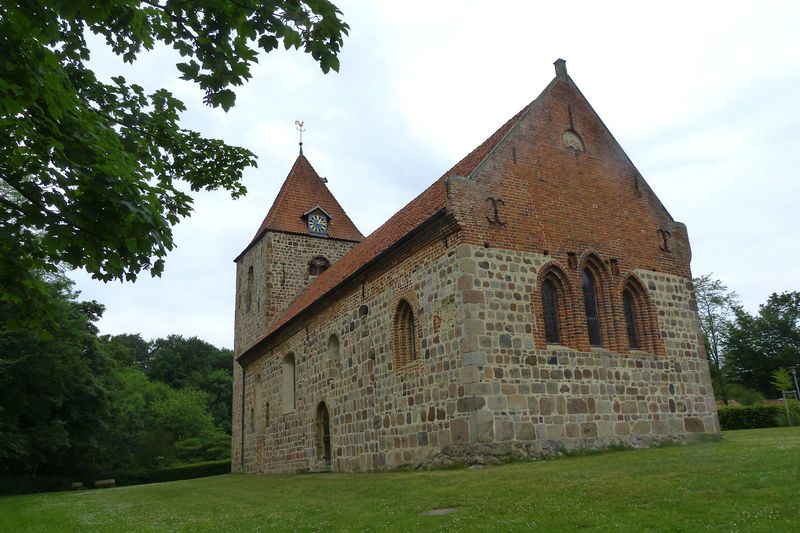
Dötlingen has earned recognition as one of Germany’s most beautiful villages, and it is easy to understand why. Traditional farmhouses with thatched roofs, stone walls draped in moss, and a church dating back to the 13th century create a scene that feels untouched by modern haste.
There are no big attractions here — that is entirely the point.
The surrounding landscape of meadows, ponds, and heath is ideal for cycling and birdwatching. Local walking trails are well-marked and lead through countryside that changes beautifully with each season.
Dötlingen draws visitors who are tired of checking off sights and simply want to breathe. A picnic under one of those ancient oaks, with nothing but birdsong and rustling leaves for company, is the kind of experience that resets the mind completely.
This village is a genuine slow-travel treasure.
Monschau — Eifel Jewel with Fachwerk Houses
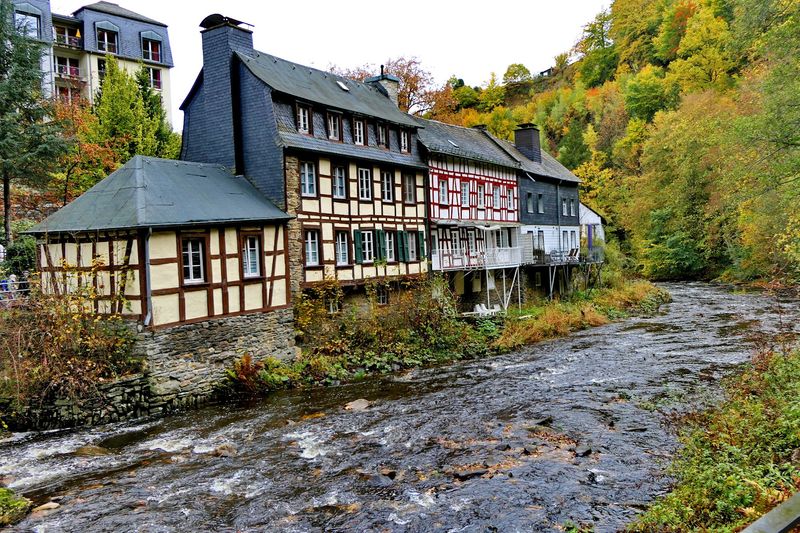
Tucked into a narrow valley in the Eifel hills, Monschau looks like it was designed by someone who wanted to prove that Germany has the world’s most photogenic small towns. The River Rur winds right through the heart of the village, reflecting rows of half-timbered Fachwerk houses that lean over the water in cheerful, slightly crooked rows.
Every turn here produces a postcard moment.
The Red House, an 18th-century merchant’s mansion open to visitors, gives a fascinating glimpse into the life of a prosperous cloth-trading family. Monschau was once a major center for fine cloth production, and this heritage explains the surprisingly grand architecture for such a small place.
History nerds will have a field day.
Monschau’s Christmas market is widely considered one of the most atmospheric in all of Germany, drawing visitors from neighboring Belgium and the Netherlands. Even outside the festive season, the town’s café scene and local mustard shop — yes, there is a famous mustard shop — keep things interesting.
The surrounding Eifel National Park offers excellent hiking on the town’s doorstep. Monschau manages to be charming, lively, and wonderfully compact all at once.
Rüdesheim am Rhein — Rhine Valley Wine Culture
Drosselgasse is possibly the most festive 144 meters in Germany. This narrow alley in Rüdesheim am Rhein packs in wine taverns, live music, and cheerful tourists shoulder to shoulder, creating an atmosphere that feels like a permanent street party.
It is lively, loud, and completely irresistible.
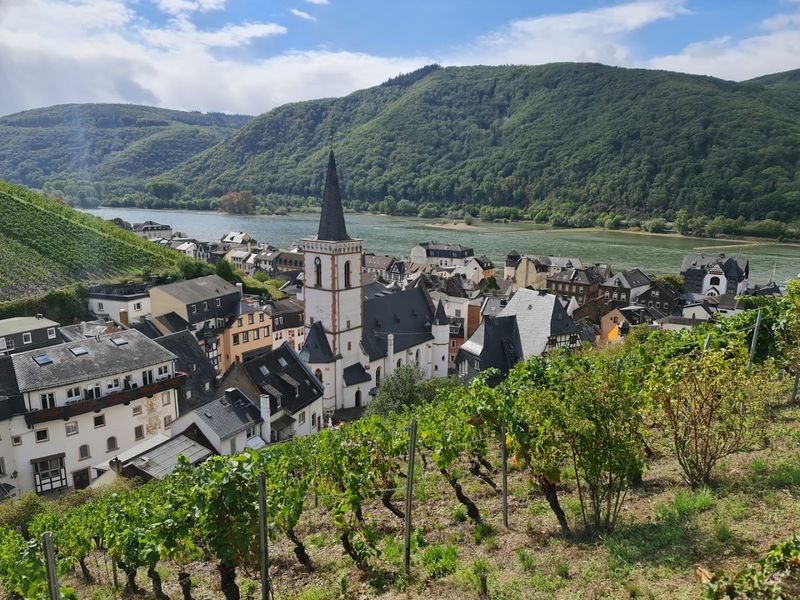
Beyond the famous alley, Rüdesheim rewards those willing to explore further. A gondola ride up to the Niederwald Monument delivers sweeping views over the Rhine Valley, with vine-covered slopes stretching in every direction.
The monument itself, commemorating German unification in 1871, is impressively dramatic against the sky.
Rüdesheim sits in the UNESCO-listed Upper Middle Rhine Valley, a stretch of river flanked by medieval castles, steep vineyards, and picturesque villages. River cruises departing from the town let you see the valley from the water, which is arguably the best angle of all.
Local wineries produce excellent Rieslings that pair perfectly with regional dishes like Sauerbraten. The town is especially lively during the Rhine in Flames festival, when fireworks illuminate the river and surrounding castles.
Rüdesheim is unapologetically touristy in places, but it backs up the hype with genuine beauty and great wine.
Bad Kötzting — Bavarian Forest Gateway
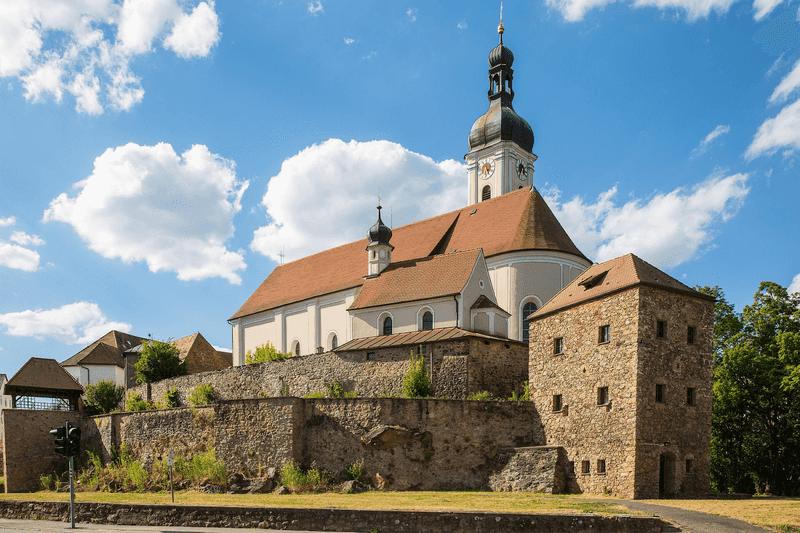
Bad Kötzting sits at the edge of the Bavarian Forest like a welcoming base camp, its colorful painted facades and church spires rising against a dense green backdrop of ancient woodland. It is the kind of town where locals still gather at the market square for weekly markets, and where the pace of life feels genuinely unhurried.
The town is famous for its Pfingstritt, one of Europe’s oldest and largest Christian horse processions, held every Whit Monday. Hundreds of riders in traditional costume make their way through the forest in a tradition dating back over 500 years.
Witnessing it even once is enough to understand why locals guard this custom so fiercely.
The Bavarian Forest National Park is practically on the doorstep, offering trails through old-growth woodland, wildlife viewing areas, and treetop walkways. Bad Kötzting itself has a pleasant spa quarter with thermal facilities that are especially welcome after a long hiking day.
The Czech border is just a short drive away, adding a cross-cultural dimension to any visit. Regional restaurants serve hearty Bavarian classics — roast pork, dumplings, and local beer — with the kind of generous portions that fuel serious forest explorers.
Bad Kötzting is wonderfully unpretentious.
Lindau — Island Town on Lake Constance
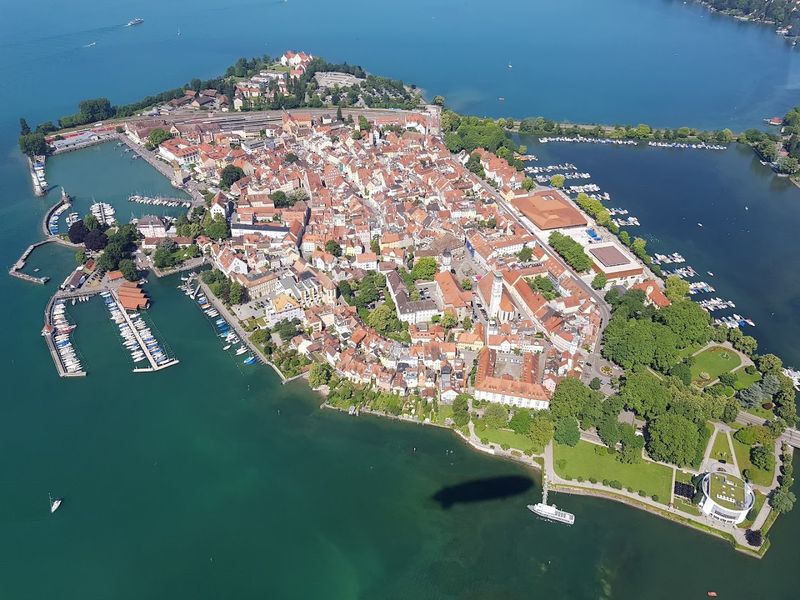
Lindau pulls off something remarkable: it is technically a town of considerable size, yet its island old town feels as intimate and village-like as anywhere in Germany. Connected to the mainland by a causeway and rail bridge, the island is compact enough to walk across in twenty minutes, yet packed with enough character for a full day of discovery.
The harbour entrance, guarded by a stone Bavarian lion and a lighthouse, is one of the most photographed spots in southern Germany. On clear days, the Austrian and Swiss Alps rise dramatically behind the shimmering lake, framing the scene with the kind of backdrop that makes photographers quietly emotional.
Even smartphone cameras do it justice.
The old town’s pedestrian lanes are lined with beautifully painted merchant houses, cozy wine bars, and ice cream shops that are hard to walk past without stopping. The island hosts a vibrant summer market and various open-air events that spill across the promenade.
Lake Constance ferry connections make it easy to combine Lindau with visits to Meersburg, Konstanz, and even Bregenz in Austria. Lindau is an island that punches well above its modest size in charm, scenery, and sheer visual appeal.
Füssen — Alpine Village at Neuschwanstein’s Doorstep
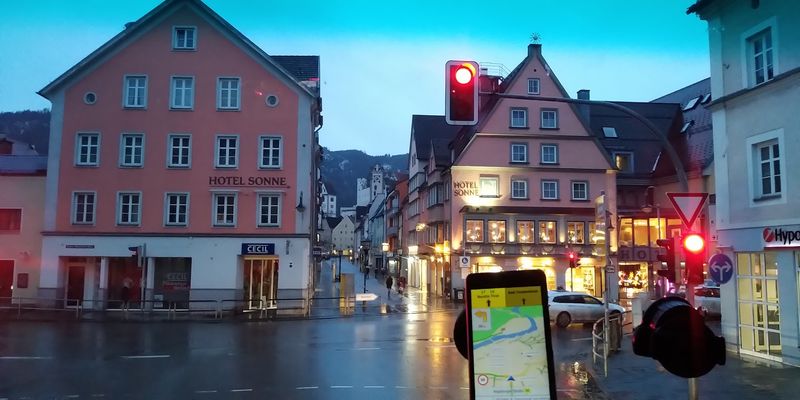
Füssen sits at the dramatic southern end of the Romantic Road, where the flat Bavarian plains suddenly give way to jagged Alpine peaks. The town’s pastel-painted buildings and cobblestone old town are lovely in their own right, but let us be honest — everyone is also there for Neuschwanstein Castle, perched on a rocky ridge just a few kilometers away.
And that is perfectly fine, because Füssen handles the combination beautifully.
The Hohes Schloss, a late Gothic palace rising above the town center, is often overshadowed by its famous neighbor but deserves its own appreciation. Its trompe-l’oeil painted facades and interior art collection are genuinely impressive and far less crowded than the main castle sites.
Art lovers should not skip it.
The Lech River, which flows right through Füssen, offers scenic cycling paths and calm spots for sitting by the water. The Forggen and Bannwald lakes nearby are stunning in summer, with turquoise waters reflecting surrounding peaks.
Local restaurants serve Allgäu specialties including Käsespätzle, a gloriously cheesy noodle dish that is pure comfort food. Füssen rewards visitors who stay at least one night, allowing time to explore beyond the castle rush and discover the town’s own quiet magic.
Bad Tölz — Historic Bavarian Market Town
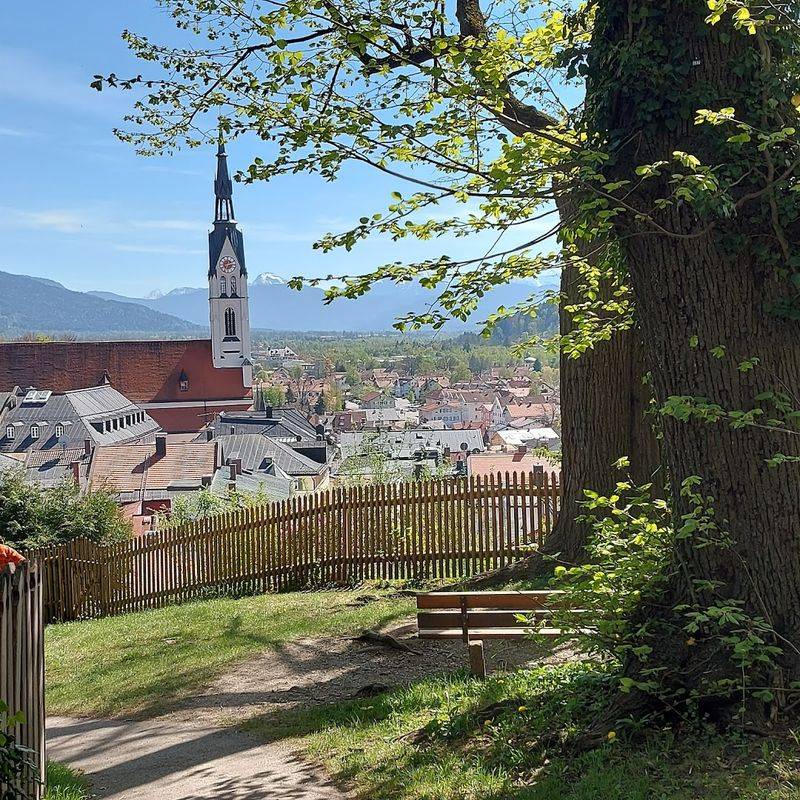
Bad Tölz’s main street, Marktstraße, is one of the most visually striking in all of Bavaria. Buildings decorated with elaborate Lüftlmalerei — a traditional Bavarian style of exterior fresco painting — line both sides of the broad pedestrian street, their colorful facades depicting religious scenes, hunting motifs, and floral patterns.
It is an open-air gallery that happens to also have excellent coffee shops.
The town straddles the Isar River, and the contrast between the lively market street and the quiet green riverbanks is one of Bad Tölz’s great pleasures. A short walk from the center brings you to the Kalvarienberg hill, topped by a pilgrimage church offering views over the rooftops and toward the Alps.
The climb is easy and the reward is generous.
Bad Tölz is also a recognized spa town, with iodine-rich mineral springs that have attracted health visitors since the 19th century. The Alpamare water park and various wellness facilities give it a modern leisure dimension alongside its historic character.
The town’s Leonhardifahrt, a horse-drawn procession held in early November, is a deeply traditional event that locals take seriously. Bad Tölz balances Bavarian authenticity with genuine visitor comfort in a way that feels effortless.
Bernkastel-Kues — Moselle Wine Village
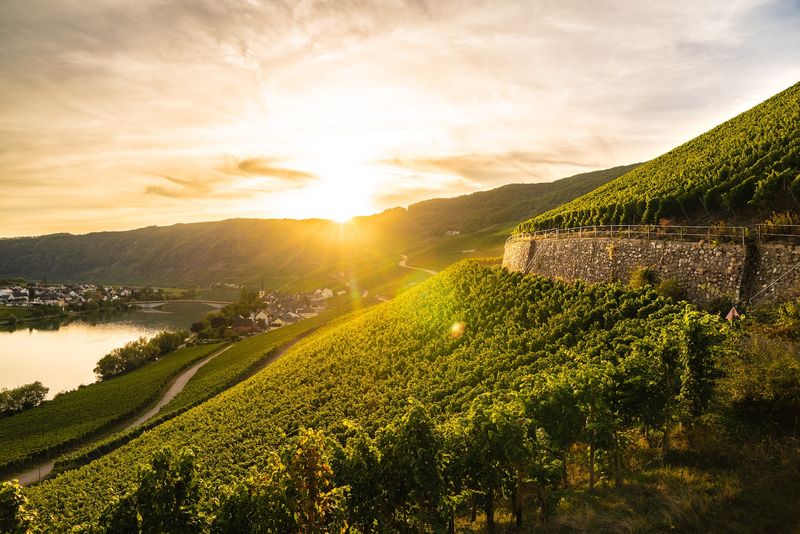
Few wine villages in Germany can compete with Bernkastel-Kues for sheer visual drama. Steep slate vineyard slopes plunge down to the Moselle River, where half-timbered houses cluster so tightly around the market square that the upper floors practically touch each other across the narrow lanes.
The whole scene looks slightly too perfect to be real.
The market square itself is one of the finest in the Rhineland, anchored by a 17th-century Renaissance fountain and surrounded by elaborately carved timber-frame buildings. Sitting at an outdoor café here with a glass of local Riesling while watching the afternoon light shift across the rooftops is an experience worth traveling a long way for.
Bernkastel-Kues takes its wine very seriously.
Across the river in Kues, the St. Nicholas Hospital founded in 1458 still functions as a charitable institution and wine estate — one of the oldest in Germany. The hospital’s wine cellar is open for tastings, and the proceeds support its residents.
The Great Moselle Wine Festival held here in September draws enthusiasts from across Europe. Boat trips along the river reveal the full sweep of the valley’s beauty.
Bernkastel-Kues is romantic, historic, and deliciously well-supplied with excellent Riesling.
Weimar — Culture-Rich Small City
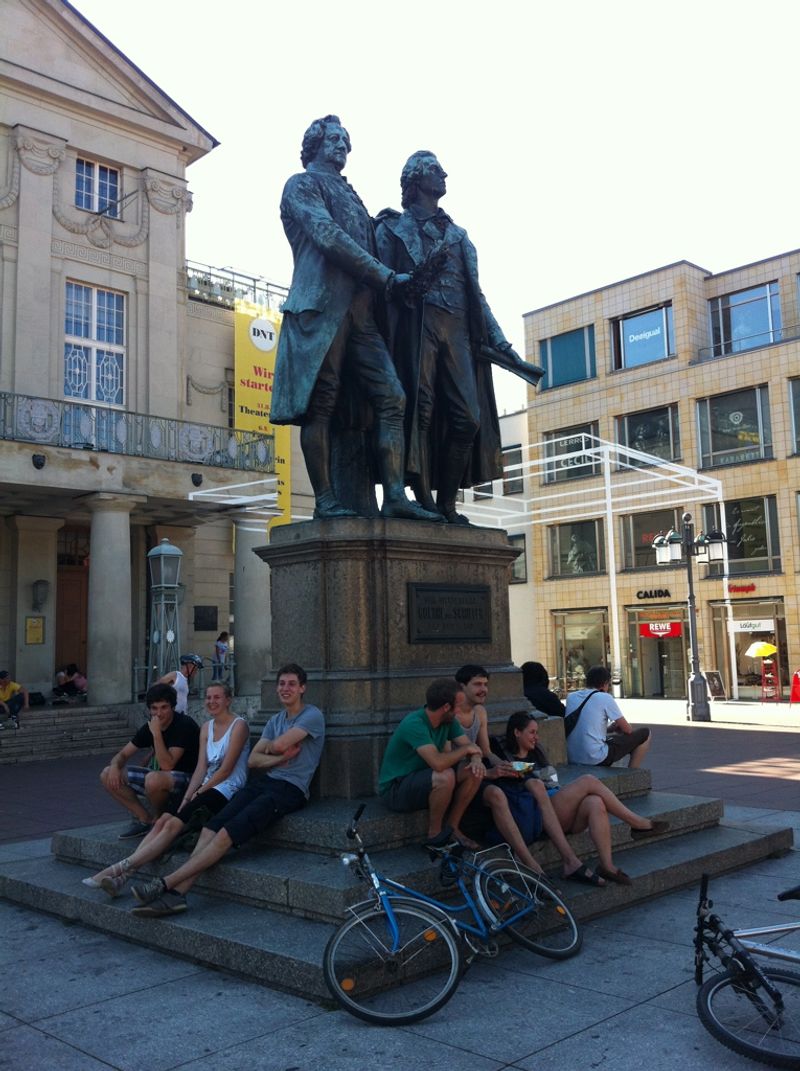
Weimar carries an extraordinary amount of cultural weight for a city of just 65,000 people. Goethe lived here for over fifty years.
Schiller was a neighbor. Liszt directed music here.
The Bauhaus design movement was born here in 1919. Nietzsche spent his final years in the city.
For a compact historic town, Weimar’s contribution to human culture is almost absurdly outsized.
The old town is elegant and walkable, with classical buildings lining broad avenues and intimate parks connecting key sites. Goethe’s house on Frauenplan is preserved almost exactly as he left it, complete with his color wheel experiments and personal library.
The Bauhaus Museum, opened in 2019, is a sleek modern counterpoint to all the classical architecture and a fascinating exploration of design history.
Weimar’s Park an der Ilm, a beautiful English-style landscape garden running along the Ilm River, is perfect for a long afternoon wander. The town’s café scene is sophisticated, with several independent places serving excellent coffee and regional pastries.
Despite all its cultural gravitas, Weimar feels relaxed and unpretentious rather than museum-stiff. Visitors often arrive expecting a history lesson and leave having genuinely fallen for the place.
It is a city that wears its brilliance lightly.
Tübingen — Fairytale Neckar Town
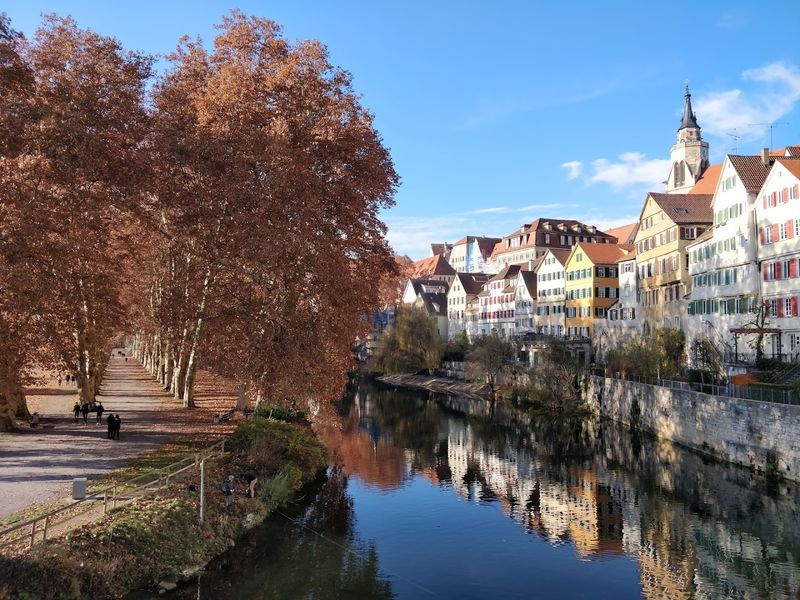
Punt a flat-bottomed boat along the Neckar River in Tübingen and the view that unfolds is one of the most charming in all of southwest Germany. Colorful half-timbered facades rise from the riverbank in a jumbled, joyful row, their reflections shimmering in the slow-moving water below.
The university town’s energy adds a youthful spark that keeps the old town feeling alive rather than preserved.
Tübingen’s Marktplatz is anchored by a 15th-century town hall with an ornate astronomical clock, and the square fills with a lively market several times a week. The lanes climbing up toward Hohentübingen Castle are steep but rewarding, with the castle terrace offering a sweeping panorama over red rooftops and the river below.
The university, founded in 1477, is deeply woven into the town’s daily fabric. Students fill the cafés, bookshops, and riverside bars, creating a buzz that other similarly sized towns simply cannot replicate.
Famous alumni include Hegel, Schelling, and Kepler, giving Tübingen an intellectual pedigree to match its good looks. The town’s independent shops, excellent regional restaurants, and scenic cycling paths along the Neckar make it a destination that offers far more than just a pretty face.
Tübingen consistently exceeds expectations.
Bad Wildbad — Spa Town in Black Forest
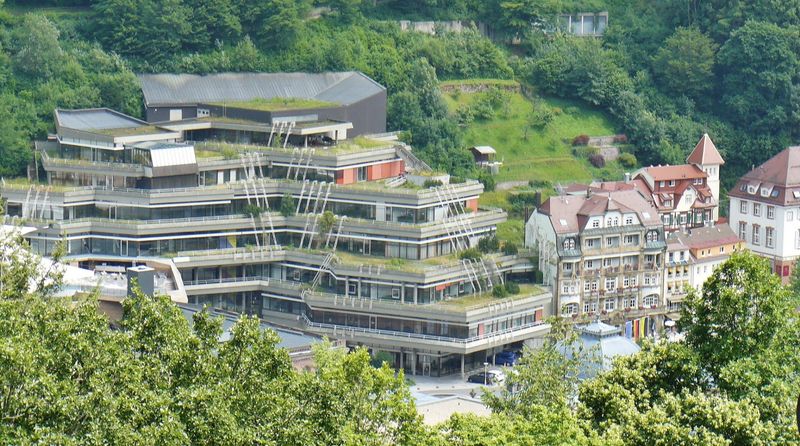
Kings and kaisers once came to Bad Wildbad for its thermal waters, and the town has been perfecting the art of relaxation for well over 600 years. Nestled in the narrow Enz Valley deep in the Black Forest, the town is surrounded by dense woodland on all sides, creating a natural cocoon that feels genuinely restorative the moment you arrive.
The Palais Thermal is the architectural heart of the spa experience, a grand 19th-century building housing indoor thermal pools, saunas, and treatment rooms. Just outside town, the Sommerberg plateau is reached by a historic funicular railway and offers miles of forest trails, a treetop walkway, and a toboggan run that children and adults both enjoy without any shame.
Bad Wildbad’s town center has a pleasantly old-fashioned character, with colonnaded walkways, a historic pump room, and gentle riverside paths along the Enz. The Black Forest Panorama Road, one of Germany’s most scenic drives, passes nearby and makes a superb day trip route.
Regional cuisine here leans into Black Forest classics — venison, trout, Schwarzwälder Kirschtorte — all done with local pride. Bad Wildbad is the kind of place where slowing down feels not just allowed but actively encouraged.
It is unapologetically good for the soul.
Monschau-Höfen — Mountain Village
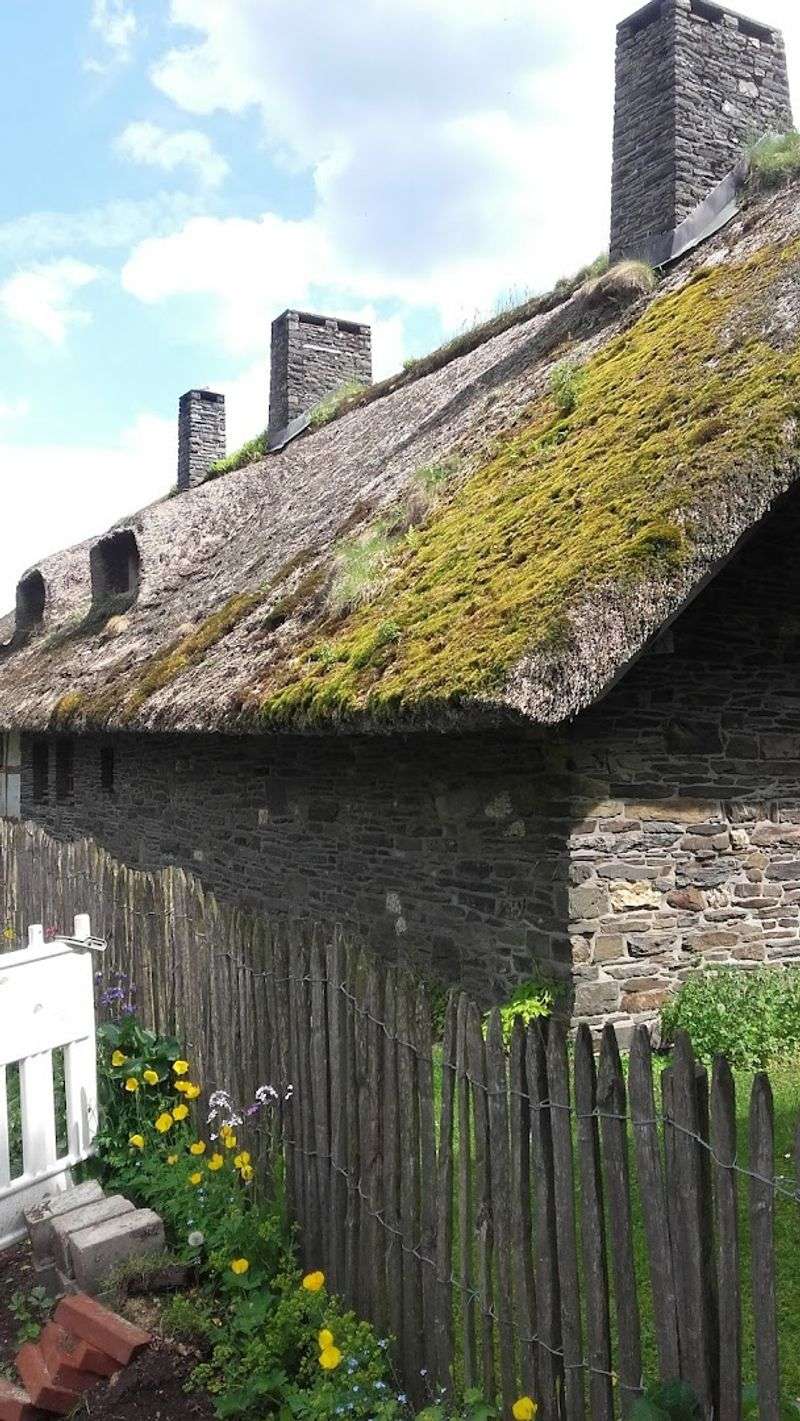
Most visitors to the Monschau area never make it up to Höfen, which is precisely what makes this tiny hilltop village such a satisfying discovery. Perched on the slopes above the main town, Höfen offers a quieter, greener perspective on Eifel life, with meadow views, forest trails, and the kind of deep rural silence that is increasingly hard to find in Western Europe.
The village itself is small enough to walk through in minutes, but the surrounding landscape invites hours of exploration. Hiking paths fan out in every direction through the Eifel National Park, passing moorland, ancient beech forests, and small streams.
In autumn, the colors are spectacular, and the forest light has a golden quality that photographers chase from across the region.
Höfen works brilliantly as a base for exploring both the Monschau area and the wider Eifel National Park without staying in the more tourist-heavy center below. A handful of guesthouses and farm stays offer accommodation with genuinely local character.
Mornings here begin with birdsong and mist rolling across the fields — a striking contrast to the wine-tavern energy of the town below. Höfen is for travelers who want the Eifel experience at its most raw and unhurried.
It delivers that completely.
Bad Mergentheim — Spa & History Along the Tauber
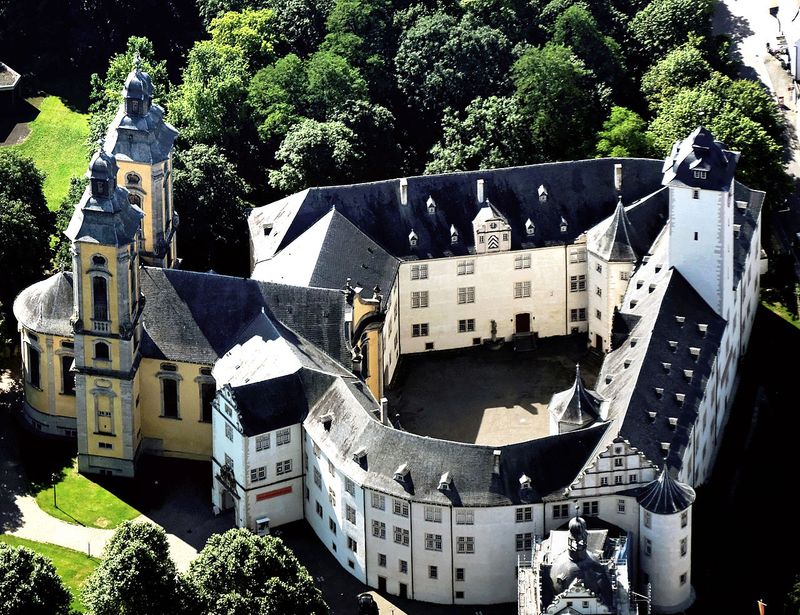
Bad Mergentheim has a secret that most road-trippers on the Romantic Road drive straight past: it was once the headquarters of the Teutonic Knights, one of the most powerful military orders of the medieval world. Their magnificent Renaissance castle, Deutschordensschloss, still stands in the town center and houses a fascinating museum.
The history here is surprisingly gripping.
The town sits prettily in the Tauber Valley, with a compact old town of half-timbered buildings, a handsome market square, and spa gardens that have been drawing health visitors since mineral springs were discovered here in 1826. The Solymar thermal spa is the modern centerpiece of this wellness tradition, offering pools and saunas in a relaxed setting.
Cycling along the Tauber Valley cycle path, which passes through Bad Mergentheim, is one of the region’s great pleasures. The route connects a string of charming villages and vineyards in both directions, making a two-wheel exploration deeply rewarding.
Local restaurants serve Franconian specialties alongside the town’s own mineral water, bottled and sold throughout the region. Bad Mergentheim is the kind of historic spa town that earns its reputation honestly, through genuine heritage, pleasant surroundings, and a pace of life that feels like a long exhale.
It is quietly wonderful.
Ladenburg — Historic Rhine Neckar Town
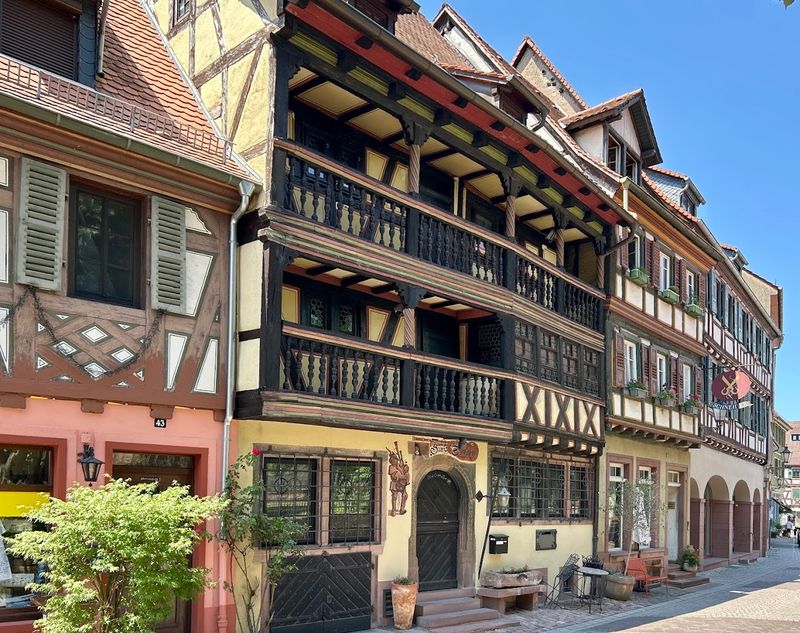
Ladenburg does not shout about its history — it simply lives inside it. Founded as Lopodunum by the Romans in the 1st century AD, the town near Heidelberg is one of the oldest continuously settled urban centers in Germany, and traces of that extraordinary timeline are visible throughout the compact old town.
Roman column fragments appear in garden walls. Medieval towers anchor street corners.
It is history layered on history.
The Church of St. Gallus, a Romanesque basilica dating back to the 12th century, anchors the town’s skyline and is worth stepping inside for its serene interior. The surrounding streets are lined with well-preserved timber-frame houses from various centuries, giving the town an architectural variety that rewards slow, observant walking.
Ladenburg is small enough that most visitors can cover the highlights on foot in a morning, leaving the afternoon for a riverside walk along the Neckar or a short drive to Heidelberg. The town’s museum, housed in a former bishop’s palace, covers everything from Roman artifacts to local crafts in an engaging and accessible way.
Weekly markets bring the market square to life with regional produce and local traders. Ladenburg is proof that some of Germany’s most compelling history is found not in major cities but in modest, quietly magnificent small towns.



