Highway 101 on the Oregon Coast is basically a nonstop temptation to slam the brakes. One minute you’re cruising, the next you’re staring at sea stacks the size of buildings, secret tide pools, and beaches that feel like they belong in a movie.
If you’ve ever wanted a trip where every stop tops the last one, you’re in the right place. Here are 10 Oregon Coast spots that will make you want to pull over again and again.
1. Haystack Rock (Cannon Beach)
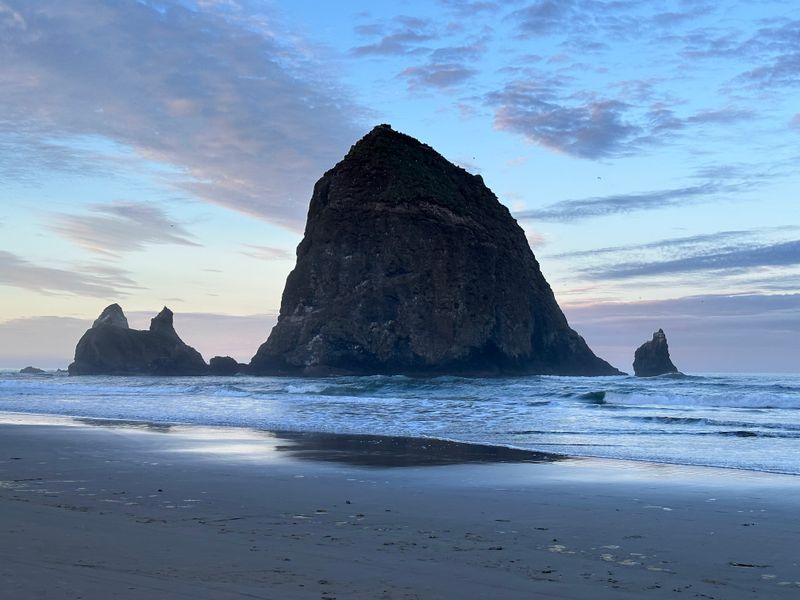
Standing 235 feet tall and visible from miles away, Haystack Rock commands attention from the moment you arrive at Cannon Beach. This massive sea stack isn’t just a photo opportunity—it’s a living ecosystem that transforms with the tides.
When the ocean pulls back, the base becomes an accessible wonderland of marine life.
Timing matters here more than most places. Low tide reveals starfish clinging to rocks, anemones tucked into crevices, and tiny crabs scuttling between pools.
Rangers often set up interpretive programs during summer months, helping visitors spot puffins nesting on the rock’s upper ledges between April and August.
The beach itself stretches wide and flat, perfect for long walks where the sand feels firm underfoot. Sunrise paints the rock in warm oranges and pinks, while sunset creates dramatic silhouettes against the western sky.
Families spread out blankets, dogs chase waves, and photographers claim their favorite angles hours before golden hour hits.
Parking fills quickly on weekends and holidays, so arriving early or late in the day gives you better odds of finding a spot close to beach access points. The walk from town takes about ten minutes if you park further back.
2. Ecola State Park (near Cannon Beach)
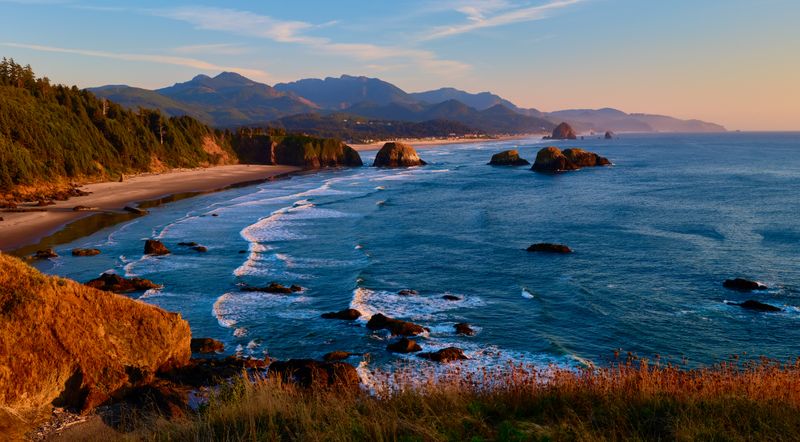
Perched on headlands just north of Cannon Beach, Ecola State Park delivers the kind of coastal views that make you understand why people move to Oregon. The park’s name comes from the Chinook word for whale, and these cliffs have served as prime whale-watching territory for centuries.
Dense Sitka spruce forests frame every viewpoint, creating natural windows to the Pacific.
Two main areas anchor the park: Ecola Point and Indian Beach. Ecola Point offers the quickest scenic payoff—park, walk a few steps, and you’re standing above crashing waves with Tillamook Rock Lighthouse visible offshore.
Indian Beach sits lower, accessible via a winding road that drops through old-growth forest to a cove popular with surfers year-round.
Hikers find serious mileage here too. The Clatsop Loop Trail connects both areas through six miles of coastal forest, while shorter paths like the one-mile trek to Crescent Beach reward minimal effort with maximum views.
Wildlife sightings happen regularly: bald eagles soaring overhead, harbor seals bobbing in kelp beds, and during migration seasons, gray whales passing close to shore.
The park charges a day-use fee, but an Oregon State Parks pass covers entry if you’re planning multiple coastal stops.
3. Oswald West State Park (Short Sand Beach + rainforest trails)
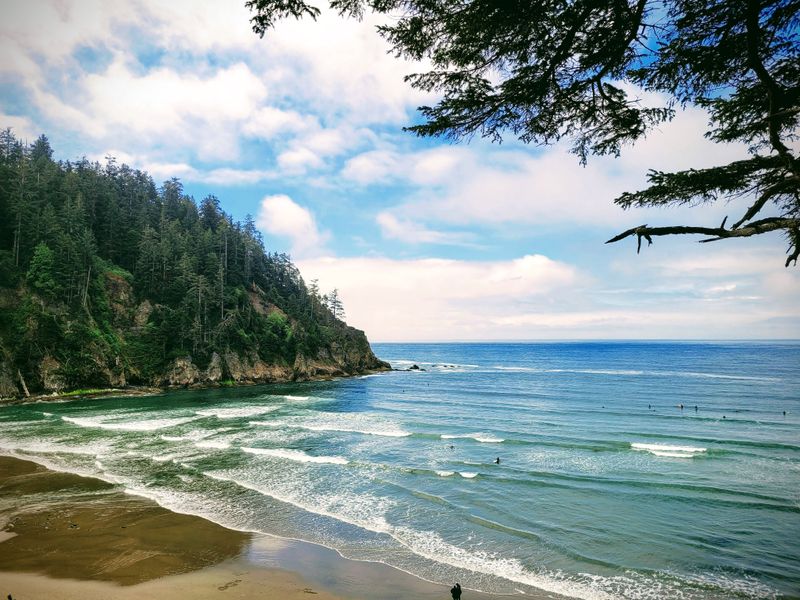
Named after a forward-thinking governor who helped preserve Oregon’s beaches for public access, Oswald West packs remarkable diversity into a relatively compact area. Park in the main lot, and you’re a quarter-mile wheelbarrow-assisted walk from Short Sand Beach—yes, the park provides wheelbarrows for hauling your gear through the forest tunnel that leads to the cove.
Short Sand Beach curves into a protected inlet where surfers paddle out year-round, catching waves that break more gently than the exposed beaches to the north and south. The beach itself stays partially sheltered by headlands, creating a microclimate that feels a few degrees warmer than surrounding areas.
Driftwood logs scattered across the sand provide natural seating for watching the action.
Beyond the beach, trails branch into old-growth Sitka spruce and western hemlock forest draped in moss and ferns. The Cape Falcon Trail climbs gradually for 2.5 miles to a dramatic headland viewpoint, while shorter loops wander through groves that feel primordial.
Listen for the varied thrush’s haunting whistle echoing through the canopy.
Camping is available at walk-in sites tucked into the forest, offering that rare combination of ocean proximity and woodland privacy. Reservations fill quickly for summer weekends, so booking ahead makes sense if you’re planning an overnight stay.
4. Cape Kiwanda State Natural Area (Pacific City)
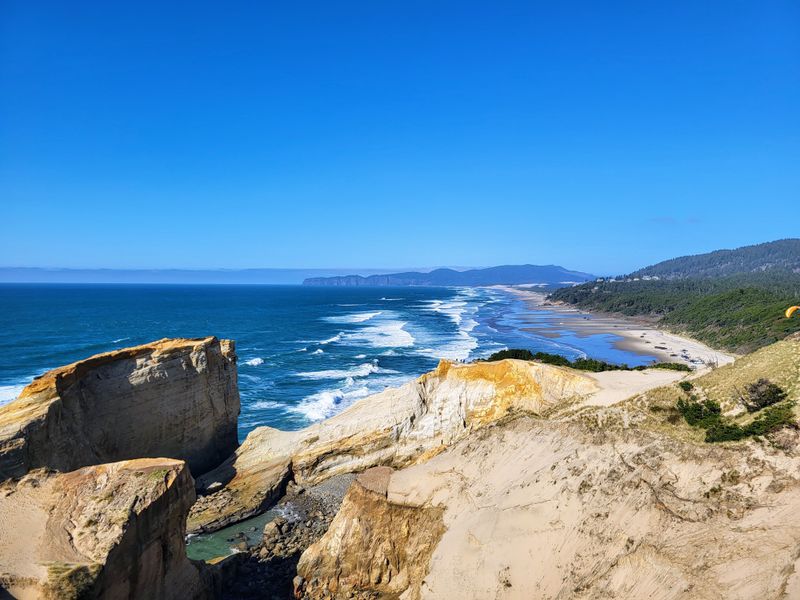
Raw energy defines Cape Kiwanda—this isn’t a place for quiet contemplation so much as active engagement with dramatic coastal forces. The cape’s golden sandstone cliffs glow almost amber in afternoon light, carved by millennia of wave action into caves, arches, and jagged formations.
Just south, a massive sand dune rises steeply from the beach, and climbing it has become a Pacific City tradition.
The dune climb tests your calves but rewards persistence with panoramic views: Haystack Rock offshore, Nestucca Bay curving south, and the Pacific stretching to the horizon. Sandboarders sometimes ride down the steeper faces, though the loose sand makes for slow, bumpy descents.
Morning visits mean cooler temperatures and softer light for photography.
Below the headland, dory fishermen still launch flat-bottomed boats directly into the surf—a practice dating back generations and now mostly performed for tradition and tourism. Watching these boats power through breaking waves, then return by surfing back to shore, never gets old.
Cape Kiwanda anchors the southern point of the Three Capes Scenic Route, a 40-mile alternative to Highway 101 that includes Cape Lookout and Cape Meares. Tide pools appear at low tide around the cape’s base, though the surf stays rougher here than at more protected spots.
5. Depoe Bay (the small harbor, big ocean stop)
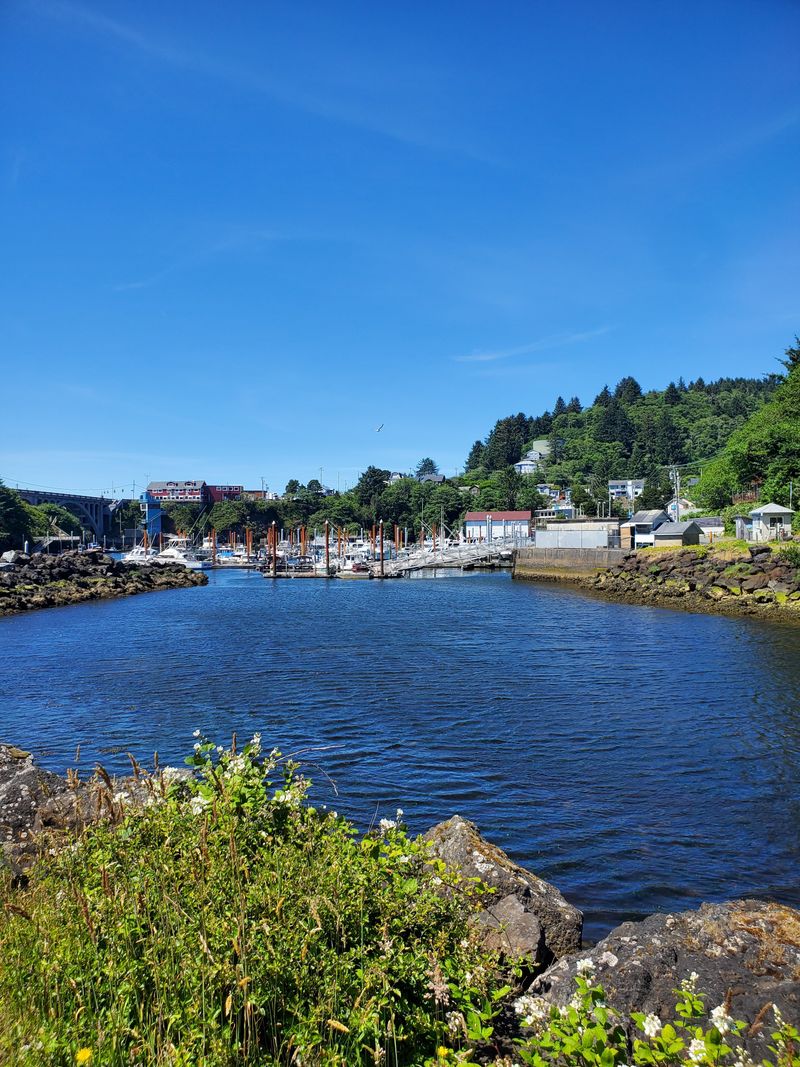
Billing itself as the world’s smallest navigable harbor, Depoe Bay crams considerable personality into a tiny footprint. The harbor entrance measures just 50 feet wide, and watching fishing boats time their exits and entries with incoming swells provides free entertainment from the bridge that spans the channel.
During winter storms, waves slam the seawall with enough force to send spray 30 feet into the air.
The Whale Watching Center sits right on the seawall, staffed by volunteers who help visitors spot gray whales during migration seasons. Spring and winter bring the highest numbers, but resident whales feed in the area year-round, making any visit a potential sighting opportunity.
Binoculars help, though whales sometimes surface close enough to see clearly with the naked eye.
Downtown Depoe Bay stretches along Highway 101 for just a few blocks, packed with galleries, gift shops, and restaurants specializing in fresh seafood. Chowder features prominently on most menus, and harbor views come standard at waterfront establishments.
Charter fishing and whale-watching tours depart from the harbor when weather permits.
The town makes an ideal quick stop—park, walk the seawall, grab lunch, maybe spot a whale, and you’re back on the road within an hour. Or linger longer if the ocean puts on a show, which happens often enough to keep things interesting.
6. Yaquina Head Outstanding Natural Area (Newport)
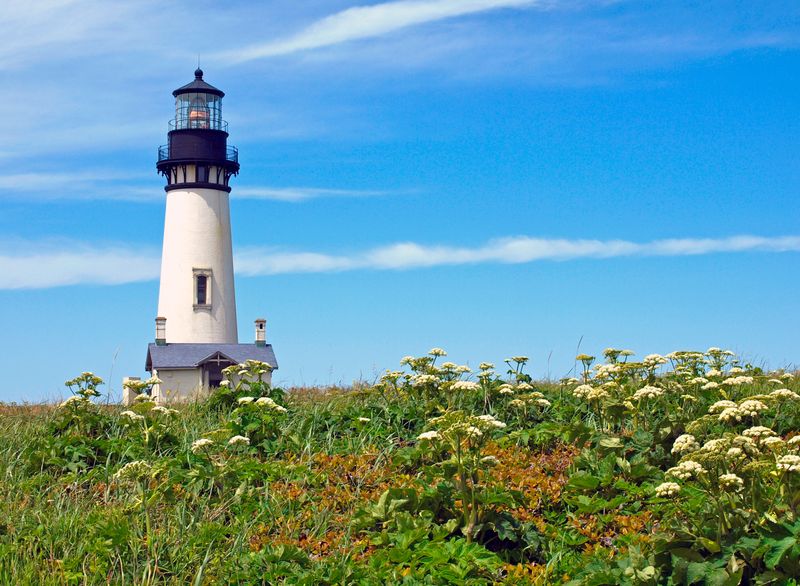
Managed by the Bureau of Land Management, Yaquina Head concentrates multiple coastal experiences into one well-organized stop. The 93-foot lighthouse, still operational since 1873, stands as Oregon’s tallest and offers tours that climb the spiral staircase to panoramic views.
Black-and-white stripes make it instantly recognizable from Highway 101.
Tide pools here rank among the coast’s best for accessibility and diversity. Cobble Beach spreads below the interpretive center, its rocks harboring purple sea urchins, ochre sea stars, and giant green anemones.
Rangers lead guided tide pool walks during summer low tides, pointing out creatures that blend into the rocky landscape. Rubber boots or shoes you don’t mind getting wet make exploring more comfortable.
Seabirds nest on offshore rocks and the headland’s cliffs in staggering numbers. Common murres pack together so tightly they appear as a single dark mass, while cormorants spread wings to dry on exposed perches.
Pigeon guillemots nest in cliff crevices, their bright red feet visible during flight.
The interpretive center provides context with exhibits on geology, marine ecosystems, and lighthouse history. A small fee covers entry, and the facilities include restrooms, parking, and paved paths to most viewpoints.
Wheelchair accessibility here exceeds most coastal stops, with ramps leading to prime viewing areas.
7. Cape Perpetua Scenic Area (Yachats area)
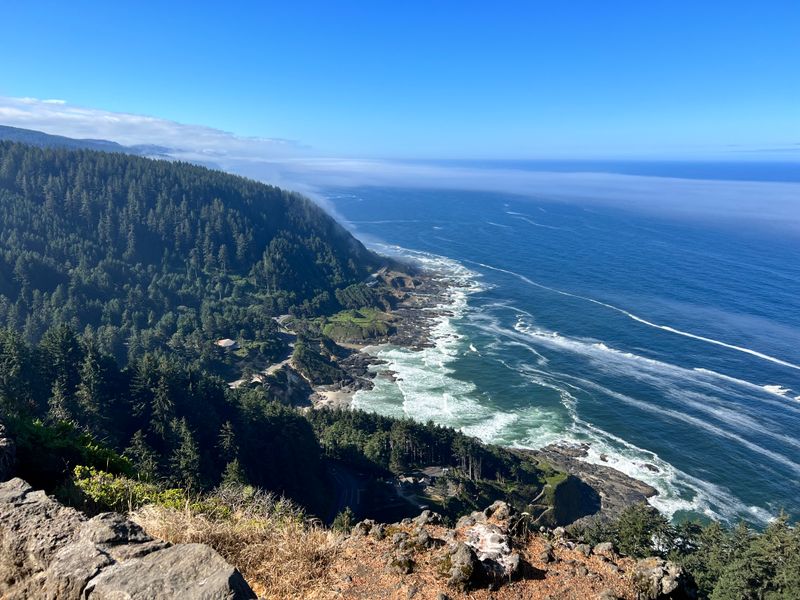
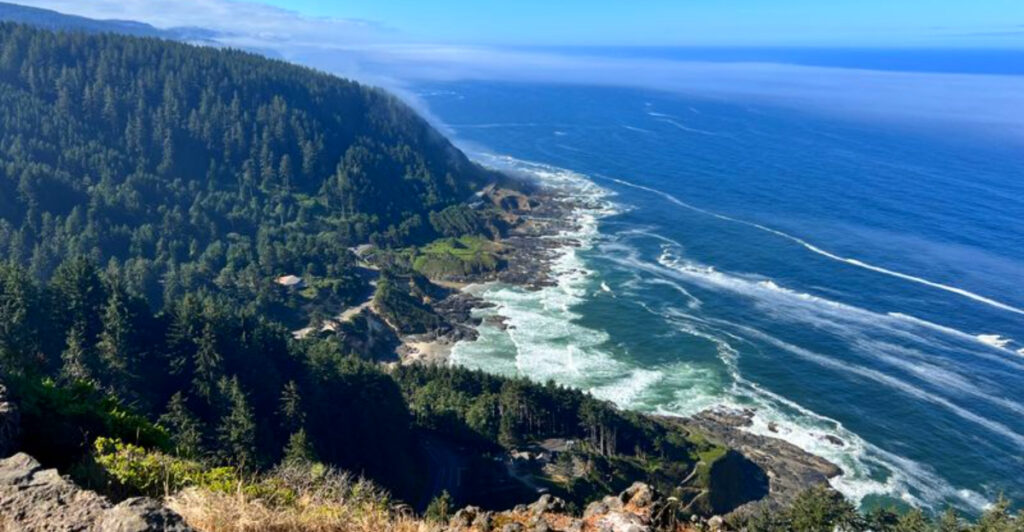
Rising 800 feet directly from the Pacific, Cape Perpetua claims the title of highest point on the Oregon Coast accessible by car. The summit viewpoint delivers 360-degree views: forested mountains to the east, ocean to the west, and on clear days, visibility stretching 70 miles in either direction along the coastline.
Captain James Cook named the cape in 1778, and its prominence remains as striking now as it must have been from his ship’s deck.
Down at sea level, wave-carved features create natural drama. Thor’s Well appears as a gaping hole in the rock where seawater churns and drains—most impressive during high tide when waves refill it constantly.
The Spouting Horn shoots spray skyward through a natural blowhole. Both features require careful timing and attention to tide tables for safe viewing.
Twenty-six miles of trails wind through old-growth forest and along the shoreline. The Cape Perpetua Trail climbs through massive Sitka spruce to the summit, while the Cook’s Chasm loop stays coastal, passing through a stone shelter built by the Civilian Conservation Corps in the 1930s.
Interpretive signs explain the area’s geology, ecology, and human history.
The visitor center opens seasonally with exhibits, maps, and ranger programs. Even when closed, the parking area provides trail access and the road to the summit stays open year-round, weather permitting.
8. Heceta Head Lighthouse State Scenic Viewpoint (near Florence)
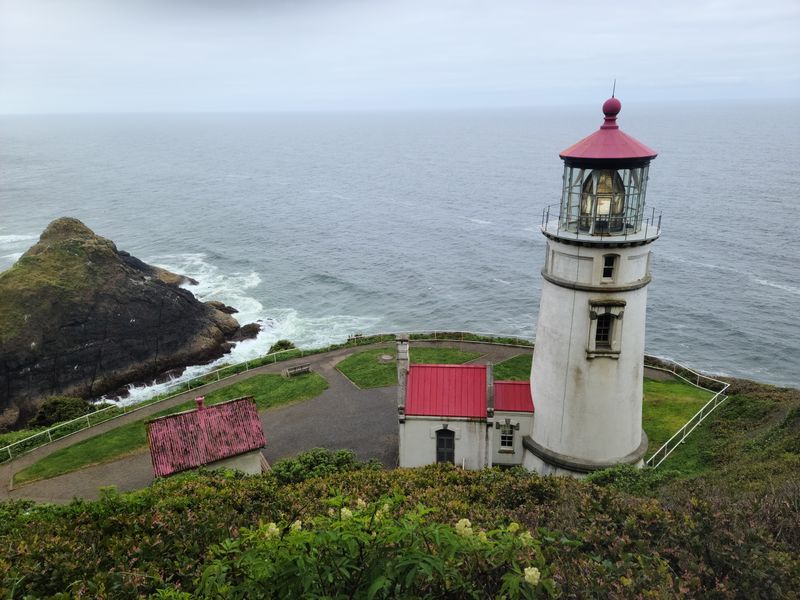
Photographers consider Heceta Head one of the most photogenic lighthouse settings in America, and walking the trail quickly confirms why. The white tower and keeper’s house perch on a headland backed by dark forest, creating contrast that looks intentional enough to seem staged.
Built in 1894, the lighthouse still beams the strongest light on the Oregon Coast, visible 21 miles out to sea.
The paved trail from the parking area climbs gradually for half a mile, gaining enough elevation to look down on the lighthouse from above—the angle that graces most postcards. Continue past the lighthouse and the path drops to Heceta Beach, a wide stretch of sand accessible via stairs and popular with beachcombers searching for agates and driftwood.
Harbor seals haul out on rocks below the headland, visible from viewpoints along the trail. Sea lion barks echo from offshore rocks, and during migration seasons, whales pass close enough to spot from the cliffs.
The lighthouse keeper’s house operates as a bed and breakfast, offering overnight stays in one of Oregon’s most scenic locations.
Adjacent to the lighthouse area, Devil’s Elbow State Park provides additional beach access and picnic areas. The sea cave visible from the beach once served as a shelter for Native American peoples and later for shipwreck survivors, its entrance large enough to walk through at low tide.
9. Oregon Dunes National Recreation Area (Florence–Reedsport area)
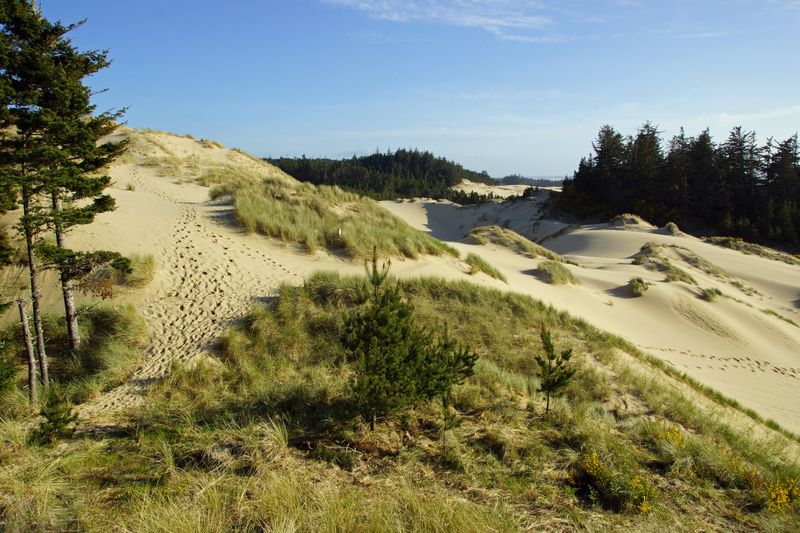
Stretching 40 miles along the central coast, the Oregon Dunes create a landscape so different from typical coastal scenery that first-time visitors often stop and stare in disbelief. Sand rises in wind-sculpted ridges, some reaching 500 feet tall, creating an environment that shifts constantly with weather and seasons.
The transition from dense coastal forest to open dunes to ocean happens within a mile in some areas.
Multiple access points serve different interests. The Umpqua Dunes Trail near Eel Creek offers a challenging 3-mile round trip hike into the largest dune formations, where sand stretches to the horizon in every direction.
John Dellenback Trail provides easier access to smaller dunes and the beach beyond. Some areas allow off-highway vehicles, creating a different atmosphere than the quieter hiking zones.
Plant life demonstrates remarkable adaptation to these harsh conditions. European beachgrass, introduced decades ago to stabilize the dunes, now dominates many areas, while native species like yellow sand verbena and beach evening primrose bloom in summer.
Wildlife ranges from Roosevelt elk browsing in forest edges to snowy plovers nesting in protected beach areas.
Winter brings different challenges and different beauty. Rain firms the sand, making hiking easier, while storm winds reshape dunes overnight.
Summer sees crowds increase, especially in vehicle-accessible areas, so weekday visits offer more solitude for those seeking quieter experiences.
10. Samuel H. Boardman State Scenic Corridor (Brookings–Gold Beach area)
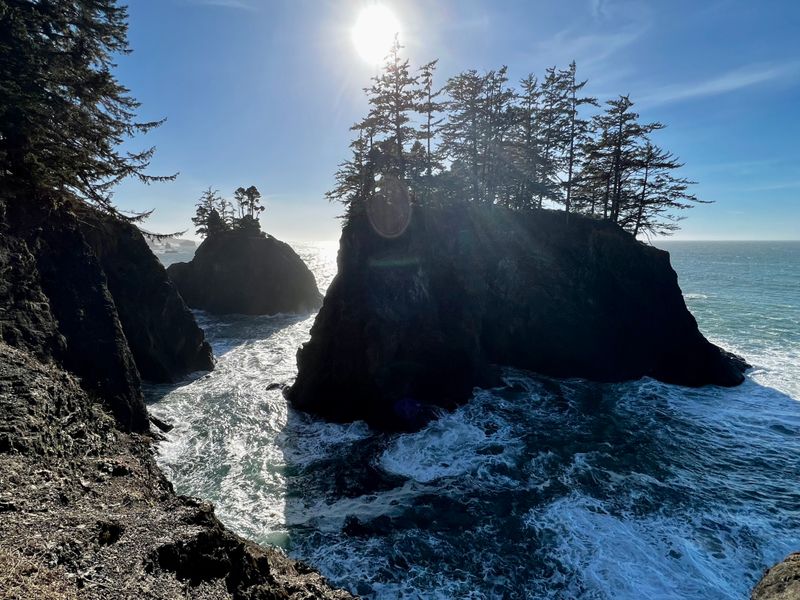
The southern Oregon Coast saves some of its most dramatic scenery for this 12-mile stretch of Highway 101, where pullouts appear every few hundred yards and each one reveals something worth seeing. Named after Oregon’s first state parks superintendent, the corridor protects a landscape of sheer cliffs, hidden coves, natural arches, and offshore rock formations that create an almost sculptural quality to the coastline.
Arch Rock viewpoint showcases a massive natural arch carved by wave action, while Natural Bridges features a cove where three rock arches frame ocean views. Secret Beach requires a short steep trail but rewards the effort with a secluded cove surrounded by towering cliffs.
Thunder Rock Cove, Whaleshead Beach, and Indian Sands each offer distinct perspectives on this varied coastline.
The Oregon Coast Trail runs the corridor’s length, connecting viewpoints and beaches through forest and along clifftops. Day hikers can sample sections, while through-hikers tackle the entire stretch as part of longer coastal treks.
Wildflowers bloom prolifically in spring, painting meadows and cliffsides with color against the blue Pacific backdrop.
This far south, the climate shifts slightly warmer and drier than northern sections of the coast. Summer fog occurs less frequently, and sunny days feel more predictable.
Crowds thin out too, despite the spectacular scenery, making it easier to find solitude even during peak season.
Share this story