You could walk right past it and still feel like something is off. Just outside the small Polish town of Gryfino, there’s a grove of about 400 pine trees that all do the same impossible thing. Each one kinks hard near the ground, then shoots up straight like it changed its mind halfway through growing.
It’s called the Crooked Forest, and the weird part is nobody can agree on why it happened. Not scientists.
Not historians. Not locals. And once you see the shapes they make, the real question becomes this: was it nature, or was someone messing with these trees on purpose?
1. It’s real and it has a real name
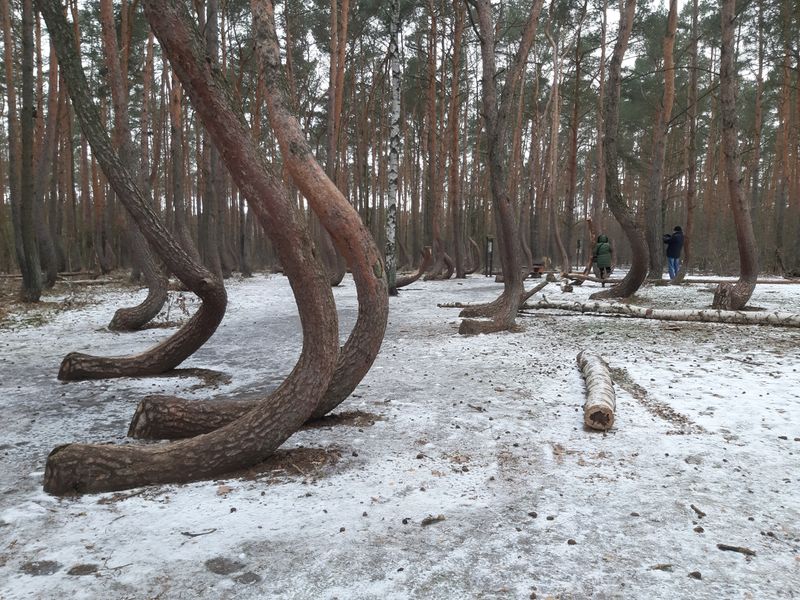
The nickname sounds like something made up for a storybook, but this forest actually exists. Locals call it Krzywy Las, which translates directly to Crooked Forest in Polish.
You’ll find it tucked away near Gryfino, a town in the northwestern corner of Poland, not far from the German border.
What makes this spot remarkable isn’t just that the trees are bent. It’s that they’re bent in such an organized, almost unnatural way.
Walk through the grove and you’ll see trunk after trunk curving in the same direction, creating a scene that feels more like an art installation than a random quirk of nature.
The forest sits quietly off the beaten path, not marked by flashy signs or tourist traps. For years, it remained a local curiosity known mostly to people in the region.
But once photos started circulating online, the Crooked Forest became an internet sensation.
Today, visitors from around the world make the trip to see it in person. Standing among those curved trunks feels surreal, like stepping into a place where the usual rules of nature took a day off.
2. The mystery is part of the point
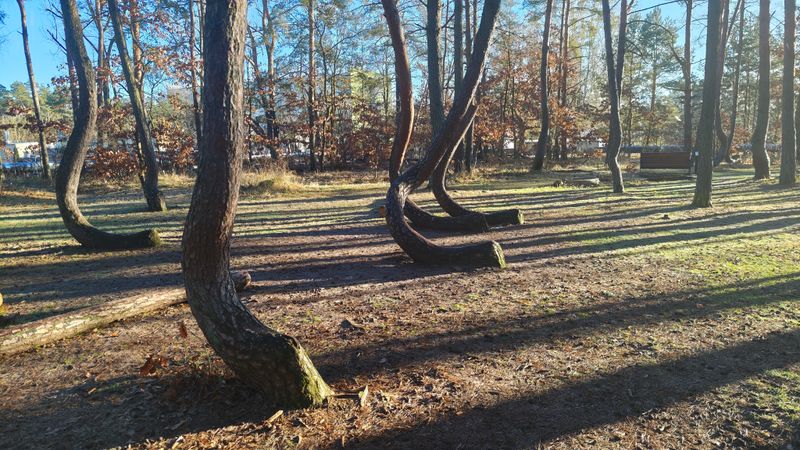
For decades, people have been trying to crack the code behind these oddly shaped pines. Researchers, foresters, and amateur detectives have all weighed in with theories.
Yet nobody has produced a single explanation that everyone agrees on.
That lack of a definitive answer is actually a huge part of what made the Crooked Forest famous. Mysteries grab attention.
When something in nature looks this deliberate but remains unexplained, curiosity spreads fast.
Online forums, travel blogs, and social media pages have all contributed to the legend. Some people love the scientific puzzle.
Others enjoy the spooky, folkloric vibe the forest gives off. Either way, the uncertainty keeps the conversation alive.
There are plenty of educated guesses floating around, ranging from human interference to freak weather events. But none of them have been proven beyond doubt.
Until someone uncovers hard evidence, the Crooked Forest will remain one of Europe’s most intriguing natural question marks.
In a way, that’s perfect. Sometimes the best stories are the ones that don’t have neat endings.
3. The ‘crooked’ part is very specific
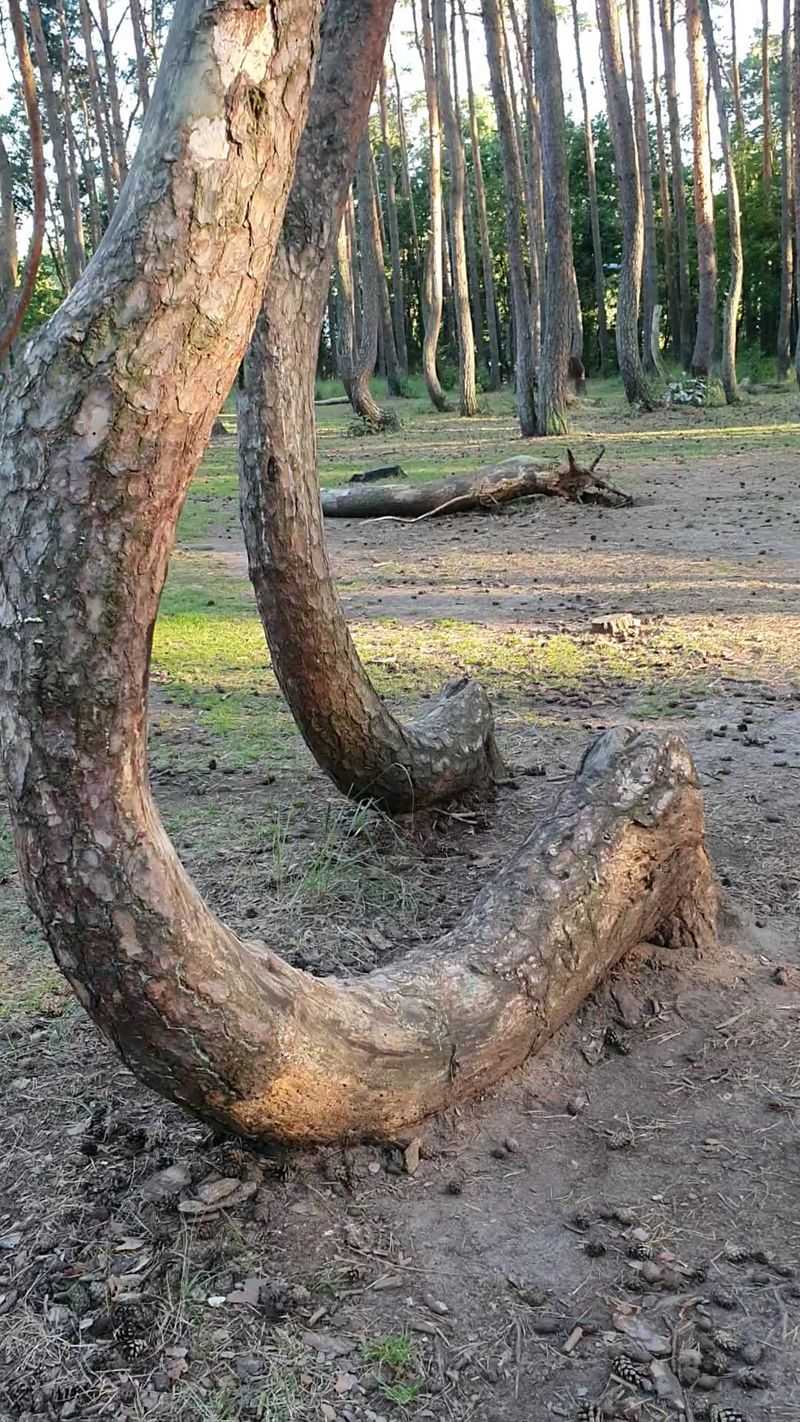
Forget spirals, twists, or branches that zigzag in random directions. The trees in this forest follow a very specific pattern.
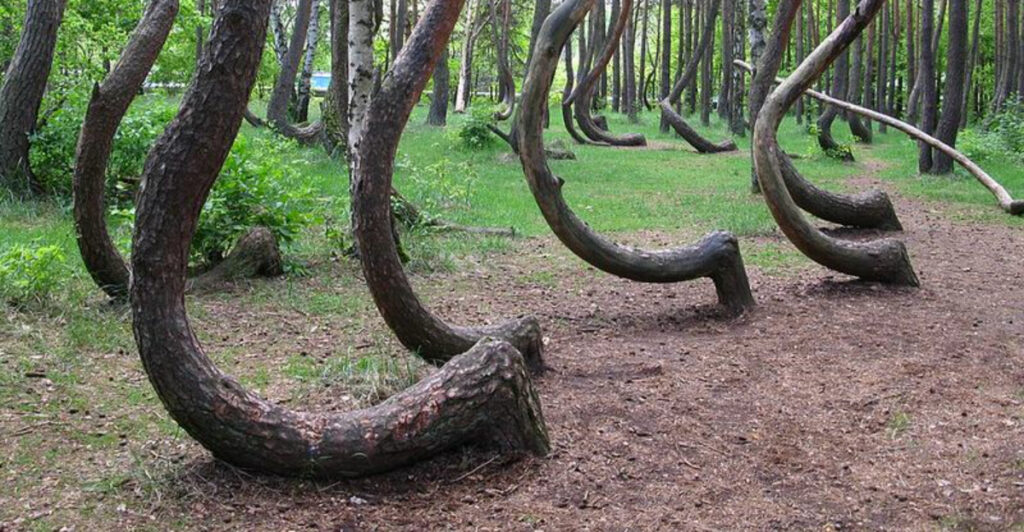
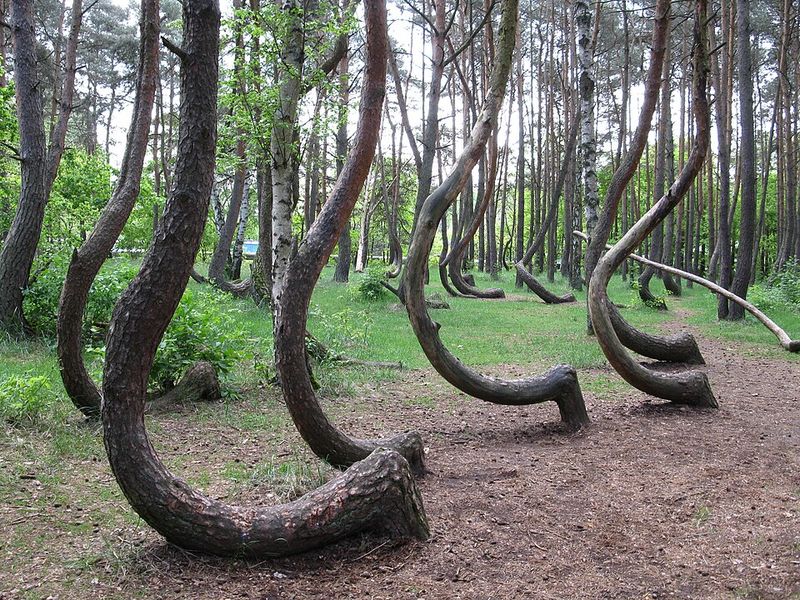
Each trunk bends into a shape that looks remarkably like the letter J.
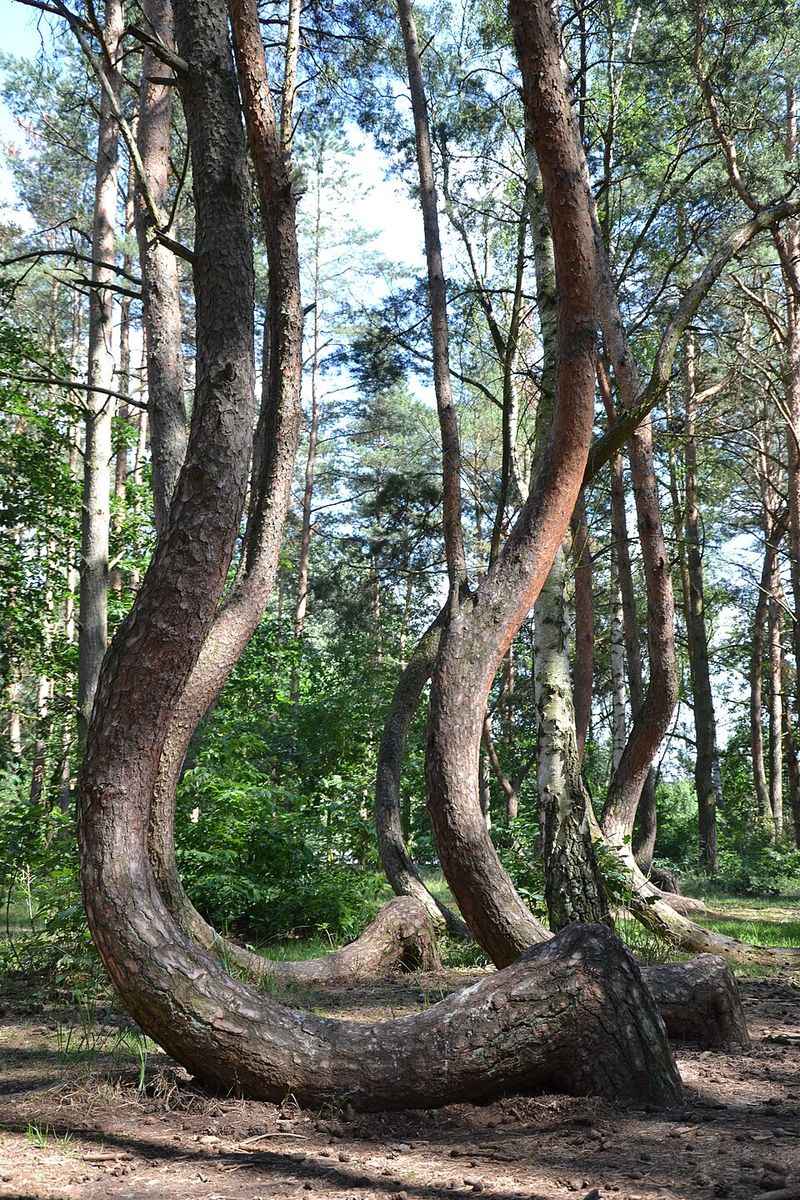
The curve is dramatic and pronounced. Near the base, the trunk swoops outward in a smooth arc, almost like someone grabbed it and pulled it sideways.
Then, just as suddenly, it straightens out and shoots upward like a normal tree.
This isn’t the kind of damage you’d see from a storm or disease. There’s nothing jagged or broken about it.
The bend looks controlled, even graceful. That’s what makes it so eerie.
If you’ve ever tried to bend a young sapling, you know it takes steady pressure over time to create a permanent curve. These trees show exactly that kind of result, which is why so many people suspect human involvement.
But proving it is another story.
The J-shape is so consistent across the grove that it’s hard to believe it happened by accident. Whether it was nature or people behind it, the effect is unforgettable.
4. The bend starts close to the ground
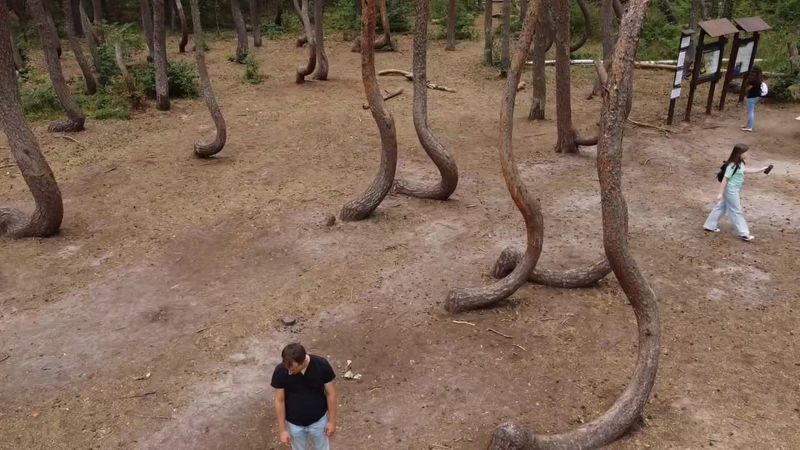
One detail that really stands out is how low the curve begins. We’re not talking about a bend that happens halfway up the trunk.
The curve starts shockingly close to the forest floor, sometimes just 10 centimeters above the ground.
In some cases, it can be as high as 50 centimeters, but that’s still incredibly low. And the angle?
Nearly 90 degrees in some trees. That’s not a gentle lean.
It’s a hard turn.
Picture a tree that grows straight up for a few inches, then suddenly bends sideways like it hit an invisible wall. That’s essentially what you’re looking at.
The effect is so dramatic that it almost doesn’t look real.
This low starting point is one reason people suspect the trees were manipulated when they were very young. A sapling that’s only a year or two old would be flexible enough to bend this way without snapping.
But once a tree matures, forcing that kind of curve would be nearly impossible.
The precision of it all adds to the mystery. These aren’t random accidents.
They look planned.
5. They all lean the same way, which looks almost
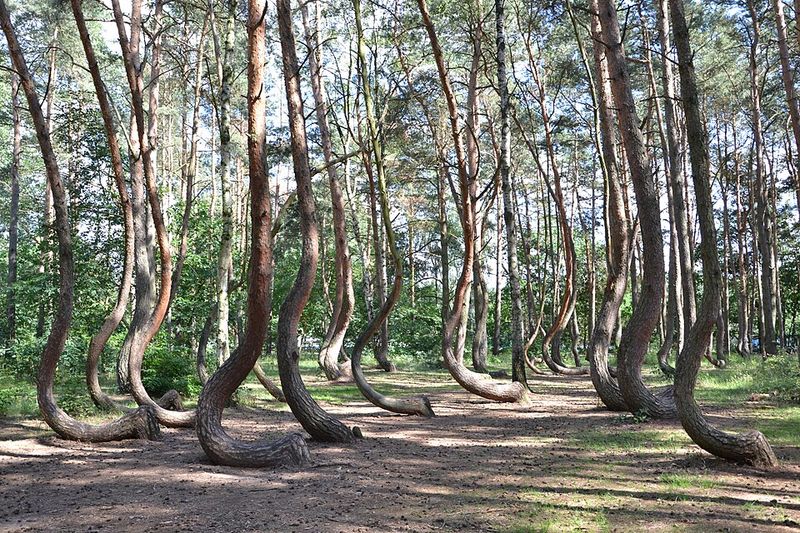
If you stumble across a single bent tree in the woods, you might shrug it off. But when you see dozens of them, all leaning in the same direction, something feels off.
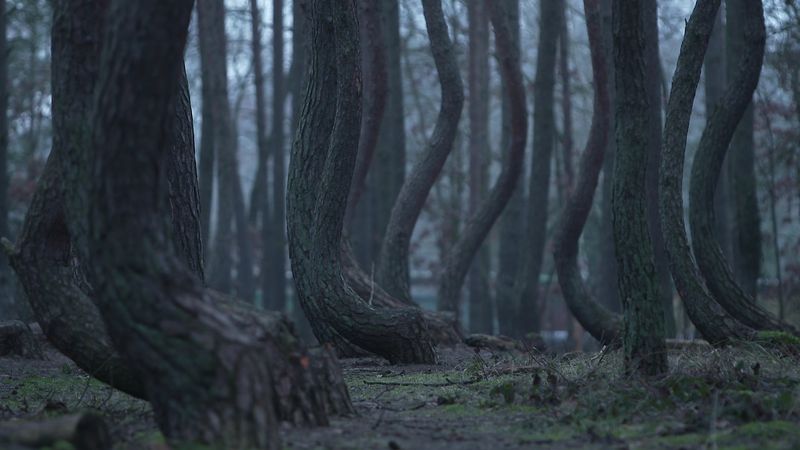
The crooked pines don’t bend randomly. They curve toward the north.
That uniformity is what makes the scene so unsettling. It’s too neat.
Too organized. Nature usually creates chaos, not patterns that look like they were designed by a committee.
Some visitors describe the grove as looking almost military in its precision. The trees line up like soldiers standing at attention, except they’re all tilted the same way.
It’s beautiful and bizarre at the same time.
This coordinated lean is one of the strongest arguments for human involvement. If snow or wind caused the bending, you’d expect more variation.
Different trees would bend in different directions depending on where the pressure came from.
Instead, the grove looks like someone followed a plan. Whether that plan was for art, agriculture, or something else entirely remains unclear.
But the effect is impossible to ignore.
6. The forest patch is surprisingly small
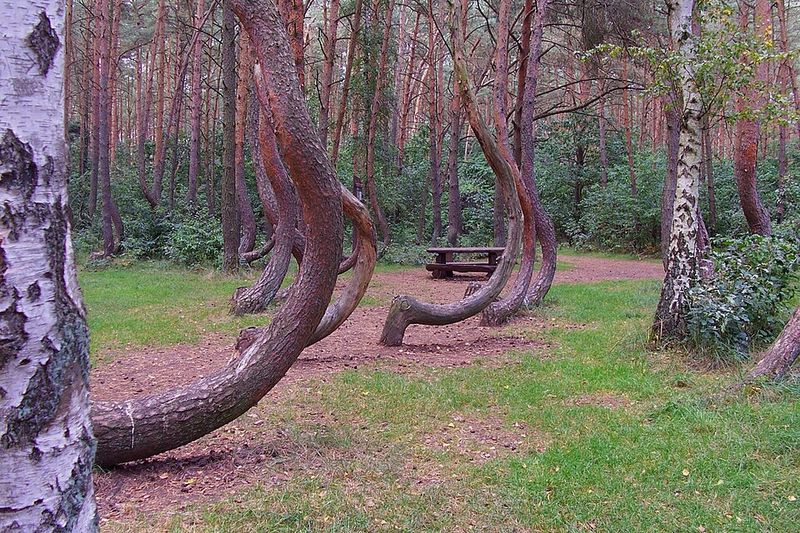
When something becomes world-famous, you expect it to be huge. But the Crooked Forest isn’t some sprawling enchanted woodland stretching for miles.
The entire grove of bent pines covers roughly two hectares, which is about the size of a couple of soccer fields.
That’s it. The famous crooked trees occupy a surprisingly compact area.
Step outside that patch, and you’re surrounded by normal, straight-trunked pines that look completely ordinary.
This small size makes the phenomenon even stranger. If the bending was caused by some widespread environmental factor like a storm or soil condition, you’d expect to see it affecting a much larger area.
But it’s confined to this one little pocket.
The compactness also makes the grove feel more intentional. It’s like someone carved out a specific section of forest and decided to experiment.
The boundaries are clear, the effect is concentrated, and the contrast with the surrounding trees is striking.
For visitors, the small size actually enhances the experience. You can walk through the entire grove in a short time, taking in the full strangeness without getting lost.
7. The ‘how many trees?’ number is more complicated than you think
Ask how many crooked trees are in the forest, and you’ll get different answers depending on who you ask. The number 400 gets thrown around a lot online, and it’s become the most commonly cited figure.
But it’s not that simple.
More recent sources suggest the actual number is far lower. Some estimates put it closer to 100 trees.
A local forestry reference allegedly mentions only about 80. So which is it?
The confusion comes down to what counts as crooked enough. Does a slight bend qualify, or does the curve need to be dramatic?
Who’s doing the counting, and what criteria are they using? There’s no official survey that settles the debate.
Some trees might have straightened out over time or been removed. Others might have been overlooked in earlier counts.
And since the grove isn’t fenced off or formally cataloged, there’s no single authoritative source.
The takeaway? The exact number is messier than it seems.
Whether it’s 80, 100, or 400, the visual impact remains the same. The forest is strange, and the mystery is real.
8. The trees aren’t sick – they’re thriving
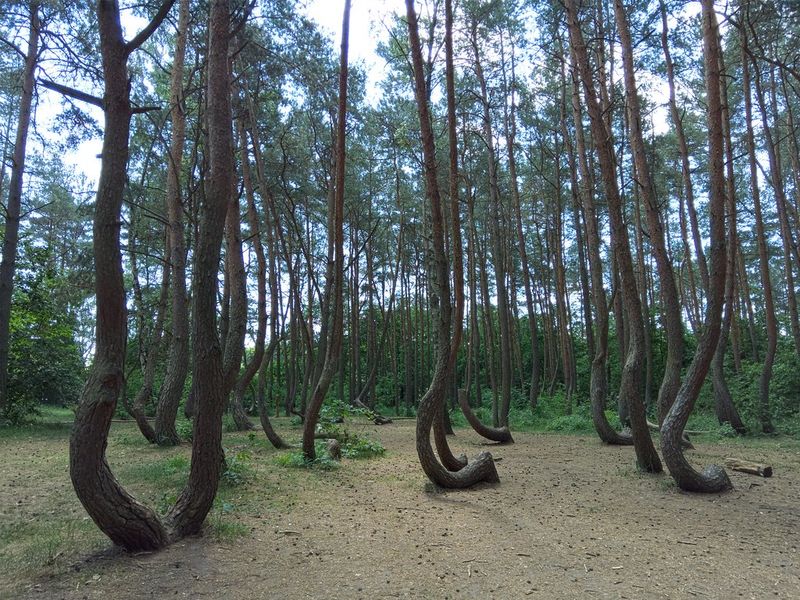
When people first see the Crooked Forest, they often assume something must be wrong with the trees. Maybe they’re diseased, damaged, or struggling to survive.
But that’s not the case at all. These pines are healthy.
The bend doesn’t seem to harm them in any meaningful way. Once the trunk straightens out above the curve, the tree grows normally.
Branches spread, needles stay green, and the wood develops just like any other pine.
In fact, the trees have been thriving for decades. They’ve survived harsh winters, changing weather patterns, and the test of time.
Whatever caused the bend didn’t weaken them. If anything, they’ve proven remarkably resilient.
This health is another clue that the bending might have been intentional. If the trees were damaged by accident, you’d expect to see signs of stress, disease, or stunted growth.
Instead, they look strong and vigorous.
It’s a reminder that nature is adaptable. Even when shaped in unusual ways, living things find ways to keep going.
The Crooked Forest isn’t a graveyard of broken trees. It’s a testament to survival.
9. Some of them grow impressively tall anyway
You might think that bending a tree near the base would limit how tall it could grow. But some of the crooked pines in Gryfino reach around 15 meters in height.
That’s about as tall as a five-story building.
The curved portion itself can rise up to about three meters before the trunk straightens out. So you’ve got this dramatic, sweeping arc near the bottom, and then the tree just takes off skyward like nothing unusual happened.
It’s a strange sight. From a distance, the trees look relatively normal.
But once you get close and see that sharp bend near the ground, the scale becomes impressive. These aren’t small saplings frozen in time.
They’re mature, towering pines.
The height suggests the trees have been growing for many decades, possibly close to a century. That kind of longevity adds weight to the theory that they were planted and shaped intentionally, then left alone to mature.
Standing beneath one of the taller crooked pines is humbling. Despite the oddity at the base, the tree reaches confidently toward the sky, unbothered by its unusual start.
10. The planting period is tied to a turbulent era

One widely discussed theory places the planting of these trees somewhere between 1930 and 1945. That’s a significant window because it overlaps with some of the most chaotic years in European history, including World War II.
According to this timeline, the trees may have been around seven to ten years old at the time they were planted. That would mean they were grown elsewhere first, then transplanted to the site near Gryfino.
Transplanting young trees was common practice, especially if someone had a specific plan for them.
The timing matters because it helps narrow down possible explanations. If the trees were planted during the war years, it raises questions about who had the time, resources, and motivation to do it.
Was it local farmers? German occupiers?
Polish foresters?
The region itself went through dramatic changes during this period. Borders shifted, populations moved, and entire communities were displaced.
Any project started in the 1930s or early 1940s could easily have been abandoned or forgotten in the chaos.
This turbulent backdrop adds a layer of human drama to the mystery, making the forest feel like a relic of lost intentions.
11. There’s also an alternative timeline and it changes the story
Not everyone agrees on the 1930s planting date. Another theory pushes the timeline earlier, suggesting the trees were planted around 1925 to 1928.
Then, roughly ten years later, someone deliberately bent them.
That’s a meaningful shift. If the trees were shaped around 1935 to 1938, it would have been before the worst of World War II reached the region.
That opens the door to the idea that this was a planned agricultural or commercial project, not something done hastily during wartime.
The difference between these timelines changes the entire narrative. One suggests chaos and abandonment.
The other suggests intention and planning. Both are plausible, but they lead to very different conclusions about who did this and why.
Bending a ten-year-old tree is much more deliberate than planting a sapling in a crooked position. It requires tools, time, and know-how.
Whoever did it would have needed a clear purpose in mind, whether that was producing curved timber or experimenting with tree shaping techniques.
Without hard evidence like planting records or eyewitness accounts, both timelines remain possible. The mystery deepens with every new theory.
12. The ‘Nazi tanks did it’ theory is popular but heavily questioned

One of the most popular explanations on the internet is that Nazi tanks rolled through the area during World War II and crushed the young trees. The idea is that military vehicles flattened the saplings, forcing them into their crooked shape.
It’s a dramatic story, and it fits with the region’s history. The town of Szczecin, located nearby, was under German control during the war.
Military activity in the area was common, and tanks certainly moved through forests.
But critics of this theory point out some serious problems. If tanks had driven over the trees, you’d expect to see far more severe damage.
Crushed saplings don’t usually recover into neat, uniform curves. They snap, splinter, or die.
You’d also expect more variation in the bending patterns. Tanks don’t move in perfectly straight lines, and they don’t apply pressure evenly.
The fact that all the trees curve the same way, with similar angles and directions, doesn’t match what tank tracks would produce.
Still, the theory persists because it’s easy to imagine and emotionally compelling. War leaves scars, and the Crooked Forest could be one of them.
But the evidence doesn’t quite add up.
13. The ‘snow did it’ theory is plausible but not proven
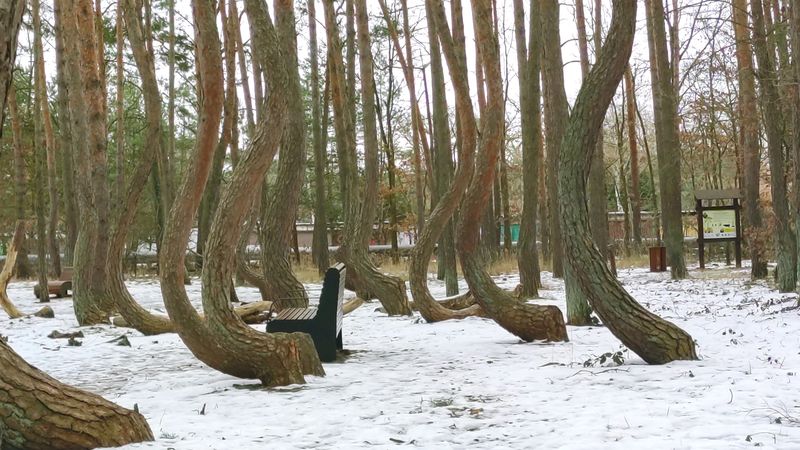
Another frequently repeated explanation is that heavy snow bent the trees when they were young. Poland gets harsh winters, and it’s not hard to imagine a thick layer of snow weighing down flexible saplings until they stayed bent permanently.
Snow can absolutely deform young trees. Foresters see it happen all the time.
If a sapling is buried under heavy snow for weeks or months, the pressure can force it into a curve that never fully straightens out.
So why doesn’t this theory settle the debate? Because it still doesn’t explain the uniformity.
If snow caused the bending, you’d expect trees in different parts of the grove to bend in different directions depending on how the snow fell and drifted.
You’d also expect more variation in the severity of the curves. Some trees would be barely bent, others severely deformed.
Instead, the Crooked Forest shows a remarkably consistent pattern, which makes the snow theory feel incomplete.
It’s plausible as a contributing factor, but probably not the whole story. Maybe snow played a role, but something else guided the process.
The mystery remains unsolved.
14. The most ‘practical’ theory: the trees were shaped on purpose for curved timber
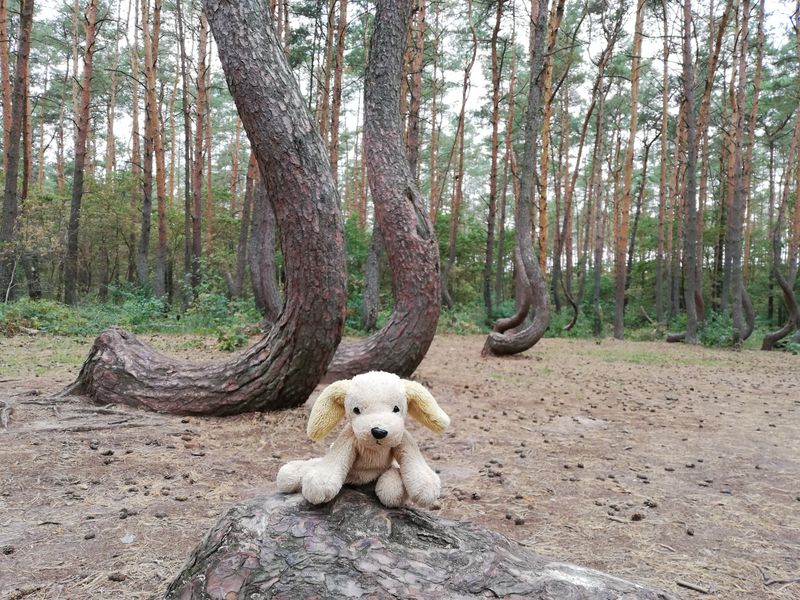
The most down-to-earth explanation is also the most practical. Some experts believe the trees were deliberately shaped by people who wanted to produce naturally curved wood.
This kind of timber was valuable for making furniture, musical instruments, and boat ribs.
Before modern steam-bending techniques, getting curved wood meant either finding it naturally or growing it intentionally. Shaping young trees was a known practice in forestry, especially in Europe.
It took patience, but the results were worth it.
The theory suggests this was a business venture. Someone planted the trees, bent them at the right age, and planned to harvest them years later.
But then something went wrong. War, invasion, or economic collapse could have derailed the project, leaving the grove abandoned.
This explanation fits the evidence better than most. It accounts for the uniformity, the precision, and the health of the trees.
It also explains why the grove is so small and concentrated. This wasn’t a natural event.
It was a plan that never got finished.
If true, the Crooked Forest is a living reminder of interrupted ambitions, a forest frozen in time by history’s chaos.
Share this story