Florida is famously flat, sunny, and surrounded by beaches, so the last thing most people expect to find here is a 120-foot-deep sinkhole filled with lush, tropical-looking vegetation, tiny waterfalls, and fossils millions of years old. Yet tucked right inside the city of Gainesville, this geological wonder pulls visitors into a world that feels nothing like the Florida they thought they knew.
The descent down a wooden staircase takes you through layers of time, cooler air, and greenery so thick it almost feels like another continent. Whether you are a nature lover, a curious explorer, or just someone looking for a surprisingly affordable and unique outing, this place delivers something genuinely hard to find anywhere else in the Sunshine State.
Where Exactly You Will Find This Hidden World
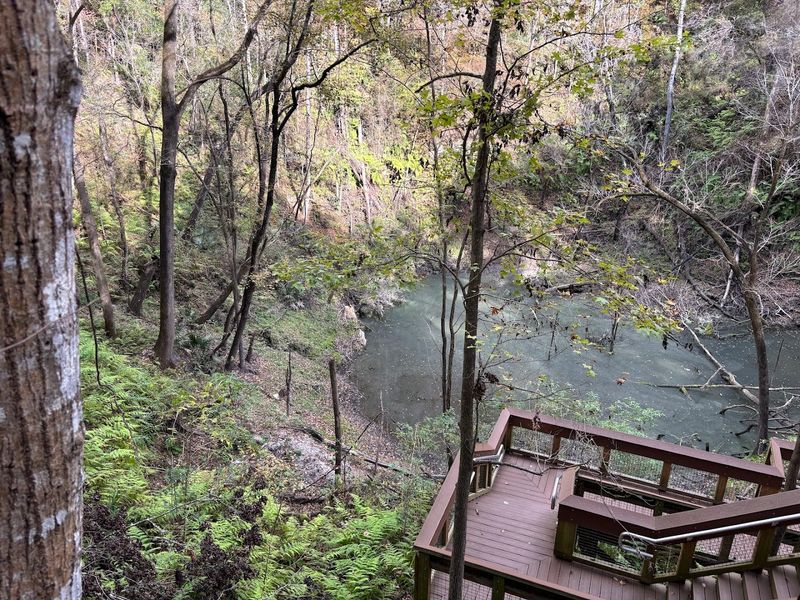
Right in the middle of Gainesville, Florida, a city better known for its university football games than geological wonders, sits one of the most unexpected natural sites in the entire Southeast. Devil’s Millhopper Geological State Park is located at 4732 Millhopper Rd, Gainesville, FL 32653, and it is very easy to reach from the city center.
The park sits in Alachua County, well within the urban limits, which makes the experience even more surprising. You are essentially driving through a regular neighborhood and then suddenly arriving at a place that feels ancient and remote.
Parking is easy, shaded, and costs just four dollars per vehicle, which is a rare deal for a state park experience this memorable. The ranger station near the entrance greets you with educational displays before you even take your first step toward the sinkhole.
The Geological Story Behind the Sinkhole
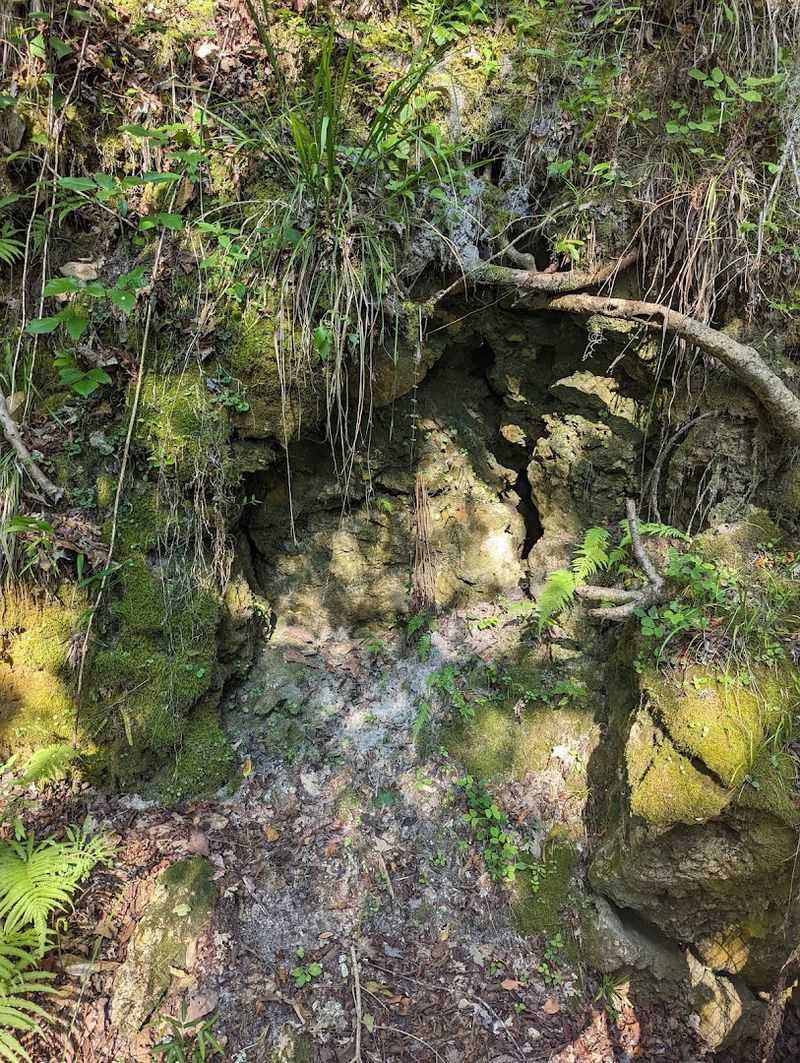
About 10,000 years ago, underground limestone slowly dissolved beneath this spot, creating a hidden cavern that eventually could not support the weight of the earth above it. When the roof of that cavern gave way, the ground collapsed inward, forming the bowl-shaped depression now known as Devil’s Millhopper.
The name itself has a colorful origin. Early settlers noticed that animals and objects seemed to disappear into the sinkhole the way grain disappears into a millhopper, a funnel-shaped grain feeder.
The “Devil’s” part was added for dramatic effect, and it stuck.
What makes this sinkhole scientifically remarkable is that its steep walls expose millions of years of geological layers, including marine fossils from when this part of Florida was actually covered by a shallow sea. Shark teeth, shell fragments, and ancient bone fragments have all been recovered from these exposed sediment layers over the decades.
The 120-Foot Descent Down the Wooden Staircase
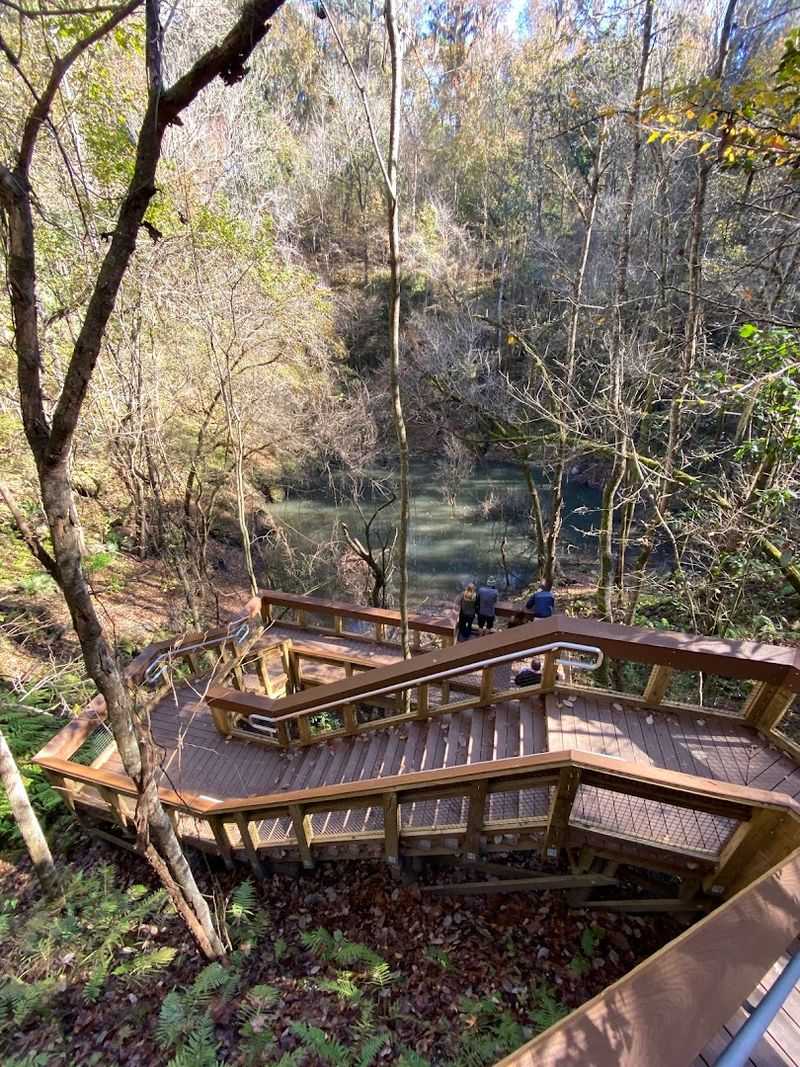
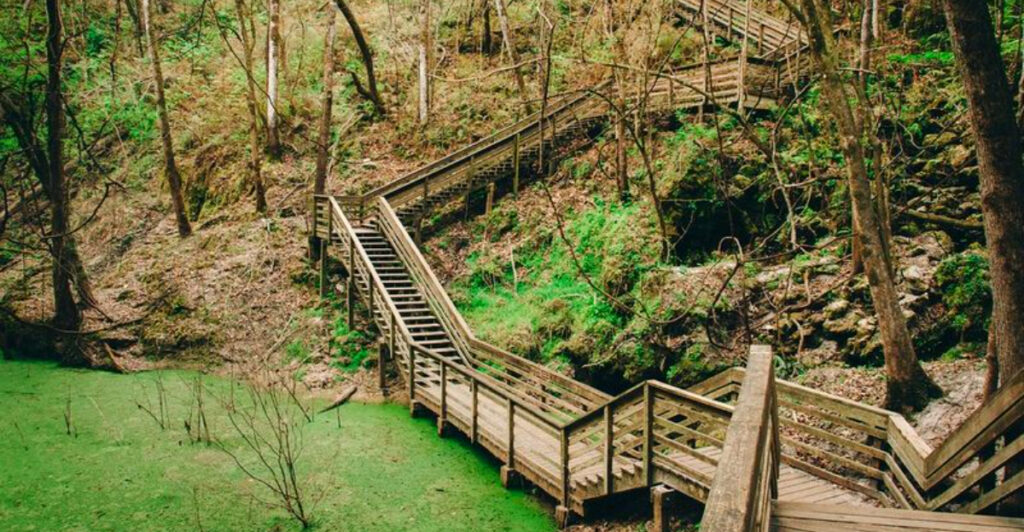
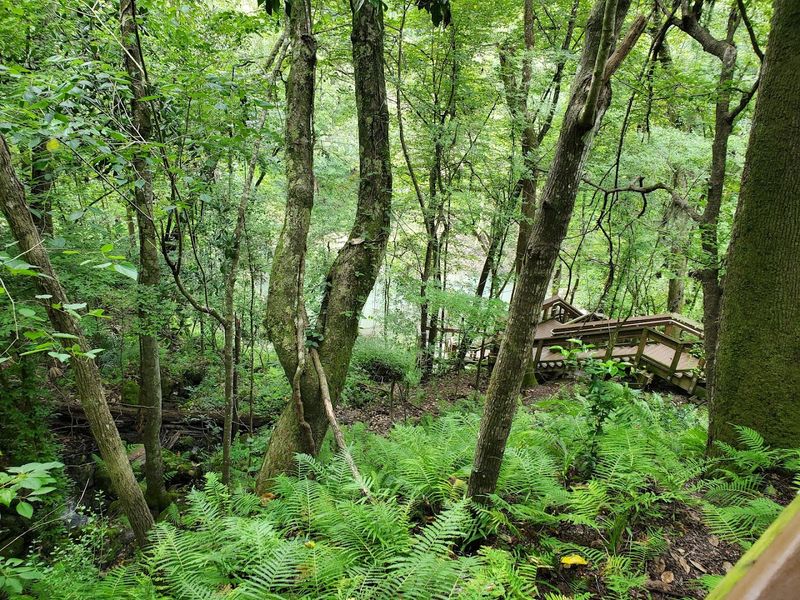
The main event at this park is the wooden staircase that winds 120 feet down into the sinkhole, and it is not something you forget quickly. The structure consists of 132 steps broken up by small wooden landings where you can catch your breath, take photos, or simply stop and listen to the sounds of dripping water and rustling leaves far below.
As you descend, the temperature noticeably drops, sometimes by as much as ten degrees compared to the surface. The air feels damper and cooler, and the vegetation changes dramatically with every few steps, shifting from familiar Florida scrub to something that looks far more like a Central American rainforest.
The climb back up is a solid workout, so wearing proper shoes with good grip is genuinely important here. Most visitors complete the full round trip in under an hour, though rushing would mean missing the best details along the way.
The Mini Rainforest Growing at the Bottom
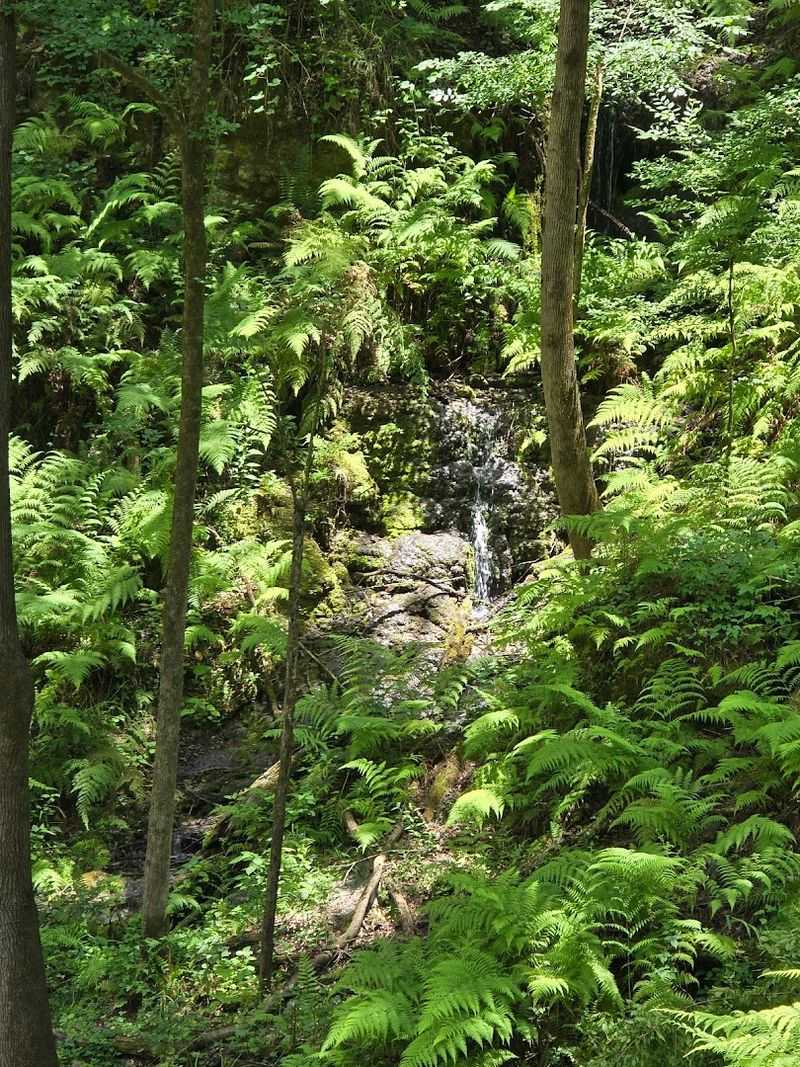
At the bottom of the sinkhole, the ecosystem is genuinely unlike anything else in Florida. Because the sinkhole is so deep and shaded, it traps cool, moist air that supports plant species more commonly found in Appalachian forests or even tropical environments farther south.
Ferns carpet the ground in thick, bright-green layers. Mosses cling to every rock and log.
Trees that would never survive in the dry scrubland just a few hundred feet above thrive down here in remarkable abundance.
The contrast between the top of the sinkhole and the bottom is sharp enough to feel almost theatrical. Biologists have documented a microclimate at the base that behaves differently from the surrounding environment, making this a genuinely rare and scientifically interesting pocket of biodiversity.
For plant lovers especially, the variety of species packed into such a small space is a quiet but real thrill that rewards a slow, attentive walk.
Small Waterfalls That Appear After Rain
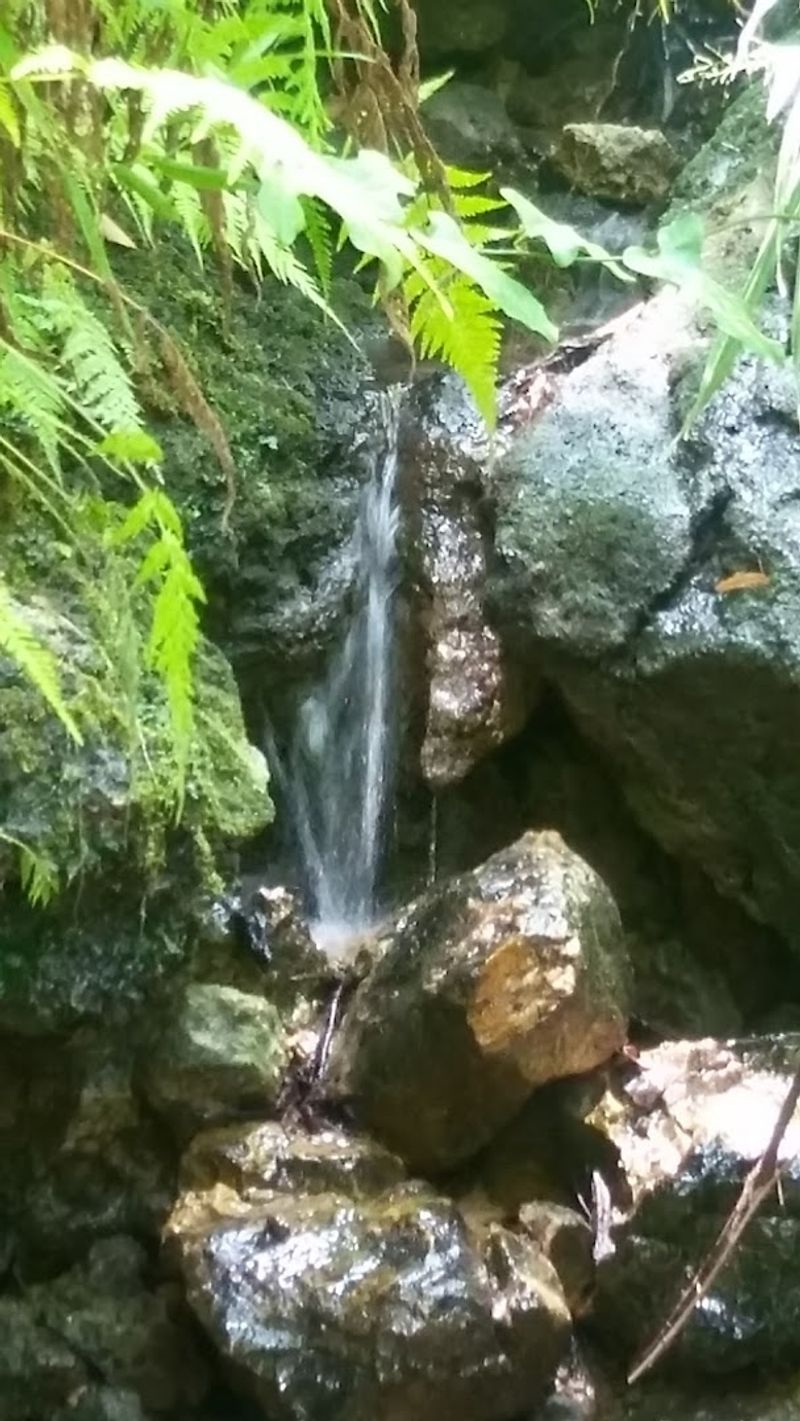
After a good rain, the walls of the sinkhole come alive with small streams that trickle and tumble down the rocky sides, creating a series of delicate waterfalls that feed the basin below. The effect is genuinely beautiful, and visitors who time their trip after wet weather are often rewarded with a much more dramatic scene than those who visit during dry spells.
Even without recent rainfall, there is usually some water movement visible, since several small underground springs feed into the sinkhole year-round. The water at the bottom has a bluish tint in the morning light and shifts to a brownish tone as the day progresses and sunlight changes the viewing angle.
There is no swimming or wading allowed in the basin, but simply watching the water collect and flow is peaceful in a way that feels surprisingly meditative for a park that sits right inside a busy city.
Ancient Fossils Found in the Exposed Walls
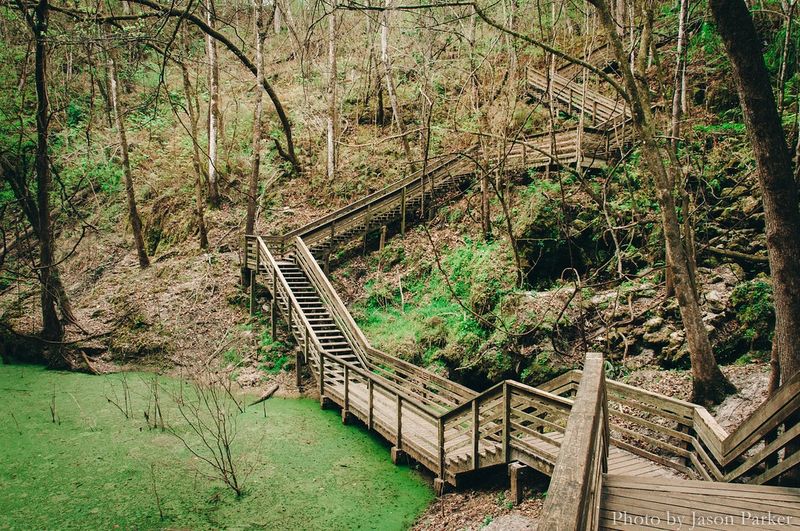
The walls of the sinkhole act like a natural museum display, revealing sediment layers that span millions of years of Florida’s geological past. Fossil hunters and geologists have long been drawn to this site because the exposed rock contains remains from a time when sea levels were far higher and this entire region sat beneath warm, shallow ocean water.
Shark teeth are among the most commonly found fossils here, along with marine shell fragments and occasionally mammal bones from the Pleistocene era. The educational signs along the staircase explain each visible layer and what it represents, turning the descent into an informal geology lesson that is genuinely engaging.
Collecting fossils is not permitted inside the park, which helps preserve the site for future visitors and researchers. Still, simply knowing what you are looking at as you pass each layer of sediment adds a whole new dimension to what might otherwise seem like just a walk down some stairs.
The Nature Trail Around the Rim
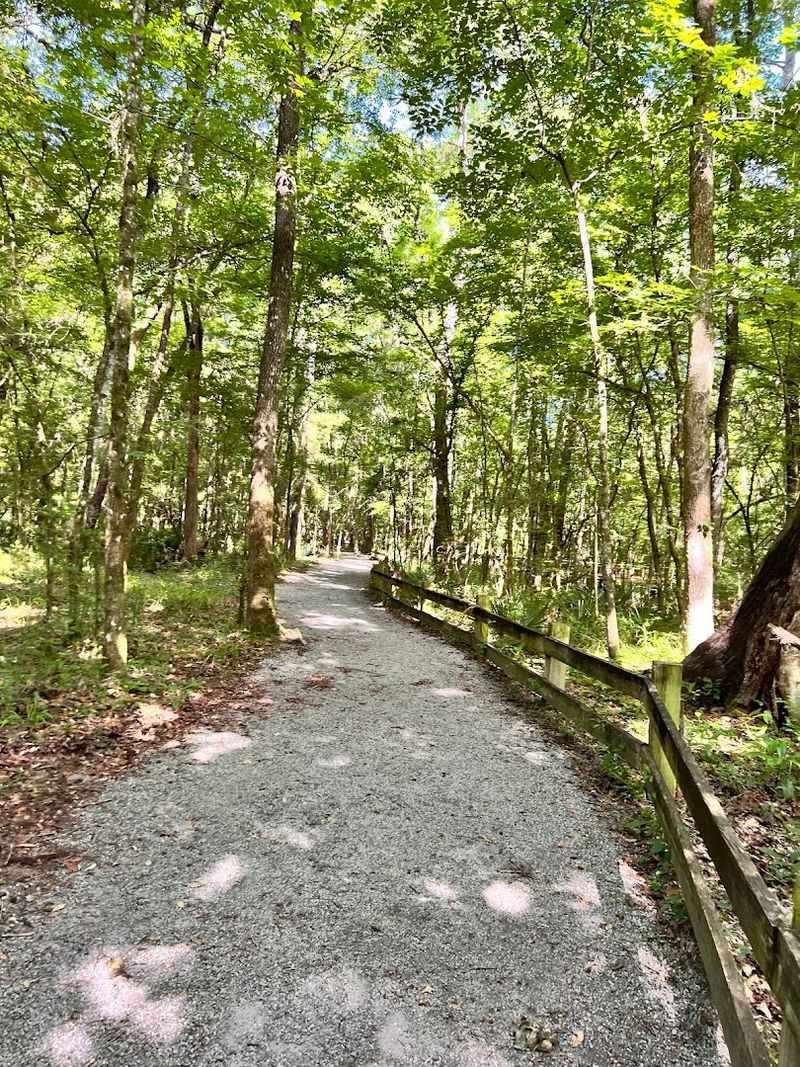
Not everyone in your group may want to tackle the staircase, and that is completely fine because the park also offers a paved nature trail that circles the rim of the sinkhole. This trail is mostly flat, easy to walk, and heavily shaded by a canopy of tall oaks and other native trees.
The rim trail runs roughly half a mile and offers several viewpoints where you can peer down into the sinkhole from above. There is also a small wooden bridge along the route where you can watch one of the creeks that eventually drains into the sinkhole far below.
Benches are placed at thoughtful intervals along the trail, making it accessible for visitors who want to rest and take in the surroundings at a relaxed pace. Owls have been spotted and heard along this trail during quieter morning visits, which adds an unexpected layer of wildlife watching to an already pleasant walk.
The Educational Ranger Station and Displays
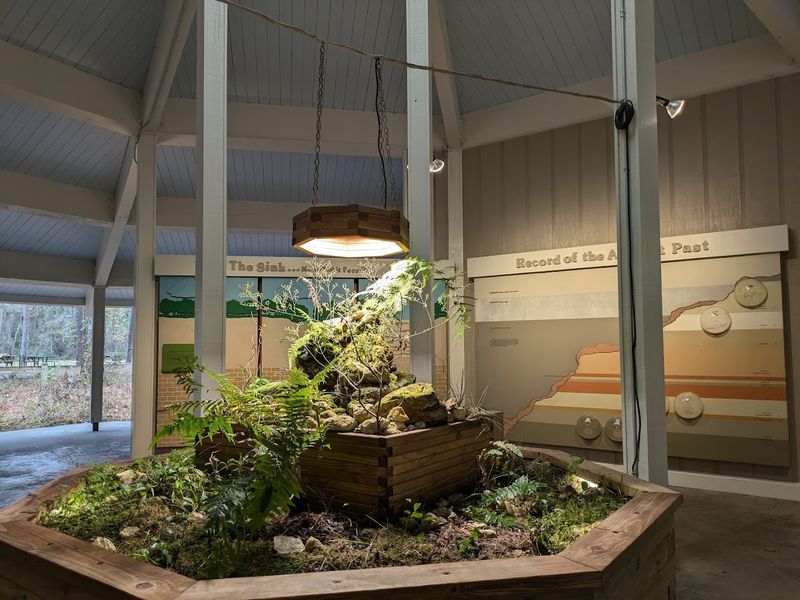
Before you even reach the sinkhole itself, the ranger station near the parking area offers a solid introduction to what you are about to experience. The displays inside cover the geology of sinkholes, the history of Devil’s Millhopper specifically, and the unusual ecology of the microclimate at the bottom.
Rangers are genuinely knowledgeable and approachable, happy to answer questions and point out details that most visitors would walk right past. The informational signs posted throughout the trail and staircase continue this educational thread, making the whole visit feel like a well-organized outdoor classroom.
For families with kids, the educational component is one of the strongest selling points of this park. The combination of hands-on exploration and clearly explained science makes it the kind of place where children actually absorb information because they are too busy being fascinated to realize they are learning something.
Practical Tips for Planning Your Visit
The park is open Wednesday through Sunday, and the entrance fee is just four dollars per vehicle, payable via a QR code at the entrance kiosk. Florida State Park annual pass holders can simply leave their pass visible on the dashboard and walk right in, which is a nice perk for frequent park visitors.
Restrooms are available near the ranger station, and the parking lot has plenty of shaded spots, which is a genuine comfort on warmer Florida days. Leashed pets are welcome on the trails, so bringing a well-behaved dog along is a perfectly reasonable choice.
Mornings are the best time to visit both for cooler temperatures and for seeing the sinkhole water at its most photogenic bluish color. Plan for about 40 minutes to an hour if you want to do both the staircase and the rim trail without feeling rushed, though the park rewards those who linger a little longer.
What the Microclimate Feels Like in Person
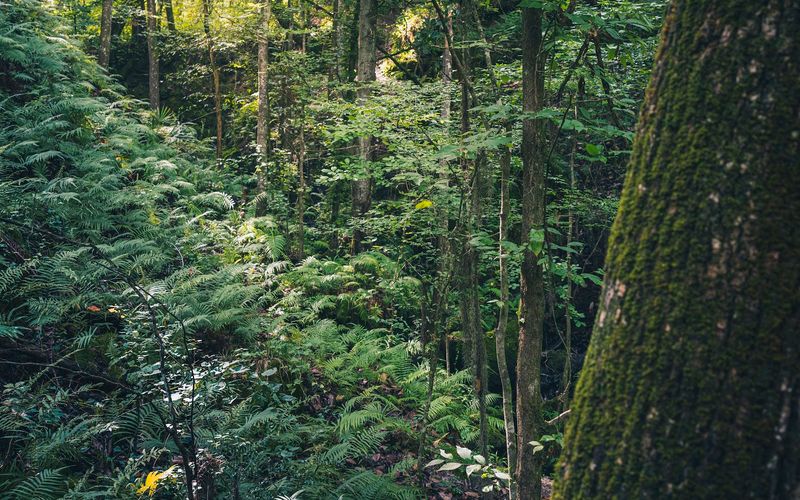
The temperature drop as you descend the staircase is one of the most physically striking parts of the experience. On a warm Florida afternoon, the air at the surface might feel thick and humid, but by the time you reach the bottom of the sinkhole, the temperature can be noticeably cooler, sometimes by eight to ten degrees Fahrenheit.
The moisture in the air increases with every step downward, and the smell changes too, shifting from the dry, piney scent of the surface to something earthier and greener, the kind of air that feels like it belongs in a forest far older and wetter than anything typically found in Florida.
That sensory shift is hard to fully describe to someone who has not experienced it, but it is the moment that makes most visitors understand why this place has such a devoted following among locals. The sinkhole does not just look different from the Florida outside it, it genuinely feels different.
How This Sinkhole Compares to Others in Florida
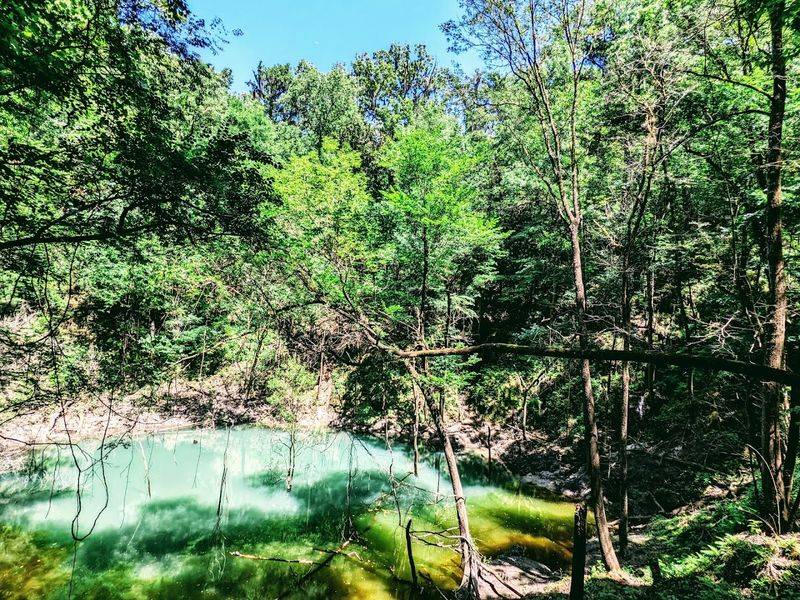
Florida has thousands of sinkholes, but most of them are not the kind you visit on purpose. They tend to appear suddenly, swallowing roads or portions of buildings, and they are rarely celebrated.
Devil’s Millhopper stands apart because it is old, stable, and large enough to have developed its own thriving ecosystem over thousands of years.
At 120 feet deep and roughly 500 feet wide at the top, it is one of the most impressive sinkholes in the state that is open to the public. Its size, depth, and the richness of the plant life inside make it genuinely unusual even by Florida standards.
Other sinkholes in the region exist, but few have the combination of geological exposure, microclimate diversity, and accessibility that this one offers. For anyone curious about how Florida’s karst landscape actually works beneath the surface, this park is one of the clearest and most vivid demonstrations available anywhere in the state.
Why This Park Stays With You Long After You Leave
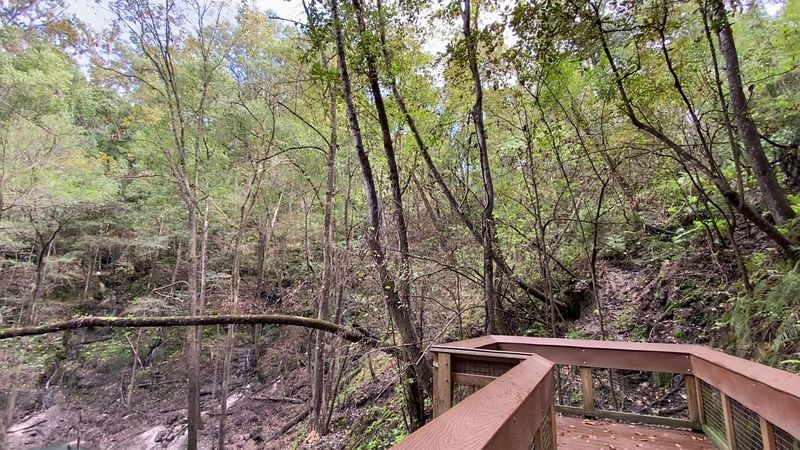
There is something about walking down into the earth and looking up at the sky through a ring of trees that resets your sense of scale in a way few experiences can. The sinkhole is not enormous by global standards, but its depth and the lushness of what grows inside it create a feeling of discovery that is hard to replicate at a more conventional park.
The combination of geology, ecology, history, and sheer visual strangeness makes Devil’s Millhopper one of those places that sticks in your memory longer than its modest size might suggest. It is the kind of spot you find yourself telling people about weeks after your visit.
For four dollars and less than an hour of your time, this park delivers an experience that is genuinely rare, quietly spectacular, and completely unlike anything else in Florida. That is a combination worth seeking out, and once you have been, you will almost certainly want to come back.
Share this story