Key West has no shortage of colorful stories, but one address on Whitehead Street holds more literary weight than almost anywhere else in America. Ernest Hemingway spent nearly a decade living and writing here, producing some of his most celebrated works while surrounded by tropical gardens, a sparkling pool, and a rotating cast of six-toed cats.
The house has been preserved so carefully that you half expect to find a typewriter still warm from a morning writing session. Whether you are a lifelong Hemingway reader or simply someone who appreciates a good story told through a beautifully kept historic home, this Key West landmark delivers an experience that is equal parts personal, fascinating, and genuinely fun.
The Address That Started It All: 907 Whitehead Street

There is something quietly thrilling about standing in front of a building and knowing that real history happened behind its walls. The Ernest Hemingway Home and Museum sits at 907 Whitehead St, Key West, right in the heart of Old Town, one of the most walkable and historically rich neighborhoods on the island.
The house itself is a Spanish Colonial style structure built in 1851, making it one of the oldest and most solidly constructed homes in the area. It was built from local coral rock, which kept it cool in the Florida heat long before air conditioning was a thought.
Hemingway moved in during 1931 with his second wife, Pauline, and the property immediately felt like his kind of place: private, shaded, and surrounded by enough space to think. The museum is open daily from 9 AM to 5 PM, and admission is $19 per person.
Eight Years of Creative Fire: Hemingway’s Time in Key West

Hemingway called Key West home for about eight and a half years, and that stretch turned out to be one of the most productive periods of his entire career. During those years on Whitehead Street, he completed “A Farewell to Arms,” worked on “To Have and Have Not,” and wrote “Death in the Afternoon,” among other major projects.
One fascinating detail that tour guides love to share is that Hemingway wrote 47 different endings to “A Farewell to Arms” before settling on the one readers know today. That kind of relentless revision tells you everything about how seriously he took his craft.
The Key West years were also marked by deep friendships, fishing trips in the Gulf Stream, and a lifestyle that balanced hard creative work in the mornings with outdoor adventure in the afternoons. The house absorbed all of it, and that energy still lingers.
The Writing Studio Above the Carriage House

Ask any visitor what the single most memorable spot on the property is, and a large number will point you toward the writing studio perched above the carriage house out back. It is a compact, no-frills space, which is exactly the point.
Hemingway reportedly preferred to write standing up, early in the morning, before the rest of the household stirred. The studio reflects that discipline: it is spare, focused, and free of unnecessary decoration.
A walkway once connected the studio directly to the main house, though it has not been fully restored, which is a small detail that some visitors wish had been preserved.
The studio sits above what is now the gift shop, and climbing up to it feels like a small pilgrimage. Seeing the actual space where so many celebrated sentences were shaped gives the visit a personal, almost intimate quality that photographs simply cannot replicate.
The Famous Polydactyl Cats of the Property

No visit to this museum is complete without a proper introduction to its most relaxed residents. Around 60 polydactyl cats, meaning cats born with extra toes, roam the property freely at any given time.
Many are believed to be descendants of a six-toed cat that a ship’s captain once gave to Hemingway.
The cats have their own dedicated care staff, their own small cemetery on the grounds, and absolutely zero interest in following anyone’s schedule but their own. Most of them are extraordinarily calm, happy to be admired from a respectful distance or to accept a gentle pat before wandering back to their favorite shady spot.
They are named after famous figures, which adds a layer of charm to the whole experience. A word of friendly advice: do not try to pick them up, as a few have made it very clear they prefer to set the terms of any interaction.
The Guided Tour Experience: Stories You Would Otherwise Miss

Going in without a guide is possible, but the guided tour is where the real magic happens. Tours run every 15 minutes throughout the day and are included with the price of admission, so there is no reason to skip them.
Each guide brings their own personality and emphasis to the stories, which means that taking two tours back to back, as some visitors actually do, can yield entirely different insights. You will hear about the penny Hemingway embedded upside down in the pool surround, which he called his last cent, the history of the rooms, and the habits that shaped his daily routine.
Guides are careful to separate well-worn myths from documented habits, which keeps the tour grounded and genuinely informative rather than sensationalized. The storytelling is engaging enough to hold the attention of visitors who arrived knowing very little about Hemingway and leave feeling genuinely curious about his books.
The Tropical Gardens and Lush Grounds

The grounds surrounding the house are a destination in their own right. Giant trees create a dense, cooling canopy over the garden paths, and koi ponds add a calm, reflective quality to the whole setting.
The landscaping feels both deliberately maintained and naturally wild, which suits the spirit of the place perfectly.
Walking the garden paths between the main house, the pool area, and the outbuildings feels unhurried and pleasant, even on a warm Key West afternoon. The tropical plants, flowering shrubs, and stone walkways give the property a lush, almost secretive atmosphere that makes it easy to linger.
Photographers will find no shortage of compelling angles here, from the shuttered windows of the main house to the dappled light falling across the pool. The exterior architecture and the greenery surrounding it photograph especially well in the softer light of the morning, which is another reason to arrive early.
The Pool: A Legendary Luxury and a Famous Argument

The pool at the Hemingway Home is the kind of detail that sounds like fiction but is completely true. When it was built in the late 1930s, it was the largest private pool in Key West, a remarkable extravagance for its time and place.
The construction cost around $20,000, which was a staggering sum during that era.
Hemingway was famously displeased about the expense and, according to the story told on tours, pressed a penny into the wet concrete of the pool surround and declared it his last cent. That penny is still embedded there today, upside down, and spotting it feels like finding a tiny piece of living history.
The pool replaced what had previously been a boxing ring on the property, which tells you quite a bit about the shift in priorities during those years. It remains one of the most photographed spots on the entire estate.
Inside the Main House: Preserved Rooms and Personal Artifacts

The interior of the main house has been preserved with care and attention to the period in which Hemingway actually lived there. The rooms are furnished in a style that reflects the 1930s, and personal artifacts, original letters, photographs, and memorabilia are displayed throughout the home in glass cases along the walls.
Nothing about the interior feels overdone or theatrical. The rooms are confident and spare, with light coming in cleanly through the louvered shutters, and the overall effect is one of quiet authenticity rather than dramatic staging.
You get a genuine sense of how daily life unfolded in these spaces.
The hunting and fishing trophies mounted around the house, along with Hemingway’s extensive personal library, fill in a portrait of the man that goes well beyond his literary reputation. Seeing the breadth of his reading interests and the objects he chose to surround himself with adds real texture to the experience.
The Architecture: Spanish Colonial Style Meets Florida Practicality

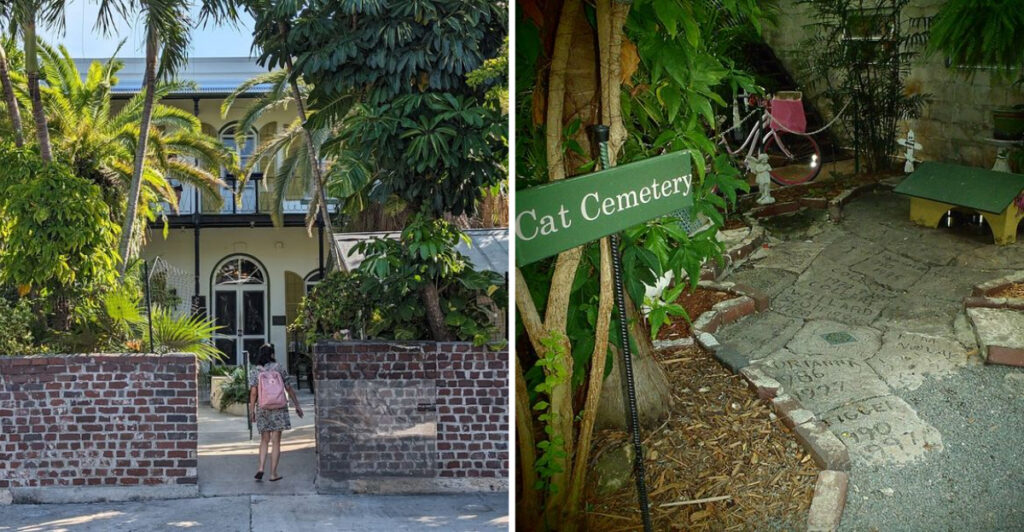
The building itself is worth studying before you even walk through the gate. Constructed in 1851 from local coral rock, the Hemingway Home was built to last and to breathe, two qualities that matter enormously in the Florida Keys.
The thick walls keep the interior noticeably cooler than the outside air, even on the warmest days.
Wide verandas wrap around both floors, providing shaded outdoor space that Hemingway and his family would have used regularly. The green shutters, the arched doorways, and the elevated foundation, which sits slightly above the coral ground to allow for air circulation, all reflect a building designed with its environment in mind.
The architecture has a quiet confidence to it that mirrors the writing style Hemingway became famous for: nothing unnecessary, everything in its right place. The house is genuinely beautiful, and spending time simply looking at it from the garden is a pleasure that does not require any literary knowledge at all.
The Gift Shop: More Than Just Souvenirs

The gift shop sits on the ground floor beneath the writing studio, and it is worth more than a quick glance on the way out. Beyond the expected keychains and magnets, the shop carries a solid selection of Hemingway’s books, which makes it a genuinely useful stop for anyone who leaves the tour feeling inspired to read or reread his work.
Picking up a copy of “The Old Man and the Sea” here, in the place where the man himself once lived, gives the book a different kind of weight. Several visitors have mentioned that the copy they bought at the gift shop became one of their most memorable travel souvenirs, not because of its monetary value but because of the context attached to it.
The shop also carries items related to the cats, the house, and Key West more broadly. It is well curated without feeling cluttered, and the staff are friendly and easy to talk to.
The Cat Cemetery: A Quiet Corner of the Property

Tucked into a shaded corner of the property is a small cemetery dedicated to the cats that have called the Hemingway Home their home over the decades. It is easy to walk past without noticing it, but it is one of those quiet details that adds an unexpected layer of character to the visit.
The markers are modest and the space is peaceful, fitting naturally into the surrounding garden rather than drawing attention to itself. It is a reminder that the cats here are not props or a marketing gimmick but actual residents with their own history and continuity on the property.
For cat lovers especially, the cemetery tends to leave a lasting impression. It speaks to the genuine care that the museum staff put into maintaining the welfare and the legacy of the feline population, which is managed and monitored by a dedicated team year-round.
Practical Tips for Planning Your Visit

A few pieces of practical advice can make the difference between a good visit and a great one. Arriving early, ideally right at the 9 AM opening, is the single most effective way to beat the crowds and the midday heat.
By 11 AM, a line can form at the entrance, and the Florida sun is already doing its best work on anyone standing outdoors.
Admission is $19 per person, and tours are included at no extra charge. Wear light, breathable clothing and bring water, since portions of the visit are spent outdoors in the open air.
Comfortable shoes are also a practical choice, as the property involves some walking and a set of fairly steep stairs inside the main house.
Photography is permitted throughout the property, though flash photography is not allowed indoors. Street parking is available along Whitehead Street and nearby blocks, and a small on-site lot fills quickly, so arriving early solves that problem too.
The Hemingway Home for Non-Readers: Why It Works for Everyone

Not everyone who walks through the gate on Whitehead Street has read a single Hemingway novel, and that is perfectly fine. The house, the gardens, the cats, and the stories told on the guided tour hold up as a compelling experience regardless of how familiar you are with his bibliography.
The history of the building itself, the Key West of the 1930s, the personal details of how Hemingway lived and worked, and the sheer beauty of the property all combine to create something that appeals to history enthusiasts, architecture lovers, and cat fans just as much as it does to literary devotees.
Several visitors have noted that they arrived knowing very little about Hemingway and left genuinely curious, picking up one of his books at the gift shop on the way out. That kind of conversion is a testament to how well the museum tells its story without requiring any prior knowledge from its guests.
The Atmosphere of Old Town Key West Around the Museum

The museum does not exist in isolation. It sits in the middle of Old Town Key West, one of the most charming and walkable historic districts in the entire state of Florida.
The streets around the property are narrow, lined with mature trees, and filled with the kind of unhurried energy that makes Key West feel like a world slightly apart from everywhere else.
After finishing the tour, the natural next step is to simply walk. Duval Street is close by, as are smaller side streets full of local color, architecture, and good places to find lunch.
The rhythm of the neighborhood, work in the morning and then let the island take over in the afternoon, is exactly what Hemingway himself followed during his years here.
The location of the museum makes it easy to fold into a longer day of exploring Old Town, and the walk between major landmarks is genuinely pleasant rather than a chore.
Share this story