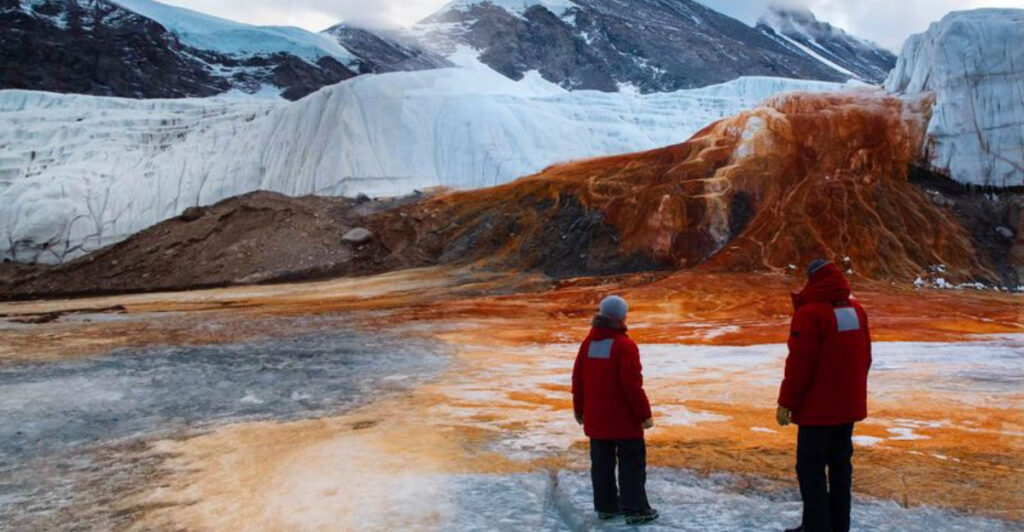
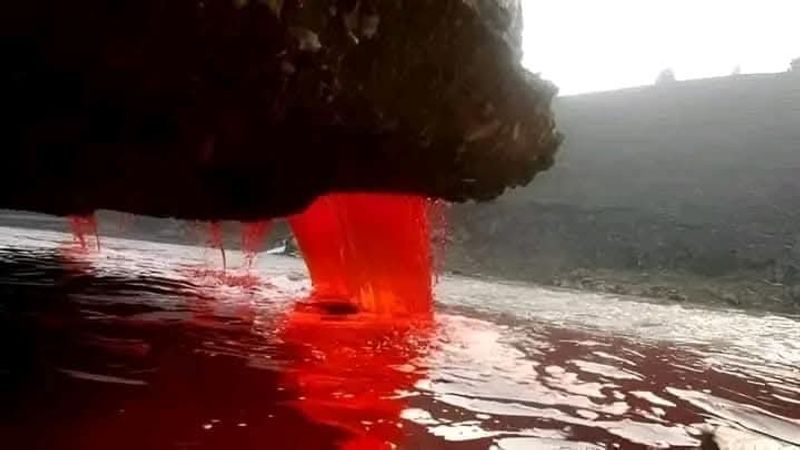
Hidden deep in one of the coldest corners of the world, Antarctica’s Blood Falls looks like something straight out of a science fiction movie. A vivid red waterfall flows from a glacier, staining the icy landscape with what appears to be blood.
But the real story behind this strange phenomenon is even more incredible than its appearance. From ancient trapped seawater to alien-hunting scientists, Blood Falls is one of nature’s most jaw-dropping mysteries.
1. Blood Falls Was First Discovered in 1911
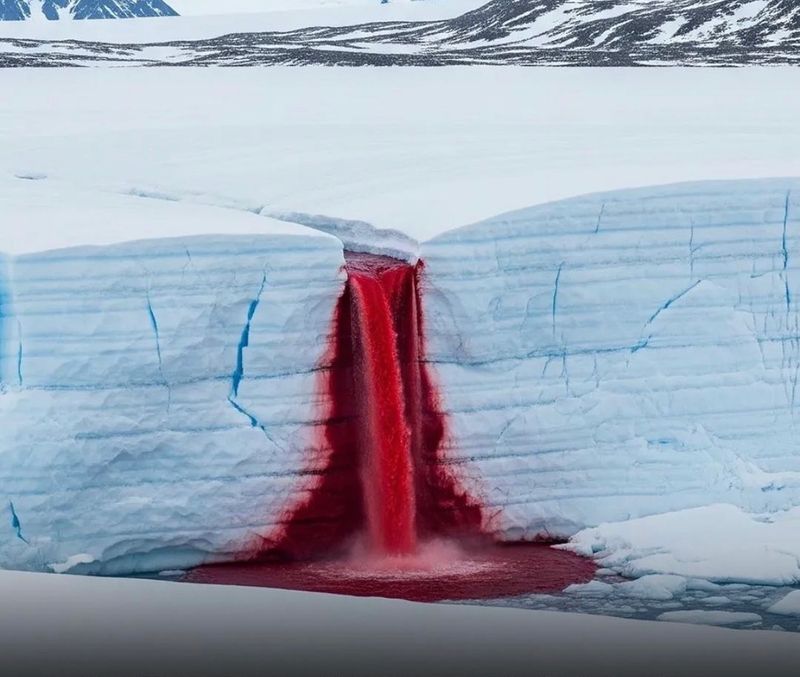
Back in 1911, explorers on the Terra Nova Expedition stumbled upon something that must have seemed almost unbelievable. Australian geologist Thomas Griffith Taylor spotted a vivid red waterfall spilling out of a glacier in the McMurdo Dry Valleys.
Nobody had ever seen anything like it before.
Taylor and his team were in Antarctica to study its geology, not to solve mysteries. Yet this strange, blood-colored flow would go on to puzzle scientists for over a century.
The glacier where it flows was later named Taylor Glacier in his honor.
At first, scientists thought the red color came from red algae living in the water. It took decades of research and modern technology to finally uncover the true cause.
Few discoveries in polar exploration have sparked as much scientific curiosity as this one has over the years.
2. It Sits in One of the Harshest Places on Earth
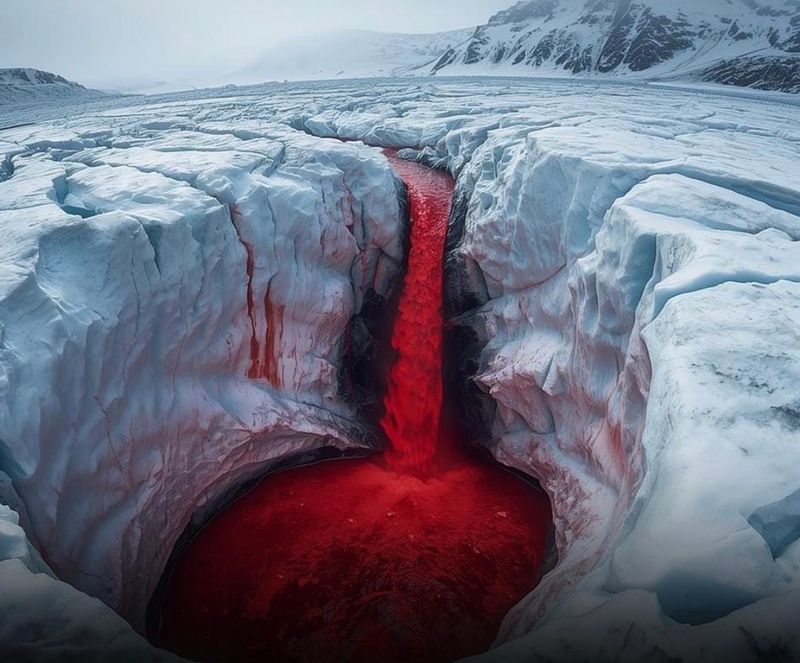
The McMurdo Dry Valleys are unlike almost anywhere else on Earth. Fierce winds called katabatic winds sweep moisture away so quickly that very little snow ever settles here.
The result is a bone-dry, bitterly cold desert that looks more like another planet than a place on Earth.
Temperatures in this region can plunge far below freezing, and the sun does not rise for months during the Antarctic winter. Scientists who work here describe conditions that push human endurance to its limits.
Equipment freezes, skin dries out, and even breathing can feel painful in the frigid air.
Because of how extreme the environment is, researchers have long compared the McMurdo Dry Valleys to the surface of Mars. That comparison makes Blood Falls even more fascinating, since it shows that liquid water and life can exist even in the most punishing landscapes imaginable.
3. The Red Water Contains No Blood Whatsoever
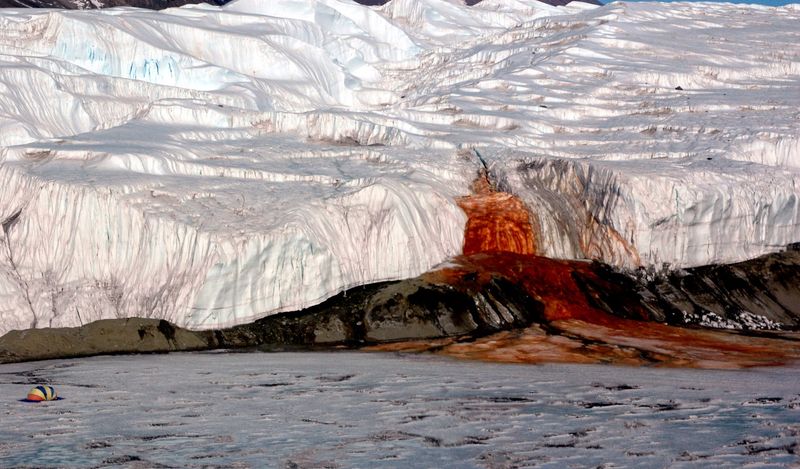
Seeing a bright red waterfall for the first time, it is easy to understand why early explorers were startled. The color is so intense and so lifelike that the name Blood Falls stuck immediately.
But despite looking remarkably like blood, not a drop of the actual substance is involved.
The real culprit is iron-rich saltwater. When the iron dissolved in the water comes into contact with oxygen in the air, a chemical reaction occurs.
The iron oxidizes, which is essentially the same process that creates rust on metal, and that reaction produces the deep, striking red color.
Think of it like leaving a nail outside in the rain. Over time, it turns orange-red with rust.
Blood Falls works the same way, just on a much grander and more dramatic scale. The science is straightforward, but the visual result is genuinely spectacular and hard to forget.
4. An Ancient Saltwater Reservoir Powers the Falls
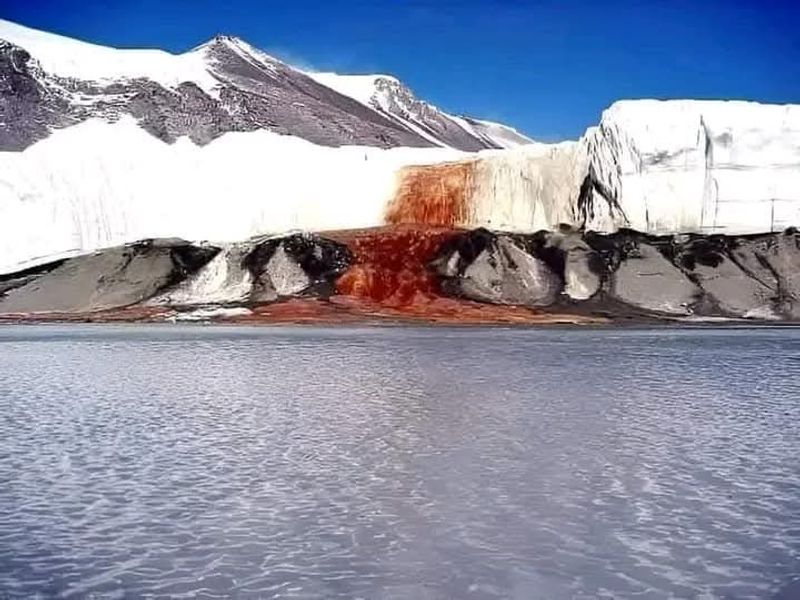
Beneath Taylor Glacier, locked away under roughly 400 meters of solid ice, lies a pool of ancient seawater. Scientists believe this water became trapped millions of years ago when glaciers advanced and sealed off the area from the ocean.
Since then, it has been sitting in total darkness, completely cut off from the outside world.
What makes this especially remarkable is the age of the water itself. Some estimates suggest the brine could be around 1.5 million years old or more.
That means the water feeding Blood Falls may have been isolated longer than modern humans have even existed on Earth.
Finding a liquid water reservoir hidden beneath thick Antarctic ice was a major scientific breakthrough. It opened up new questions about what kinds of environments can support water and, potentially, life.
The discovery changed how researchers think about hidden water systems in extreme cold regions around the world.
5. The Water Stays Liquid Thanks to Extreme Saltiness
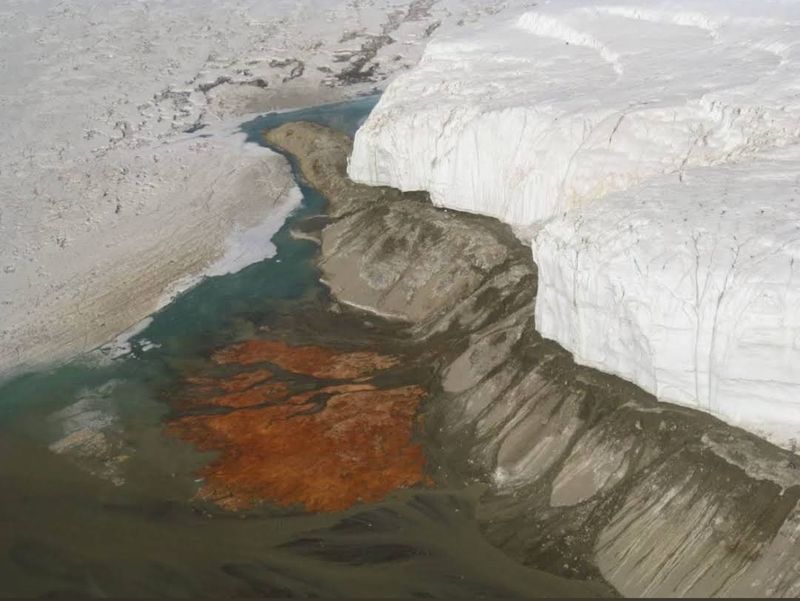
Pure water freezes at 32 degrees Fahrenheit (0 degrees Celsius), but the brine beneath Taylor Glacier does not play by those rules. The water is so loaded with salt that its freezing point drops dramatically, allowing it to remain liquid even when the surrounding ice is brutally cold.
Scientists call this kind of water hypersaline brine.
To put it in everyday terms, think about how cities sprinkle salt on icy roads in winter. Salt lowers the freezing point of water, which melts the ice.
The same chemistry is happening deep beneath the glacier, just on a far more extreme scale than any road crew could manage.
The salt concentration in the subglacial brine is nearly three times saltier than the ocean. That is salty enough to preserve the water in liquid form even at temperatures well below what most liquids could handle.
Without this property, Blood Falls simply would not exist.
6. The Glacier Essentially Squeezes the Water Out
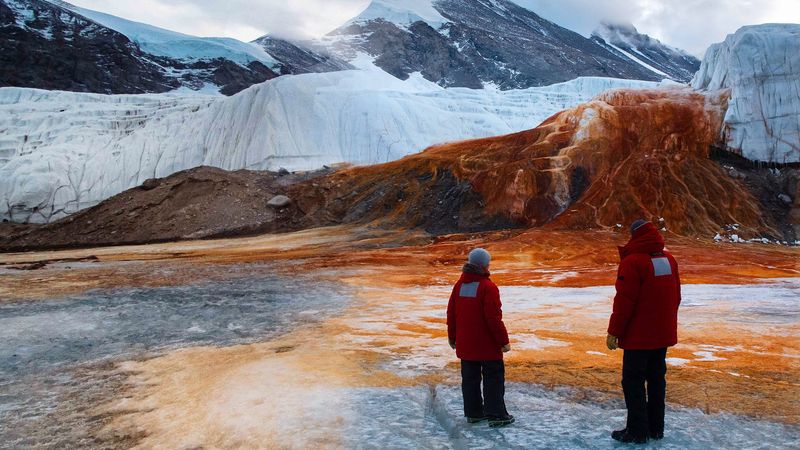
Glaciers are not as still as they look. Taylor Glacier is constantly moving, creeping forward under its own massive weight.
As it slides, pressure builds up in the brine-filled cracks and spaces beneath the ice. Eventually, that pressure has nowhere to go but up and out.
When the pressure becomes strong enough, the brine is forced through fractures in the glacier and released in short, powerful bursts at the surface. This is why Blood Falls does not flow in a steady, gentle stream like a typical waterfall.
Instead, it surges out in episodes, almost as if the glacier is breathing and releasing tension.
Researchers describe the process as similar to squeezing a tube of toothpaste. The glacier acts as the tube, and the brine acts as the toothpaste being pushed out through the opening.
Understanding this mechanism helped scientists finally explain why Blood Falls behaves so differently from other Antarctic water features.
7. A Fortunate Chain of Events Cracked the Mystery Open

For years, scientists knew what Blood Falls looked like, but they could not fully explain how the water got to the surface. Then in 2018, a lucky combination of instruments all recorded the same event at exactly the same moment, and the puzzle finally began to come together.
A GPS tracker detected the glacier sinking slightly. A camera positioned nearby captured the red brine suddenly appearing on the surface.
At the same time, a sensor in a nearby lake registered cold, salty water entering from underground. Three separate pieces of equipment, all pointing to the same underground event, happening simultaneously.
That kind of multi-instrument observation is rare in field science, especially in Antarctica where harsh conditions make precise measurements difficult. Scientists described it as a breakthrough moment that confirmed their theories about how pressure drives the brine upward.
Sometimes, good timing and careful preparation make all the difference in scientific discovery.
8. Tiny Iron Nanoparticles Are Behind the Bold Red Color
Earlier scientists assumed the red color came from crystalline iron minerals, the kind you can see and identify under a standard microscope. But more recent research revealed something far more interesting hiding in the water.
The color actually comes from microscopic iron-rich nanospheres, particles so small they were invisible to older research methods.
Nanospheres are not like typical mineral crystals. They are round, ultra-tiny particles that behave differently from the iron compounds scientists had previously studied.
Because they are not crystalline, early researchers kept looking past them without realizing what they were seeing. It was only with advanced imaging technology that these particles were finally identified.
This discovery matters beyond Blood Falls itself. Finding a new type of iron particle in nature could have broader implications for understanding how iron behaves in cold, salty environments.
It is a reminder that even well-studied phenomena can still hold surprises when scientists look closely enough with the right tools.
9. Microbes Thrive in the Pitch-Dark Brine Below

No sunlight. No oxygen.
Temperatures well below freezing. For most living things, those conditions would be a death sentence.
But tucked inside the ancient brine beneath Taylor Glacier, a community of microbes has been quietly surviving for possibly millions of years.
These organisms are called extremophiles, meaning they thrive in conditions that would destroy most other life forms. Rather than using sunlight or oxygen for energy, they rely on chemical reactions involving iron and sulfur.
This process, known as chemosynthesis, allows them to extract just enough energy to survive in their frozen, lightless home.
What makes this discovery especially striking is how isolated these microbes are. They have been cut off from the rest of the world for an enormous stretch of time, yet they kept living.
Studying how they manage to survive gives scientists a window into the possibilities of life in environments far beyond what we once considered survivable.
10. Blood Falls May Hold Clues to Life Beyond Earth

When scientists find life thriving in the harshest places on Earth, they naturally start wondering about other planets. Blood Falls has become one of the most compelling examples of how life can survive in cold, dark, oxygen-free environments sealed beneath thick layers of ice.
Jupiter’s moon Europa and Saturn’s moon Enceladus are both thought to have vast liquid oceans hidden beneath their frozen surfaces. Mars may have had underground liquid water in the past, and some researchers believe pockets of brine could still exist there today.
If microbes can survive under Taylor Glacier, similar life could exist in those distant icy worlds.
Blood Falls has essentially become a testing ground for astrobiology, the science of searching for life beyond Earth. Every new finding about how organisms survive in the subglacial brine feeds directly into theories about what future space missions should look for.
Antarctica, it turns out, might be our best guide to the universe.
Share this story