Out in the sun-scorched desert of Southern California, there is a hillside that looks like it was painted by someone who truly believed color could change the world. A self-taught artist spent over three decades covering a natural mound with adobe, hay, and thousands of gallons of paint, turning a remote patch of land into something that now draws visitors from every corner of the globe.
The story behind it is as vivid as the reds and yellows that coat every surface. From curious road-trippers to documentary filmmakers, people keep making the trek out here, and once you see it for yourself, it is not hard to understand why this place has earned a permanent spot on so many bucket lists.
Where to Find This Colorful Desert Landmark
The address is Beal Road, Niland, CA 92257, and getting there is part of the adventure. Niland sits on the eastern edge of the Salton Sea in the Imperial Valley of Southern California, a region that feels wonderfully remote and far removed from the polished tourist circuits of Los Angeles or San Diego.
The road leading out to the site runs through the edges of Slab City, a famous off-grid community that adds its own layer of character to the journey. The pavement gets rougher as you approach, and the desert stretches wide in every direction, flat and sun-baked.
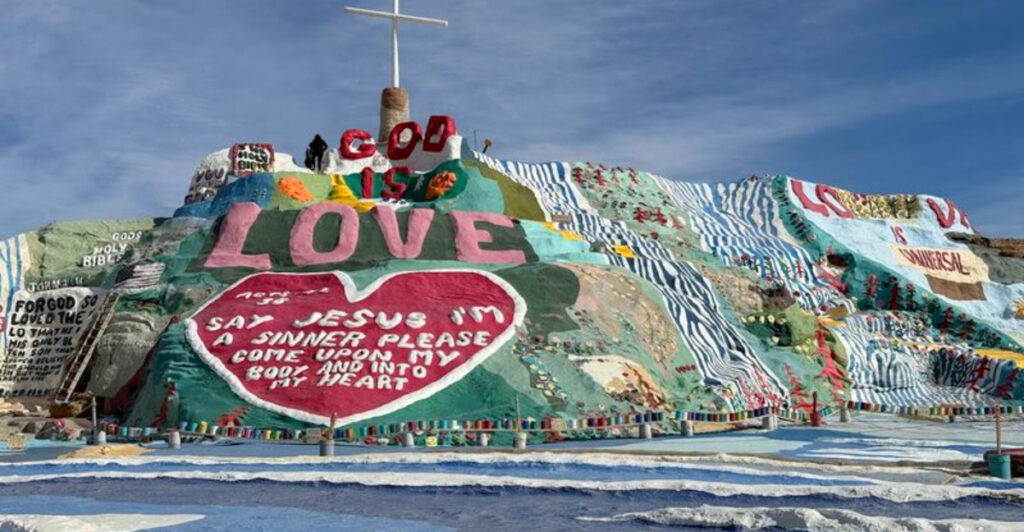
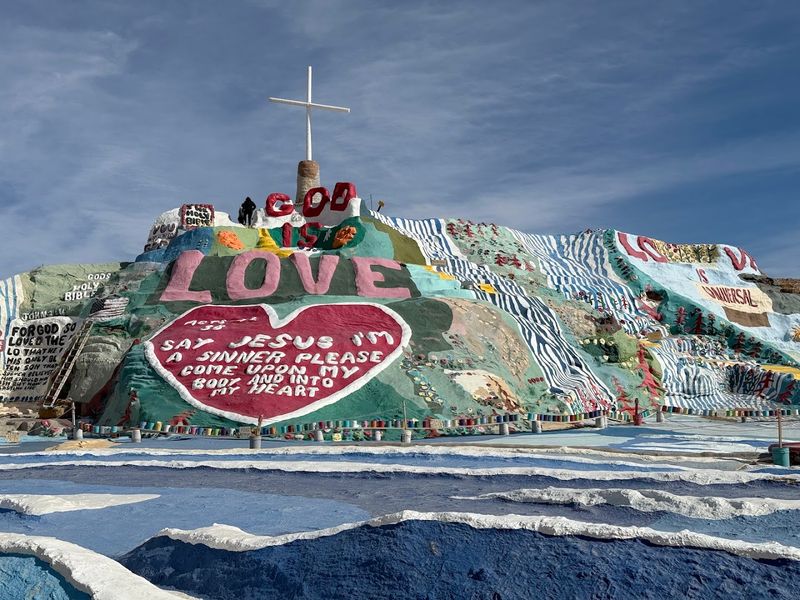
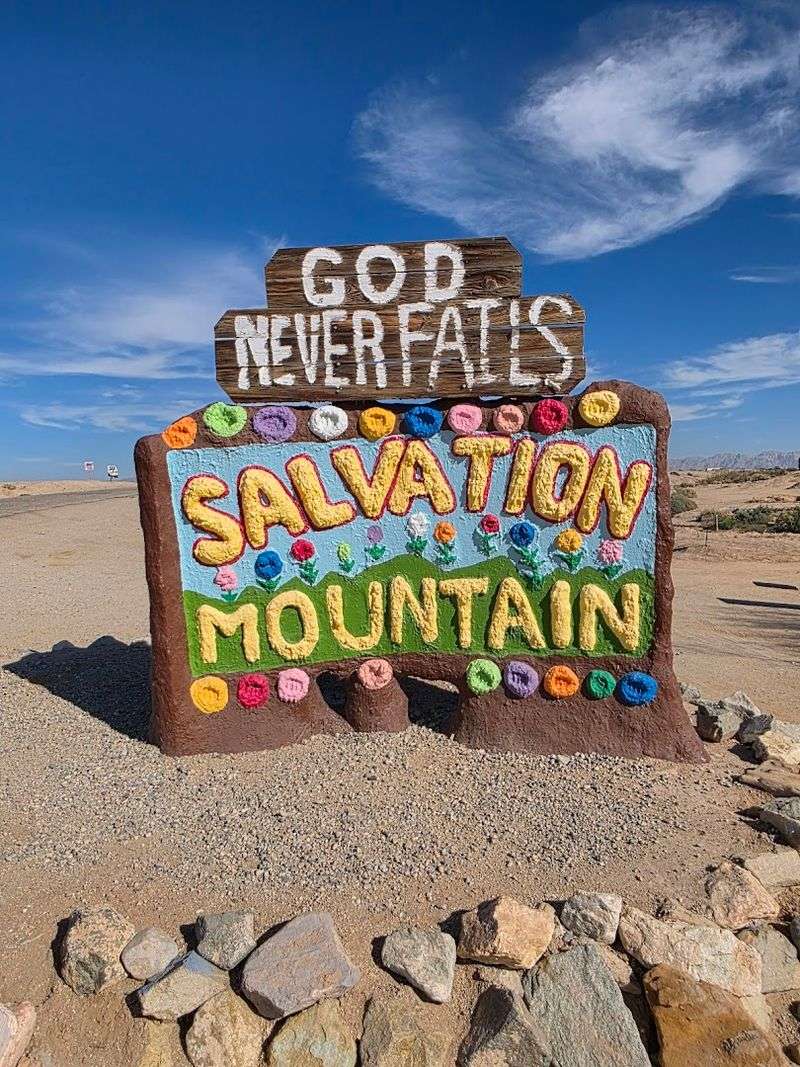
Then, almost without warning, a burst of color appears on the horizon. The mountain rises from the earth in shades of red, yellow, blue, and white, impossible to miss against the pale desert background.
Parking is free, the entrance is free, and the site is open every day from 8 AM to 4:30 PM. For anyone driving through the California desert, this stop is genuinely worth every extra mile on the odometer.
The Man Behind the Mountain: Leonard Knight’s Story
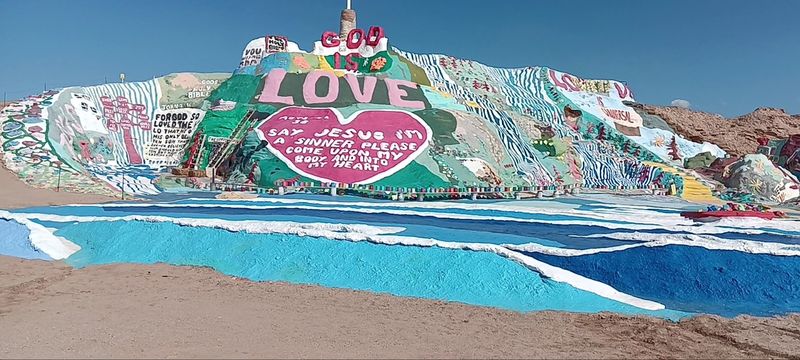
Leonard Knight was not an architect, an engineer, or a trained artist. He was a Vermont-born man who arrived in the California desert in the early 1980s with a simple message he wanted to share with the world: “God is Love.”
His original plan was to launch a hot air balloon carrying that message, but when the balloon failed, he stayed. He started piling adobe and hay onto a small hill near Niland, then covered every inch with layers of paint.
What began as a modest project grew into a massive structure over 50 feet tall and over 150 feet wide.
Knight worked on the mountain for more than 28 years, often living on-site in a truck with no running water or electricity. He accepted donations of paint and supplies from visitors who stopped to watch him work.
Leonard passed away in 2014, but his creation still stands as one of the most personal and heartfelt artistic statements in American history, drawing comparisons to folk art traditions seen nowhere else in the country.
A Structure Built From Faith, Adobe, and Sheer Willpower
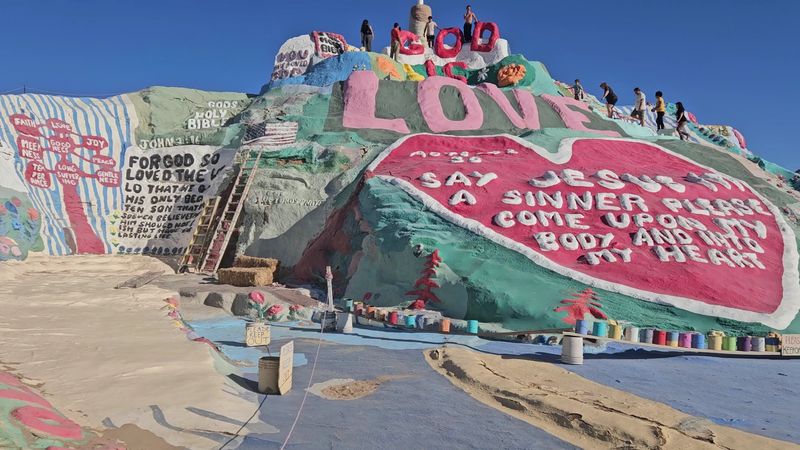
The physical construction of Salvation Mountain is, on its own, a remarkable engineering story. Knight used adobe clay mixed with straw and hay as the base material, applying layer after layer by hand to build up the mountain’s shape over decades.
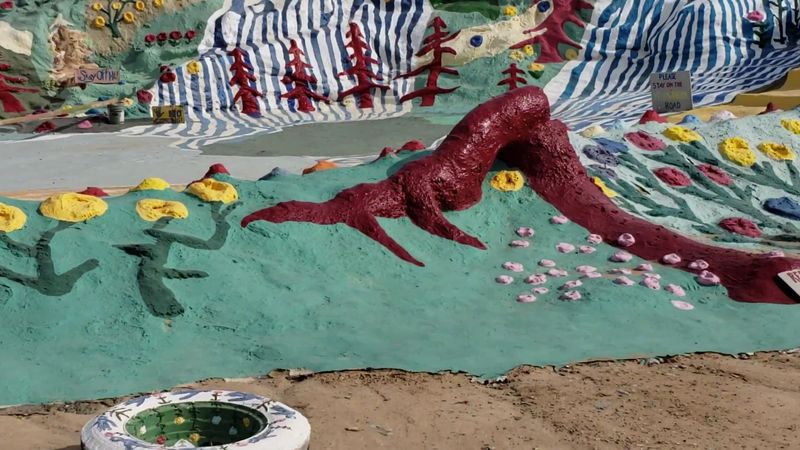
He then coated every surface with exterior latex paint, using an estimated 100,000 gallons of donated paint throughout the project’s lifetime. The layers are thick and textured, creating a surface that almost looks like cake frosting up close, with waves, ridges, and sculptural details built up over years of work.
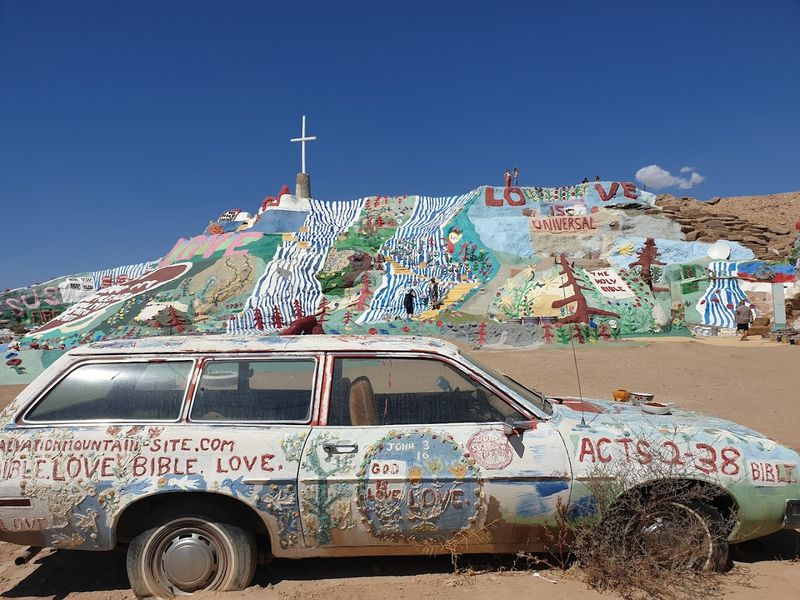
Painted flowers, trees, birds, and biblical phrases cover the entire structure from base to peak. The words “God Is Love” sit prominently at the top, visible from a surprising distance across the flat desert floor.
The sheer physical effort involved is staggering when you stand next to it and realize one person did all of this with his hands. The mountain is a testament to what focused, patient, and deeply personal effort can produce over time.
The Spiritual Message Woven Into Every Surface
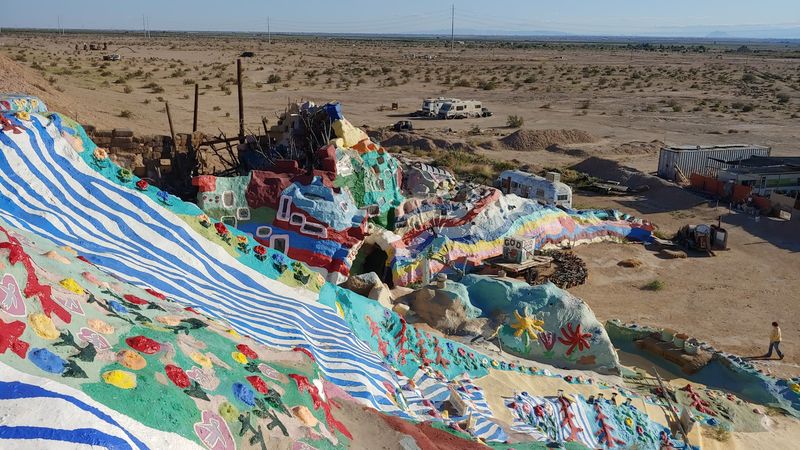
Every inch of Salvation Mountain carries a message. Knight was deeply motivated by his Christian faith, and he wanted the mountain to serve as a public declaration of God’s love for humanity.
Biblical verses, prayers, and the phrase “God Is Love” appear repeatedly across the structure in large, hand-painted letters.
The Sinner’s Prayer is painted across a wide section of the lower facade, and passages from the New Testament are worked into the design throughout. Despite the explicitly religious content, the mountain has always attracted visitors of all backgrounds, including those with no religious affiliation at all.
The colors and craftsmanship are so visually engaging that even secular visitors find themselves spending significant time exploring every corner. The message is presented without judgment or pressure, which may explain why the site feels welcoming rather than exclusive.
Much like folk art traditions found in parts of Oklahoma and other American states, Salvation Mountain reflects one individual’s need to express something deeply personal through a public and permanent creative act.
What the Site Actually Looks Like Up Close
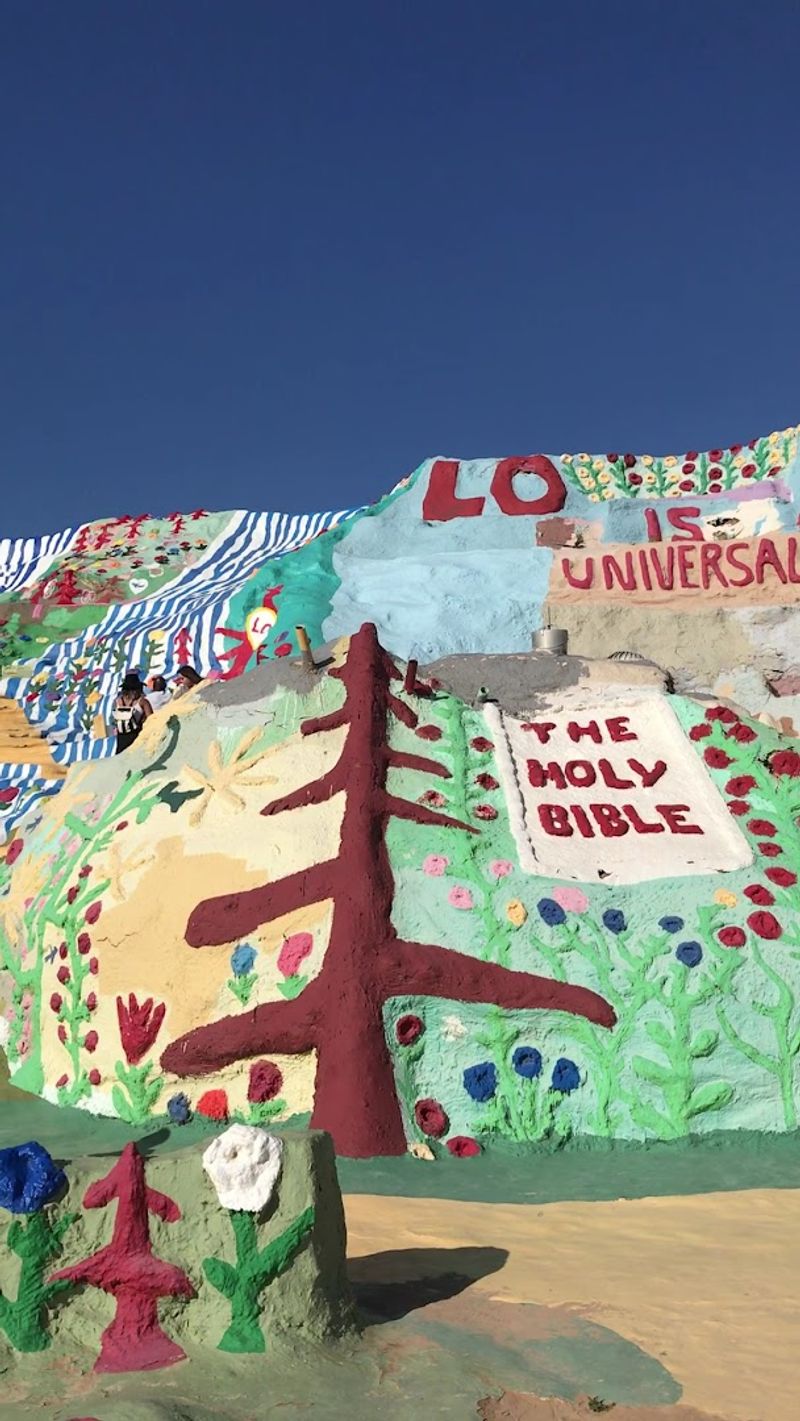
Photos of Salvation Mountain are everywhere online, but nothing fully prepares you for the scale and sensory experience of seeing it in person. The colors are far more saturated and vivid than any camera seems to capture, especially on a bright desert morning when the sunlight hits the painted surfaces directly.
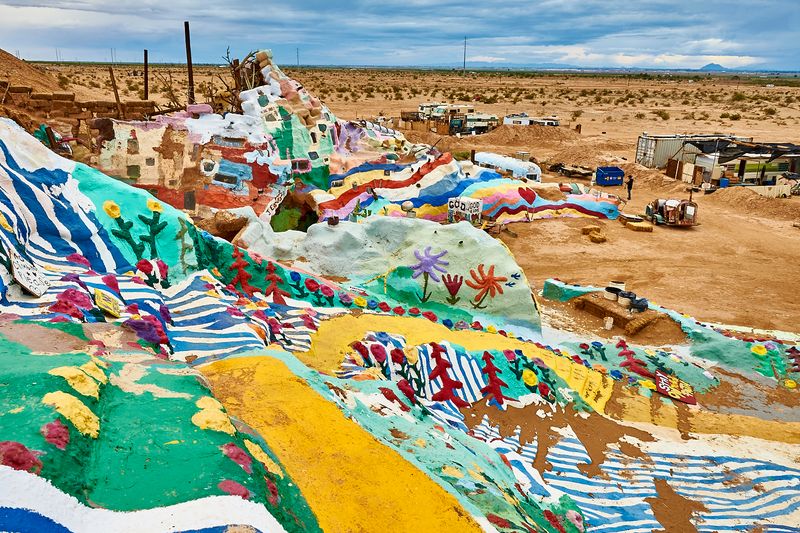
The mountain’s face is divided into distinct zones, each with its own painted landscape of flowers, rivers, trees, and text. A path winds up one side of the structure to the top, offering a view across the surrounding desert that stretches for miles in every direction.
The climb is steep in places, so sturdy footwear is a practical necessity.
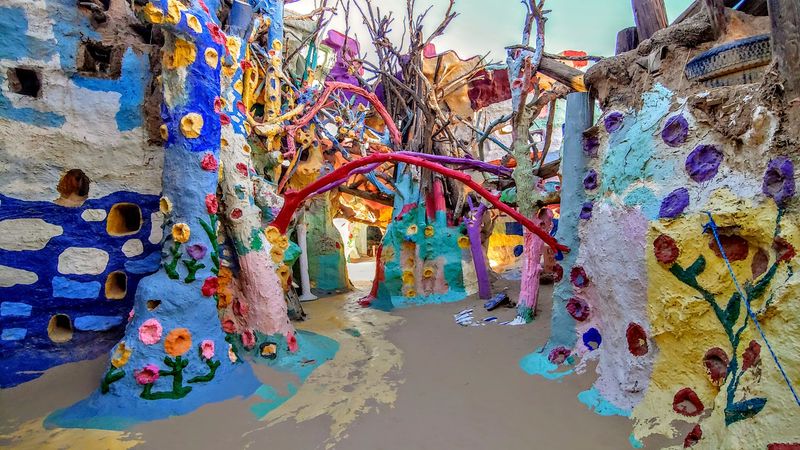
At the base, there are several small adobe rooms and passageways that Knight built over the years, though some sections are currently closed for restoration and safety reasons. Volunteers are typically on-site during opening hours, happy to share the history and answer questions.
The whole visit takes between 30 minutes and an hour, though the new audio tour featuring real recordings of Leonard himself is worth taking your time with.
The Surrounding Desert and Slab City Next Door
The landscape surrounding Salvation Mountain is part of what makes the visit so memorable. The Imperial Valley desert is flat, dry, and almost eerily quiet, which makes the mountain’s explosion of color feel even more dramatic by contrast.
Directly adjacent to the site is Slab City, a legendary off-grid community built on the concrete slabs left behind after a World War II military base was decommissioned. Slab City has no running water, no electricity grid, and no formal governance, attracting a mix of full-time residents, artists, and seasonal travelers who value freedom and self-sufficiency above comfort.
A short drive from Salvation Mountain within Slab City is East Jesus, an outdoor art installation that transforms salvaged materials into large-scale sculptures and environments. The combination of Salvation Mountain, Slab City, and East Jesus creates an experience unlike anything else in California or, frankly, anywhere else in the United States.
Visitors who have traveled widely, including through the art-rich landscapes of places like Oklahoma, often describe this corner of California as genuinely one-of-a-kind.
Recognition, Controversy, and a Fight to Survive
Salvation Mountain’s existence has not always been secure. In 1994, Imperial County officials declared the structure a toxic waste site, citing concerns about the lead content in the paint Knight had used.
The announcement threatened to result in the mountain’s removal entirely.
Knight fought back with the help of supporters and eventually commissioned independent testing that found no significant environmental hazard. The controversy brought national attention to the site and rallied a broad coalition of artists, religious groups, and free-speech advocates to his cause.
In 2000, the United States Congress officially recognized Salvation Mountain as a national treasure, a designation that provided both symbolic protection and public visibility. Folk Art magazine named it one of the thirteen great pieces of American folk art, placing it alongside works from states like Oklahoma and beyond.
A San Diego-based church organization now manages and maintains the site, covering operational costs and restoration work entirely through donations. The fight to preserve the mountain is ongoing, as the desert climate and natural weathering constantly test the adobe structure’s durability.
The Global Spotlight: Film, Media, and Pop Culture
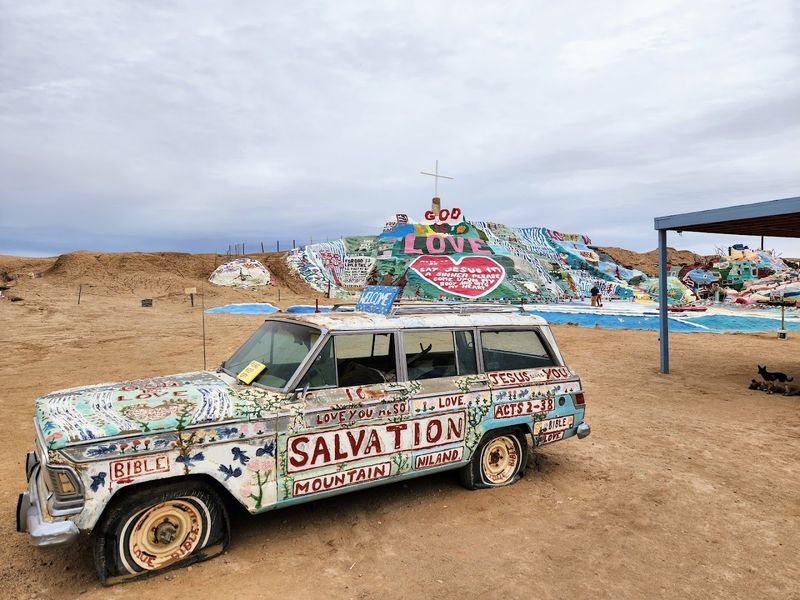
Salvation Mountain found a massive new audience when it appeared in Sean Penn’s 2007 film “Into the Wild,” the adaptation of Jon Krakauer’s book about Christopher McCandless. The film’s depiction of the mountain and the surrounding Slab City area introduced the site to millions of viewers worldwide who had never heard of it before.
Since then, the location has appeared in music videos, fashion editorials, travel documentaries, and countless social media posts. It has become one of the most photographed destinations in all of Southern California, despite sitting in one of the state’s most remote corners.
Documentaries focused specifically on Leonard Knight and his creation have been produced and screened at film festivals, bringing his personal story to audiences far beyond the desert. The mountain’s visual appeal translates well to any medium, which partly explains its enduring presence in popular culture.
Much like certain iconic folk art environments found in states such as Oklahoma, Salvation Mountain has crossed the line from regional curiosity to internationally recognized cultural landmark, and that transition happened entirely through the power of one man’s vision.
Practical Tips for Planning Your Visit
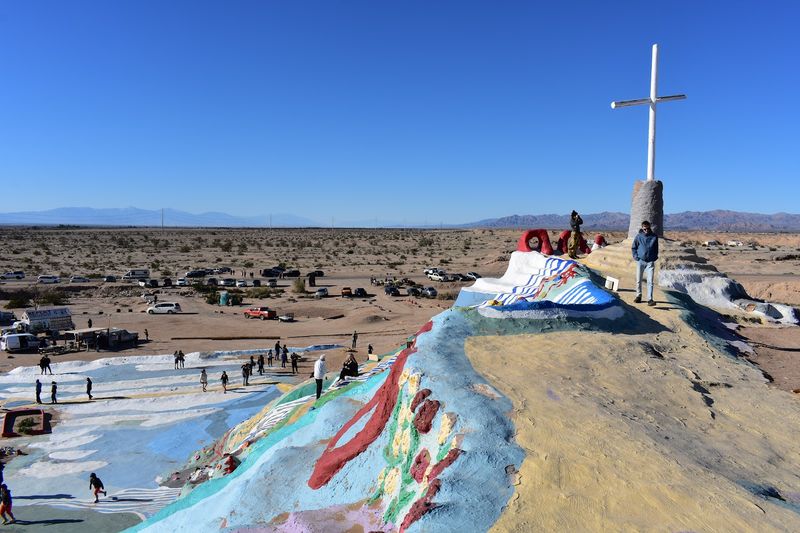
A visit to Salvation Mountain rewards those who plan ahead, especially when it comes to timing and supplies. The desert heat around Niland can be extreme, particularly from late spring through early fall, when temperatures regularly climb well above 100 degrees Fahrenheit during midday hours.
The best time to visit is from October through March, when cooler temperatures make the outdoor experience genuinely comfortable. Arriving early in the morning allows you to explore before the sun reaches full intensity, and the light in the early hours is particularly beautiful for photography.
Bring more water than you think you need, wear sunscreen generously, and pack a hat with a wide brim. The site has portable restrooms available on-site, which is a practical detail worth knowing before you drive out into the middle of the desert.
The entrance is completely free, though donations are warmly appreciated and directly support ongoing maintenance and restoration. The phone number for the site is 760-624-8754, and the official website at salvationmountaininc.org has updated information on current conditions and access restrictions.
The Audio Tour and Volunteer Experience On-Site
One of the most underrated aspects of a visit to Salvation Mountain is the human element. Volunteers are present during operating hours and bring genuine enthusiasm and deep knowledge to every conversation.
They hand out informational pamphlets, share stories about Leonard Knight’s life and working methods, and make even a brief visit feel personal and meaningful.
The site recently introduced an audio tour that runs approximately 30 minutes and includes actual recorded audio of Leonard Knight speaking in his own voice. Hearing him describe his motivations, his process, and his faith in his own words adds a layer of connection that no written description can replicate.
The audio tour is available on-site and transforms a visual experience into something more immersive. Visitors who take the time to engage with the volunteers or complete the audio tour consistently report that their understanding and appreciation of the mountain deepens significantly.
The staff genuinely enjoy talking with visitors, and some conversations stretch well beyond the tour itself into wide-ranging discussions about art, faith, and what drives a person to build something this extraordinary with their own two hands.
Why Artists and Travelers Keep Coming Back
The creative community has embraced Salvation Mountain in a way that goes beyond simple admiration. Artists, photographers, designers, and filmmakers return repeatedly because the mountain offers something genuinely rare: a handmade environment of this scale that feels both intensely personal and completely open to interpretation.
The colors shift dramatically depending on the time of day and the season, making each visit visually distinct from the last. Early morning light gives the reds a warm, almost amber quality, while late afternoon casts long shadows that add depth to the painted textures.
Sunset from the top of the mountain, with the desert spreading out in every direction, is a specific experience that visitors describe with consistent reverence.
The folk art tradition that Salvation Mountain represents has parallels in other parts of the country, including Oklahoma, where individual creators have built environments of personal and spiritual significance outside the formal art world. What sets this California landmark apart is its combination of scale, color, isolation, and the completeness of Leonard Knight’s singular vision.
Returning visitors often say the mountain feels different each time, which may be the highest compliment any work of art can receive.
A Lasting Legacy in the California Desert
Leonard Knight never set out to become famous. He wanted to share a message, and he chose the most direct method available to him: covering a hillside in paint until the whole world could see it.
The fact that his creation outlived him and continues to draw visitors from across the globe would likely have felt like the best possible outcome to a man who measured success in sincerity rather than statistics.
The mountain now serves as a gathering point for people with vastly different backgrounds, beliefs, and reasons for making the trip out to the California desert. Some come for spiritual reflection, some for photography, some simply out of curiosity about what one determined person can build in a lifetime.
The ongoing restoration work ensures that future generations will have the chance to stand at the base of that painted hillside and feel the same quiet astonishment that first-time visitors feel today. In a cultural landscape full of polished productions and calculated experiences, Salvation Mountain remains something genuinely handmade, personal, and free, which may be exactly why it keeps finding new admirers with every passing year.
Share this story