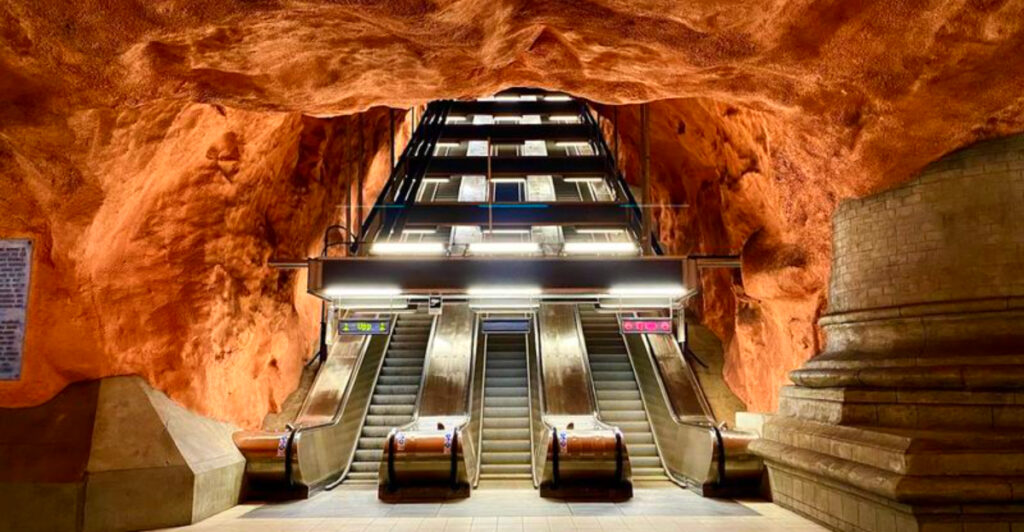
Most people count subway stations by how many stops until their destination. But in some cities around the world, the station itself is the destination.
Architects, artists, and city planners have turned ordinary transit stops into jaw-dropping spaces filled with mosaics, sculptures, ancient artifacts, and bold architectural designs that rival any museum above ground. From copper-clad walls inspired by Jules Verne to glass domes the size of a small stadium, these stations prove that public transportation does not have to be boring.
Some took decades of planning, others were born from a single artist’s wild vision, and a few accidentally became museums when construction crews dug up history along the way. Get ready to rethink everything you thought you knew about catching a train.
1. Toledo Station – Naples, Italy
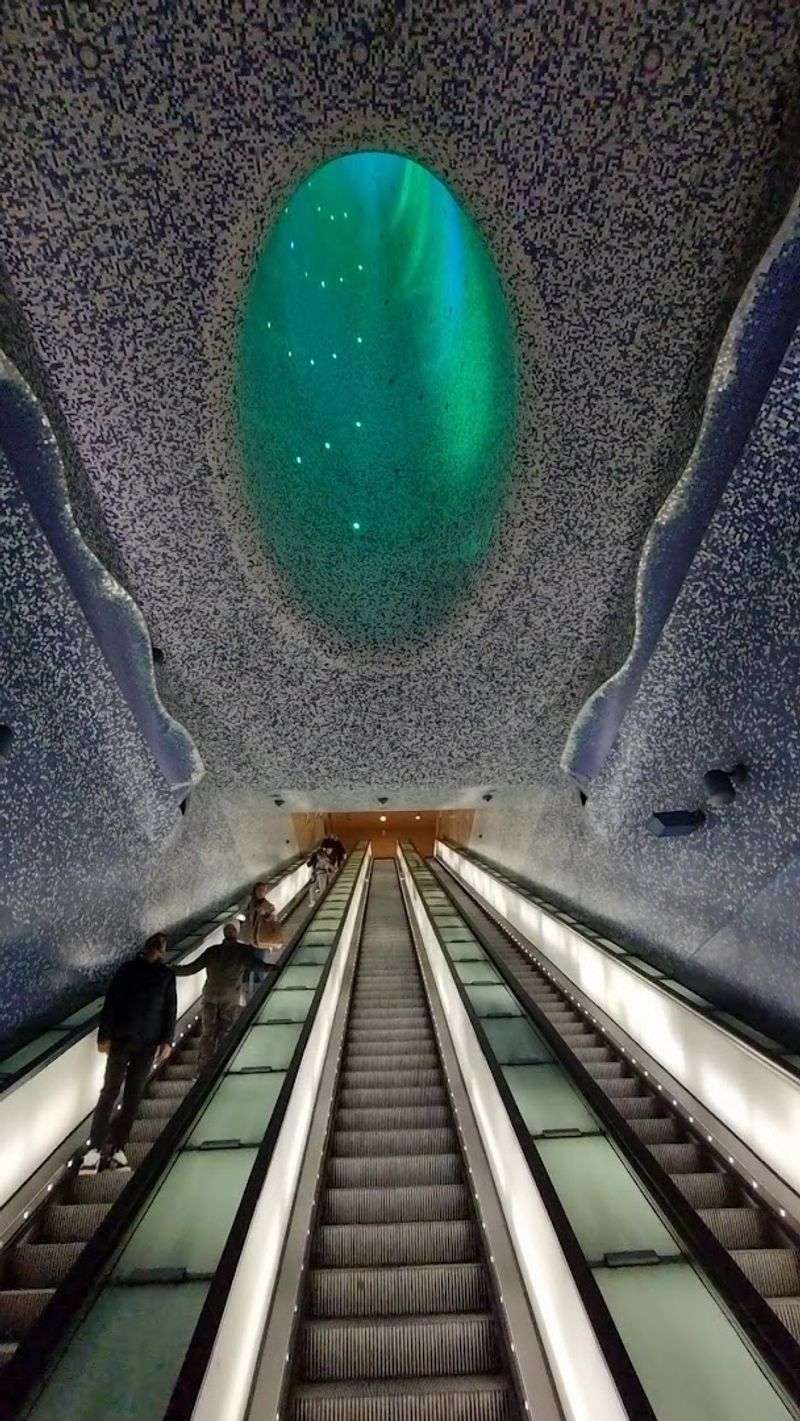
Opened in 2012, Toledo station on Naples Metro Line 1 has earned a reputation as one of the most breathtaking transit spaces in the world. Spanish architect Oscar Tusquets Blanca designed it around a sea-and-light theme, complete with a “Crater de Luz,” a large cone-shaped opening that channels natural light down through every level of the station.
The mosaic walls shift from deep navy at the bottom to lighter shades near the surface, a deliberate nod to the ocean above Naples. Artist Robert Wilson contributed a luminous installation, while William Kentridge added mosaics depicting Neapolitan street life.
During construction, workers uncovered ancient Greek and Roman ruins, which are now displayed inside the station itself.
2. Solna Centrum – Stockholm, Sweden
Red paint covers an entire cave ceiling here, which is not something you expect when your only plan was to catch a train to work. Solna Centrum, part of Stockholm’s famous “Tunnelbana” art project, was designed by artists Anders Aberg and Karl-Olov Bjork and opened in 1975.
The red ceiling and green murals depicting a dying forest were intended as a political statement about urban sprawl and environmental neglect, which makes this station one of the few transit stops with an actual agenda. The raw rock walls were left unpainted and unfinished, giving the whole space a dramatic, cave-like character.
Nearly 50 years later, commuters still stop to look up.
3. Arts et Métiers – Paris, France
Belgian comic artist Francois Schuiten transformed this station’s Line 11 platform into something that looks like the interior of a 19th-century submarine. Copper plates cover the walls, large cogs line the ceiling, and circular porthole windows display scenes connected to the nearby Conservatoire National des Arts et Metiers, one of France’s oldest science museums.
The redesign was completed in 1994 to celebrate the museum’s bicentenary, and the inspiration came directly from Jules Verne’s fictional worlds. Every rivet, every porthole, and every gear was placed with intention.
Visitors who step onto this platform for the first time often pull out their phones before they even check the departure board.
4. Komsomolskaya – Moscow, Russia
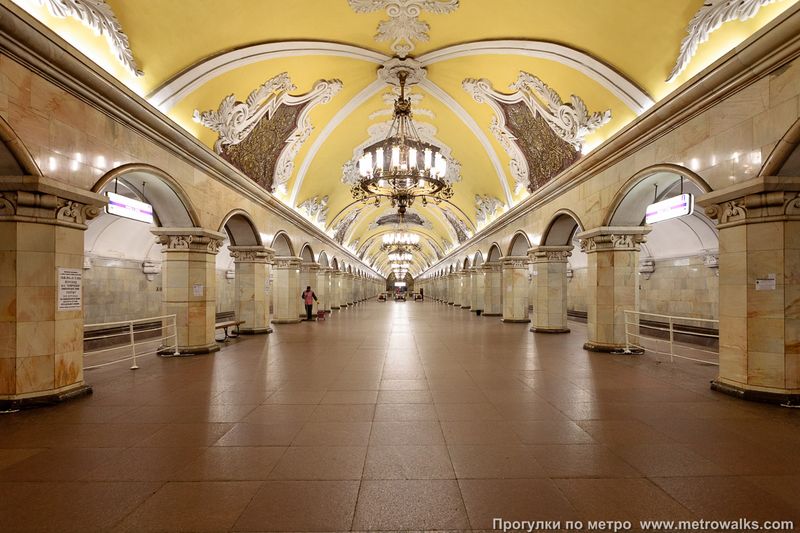
Grand chandeliers hang from a ceiling covered in golden mosaic panels celebrating Russian military history, and the columns lining the platform are faced with polished marble. Komsomolskaya station on Moscow’s Circle Line opened in 1952 and was designed by architect Alexei Shchusev as a monument to Soviet triumph and national pride.
The mosaics depict famous military commanders and scenes from Russian history, making the station feel closer to a royal banquet hall than a transit hub. At peak hours, thousands of commuters pass through without slowing down, which somehow makes the whole spectacle even more impressive.
The contrast between the grandeur above and the ordinary crowd below is genuinely striking.
5. Formosa Boulevard – Kaohsiung, Taiwan
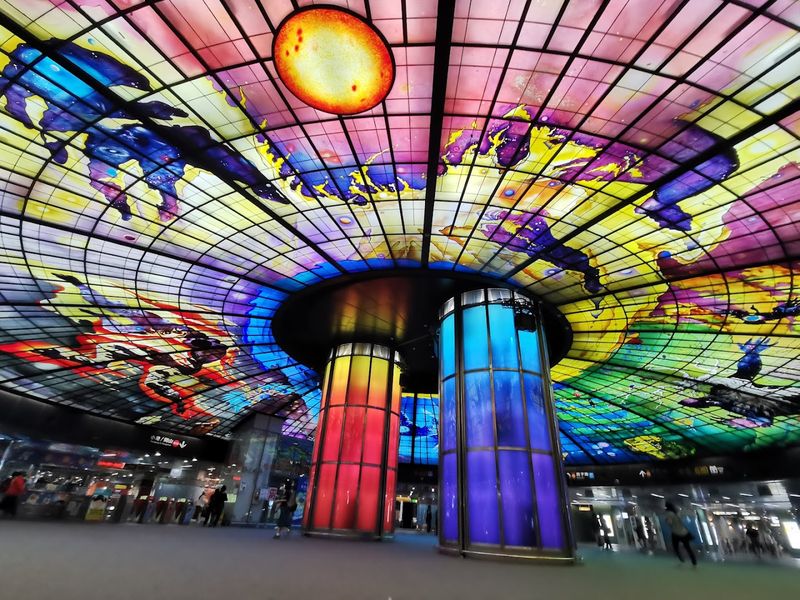
The numbers alone are worth pausing over: 30 meters in diameter, 2,180 square meters of coverage, and 4,500 individual glass panels. The “Dome of Light” at Formosa Boulevard station is the largest glass artwork in the world, designed by Italian artist Narcissus Quagliata and installed at the center of Kaohsiung’s busiest metro interchange.
The artwork is divided into four sections representing Earth, Water, Fire, and Wind, together forming a visual story about the human life cycle. The station also features dramatic glass entrance canopies designed by Japanese architect Shin Takamatsu.
Locals use the concourse as a meeting point, and tourists plan entire layovers around getting a proper look at the ceiling.
6. T-Centralen – Stockholm, Sweden
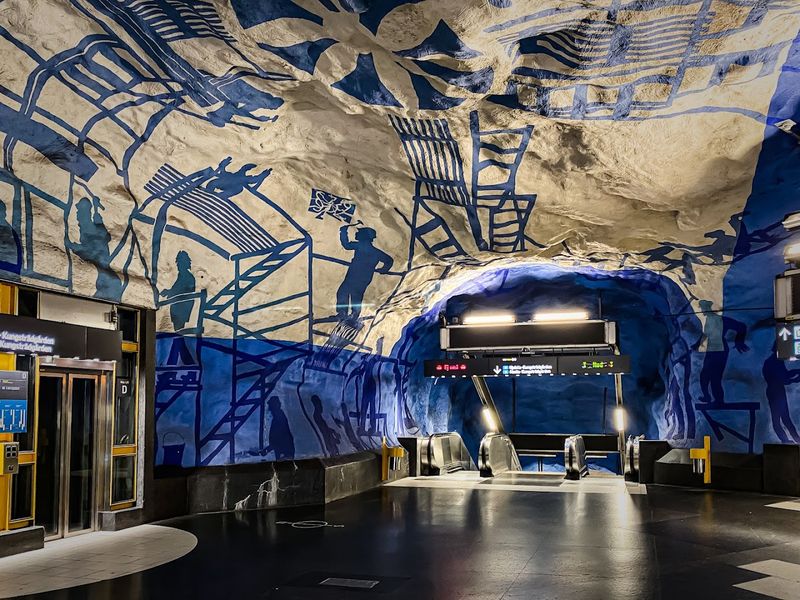
At first glance, the Blue Line platform at T-Centralen looks like someone handed a very talented artist a can of blue paint and a whole lot of time. The exposed bedrock ceiling and walls are painted white, then decorated with bold blue flowers and climbing vines by artist Per Olof Ultvedt, who completed the work in 1975.
T-Centralen is Stockholm’s central hub, which means millions of commuters pass through every year, many of them barely noticing the artwork above their heads. The design was meant to offer a calming visual break in the middle of a hectic commute.
It works. The simplicity of the pattern is what makes it memorable long after you have left the platform.
7. Università Station – Naples, Italy
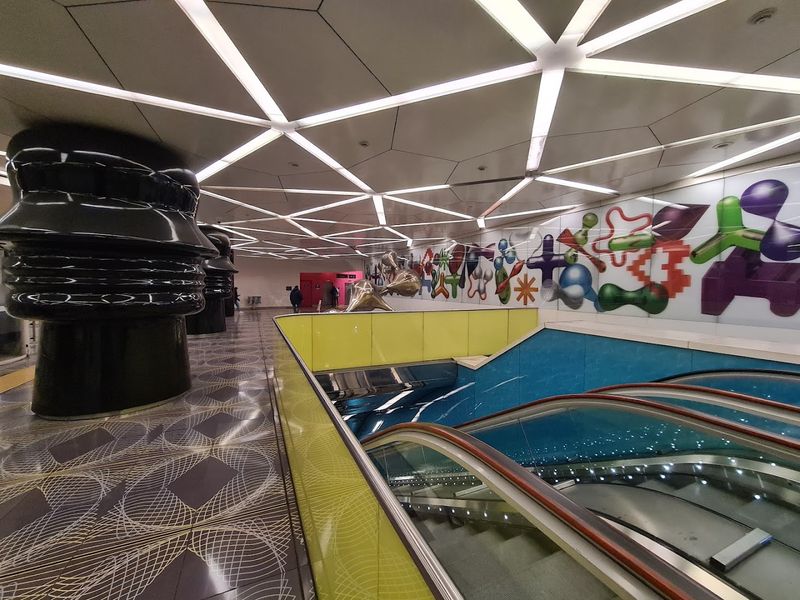
Naples does not do anything halfway when it comes to its metro stations, and Universita is proof of that commitment. Part of the city’s celebrated “Art Stations” initiative, this stop features bold, saturated colors and installations that play with geometry, scale, and perspective in ways that make the platform feel more like a contemporary art fair than a commuter stop.
The station design incorporates contributions from multiple artists, each adding a layer of visual energy to the space. Digital elements sit alongside traditional mosaic work, creating a conversation between old and new.
Students from the nearby university use the station daily, and many treat the platform as an informal gallery worth revisiting between classes.
8. Drassanes – Barcelona, Spain
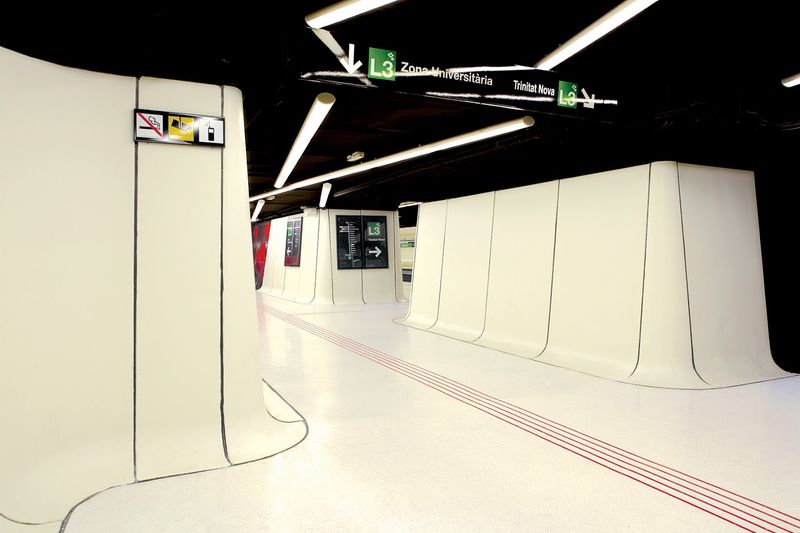
Barcelona’s metro system is known for clean design, but Drassanes takes minimalism to a level that feels almost deliberate in its restraint. The station sits near the Gothic Quarter and the old maritime shipyards, and its interior uses reflective surfaces and focused architectural lines to create a futuristic contrast with the medieval city directly above it.
The design choices are not accidental. Every surface, angle, and lighting fixture was selected to create a specific spatial experience without relying on murals or heavy ornamentation.
For transit designers, Drassanes is often cited as an example of how strong architecture alone can transform a functional space into something worth noticing. It is quietly confident in a city that is rarely quiet about anything.
9. City Hall Station – New York, USA
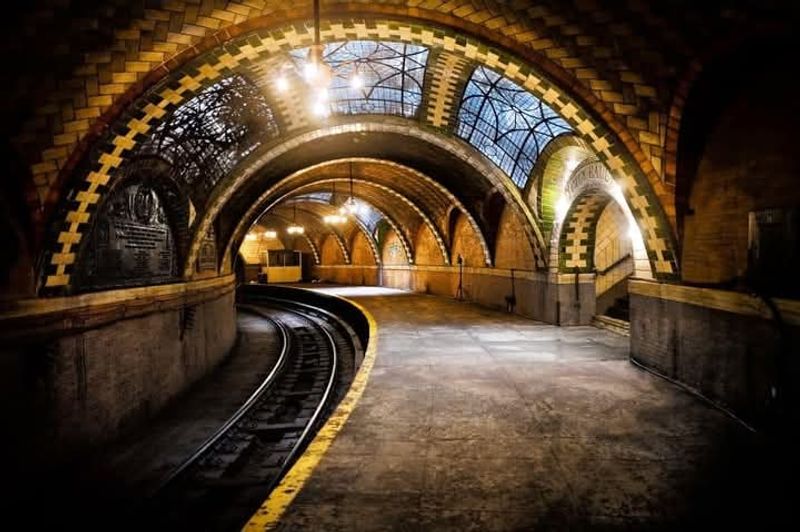
Built in 1904 as the crown jewel of New York City’s original subway system, City Hall station was closed to regular passengers in 1945 because its curved platform could not accommodate longer modern trains. The station has been sitting underground ever since, largely preserved and largely unseen by the general public.
Designed by architects Heins and LaFarge, the station features Guastavino tile vaulting, brass chandeliers, and graceful arched skylights that filter light from the street above. The New York Transit Museum offers occasional tours, and the waiting list fills up fast.
For architecture fans, this station represents a rare chance to see what New York’s subway looked like before efficiency replaced elegance.
10. Westfriedhof – Munich, Germany
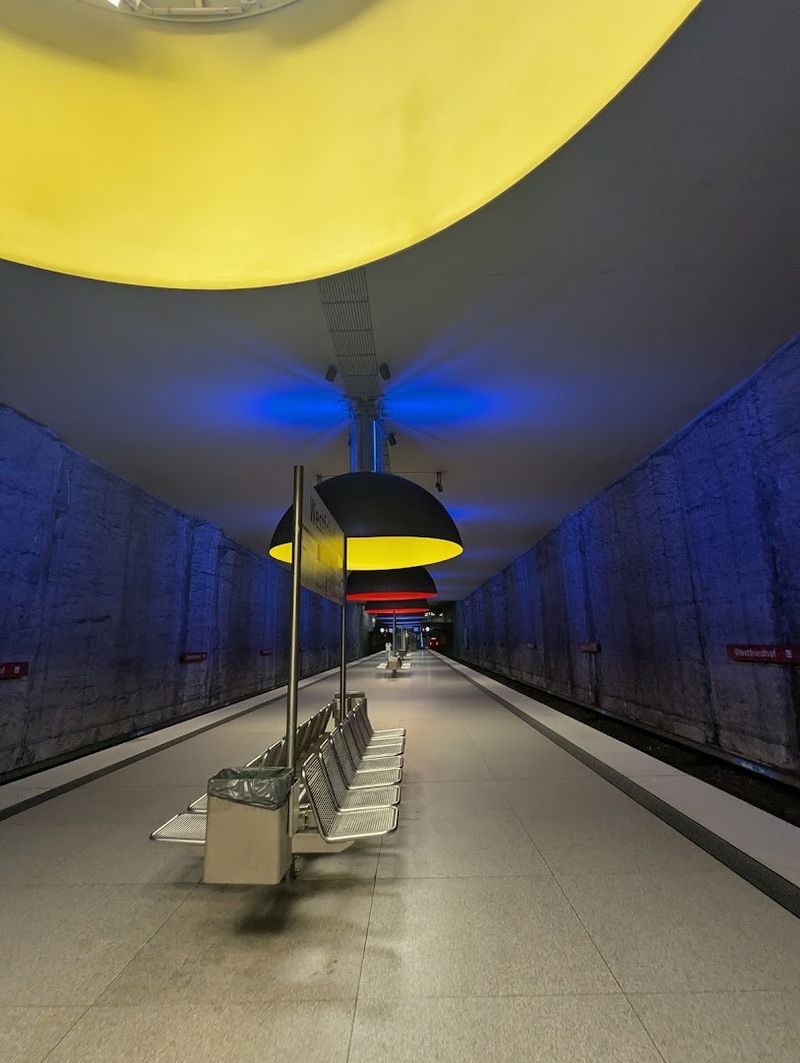
Eleven enormous lamps, each measuring 3.80 meters in diameter, hang from the ceiling of this station like a collection of abstract planets. Designed by lighting artist Ingo Maurer and opened in 1998, Westfriedhof on Munich’s U1 line is one of the most visually distinctive metro stations in Germany, and the contrast between the rough, untreated tunnel walls and the dramatically lit platform is entirely intentional.
The lamps cycle through blue, red, and yellow tones, and the unfinished rock walls surrounding them amplify the theatrical effect. Maurer, who was internationally recognized for his innovative approach to lighting design, treated the station as a large-scale art installation rather than a transit project.
The result speaks for itself.
11. Stadion Station – Stockholm, Sweden
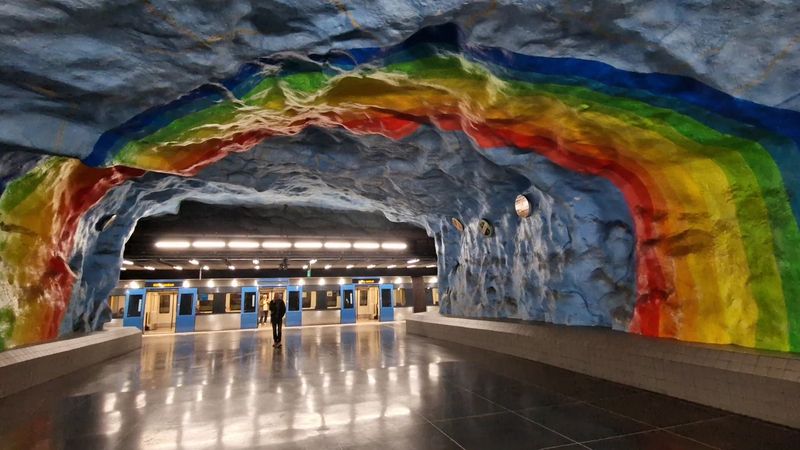
A full rainbow painted across a cave ceiling sounds like something from a children’s book, but at Stadion station in Stockholm, it is simply Tuesday. Opened in 1973 and designed by artists Enno Hallek and Åke Pallarp, the station sits near the 1912 Olympic Stadium, which directly inspired the rainbow motif as a symbol of international unity and sporting spirit.
The raw rock ceiling was left exposed and painted over in careful color gradients, a technique used throughout Stockholm’s metro art project. The rainbow spans the full width of the platform and is visible the moment you step off the train.
Simple concepts executed with precision tend to be the most enduring, and this one has been drawing visitors for more than five decades.
12. BurJuman Station – Dubai, UAE
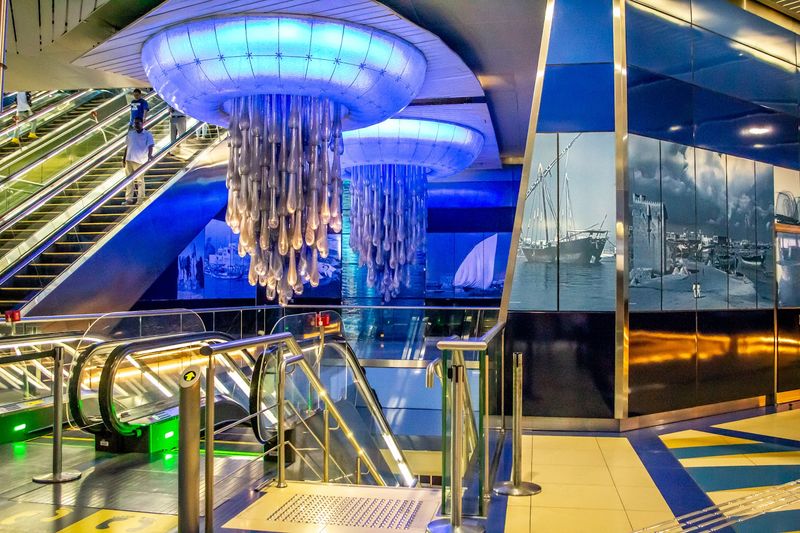
Dubai’s metro is one of the youngest major transit systems in the world, having opened in 2009, and BurJuman station reflects the city’s preference for precision and scale. The station serves as a major interchange between the Red and Green lines, handling enormous passenger volumes with a layout designed for efficiency and visual clarity.
The interiors feature clean geometric forms, polished floors, and wide-open concourses that give the station an airport-terminal quality. Unlike many stations on this list, BurJuman does not rely on murals or historical references.
Its statement is architectural, built on proportion, material quality, and the logic of its spatial planning. In a city obsessed with records and firsts, even its subway stations feel like they are making a point.
13. Mayakovskaya – Moscow, Russia
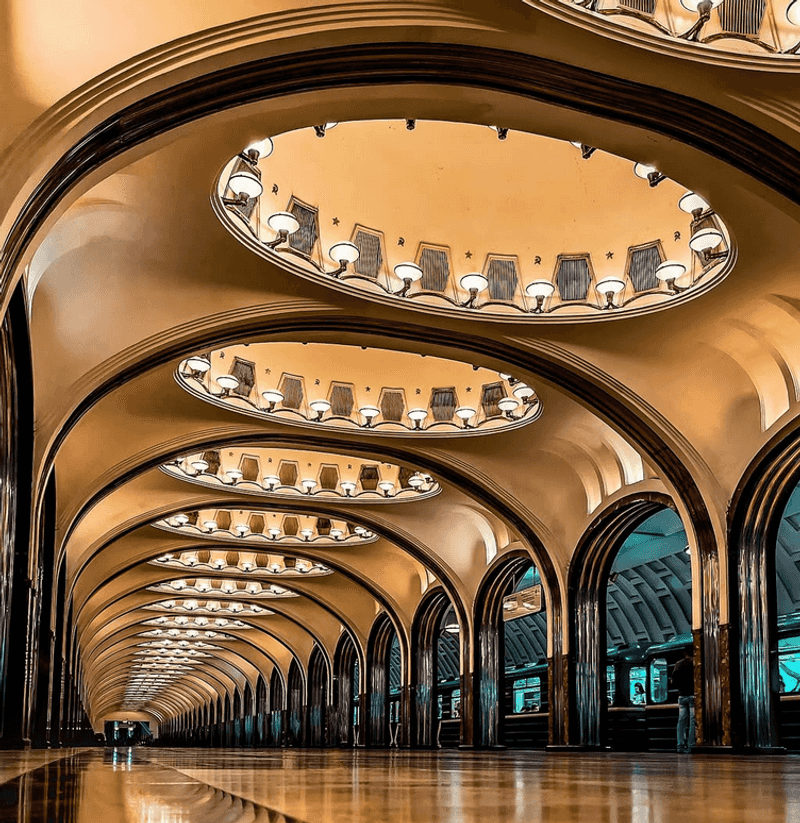
Mayakovskaya station won the Grand Prize at the 1939 New York World’s Fair, which tells you something about how seriously Moscow took underground design. Built in 1938 and named after the Russian poet Vladimir Mayakovsky, the station features an Art Deco interior with 34 oval ceiling mosaics by artist Alexander Deineka, each one depicting a scene from Soviet aviation and the sky above Russia.
Slender stainless steel columns line the platform, giving the space a vertical rhythm that pulls the eye upward toward the mosaics. The station was also used as a bomb shelter and military command center during World War Two.
That history adds a layer of weight to what is already one of the most visually accomplished transit stations ever constructed.
14. Olaias Station – Lisbon, Portugal
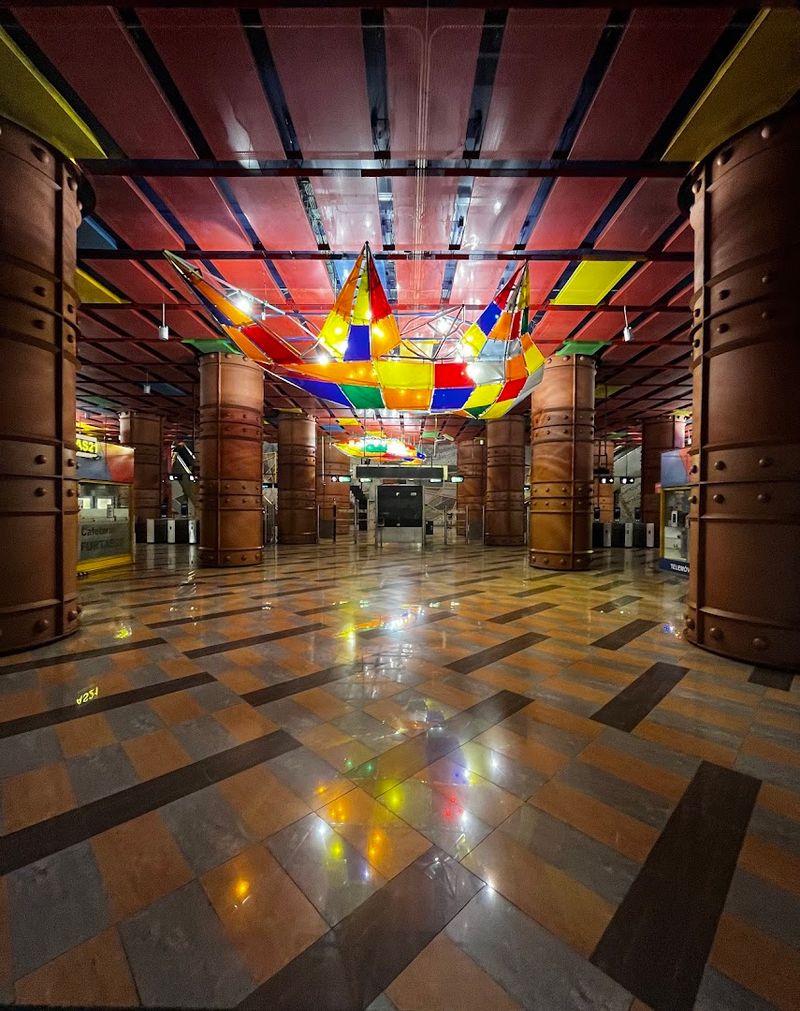
Architect Tomas Taveira designed Olaias station for Lisbon’s Red Line with a brief that seemed to have no upper limit on ambition. Opened in 1998 to coincide with Expo 98, the station features towering columns covered in colorful mosaic work by artists Pedro Cabrita Reis, Graca Pereira Coutinho, Pedro Calapez, and Rui Sanchez, each contributing a distinct visual identity to different sections of the space.
The ceiling height is exceptional, giving the station an open, almost theatrical quality. The combination of bold color, geometric pattern, and large-scale installation work has made Olaias a frequent entry on global lists of the world’s most beautiful metro stations.
Lisbon’s metro system as a whole has a strong art program, but Olaias is consistently its showstopper.
15. Zoloti Vorota – Kyiv, Ukraine
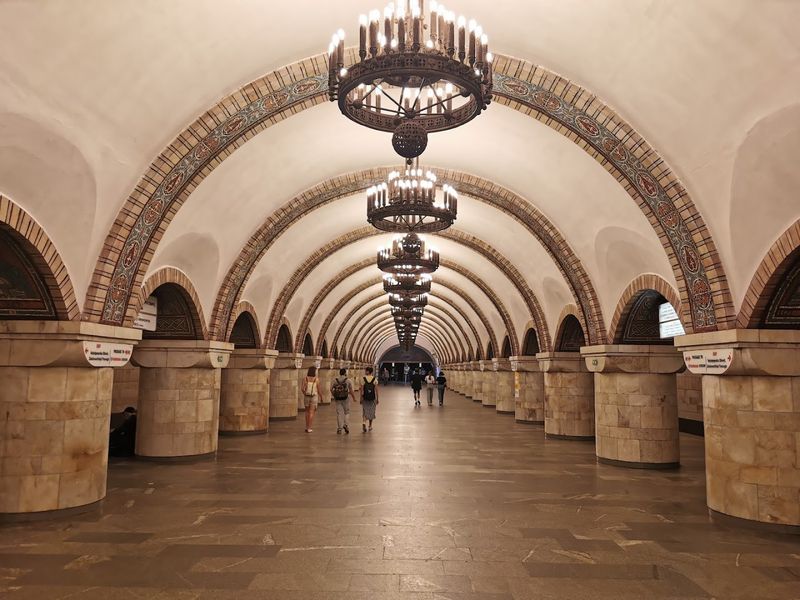
Named after the Golden Gate of ancient Kyiv, this station was designed to evoke the architecture and artistic traditions of Kievan Rus, the medieval state that once made Kyiv one of Europe’s most powerful cities. Opened in 1989, Zoloti Vorota features arched ceilings lined with Byzantine-style mosaics, decorative columns, and ornamental details drawn from medieval Ukrainian craftsmanship.
The mosaics depict historical scenes and folk motifs, and the overall palette leans toward gold, terracotta, and deep jewel tones. The station functions as both a transit hub and a cultural statement about Ukrainian identity and historical continuity.
For visitors unfamiliar with Kyiv’s history, a few minutes on this platform offers a surprisingly rich visual introduction to the city’s medieval past.
16. Canary Wharf Station – London, England
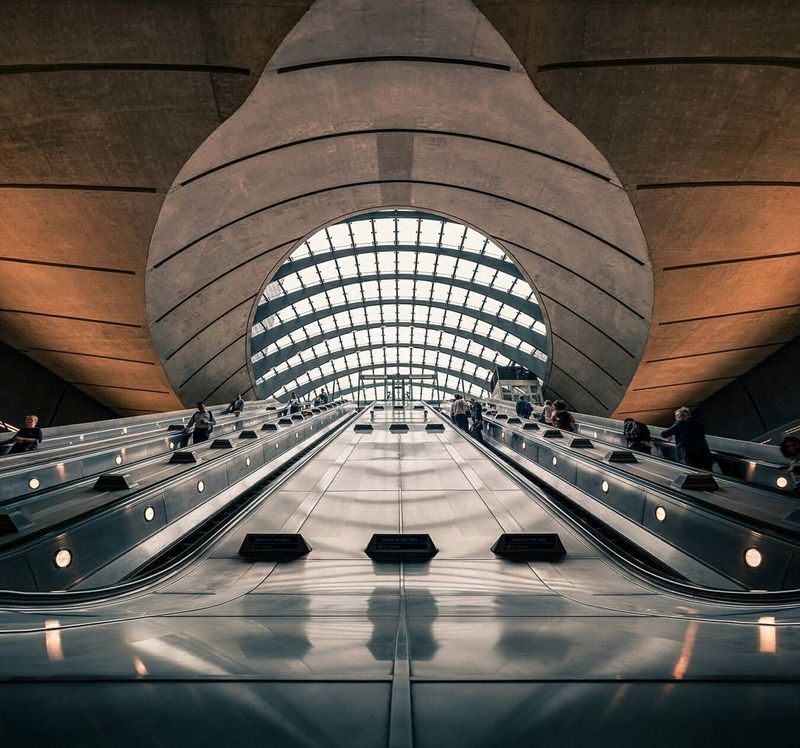
Norman Foster designed this station for the Jubilee Line extension, and it opened in 1999 as one of the largest underground stations in the entire London network. The signature feature is its enormous curved glass canopy at the entrance, which stretches over a shopping and leisure complex and channels daylight down into the ticket hall below.
The main platform cavern is cavernous by London Underground standards, with high concrete barrel-vault ceilings that give the space a scale rarely encountered on the network. Canary Wharf station handles heavy financial district traffic with a layout that prioritizes flow and clarity.
Foster’s design proved that a functional transit station built for a modern business district could also be worth a second look on architectural merit alone.
17. Syntagma Station – Athens, Greece
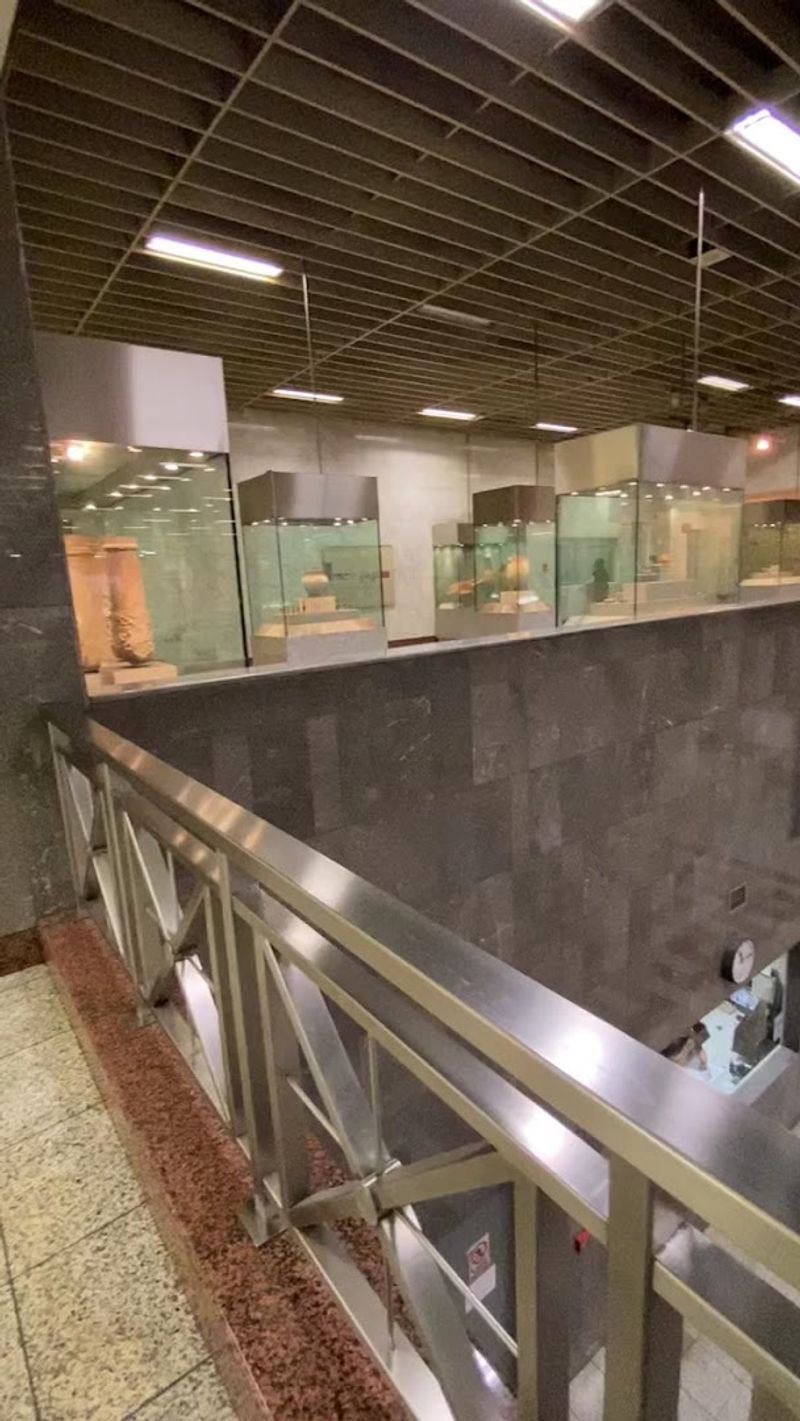
Construction crews digging the Athens metro in the 1990s kept running into ancient history, literally. At Syntagma station, excavations for the 2004 Olympics infrastructure uncovered between 30,000 and 50,000 artifacts spanning more than 5,000 years of continuous habitation.
Rather than relocating everything to a separate facility, city planners decided to turn the station itself into a display space.
A large glass-enclosed cross-section of excavated soil layers runs along one wall, showing strata from prehistoric times through the Byzantine and Ottoman periods. Human remains, grave goods, ancient plumbing systems, and Classical-era objects are all displayed behind glass in the main concourse.
Syntagma is the only station on this list where your commute doubles as a genuine archaeology lesson.
18. Rådhuset – Stockholm, Sweden
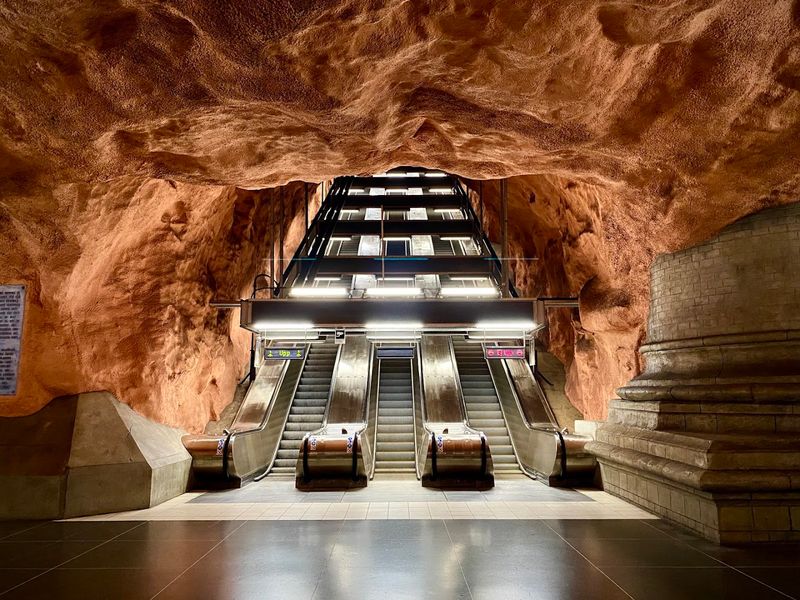
Stockholm’s metro art project includes stations that use paint, mosaic, and sculpture, but Rådhuset takes a different approach entirely: the rock itself is the art. Opened in 1975, the station was designed by architect Sigvard Martensson, who made the decision to leave the blasted granite walls completely raw and unfinished, treating the natural rock formation as a design feature rather than something to be covered up.
Warm artificial lighting highlights the texture and color variations in the stone, and the result is a platform that feels geological rather than constructed. The contrast with the polished trains pulling in and out is part of the appeal.
Rådhuset is proof that restraint, when applied with intention, can be just as powerful as elaborate decoration.
19. Bund Sightseeing Tunnel – Shanghai, China
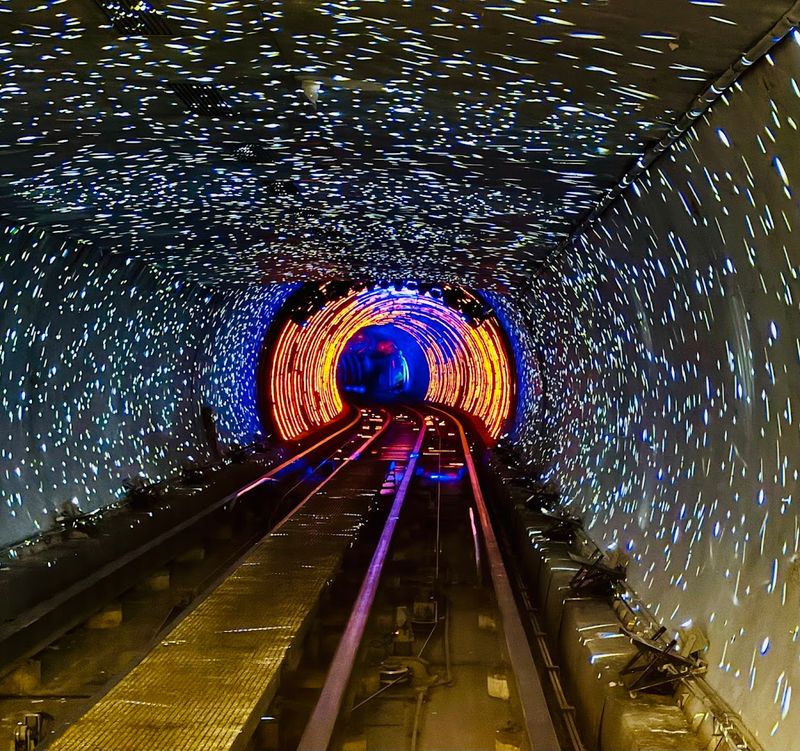
This one does not quite follow the rules of a standard subway station, and that is exactly the point. The Bund Sightseeing Tunnel in Shanghai connects the historic Bund waterfront to Pudong across the Huangpu River, and the journey through it is a deliberate visual experience built around light projections, color sequences, and moving installations displayed along the tunnel walls during the ride.
Passengers travel in transparent capsule cars that move slowly enough to take in the show. The tunnel opened in 2000 and was designed specifically as a tourist attraction rather than a commuter route.
It blurs the line between transit and entertainment in a way that no other entry on this list attempts, which earns it a well-deserved spot at number 20.
Share this story