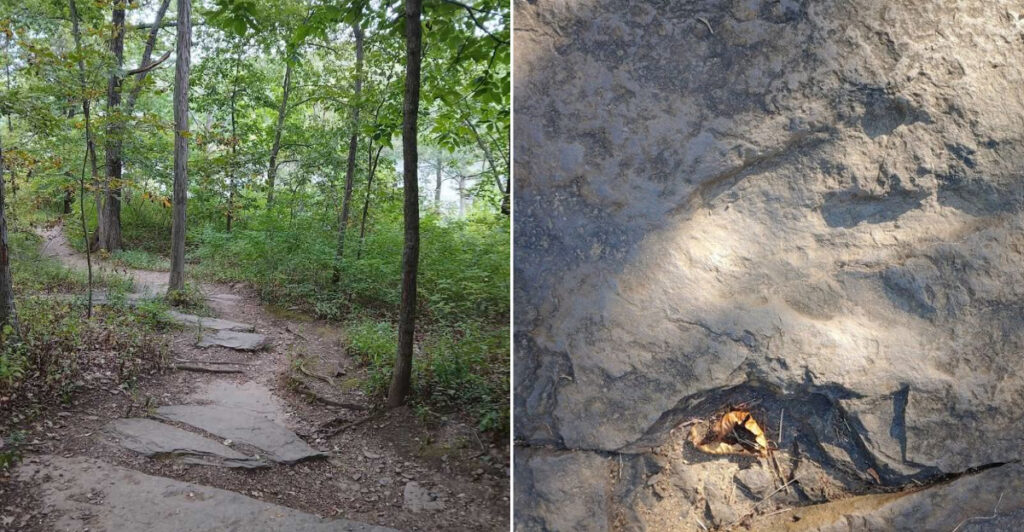
Along a quiet stretch of Route 5 in Holyoke, Massachusetts, a short walk from the road leads to something that most people would never expect to find in New England. Hundreds of three-toed dinosaur footprints are pressed into ancient sandstone, preserved for roughly 190 to 200 million years along the banks of the Connecticut River.
These were not just any old tracks. They were the first dinosaur footprints ever formally described by scientists in North America, making this small roadside reservation one of the most historically significant natural sites on the entire continent.
The site is free to visit, open to the public, and managed by The Trustees of Reservations. Whether you are a history enthusiast, a curious traveler, or someone looking for a genuinely memorable detour, this trail delivers something rare and completely real.
The Science Behind the First Described Tracks in North America
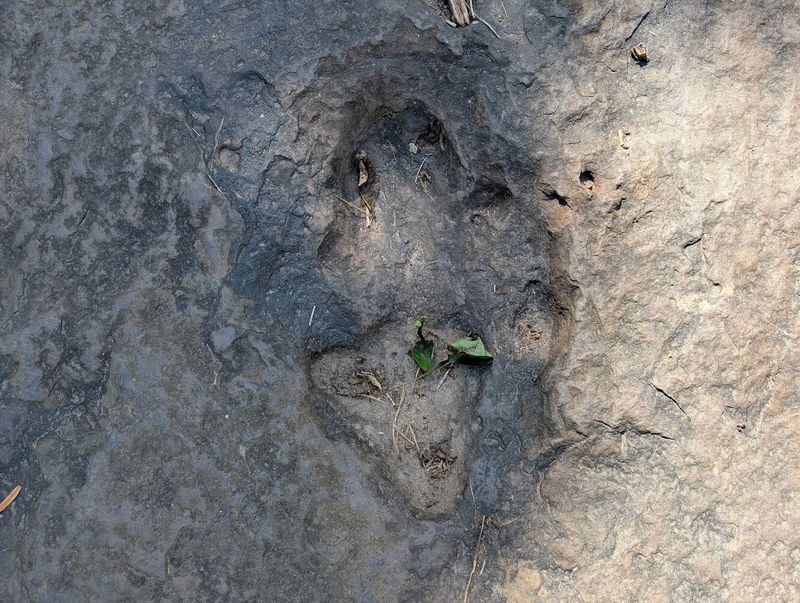
In the early 1800s, these tracks along the Connecticut River Valley became the first dinosaur footprints ever formally described by scientists in North America. That distinction alone puts this site in a category that very few places on earth can claim.
The footprints are believed to have been left during the Early Jurassic Period, approximately 190 to 200 million years ago. The rock surface was once a muddy lakebed, and the creatures that crossed it left behind deep impressions that eventually hardened into stone over millions of years.
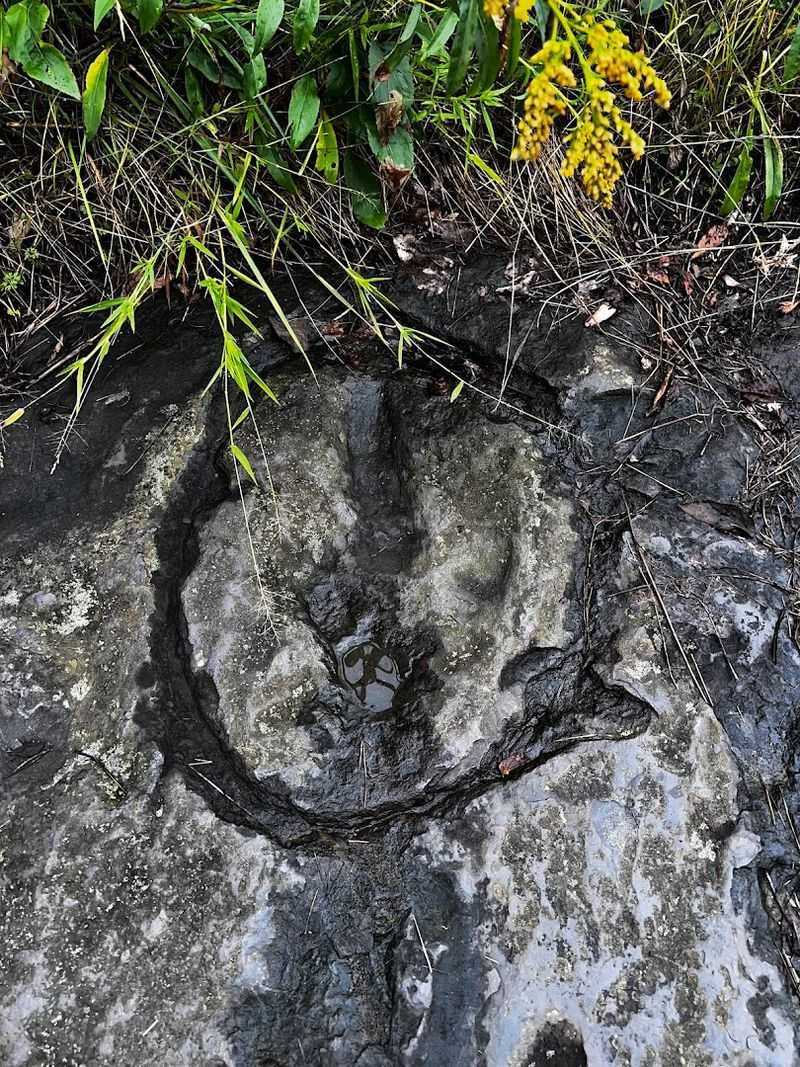
The most prominent tracks are attributed to Eubrontes giganteus, a large bipedal dinosaur that walked on two legs and left three-toed prints that can measure up to 15 inches in length. Scientists have identified prints from at least three different species across the site.
The Connecticut River Valley has long been considered one of the richest areas in North America for Early Jurassic fossil track sites, and this reservation sits at the heart of that legacy.
What the Rock Surface Actually Looks Like Up Close
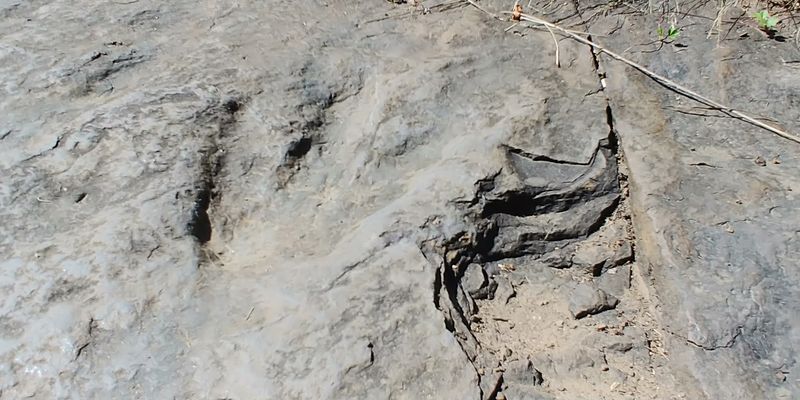
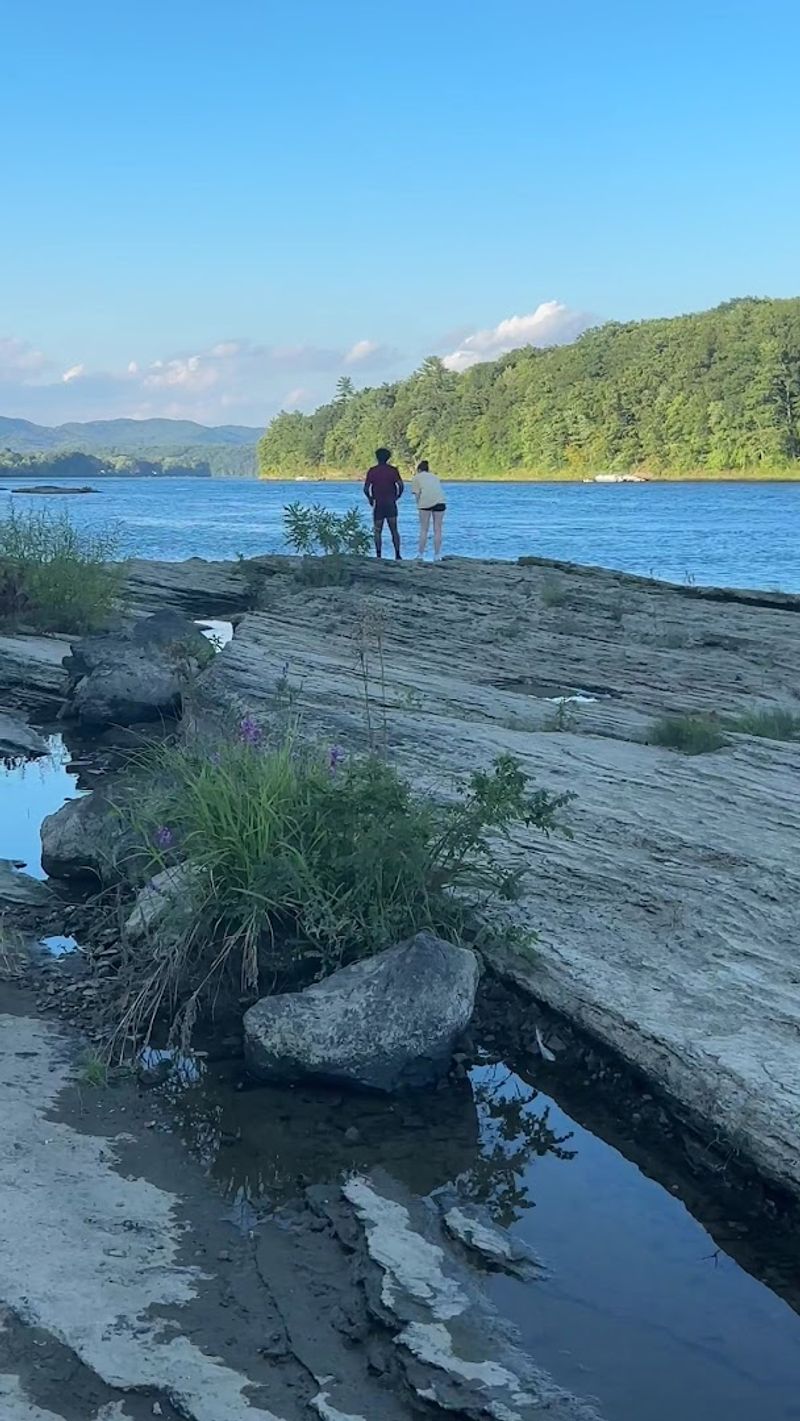
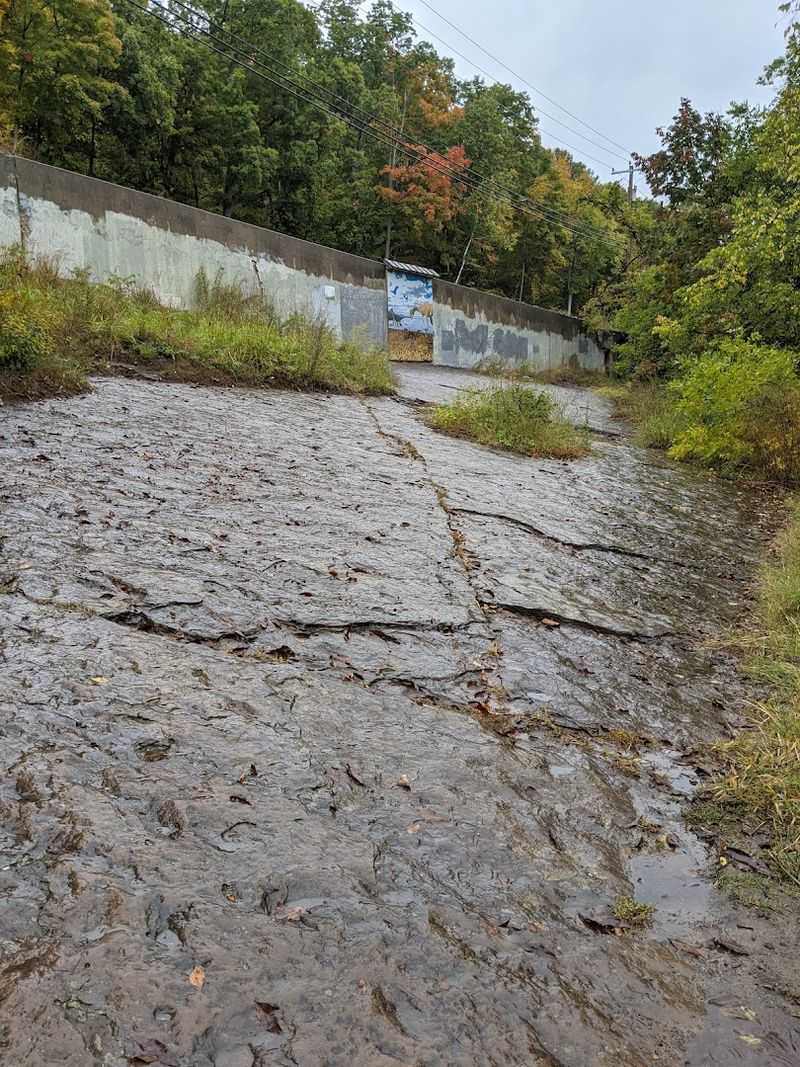
The rock surface at this reservation is not enclosed behind glass or roped off behind barriers. The prints are fully exposed on open slabs of reddish-brown sandstone, spread across several acres of rocky ground near the Connecticut River.
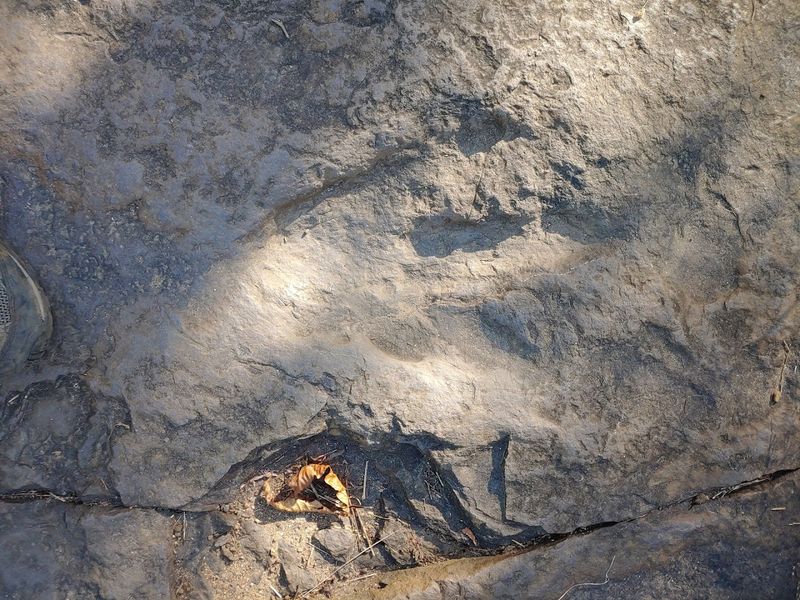
Some prints are immediately obvious, with deep, well-defined three-toed shapes that stand out clearly against the flat rock. Others require a bit more focus to identify, especially in certain lighting conditions when shadows are minimal.
Chalk outlines and circles have been drawn around several of the more prominent tracks by previous visitors, which helps newcomers locate them more quickly. The impressions vary in depth and clarity, with some showing fine detail in the toe structure and others worn smoother by centuries of weathering.
The sheer number of prints is part of what makes the surface so compelling. Over 700 individual footprints have been documented at this site, scattered across the layered stone in patterns that suggest regular movement across the ancient lakebed.
How the Prints Survived 200 Million Years
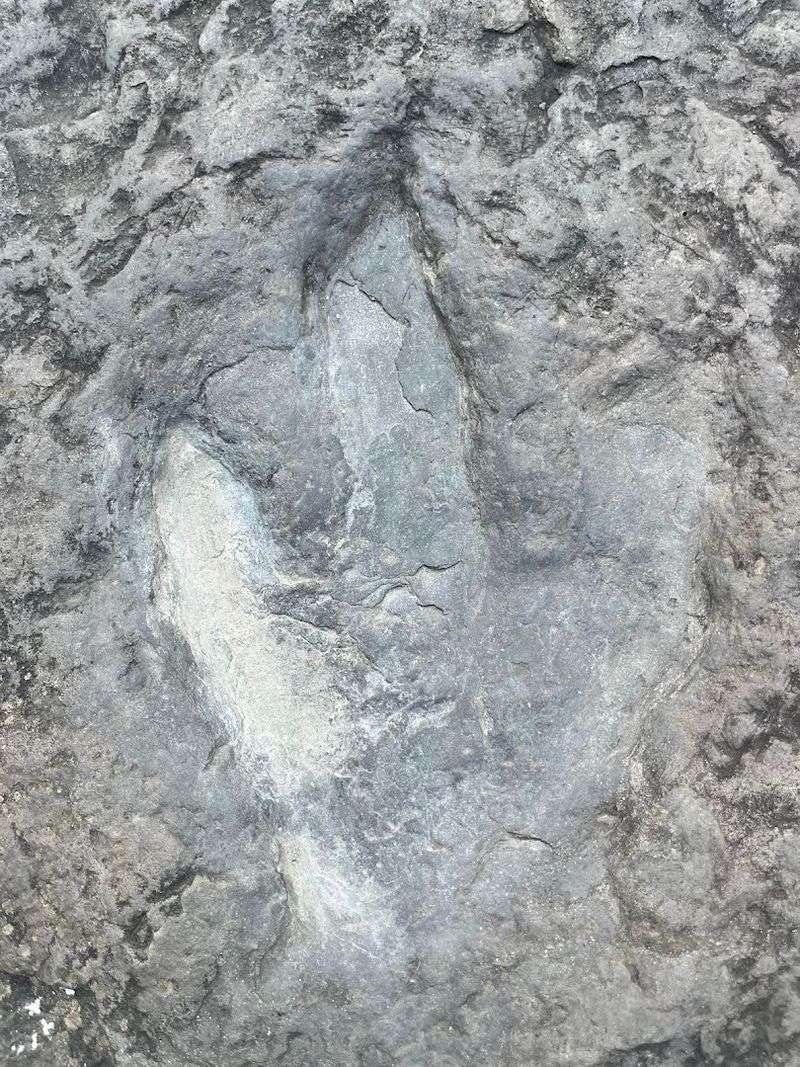
The preservation of these tracks is a result of very specific geological conditions that came together in the Connecticut River Valley during the Early Jurassic Period. The area was once a broad rift basin filled with shallow lakes and mudflats, which provided the perfect surface for large animals to leave deep impressions.
After the footprints were made, fine layers of sediment washed over them and buried the impressions before they could erode. Over millions of years, pressure from additional sediment layers compressed everything into solid rock, locking the prints in place.
Tectonic activity eventually tilted and uplifted the rock layers, bringing the prints back toward the surface. Erosion from the Connecticut River then stripped away the upper layers, gradually exposing the sandstone slabs that visitors walk across today.
The fact that these prints survived at all is a combination of timing, geology, and luck. That they ended up visible at ground level, free to examine without any excavation, makes this site genuinely unusual in the world of paleontology.
The Short Trail From Road to Rock
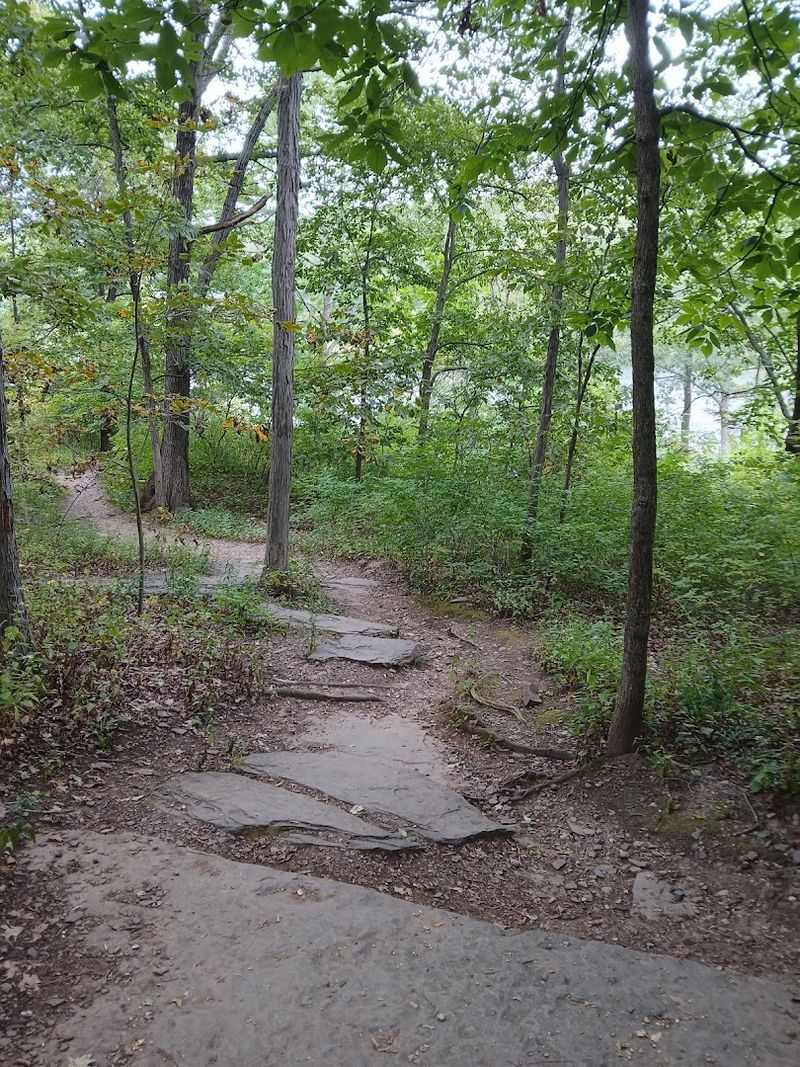
The trail from the parking area to the footprint surface is not a long hike by any measure. The walk covers roughly 100 yards along a gently sloping path that descends from the road toward the riverbank.
The path is unpaved and can be uneven in places, with loose rock and occasional roots. Sturdy footwear is a practical choice, and those with limited mobility may find certain sections of the descent a bit tricky.
A walking stick can be helpful on the return uphill stretch.
The entire walk from car to prints takes only a few minutes at a casual pace. Most people spend between 15 and 45 minutes total at the site, depending on how thoroughly they explore the rock surface and whether they continue down to the river.
A second path extends beyond the main print area and leads toward the Connecticut River, where there is open space to sit near the water. The trail is not formally maintained as a long hiking route, but the short walk is accessible enough for most ages.
Who Manages This Site and Why It Stays Free
The Dinosaur Footprints Reservation is managed by The Trustees of Reservations, one of the oldest land conservation organizations in the United States. Founded in Massachusetts in 1891, the organization manages over 120 properties across the state, protecting natural landscapes, historic sites, and ecologically significant land.
The Trustees maintain this site as a free, publicly accessible reservation. There are no membership requirements or fees to visit.
The organization believes that places like this should remain open and available to everyone, regardless of budget or background.
Upkeep at the site is minimal by design. The prints are left in their natural state without protective coverings or formal exhibits, which keeps the experience raw and direct.
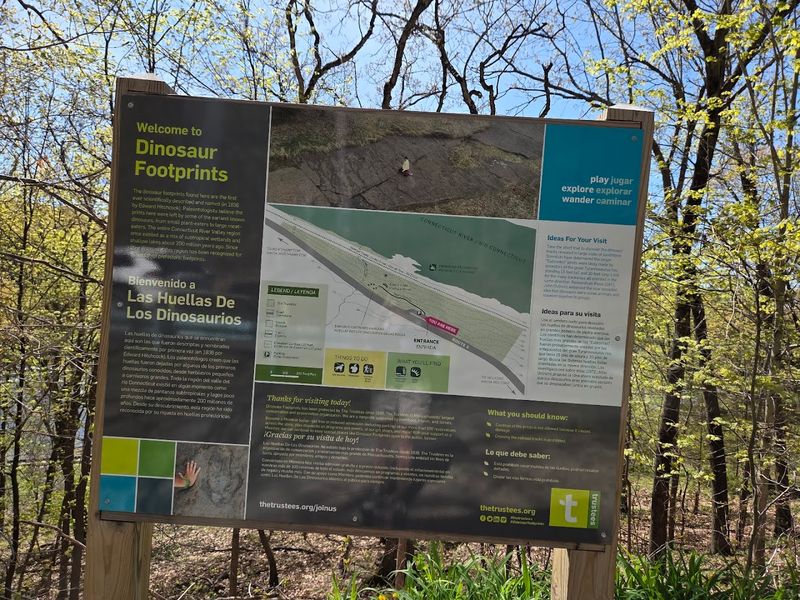
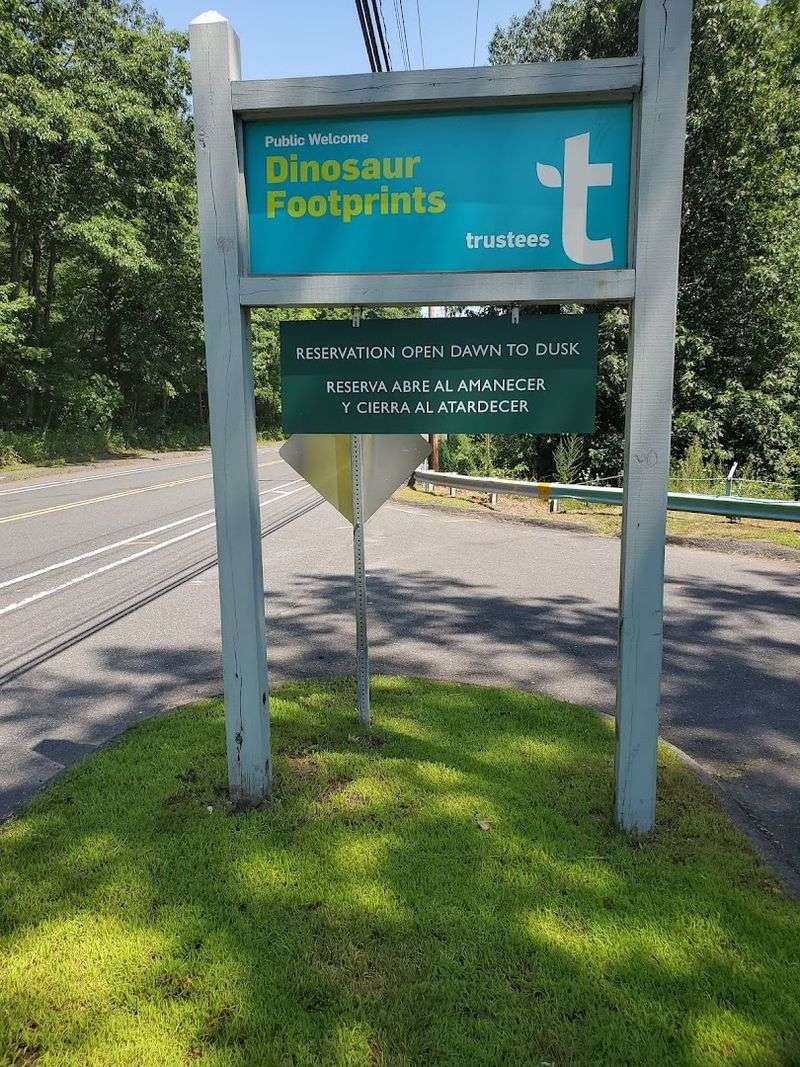
The informational sign near the parking area provides basic context about the history and scientific significance of the tracks.
More detailed information about the site, its history, and current conditions can be found on The Trustees website at thetrustees.org/place/dinosaur-footprints. The page includes visiting guidelines and background on the reservation’s conservation status.
The Three Dinosaur Species That Left Their Mark
Three distinct species of dinosaurs are believed to have left tracks at this site during the Early Jurassic Period. Each species left prints with slightly different shapes, sizes, and stride patterns, which paleontologists have used to identify and classify them over the years.
The largest and most recognizable tracks belong to Eubrontes giganteus, a theropod dinosaur that moved on two legs and likely reached significant size. Its three-toed prints are the most frequently photographed at the site and are among the clearest to identify on the rock surface.
Smaller prints at the site are attributed to Anchisauripus and Grallator, two other track types associated with smaller theropod dinosaurs that also lived during this period in the Connecticut River Valley region. The variety of track types across the same surface suggests the area was an active crossing point for multiple species.
Having three species represented at one open-air site with no admission fee is the kind of thing that tends to surprise first-time visitors who arrive expecting something modest.
What Makes This Discovery Historically Groundbreaking
Before the tracks at this site were formally described, the scientific world had no established framework for understanding dinosaur footprints. The Connecticut River Valley discoveries in the early 1800s changed that entirely, helping to launch a new chapter in North American paleontology.
Edward Hitchcock, a geologist and president of Amherst College, was the first scientist to systematically study and describe the tracks found throughout the valley. His work in the early to mid-1800s produced one of the most detailed catalogs of fossil footprints ever assembled at that time.
Hitchcock initially believed the tracks were made by large ancient birds rather than reptiles, since the concept of dinosaurs as a distinct group had not yet been fully developed. It was only later that scientists reinterpreted his findings within the broader understanding of dinosaur evolution.
The tracks at Holyoke sit within the same geological formation that Hitchcock studied, making them part of the original body of evidence that helped define early American paleontology as a legitimate field of scientific study.
Tips for Getting the Most Out of Your Visit
A few practical details can make a real difference at this site. The parking area holds a limited number of cars, so arriving early in the morning or on a weekday reduces the chance of finding the lot full.
The turnover is generally fast, so waiting a few minutes usually solves the problem.
The prints are easier to spot when the light hits the rock at a low angle, which makes morning visits particularly good for photography. Overcast days can also work well since flat light reduces glare on the stone surface.
Wearing closed-toe shoes with some grip is a smart choice given the uneven rock terrain. The surface can be slippery in wet conditions, so checking the forecast before heading out is worthwhile.
Reading the informational sign near the trailhead before walking down gives helpful context that makes the prints easier to identify and appreciate once you reach the rock surface. The entire experience moves at whatever pace feels right, with no time limits or guided schedules to follow.
The Connecticut River Setting That Frames It All
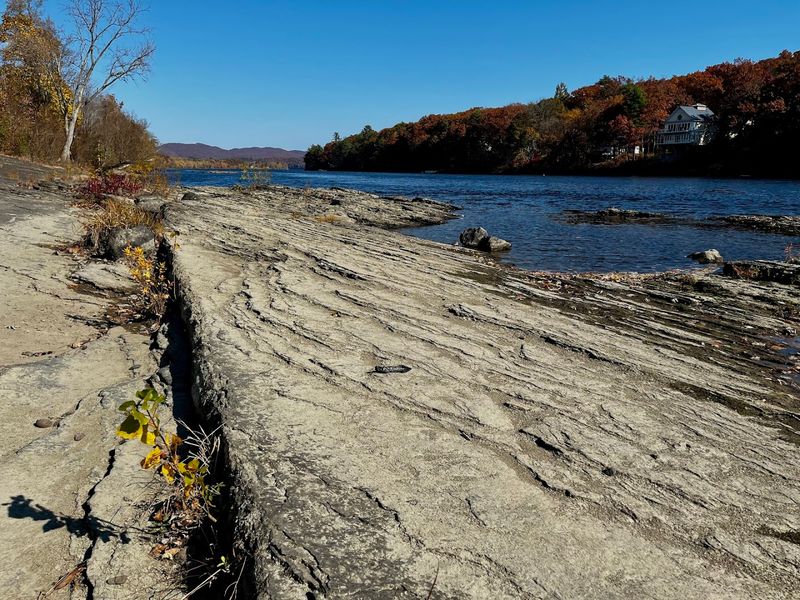
The Connecticut River runs directly alongside the reservation, and the proximity of the water adds a distinct character to the visit that goes beyond the footprints themselves. The river has shaped this landscape over millions of years, and it continues to do so today.
A path from the main print area leads further toward the riverbank, where the rock gives way to a more open stretch of shoreline. The area near the water is a popular spot for sitting, fishing, or simply taking in the view across the river.
Wildlife is present throughout the site. Turtles are commonly spotted near the water’s edge, and fish are visible in the shallower sections of the river.
The natural setting feels removed from the busy road above, even though the parking lot is only a short walk away.
The combination of ancient geology and an active river ecosystem in the same small area gives the site a layered quality that goes well beyond what the roadside sign would lead most people to expect.
A Roadside Stop That Earns Its Reputation
Not every roadside attraction lives up to its billing, but this one consistently delivers more than the modest parking lot and highway-side sign would suggest. The prints are real, the history is well-documented, and the setting along the Connecticut River gives the visit a natural depth that is hard to manufacture.
The site draws a steady mix of curious travelers, families on road trips, local residents, and geology enthusiasts who already know the scientific background. The common thread among first-time visitors is genuine surprise at how significant and accessible the site turns out to be.
There is no merchandise, no gift shop, and no admission fee. The experience is entirely about the rock surface, the prints, and the remarkable fact that creatures from the Early Jurassic left a clear record of their movement in a spot now reachable by a two-minute walk from a Massachusetts highway.
For anyone passing through western Massachusetts on Route 5, skipping this stop would mean missing one of the most quietly extraordinary natural history sites in the entire northeastern United States.
Where Exactly This Historic Site Sits
The Dinosaur Footprints Reservation is located at 1099 US-5, Holyoke, MA 01040, right along the Connecticut River in western Massachusetts. The site sits beside a busy road, which means it is easy to drive past without noticing it at all.
A small pull-off parking area on the side of Route 5 serves as the entry point. The lot holds roughly seven to eight cars at a time, but the turnover is quick since most visits last under an hour.
The property is managed by The Trustees of Reservations, a nonprofit land conservation organization. There is no entrance fee, no ticket booth, and no gate.
A short informational sign near the trailhead gives background on the discovery and the species believed to have left the tracks.
The Connecticut River runs just beyond the rock surface where the prints are found, and a path continues past the tracks down toward the riverbank for those who want to explore further.
Share this story