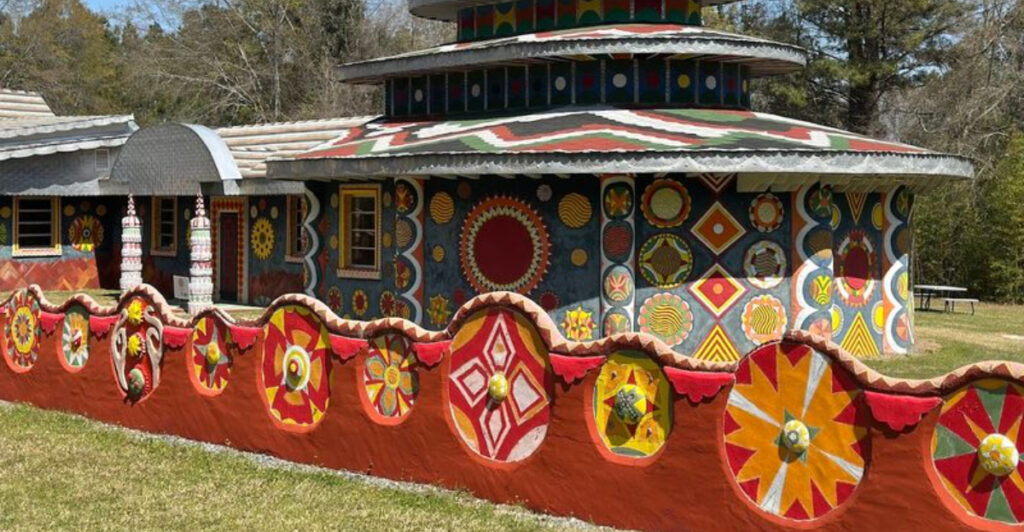
Deep in rural Marion County, Georgia, there is a seven-acre compound covered in painted sculptures, murals, and towering figures that most people have never heard of. Built almost entirely by one man over several decades, this place defies easy explanation and rewards anyone willing to make the drive.
The artist behind it all created an entire culture, a spiritual philosophy, and a visual language that still puzzles and fascinates scholars today. This article takes a close look at what makes this site one of the most remarkable visionary art environments in the entire United States, and why it keeps drawing curious travelers from across the country.
The Man Who Built an Entire World by Hand
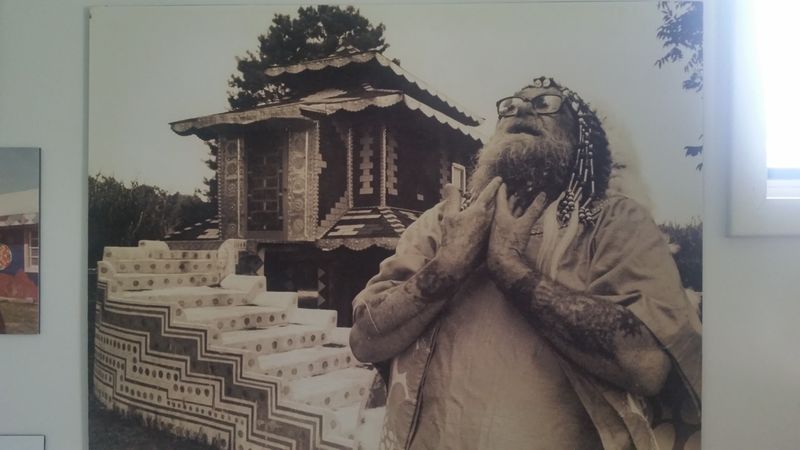
Eddie Owens Martin was born in 1908 in Oglethorpe, Georgia, into a poor rural family. He left home as a teenager and eventually made his way to New York City, where he worked various jobs and began developing his own spiritual philosophy that blended elements from multiple world cultures.
After a serious illness in the 1950s, Martin claimed to have received a vision that directed him to return to his family’s land in Marion County and build a place he would call Pasaquan. He gave himself the title Saint EOM, which he used for the rest of his life.
From that point forward, Martin dedicated nearly every waking hour to constructing and painting the compound, working largely without outside help. He mixed his own pigments, carved his own molds, and poured concrete by hand.
The result was a completely self-contained artistic and spiritual universe that he built over the course of about three decades.
What the Word Pasaquan Actually Means
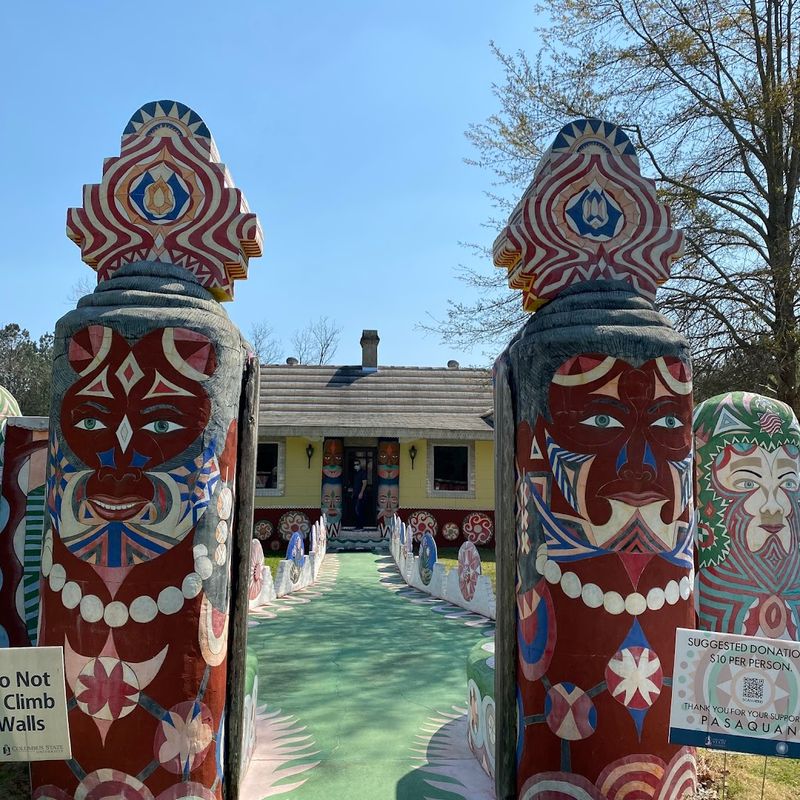
The name Pasaquan was not borrowed from any existing language or tradition. Eddie Owens Martin invented it himself as part of the broader spiritual and cultural system he called Pasaquoyanism.
In Martin’s framework, Pasaquan represented a kind of bridge between the past and the future, a place where different spiritual energies could meet and coexist. He drew visual inspiration from Aztec, Egyptian, Hindu, and various indigenous traditions, but he never directly copied any of them.
Instead, he synthesized them into something entirely his own.
The word itself carries weight within the site because Martin believed the land had a specific spiritual purpose. He designed the compound to function as a temple of sorts, a place where people could come to connect with something larger than everyday life.
Understanding the name helps visitors make sense of the layered symbolism found throughout the paintings, sculptures, and architectural details that cover nearly every surface of the property.
Six Structures That Tell One Continuous Story
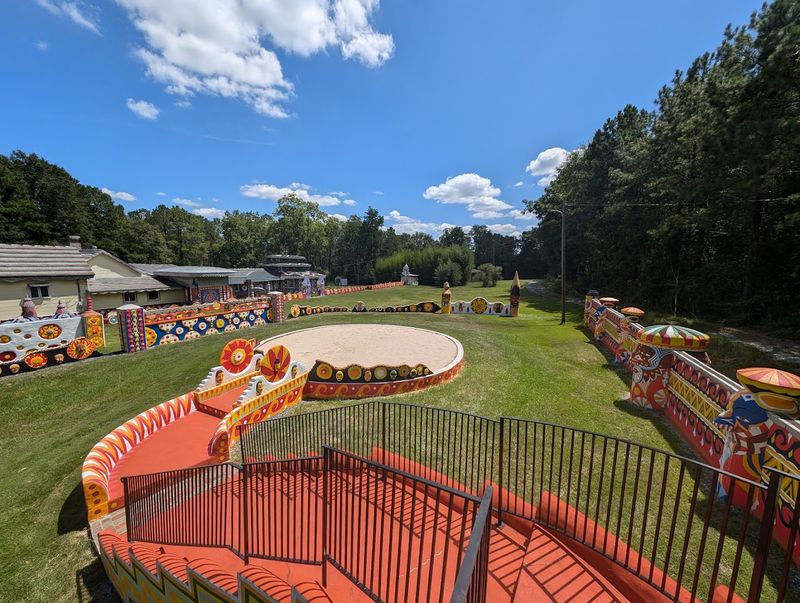
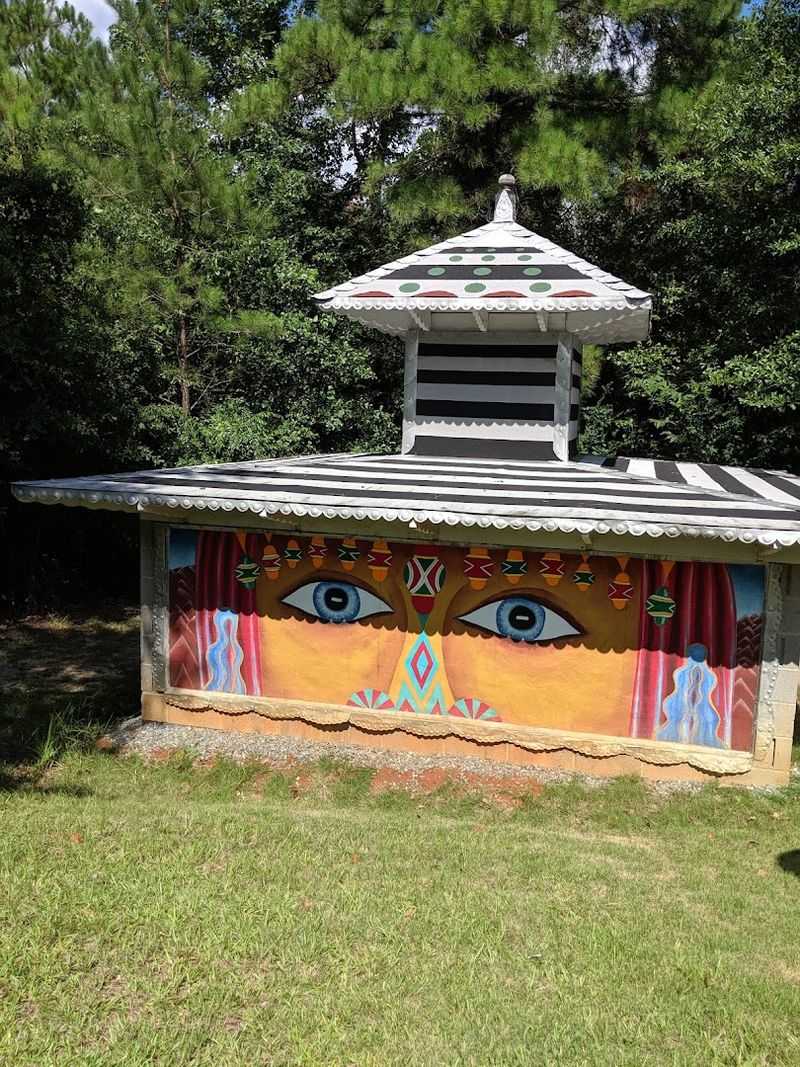
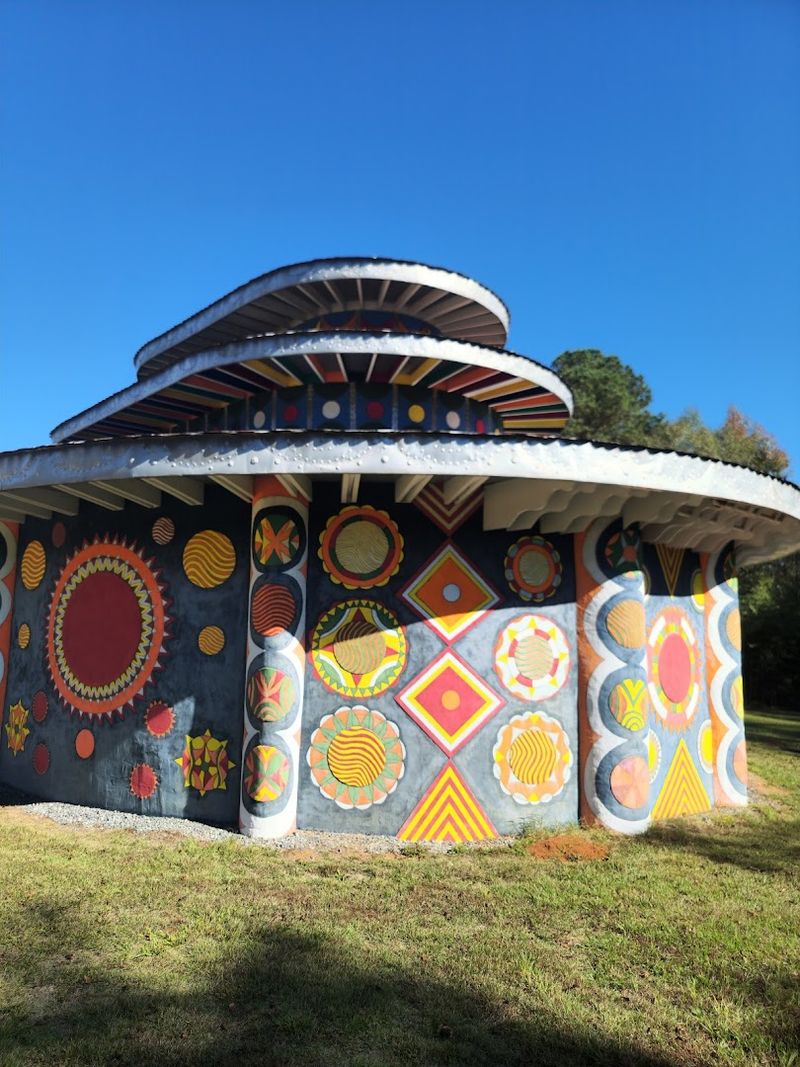
The compound at Pasaquan contains six major structures, all of which Martin redesigned and covered with his distinctive painted concrete work. The oldest building on the property is a farmhouse that dates back to 1885, and Martin transformed it just as thoroughly as everything else.
Each structure connects to the others through a series of painted walls, pathways, and open-air spaces that create a sense of moving through different rooms of one very large, very unusual gallery. The buildings are not enormous, but the density of detail on every surface makes each one feel like a full experience on its own.
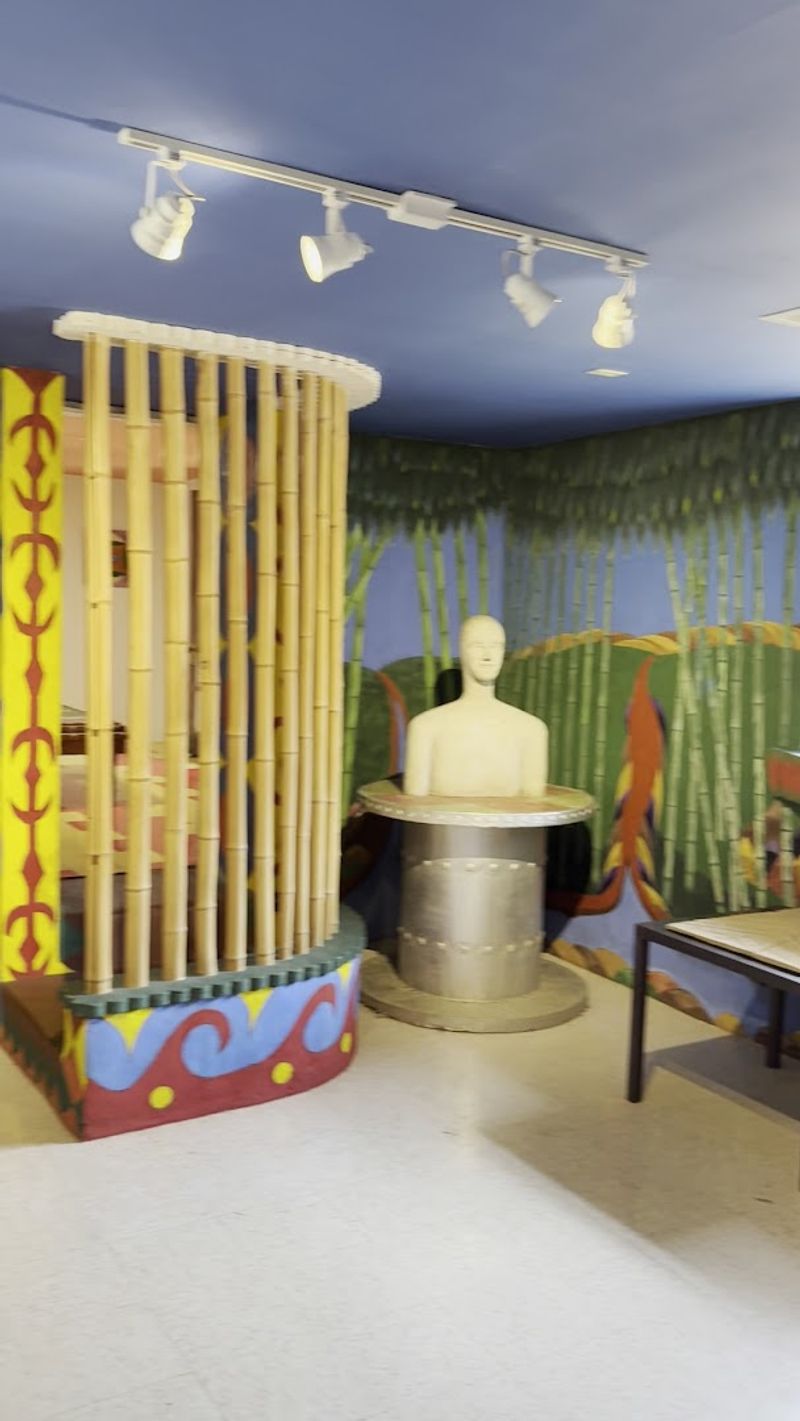
There are also interior spaces filled with paintings, drawings, and objects that Martin created throughout his life. The interiors add a quieter, more personal dimension to the outdoor spectacle of the grounds.
Together, the six structures cover about four acres of masonry work, all painted by Martin in the bold patterns and figures that define his visual style.
A Color Palette Unlike Anything Else in the South
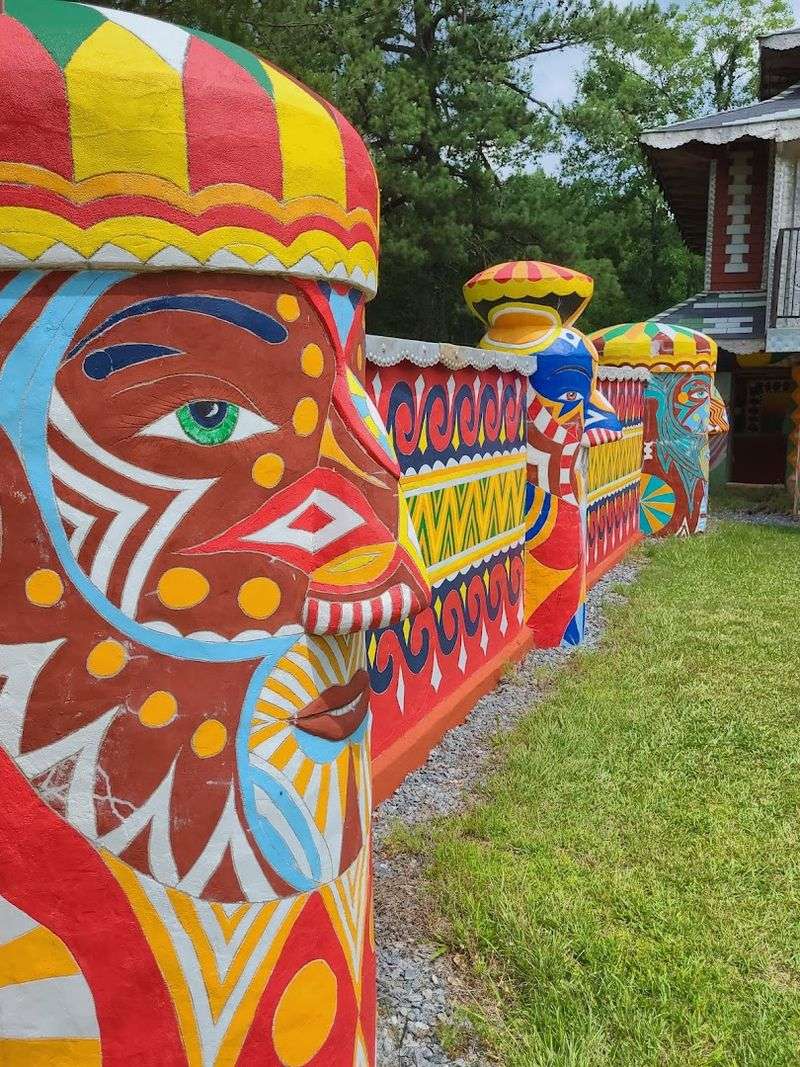
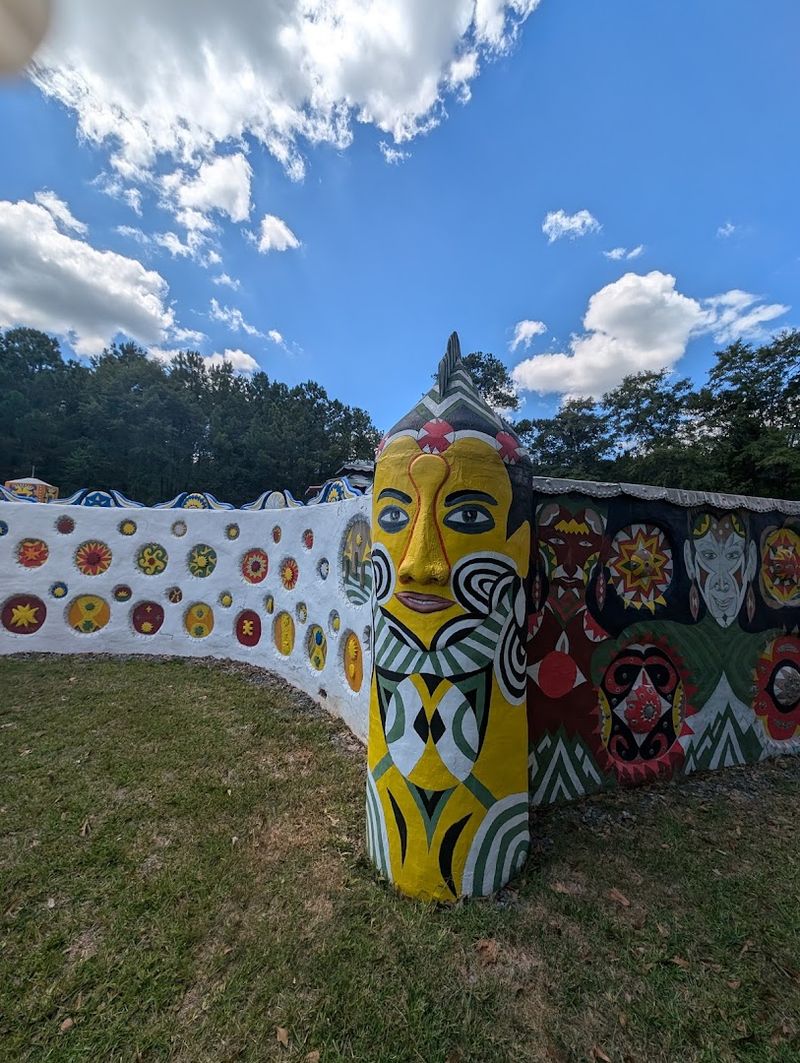
One of the first things that registers when approaching Pasaquan is the color. Martin used bold, saturated hues across every painted surface, and the combinations he chose do not follow conventional decorative logic.
Reds sit next to electric blues, yellows push up against deep greens, and everything is outlined in ways that make the patterns almost hum with visual energy.
Martin mixed his own paints using dry pigments, and he was meticulous about maintaining the vibrancy of his work. Over the decades since his passing in 1986, weather and time took a toll on many of the surfaces, which is why the ongoing restoration work has been so critical to preserving what he built.
The restored sections now match the original intensity that Martin intended, and seeing the colors in person against the backdrop of rural Georgia countryside creates a contrast that photographs struggle to fully capture. The palette is genuinely unlike anything else in the region.
The Figures and Symbols Covering Every Surface
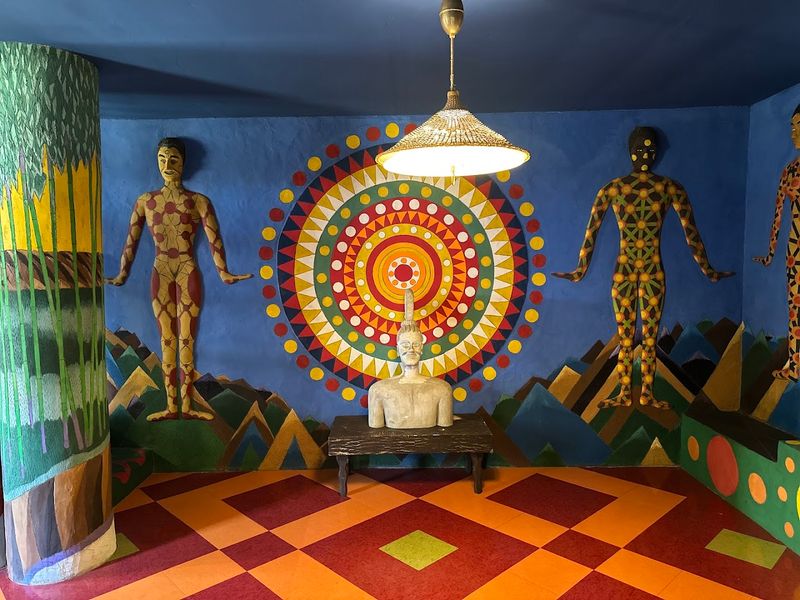
Martin populated Pasaquan with figures drawn from his spiritual imagination. Tall, stylized human forms appear across the walls and towers, often depicted with elaborate headdresses, ceremonial poses, and symbolic accessories that Martin defined within his Pasaquoyan belief system.
Serpents, geometric mandalas, eyes, and abstracted animal forms also appear throughout the compound. Martin wrote extensively about the meanings he assigned to these symbols, and some of that writing is available on-site for visitors who want to understand the logic behind the visual choices.
The figures are not random decoration. Martin treated each one as a participant in a larger spiritual narrative that he believed the compound was meant to house and transmit.
That intentionality gives the artwork a coherence that distinguishes Pasaquan from sites where outsider art feels more impulsive or disconnected.
Spending time with the figures and reading the accompanying explanations adds a layer of meaning that makes the visit considerably richer than a quick walkthrough would suggest.
How Columbus State University Stepped In to Save It
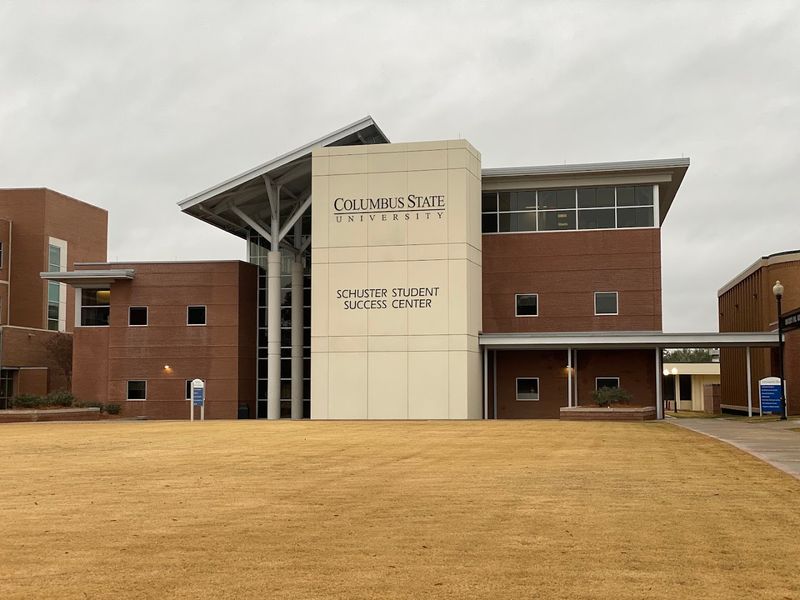
After Eddie Owens Martin’s passing in 1986, Pasaquan fell into disrepair. The Marion County Historical Society took custody of the property and worked to stabilize it, but the resources needed for full restoration were beyond what a small county organization could manage on its own.
Columbus State University eventually stepped in and took on the stewardship of the site, launching a major restoration project that began around 2014. The university brought in professional conservators, art historians, and student volunteers to document and restore Martin’s work surface by surface.
The project has been praised within the conservation community as a model for how to approach outsider and visionary art environments, which often present unique challenges because the materials and methods used by self-taught artists do not always follow standard conservation protocols.
Today, Columbus State operates the site, maintains the grounds, and runs educational programming that connects Pasaquan to a broader audience through school field trips, academic research, and public events held throughout the year.
What a Typical Visit to the Compound Looks Like
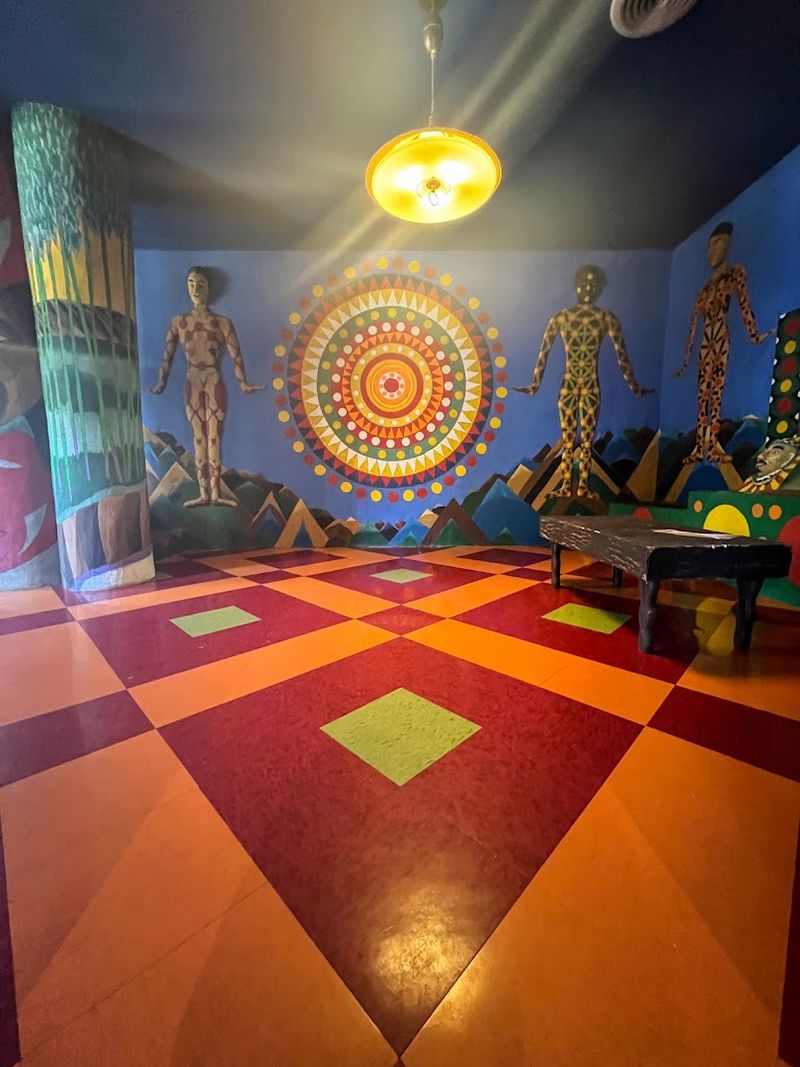
A visit to Pasaquan typically runs between 30 minutes and an hour, depending on how much time a person spends reading the interpretive signs and exploring the interior spaces. The grounds are compact but detailed, and rushing through them means missing a lot of what makes the site worth the drive.
The caretakers on-site are knowledgeable and genuinely enthusiastic about sharing the history of the compound. They walk visitors through the key areas, explain the symbolism in Martin’s work, and answer questions with a depth that goes well beyond what the signs alone can provide.
There are picnic tables on the property, and bringing a packed lunch is a reasonable option for those who want to extend their time there without rushing off to find food in Buena Vista. The parking area is free and spacious, which makes the logistics of arriving simple even for larger groups.
Going inside the main building first is the recommended approach, as it sets up the context for everything seen outdoors.
The Annual Festival That Brings the Site to Life
Pasaquan hosts an annual festival that draws a larger crowd than the typical weekend visit. The event usually features live music, art demonstrations, and programming that connects the compound’s history to contemporary conversations about folk art, visionary environments, and self-taught creativity.
The festival gives the site a different energy than a quiet weekday visit. The grounds fill with people who are genuinely curious about Martin’s work, and the atmosphere becomes more communal and celebratory than the usual contemplative pace of a solo visit.
For those who want to experience Pasaquan at its most alive, timing a visit around the festival is worth planning ahead. Details about the annual event are typically posted on the official website at pasaquan.columbusstate.edu, where current programming and event schedules are kept up to date.
Past festivals have drawn attendees from across Georgia and beyond, which speaks to the growing reputation of Pasaquan as a destination worth making a special trip to visit.
Why Scholars Call It Visionary Art
The term visionary art refers to work created by artists who draw primarily from internal spiritual or psychological experiences rather than from formal training or established art world conventions. Eddie Owens Martin fits that definition precisely.
Martin had no formal art education. His visual language came entirely from his own spiritual encounters, his extensive self-directed reading across world cultures, and his hands-on experimentation with materials over decades of daily work on the compound.
Art historians have placed Pasaquan in conversation with other major visionary environments in the United States, including Howard Finster’s Paradise Garden in Summerville, Georgia, and Simon Rodia’s Watts Towers in Los Angeles. Each of these sites was built by a single individual driven by an internal vision rather than external commissions or institutional support.
What makes Pasaquan particularly significant in that company is the coherence of Martin’s philosophical framework, which gives the visual work a conceptual depth that rewards serious study alongside casual appreciation.
Souvenirs, Donations, and Supporting the Site
Pasaquan operates on a donation-based model, and the suggested contribution is around ten dollars per visitor. There is no hard ticket price, and no one is turned away for not donating, but the site genuinely depends on that income to sustain the ongoing restoration and maintenance work.
One of the more distinctive souvenirs available on-site is a necklace made with beads that Eddie Owens Martin himself crafted during his lifetime. Owning one of those pieces connects a visitor to Martin’s work in a tangible way that a photograph cannot replicate.
The official website also offers additional ways to support the site and learn more about its history. For those who want to go deeper into Martin’s story before arriving, reading about his life and philosophy in advance makes the visit significantly more meaningful.
Cash is the most practical form of donation on-site, so arriving with some on hand is a straightforward way to contribute to keeping this irreplaceable place accessible to the public.
Practical Tips Before Making the Drive
Pasaquan is open Friday through Sunday, 10 AM to 5 PM, and is closed Monday through Thursday. Planning around those hours is essential, since the surrounding area in Marion County offers very limited alternatives if a visitor arrives on the wrong day.
The property does not have restroom facilities available to the public, so handling that before arriving is a practical necessity. There are also no food vendors on-site, which makes bringing snacks or a full lunch a smart move, especially for families or anyone planning to spend a full hour exploring.
Wildlife is present on the property, as the rural setting means the grounds are shared with the natural environment. Staying on the marked pathways and watching where you step is a reasonable precaution.
Cell service in the area can be unreliable, so downloading directions or a map before leaving is worth doing. The drive itself, through the quiet farmland of southwest Georgia, is a pleasant part of the overall experience.
Why Pasaquan Deserves a Spot on Every Georgia Bucket List
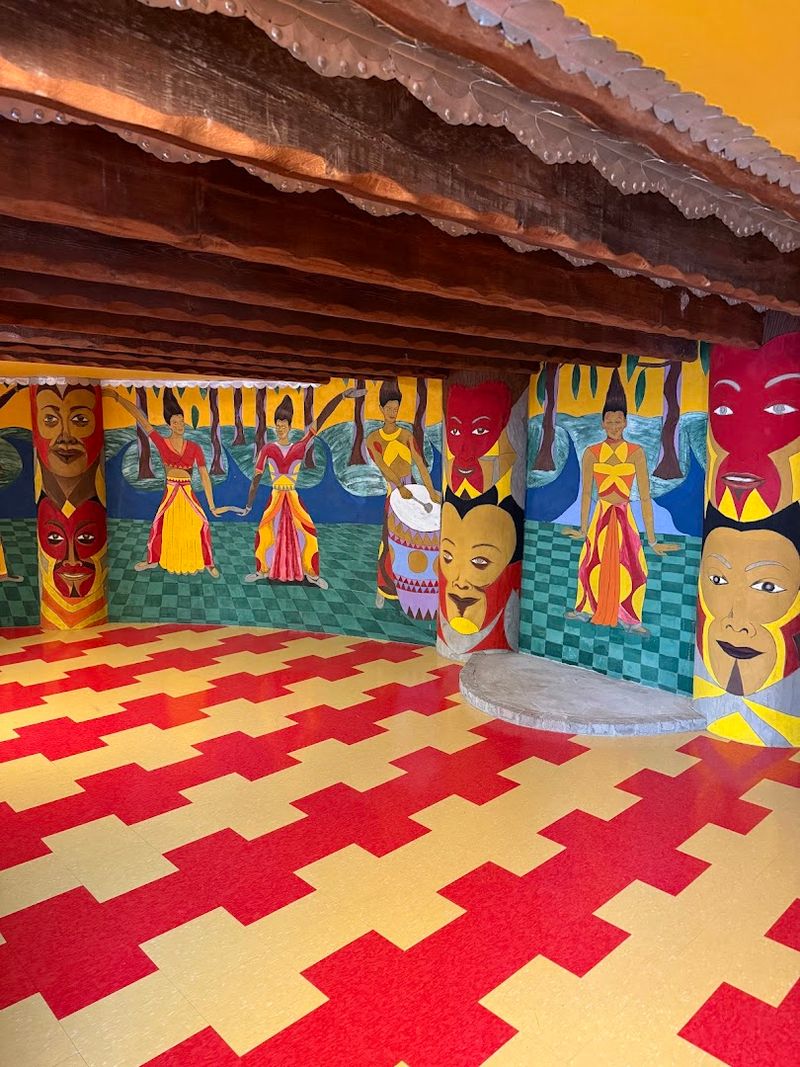
Georgia has no shortage of interesting places to visit, but very few of them were built entirely by one person working from a private spiritual vision over the course of three decades. That fact alone makes Pasaquan worth seeking out.
The site has been compared favorably to other major visionary environments across the country, and by most accounts it holds up well in that company. The restoration work has returned much of the compound to something close to what Martin intended, and the interpretive programming helps visitors understand what they are looking at rather than just passing through.
For anyone with an interest in American folk art, self-taught creativity, or the history of unconventional cultural spaces, Pasaquan is not a footnote. It is one of the central examples of what a single determined individual can create when given enough time, space, and belief in their own vision.
The drive to Buena Vista is long for most people, but the compound at the end of it earns every mile.
Where Exactly Pasaquan Sits in Georgia
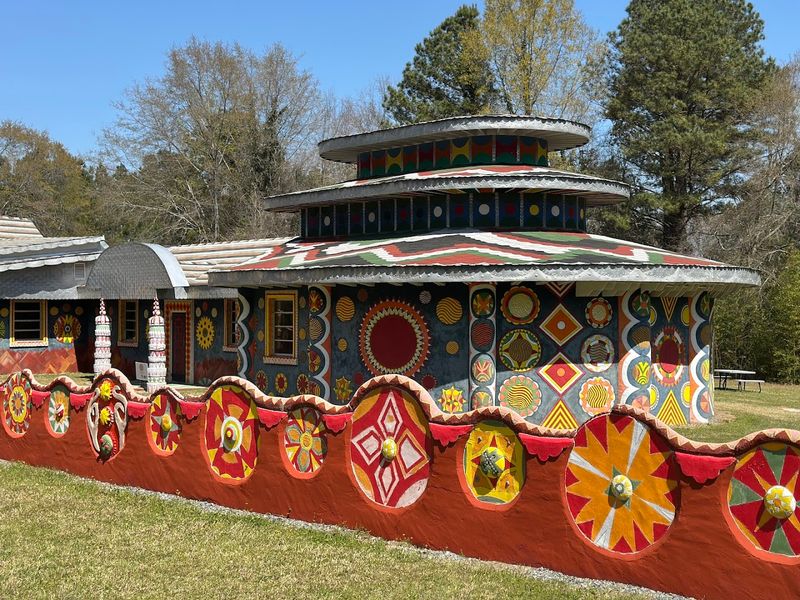
Tucked away on a quiet country road in Buena Vista, Georgia, Pasaquan is not the kind of place you stumble upon by accident. The full address is 238 Eddie Martin Rd, Buena Vista, GA 31803, and getting there means driving through miles of farmland and pine forest in Marion County.
Buena Vista is a small town, and the surrounding landscape is flat and rural, which makes the explosion of color and pattern at Pasaquan feel even more dramatic when it finally comes into view. The site sits roughly 30 miles northwest of Americus and about an hour’s drive from Columbus, Georgia.
Managed today through Columbus State University, the property is open to the public on Fridays, Saturdays, and Sundays from 10 AM to 5 PM. Admission is free, though a suggested donation of around ten dollars helps keep the grounds maintained and the restoration work moving forward.
Share this story