Some coffee shops are just places to grab a quick drink. But a handful of cafés around the world are something else entirely.
Walking through their doors feels like stepping back in time, where gilded ceilings, oil paintings, and marble columns make you forget you ordered a cappuccino. These places have hosted writers, philosophers, revolutionaries, and royalty.
They carry centuries of stories in their walls, and somehow, the coffee still tastes better because of it. From Venice’s oldest café to a grand Budapest palace that nearly became a ruin, these spots blur the line between culture and caffeine in the most beautiful way.
Whether you are a history lover, a curious traveler, or just someone who appreciates a gorgeous room, this list will make you want to book a flight and pull up a velvet chair.
1. Caffè Florian, Venice, Italy
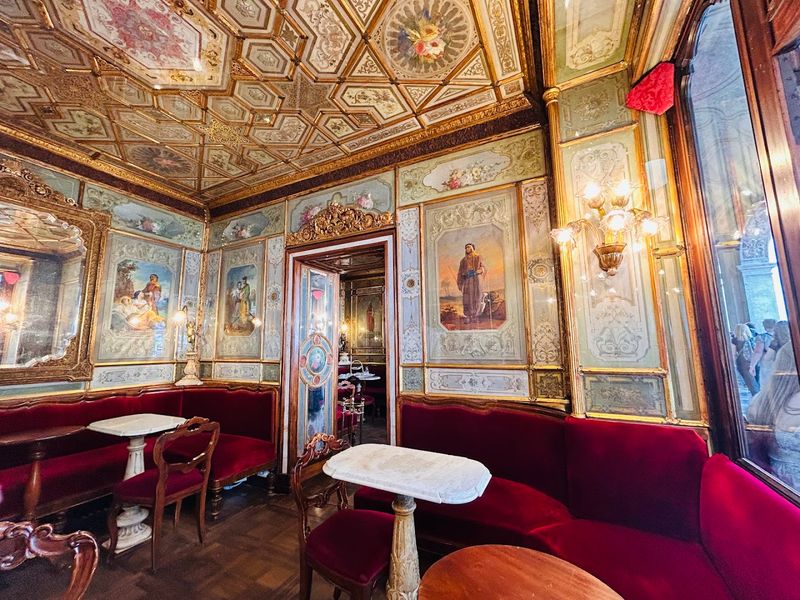
Opened in 1720, Caffè Florian holds the title of the oldest continuously operating café in Italy. It sits directly on St. Mark’s Square, one of the most famous public spaces in the world.
For over 300 years, it has served coffee to artists, writers, and curious travelers from every corner of the globe.
The interior looks like a painting itself. Every room is decorated with frescoed walls, gold-framed mirrors, and plush red velvet benches.
Composers like Richard Wagner and writers like Charles Dickens were once regulars here.
What surprises most first-time visitors is how small the rooms actually are. The café feels intimate despite its grand reputation.
Prices are higher than anywhere else in Venice, but many people consider one coffee here to be a genuine cultural experience rather than just a beverage.
2. Antico Caffè Greco, Rome, Italy
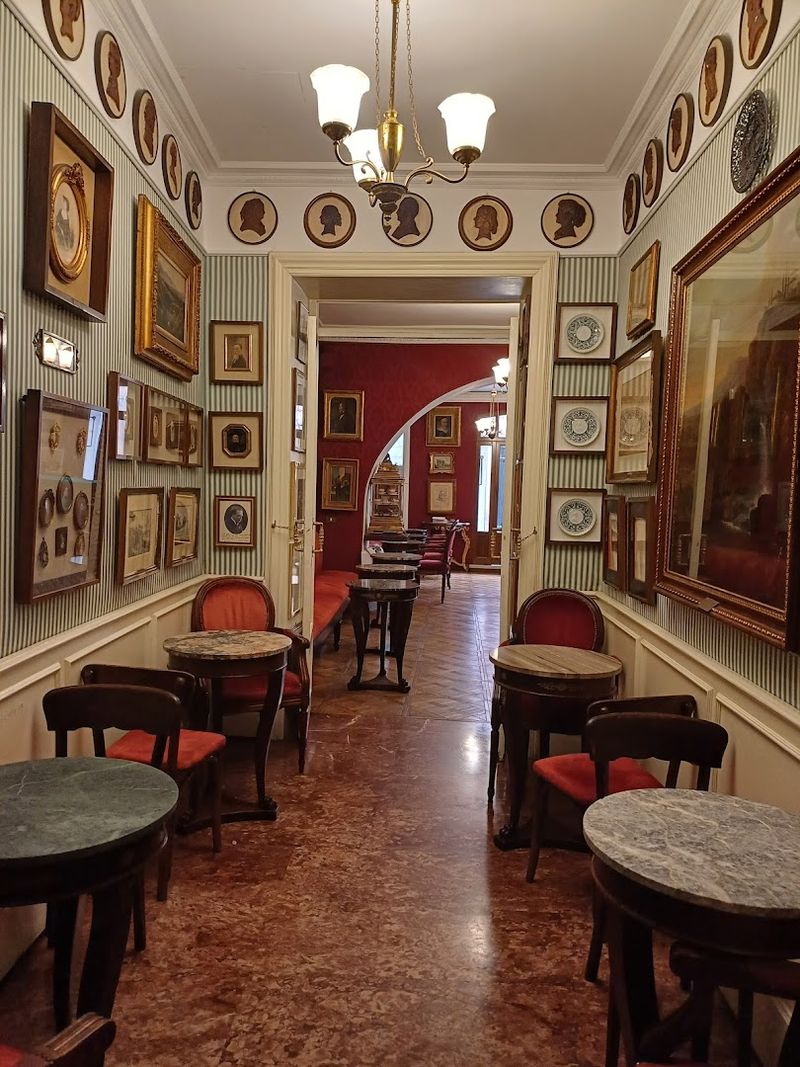
Founded in 1760 on Via Condotti, just steps from the Spanish Steps, Antico Caffè Greco is Rome’s oldest café still in operation. The name means “Ancient Greek Café,” a nod to its Greek founder.
Over the centuries, it became a favorite meeting spot for foreign artists and intellectuals visiting the city.
The walls are covered with more than 300 paintings, drawings, and portraits collected over generations. Busts of famous visitors line the narrow corridors, giving the café the unmistakable feel of a small gallery.
Composers like Liszt and Berlioz, and writers like Keats and Goethe, all passed through these rooms.
One fascinating detail: the café’s layout has barely changed since the 1800s. The tiny interconnected rooms feel frozen in time.
Locals and tourists alike still crowd in for an espresso, standing at the bar exactly as Romans have done for centuries.
3. Café Central, Vienna, Austria
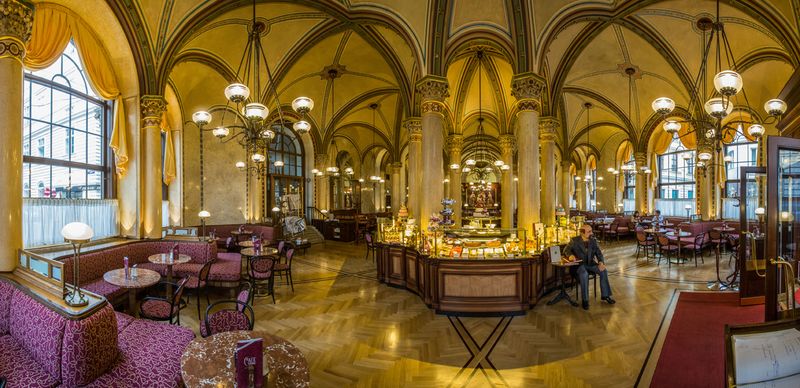
Café Central opened in 1876 inside the Palais Ferstel, a stunning 19th-century building in the heart of Vienna. The soaring vaulted ceilings, marble pillars, and arched windows make it look more like a cathedral than a place to drink coffee.
It quickly became a second home for Vienna’s intellectual crowd.
Sigmund Freud, Leon Trotsky, and the poet Peter Altenberg were all known regulars. Altenberg was such a fixture that a lifelike figure of him now sits near the entrance, hat and all.
The café even has its own pastry kitchen, producing elaborate cakes that have been on the menu for generations.
Vienna’s coffeehouse culture is recognized by UNESCO as an Intangible Cultural Heritage, and Café Central is considered one of its finest examples. Spending an afternoon here with a melange and a slice of apple strudel feels like a small act of cultural participation.
4. New York Café, Budapest, Hungary
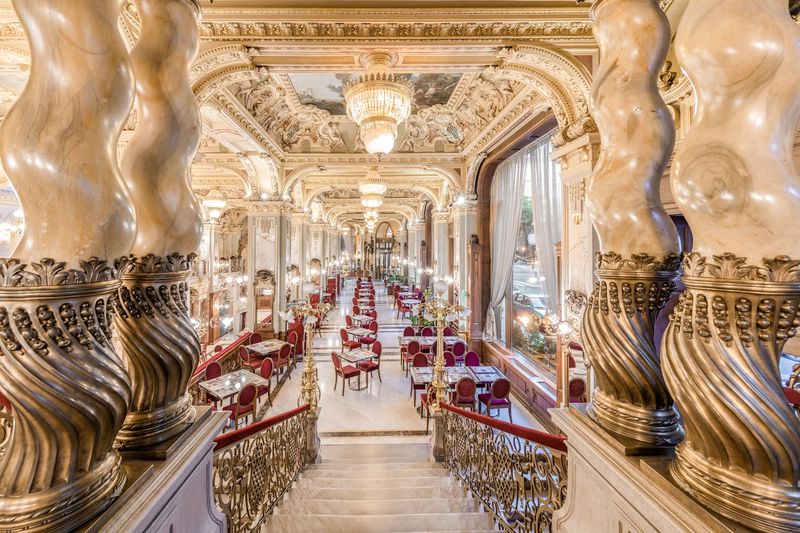
When New York Café opened in 1894, it was immediately called the most beautiful café in the world by local newspapers. That reputation has proved surprisingly durable.
The interior is almost shockingly ornate, with gilded columns, frescoed ceilings, marble floors, and chandeliers that look like they belong in an opera house.
In its early years, the café became the unofficial headquarters of Budapest’s literary community. Writers would spend entire days here, reportedly because the owner kept the café open around the clock.
Legend says that on opening night, a group of writers threw the keys into the Danube River so it could never close.
The café fell into serious disrepair during the communist era and was eventually used as a sporting goods store. A major restoration completed in 2006 brought it back to its original grandeur.
Today it operates as part of a luxury hotel, drawing visitors from around the world.
5. Café Imperial, Prague, Czech Republic
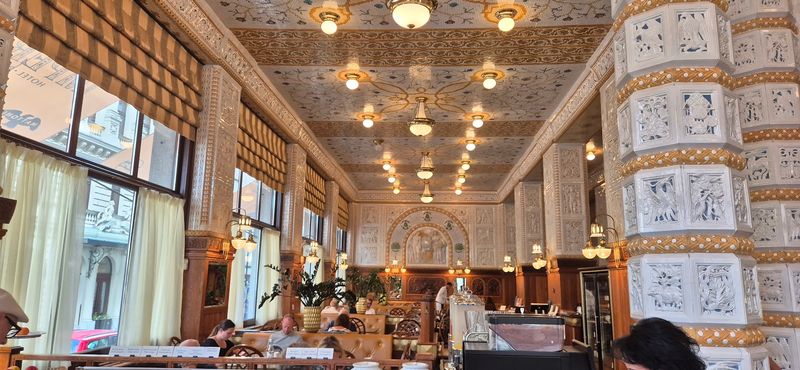
Café Imperial opened in 1914 and immediately stood out for one very specific reason: its walls and ceiling are completely covered in hand-crafted ceramic tiles and mosaic panels. The effect is extraordinary.
Walking inside feels less like entering a café and more like stepping into an Art Deco palace.
The tiles were produced in local Czech workshops, and the craftsmanship involved was remarkable even by the standards of the time. During the communist period, the café was converted into a canteen and the tiles were covered up.
A full restoration completed around 2007 brought the original surfaces back to life.
Today the café serves traditional Czech cuisine alongside its coffee menu. The breakfast and brunch options attract both locals and visitors.
What makes Café Imperial genuinely special is that the decoration is not reproduction or imitation. Every tile on those walls is over a century old and original to the building.
6. Majestic Café, Porto, Portugal
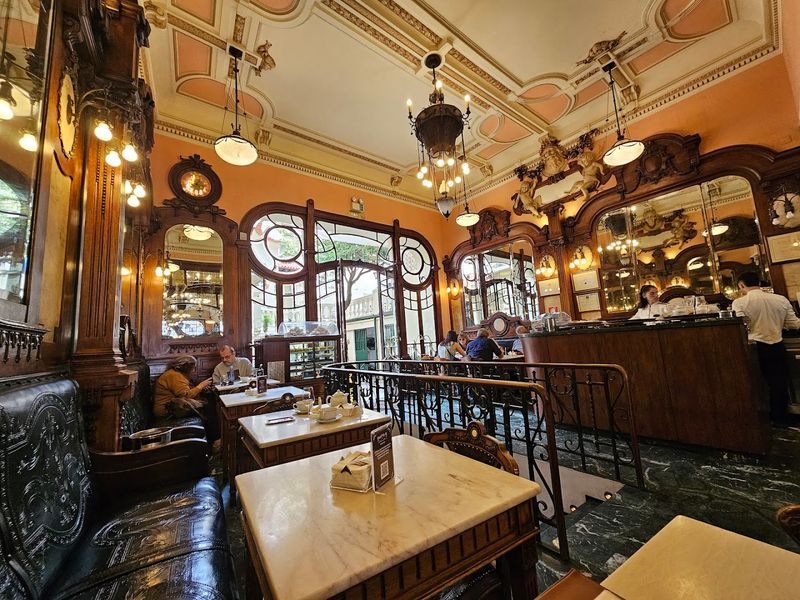
Majestic Café opened on Rua de Santa Catarina in Porto in 1921 and has been turning heads ever since. The exterior alone is worth stopping for, with its carved wooden doorway and large windows framed in decorative ironwork.
Inside, the Belle Époque styling continues with cherub sculptures, gilded mirrors, and leather seating arranged in neat rows.
The café was a gathering place for Porto’s artists and intellectuals during the early 20th century. It closed for a period and was carefully restored before reopening in 1994.
One notable connection: J.K. Rowling lived in Porto for a time in the early 1990s and is said to have visited the café regularly while working on early ideas for Harry Potter.
Whether or not the Hogwarts connection is the draw, the café earns its reputation on its own terms. The pastel de nata and strong Portuguese coffee are consistently excellent, and the room is genuinely beautiful.
7. Café Tortoni, Buenos Aires, Argentina
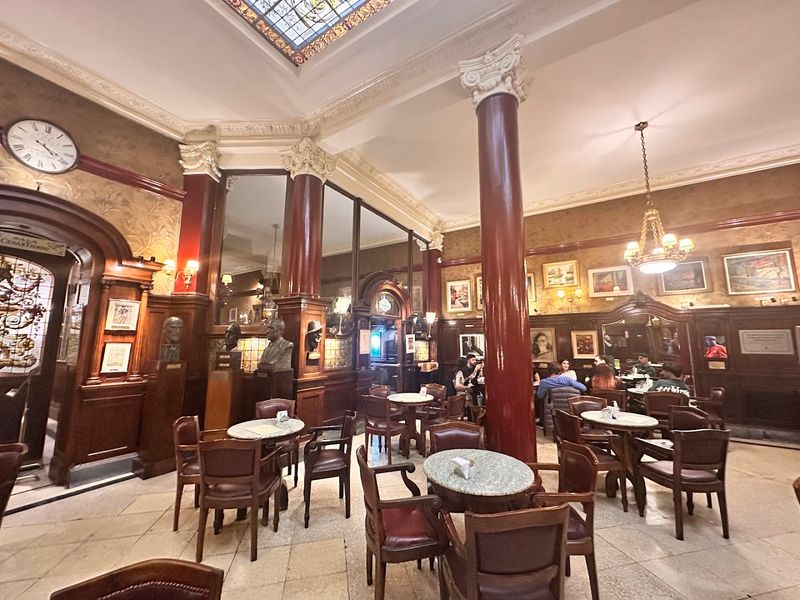
Café Tortoni has been serving coffee on Avenida de Mayo since 1858, making it the oldest café in Buenos Aires. The interior has the warm, slightly worn-in feel of a place that has genuinely been used and loved for generations.
Dark wood paneling, marble-topped tables, and black-and-white photographs of famous visitors line the walls.
The café became a cultural institution by hosting tango performances, poetry readings, and art exhibitions throughout the 20th century. A back room called the Peña still hosts live tango shows on certain evenings.
Notable visitors over the years have included Federico García Lorca, Albert Einstein, and several Argentine presidents.
One charming detail: the waitstaff have traditionally worn formal uniforms, maintaining a level of old-world service that feels rare today. The café also has a small billiard room that dates back to the early 1900s.
Café Tortoni is genuinely proud of what it is, and that pride shows.
8. Café de Flore, Paris, France
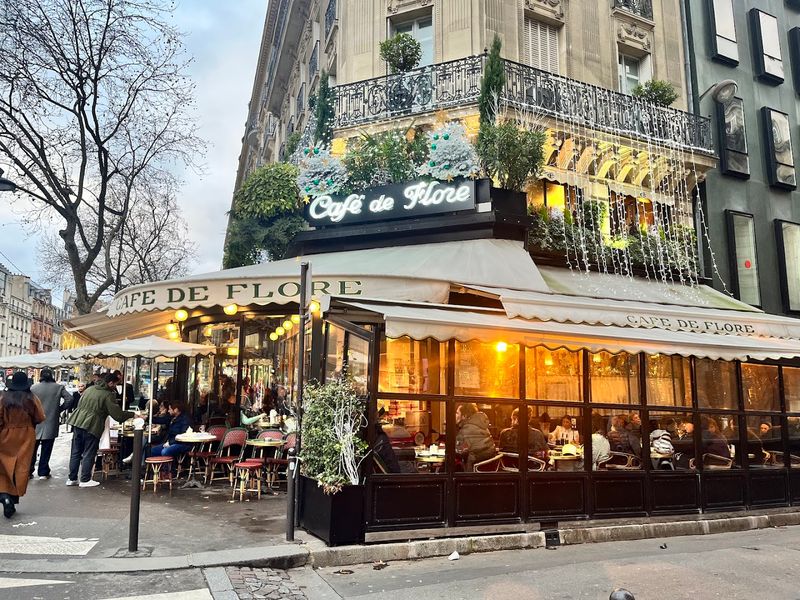
Café de Flore on Boulevard Saint-Germain has been open since 1887, but its real cultural moment came in the 1940s and 1950s. During that period, Jean-Paul Sartre and Simone de Beauvoir essentially used the café as their office.
They wrote, held meetings, and debated philosophy at their regular tables, often for hours at a time.
The interior is Art Deco in style, with warm mahogany paneling, red leather banquettes, and globe lights that cast a flattering glow. It looks polished but not stuffy.
The upstairs room offers a slightly quieter experience than the busy ground floor.
Every year, Café de Flore awards the Prix de Flore, a literary prize given to a promising young French-language author. The award comes with a daily croissant and hot chocolate at the café for a year, which is possibly the most Parisian prize in existence.
The café remains genuinely popular with Parisians, not just tourists.
9. Les Deux Magots, Paris, France
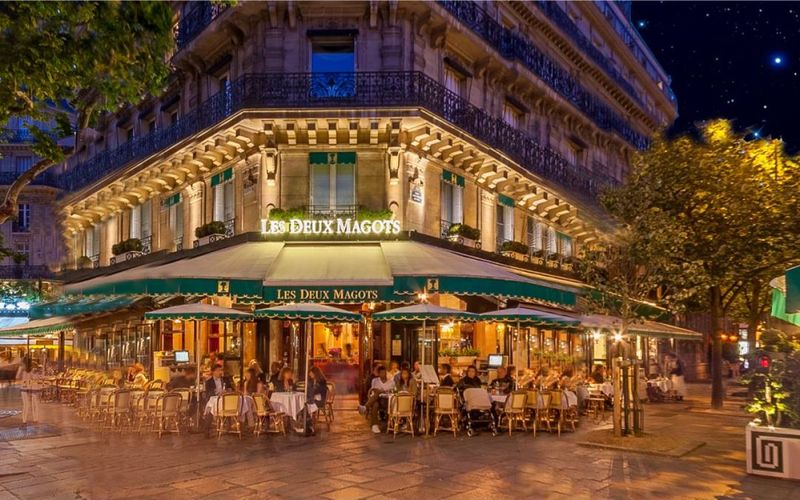
Les Deux Magots sits just across from the church of Saint-Germain-des-Prés and takes its unusual name from two carved wooden Chinese merchant figures mounted on columns inside the café. The word “magot” in old French referred to a decorative figurine of an East Asian merchant.
The figures have been there since the café moved to its current location in 1884.
Ernest Hemingway, James Baldwin, Pablo Picasso, and Albert Camus were all associated with the café during the early-to-mid 20th century. Since 1933, the café has awarded its own literary prize, the Prix des Deux Magots, which has recognized writers who went on to major careers.
Sitting at an outdoor table here on a quiet morning, watching the pigeons circle the old church across the street, is one of those Paris experiences that feels almost too cinematic to be real. The hot chocolate is famously thick and worth ordering even in summer.
10. Caffè Pedrocchi, Padua, Italy
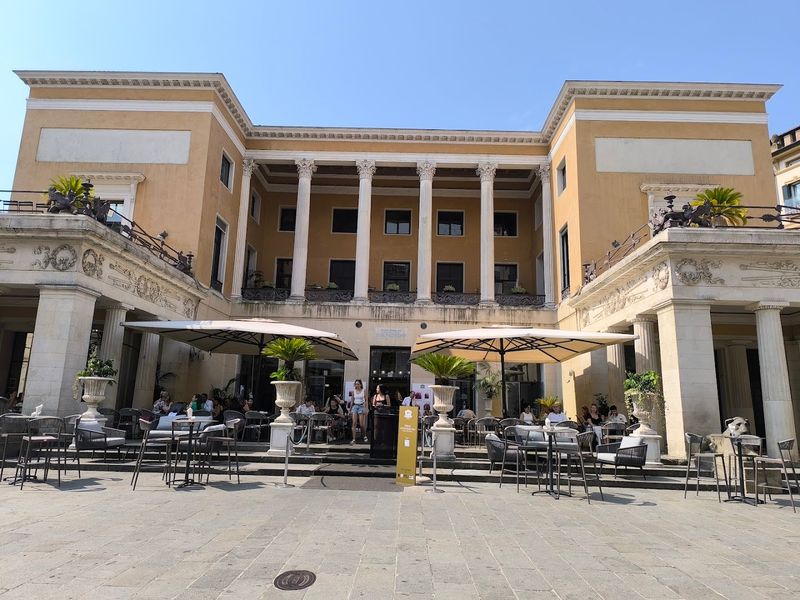
Caffè Pedrocchi opened in 1831 and quickly earned a nickname that still applies today: the Café Without Doors. For much of the 19th century, it stayed open around the clock with no closing time.
Students and professors from the nearby University of Padua, one of the oldest universities in the world, made it their meeting place day and night.
The building itself is a neoclassical masterpiece designed by architect Giuseppe Jappelli. Inside, different rooms are decorated in entirely different historical styles, including Egyptian, Greek, Roman, and Gothic revival themes.
Each room feels like a separate exhibit in an architectural history museum.
In 1848, the café became the site of a student uprising against Austrian rule, and a bullet hole from that event is still visible in the wall. That detail alone makes Caffè Pedrocchi more than just a café.
It is a physical piece of Italian history that still serves coffee.
11. Café Pushkin, Moscow, Russia
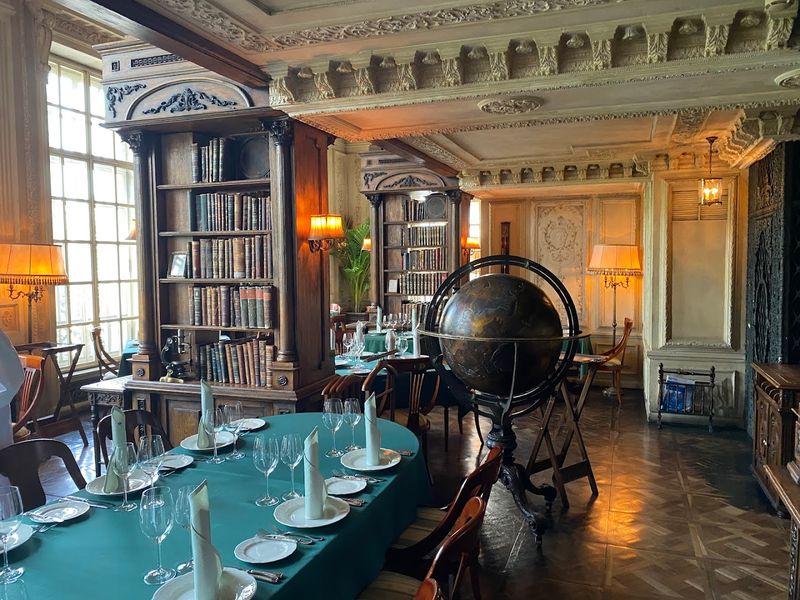
Despite feeling centuries old, Café Pushkin only opened in 1999. It was created by French singer Gilbert Becaud, who had written a song in 1965 about a fictional café in Moscow named after the poet Alexander Pushkin.
When the restaurant was eventually built, the owners committed fully to the illusion of age.
The building was designed to look like a 19th-century Russian nobleman’s house, complete with floor-to-ceiling bookshelves filled with antique volumes, oil portrait paintings, and dark carved wood throughout. The menu draws from pre-revolutionary Russian aristocratic cuisine, and the staff wear period-appropriate uniforms.
What makes this café fascinating is the philosophical question it raises: can a place feel genuinely historic if its history is constructed? Most visitors, surrounded by candlelight and leather-bound books, stop asking that question fairly quickly.
The food is consistently praised, and the atmosphere is unlike anything else in Moscow’s dining scene.
12. El Molino Patisserie, Buenos Aires, Argentina
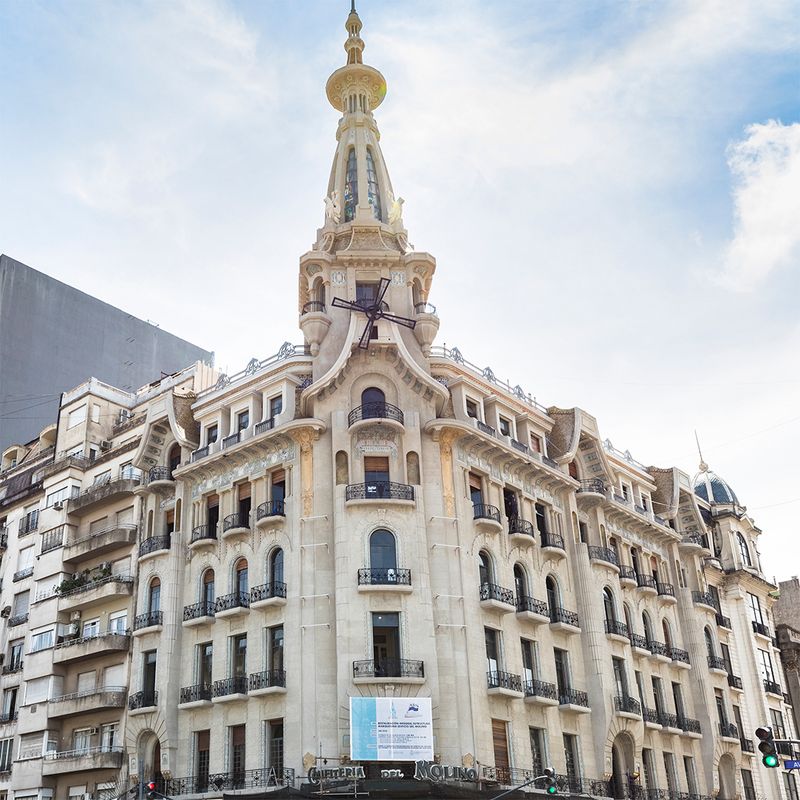
El Molino Patisserie opened in 1916 directly across from the Argentine National Congress building, and for decades it served as the unofficial gathering place for politicians, journalists, and public figures. The building is an Art Nouveau landmark, topped with a distinctive windmill tower that gave the café its name. “Del Molino” means “of the windmill.”
At its peak, the confitería was famous for its elaborate pastries and chocolates, produced in a kitchen visible through glass panels from the main room. The café closed in 1997 after a long period of financial difficulty, and the building sat empty and deteriorating for over two decades.
A government-funded restoration project was completed in 2022, bringing the café back to life after years of public campaigning to save it. The stained glass, tilework, and ornate plasterwork were carefully restored.
Reopening was widely celebrated in Buenos Aires as the return of a genuine piece of the city’s cultural identity.
13. Gran Café de Gijón, Madrid, Spain
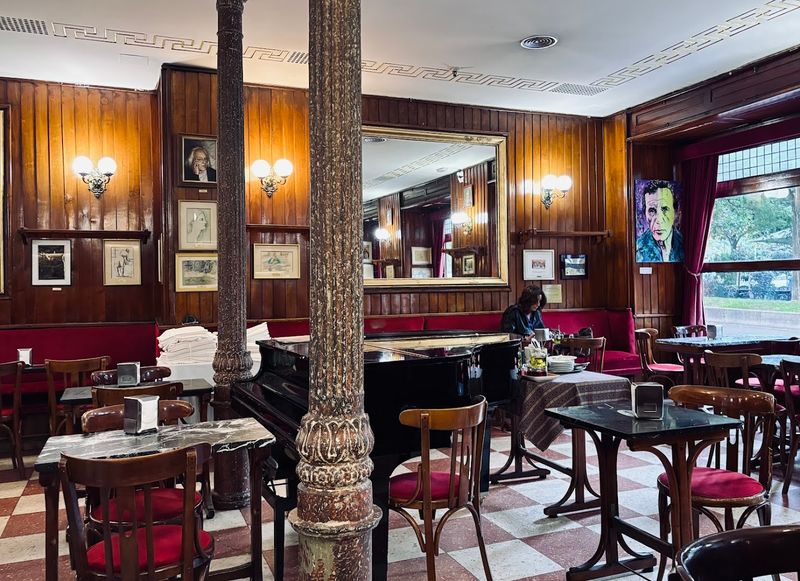
Gran Café de Gijón has been operating on the Paseo de Recoletos since 1888, making it one of Madrid’s oldest continuously running cafés. It became famous as a tertulia café, meaning a place where regular groups gathered to debate literature, politics, and philosophy over long afternoons.
That tradition of intellectual conversation was central to Spanish café culture for generations.
Writers like Valle-Inclán and poets associated with the Generation of 98 were regulars here. The café has appeared in Spanish novels and films, cementing its place in the country’s cultural memory.
The interior maintains its original character, with dark wood, marble surfaces, and a long bar that has seen more than a century of conversations.
One interesting detail: the café publishes its own literary award, the Premio Café Gijón, which has been awarded since 1949 and is considered one of Spain’s most prestigious prizes for narrative fiction. Coffee and literature, it turns out, have always gone together in Madrid.
14. A Brasileira, Lisbon, Portugal
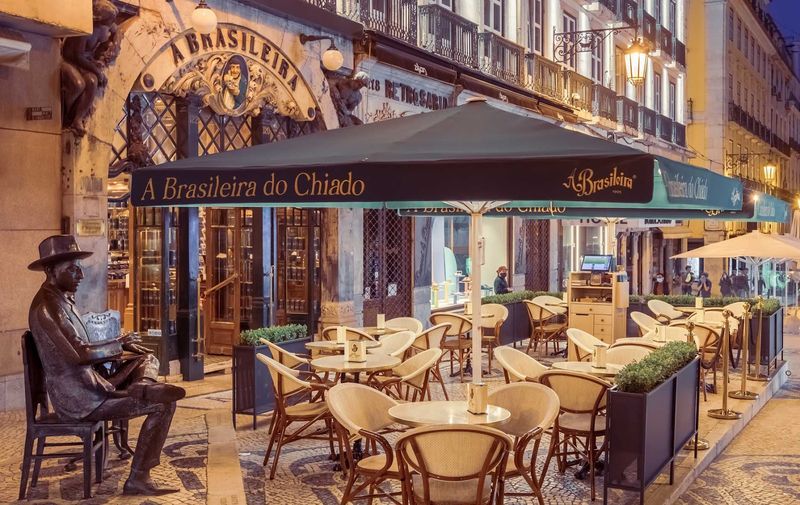
A Brasileira opened in 1905 on Rua Garrett in the Chiado neighborhood of Lisbon, originally as a shop selling Brazilian coffee. It quickly became a café and gathering place for the city’s artistic and literary crowd.
The name simply means “The Brazilian Woman,” a reference to the café’s coffee origins.
The poet Fernando Pessoa was among its most famous regulars, and a bronze statue of him seated at an outdoor table has become one of Lisbon’s most photographed landmarks. Tourists line up to sit beside the statue for a photo, which Pessoa himself, a notoriously private man, would almost certainly have found mortifying.
The interior is beautifully preserved, with Art Nouveau tilework, dark wood paneling, and oil paintings covering the walls. A Brasileira introduced the bica, a strong short espresso, to Lisbon, and the city has never looked back.
That small contribution to coffee culture alone earns it a permanent place in Portuguese history.
15. Café Louvre, Prague, Czech Republic
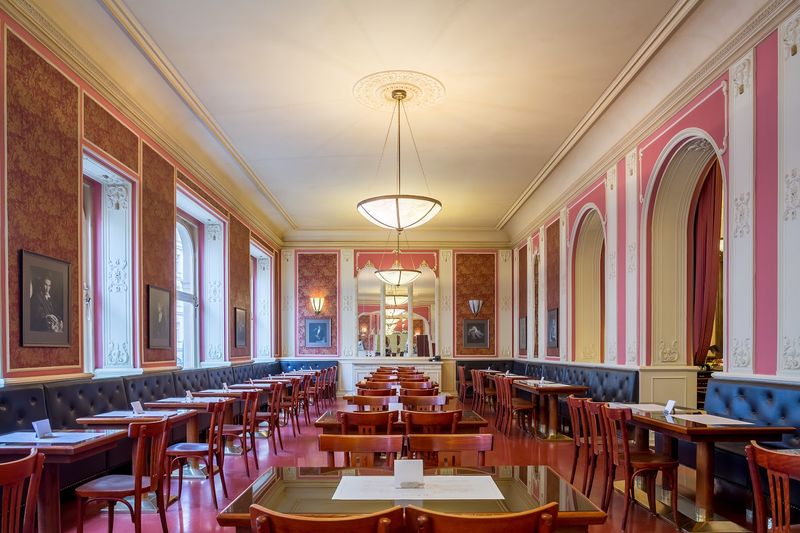
Café Louvre has occupied a spot on Národní Street in Prague since 1902, though it has had a few interruptions along the way. The café became well known in the early 20th century as a meeting place for Prague’s German-speaking intellectual community.
Franz Kafka and Albert Einstein, both of whom lived in Prague at various points, are among the notable figures connected to the café.
The communist government closed the café in 1948, and it remained shut for decades. When it reopened in 1992 after the fall of communism, the owners worked to restore its original character.
The high ceilings, large street-facing windows, and period light fixtures give it a timeless Central European atmosphere.
A billiard room at the back of the café has been in operation since the original opening and remains one of the more charming quirks of the place. Café Louvre serves hearty Czech and European dishes alongside its coffee menu, making it a comfortable place to spend a rainy Prague afternoon.
Share this story