North Carolina’s mountains are home to hundreds of waterfalls, many tucked deep inside lush forests, scenic gorges, and protected state parks. Some require only a short walk, while others reward hikers with miles of unforgettable scenery before revealing a spectacular cascade.
Whether you’re a seasoned trail runner or a casual weekend explorer, these waterfalls prove that the journey is every bit as memorable as the destination itself.
Linville Falls — Linville Gorge
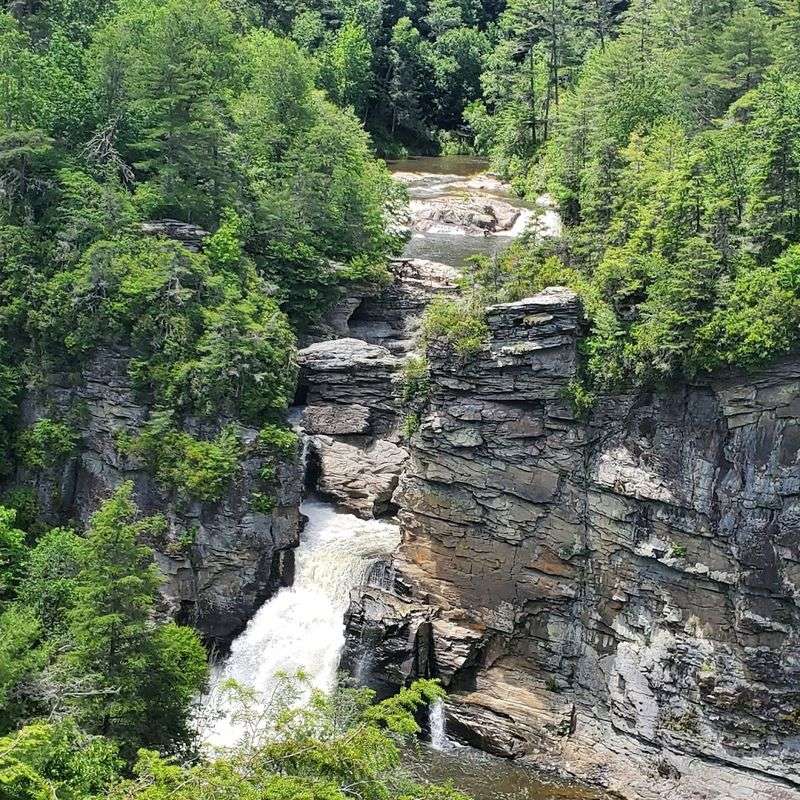
Standing at the edge of a Linville Gorge overlook, you genuinely feel small in the best possible way. Linville Falls is one of North Carolina’s most celebrated natural landmarks, drawing hikers from across the country who want more than just a quick photo stop.
The waterfall drops in two dramatic stages before crashing into the rugged gorge below.
Multiple trails branch out from the main trailhead, giving visitors the freedom to choose their own adventure. The Erwin’s View Trail is the most popular, winding through hardwood forest and delivering four separate overlooks along the way.
Each viewpoint frames the falls differently, so no two stops feel the same.
The moderate difficulty level makes this accessible to most hikers, though sturdy footwear is always a smart call. Fall foliage season transforms the surrounding forest into a kaleidoscope of color that rivals any view in the state.
Managed by the National Park Service, the area stays well maintained, with clean facilities near the trailhead. Pack a lunch, take your time between overlooks, and let Linville Falls remind you why North Carolina’s wilderness is worth every single step.
Catawba Falls — Old Fort
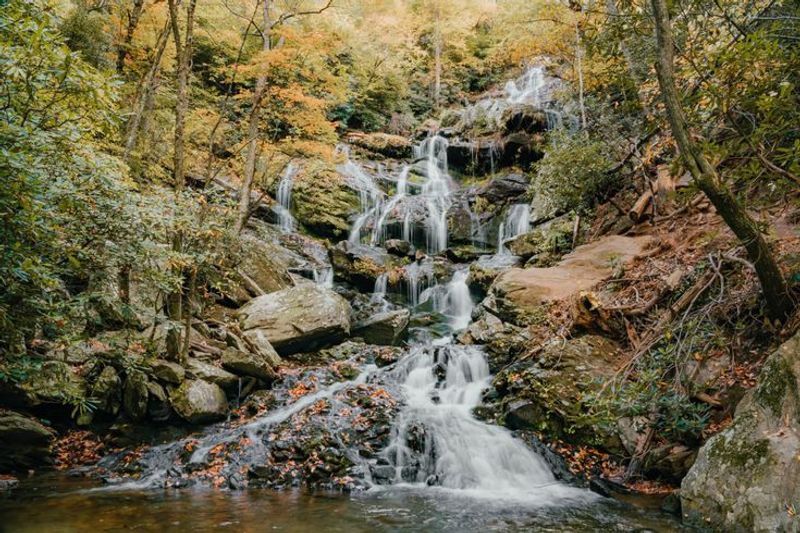
The sound of rushing water starts long before you ever see the falls, building anticipation with every step along the trail. Catawba Falls sits inside Pisgah National Forest near the small mountain town of Old Fort, and recent trail upgrades have made the experience even better than before.
A new observation tower now gives visitors an elevated view that simply did not exist a few years ago.
The trail follows the Catawba River for most of the hike, crossing charming wooden bridges and weaving through stands of towering hardwoods. Spring visits are especially rewarding, when snowmelt pushes the water volume to its peak and the forest floor bursts with wildflowers.
The multi-tiered waterfall at the end reveals itself gradually, each level adding to the drama.
Parking fills up fast on weekends, so arriving early is a genuinely good strategy rather than just polite advice. The round trip covers about three miles with manageable elevation gain, making it a solid choice for active families.
Trail conditions can get muddy after rain, so waterproof boots earn their keep here. Catawba Falls consistently surprises first-time visitors who expected something smaller.
Crabtree Falls — Blue Ridge Parkway
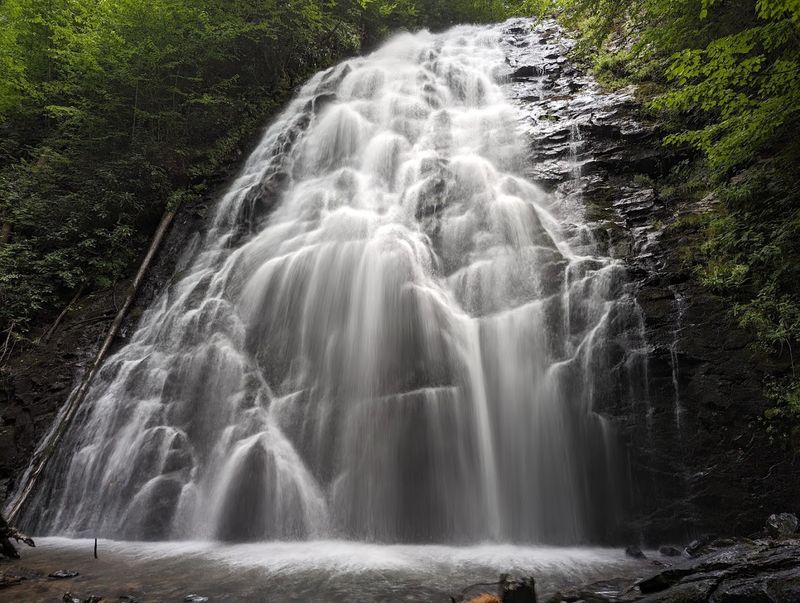
Tucked just off one of America’s most scenic highways, Crabtree Falls manages to feel like a genuine wilderness discovery. The trailhead sits at Crabtree Meadows Campground along the Blue Ridge Parkway, making it a natural stop for road trippers already soaking up mountain views.
What awaits at the end of the loop trail is a 70-foot waterfall dropping over moss-covered boulders in a cathedral-like forest setting.
The loop covers roughly 2.5 miles and passes through thick rhododendron tunnels that bloom brilliantly in late spring and early summer. Those tunnels create a cool, shaded corridor that makes even warm summer hikes surprisingly comfortable.
The trail descends fairly steeply toward the falls, so the return climb gives your legs a proper workout.
Photographers absolutely love the soft light that filters through the canopy around the falls basin. The pool at the base reflects the cascade beautifully during calm conditions, creating mirror-like shots that look almost too good to be real.
Weekday visits are noticeably quieter, giving you more time to simply sit and listen to the water. Crabtree Falls rewards patience and earns its reputation as one of the Parkway’s finest short hikes.
Upper Whitewater Falls — Sapphire
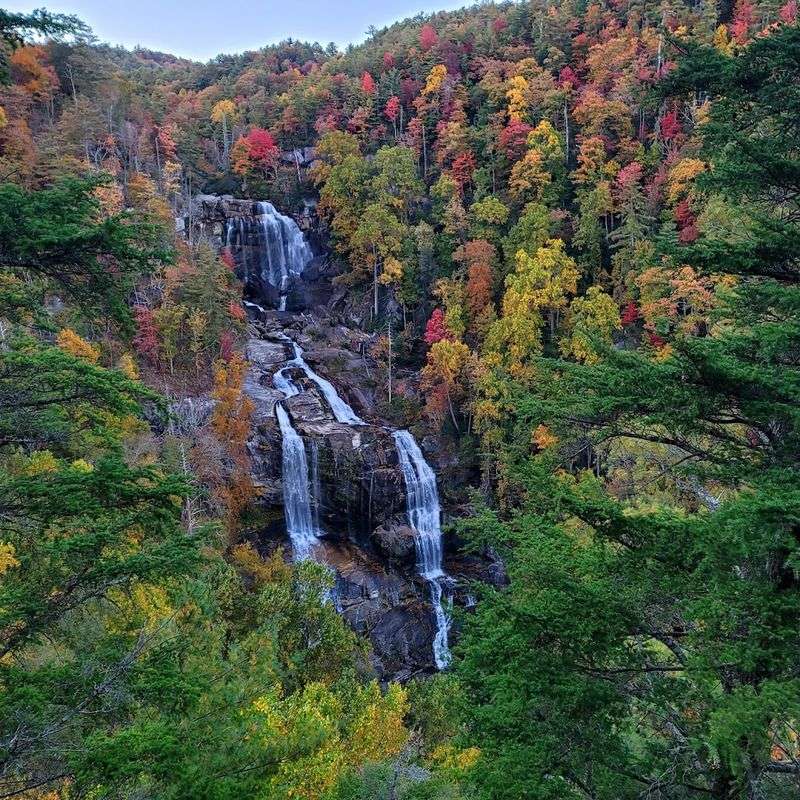
At 411 feet, Upper Whitewater Falls does not just impress, it absolutely stuns. This is the tallest waterfall in North Carolina and one of the tallest cascades found anywhere east of the Rocky Mountains, which makes standing at the overlook feel like a genuine bragging-rights moment.
The sheer volume of water thundering down the granite face creates a mist cloud visible from the viewing platform.
The main overlook is reached via a paved trail from the parking area, making it one of the more accessible big waterfall experiences in the state. For visitors who want a closer look, a long staircase descends toward the base and delivers a perspective that puts the full scale of the falls into sharp focus.
Each step down reveals more of the cascade, layer by dramatic layer.
The surrounding Nantahala National Forest adds lush green framing to every photograph, and the gorge below looks almost impossibly deep from the upper platform. Swimming near the base is not permitted due to strong currents, which is a rule worth respecting.
Autumn brings spectacular foliage that wraps the falls in warm gold and orange tones. Upper Whitewater Falls is simply one of those places that demands a return visit.
Triple Falls — DuPont State Recreational Forest
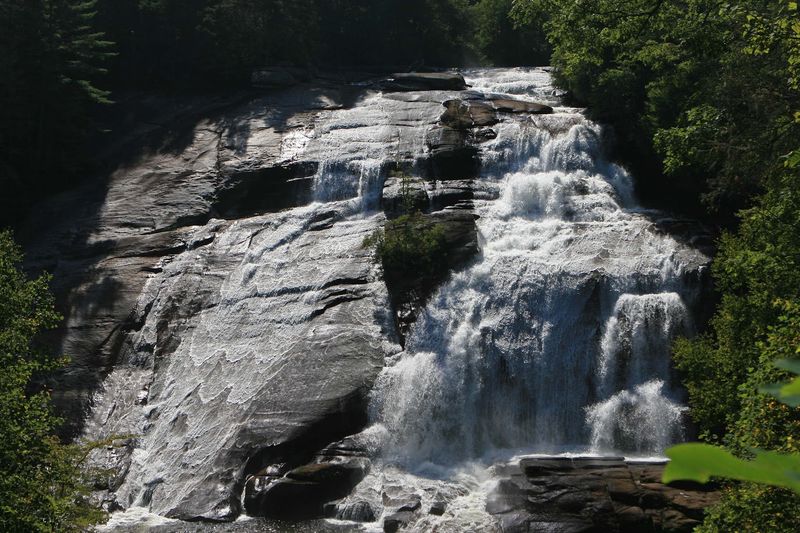
Hollywood came calling at Triple Falls long before most hikers even knew its name. Scenes from The Hunger Games were filmed right here in DuPont State Recreational Forest, and standing at the water’s edge, it is easy to understand why filmmakers chose this location.
Three distinct ledges send the Little River tumbling in wide, photogenic sheets across broad rock faces.
The hike to Triple Falls is moderate and well-marked, winding through a forest that feels genuinely cinematic at every turn. Most visitors combine the trip with nearby High Falls and Hooker Falls, creating a full waterfall-hopping day that covers several miles without ever feeling repetitive.
The variety of cascades along the route keeps energy levels surprisingly high.
Cycling is permitted on many DuPont trails, so do not be surprised if mountain bikers zip past while you are pausing for photos. The forest is open year-round, and winter visits reveal the rock faces in dramatic bare-tree clarity that summer foliage hides completely.
Parking at the High Falls trailhead is the most convenient starting point for a Triple Falls adventure. Bring snacks, wear layers in cooler months, and plan for at least half a day to fully appreciate everything DuPont has to offer.
Rainbow Falls — Gorges State Park
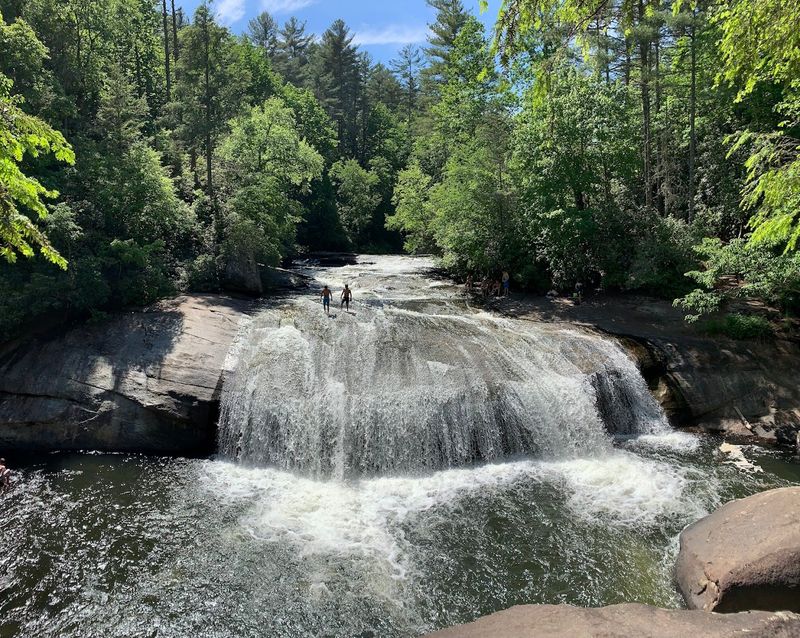
Earning this waterfall requires real effort, and that is precisely what makes arriving here so satisfying. Rainbow Falls drops a jaw-dropping 150 feet along the Horsepasture River inside Gorges State Park, a place so botanically rich it is sometimes called the “land of waterfalls.” The trail is genuinely challenging, with steep sections and rocky terrain that demand solid footwear and a reasonable fitness level.
The payoff arrives in spectacular fashion. On sunny days, the mist rising from the base catches sunlight and produces vivid rainbows that arc across the falls with almost theatrical timing.
That recurring light show is how this waterfall earned its name, and it never gets old no matter how many times you witness it.
The round trip runs roughly four miles with significant elevation change, so starting early gives you both cooler temperatures and better lighting for photography. Gorges State Park sits near the South Carolina border in a unique microclimate that supports subtropical plant species rarely seen this far north.
Rhododendron, trillium, and rare ferns line the trail in spring. Water shoes are handy if you want to explore near the base pool.
Rainbow Falls rewards every hiker who commits to the climb with a memory that genuinely lasts.
Mingo Falls — Cherokee
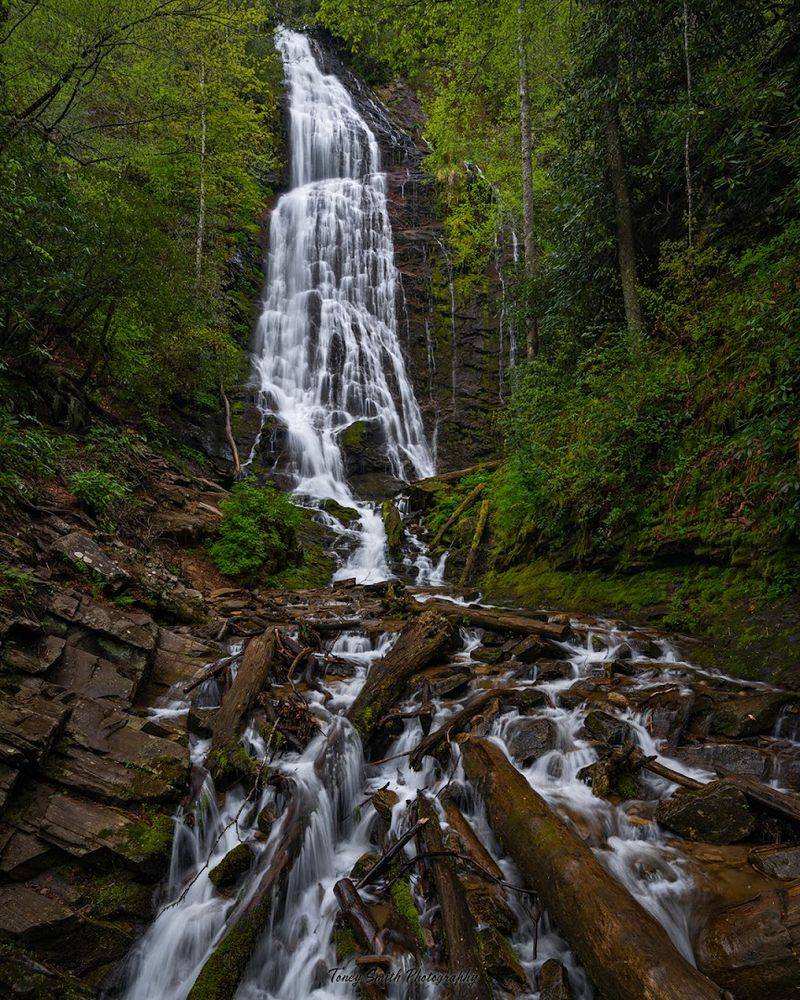
Roughly 600 steps stand between the trailhead parking area and one of the most dramatic waterfall reveals in the entire southern Appalachian region. Mingo Falls towers approximately 120 feet above the forest floor on the Qualla Boundary, the sovereign homeland of the Eastern Band of Cherokee Indians.
That cultural context adds a meaningful layer to what is already a physically impressive destination.
The climb up the wooden staircase is steep and relentless, but the trail levels out briefly before delivering the falls into full view. The sheer height of Mingo Falls catches most first-time visitors completely off guard, since the narrow gorge makes the cascade appear even taller than its already impressive measurement suggests.
Water volume peaks dramatically after heavy rainfall.
The surrounding forest feels ancient and undisturbed, with large hemlocks and moss-covered boulders framing the base of the falls. Morning light filters beautifully through the canopy during spring and early summer visits.
The trailhead is located just minutes from downtown Cherokee, making it an easy add-on to any visit to the Great Smoky Mountains area. Admission fees support the tribal community.
Mingo Falls is short on distance but absolutely enormous on impact, delivering a genuine wow moment at the top of every staircase climb.
Dry Falls — Highlands
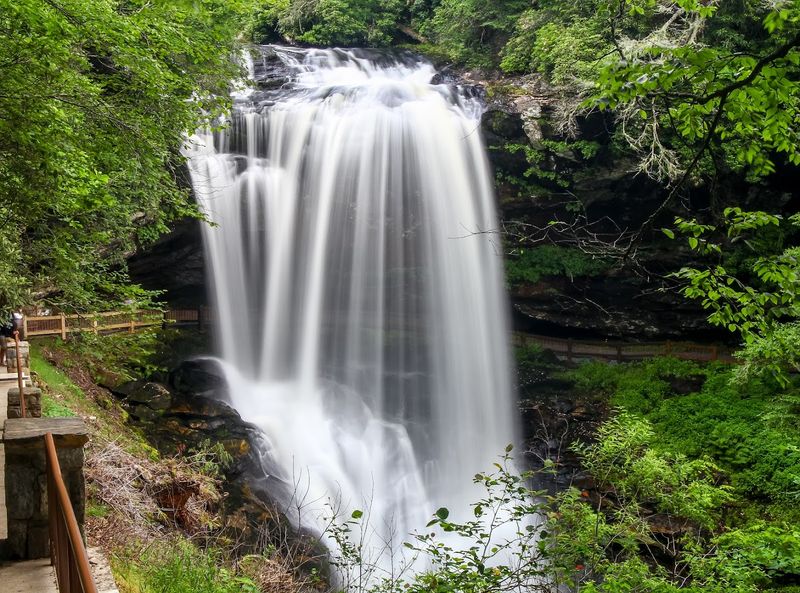
Walking behind a waterfall without getting soaked sounds like a trick, but Dry Falls makes it a perfectly normal Tuesday afternoon activity. Located along the Cullasaja River Gorge near Highlands, this 75-foot cascade gets its quirky name from the fact that visitors can stroll along a paved path directly behind the curtain of falling water while staying mostly dry.
The cool mist and roaring sound create a fully immersive experience that no photograph can fully capture.
The path down from the parking area is short and paved, making Dry Falls one of the most accessible waterfall experiences in the state. Families with young children frequently make this a highlight of their mountain vacation, and it is easy to see why.
The combination of novelty, beauty, and ease of access is nearly impossible to beat in one stop.
Nantahala National Forest surrounds the gorge with dense hardwood canopy that explodes in color each autumn. The drive along the Cullasaja Gorge Road to reach the falls is itself a scenic experience, passing several smaller cascades along the way.
Dry Falls is managed by the U.S. Forest Service and charges a small parking fee.
Bring a light jacket even in summer, because the mist behind the falls stays impressively cold year-round.
Looking Glass Falls — Pisgah National Forest
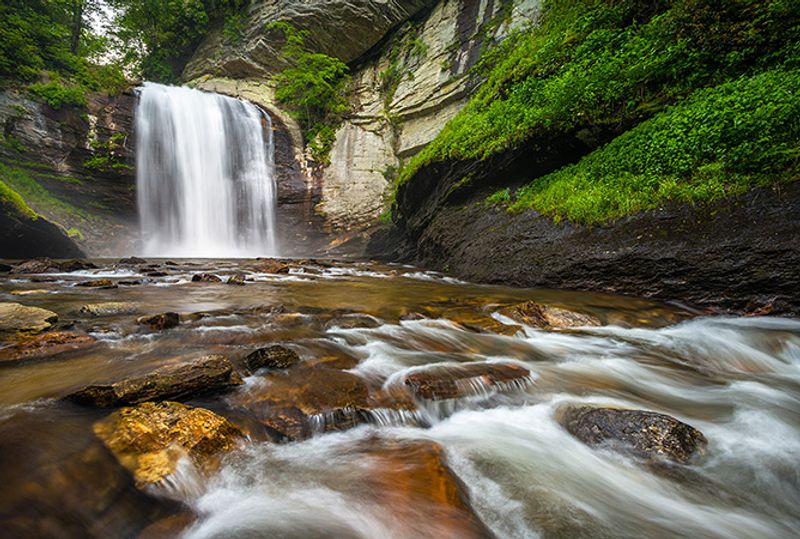
Few waterfalls in North Carolina are as instantly rewarding as this one, which practically leaps into view the moment you step out of your car. Looking Glass Falls drops 60 feet over a smooth, curved rock face into a wide, clear pool below, creating the kind of postcard-perfect scene that stops people mid-sentence.
It is one of the most photographed waterfalls in the entire state, and the camera never lies about why.
A short staircase leads from the roadside parking area down to the base viewing platform, where the sound of the falls fills every corner of the small gorge. During summer, brave swimmers cool off in the pool beneath the cascade, though the water temperature stays bracingly cold even in July.
The scene feels lively and communal in a way that quieter backcountry falls simply do not.
Looking Glass Creek feeds the falls after draining from the nearby Looking Glass Rock formation, one of Pisgah’s most recognizable granite domes. The name comes from the way ice sheets on the rock face once glittered like a mirror in winter sunlight.
Surrounding trails connect to deeper forest adventures for visitors who want more mileage. Looking Glass Falls works equally well as a quick stop or a full morning destination.
Moore Cove Falls — Pisgah National Forest
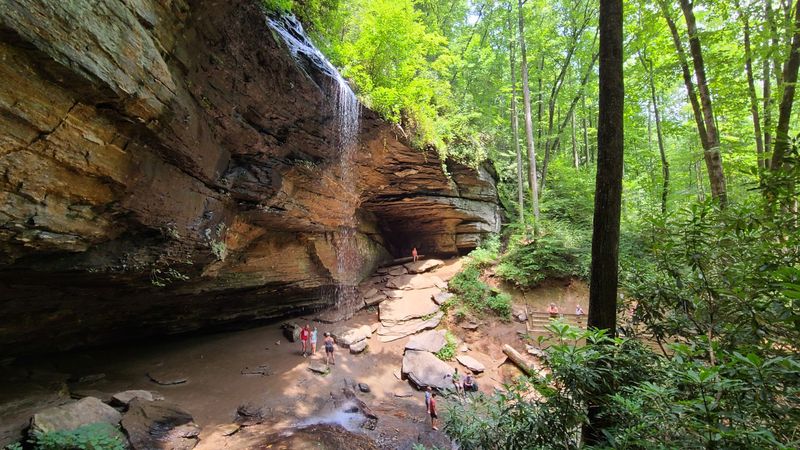
There is something quietly magical about a waterfall that invites you to step inside it rather than simply admire it from a distance. Moore Cove Falls spills over a mossy rock overhang in Pisgah National Forest, creating a thin but graceful curtain of water that visitors can walk directly behind without getting drenched.
The experience feels almost secretive, like discovering a hidden room tucked into the side of a mountain.
The trail to reach it covers about 1.4 miles round trip with minimal elevation gain, making it a top pick for families, beginners, and anyone who wants a rewarding forest walk without a punishing climb. The path winds through tall hemlocks and lush fern beds that stay green and vibrant well into autumn.
Birdsong accompanies most of the hike, adding a peaceful soundtrack to the whole experience.
Moore Cove Falls sits just a short drive from Looking Glass Falls, so combining both in a single outing is a completely logical and satisfying plan. The intimate scale of Moore Cove is a lovely contrast to the bold drama of its neighbor.
Morning visits offer the best light inside the cove and fewer fellow hikers crowding the space behind the falls. This one rewards those who take their time and linger a little longer than planned.
Hickory Nut Falls — Chimney Rock State Park
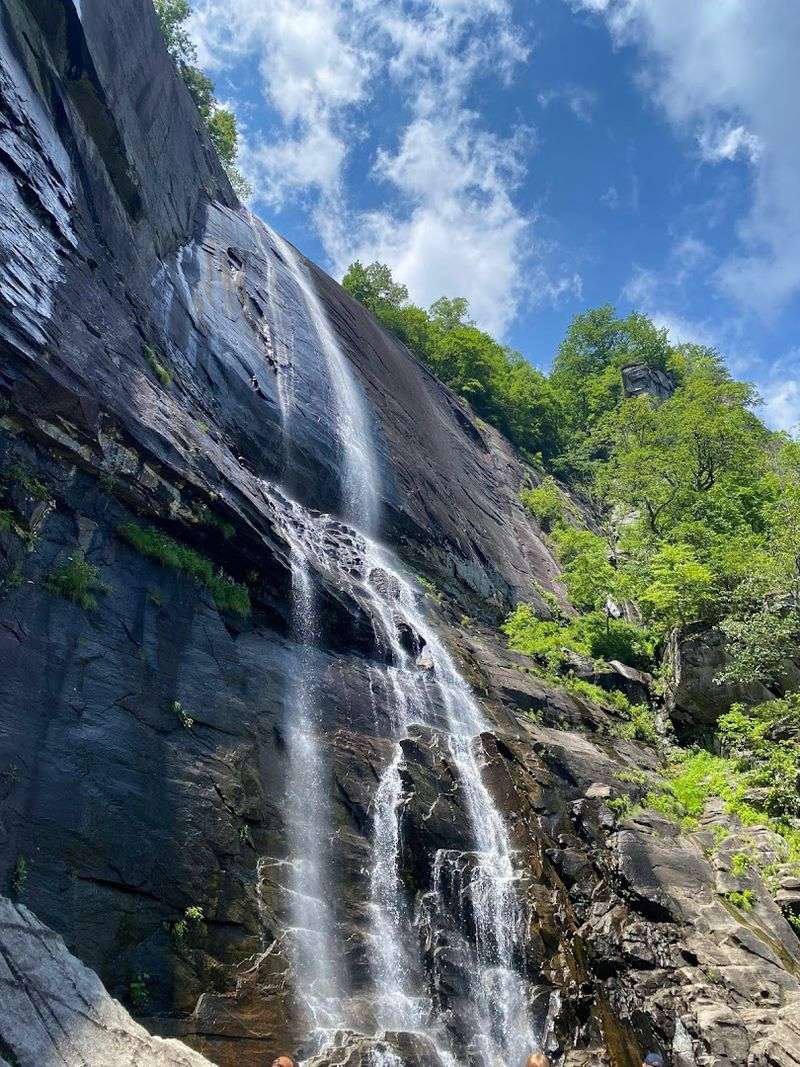
Dropping more than 400 feet straight down a rocky cliff face, Hickory Nut Falls holds the impressive title of one of the tallest waterfalls east of the Mississippi River. Located inside Chimney Rock State Park in the Hickory Nut Gorge, the falls gained international attention when they appeared in the 1992 film The Last of the Mohicans.
That Hollywood cameo brought visitors from around the world, and the scenery has held up its end of the bargain ever since.
The Hickory Nut Falls Trail follows a gentle, forested path for about 1.5 miles before opening up beneath the towering cascade. Looking straight up from the base delivers one of the most vertigo-inducing perspectives available on any North Carolina trail.
The sheer height of the cliff above makes the surrounding trees look almost miniature by comparison.
Chimney Rock State Park charges an admission fee that also grants access to the iconic Chimney Rock formation and its sweeping mountain views. The combination of geological drama, film history, and waterfall grandeur makes this park genuinely worth a full day of exploration.
Peak waterfall flow occurs in late winter and early spring after heavy rains. Comfortable walking shoes handle the Hickory Nut Falls Trail easily, though the rest of the park involves steeper terrain.
High Falls — DuPont State Recreational Forest
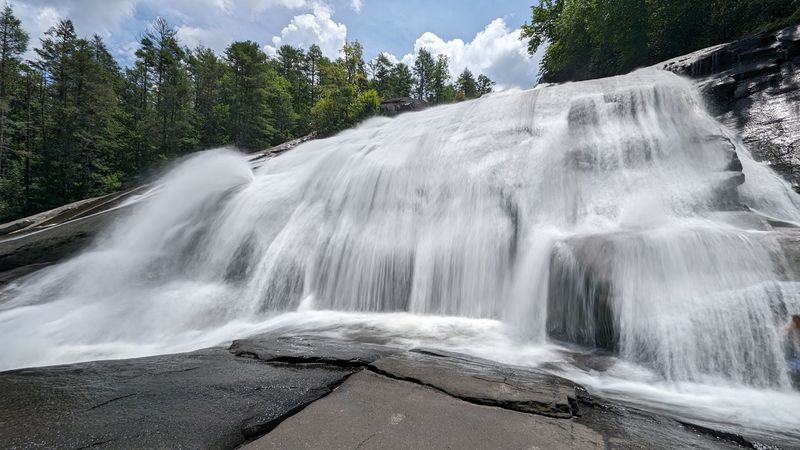
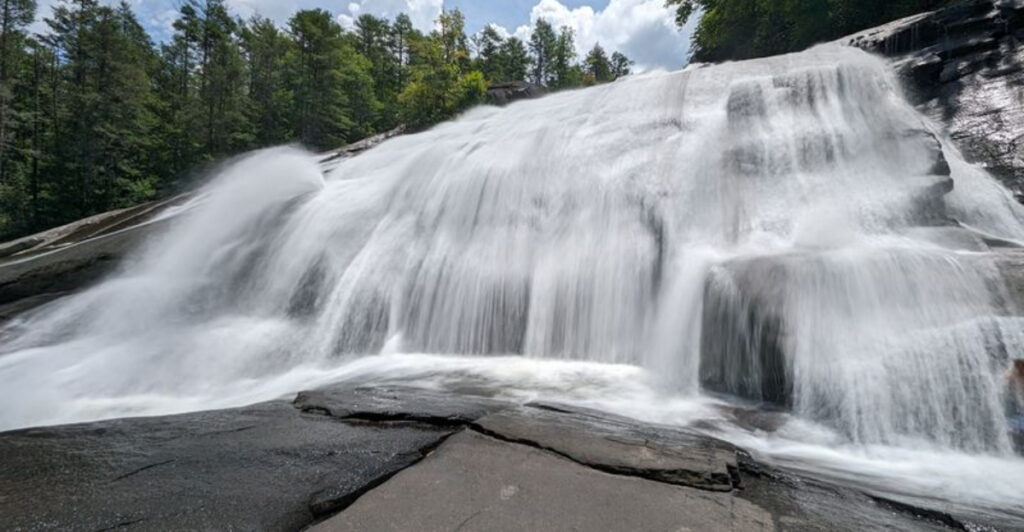
Most waterfalls fall straight down. High Falls takes a more theatrical approach, spreading dramatically across a wide granite face before plunging nearly 150 feet in a broad, sweeping display that looks more like a natural water slide than a traditional cascade.
The sheer width of the falls sets it apart from every other waterfall in DuPont State Recreational Forest, which is already a region packed with impressive options.
The trail network inside DuPont is extensive and well-signed, making High Falls easy to reach from multiple trailheads depending on how much mileage you want to log. Many hikers combine High Falls with Triple Falls and Hooker Falls in a single loop, creating a waterfall-rich route that covers several miles through some of the most scenic forest in western North Carolina.
The varied terrain keeps the hike interesting from start to finish.
Flat rocks near the top of High Falls offer a dramatic perch for those comfortable with heights, though caution is absolutely essential near the edge. The Little River runs swift and cold, especially in spring.
Autumn turns the surrounding hardwood canopy into a brilliant display of red, orange, and gold that reflects beautifully in the river below the falls. High Falls earns its name and then some, delivering a finale worthy of any full day spent exploring DuPont.
Share this story