The United States has the world’s largest economy, and several individual states generate more economic output than entire nations. Measured by nominal GDP, these state economies rival some of the world’s biggest countries thanks to strengths in technology, finance, manufacturing, energy, agriculture, and trade.
The comparisons below use the latest U.S. Bureau of Economic Analysis (BEA) state GDP figures alongside IMF country GDP estimates.
Get ready to see just how jaw-dropping American economic power really is.
California

Picture the world’s fourth-largest economy and you might imagine a massive country. Surprise: it is a single U.S. state.
California’s GDP of roughly $4.25 trillion puts it ahead of Japan and India, trailing only the United States as a whole, China, and Germany on the global stage.
Silicon Valley alone pumps out more innovation than most nations can dream of. Companies like Apple, Google, Alphabet, and Meta call California home, and their combined market value is simply staggering.
Technology is the crown jewel, but it is far from the only gem in the state’s economic chest.
Agriculture feeds the nation, Hollywood feeds the world’s imagination, and the Port of Los Angeles handles an enormous share of U.S. trade. California also leads the country in clean energy investment, adding another fast-growing layer to its already massive output.
No other state even comes close to matching this kind of economic firepower. California is not just a state economy; it is a global force that keeps growing year after year with remarkable consistency.
Texas

Everything really is bigger in Texas, including the economy. With a GDP of approximately $2.9 trillion, the Lone Star State produces more economic output than the entire country of Canada.
That is a remarkable achievement for a state that only a few decades ago was almost entirely dependent on oil.
Energy still plays a huge role, and Texas remains the top oil and natural gas producer in the country. But the economy has diversified in a big way.
Technology companies have flooded into Austin, turning it into a buzzing hub sometimes called “Silicon Hills.” Tesla, Oracle, and dozens of other major firms have relocated their headquarters to Texas in recent years.
Aerospace, healthcare, manufacturing, and finance round out an economy that is firing on all cylinders. Texas also benefits from having no state income tax, which attracts both businesses and workers from across the country.
Population growth here is among the fastest in the nation, and more people means more spending, more housing, and more economic activity. Texas is not slowing down anytime soon, and its rivalry with California for economic supremacy is only getting more interesting.
New York

Wall Street has a way of making the whole world pay attention. New York’s economy generates around $2.47 trillion in GDP, a number so large it exceeds the total economic output of countries like Canada and Brazil.
For a state that could fit inside Texas about three times, that is extraordinary productivity.
Finance is the obvious star of the show. The New York Stock Exchange and NASDAQ together list companies worth tens of trillions of dollars, and the city’s banks, hedge funds, and investment firms move money on a scale that influences markets worldwide.
But New York’s economy is not a one-trick pony.
Media, healthcare, fashion, real estate, and tourism all contribute billions annually. The city alone attracts tens of millions of visitors every year, each spending money on hotels, food, Broadway shows, and shopping.
Upstate New York adds manufacturing, agriculture, and education to the mix. Columbia, Cornell, and New York University are among the many world-class research institutions that keep talent and innovation flowing into the state.
New York’s economy has faced challenges, but its ability to bounce back and keep growing is a testament to its sheer economic depth and resilience.
Florida

Sunshine is good for business, apparently. Florida’s GDP of roughly $1.83 trillion makes its economy larger than Australia’s, which is a country of 26 million people spanning an entire continent.
Florida has about 22 million residents, making this comparison even more impressive on a per-capita basis.
Tourism is the headline act, drawing over 130 million visitors annually to its theme parks, beaches, and cruise ports. Walt Disney World, Universal Studios, and a coastline that seems to go on forever keep the hospitality and retail industries humming.
But Florida’s economy has grown well beyond just fun in the sun.
Real estate is booming, fueled by a wave of new residents relocating from higher-tax states. Healthcare is a massive sector, driven partly by a large retiree population.
Aerospace and defense have deep roots here, with Kennedy Space Center and a growing commercial space industry adding a futuristic edge. International trade also flows heavily through Miami, which serves as a gateway between the United States and Latin America.
Florida’s combination of business-friendly policies, warm weather, and diverse industries has made it one of the fastest-growing state economies in the entire country.
Illinois

Chicago once called itself “the city that works,” and the numbers back that claim up. Illinois generates about $1.2 trillion in GDP, surpassing countries like the Netherlands, which has a population of 18 million people and a highly developed economy.
For a Midwestern state, that kind of global comparison is genuinely impressive.
Chicago sits at the geographic center of North America’s transportation network, which gives Illinois a structural economic advantage few states can replicate. O’Hare International Airport is one of the busiest in the world, and the city is a critical hub for rail freight, trucking, and commodity trading.
The Chicago Mercantile Exchange is the largest futures exchange on the planet.
Finance, manufacturing, and professional services drive much of the state’s output, but healthcare and education are growing contributors too. Major corporations including Boeing, Caterpillar, Abbott, and Walgreens have headquarters in Illinois.
The state also has a strong agricultural base downstate, producing significant quantities of corn and soybeans. Illinois faces some fiscal challenges, including pension debt, but its core economic infrastructure remains powerful and deeply connected to both national and global markets in ways that continue to generate substantial wealth.
Pennsylvania

Few states can claim both a founding role in American democracy and a GDP that tops Switzerland. Pennsylvania does both.
With economic output exceeding $1 trillion, the Keystone State punches well above its weight, blending old industrial strength with a modern, diversified economy that keeps delivering results.
Philadelphia anchors the southeastern part of the state with a powerful mix of healthcare, education, finance, and pharmaceuticals. The city is home to some of the country’s top hospital systems and research universities, making it a genuine life sciences powerhouse.
Pittsburgh, meanwhile, has reinvented itself from a steel town into a hub for robotics, artificial intelligence, and autonomous vehicle research.
Natural gas production from the Marcellus Shale formation has added another major revenue stream, turning Pennsylvania into one of the top energy-producing states in the country. Advanced manufacturing still plays a meaningful role, particularly in aerospace components and specialty materials.
Agriculture, though less visible, contributes significantly through dairy, mushrooms, and poultry production. Pennsylvania’s economy benefits from being situated between New York and Washington, D.C., giving it access to two of the country’s most influential economic corridors.
That geographic advantage, combined with its industrial heritage and innovation push, keeps Pennsylvania firmly in the economic top tier.
Ohio
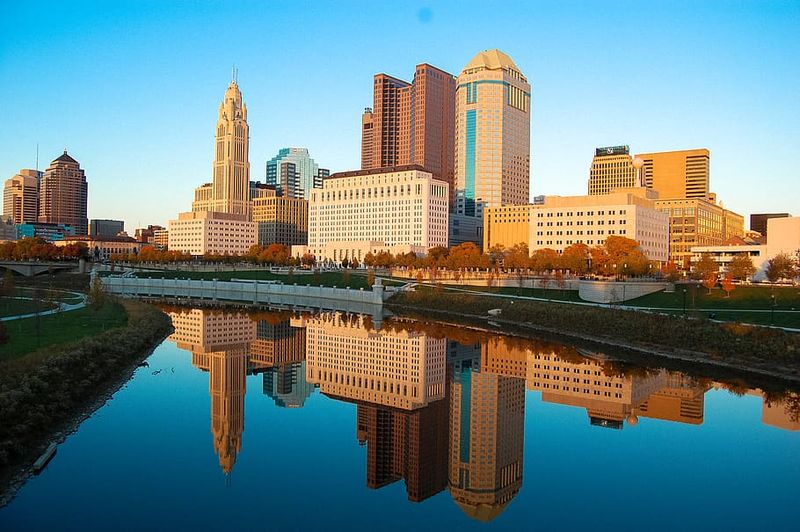
Ohio quietly gets things done. Generating nearly $970 billion in GDP, the Buckeye State’s economy is larger than Belgium’s, a country that hosts the headquarters of the European Union and NATO.
That comparison alone tells you something about Ohio’s underrated but genuinely formidable economic weight.
Manufacturing has been Ohio’s backbone for well over a century, and it remains strong. The state produces vehicles, aircraft components, steel, plastics, and chemicals at a scale that keeps supply chains across the country moving.
Honda, Ford, and General Motors all have significant manufacturing operations here, and a growing number of electric vehicle battery plants are being built across the state.
Aviation has deep roots in Ohio too. The Wright Brothers were from Dayton, and that spirit of engineering innovation never really left.
Today, Wright-Patterson Air Force Base is one of the largest military installations in the country, supporting thousands of jobs in defense and research. Healthcare is another pillar, with the Cleveland Clinic and Ohio State University’s Wexner Medical Center ranking among the best hospitals in the world.
Logistics companies love Ohio’s central location, which puts the state within a day’s drive of more than half the U.S. population. Ohio’s economy is steady, diverse, and seriously underestimated.
Georgia

Atlanta has a not-so-secret superpower: it sits at the center of everything. Georgia’s economy, worth roughly $925 billion, surpasses Austria’s total GDP, and Atlanta’s role as a transportation and logistics hub is a big reason why.
Hartsfield-Jackson Atlanta International Airport is the world’s busiest airport by passenger traffic, making Georgia a genuine crossroads of global commerce.
Corporate America has taken notice. Coca-Cola, Delta Air Lines, Home Depot, UPS, and CNN are among the dozens of Fortune 500 companies that call Georgia home.
That concentration of major headquarters brings high-paying jobs, massive tax revenue, and a gravitational pull that attracts even more businesses to the region year after year.
The film and television industry has exploded in Georgia over the past decade, earning Atlanta the nickname “Hollywood of the South.” Tax incentives have lured productions from Marvel blockbusters to major streaming series, creating thousands of jobs in production, catering, and technical services. Technology and cybersecurity are growing fast, particularly around Georgia Tech’s innovation ecosystem.
Agriculture still contributes meaningfully, with Georgia leading the country in peanut and peach production. The state’s combination of business-friendly policy, infrastructure, and cultural appeal has turned it into one of the most dynamic economies in the American South.
Washington

Tucked into the Pacific Northwest, Washington State quietly became home to some of the most valuable companies ever created. With a GDP approaching $895 billion, Washington’s economy is larger than Ireland’s, a country celebrated for its own tech-driven economic miracle.
The secret ingredient here is a concentration of global tech giants that is almost impossible to overstate.
Microsoft, Amazon, and Boeing together generate hundreds of billions in revenue annually, and their presence has created an entire ecosystem of suppliers, startups, and skilled workers. The Seattle area has one of the highest concentrations of engineers and software developers anywhere on Earth.
That talent density keeps attracting more companies, creating a self-reinforcing cycle of growth.
Trade is another major driver. Washington’s ports handle enormous volumes of goods flowing between the United States and Asia, making geography a genuine economic asset.
Agriculture rounds out the picture in a big way. Washington is the top apple-producing state in the country and a major exporter of wheat, cherries, and hops.
The craft beer industry, fueled by all those hops, has become a cultural and economic force in its own right. Washington benefits from having no state income tax, which helps retain high earners and keeps the business climate highly competitive on a national scale.
North Carolina

North Carolina’s economy is quietly becoming one of the great American success stories of the 21st century. Approaching $894 billion in GDP, it now ranks ahead of Denmark, a prosperous Scandinavian nation known for its high standard of living and strong institutions.
For a state that many once associated mainly with tobacco and furniture, this transformation is remarkable.
Banking is a cornerstone that often surprises outsiders. Charlotte is the second-largest banking center in the United States, home to the headquarters of Bank of America and a major operations hub for Wells Fargo.
That financial muscle brings stability and high-wage employment that ripples through the broader economy in meaningful ways.
The Research Triangle, formed by Raleigh, Durham, and Chapel Hill, is one of the most productive innovation corridors in the country. Duke University, UNC-Chapel Hill, and NC State generate a steady stream of research, patents, and startups in biotechnology, pharmaceuticals, and artificial intelligence.
Technology companies including Apple, Google, and IBM have established major operations in the area, attracted by the talent pipeline and quality of life. Manufacturing remains important too, particularly in aerospace, defense, and advanced materials.
North Carolina’s blend of financial strength, research excellence, and manufacturing heritage makes it a genuinely formidable economic player on the world stage.
Share this story