Somewhere in the rolling hills of Lancaster County, Pennsylvania, a cluster of centuries-old timber and stone buildings quietly holds one of the most extraordinary stories in American history. A group of German immigrants once built a world so entirely their own that they slept on wooden benches, woke at midnight to pray, and composed music that no one else in colonial America was writing.
Their community was not a footnote; it was a bold, living experiment in faith, creativity, and radical self-discipline. The Historic Ephrata Cloister, tucked along a quiet stretch of road in Ephrata, Pennsylvania, preserves that world with remarkable care.
I visited on a clear weekday morning and left hours later with my mind full of questions about devotion, sacrifice, and what it truly means to build a life around belief. Keep reading, because the story only gets more fascinating from here.
Arriving at a Quiet Corner of History
The address is simple enough: 632 West Main Street, Ephrata, PA 17522, right in the heart of Lancaster County, Pennsylvania. But the moment you step through the gate of the Historic Ephrata Cloister, simple is no longer the right word for anything you encounter.
The grounds feel immediately set apart from the busy road just beyond them. A hush settles over the place, almost physical in its weight, as if the air itself has been absorbing centuries of quiet contemplation and hasn’t quite let it go yet.
Administered by the Pennsylvania Historical and Museum Commission, the site sits on 28 acres and features numerous surviving 18th-century structures. Free parking is available, and the Visitor Center is a welcoming first stop before you wander the grounds.
The cloister is open Wednesday through Saturday from 9 a.m. to 4 p.m. and on Sundays from noon to 4 p.m., so plan your arrival accordingly to make the most of your time here.
The Visionary Who Started It All
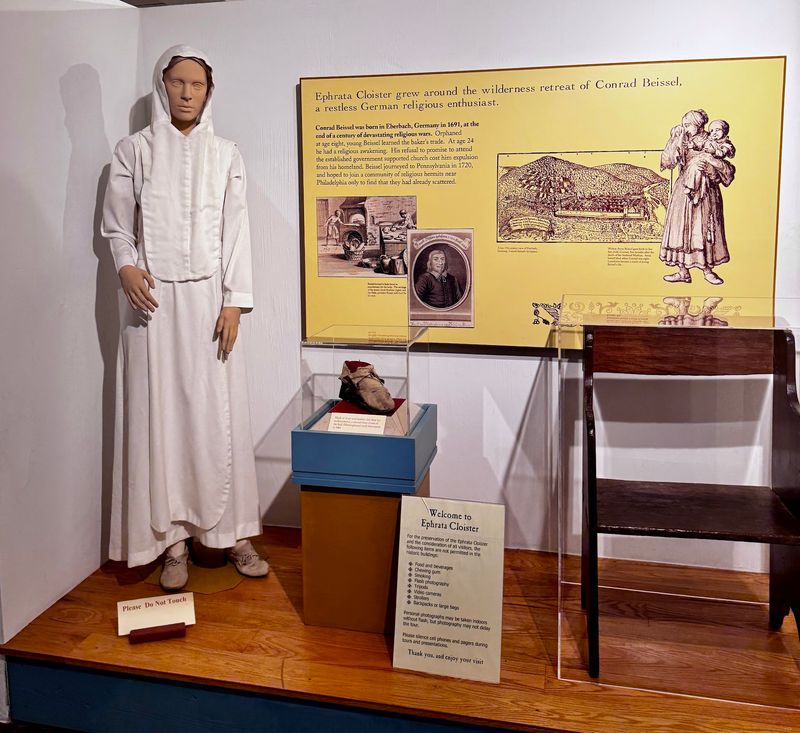
Conrad Beissel arrived in Pennsylvania in 1720 as a young German immigrant with deeply personal spiritual convictions and no real plan beyond following them wherever they led. He had intended to join a hermit commune, but its founder had already passed away, which left Beissel to forge his own path entirely.
By 1732, he had settled near the Cocalico Creek and begun gathering a small group of like-minded followers around his unique blend of Pietism, mysticism, and communal living. His core belief was that earthly life was a preparation for an imminent divine union, and that conviction shaped every single rule the community would ever follow.
Beissel even composed his own system of musical harmony and served as the community’s spiritual guide and composer simultaneously. He later took the name “Friedsam Gottrecht,” meaning Peaceful God-Right.
His personal magnetism drew people willing to give up ordinary life entirely, and the results of that pull still stand on 28 acres today.
Two Worlds Under One Roof: The Solitary and the Householders
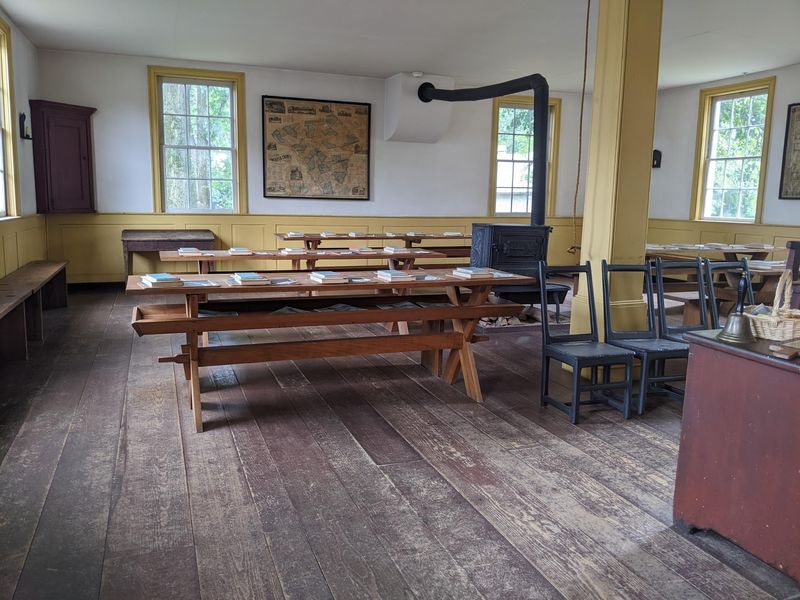
The Ephrata Community was structured in a way that no other colonial American settlement quite matched. At its center were the celibate members, known collectively as “the Solitary,” divided into a Brotherhood and a Sisterhood, each group living in separate communal dwellings on the property.
Surrounding this monastic core was a second group called the Householders, married families who lived on nearby farms and accepted Beissel as their spiritual leader. At the community’s peak in the 1740s and 1750s, roughly 80 celibate Brothers and Sisters lived on site, while approximately 200 to 250 Householders supported the broader mission through farming and trade.
This unusual arrangement created a genuinely dynamic social fabric, where two very different ways of life fed a shared spiritual purpose. The Householders were not outsiders; they worshipped alongside the Solitary on the Sabbath and contributed labor and resources that kept the community functioning.
It was a creative solution to an ancient problem: how to build a holy community without losing your neighbors in the process.
Sleeping on Wood and Waking at Midnight
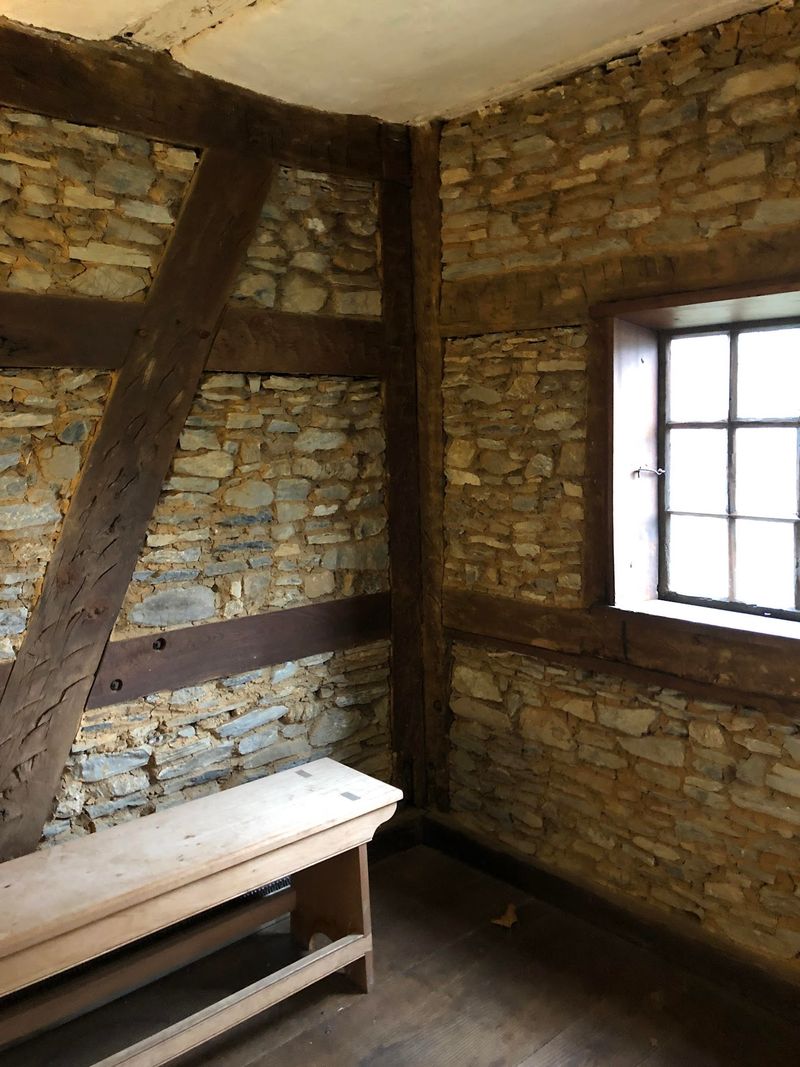
Few details about the Ephrata Cloister stop visitors in their tracks quite like the sleeping arrangements. The celibate members rested on wooden benches just 15 inches wide, with wooden blocks serving as pillows, a deliberate choice rooted in spiritual discipline rather than a lack of resources.
Their allotted sleep was limited to roughly six hours per night, and even that was interrupted by a mandatory two-hour vigil from midnight to 2 a.m. That nightly watch was considered a sacred act of preparation for the Second Coming of Christ, not a burden but a privilege.
Their diet matched the austerity of their beds. The community reportedly abstained from meat, dairy, eggs, and honey, with lamb served only during communion, making them one of the earliest groups in North America to practice a religiously motivated plant-based diet.
Buckwheat, cabbage, potatoes, and seasonal vegetables formed the backbone of their meals. Every physical discomfort was framed as a step closer to the divine, which makes their endurance feel less extreme and more quietly extraordinary.
Architecture Built for the Soul, Not the Eye
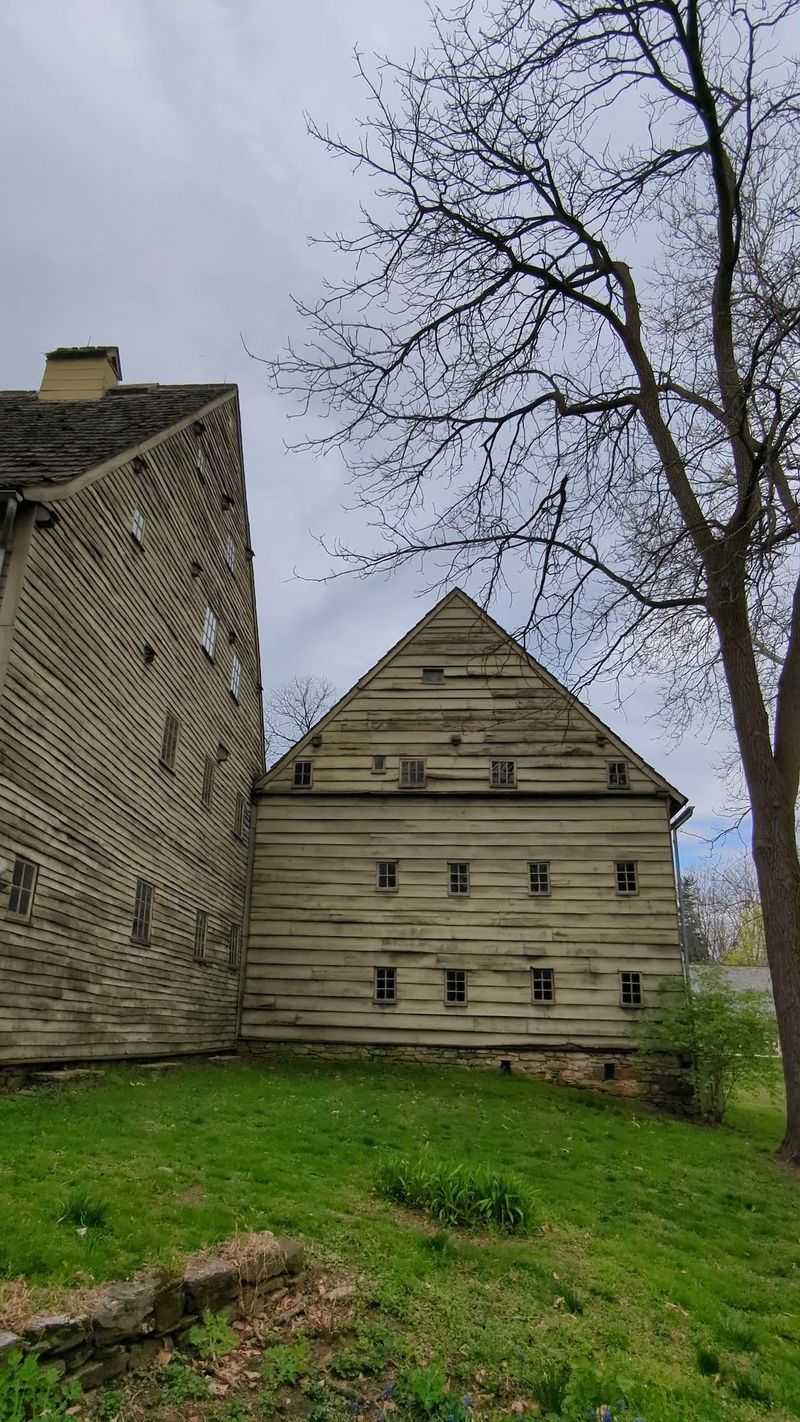
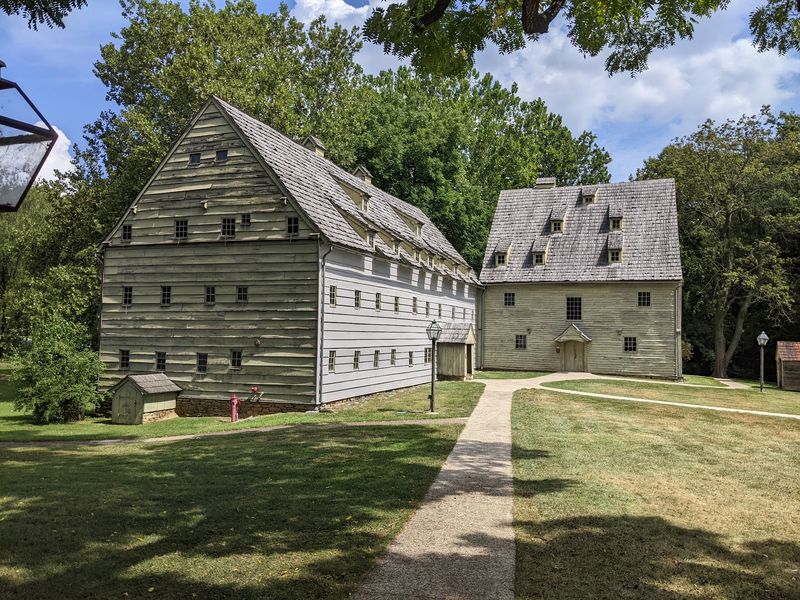
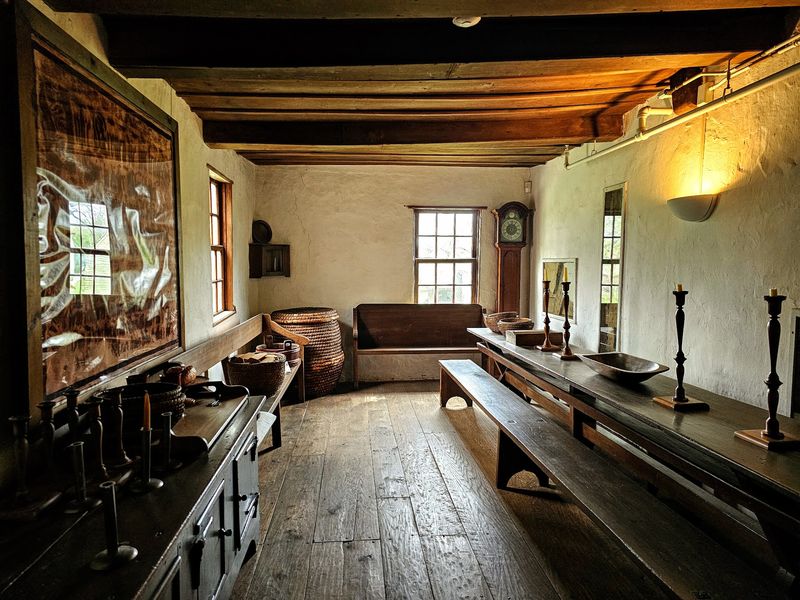
The buildings at the Historic Ephrata Cloister are not trying to impress anyone, and that restraint is exactly what makes them so striking. Constructed in a style often described as German Medieval or Romanesque, they feature semi-circular arches, thick log and stone walls, and windows kept deliberately small to let in only a subdued, contemplative light.
The Saal, or Meetinghouse, was built in 1741 and showcases a half-timbered Fachwerk construction technique brought directly from German building traditions. The Saron, or Sisters’ House, contains small individual sleeping chambers that reflect the community’s emphasis on solitude and introspection even within a shared space.
These are not decorative reconstructions. Many of the surviving structures are original, and walking through them feels genuinely different from visiting a recreated historical village.
The walls carry a weight that reproductions cannot fake. Guided tours are the only way to access the interiors of the Saal and Saron, which makes signing up for one an easy decision once you see the buildings from the outside.
Music That America Had Never Heard Before
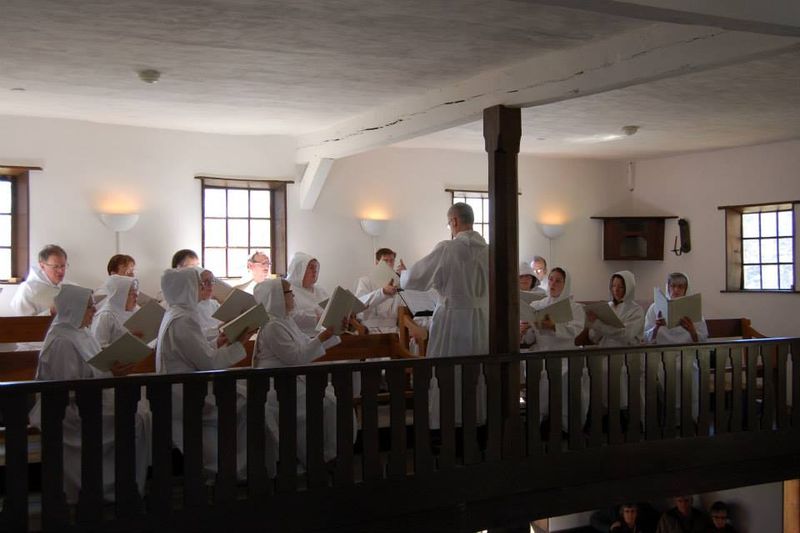
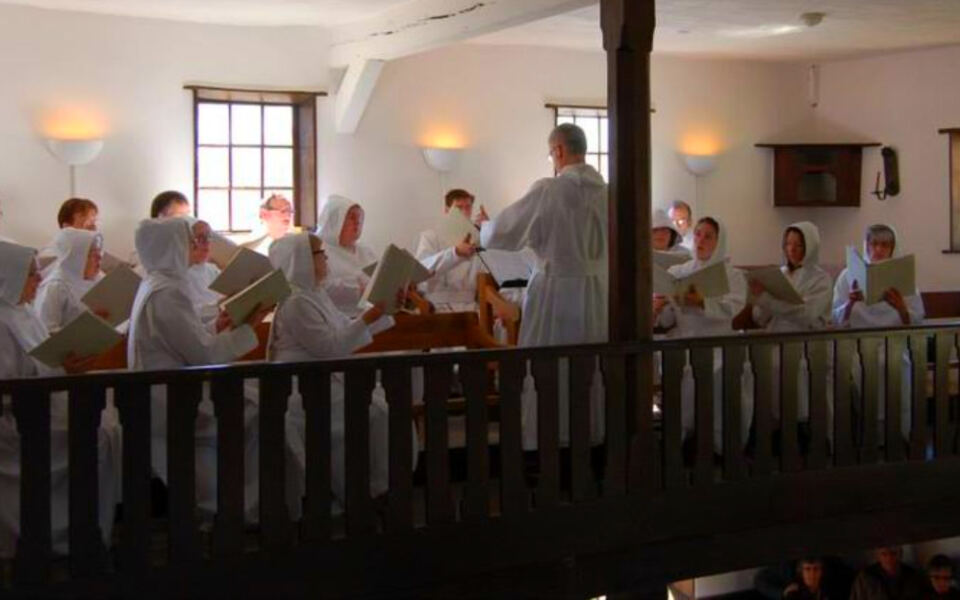
Music at the Ephrata Cloister was not background sound or casual entertainment. It was central to worship, and Beissel developed his own system of four-part a cappella harmony specifically for the community’s use, a musical framework unlike anything else being composed in colonial America at the time.
The community produced over one thousand original compositions, an output that would be impressive for any institution, let alone a small religious settlement in rural Pennsylvania. Among the most remarkable facts embedded in that history is that the first credited female composers in North America lived and wrote at Ephrata during the 1740s, creating hymn melodies and texts intended for worship services.
The Historic Ephrata Cloister Chorus continues to perform this music today, keeping those intricate harmonies alive for modern audiences. Hearing those compositions echo through the same spaces where they were first sung adds a layer to the visit that no exhibit panel can fully replicate.
The music alone is reason enough to plan a special trip around one of the chorus’s scheduled performances.
Ink, Paper, and the Largest Book in Colonial America
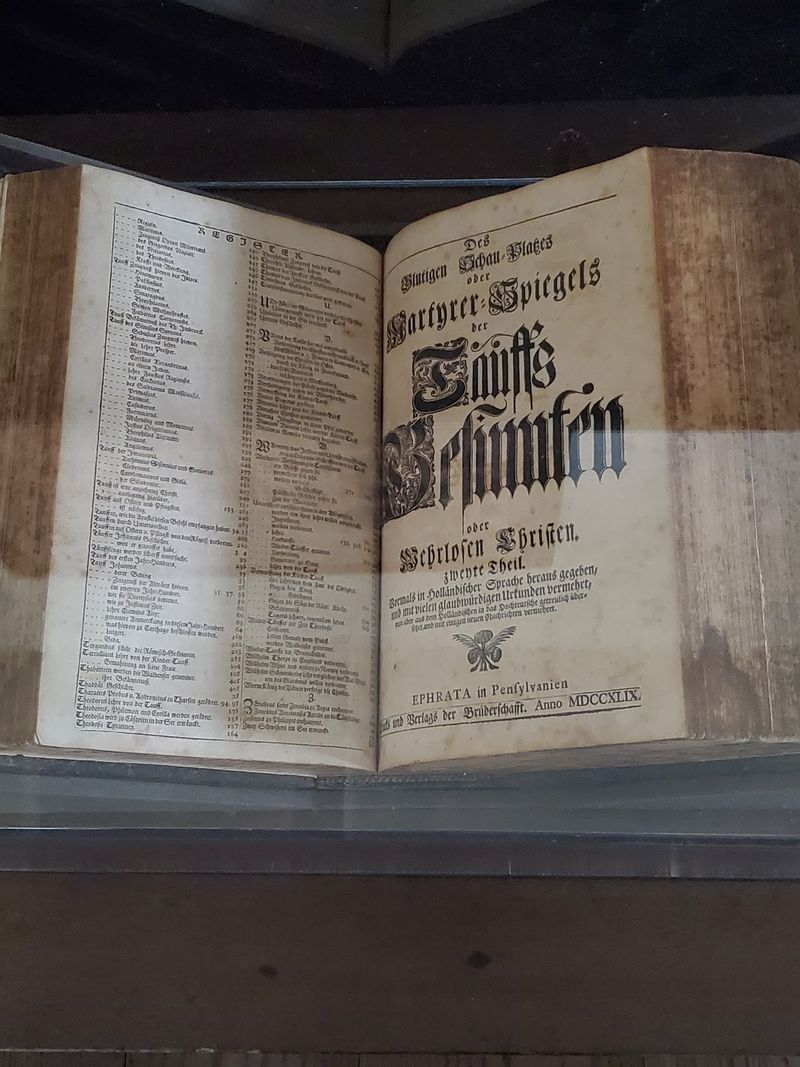
The Ephrata Community operated the second German printing press in the American colonies, and they did not use it modestly. Brothers and sisters made their own paper and ink, turning the printing office into a hub of serious scholarly and religious production that served both the community and the wider region.
Their crowning publishing achievement was the Martyrs Mirror, a 1,500-page history of Christian martyrs originally written in Dutch. Peter Miller, a key community member, translated the entire work into German, and the printing process took approximately three years, concluding in 1751 with 1,300 bound copies produced.
That single project made it the largest book printed in colonial America.
The community also published its own hymnal in 1747 and produced numerous other texts for internal and external use. The printing office building still stands on the grounds and is included in the self-guided tour.
Standing inside it, you get a vivid sense of how much intellectual energy was channeled through this small, plain-walled room into the broader world of early American letters.
Fraktur: The Art Hidden in Plain Sight
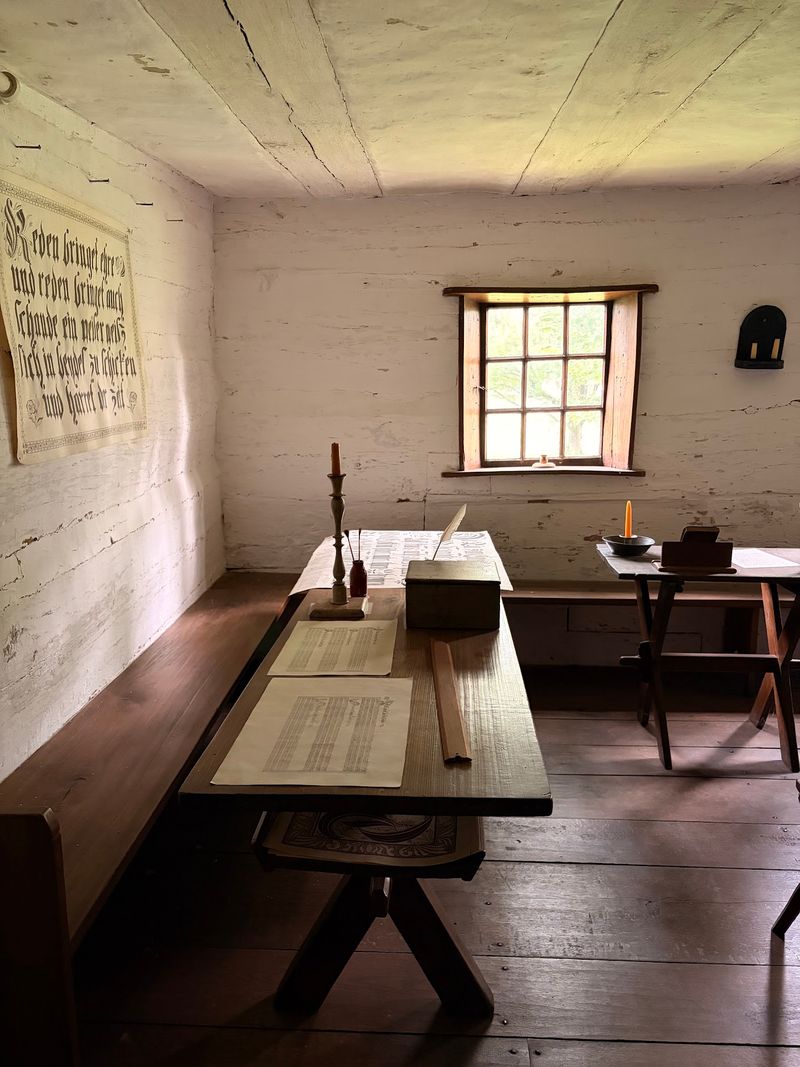
Beyond their music and printing work, the Ephrata community developed a visual art tradition that holds a remarkable place in American cultural history. Their practice of Frakturschriften, an intricate form of German calligraphic folk art, produced the first examples of this style made in America and eventually developed a distinctive Ephrata look that art historians can identify at a glance.
These were not purely decorative pieces. Fraktur was used to illuminate important texts, record significant dates and spiritual passages, and create documents of lasting religious meaning.
The delicate hand-drawn letters, often intertwined with symbolic motifs in rich colors, reflect a community that found beauty not in contradiction to austerity but as an extension of devotion.
Seeing original examples of Ephrata Fraktur in person, whether in the Visitor Center exhibits or in published reproductions, makes it clear how much creative intelligence was flowing through this community. Their art was a quiet sermon written in ink and pigment, and it spoke a language that transcended the plain white robes and narrow sleeping benches of daily cloister life.
When Peace Met War: A Hospital in the Revolution
A community built entirely on pacifist principles found itself at the center of one of American history’s most turbulent moments when, in 1777, the cloister was converted into a military hospital for Continental Army soldiers. Approximately 250 to 260 wounded and ill soldiers were brought to Ephrata, many of them coming from the aftermath of the Battle of Brandywine and the hardships of encampments at Valley Forge and Yellow Springs.
The Brotherhood’s buildings on Mount Zion were repurposed to receive these soldiers, their quiet dormitories and meetinghouses suddenly filled with the urgent needs of wartime medicine. Despite the stark contrast between their peaceful mission and the chaos of conflict, the community offered care without hesitation.
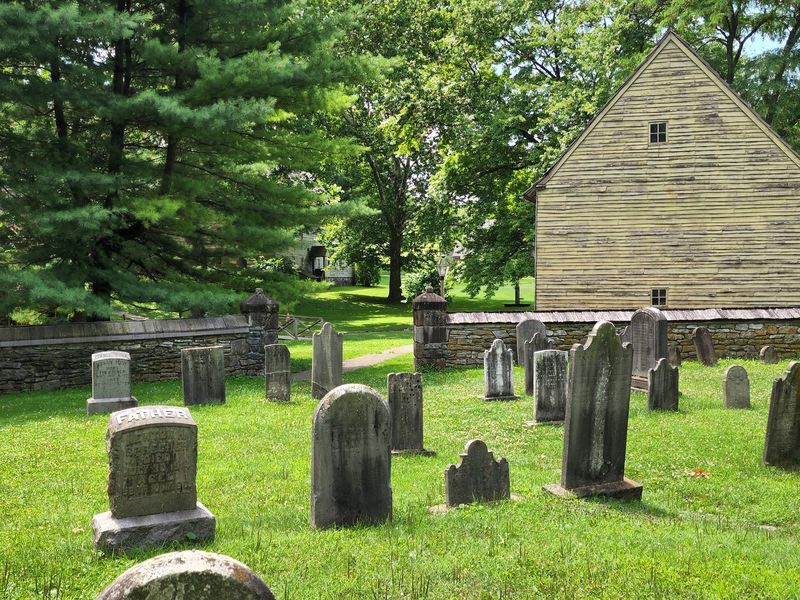
Some soldiers who did not recover were laid to rest in the nearby Mount Zion cemetery, which still overlooks the historic grounds today. That cemetery serves as a quiet, powerful reminder of how even the most deliberately isolated community can be drawn into the larger sweep of history.
The cloister’s role in the Revolution adds a dimension to the site that few visitors expect to find.
The Long Decline and the Preservation That Followed
After Conrad Beissel’s passing in 1768, the intense spiritual energy that had defined the cloister’s early decades began to gradually fade. The monastic practice of celibacy was eventually abandoned, and the last celibate member of the community passed in 1813, marking the quiet end of that particular chapter.
The remaining Householders incorporated as the German Seventh Day Baptist Church in 1814, continuing to worship in the historic buildings and carrying forward many of Beissel’s traditions, including Sabbath observance. The church held services on the grounds until 1934, when it officially closed.
Pennsylvania acquired the surviving site in 1941, and the Pennsylvania Historical and Museum Commission has since led a sustained program of research, restoration, and interpretation that has kept the cloister’s story accessible to the public. The site was designated a National Historic Landmark, a recognition that feels entirely earned given the breadth of what happened here.
The fact that so many original structures still stand is a testament to both the quality of 18th-century craftsmanship and the commitment of those who chose to protect it.
Planning Your Visit: What to Know Before You Go
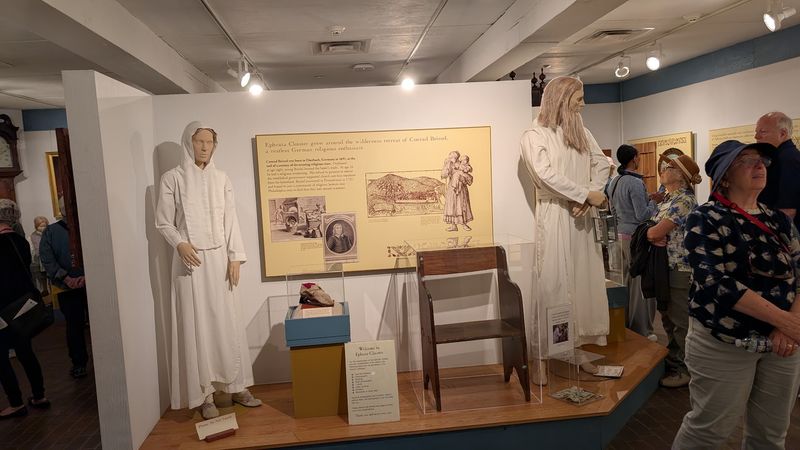
A guided tour is genuinely the best way to experience the Historic Ephrata Cloister, and the knowledgeable guides make that recommendation easy to stand behind. The guided option runs approximately one hour and fifteen minutes and is the only way to access the interiors of the Saron and the Saal, the two most significant original buildings on the property.
Admission is very reasonable, with adult tickets priced at around $10 and discounts available for seniors, AAA members, and youth. Children under three enter free.
The Lancaster County Library also offers loaned passes for free entry, which is worth checking if you are a local or a frequent visitor to the area.
The grounds are open Wednesday through Saturday from 9 a.m. to 4 p.m. and Sundays from noon to 4 p.m., with the site closed Monday and Tuesday. Wear comfortable walking shoes, as the grounds cover 28 acres with multiple buildings to explore.
Interpretive brochures are available in German, French, Spanish, Italian, Dutch, and Russian, making this a genuinely welcoming destination for international visitors as well.
Share this story