Pennsylvania might not get the same attention as the American West, but photographers who know the state well will tell you it punches well above its weight. Within a single day’s drive, you can photograph 22 named waterfalls inside one park, stand inside a crumbling 19th-century prison, or watch the Milky Way arc over a ridge so dark that city lights are a distant memory.
The state shifts visually from season to season, meaning a location you photograph in October looks almost nothing like the same spot in April. This list covers 13 spots that offer something genuinely distinct, and each one rewards photographers who show up with a plan and a bit of patience.
1. Ricketts Glen State Park, Benton, Pennsylvania
Twenty-two named waterfalls inside one trail system is not a boast you hear often, but Ricketts Glen delivers exactly that. The Falls Trail passes each cascade in sequence, with 94-foot Ganoga Falls standing as the tallest of the group.
Old-growth hemlocks and thick moss line the rocky gorge walls, adding layers of texture around each drop. Photographers working with slower shutter speeds can turn the moving water into soft streaks while keeping the surrounding forest sharp.
The full loop covers 7.2 miles with significant elevation changes, so building in four to six hours gives you time to work each composition without rushing. Early morning visits reduce foot traffic on the trail, which matters when you are trying to frame a waterfall without other hikers in the shot.
Lake Jean, located in the upper section of the park, adds a calmer water option for reflection photography on days when the gorge trails are crowded.
2. Fallingwater, Mill Run, Pennsylvania
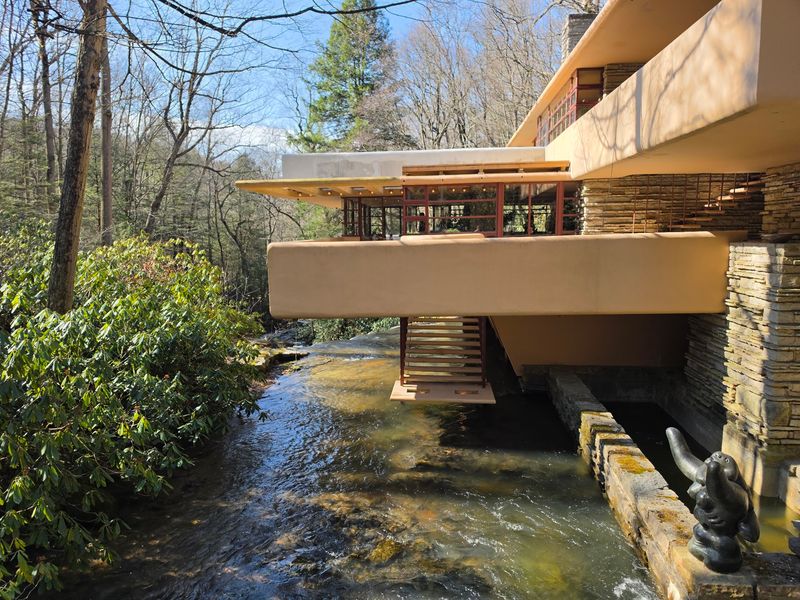
Frank Lloyd Wright designed Fallingwater so that the building and the landscape would be inseparable, and after decades, that relationship still holds. Horizontal concrete terraces extend over Bear Run, and the local sandstone used in the walls reads almost like a continuation of the rocky creek bed below.
Every angle around the structure produces a different composition. The classic downstream view frames the cantilevered levels against the forest canopy, while closer positions reveal the contrast between smooth poured concrete and rough stone.
Photographers visiting on a guided exterior tour can access the main viewing areas around the house. Interior photography access is limited, so most serious camera work happens outside, where natural forest light shifts throughout the day.
Bear Run itself adds a moving element to compositions, and the surrounding trees change color dramatically in autumn, making October one of the busiest and most visually rewarding months to visit.
3. Longwood Gardens, Kennett Square, Pennsylvania
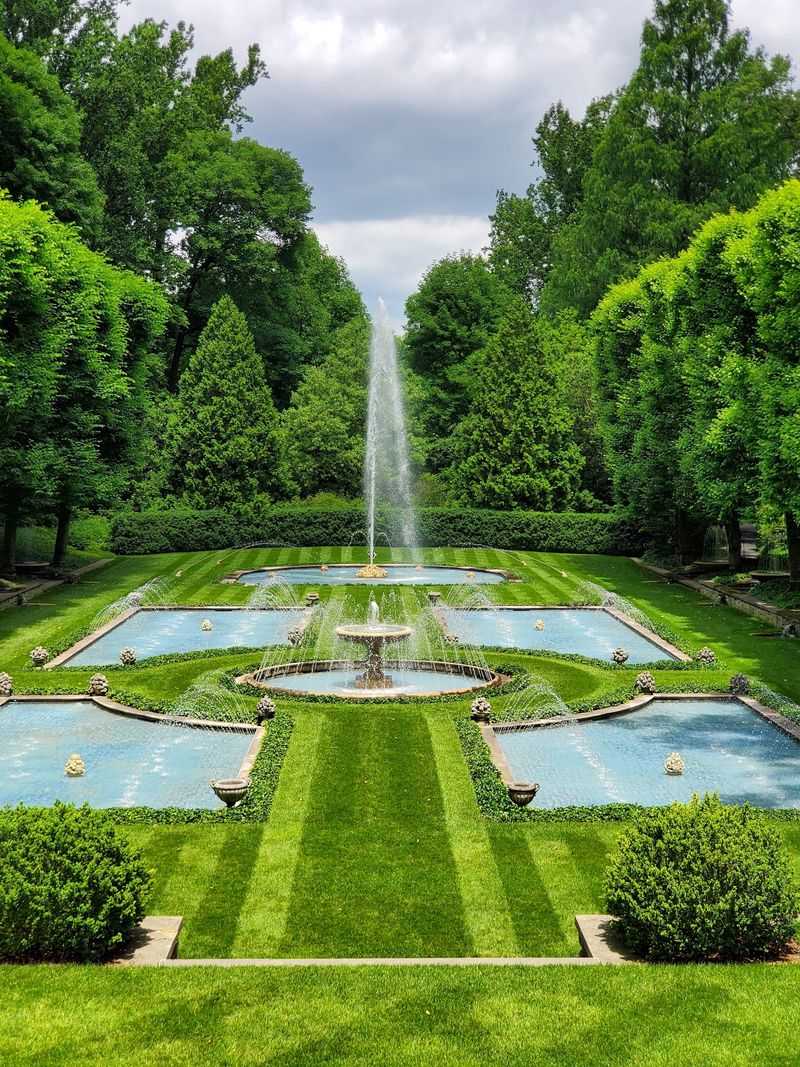
More than 1,100 acres of cultivated landscape means Longwood Gardens never really runs out of subject matter. The outdoor gardens alone cover dozens of distinct areas, from formal Italian water gardens to woodland paths lined with native plantings.
The conservatory’s glass and steel exterior makes a compelling architectural subject on its own, particularly in late afternoon when the angle of light hits the framework directly. Inside, 14 distinct rooms cover tropical forests, desert plants, and butterfly habitats, each with its own visual logic.
Seasonal displays rotate throughout the year, which means a visit in February looks nothing like one in July. Photographers planning professional sessions should note that tripod use requires a permit and must be booked in advance.
Fountain shows run on a seasonal schedule and draw crowds, but the choreographed water displays also give photographers a chance to work with fast-moving water in an unusually controlled and photogenic setting.
4. Kinzua Bridge State Park, Mount Jewett, Pennsylvania
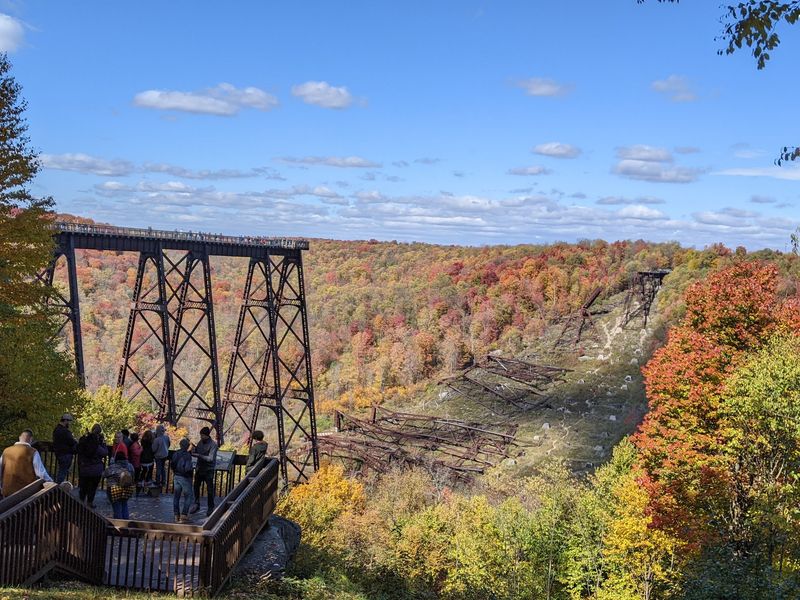
A tornado in 2003 took down most of the Kinzua Viaduct, but what remained turned out to be even more photogenic than the original intact structure. The surviving towers still stand at the gorge rim while the twisted wreckage of the fallen sections rests 225 feet below, creating a scene that mixes industrial history with raw natural force.
The Kinzua Skywalk extends 624 feet out from the rim along six of the original towers that survived the storm. A glass-bottom observation section at the end lets photographers shoot straight down into the gorge, which produces a genuinely unusual perspective.
Autumn foliage typically peaks in the first two weeks of October, filling the valley floor with color that contrasts sharply against the rusted iron. A dedicated Picture Taking Platform below the Skywalk provides a lower angle on the surviving structure for photographers who want a less expected composition.
5. Ohiopyle State Park, Ohiopyle, Pennsylvania
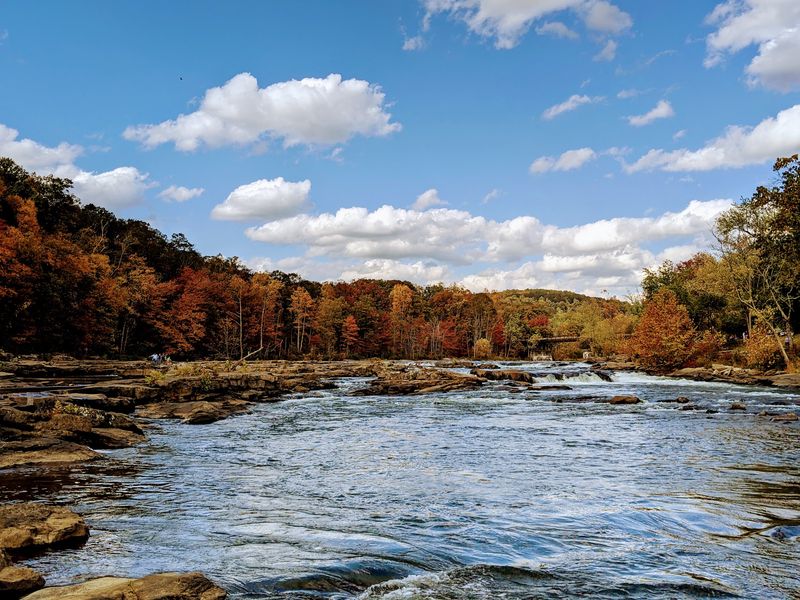
The Youghiogheny River does not ease gently through Ohiopyle. It drops 20 feet at Ohiopyle Falls in a broad curtain of white water that fills the frame from nearly any position along the accessible observation platforms.
Cucumber Falls, a 30-foot drop tucked into a side hollow, offers a more enclosed composition with forest walls on three sides. The contrast between the two waterfalls gives photographers two completely different subjects within the same park visit.
Ferncliff Peninsula, almost entirely encircled by the river, provides river-level compositions and forest trails with layered autumn color. Baughman Rock Overlook sits above the gorge and delivers panoramic views of the river winding through the forested valley below.
The High Bridge on the Great Allegheny Passage trail adds an elevated river perspective that works particularly well in fall when the tree canopy on both banks changes color simultaneously, framing the water between bands of orange and red.
6. Eastern State Penitentiary, Philadelphia, Pennsylvania
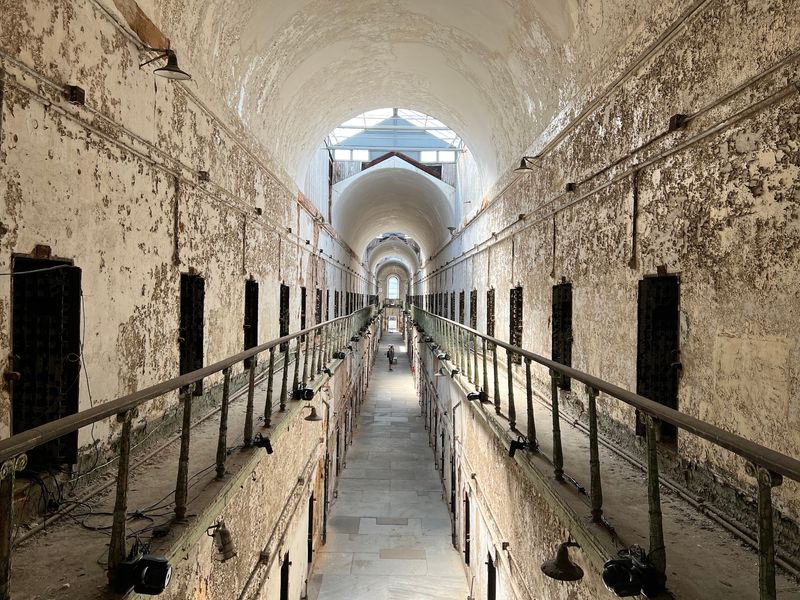
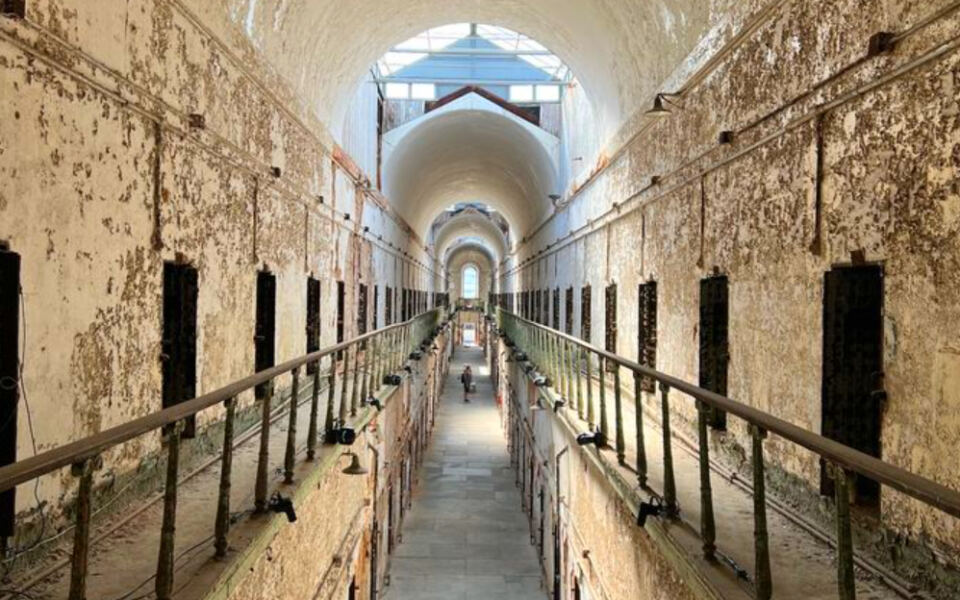
Opened in 1829 and closed in 1971, Eastern State Penitentiary spent decades sitting empty before becoming a historic site, and that long period of abandonment left the interior looking exactly as dramatic as photographers hope it will.
The hub-and-spoke floor plan radiates seven cellblocks from a central octagonal hub, which gives photographers a repeating architectural geometry to work with throughout the building. Long corridors, vaulted ceilings, rusted cell doors, and paint that has been peeling for decades all reward careful framing.
Natural light enters through skylights and narrow windows, creating concentrated patches of brightness against shadowed walls. Flash photography is generally discouraged, so working with available light is both a technical challenge and the approach that produces the most authentic results.
Photographers bringing tripods must purchase a daily equipment pass. Al Capone’s preserved cell, with its furnished interior, offers a very different subject from the abandoned blocks surrounding it.
7. Cherry Springs State Park, Coudersport, Pennsylvania
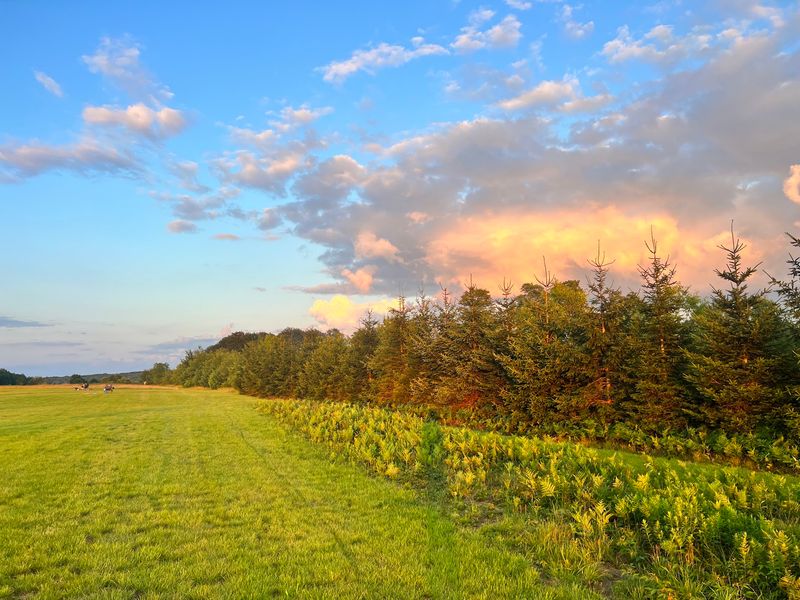
A Bortle Scale 2 rating puts Cherry Springs among the darkest accessible locations in the entire eastern United States. On clear nights, the Milky Way core is visible without any optical aid, which is a genuinely rare experience east of the Mississippi.
The park sits at 2,300 feet elevation on a ridge surrounded by State Forest land, which keeps light pollution off the horizon in nearly every direction. The Milky Way core is typically photographable from March through October, with summer months offering the densest part of the galactic band.
Photographers should arrive before dark to set up compositions and identify foreground elements, since working in full darkness limits your options considerably. Red-filtered flashlights are required in the observation areas because white light destroys night vision for everyone nearby.
New moon weekends draw the largest crowds of astrophotographers, so booking nearby accommodations well in advance is practical advice rather than a suggestion.
8. McConnells Mill State Park, Portersville, Pennsylvania
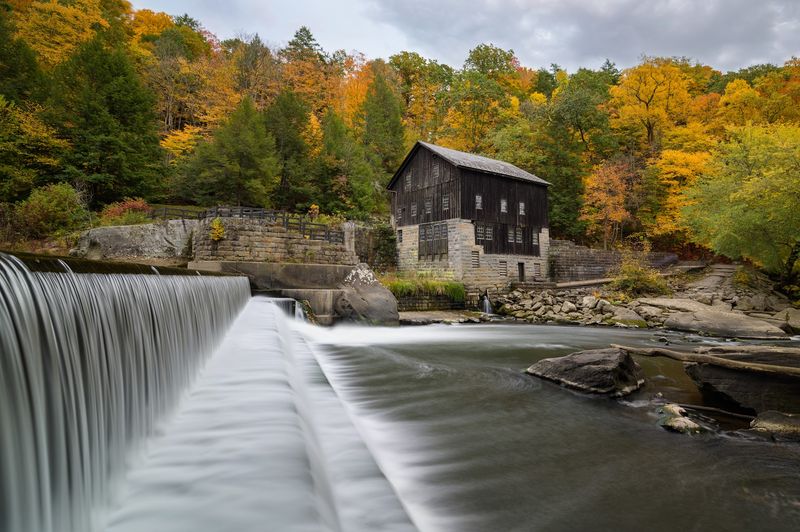
Glacial lakes carved the Slippery Rock Creek Gorge thousands of years ago, leaving behind a landscape of enormous boulders and steep forested walls that frames the historic gristmill and covered bridge in a way no landscape designer could replicate.
The 19th-century mill building sits directly beside the creek, and the covered bridge crosses a short distance upstream. Together, they give photographers two classic Pennsylvania structures within a single wide composition, particularly effective when autumn color fills the gorge.
Smaller waterfalls and fast-moving creek sections appear throughout the trail system, giving photographers moving water subjects beyond the main mill area. Hell Run, a tributary stream, produces calm reflective pools surrounded by fall foliage that work well for detail shots.
Cleland Rock Scenic Vista delivers a panoramic view of the gorge from above, offering a completely different scale from the close-up mill compositions at water level. A tripod, neutral density filter, and circular polarizer are practical tools for working this location effectively.
9. Presque Isle Lighthouse, Erie, Pennsylvania
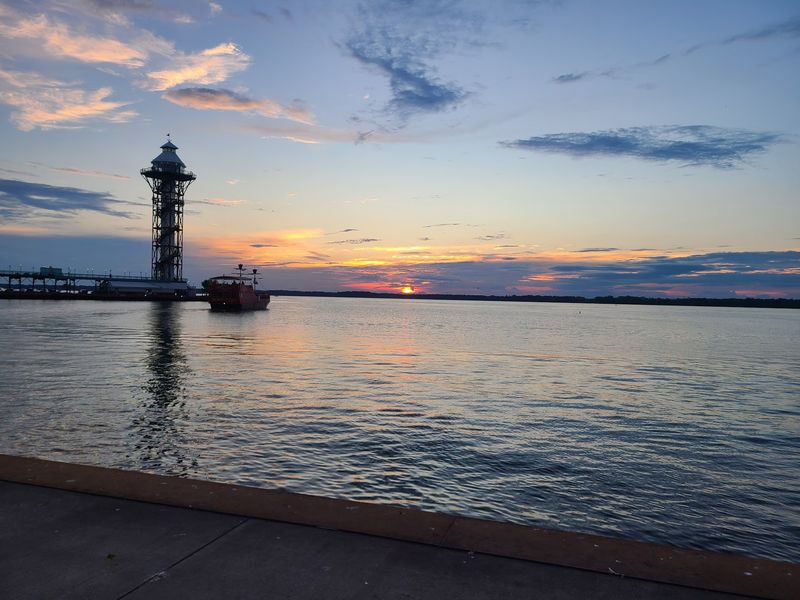
Built between 1872 and 1873, the Presque Isle Lighthouse started at 40 feet before an additional 17 feet were added in 1896, giving the white brick tower its current proportions against the Lake Erie horizon.
The attached keeper’s dwelling reflects a 19th-century French architectural style, with rounded corners and handcrafted woodwork that add detail for photographers working at close range. The combination of the tower and dwelling in a single frame produces a composition that reads clearly against both sky and water backgrounds.
Lake Erie’s shoreline changes character significantly between seasons. Summer visits offer clean blue sky contrasts, while off-season visits bring more complex cloud formations and softer, more diffused light across the same structure.
Climbing the 78 interior steps and six landings rewards visitors with a panoramic view of the surrounding shoreline. The lighthouse can be seen from ships 25 miles out on the lake, which gives some sense of how prominently it sits within the landscape.
10. Hyner View State Park, Hyner, Pennsylvania
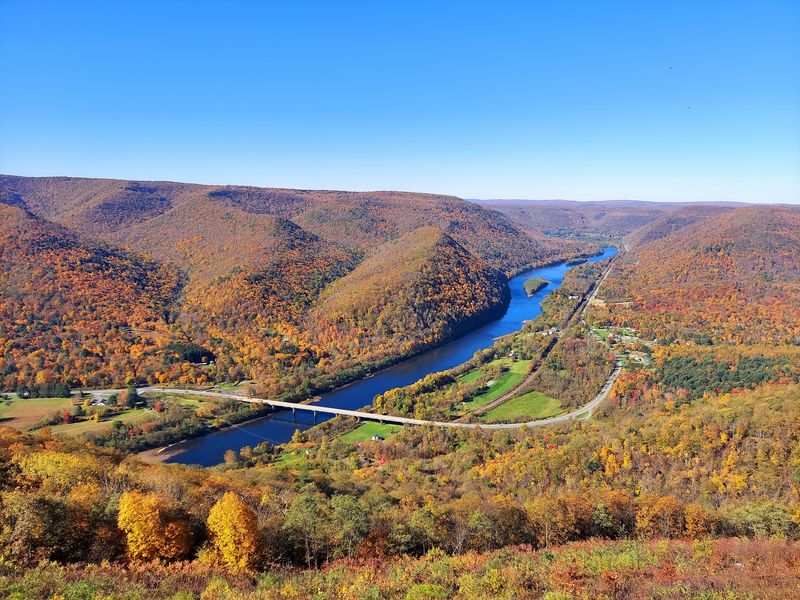
From 1,300 feet above the river, the West Branch of the Susquehanna traces a wide arc through a valley ringed by Sproul State Forest, and the view stretches more than 180 degrees without a single rooftop or utility line interrupting the ridgelines.
The stone-walled overlook was built by Civilian Conservation Corps workers in the 1930s and remains structurally solid, giving photographers a stable and accessible position above the drop. The wall itself adds a foreground element that grounds wide-angle compositions.
Autumn brings the most photographed version of this view, when the forest below turns from green to red, orange, and gold across the entire visible valley. Sunrise and sunset both work well here because the low-angle light enhances the color contrast between the river and the surrounding ridges.
Hyner View also carries a Bortle Scale 2 dark sky rating, which opens up the possibility of Milky Way photography on clear nights when conditions cooperate.
11. Phipps Conservatory and Botanical Gardens, Pittsburgh, Pennsylvania
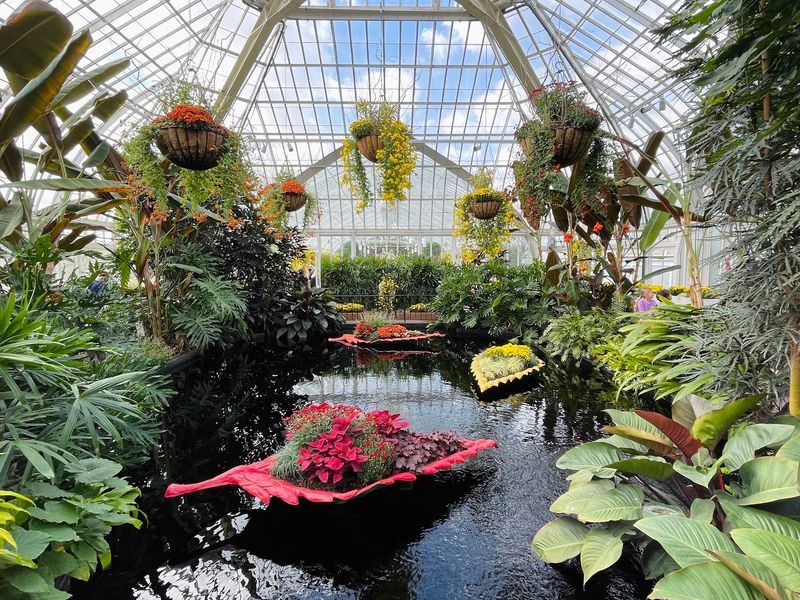
Established in 1893, Phipps Conservatory’s Victorian glass and steel framework in Schenley Park makes an architectural subject that holds up from nearly any exterior angle, particularly when the light hits the glass panels at a low angle.
Inside, 14 distinct rooms cover climates ranging from tropical forest to desert, and each room has its own visual logic and plant density. The Palm Court, with its tall ceiling and layered tropical canopy, gives photographers a vertical composition that most outdoor locations cannot replicate.
Chihuly glass installations appear throughout the conservatory, adding color and sculptural form among the plant collections. An outdoor aquatic garden featuring water lily specimens expands the photographic options beyond the greenhouse walls.
The Center for Sustainable Landscapes, a modern building adjacent to the historic conservatory, adds a contemporary architectural contrast worth documenting. Weekday visits and extended Friday evening hours tend to offer a calmer environment for deliberate, unhurried photography sessions.
12. Pinnacle Overlook, Holtwood, Pennsylvania
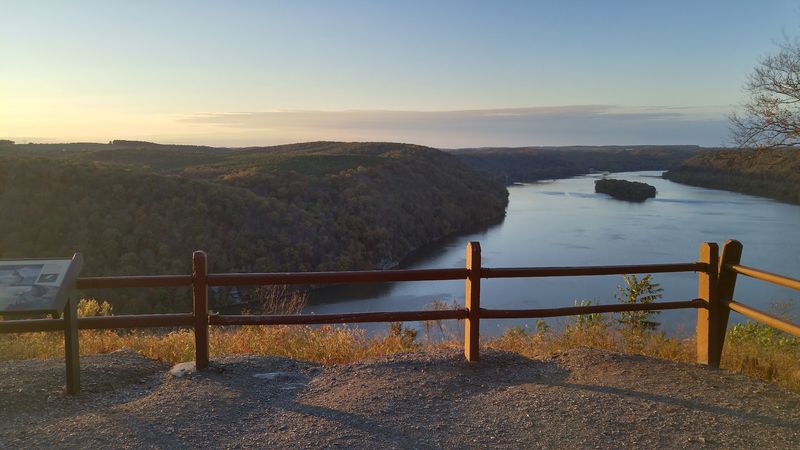
At 380 feet above the water, Pinnacle Overlook frames a stretch of the Susquehanna River that widens into Lake Aldred below, with forested islands breaking the surface and wooded hills layering into the distance on both banks.
The main viewing area sits at the end of a flat, paved path from the parking lot, making the overlook accessible to photographers who are not looking for a technical hike. Rocky outcroppings at the rim add foreground interest for wide compositions.
Autumn is the most visually productive season here, when red, orange, and gold cover the hillsides on both sides of the river simultaneously. The broad river surface also picks up sky color during early morning and late afternoon, adding a horizontal band of reflected light to landscape compositions.
Nearly three miles of connecting trails lead through the preserve toward Kelly’s Run and Tucquan Glen, offering forest and stream compositions for photographers willing to extend the visit beyond the main overlook.
13. Hopewell Furnace National Historic Site, Elverson, Pennsylvania
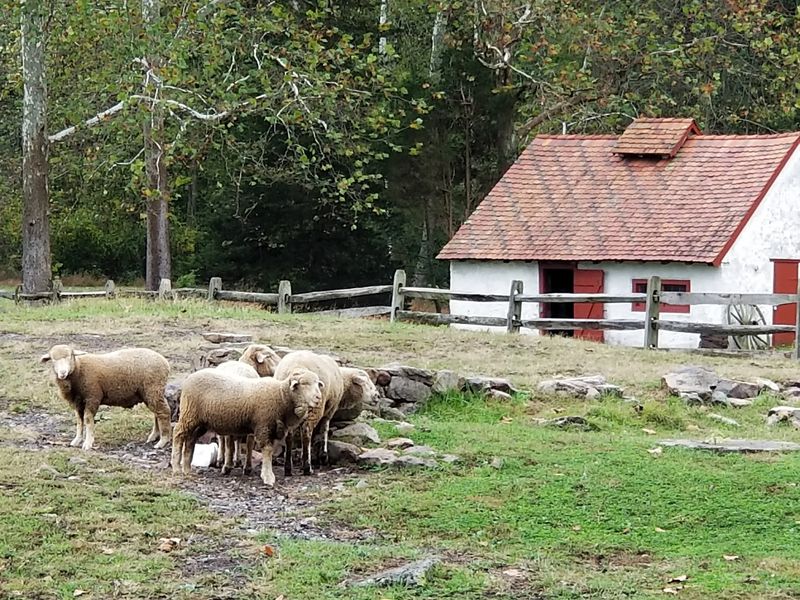
Founded in 1771, Hopewell Furnace operated as a self-contained iron plantation, and 14 of its original structures have been preserved and restored, giving photographers a range of subjects spread across a pastoral landscape that looks remarkably undisturbed.
The blast furnace itself is the dominant industrial structure on the site, a massive stone construction that anchors the wider scene. The ironmaster’s mansion, spring house, smoke house, blacksmith shop, and charcoal house each offer their own architectural details at a human scale.
A large water wheel, once used to power the furnace bellows, remains on site and adds a mechanical element to compositions that would otherwise read as purely agricultural. The surrounding fields and tree lines shift color in autumn, which softens the industrial character of the site considerably.
Morning light tends to be particularly useful here, as it rakes across the stone and wooden surfaces at low angles and brings out the texture of aged materials without the flat midday brightness that reduces contrast.
Share this story