 Unearth The Voyage
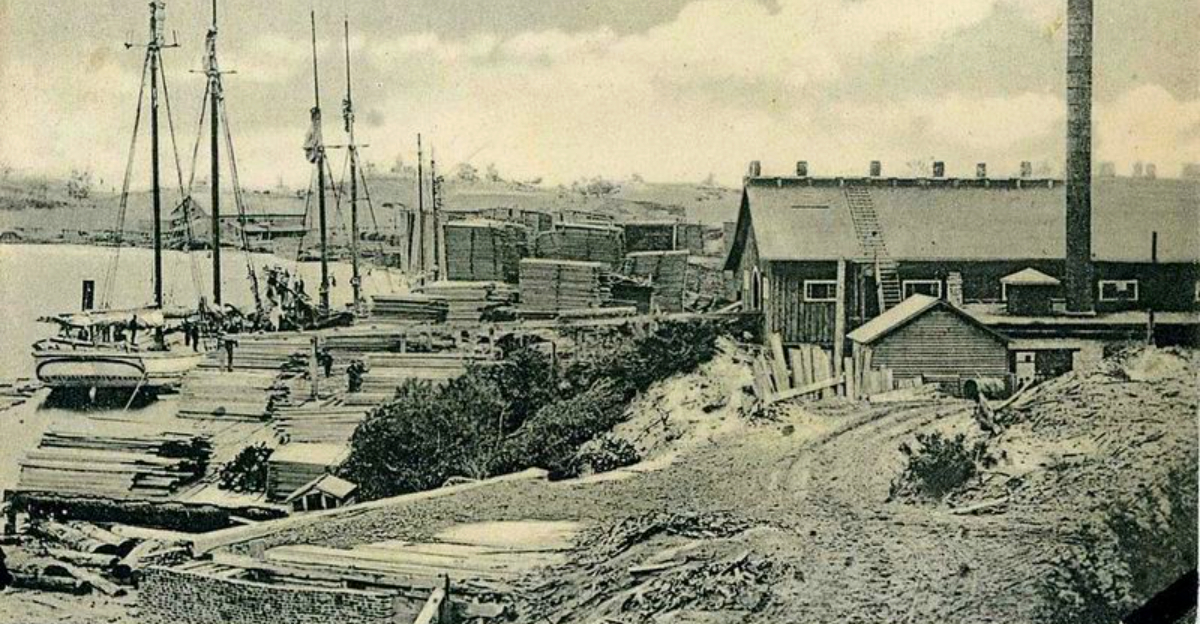
You cannot visit this Michigan town in any normal way. It sits buried beneath massive sand dunes along Lake Michigan, with no streets, buildings, or visible remains left above ground.
Singapore, Michigan was once a fast-growing lumber port with plans to rival Chicago. Today, it survives only as a cautionary story shaped by deforestation, shifting dunes, and failed ambition.
The only physical trace is a small historical marker near Saugatuck’s Village Hall.
What happened here is one of the most unusual stories in the Midwest, and it explains how an entire town disappeared. Here’s how it unfolded.
Where the Marker Stands Today
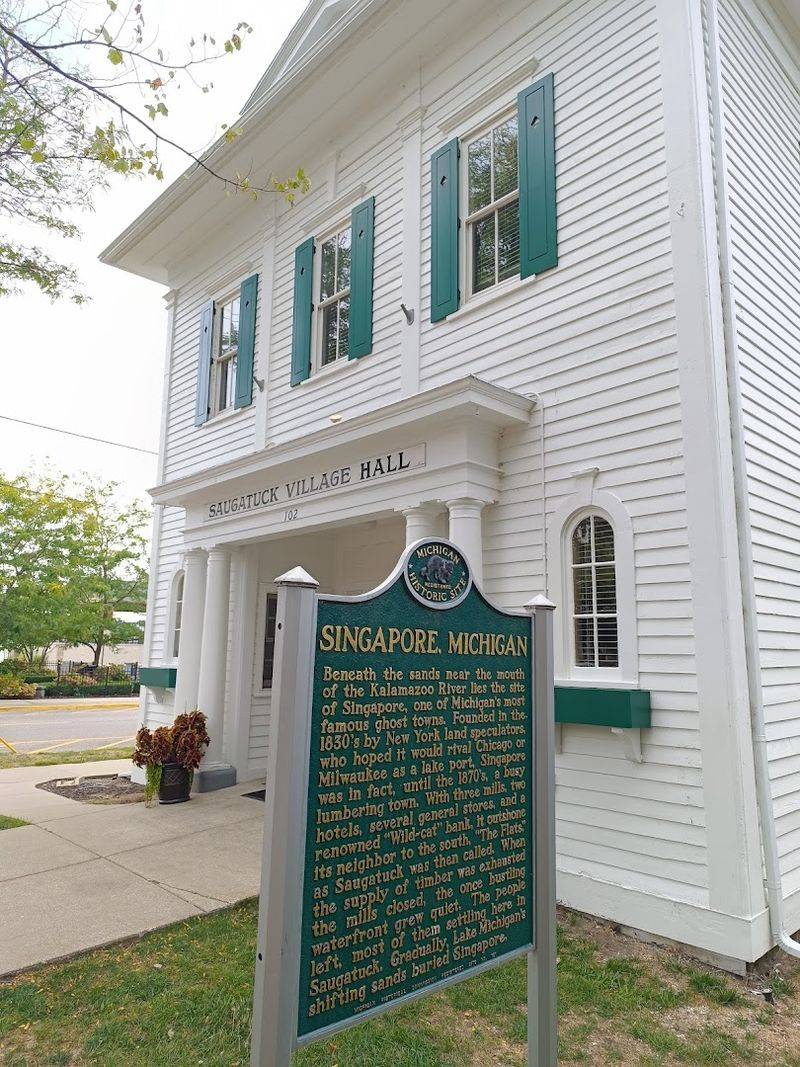
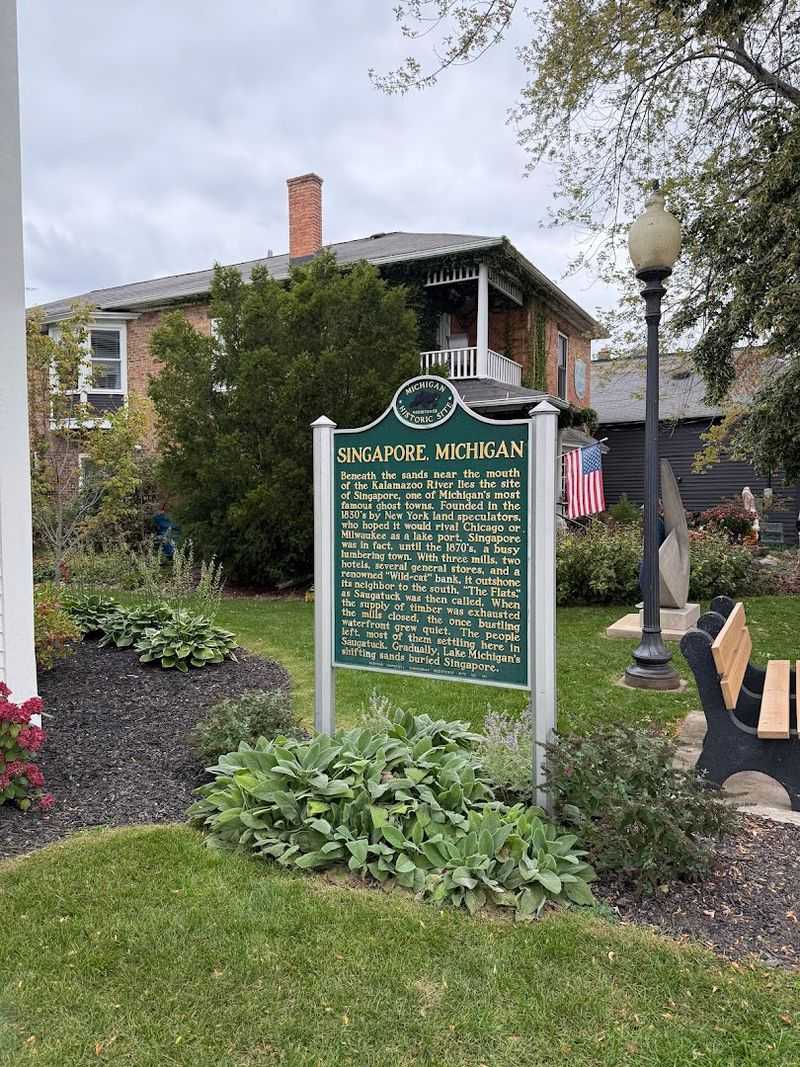
A green cast-iron plaque on Butler Street in Saugatuck, Michigan, 49453, is the only above-ground evidence that an entire town once thrived nearby. The Singapore, Michigan Historical Marker sits close to the Saugatuck Village Hall, just before the street meets the harbor.
The marker is open to visitors every single day, all year round, twenty-four hours a day. There is no admission fee, no gate, and no waiting in line.
You simply walk up, read the text, and let the weight of what happened here settle in.
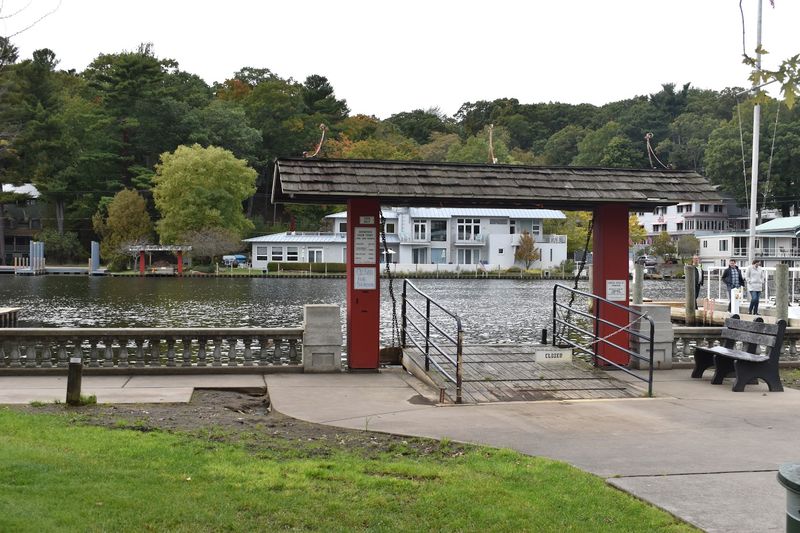
The surrounding area is peaceful and scenic, with the Kalamazoo River mouth and Lake Michigan dunes framing the view. The marker earns a solid 4.7-star rating from visitors who consistently describe it as a surprisingly moving stop on any Saugatuck itinerary.
Small as it is, this plaque carries an enormous story.
The Bold Dream That Started It All
Back in 1836, a group of New York land speculators looked at the mouth of the Kalamazoo River and saw a future metropolis. They named their new settlement Singapore, a nod to the prosperous Asian port city, and fully believed it would grow into a rival for Chicago and Milwaukee.
The location made practical sense at the time. The Kalamazoo River offered a natural channel into the interior of Michigan, and Lake Michigan provided direct access to major shipping routes.
Singapore quickly attracted settlers, merchants, and mill operators who shared the founders’ confidence in the town’s future.
Three sawmills were operating within a few years, and the port buzzed with activity as lumber moved out and supplies moved in. At its peak, roughly 200 people called Singapore home.
For a brief, shining moment, the dream seemed entirely reasonable, and the town’s ambition was matched only by the forest surrounding it.
Lumber Was King, Until It Wasn’t
The lumber industry was the engine that drove Singapore forward. The forests of western Michigan were dense with white pine, and sawmill operators worked around the clock to convert those trees into planks, boards, and beams that fed the construction boom across the Midwest.
Singapore had not one but three operating sawmills at its height, along with a general store, a hotel, and a functioning port that connected the town to broader markets. The Kalamazoo River made log transport relatively straightforward, and the town’s infrastructure grew to support the constant flow of raw timber.
The problem with building an entire economy on a finite natural resource is that the resource eventually runs out. Singapore’s loggers were extraordinarily efficient, which turned out to be the town’s greatest weakness.
The faster the trees fell, the faster the sand began to move, and nobody at the time fully understood the connection between the two until it was far too late.
The Great Chicago Fire Changed Everything
On October 8, 1871, fire tore through Chicago and reduced vast sections of the city to ash. The rebuilding effort that followed was enormous, and it created a near-insatiable demand for lumber across the entire Midwest.
Michigan’s sawmill towns answered that call immediately.
Singapore’s mills ramped up production to help supply the reconstruction of Chicago. Loggers pushed deeper into the surrounding forests, stripping hillsides and riverbanks of the trees that had held the sandy soil in place for centuries.
The economic incentive was simply too strong for anyone to slow down and assess the environmental consequences.
Within just a few years of the fire, the forests around Singapore were largely gone. What had once been a green, tree-covered landscape was now exposed sand, and the dunes along Lake Michigan had nothing left to anchor them.
The wind began doing what wind always does when given an unobstructed run at a sandy shoreline: it moved the sand, steadily and without mercy.
When the Dunes Started Moving
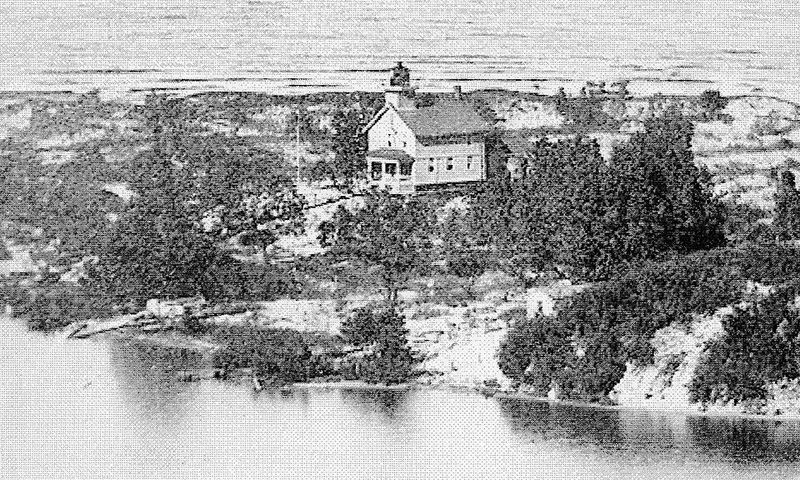
Sand dunes along Lake Michigan are not static features. They shift constantly under the influence of wind, and the only thing that reliably holds them in place is deep-rooted vegetation, particularly trees.
Once Singapore’s surrounding forests were stripped away, the dunes had nothing to stop them.
The movement was gradual at first, and residents likely dismissed early signs as seasonal variation. But the sand kept coming, year after year, creeping toward buildings and streets with a slow inevitability that no amount of effort could reverse.
Doorways filled with sand, roads became impassable, and the town’s usefulness as a port and mill site collapsed.
By the mid-1870s, Singapore was effectively abandoned. The residents packed what they could carry and left, and the dunes moved in to claim the rest.
The whole process took roughly four years from the end of the logging boom to complete abandonment, which is a remarkably short time for an entire town to vanish.
A Town Buried Alive Under Sand
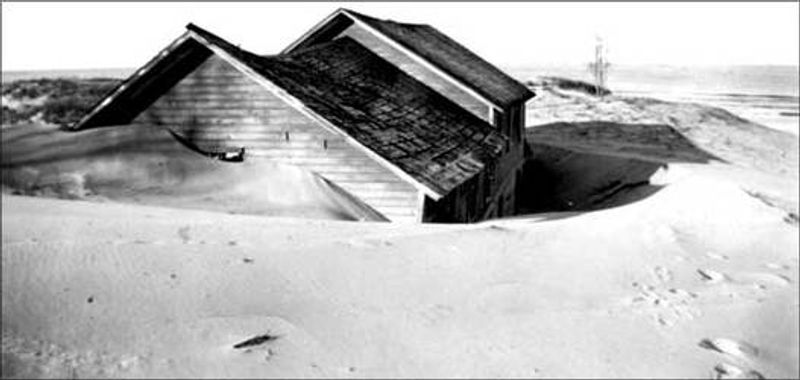
The dunes did not simply cover Singapore the way snow covers a sidewalk. They buried it deeply and thoroughly, swallowing buildings, streets, and whatever the residents left behind.
The town did not burn or flood or fall apart; it was simply consumed by sand, layer by layer.
Estimates suggest that the buried remains of Singapore lie somewhere beneath the dunes on the north side of the Kalamazoo River mouth. Occasionally, when wind patterns shift dramatically, the dunes move enough to expose a weathered timber, a fragment of foundation, or another relic from the town’s brief life.
That unpredictability makes the site genuinely thrilling for history enthusiasts. There is always the slim but real possibility that a visit to the area after a strong storm might reveal something new.
The town is not gone so much as it is waiting, preserved in a strange kind of sandy amber beneath one of Michigan’s most scenic stretches of shoreline.
The Saugatuck Connection and Nearby Community
Saugatuck, the town that grew up nearby while Singapore disappeared, is a lively and artsy community that draws thousands of visitors every summer. The two towns share the same general geography along the Kalamazoo River and Lake Michigan, but their fates could not have been more different.
Saugatuck developed more sustainably and eventually became known as an arts colony, attracting painters, sculptors, and creative types who were drawn to the area’s natural beauty. The Ox-Bow School of Art, founded in 1910, helped cement the town’s reputation as a creative hub that continues to thrive today.
The historical marker sits right in the heart of Saugatuck’s waterfront area, which means a visit to read about Singapore’s fate can easily be combined with a stroll through Saugatuck’s galleries, shops, and restaurants. The contrast between the buried ghost town and the thriving arts community next door gives the whole experience an extra layer of meaning that sticks with you.
What the Historical Marker Actually Says
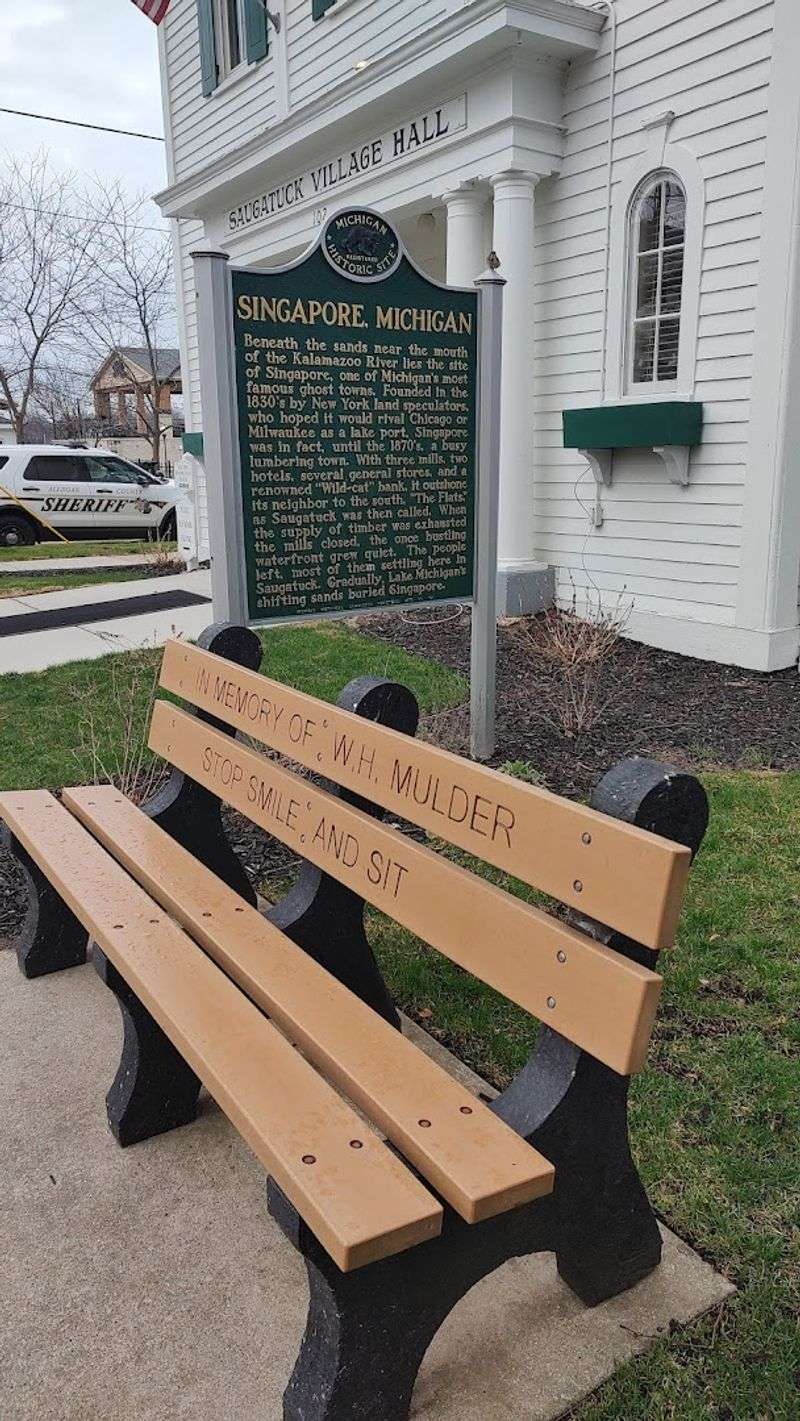
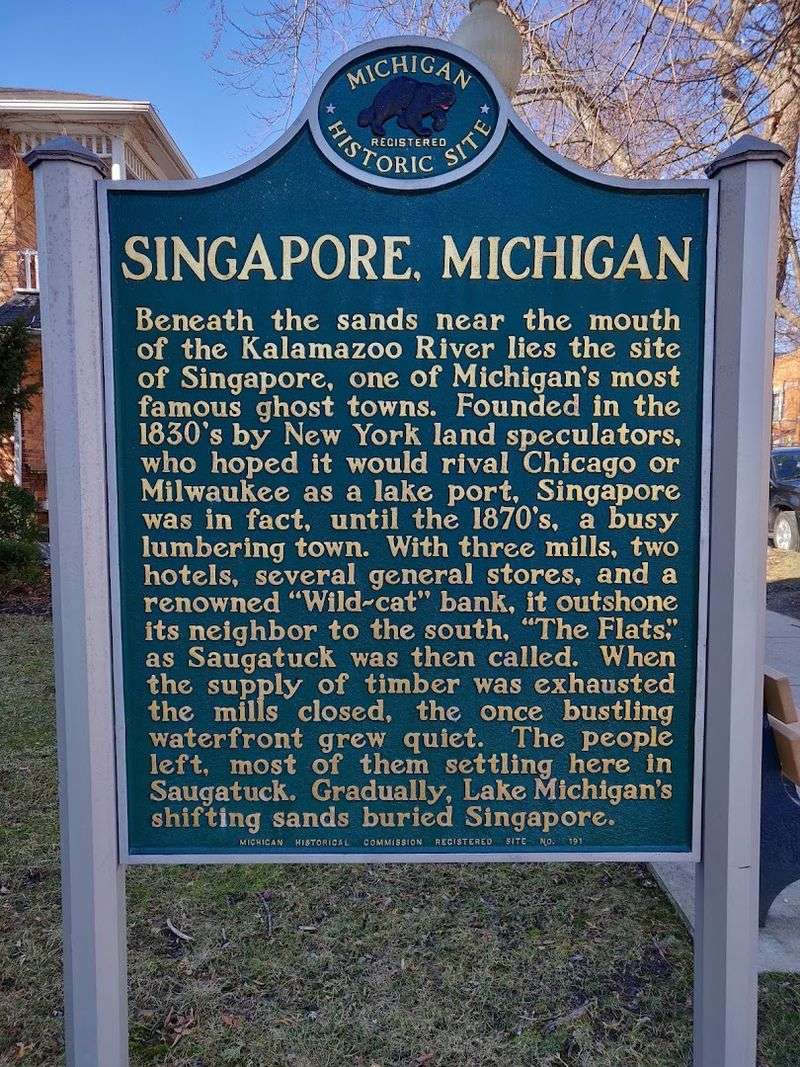
The marker itself is a classic Michigan historical plaque, the kind you find at significant sites throughout the state. It tells the essential story of Singapore in concise, well-chosen language, covering the town’s founding, its role in the lumber trade, and its eventual burial under the dunes.
Reading the marker takes only a couple of minutes, but the information it packs in is genuinely dense. It connects Singapore’s rise and fall to broader historical events, including the deforestation of Michigan’s forests and the consequences of rapid, unregulated resource extraction in the 19th century.
The plaque is mounted at a comfortable reading height and is well maintained, making it easy to photograph and share. Visitors frequently note that the marker feels like the opening page of a much longer book, one that leaves you wanting to know more about what lies beneath the sand just a short distance away.
It is a small object carrying a very large story.
The Environmental Lesson Buried in the Sand

Singapore’s story is not just a quirky historical footnote. It is one of the clearest early American examples of how quickly environmental damage can spiral out of control when short-term economic gain overrides long-term thinking.
The town essentially engineered its own disappearance.
The trees that loggers harvested so aggressively were doing a job that nobody fully appreciated until they were gone. Their roots held the sandy soil together, their canopies broke the force of the wind, and their presence kept the dunes stable.
Remove the trees, and the dunes become a slow-moving force that nothing can stop.
Environmental educators and historians frequently use Singapore as a case study in the consequences of deforestation. The story resonates particularly well with younger audiences because the cause-and-effect relationship is so direct and so dramatic.
A town that cut down all its trees was buried by the sand those trees had been holding back. It is hard to imagine a more vivid lesson in ecological balance.
Visiting Tips for History Enthusiasts
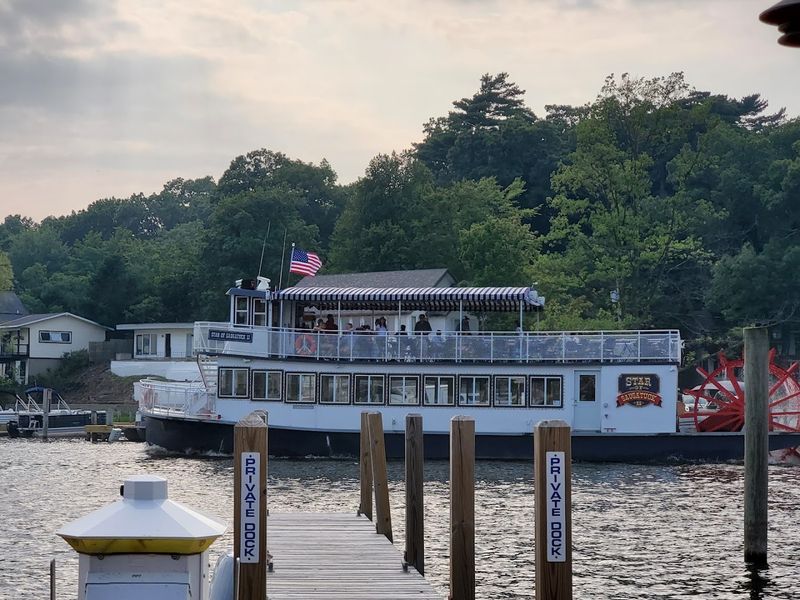
The marker on Butler Street is genuinely easy to reach and costs nothing to visit. Parking is available near the Saugatuck waterfront, and the walk from most public lots to the marker is short and pleasant, passing along the river with views of boats and the surrounding dune landscape.
Summer is the most popular time to visit Saugatuck, so if you prefer a quieter experience at the marker, consider a weekday morning in late spring or early fall. The light at those times is also better for photographs, and the cooler temperatures make the walk from your car more comfortable.
Pairing the marker visit with a trip to Oval Beach or a dune ride through the surrounding area gives you a fuller sense of the landscape that buried Singapore. Seeing the actual scale of the dunes in person makes the story on the plaque feel far more real and immediate than any photograph can convey.
The Dunes That Still Shift Today

The dunes around Saugatuck are not a static backdrop. They continue to shift and move, just as they did when they swallowed Singapore more than 150 years ago.
The forces of wind and water that buried the town are still very much active in the landscape today.
Mount Baldhead, a prominent dune on the north side of the Kalamazoo River channel, offers a dramatic vantage point over the area where Singapore once stood. Climbing to the top gives you a clear sense of the scale of the dune system and why a 19th-century town had absolutely no chance once the trees were gone.
The dune ecosystem in this part of Michigan is considered ecologically significant, and conservation efforts are ongoing to protect and stabilize the remaining natural areas. Visiting with that context in mind transforms a scenic landscape into something more layered and thought-provoking, a place where beauty and consequence exist side by side in plain sight.
Why Singapore’s Story Still Matters
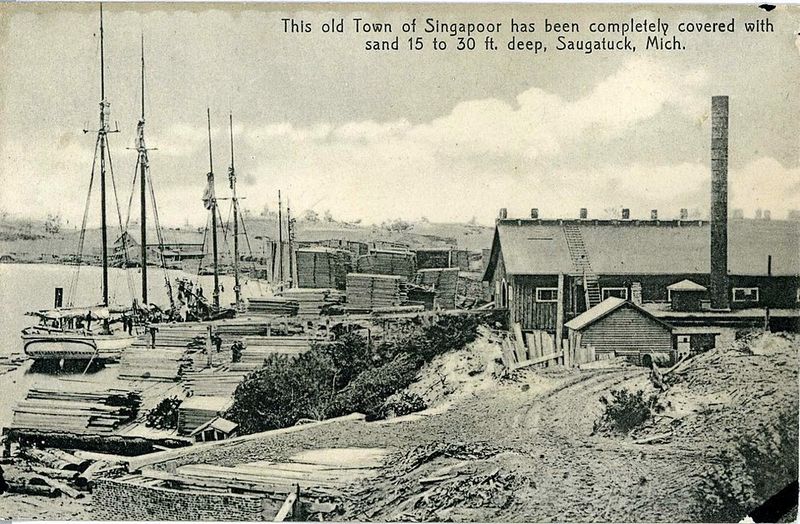
More than a century and a half after its abandonment, Singapore continues to capture the imagination of historians, environmentalists, and curious travelers. The story has a quality that most historical cautionary tales lack: it is visually dramatic, physically present, and geographically accessible.
The buried town is not in a remote archive or a dusty museum. It is right there, under the sand, a short drive from a charming lakeside community that welcomes visitors every season of the year.
That proximity makes the story feel alive in a way that purely textual history rarely achieves.
Reading the marker, looking out over the dunes, and knowing that an entire town is somewhere beneath your feet is a genuinely affecting experience. Singapore is a reminder that nature operates on its own timeline and by its own rules, and that the choices made by one generation can reshape the physical landscape for every generation that follows.
Some lessons are worth driving to see in person.



