 Unearth The Voyage
Ottoman architecture stands as one of history’s most breathtaking building traditions, blending Islamic design with influences from Byzantine, Persian, and local cultures across three continents. For over 600 years, the Ottoman Empire created mosques, palaces, bridges, and markets that still inspire awe today with their soaring domes, intricate tilework, and elegant proportions. From the grand mosques of Istanbul to hidden gems in the Balkans, these structures tell stories of imperial power, artistic genius, and cultural exchange that shaped the world we know today.
1. Selimiye Mosque, Edirne (Turkey)
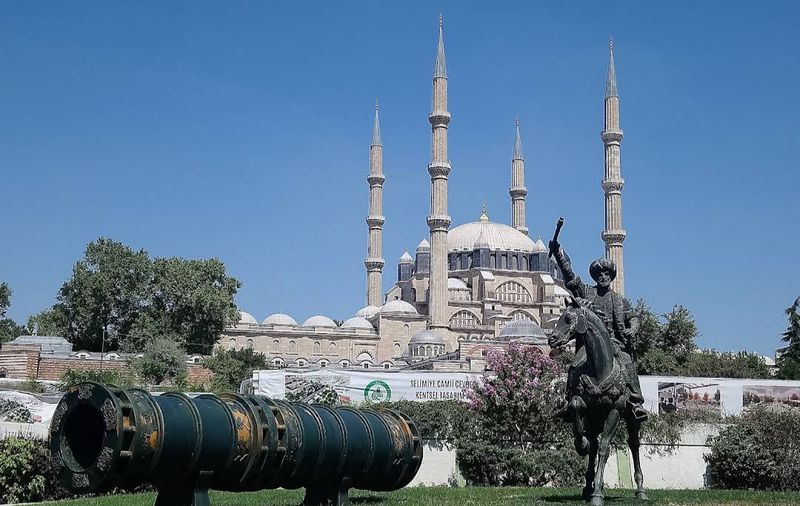
Architect Mimar Sinan himself declared this his greatest work, and standing before its towering dome makes it easy to see why. Completed between 1568 and 1575, the Selimiye Mosque pushes the boundaries of what stone and geometry can achieve. Its central dome, wider than any other Ottoman dome, seems to float effortlessly above the prayer hall, supported by eight massive pillars that create an airy, unified space.
The four needle-thin minarets pierce the skyline at each corner, their balconies adorned with delicate stonework. Inside, light streams through hundreds of windows, illuminating the intricate Iznik tiles and calligraphy that decorate every surface. UNESCO recognized this masterpiece as a World Heritage site, celebrating how Sinan solved architectural challenges that had puzzled builders for centuries.
Visitors often spend hours simply gazing upward, tracing the dome’s perfect curves and marveling at the engineering genius behind this 450-year-old wonder.
2. Süleymaniye Mosque, Istanbul (Turkey)
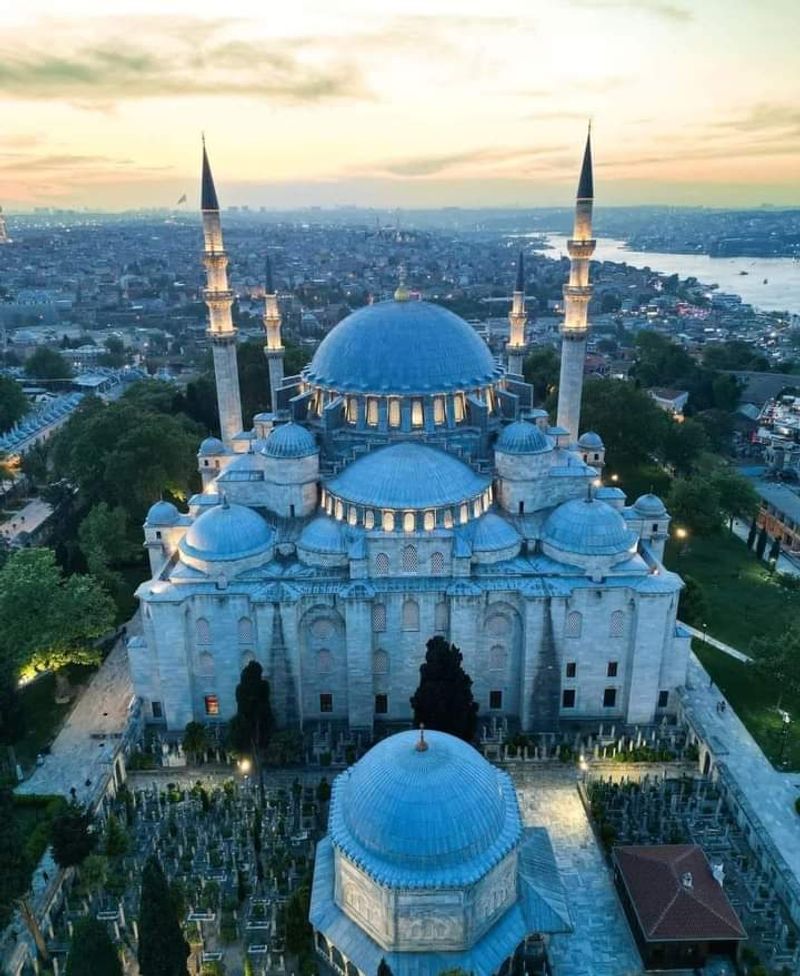
Perched majestically on Istanbul’s Third Hill, this mosque complex represents the golden age of Ottoman power and artistry. Sultan Süleyman the Magnificent commissioned Mimar Sinan to design a structure worthy of his reign, and construction began in 1550. Seven years later, the completed mosque became an instant landmark, its silhouette defining the city’s skyline for centuries to come.
The main dome rises 53 meters high, flanked by half-domes that create a cascade of curves echoing Byzantine Hagia Sophia nearby. Yet Sinan’s design feels distinctly Ottoman, with slender minarets and a courtyard that welcomes worshippers into a space of harmony and balance. The complex originally included schools, hospitals, kitchens, and baths, forming a complete community center.
Today, visitors climb the hill to experience not just architectural brilliance but also panoramic views of Istanbul spreading in every direction, exactly as Süleyman intended.
3. Sultan Ahmed (Blue) Mosque, Istanbul (Turkey)
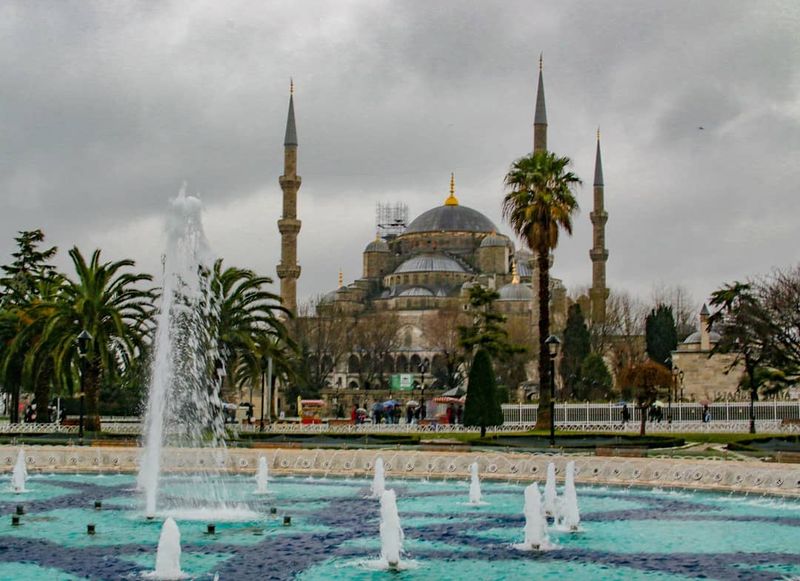
Six towering minarets caused quite a scandal when this mosque was completed in 1617, since only Mecca’s Grand Mosque had that many at the time. Sultan Ahmed I commissioned architect Sedefkâr Mehmed Ağa to create something extraordinary, and the result became Istanbul’s most photographed building. The nickname comes from the 20,000 handmade blue Iznik tiles covering the interior walls, creating an ocean of turquoise patterns and floral designs.
The cascading domes seem to tumble down from the central crown in perfect rhythm, while the slender minarets reach skyward like elegant fingers. More than 200 stained-glass windows fill the prayer hall with colored light, transforming the space into something almost magical. Part of Istanbul’s UNESCO-listed historic core, the mosque still functions as an active place of worship.
Thousands visit daily, removing their shoes to walk across plush carpets and tilt their heads back to admire the painted domes overhead.
4. Topkapı Palace, Istanbul (Turkey)
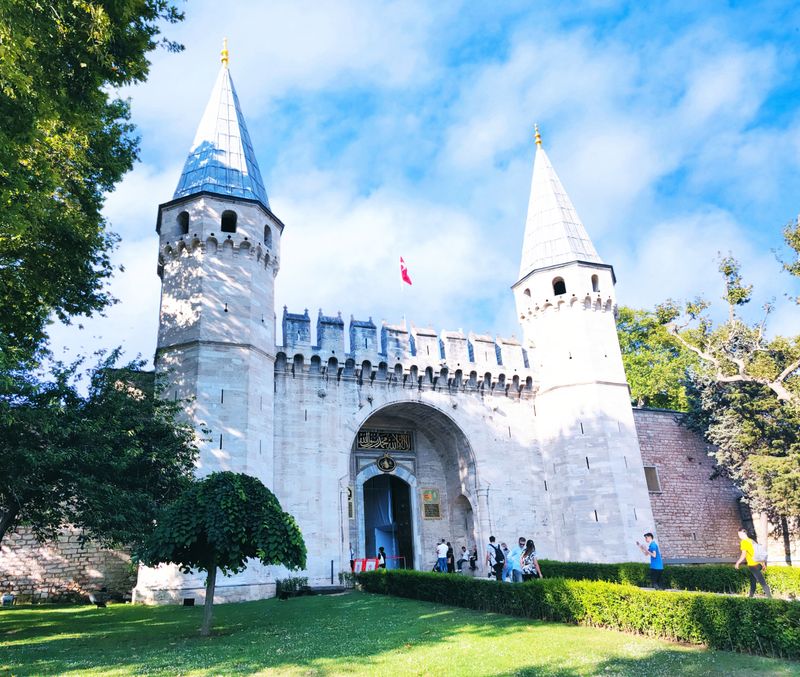
For nearly 400 years, this sprawling palace complex served as the beating heart of the Ottoman Empire, home to sultans and their courts from around 1478 until 1856. Mehmed the Conqueror began construction shortly after capturing Constantinople, choosing a dramatic promontory where the Golden Horn meets the Bosphorus. What started as a fortress evolved into a vast city-within-a-city, with courtyards, gardens, throne rooms, and the legendary Harem.
Unlike European palaces built as single massive structures, Topkapı grew organically over centuries, with each sultan adding pavilions and kiosks reflecting his personal taste. The result feels more like a collection of jewel-box buildings than one unified design. Intricate tilework, mother-of-pearl inlays, and gilded calligraphy decorate nearly every surface.
Now operating as a major museum, the palace displays imperial treasures including the Topkapı Dagger and the Spoonmaker’s Diamond, attracting millions of visitors curious about Ottoman royal life.
5. Dolmabahçe Palace, Istanbul (Turkey)
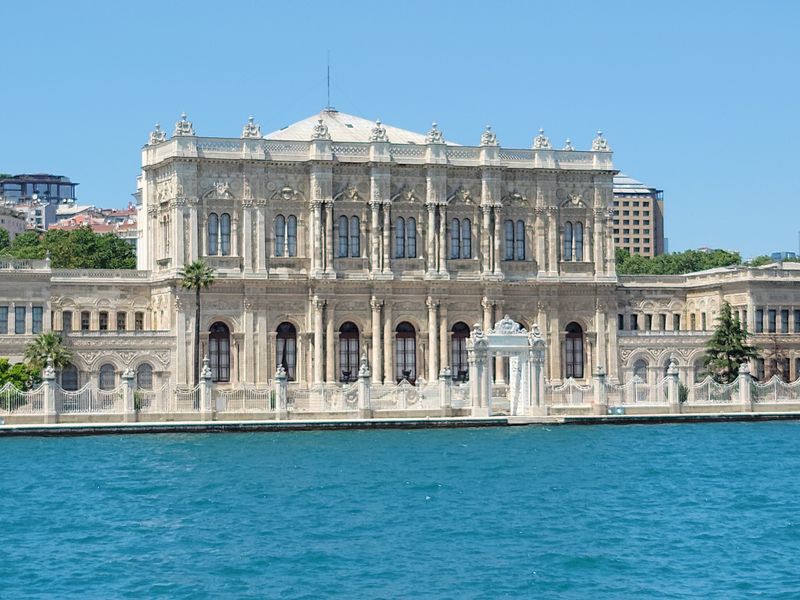
Everything about Dolmabahçe screams opulence and European ambition, a dramatic departure from traditional Ottoman design. Built between 1843 and 1856 along the Bosphorus waterfront, this palace marked the empire’s attempt to modernize and compete with European powers. Armenian architect Garabet Balyan blended baroque, rococo, and neoclassical styles into something uniquely Ottoman yet distinctly Western.
The palace stretches 600 meters along the water, its gleaming white marble facade reflecting in the waves below. Inside, 285 rooms and 46 halls dazzle visitors with crystal chandeliers (including a 4.5-ton gift from Queen Victoria), gold leaf ceilings, and silk carpets the size of tennis courts. Fourteen tons of gold and silver decorate the interiors, creating an almost overwhelming display of wealth.
Mustafa Kemal Atatürk, founder of modern Turkey, spent his final days here, and his bedroom remains preserved exactly as he left it in 1938.
6. Rüstem Pasha Mosque, Istanbul (Turkey)
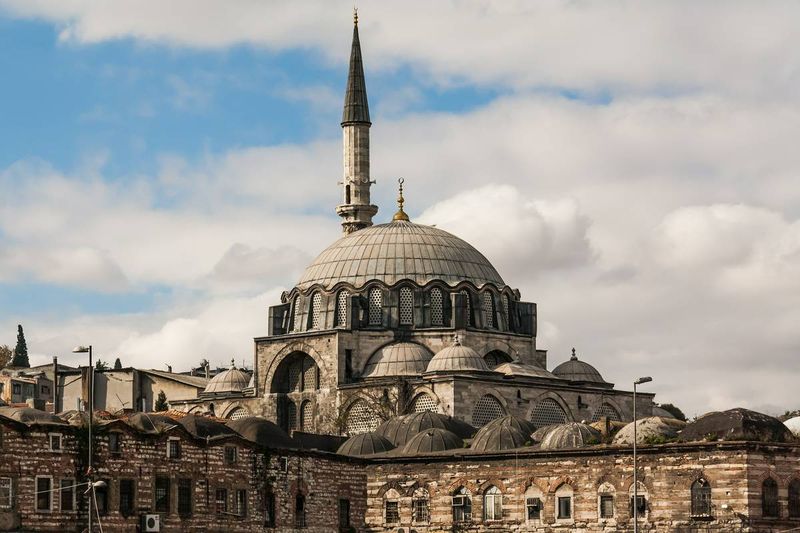
Hidden above street-level shops near the Spice Bazaar, this small mosque packs more visual punch per square meter than almost any other Ottoman building. Mimar Sinan designed it around 1563 for Rüstem Pasha, the Grand Vizier who married Sultan Süleyman’s daughter. What it lacks in size, it more than compensates for in decoration, earning its reputation as a jewel box of ceramic art.
Nearly every wall surface explodes with Iznik tiles in their absolute prime, featuring tulips, carnations, roses, and pomegranates in brilliant turquoise, emerald, coral, and cobalt. Over 80 different tile patterns cover the interior, creating a kaleidoscope of color and design. The tiles date from Iznik’s golden age, when ceramic artists perfected the famous tomato-red glaze that appears throughout the mosque.
Many architecture experts consider Rüstem Pasha the finest example of Ottoman tile decoration anywhere, making the climb upstairs absolutely worthwhile.
7. Mihrimah Sultan Mosque, Üsküdar (Turkey)
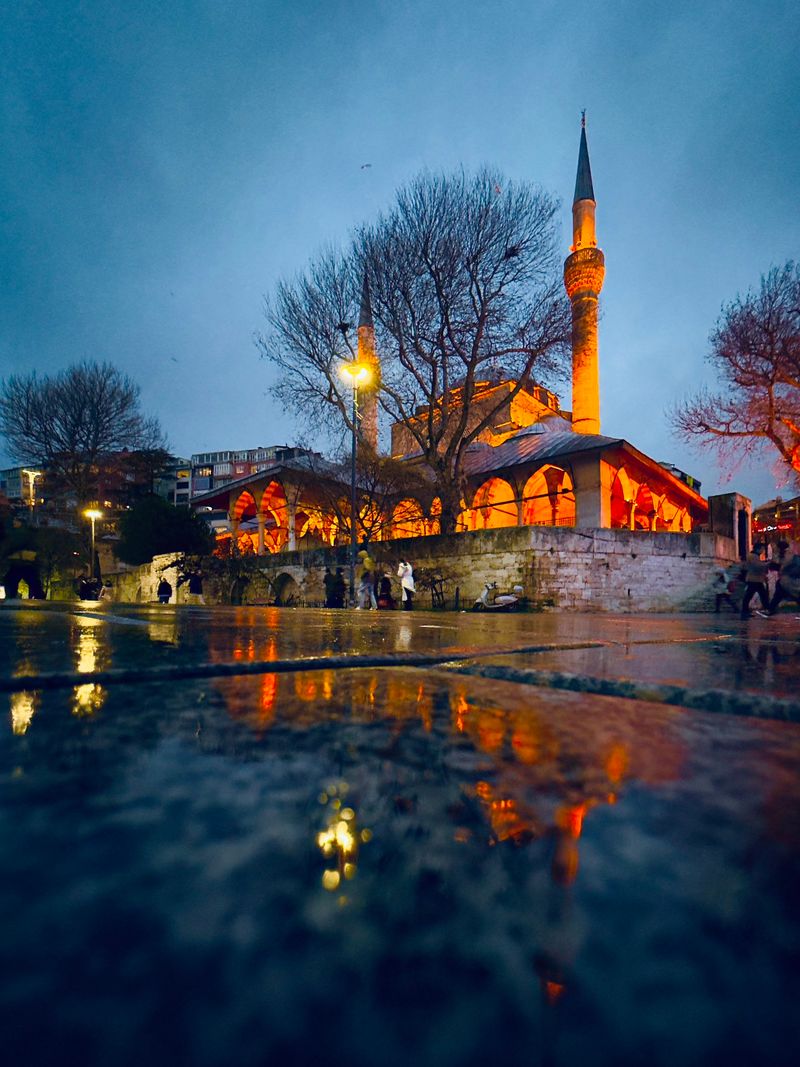
Sinan built this graceful waterfront mosque for Mihrimah Sultan, daughter of Süleyman the Magnificent and wife of Grand Vizier Rüstem Pasha. Completed in 1548, the complex sits prominently on the Asian shore of the Bosphorus in Üsküdar, greeting travelers arriving from the Marmara Sea. Legend whispers that Sinan harbored secret affection for the princess, pouring extra care into her two namesake mosques (the other stands in Edirnekapı).
The building showcases Sinan’s genius for creating luminous interior spaces through clever window placement. Large windows on three sides flood the prayer hall with natural light, making the space feel open and welcoming despite its relatively modest size. A single minaret rises beside the dome, its proportions perfectly balanced with the main structure.
The mosque sits within a larger complex that originally included a school, soup kitchen, and fountain, serving the Üsküdar community for nearly five centuries and counting.
8. Grand Bazaar, Istanbul (Turkey)

Step through any of its dozens of gates and you enter a labyrinth that has barely changed since the 1400s. The Grand Bazaar ranks among the world’s oldest and largest covered markets, with 61 streets and over 4,000 shops tucked beneath painted vaulted ceilings. Mehmed the Conqueror ordered its construction shortly after conquering Constantinople, creating a commercial heart for his new capital.
What began as two stone warehouses (bedestens) grew organically over centuries as merchants added lanes, hans (caravanserais), and shops selling everything from spices to carpets to gold jewelry. The architecture reflects this gradual evolution, with some sections featuring simple brick vaults while others display elaborate painted decoration. Earthquakes and fires damaged the bazaar repeatedly, but each time it was rebuilt, maintaining its essential character.
Today, roughly 400,000 visitors wander its maze daily, bargaining for souvenirs under the same arched passages where Ottoman merchants once traded silk and ceramics.
9. İshak Paşa Palace, Doğubayazıt (Turkey)
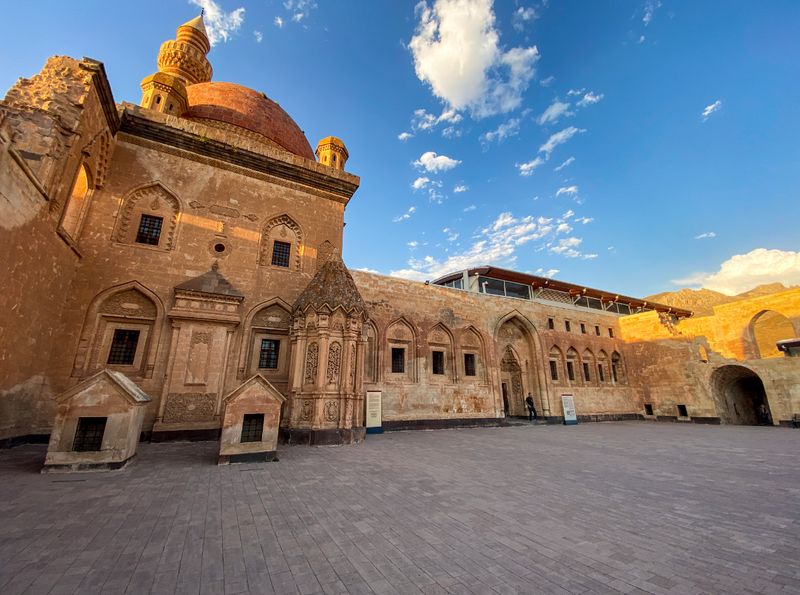
Rising dramatically from a rocky hillside near Turkey’s Armenian border, this fortress-palace feels like something from a fairy tale. Construction began in 1685 and took nearly a century to complete, with successive generations of the İshak Paşa family adding rooms and decoration. The location alone takes your breath away, with Mount Ararat’s snow-capped peak dominating the horizon and the ancient Silk Road running through the valley below.
The architecture blends Ottoman, Persian, Armenian, and Georgian styles into something uniquely regional. Intricately carved stone doorways feature geometric patterns and calligraphy, while the palace layout includes a mosque, tomb, council chamber, harem, and even a dungeon. The mix of materials, honey-colored stone contrasting with darker volcanic rock, creates striking visual patterns across the facades.
Though remote and sometimes overlooked by tourists rushing between Istanbul and elsewhere, İshak Paşa rewards adventurous visitors with atmospheric ruins and jaw-dropping mountain scenery.
10. Bursa Ulu Cami (Grand Mosque), Bursa (Turkey)

Twenty domes supported by twelve massive pillars create a forest of stone inside this early Ottoman landmark. Sultan Bayezid I ordered construction between 1396 and 1399, making Ulu Cami one of the empire’s oldest surviving grand mosques. The design follows a hypostyle plan, meaning multiple columns support the roof rather than one central dome, a layout more common in earlier Islamic architecture than later Ottoman buildings.
What makes this mosque special is how it bridges architectural traditions. Built when the Ottomans were still developing their signature style, Ulu Cami shows influences from Seljuk Turkish architecture mixed with emerging Ottoman elements. The interior features stunning calligraphy covering the walls, with verses from the Quran rendered in different scripts by master calligraphers. A marble fountain sits beneath the central dome, originally used for ablutions.
Bursa served as an early Ottoman capital, and Ulu Cami remains the city’s spiritual centerpiece, its twenty domes creating a distinctive bumpy profile on the skyline.
11. Green Mosque (Yeşil Camii), Bursa (Turkey)

Turquoise and green tiles give this mosque its name and its unforgettable character. Completed in 1424, Yeşil Camii represents early Ottoman architecture at its most refined, showcasing tilework and stone carving that set standards for centuries to come. The mosque forms part of a UNESCO-listed complex that includes a tomb, soup kitchen, and baths, all built during the reign of Sultan Mehmed I.
The entrance portal features incredibly detailed stone carving, with stalactite (muqarnas) decorations that seem to drip from above like frozen honey. Inside, green and turquoise tiles cover the mihrab (prayer niche) and walls, creating a cool, serene atmosphere. The tile decoration marks a transition between earlier Seljuk styles and the Iznik ceramics that would dominate later Ottoman buildings.
Bursa’s role as an early Ottoman capital meant sultans invested heavily in beautifying the city, and the Green Mosque remains one of their most successful artistic achievements, influencing mosque design throughout the empire.
12. Green Tomb (Yeşil Türbe), Bursa (Turkey)

An octagonal jewel box sheathed in turquoise tiles, this mausoleum houses Sultan Mehmed I, who reunited the Ottoman Empire after a devastating civil war. Completed in 1421, just a year before the nearby Green Mosque, the tomb earned its name from the stunning green and turquoise tiles that once covered the entire exterior. Time and earthquakes damaged many of these original tiles, but enough remain to hint at the structure’s original brilliance.
The interior preserves its decoration far better than the exterior. Green tiles with gold details create intricate geometric and floral patterns covering every surface. The sultan’s cenotaph sits in the center, draped in embroidered cloth, surrounded by the tombs of his children. Sunlight filtering through stained-glass windows illuminates the tiles, making the whole space glow with an otherworldly green light.
Art historians consider the Green Tomb’s tilework among the finest examples of early Ottoman ceramic art, bridging Seljuk traditions and the Iznik style that would flourish later.
13. Koza Han (Silk Caravanserai), Bursa (Turkey)
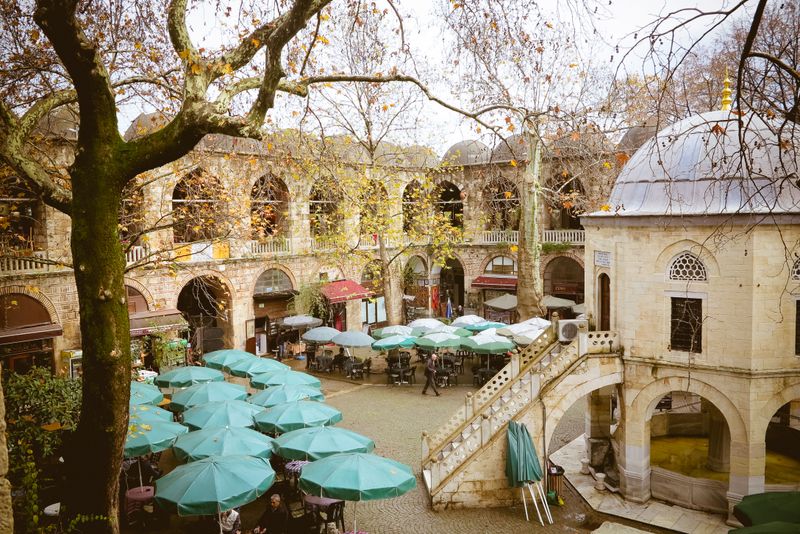
Silk merchants have conducted business in this caravanserai’s shaded courtyard for over 500 years. Built in 1491, Koza Han (meaning Cocoon Inn) anchored Bursa’s position as the Ottoman Empire’s silk capital, where raw silk from Persia met European traders hungry for luxury fabrics. The rectangular building follows the classic caravanserai design, with two stories of rooms opening onto a central courtyard.
A small mosque perched on columns rises from the courtyard’s center, surrounded by a fountain where merchants could perform ablutions before prayer. Arched galleries run along both levels, their stone columns worn smooth by centuries of passing hands. During Bursa’s heyday, the upper rooms stored silk cocoons and finished fabric, while the ground floor housed shops where deals were struck over tiny glasses of tea.
Today, Koza Han continues its commercial tradition, with silk merchants still operating from the same spaces their ancestors occupied, though now tourists outnumber the camel caravans that once crowded the courtyard.
14. Stari Most (Old Bridge), Mostar (Bosnia & Herzegovina)
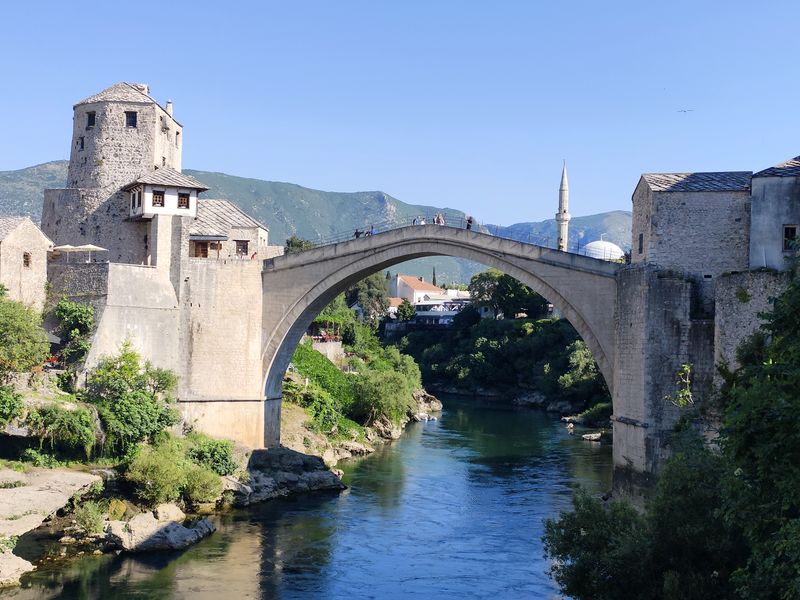
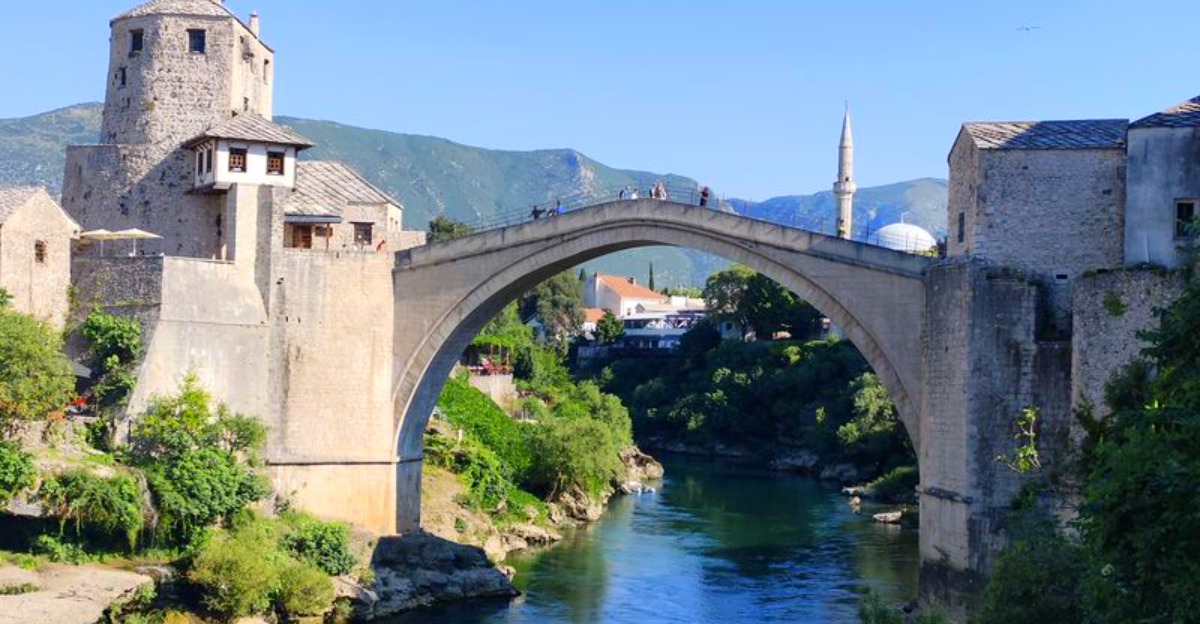
A perfect stone arch leaps across the turquoise Neretva River, connecting two sides of a city once torn apart by war. The original bridge stood for 427 years after its completion in 1566, designed by Ottoman architect Mimar Hajrudin, a student of the great Sinan. During the 1990s Bosnian War, artillery fire destroyed this beloved landmark, breaking not just stone but hearts across the region.
Reconstruction began immediately after the war ended, with engineers using traditional Ottoman techniques and stones recovered from the riverbed. The bridge reopened in 2004, becoming a UNESCO World Heritage site and a powerful symbol of reconciliation and rebuilt connections. The single arch spans 24 meters, rising high above the water, its pale stone glowing against the green hills beyond.
Local young men continue the centuries-old tradition of diving from the bridge into the cold river below, their courage watched by crowds gathered on the banks and the historic stone buildings lining both shores.
15. Mehmed Paša Sokolović Bridge, Višegrad (Bosnia & Herzegovina)
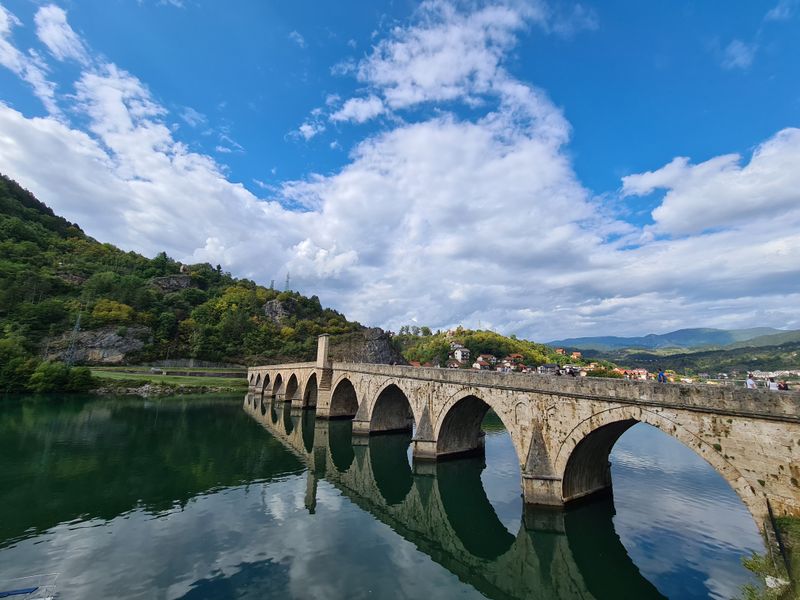
Eleven graceful stone arches march across the Drina River, each one slightly different in size to accommodate the river’s varying width and depth. Mimar Sinan designed this masterpiece in the late 16th century for Grand Vizier Mehmed Paša Sokolović, who was born in a nearby village before being recruited into Ottoman service. The bridge served as a vital link on the route between Istanbul and the western Ottoman territories.
The structure stretches 179 meters, its arches rising and falling in gentle rhythm as they follow the river’s natural contours. At the bridge’s center, a small gate and raised platform once provided a resting spot for travelers, who could gaze at the water rushing below or the mountains rising on all sides. UNESCO recognized the bridge as a World Heritage site in 2007.
Nobel Prize-winning author Ivo Andrić immortalized the bridge in his novel, making it famous worldwide as a place where cultures met, mingled, and sometimes clashed throughout four centuries of Balkan history.
16. Gazi Husrev-beg Mosque, Sarajevo (Bosnia & Herzegovina)
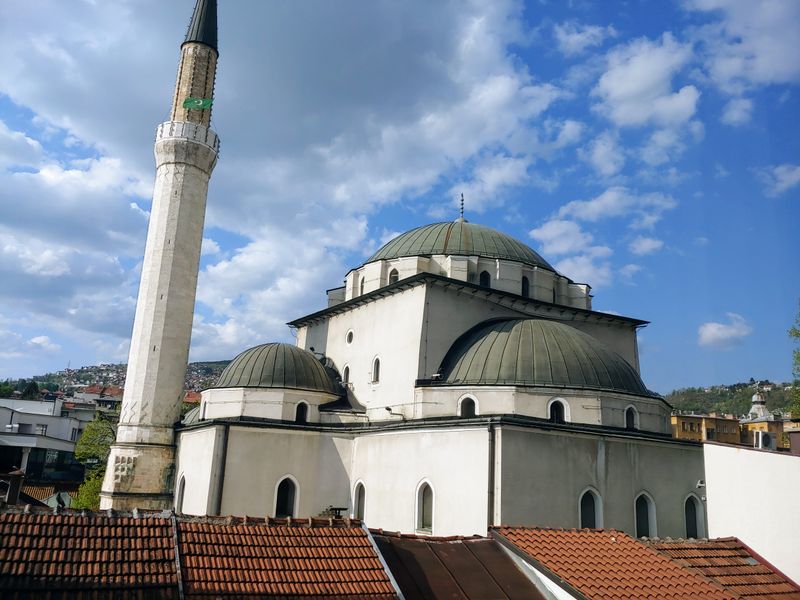
The call to prayer echoing from this mosque’s minaret has marked time in Sarajevo’s old town for nearly 500 years. Built in 1531 by Gazi Husrev-beg, the Ottoman governor of Bosnia, this complex became the spiritual and cultural heart of the city’s Muslim community. The mosque sits in Baščaršija, Sarajevo’s bustling Ottoman-era bazaar district, surrounded by the original market streets, fountains, and caravanserais that made the city prosper.
The main prayer hall features a large central dome supported by elegant arches, with a decorated mihrab and minbar (pulpit) carved from marble. A covered porch wraps around the exterior, providing shelter and creating a transition between the busy streets and the quiet interior. The complex originally included a madrasa (Islamic school), library, soup kitchen, and clock tower, many of which still function today.
The mosque survived wars and occupations, remaining Bosnia’s most important historical Islamic building and an active center of worship drawing both locals and visitors exploring Sarajevo’s Ottoman heritage.
17. Sinan Pasha Mosque, Prizren (Kosovo)
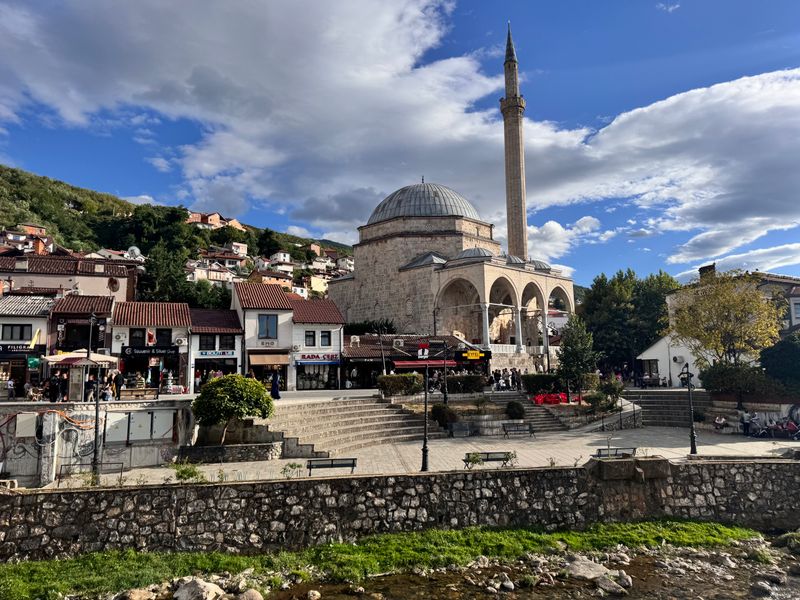
Crowning a hill above Prizren’s terracotta rooftops, this mosque’s massive dome and slender minaret have dominated the city skyline for over 400 years. Sofi Sinan Pasha, an Ottoman military commander, commissioned the building, which was finished in 1615. The mosque’s elevated position makes it visible from nearly everywhere in the old town, serving as both a spiritual beacon and an architectural landmark.
The structure follows classical Ottoman design principles, with a large central dome flanked by smaller half-domes creating a cascading effect. Inside, the prayer hall features painted decoration and calligraphy, though much simpler than the elaborate tile work found in Istanbul’s imperial mosques. The mosque sits within a walled courtyard that includes a graveyard with Ottoman-era tombstones, their carved turbans indicating the ranks of those buried beneath.
Prizren’s position on trade routes between the Adriatic coast and interior Balkans made it an important Ottoman city, and Sinan Pasha Mosque remains the most visible reminder of that imperial past, watching over the town from its hilltop perch.
18. Et’hem Bey Mosque, Tirana (Albania)

Colorful frescoes of trees, waterfalls, and bridges cover this mosque’s exterior, a rare departure from the geometric and floral patterns typical of Islamic decoration. Construction began in 1789 under Molla Bey and was completed by his son Et’hem Bey in the early 1800s, making it one of Tirana’s oldest buildings. The mosque sits on Skanderbeg Square, the capital’s main plaza, its decorated walls and minaret providing a striking contrast to the surrounding communist-era architecture.
What makes Et’hem Bey truly special are those landscape paintings, which appear both inside and outside the building. These figurative images were unusual in Ottoman mosque decoration, showing European artistic influence mixed with traditional Islamic design. During Albania’s communist period (1967-1991), when religion was completely banned, the mosque survived demolition only because of its historical significance.
The mosque reopened to worship in January 1991, with 10,000 people defying the still-standing ban to attend prayers, making it a symbol of religious freedom’s return to Albania after decades of state-enforced atheism.
19. Tombul (Şerif Halil Paşa) Mosque, Shumen (Bulgaria)
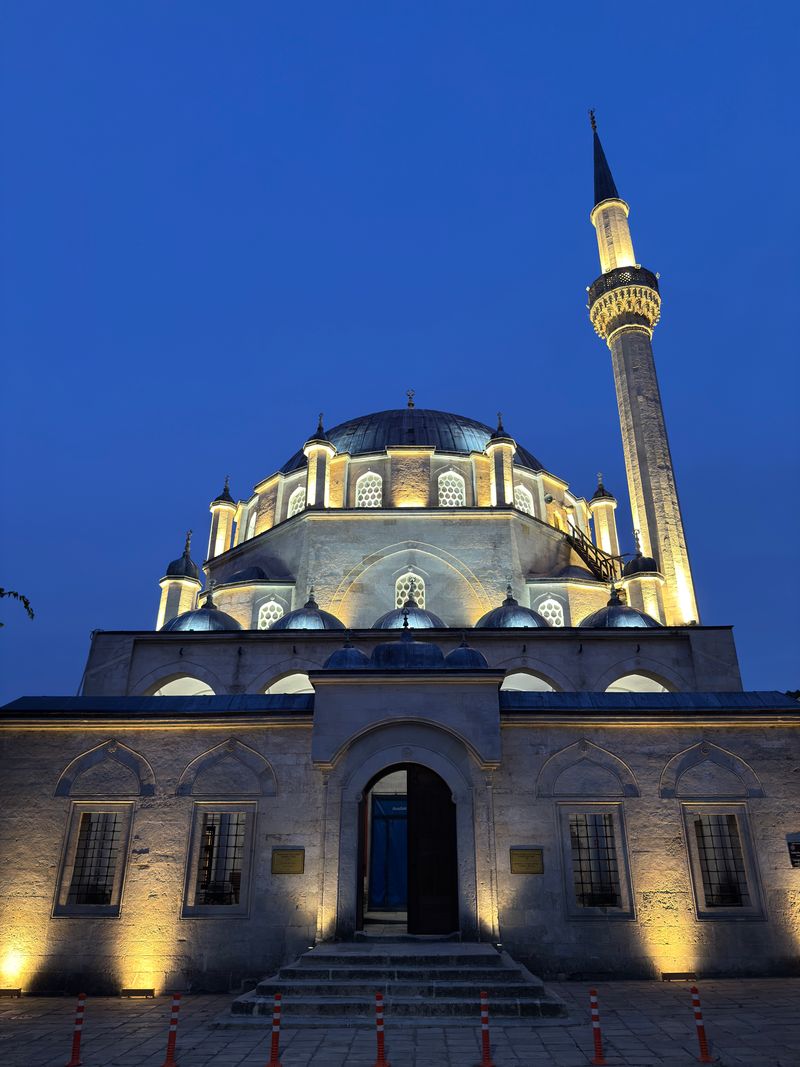
Bulgaria’s largest historic mosque rises in the town of Shumen, its nine domes creating a distinctive profile against the sky. Built in the 1740s during the Ottoman Tulip period (a time of artistic flowering and peace), the mosque was commissioned by Şerif Halil Paşa. The name Tombul means chubby or plump in Turkish, referring to the mosque’s round, substantial domes that give it a solid, grounded appearance.
The complex originally included a madrasa, library, and covered market, forming a complete religious and educational center. The main prayer hall features a large central dome surrounded by smaller domes, with tall windows flooding the space with light. The courtyard includes a fountain for ablutions, surrounded by columns supporting a covered walkway. Intricate painted decoration covers the interior, with floral and geometric patterns typical of the Tulip period’s exuberant style.
The mosque continues to serve Shumen’s Muslim community while also welcoming visitors interested in Bulgaria’s Ottoman architectural heritage, standing as evidence of the empire’s deep roots in the Balkans.
20. Bajrakli Mosque, Belgrade (Serbia)

One mosque stands where hundreds once called Belgrade’s faithful to prayer. Built around 1575 during the reign of Sultan Murad III, Bajrakli Mosque (meaning Flag Mosque) survived centuries of war, occupation changes, and deliberate destruction that erased nearly all traces of Ottoman Belgrade. Its survival feels almost miraculous given that at various points in history, particularly during the 19th and 20th centuries, most of the city’s Ottoman buildings were systematically demolished.
The mosque follows a simple rectangular plan with a single dome and minaret, its modest size and straightforward design typical of neighborhood mosques built throughout the empire. The name comes from a flag that once flew from its minaret. Inside, the prayer hall features basic decoration, stripped of many original elements over the years but still maintaining its function and dignity.
Today, Bajrakli Mosque serves Belgrade’s small Muslim community and stands as a quiet reminder of the city’s Ottoman centuries, a lone survivor bearing witness to a vanished architectural landscape that once defined the capital.



