 Unearth The Voyage
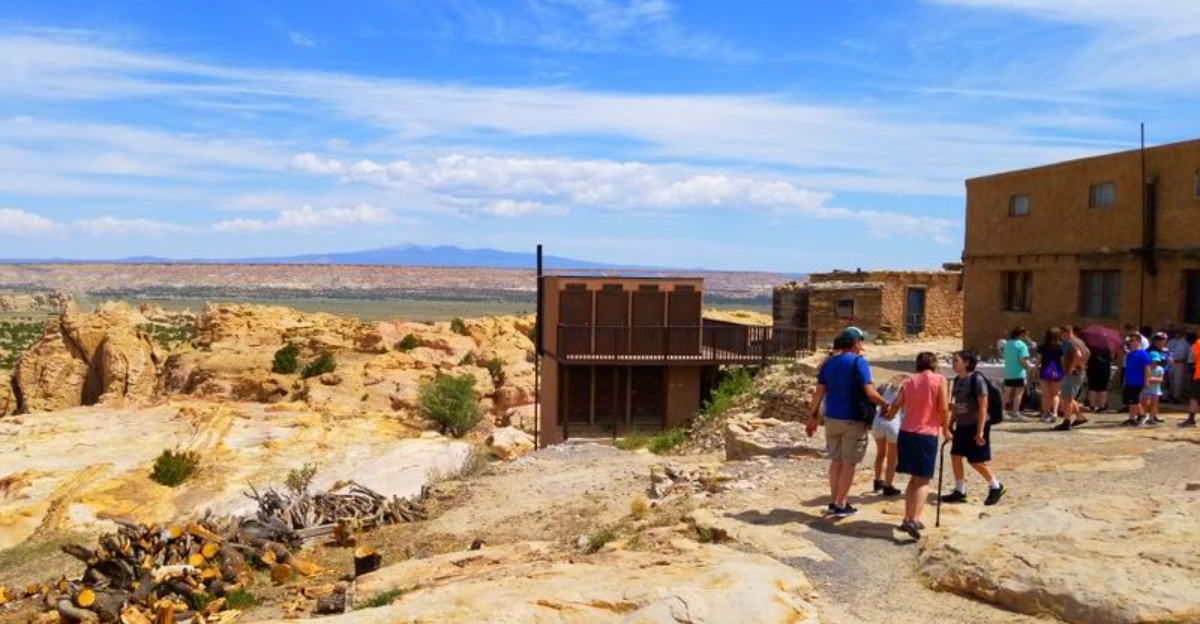
If you have ever watched a thunderhead stack over a stone mesa and wondered who first called it home, Acoma Pueblo answers with wind in its streets and centuries in its walls. Lately it is turning heads nationwide, not because it changed, but because the country is finally listening.
Walk its ancient ridge and you will feel time compress under your shoes. Keep reading and you will hear how the mesa itself teaches you where to look, when to pause, and what not to miss.
Sky City at First Light
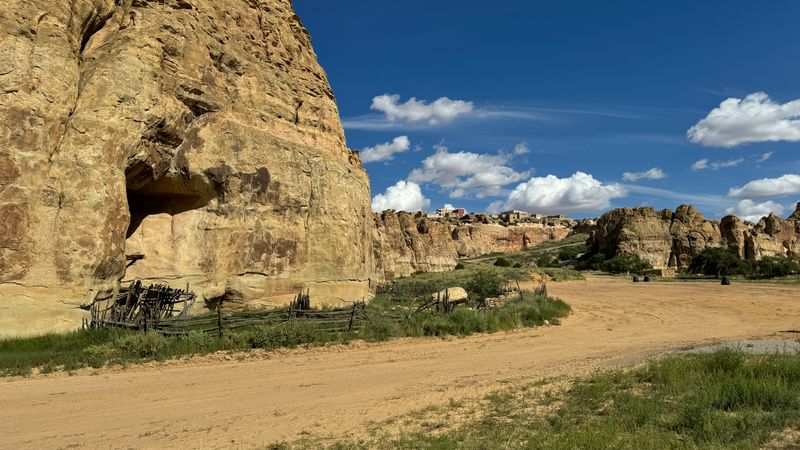
Stand on the mesa as the horizon unbuttons itself in thin orange bands. The air is cold enough to sting, and the adobe breathes a slow warmth, the way bread still holds heat after it leaves the oven.
Ravens make a bracket of sound, their wingbeats crisp in the thin air, and you notice how the ladders lean like quiet exclamation points.
Imagine walking the east edge, stones underfoot polished by generations, each scuff a footnote to a life. A guide points to a wall seam where straw glints in the plaster, and you realize repair is a ritual, not a chore.
The light moves fast here, flipping from pewter to honey in a minute, teaching you to pay attention.
Down below, Highway 40 hums softly, a reminder that modern time runs differently. Up here, morning is negotiated with the wind.
You tuck your hands in your jacket, look past the cistern and the kiva ladders, and feel the day open like a door you have been invited to notice, but not to own.
The Ladders and the Doorways
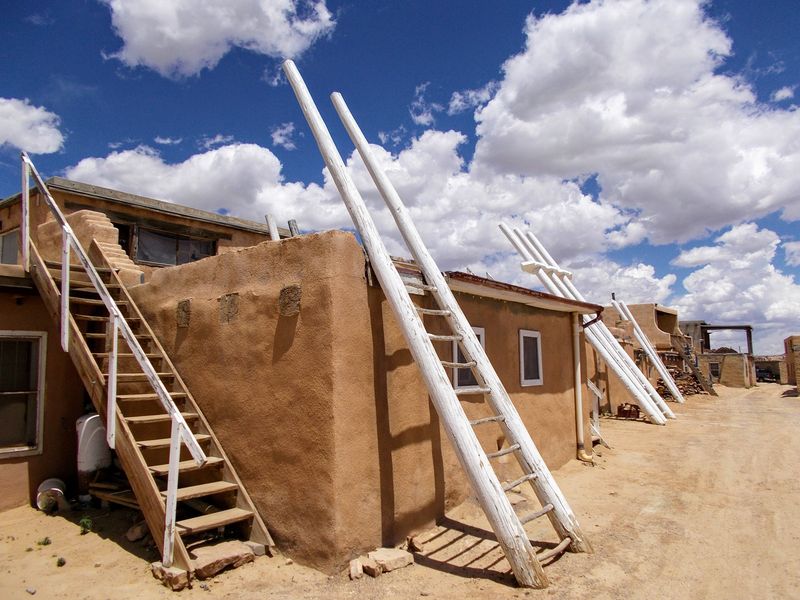
The ladders look simple until you study the hand-carved notches, each one a small decision. They lean into the sky, bypassing ground-level doors that were never meant for guests.
Roof entries double as defense and design, a quiet blueprint for resilience that still feels modern in its minimalism.
Walk closer and the doorway lintels carry smoke ghosts, a shadowy script of meals and winters and stories. You see turquoise paint peeled thin as mica, and a door knocker polished where hands always land.
The thickness of the walls surprises you when a guide taps them, drum-deep, and sound returns with a patient echo.
Imagine lifting a clay pot up a ladder rung by rung, calves burning, balance steady. It teaches you to measure effort in breaths, not steps.
These architectural choices are not quaint details but instructions on living together in tight quarters, accounting for wind, sun, and the watchfulness a mesa requires when the horizon is your front yard.
Clay That Remembers Water
You hear the whisper first, the slide of damp clay against palm. A potter builds coils that rise like a story, steady and unhurried.
The white slip flashes under sunlight, a matte moon waiting for its constellation of black and orange lines.
Patterns are not decoration here, they are maps. Step wedges, rain lines, cloud terraces, each mark a memory of weather and walking.
At one table, a shard from an earlier firing waits like a trusted tool, used to burnish until the surface holds the sky in a soft reflection.
When the fire comes, it smells like cedar and dry weeds, sharp and sweet. You stand back, feel heat brush your shins, and picture finishing a hike then cupping warm bread.
The pot cools to a dull hush, and suddenly it looks inevitable, as if the mesa had been hiding this curve inside itself the whole time and just needed patient hands to let it out.
Wind, Water, and Stone: How the Mesa Works
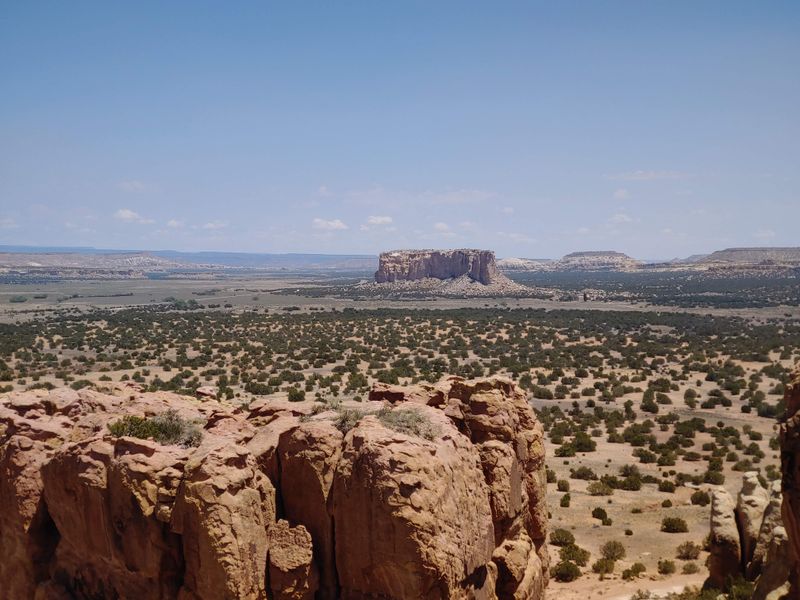
The mesa is a teacher with a firm syllabus: wind, water, stone. Sandstone cliffs hold their own archive, layered in rust and cream, each stripe a quiet timestamp.
When gusts arrive, dust lifts in lace, and you taste gypsum on your tongue, dry and mineral-sweet.
Guides talk about catchments that turn brief rains into survival math. Ciserns, channels, and patience make a city possible in the sky.
You notice where lichens grip the rock like ideas that refuse to slip, and where footpaths take the lee side because wind writes its own rules here.
There is data behind the poetry. The region averages scant inches of rain each year, and every drop is choreographed.
Standing at the rim, you understand why homes face the way they do, why windows are small, and why a ladder’s angle matters. The mesa does not forgive wishful thinking, but it rewards attention with a view that keeps unfolding, long after you think you have seen it all.
Walking Tours That Slow Time
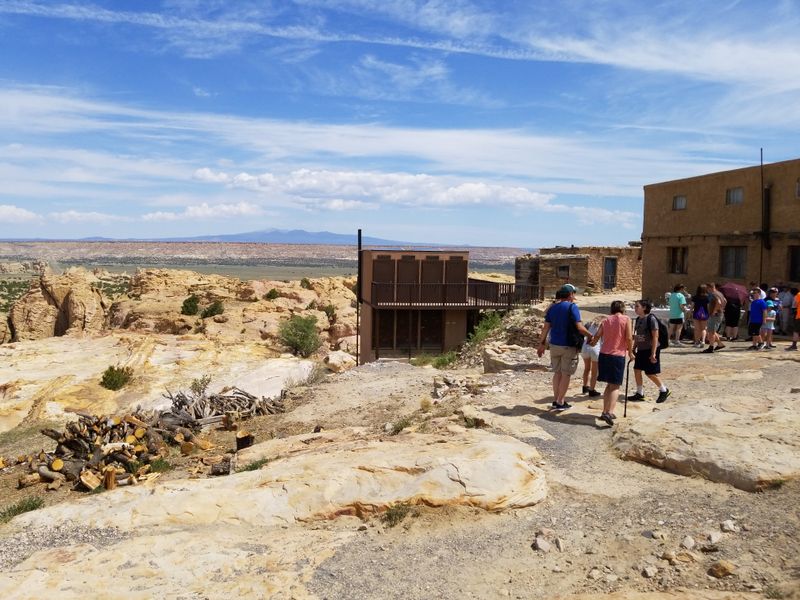
A walking tour starts as logistics and becomes calibration. Feet find the cadence of packed-earth streets, and the guide’s voice threads in and out of the wind.
You stop often, not for spectacle, but for scale, learning how a city fits on a cliff without feeling crowded.
There is etiquette, and it matters. No photos in sacred areas, no audio without consent, no drones at all.
You tuck your camera away and the day sharpens, colors suddenly less performative and more true, like noticing the quiet hiss of a kettle once the radio is off.
Practical notes help: buy bread early, carry cash for crafts, check seasonal access since ceremonies shape the calendar. The tour does not end at the parking lot.
It lingers when you taste oven bread warm enough to steam in the chilly air, and it lingers later, when a ladder flashes in your memory while you climb your own apartment stairs at home, suddenly aware of how architecture teaches behavior.
Acomita, Anzac, and McCartys: Life Beyond the Mesa
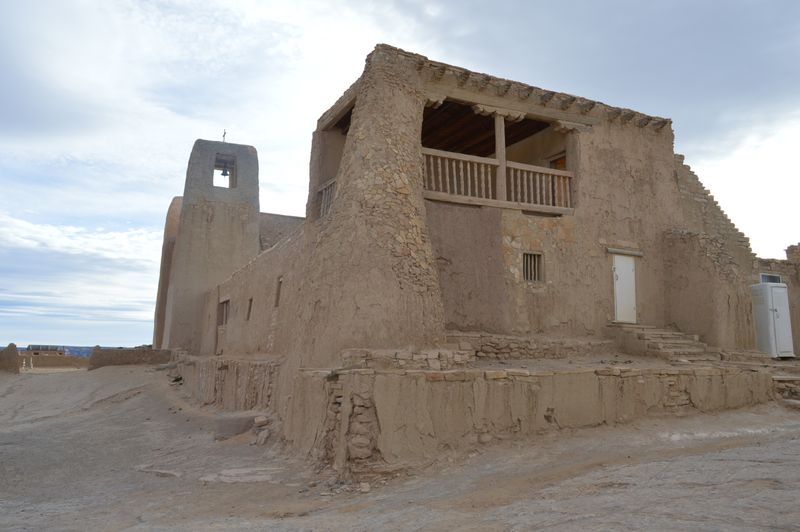
Leave Sky City and the road unspools through Acomita, Anzac, and McCartys, where daily life hums closer to ground level. School buses, basketball hoops, a pickup idling at the mini mart, all framed by the same horizon line that crowns the mesa.
The rhythm is weeknights and weekends, not festival days.
At McCartys, the lava field reads as both obstacle and archive, a black river frozen mid-breath. Railroad tracks rim its edge, metal singing when a freight passes.
You catch the smell of creosote after a brief sprinkle, that clean, peppery note that makes the desert feel awake.
Conversations turn practical: water systems, roadwork, broadband that finally cooperates on windy days. Culture does not disappear when ceremonies end, it moves through errands and repairs.
If you want to understand Acoma, look here too, where the ordinary keeps the extraordinary upright, where a fenced yard holds a hopi-tailed dog, and the kitchen window frames the mesa like a family portrait.
Respect, Access, and What To Know Now
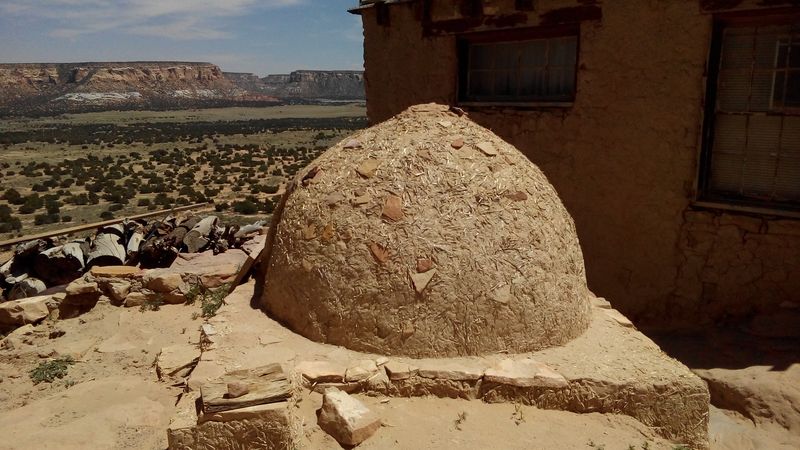
Start at the visitor center, because context is a key that actually fits the door. Hours shift with seasons and ceremonies, and access to Sky City can pause, so check updates before you drive.
Buy permits where required, ask questions, and let the staff set the tempo.
Photography rules are clear. Some places are not for your lens, even if they are for your eyes.
It feels like a limit until you realize limits make attention sharper and memory honest. Keep cash for food and art, and plan for high-desert sun: hat, water, layers.
Recent attention has increased foot traffic, which brings opportunity and pressure. Choose small-group tours, avoid blocking doorways, and park where directed.
You are a guest on a living mesa, not a museum set. Leave with purchases that pay artists directly, and leave without footprints outside the marked paths.
The reward is simple: a story you can tell without apology, anchored in respect.



