 Unearth The Voyage
Deep beneath the waves of the Pacific Ocean, a powerful force is stirring that has scientists watching more closely than ever before. While news headlines often focus on international tensions with Russia or China, there’s a different kind of threat lurking far off the Oregon coast: a massive underwater volcano called Axial Seamount.
This isn’t science fiction or distant speculation; it’s a real, closely monitored volcano that erupts regularly and could teach us vital lessons about how our planet works beneath the sea.
This volcano is real, active, and unusually well-monitored
When you hear about a volcano threatening America, you might think someone made it up for a scary movie. But Axial Seamount is absolutely real and sits on the ocean floor in the Northeast Pacific.
Scientists have labeled it the most active submarine volcano in that entire region, and it’s not some mysterious blob on an old explorer’s map.
What makes Axial special is how much attention it gets from researchers. Teams of scientists have installed high-tech equipment all around it, watching every move it makes.
They track earthquakes, measure how the seafloor rises and falls, and monitor temperature changes in the water above.
Unlike many volcanoes around the world that surprise us when they erupt, Axial is under constant surveillance. This monitoring system gives researchers a front-row seat to volcanic activity as it happens.
Every tremor, every bubble of hot water, every shift in the ground gets recorded and studied.
The data collected from Axial helps scientists understand not just this one volcano, but how underwater volcanoes everywhere might behave. That knowledge could one day help protect coastal communities from volcanic hazards we don’t yet fully understand.
It’s not near the beach; it’s far offshore
If you’re picturing a volcano just off the coast where surfers catch waves, think again. Axial Seamount sits roughly 300 miles (about 480 kilometers) west of Oregon, way out in the open Pacific.
That’s farther than driving from Portland to San Francisco.
The volcano’s remote location is actually good news for anyone living along the West Coast. Distance acts like a natural safety buffer between the erupting volcano and populated areas.
Even if Axial has a major eruption, the effects have a long way to travel before reaching land.
Axial formed along the Juan de Fuca Ridge, a zone where tectonic plates are slowly pulling apart. This undersea mountain range is part of the larger system that shapes the Pacific Northwest’s geology.
The ridge creates new ocean floor as magma rises from deep inside Earth.
Being so far offshore also means that studying Axial requires special equipment and ships. Scientists can’t just walk up to it or drive there.
They need submarines, underwater robots, and sophisticated sensors that can withstand crushing ocean pressure and total darkness to gather information about this distant volcanic giant.
It’s deep underwater; more than a kilometer below the surface
Picture standing on top of the Empire State Building three times over, then diving down that far into the ocean. That’s roughly how deep Axial Seamount’s summit sits beneath the waves.
The top of this underwater mountain rests about 1.4 kilometers (nearly a mile) below the surface.
At that depth, the ocean environment is completely different from what we experience on land. The pressure is crushing, the water is near freezing, and absolutely no sunlight penetrates the darkness.
These extreme conditions dramatically change how volcanic eruptions behave compared to volcanoes we see on land.
When lava erupts at this depth, the immense water pressure affects how gases escape and how the molten rock flows. Instead of explosive blasts that throw ash miles into the sky, deep underwater eruptions tend to be quieter affairs.
The lava often forms pillow-shaped blobs as it cools instantly upon contact with frigid seawater.
This depth also means that gases dissolved in the magma behave differently. On land, expanding gases drive explosive eruptions.
Underwater, the pressure keeps gases more contained. Understanding these differences helps scientists predict what might happen during Axial’s next eruption and whether coastal communities need to worry.
It has a recent track record of eruptions: 1998, 2011, 2015
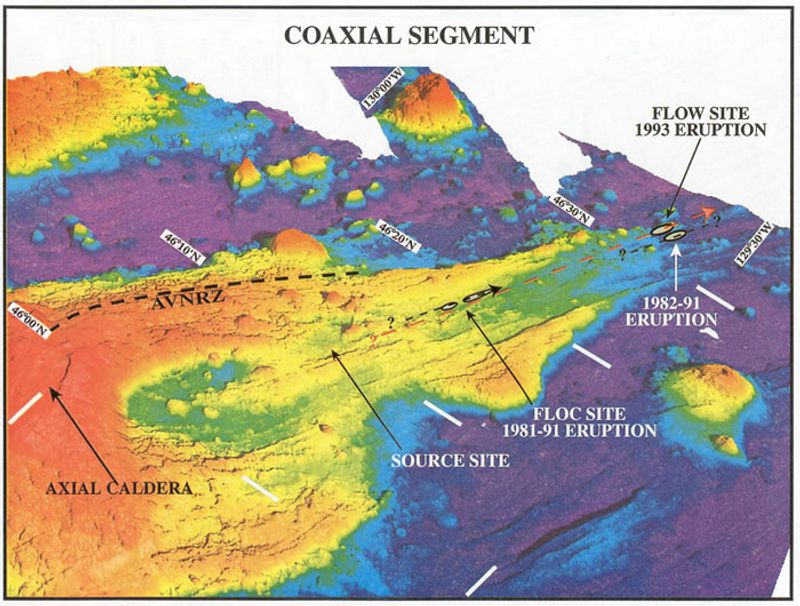
Axial Seamount isn’t just theoretically active; it has erupted three times in recent memory. Scientists documented eruptions in 1998, 2011, and 2015, giving researchers a valuable pattern to study.
Each eruption provided clues about how the volcano behaves between events.
What’s fascinating about these three eruptions is how they helped scientists recognize a predictable cycle. After each eruption, the volcano enters a recharging phase where magma slowly accumulates in chambers beneath the seafloor.
The time between eruptions has been getting shorter, suggesting the volcano might be entering a more active period.
The 1998 eruption was discovered after the fact, when scientists noticed changes during routine monitoring. By 2011, instruments were better positioned, and researchers caught that eruption as it happened.
The 2015 eruption was even more exciting because some scientists had actually predicted it would occur that year based on monitoring data.
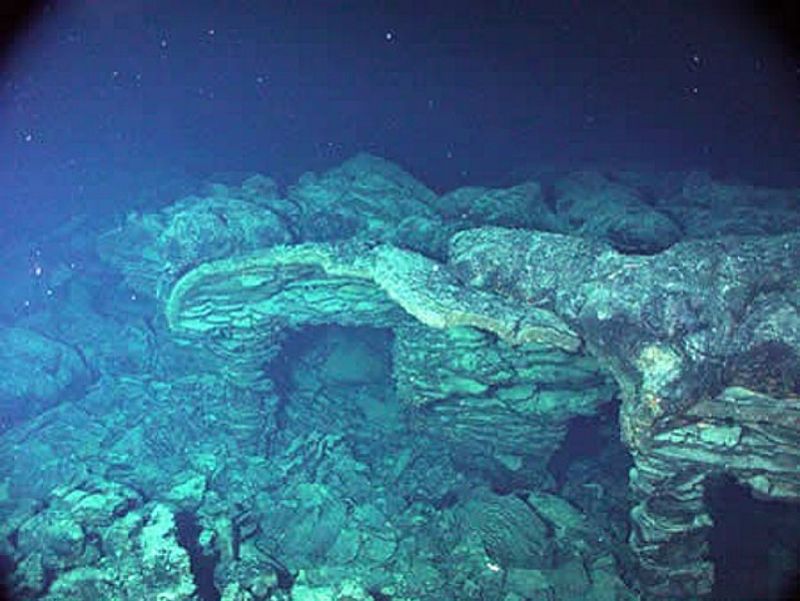
Each eruption taught volcanologists something new about forecasting underwater volcanic activity. The patterns observed at Axial, including how fast the seafloor inflates and how earthquake activity changes, are now used as models for understanding other submarine volcanoes around the world that aren’t as well monitored.
Its eruptions are typically lava flows, not Hollywood explosions
Forget everything you’ve seen in disaster movies about volcanoes. Axial Seamount doesn’t produce towering mushroom clouds of ash or fiery explosions that light up the sky.
Instead, its eruptions are what scientists call effusive, meaning lava flows relatively calmly through cracks in the seafloor.
Picture thick, glowing orange rivers of molten rock oozing along the ocean bottom rather than violently blasting into the air. This gentler style of eruption is typical for underwater volcanoes at great depth.
The enormous pressure from all that water overhead keeps gases from expanding violently.
When cracks open in Axial’s summit, magma squeezes through and spreads across the seafloor. The lava cools quickly when it touches cold seawater, forming new rock that builds up the volcano bit by bit.
Sometimes these flows can extend for several kilometers, creating new underwater landscapes.
This effusive eruption style is one major reason why scientists often assess the direct danger to coastal populations as low. There’s no ash cloud to disrupt air travel, no pyroclastic flows racing toward towns, and no volcanic bombs raining down.
The action stays contained on the deep seafloor, far from human communities.
The big tell scientists watch is seafloor swelling (inflation)
Blowing air into a balloon and watching it slowly expand. is similar to what happens at Axial Seamount as magma accumulates beneath the seafloor. Scientists call this process inflation, and it’s one of the most reliable warning signs that an eruption might be coming.
As magma rises from deep inside Earth and collects in underground chambers, it pushes the rock above it upward. The seafloor literally rises, sometimes by several meters over the course of months or years.
Sensitive instruments anchored to the ocean floor can detect these tiny changes with remarkable precision.
Past eruptions at Axial followed a clear pattern: inflation speeds up as more magma accumulates, seismic activity increases as the rock cracks under pressure, then suddenly the system erupts and the seafloor drops back down (deflation) as magma escapes. It’s like the volcano takes a deep breath, holds it, then exhales.
Measuring this inflation gives scientists their best tool for forecasting when the next eruption might occur. By tracking how fast the seafloor rises and comparing it to patterns before previous eruptions, researchers can estimate windows of time when Axial is most likely to erupt again.
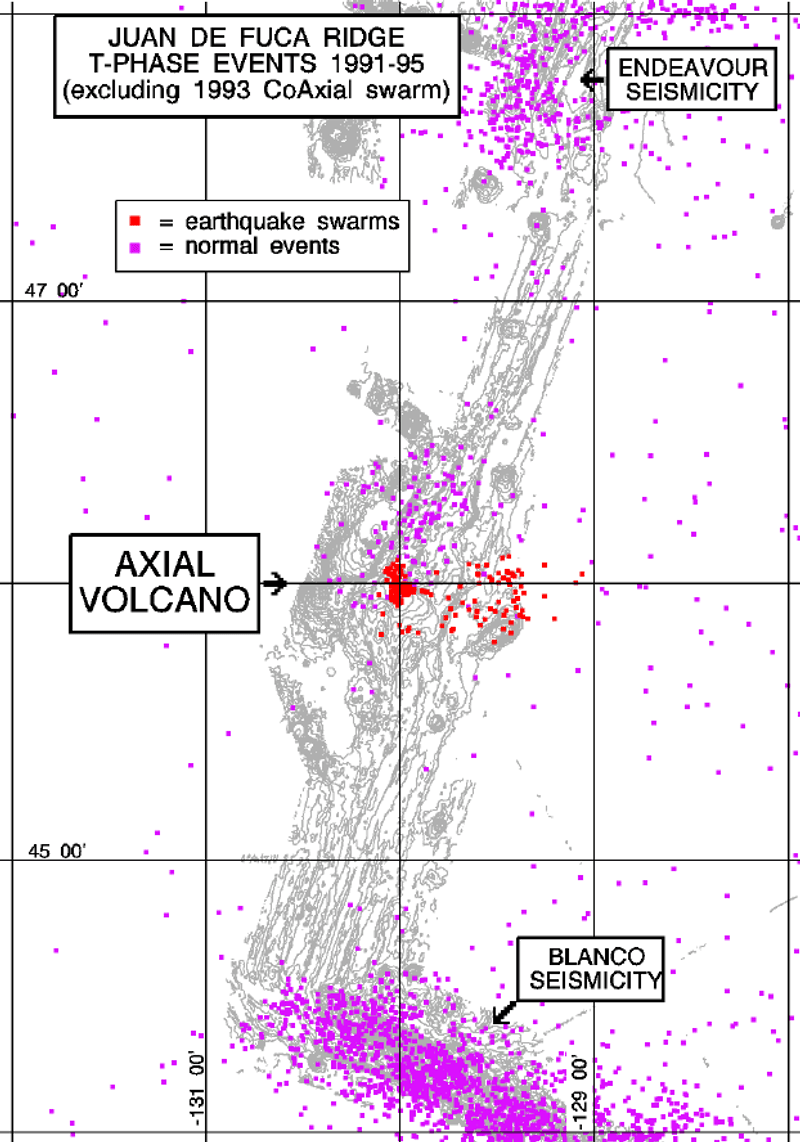
Earthquake swarms can spike as the system pressurizes
As magma pushes its way through solid rock beneath Axial Seamount, something dramatic happens: the rock breaks. Each tiny fracture generates an earthquake, and as pressure builds, these earthquakes can come in rapid-fire sequences called swarms.
Hundreds or even thousands of small quakes might occur in just a few days.
Most of these earthquakes are too small for people on land to feel, but sensitive seismometers on the seafloor detect every rumble. Scientists study these earthquake patterns like doctors listening to a heartbeat, looking for changes that signal the volcano is getting ready to erupt.
An increase in earthquake frequency and intensity often means magma is on the move.
These seismic swarms provide one of the most useful countdown-style indicators for predicting eruptions. When earthquakes suddenly spike at Axial, researchers know the volcano is entering a critical phase.
However, earthquake activity alone isn’t a perfect clock; sometimes swarms occur without an immediate eruption following.
The earthquakes also help scientists map where magma is moving underground. By analyzing where quakes occur and how seismic waves travel through rock, researchers can create three-dimensional pictures of the magma plumbing system.
This information is crucial for understanding not just when Axial might erupt, but how.
Forecasts exist, but they’re still forecasts, not promises
Predicting when a volcano will erupt sounds like something from a crystal ball, but scientists have gotten surprisingly good at it for Axial Seamount. Researchers have published forecasts suggesting eruption windows, and these predictions have come impressively close to reality.
Still, volcano forecasting isn’t the same as predicting when a train will arrive at the station.
Recent forecasts for Axial’s next eruption have shifted as new data comes in. Initially, some scientists expected an eruption by the end of 2025.
However, as monitoring continued and inflation rates were recalculated, those windows moved toward mid-to-late 2026 or even beyond.
Why do forecasts change? Volcanoes are complex systems influenced by many factors scientists don’t fully understand.
The rate at which magma accumulates can speed up or slow down. Underground pathways can shift.
Small eruptions might relieve pressure without being detected immediately.
Think of volcano forecasts like weather predictions: generally reliable for the near future but less certain the farther out you look. Scientists can say with confidence that Axial will erupt again, probably within the next few years.
Pinpointing the exact month or week remains challenging, even with excellent monitoring. That uncertainty is frustrating but honest.
New research suggests a more complex magma plumbing system
For years, scientists thought of volcano magma chambers as simple underground balloons: magma rises, fills a chamber, pressure builds, eruption happens. Recent peer-reviewed research on Axial Seamount reveals the reality is far more complicated.
The volcano is fed by multiple magma reservoirs and pathways, not just one simple chamber.
Imagine plumbing in a large building with pipes branching in different directions, some large and some small, carrying water to various floors. Axial’s magma system works similarly.
Molten rock rises from deep within Earth through focused channels, collects in different storage areas at different depths, then moves through a network of pathways before erupting.
This complexity helps explain why volcano prediction remains difficult even with excellent monitoring. Magma might accumulate in one reservoir while another stays dormant.
Pathways might open or close depending on pressure and rock properties. Small batches of magma might erupt without emptying the entire system.
The detailed mapping of Axial’s plumbing system came from analyzing earthquake locations, studying how seismic waves travel through different rock types, and modeling how the seafloor deforms. Each piece of evidence added detail to the picture.
This research represents a major step forward in understanding not just Axial, but how submarine volcanoes worldwide operate beneath our oceans.
Could it cause a tsunami? Usually: low odds, limited impact
Whenever people hear about underwater volcanic activity, one question immediately jumps to mind: could it trigger a tsunami? For Axial Seamount, scientists who have studied the situation carefully emphasize that the likelihood of a damaging tsunami reaching the West Coast is low.
That doesn’t mean zero, but it’s not something coastal residents should lose sleep over.
Tsunamis from underwater volcanoes typically require massive, sudden displacement of water. This can happen if a huge chunk of the volcano collapses in a landslide or if an explosive eruption occurs in shallow water.
Axial’s eruption style (slow lava flows) and great depth (1.4 kilometers down) work against generating significant tsunamis.
The water pressure at Axial’s depth dampens explosive activity, and lava flows don’t suddenly shove huge volumes of water aside. Even if a landslide occurred on Axial’s slopes, the energy would dissipate over the 300 miles to shore.
By comparison, the major tsunami sources for the Pacific Northwest are massive earthquakes along offshore fault zones, not volcanic eruptions.
Scientists continuously reassess tsunami risk as they learn more about Axial. Current assessments suggest that while monitoring continues, the volcano poses far less tsunami danger than earthquake-generated waves from places like the Cascadia Subduction Zone.
The biggest immediate impacts are likely underwater on ecosystems and chemistry
Just because humans aren’t directly threatened doesn’t mean Axial’s eruptions don’t matter. The most dramatic impacts happen right on the seafloor, where entire underwater ecosystems experience sudden, extreme changes.
Imagine your neighborhood going from comfortable room temperature to boiling hot in minutes; that’s what happens to creatures living near erupting vents.
When lava flows across the ocean floor, it can obliterate communities of tube worms, clams, crabs, and microbes that thrive around hydrothermal vents. These organisms depend on chemicals in the hot water seeping from the seafloor.
An eruption can destroy established vent communities instantly, but it also creates opportunities for new life to colonize fresh volcanic rock.
Eruptions also dramatically alter water chemistry in the immediate area. Hot magma heats seawater, releasing dissolved minerals and gases.
The water becomes more acidic, oxygen levels can drop, and toxic metals might spike temporarily. Fish and other mobile animals usually swim away from these danger zones, but slower creatures may not escape in time.
Interestingly, scientists study these impacts to understand how life recovers after catastrophic events. Within months or years, new vent communities establish themselves, offering a remarkable window into ecological resilience.
Axial provides a natural laboratory for studying these processes in real time.
Axial is a science gift: a safer place to learn how volcanoes work
Most active volcanoes sit dangerously close to cities and towns, making them difficult to study without putting people at risk. Axial Seamount offers scientists something rare and valuable: a highly active volcano far from any population where they can learn without worrying about evacuations or casualties.
It’s like having a natural laboratory that runs experiments on its own schedule.
Every measurement taken at Axial helps volcanologists refine their understanding of how volcanoes behave. The patterns observed, including inflation rates, earthquake sequences, and eruption timing, become templates for interpreting data from more dangerous volcanoes.
Techniques developed for monitoring Axial can be adapted for volcanoes near cities in places like Indonesia, Japan, or the Philippines.
Because Axial erupts relatively frequently and predictably, scientists get multiple chances to test their forecasting methods. Each eruption is like taking a quiz: did the predictions match reality?
What signals were missed? What worked better than expected?
This feedback loop steadily improves volcano science.
The knowledge gained from Axial could one day save lives when applied to more threatening volcanoes. Understanding how magma moves, how eruption precursors develop, and how underwater systems differ from land volcanoes all contribute to better hazard assessment worldwide.
Axial’s gift to science extends far beyond the Pacific Ocean floor.
Real-time ocean-floor infrastructure makes this possible
Studying a volcano more than a kilometer underwater sounds nearly impossible, but Axial Seamount benefits from some of the most advanced monitoring infrastructure in the world. A network of cables and sensors on the seafloor provides near-real-time data streams, something extremely rare in volcanology and almost unheard of for underwater volcanoes.
The Regional Cabled Array, part of the Ocean Observatories Initiative, connects Axial to shore through fiber-optic cables. These cables carry power to instruments on the seafloor and transmit data back to researchers continuously.
Seismometers detect earthquakes, pressure sensors measure seafloor movement, and cameras might even capture images of eruptions as they happen.
Before this infrastructure existed, scientists relied on occasional ship visits to download data from instruments or deploy new equipment. Sometimes eruptions happened between visits and were only discovered months later.
Real-time monitoring changes everything, allowing researchers to watch volcanic activity unfold minute by minute.
This level of observation is why Axial gets so much scientific attention despite being far from land. The data quality and quantity are exceptional.
Other submarine volcanoes exist around the world, but few have this kind of instrumentation. Axial’s monitoring system represents a huge investment in understanding how our planet works beneath the waves, yielding insights impossible to gain any other way.
The smartest public response is calm attention, not fear
If you live anywhere along the U.S. West Coast, reading about an active volcano in the Pacific might feel alarming at first.
Should you prepare an evacuation plan? Stock up on emergency supplies?
Book a flight to the other side of the country?
The answer is a calm and definitive no.
The practical reality is that Axial Seamount poses minimal direct threat to coastal communities. Its distance offshore (300 miles), depth underwater (1.4 kilometers), and eruption style (effusive lava flows) all combine to keep the danger contained to the deep seafloor.
Scientists with decades of experience studying this volcano consistently emphasize that panic is unwarranted.
What makes sense is informed awareness. Follow updates from credible sources like the NOAA, USGS, or university research teams when major monitoring milestones occur.
Understand that eruption forecasts come with uncertainty and might shift as new data arrives. Recognize that distance, depth, and eruption style all shape what actual risk exists.
The bigger picture is that Axial offers an opportunity to learn about our dynamic planet without facing immediate danger. It’s a reminder that Earth is constantly changing beneath our feet and beneath the waves.
Rather than fearing this natural process, we can appreciate the scientific insights it provides while staying rationally informed about any genuine risks.



