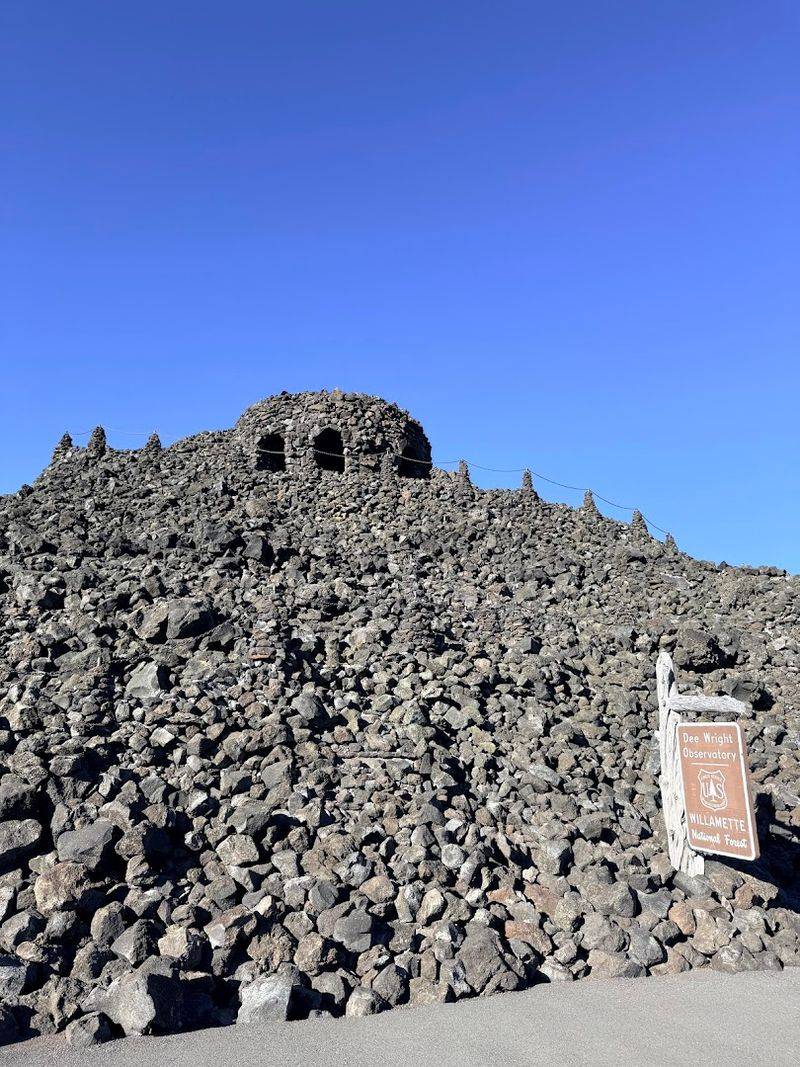
There is a spot in the Oregon Cascades where you stand on a vast field of black lava rock, surrounded by distant mountain peaks, and feel like you have stepped onto another planet. The structure at the center of it all looks like something out of a medieval storybook, built entirely from volcanic stone by hand nearly a century ago.
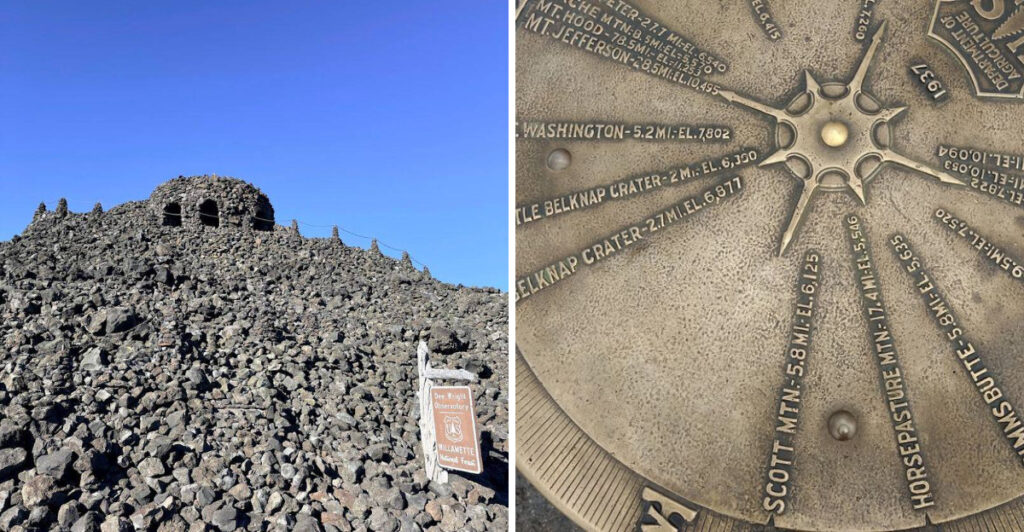
A brass compass sits at the top, pointing toward every major peak on the horizon, and narrow windows frame each summit like a painting. This place draws visitors from across the Pacific Northwest and beyond, and once you see it for yourself, you will completely understand why people keep coming back.
Where to Find This Volcanic Marvel
The address that puts you at one of Oregon’s most striking roadside destinations is McKenzie Hwy, Blue River, OR 97413, right along Highway 242 in the Willamette National Forest.
Getting there is part of the adventure. The road is narrow and winding in several stretches, cutting through the Deschutes National Forest before opening up to reveal a surreal landscape of black lava rock that seems to stretch forever.
The drive from the town of Sisters to the west is probably the most scenic approach, and the freshly paved sections near the parking lot make the final stretch feel welcoming after all those curves.
No tickets are required to visit, and parking is generally easy to find even on busier days. The site is open 24 hours a day, every day of the week, which makes it a flexible stop whether you are on a road trip or a dedicated day hike.
Cell service disappears well before you arrive, so download your maps ahead of time. The phone number for general information is 1-800-832-1355, and the official website through the US Forest Service has current road closure updates worth checking before you go.
The Story Behind the Stone Tower
Built in the early 1930s by the Civilian Conservation Corps, the observatory was named after Dee Wright, a packer and guide who spent much of his life leading expeditions through the Oregon Cascades.
Wright passed away during the construction of the road through this area, and the structure was dedicated in his honor as a tribute to his deep connection with this rugged landscape.
The building itself was constructed entirely from the lava rock that surrounds it on all sides, which is why it blends so naturally into the environment. Every stone was placed by hand, and the craftsmanship that went into the walls, archways, and stairways is genuinely impressive up close.
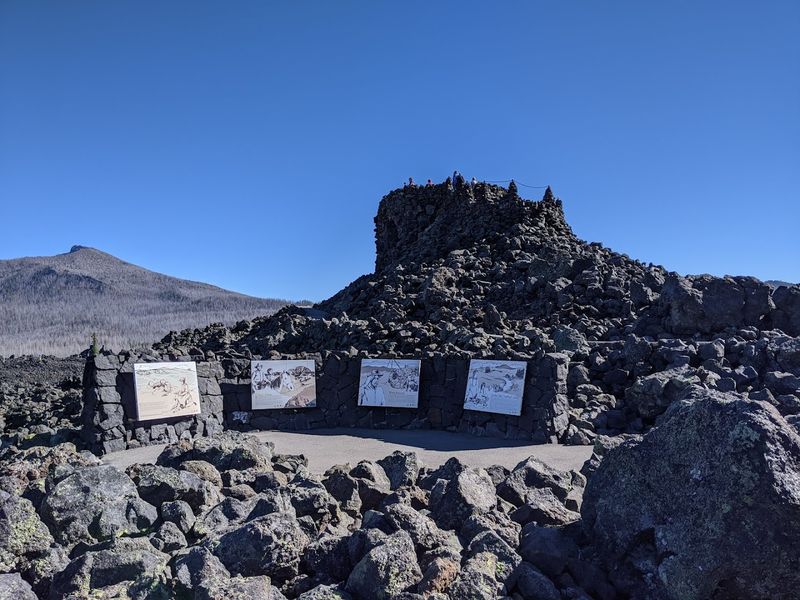
Informative signs posted around the site tell Wright’s story in detail, and reading them while standing in the middle of a lava field gives the whole experience a grounded, human quality that many historic landmarks lack.
The building has been compared to a castle or even a fort, and that comparison holds up the moment you see it rising from the black rock. It is one of the most thoughtfully constructed small buildings you will find anywhere in the Pacific Northwest.
The Castle-Like Architecture Up Close
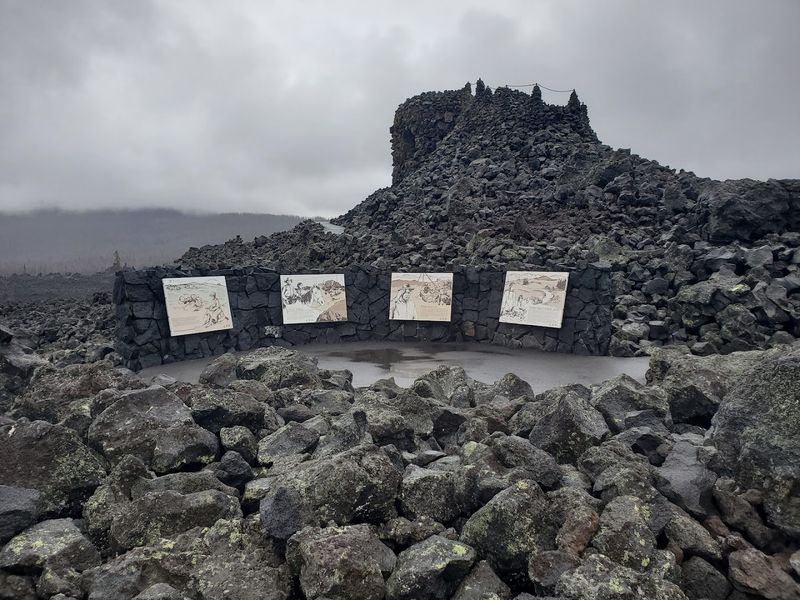
One reviewer described the building as looking like Castle Grayskull, and honestly, that description is not far off. The dark volcanic stone, the crenellated roofline, and the thick walls give it a fortress quality that feels both ancient and deliberate.
Every surface of the structure was built from the same black lava rock that blankets the surrounding landscape, which creates a seamless visual connection between the building and its environment.
The archways are low and wide, the walls are thick enough to block the wind, and the stairways leading to the top platform are worn smooth from decades of foot traffic.
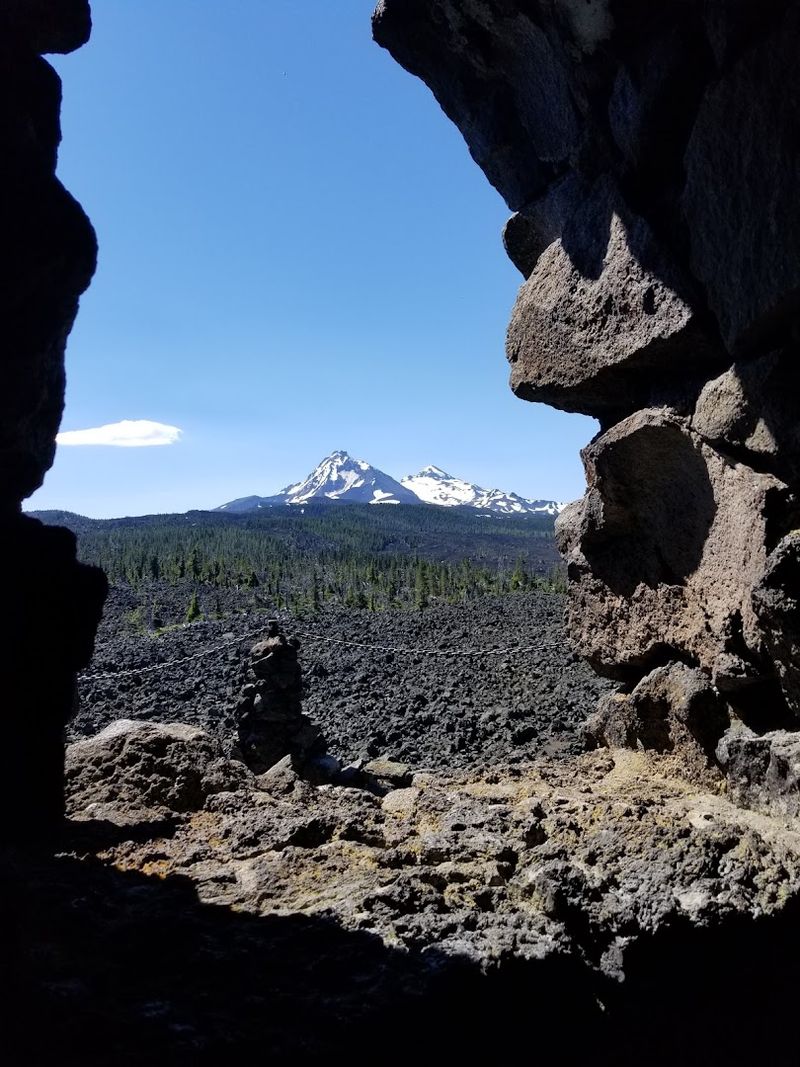
Small tunnels and slots were carved directly into the walls during construction, each one aligned to point toward a specific mountain peak or volcanic feature visible from the site. This was not an accident but a deliberate design choice that makes the building both functional and fascinating.
The craftsmanship feels almost out of place for a remote mountain outpost, and yet it fits perfectly. Standing next to the walls and running your hand along the rough stone, you get a real sense of just how much effort and intention went into every single detail of this structure.
The Brass Compass at the Summit
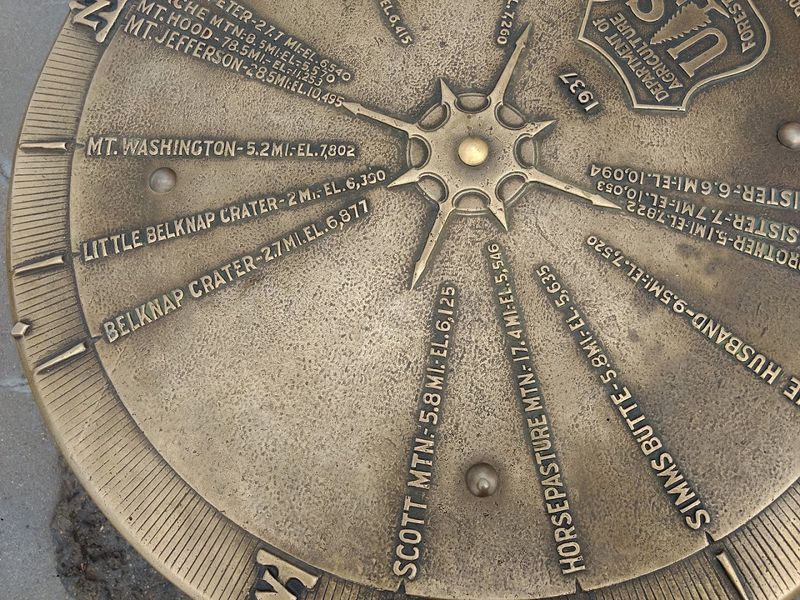
The brass compass mounted on the roof of the observatory is one of those details that genuinely surprises first-time visitors. Most people expect a nice view from the top, but the compass adds a whole layer of interactivity that turns a simple overlook into something much more engaging.
Each directional marker on the brass plate corresponds to a specific volcanic peak or mountain range visible from that exact spot, so you can stand at the summit and identify exactly what you are looking at in every direction.
On a clear day, the list of visible peaks is remarkable. Mount Washington, Three Fingered Jack, Mount Jefferson, and the Three Sisters are all within view, and the compass helps you put a name to every one of them.
The plate itself is worn in places, showing its age, but the engravings remain readable and the overall experience of using it feels genuinely old-school in the best way.
Bring a camera with a good zoom lens if you have one, because the peaks on the horizon look stunning when captured from the top platform with the brass compass in the foreground. It is the kind of shot that earns serious attention on any travel photography page.
360-Degree Mountain Views That Deliver
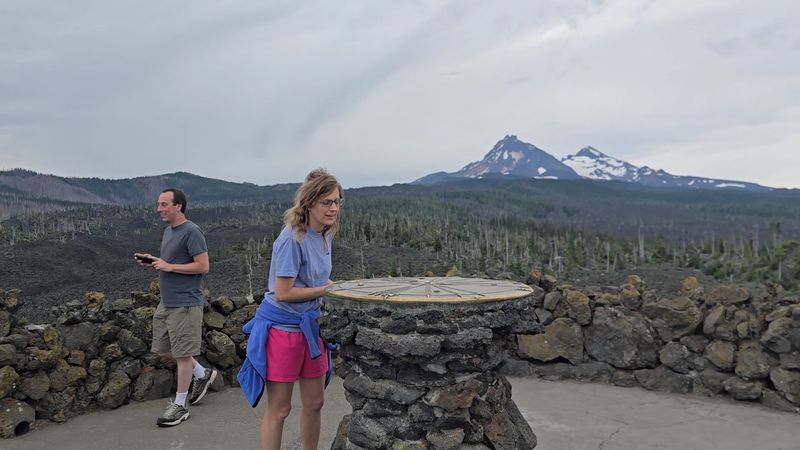
Few viewpoints in Oregon offer the kind of unobstructed, all-direction panorama that you get from the top of this observatory. The surrounding landscape is flat enough that nothing blocks the horizon, and the mountains rise dramatically from the lava fields in every direction.
Mount Washington stands out as particularly striking from this vantage point, its jagged summit clearly visible to the north. The Three Sisters and Broken Top fill the southern view, while Mount Jefferson sits further in the distance on clear days.
The absence of tall trees in the immediate area, partly due to the lava fields and partly due to recent wildfires, actually enhances the views rather than diminishing them. The open sky above the black rock creates a dramatic contrast that photographs beautifully and looks even better in person.
Visitors who arrive at sunrise or sunset report that the lighting transforms the entire scene, turning the dark lava fields into something that glows orange and gold at the edges.
Even on slightly cloudy days, the views hold up well. The clouds tend to sit above the peaks rather than obscuring them entirely, and the shifting light across the lava fields creates a constantly changing visual experience that keeps you on the platform longer than you planned.
The Lava Field Loop Trail
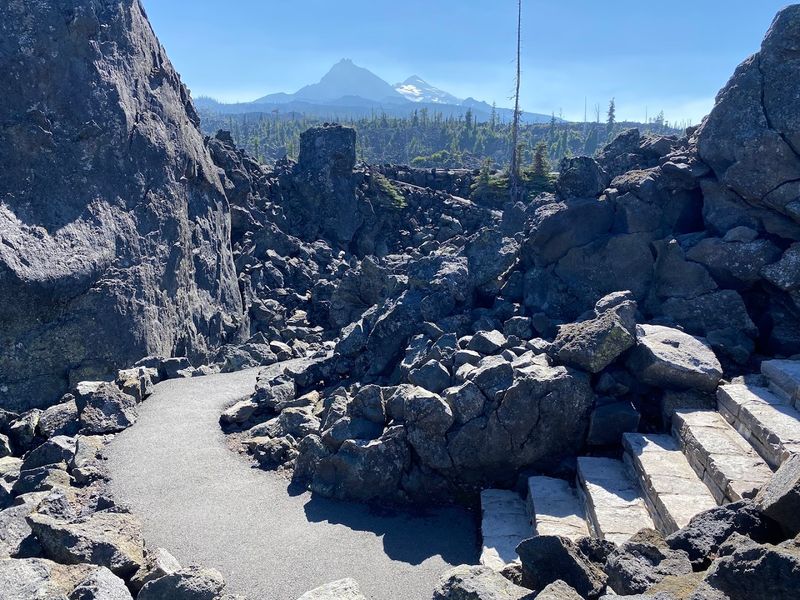
The paved interpretive trail that loops through the lava fields around the observatory is one of the best short hikes in Central Oregon for people who want big geological payoff without a big physical commitment.
The total loop is under two miles, and the paved surface makes it accessible for most visitors, though a few uneven sections near the lava formations require some careful footing. It is not ADA compliant throughout, so keep that in mind if mobility is a concern.
Interpretive signs placed along the trail explain the geological history of the area in plain, readable language. The lava fields were created thousands of years ago when Belknap Crater erupted and sent flows of molten rock spreading across the landscape, and the signs help you trace exactly how that process unfolded.
One of the most visually striking features along the trail is the small islands of trees and shrubs that survived the ancient lava flow by sitting on slightly elevated ground. These pockets of green surrounded by black rock tell a quiet story about how slowly vegetation reclaims volcanic terrain.
Dogs are welcome on the trail, which makes it a popular choice for visitors traveling with pets. The loop is short enough to complete before the afternoon wind picks up, which is a real consideration up here.
Stargazing and Night Sky Photography
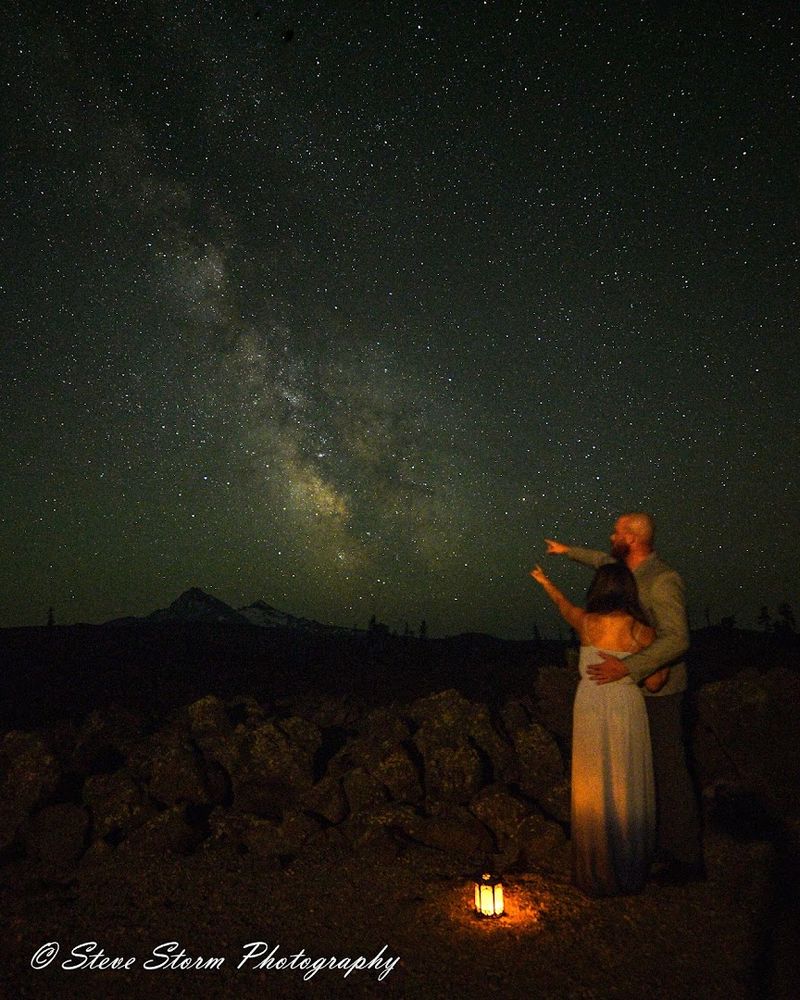
The observatory is open 24 hours a day, and the darkness up here after sunset is the kind that city dwellers rarely experience. The elevation, the lack of nearby light pollution, and the open horizon in all directions make this one of the best casual stargazing spots in Central Oregon.
Serious astrophotographers make special trips here with telescopes and camera rigs, setting up on the flat lava rock and spending the night capturing the Milky Way and individual peaks illuminated by moonlight.
The full moon rising over the volcanic mountains is a particularly dramatic sight from this elevation, and the way the moonlight falls across the black lava field creates textures and shadows that look almost three-dimensional through a camera lens.
Car camping at the observatory is an option some visitors take advantage of, spending the night and catching both the sunset and sunrise views from the same location.
The complete absence of cell service actually enhances the nighttime experience here. There are no distractions, no notifications, just you, the stars, the wind, and the quiet hum of a mountain landscape doing what it has done for thousands of years.
It is the kind of night that resets your perspective in ways that are hard to explain afterward.
Practical Tips for Your Visit
The weather at this elevation changes fast, and the wind at the top of the observatory can be genuinely cold even on days when the valley below feels warm. Layers are not optional here, they are a practical necessity regardless of the season.
The road to the observatory closes for winter, typically around early October, so checking the US Forest Service website before making the trip in fall is a smart move. The gate closure date varies depending on snowfall and road conditions each year.
Restroom facilities at the site have been inconsistent based on recent visits, with bathroom construction underway as of recent reports. Using facilities in Sisters or Blue River before making the drive is a reliable plan.
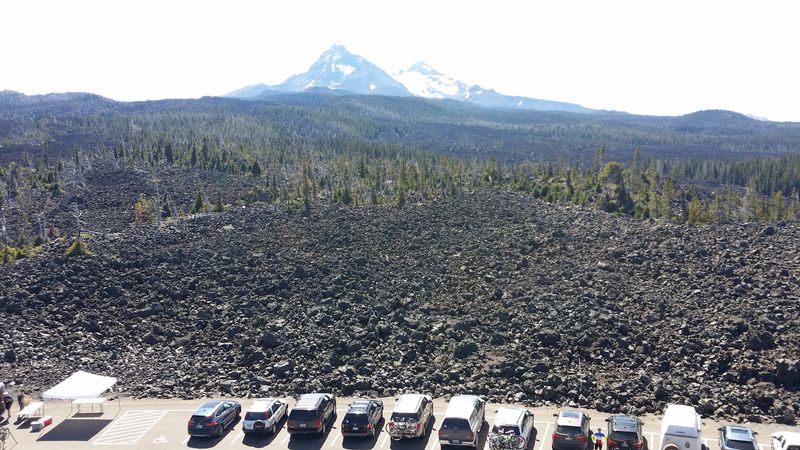
There is no fee to enter and no ticket system, which keeps the experience refreshingly uncomplicated. Parking is free and generally spacious enough to accommodate the number of visitors who show up on typical weekday and weekend visits.
The drive along Highway 242 is worth taking slowly in both directions rather than rushing through. Waterfall pullouts, picnic areas near Clear Lake, and several additional lava viewpoints along the road make the full route feel like a complete day out rather than just a single stop.
Why This Place Stays With You Long After You Leave
There are travel destinations that impress you in the moment and fade quickly once you are back home. This is not one of those places.
The combination of raw geological scale, thoughtful human craftsmanship, and total sensory immersion creates a memory that tends to stick.
Standing on the roof of a hand-built stone tower, using a brass compass to identify mountains that erupted thousands of years ago, while the wind pushes across miles of unbroken lava fields, is genuinely hard to replicate anywhere else in the United States.
Visitors who grew up in states like Oklahoma, far from volcanic landscapes, often describe the experience as their first real encounter with geology on a visible, tangible scale. The lava fields here are not a museum exhibit but the actual, unchanged surface of an ancient eruption sitting right beneath your feet.
The quiet at this elevation has a quality to it that feels earned. You drove a winding mountain road, walked across volcanic rock, climbed a stone tower, and arrived at a view that rewards every bit of that effort.
Oregon has no shortage of beautiful places, but Dee Wright Observatory holds a specific kind of magic that comes from the meeting of human ingenuity and geological power in one small, carefully crafted spot on a mountain pass.
Share this story