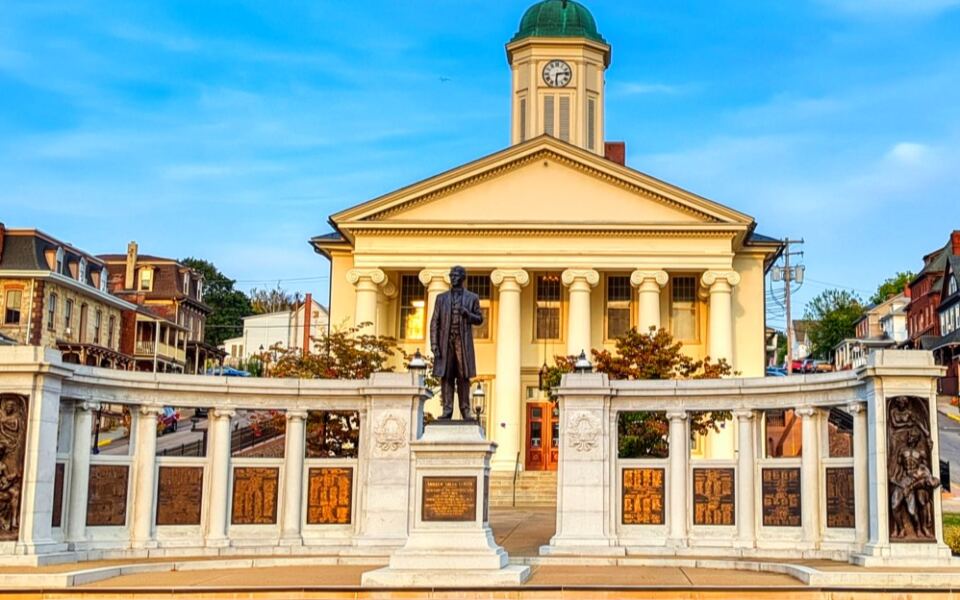
Pennsylvania’s 67 counties are home to courthouses designed to be far more than functional government buildings. Grand domes, clock towers, columns, stained glass, and elaborate stonework turned many county seats into impressive showcases of civic architecture.
These 14 Pennsylvania towns feature courthouses worth making a detour to see. From Victorian towers to historic sandstone landmarks, each preserves a time when public buildings were designed to make a lasting impression.
1. Bedford County Courthouse, Bedford, Pennsylvania
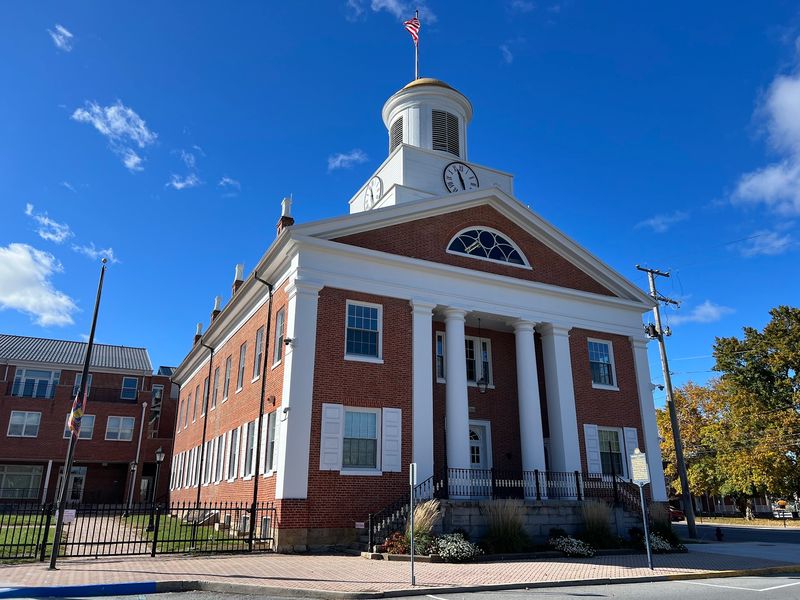
Built by local architect Solomon Filler starting in 1826, the Bedford County Courthouse is one of those rare buildings that has been quietly making history for nearly two centuries without making a fuss about it.
The original structure, completed around 1828 or 1829, was constructed in the Greek Revival style using red brick. Its Courtroom No. 1 has been in continuous use ever since, a detail that Pennsylvania’s judiciary points to with considerable pride.
Some sources call it the oldest courthouse in Pennsylvania still in active use. A modern steel, brick, and glass addition completed in 2007 connects to the original without overwhelming it.
Bedford’s downtown is already a pleasant place to walk, and the courthouse anchors a streetscape full of historic commercial buildings and 19th-century architecture that rewards anyone willing to slow down.
2. Blair County Courthouse, Hollidaysburg, Pennsylvania
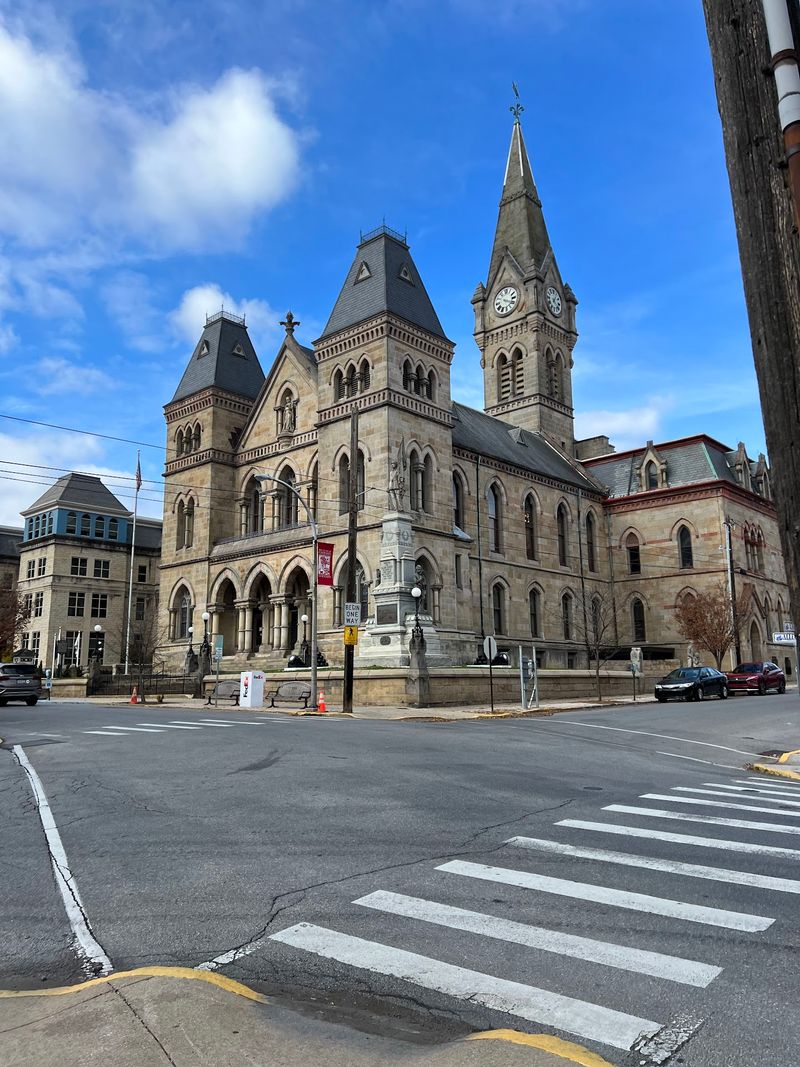
Gothic Revival and a county courthouse might seem like an unlikely combination, but Philadelphia architect David S. Gendell pulled it off in Hollidaysburg with considerable confidence.
Constructed in 1875 and 1876, the Blair County Courthouse is a T-shaped stone building flanked by two square three-story towers with truncated pyramidal roofs. Rising between them is a five-story clock tower topped by a tall stone spire that is visible from a long distance down any of the surrounding streets.
Intricate Gothic details are carved directly into the exterior stonework, giving the facade a texture that rewards a closer look. Inside, historic courtrooms feature stained glass, murals, and elaborate moldings that match the ambition of the exterior.
The building was added to the National Register of Historic Places in 1976 and anchors Hollidaysburg’s recognized historic district with real architectural authority.
3. Bradford County Courthouse, Towanda, Pennsylvania
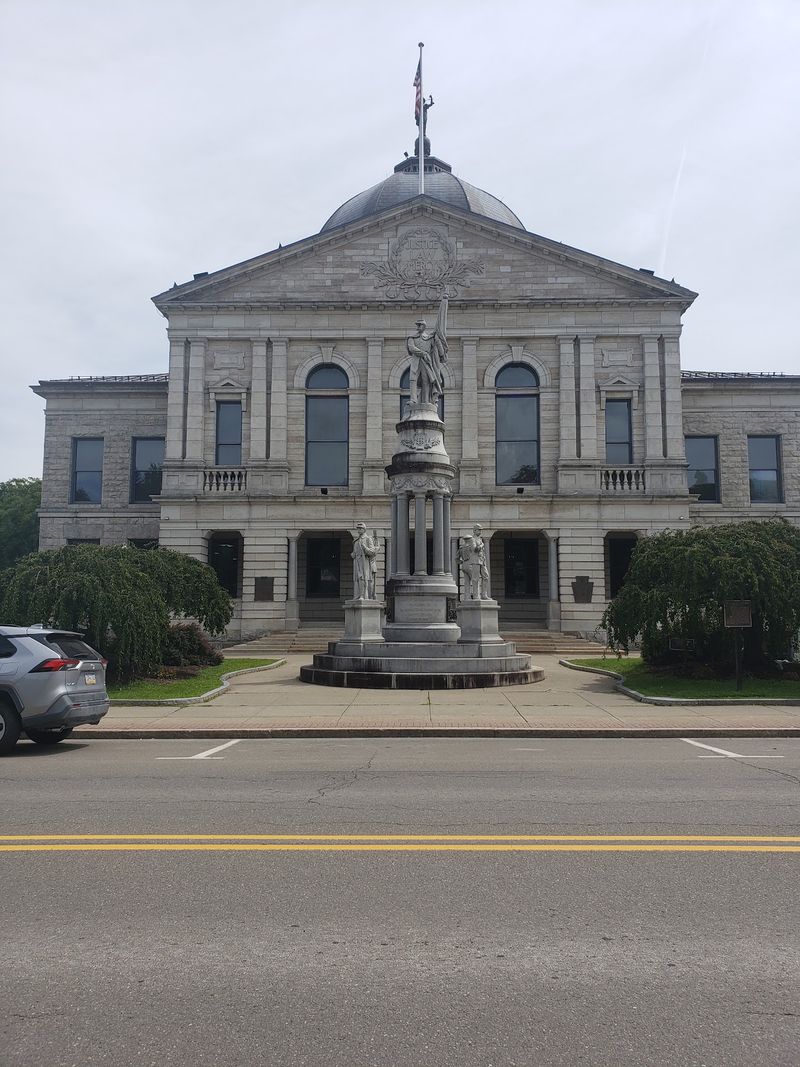
A 50-foot-diameter octagonal dome crowned by a copper statue of Lady Justice rises over downtown Towanda in a way that feels almost unexpected for a town of its size.
The third Bradford County Courthouse was built between 1896 and 1898, designed by architects Israel Lehman and Theodore Schmitt of Cleveland, Ohio. Its exterior walls are made of rusticated sandstone quarried from nearby Barclay Mountain, giving the building a substantial, grounded quality that complements its Classical and Renaissance Revival design.
Inside, native white oak woodwork and an Italian marble staircase lead to a second-story rotunda. The dome’s original brown-green glazed terra-cotta tiles were replaced with copper between 2016 and 2017 during a major restoration project.
Architectural historians have called it the most imposing historic courthouse in Pennsylvania’s Northern Tier, and from several angles along Main Street, that description holds up well.
4. Tioga County Courthouse, Wellsboro, Pennsylvania
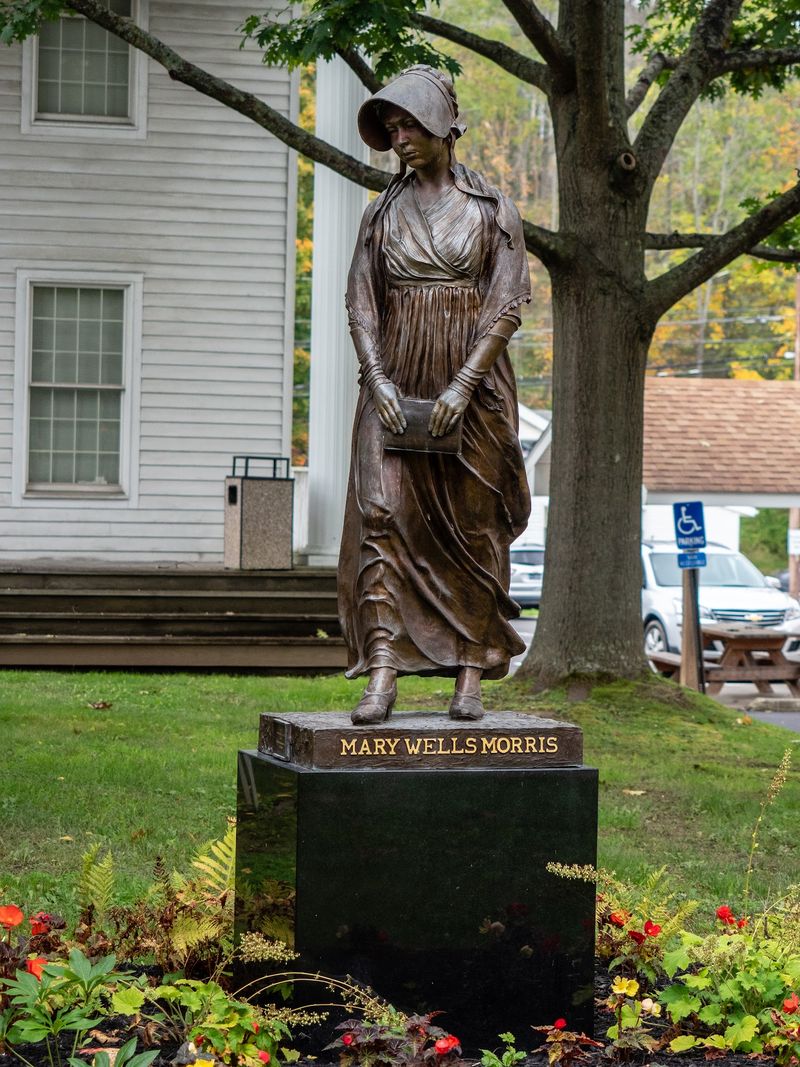
Most travelers passing through Wellsboro have the Pennsylvania Grand Canyon on their minds, but the Tioga County Courthouse is worth a few minutes before heading out of town.
The structure dates to 1835 and was built from dressed local sandstone, giving it a warm, solid appearance that fits naturally into Wellsboro’s traditional downtown. A major remodeling project in the 1930s transformed its entrance, adding a prominent Corinthian portico and a Federal-style front that gives the building considerably more presence than its original modest design.
The combination of old stonework and the later classical additions creates a layered look that reflects more than a century of civic investment in a single building. Against Wellsboro’s well-maintained Main Street, with its historic storefronts and old-fashioned character, the courthouse reinforces the sense that this is a town that takes its public buildings seriously.
5. Adams County Courthouse, Gettysburg, Pennsylvania
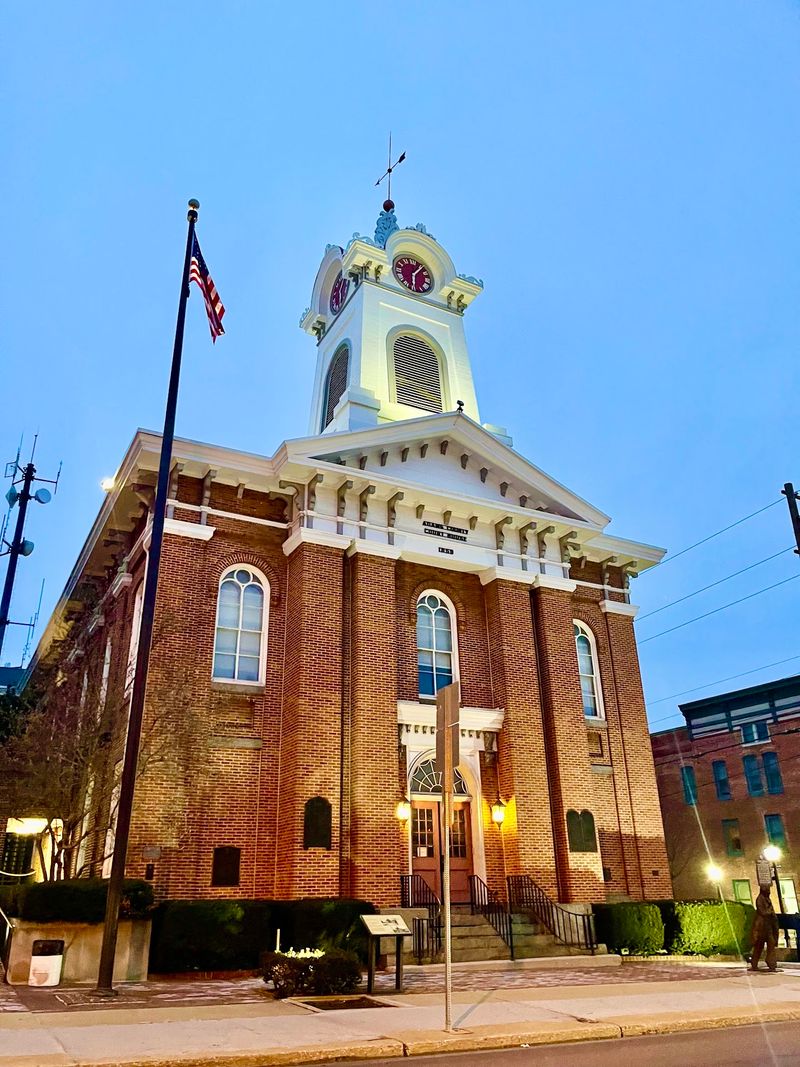
Built in 1858 and first occupied in 1859, the Adams County Courthouse had barely settled in before the Battle of Gettysburg turned the entire town upside down four years later.
Philadelphia architect Stephen Decatur Button designed the two-story red brick structure in the Italianate style. A clock tower roughly 70 feet tall rises above the main entrance on Baltimore Street, making it easy to spot from a distance even in a downtown full of 19th-century architecture.
During the 1863 battle, the building served as both a military command post and a hospital. The original courtroom contains trompe-l’oeil frescoes painted by George Seiling in 1859, which create optical illusions of structural ceiling elements that still fool visitors today.
Rear wings were added in 1895, and a full restoration took place between 1983 and 1985. The courthouse was added to the National Register of Historic Places in 1974.
6. Mercer County Courthouse, Mercer, Pennsylvania
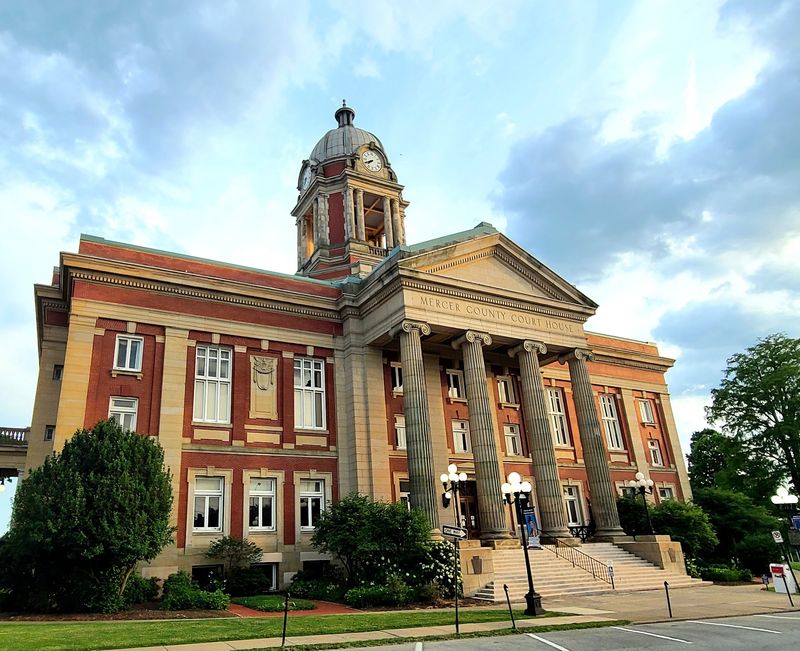
For a small western Pennsylvania borough, Mercer went remarkably big when it came time to build a courthouse in 1910 and 1911.
Designed by the architectural firm Owsley and Boucherle in the Beaux-Arts style, the three-story building combines red brick and light sandstone with monumental Ionic porticos and a soaring central dome that dominates the view from the Diamond. The exterior alone sets a high standard for civic ambition in a town of this scale.
Inside, the building becomes even more impressive. A central rotunda features stained glass, marble, brass railings, and allegorical murals representing themes like Justice and Power, with contributions from artist Vincent Aderante.
The courthouse was added to the National Register of Historic Places in 1998. Few buildings in Pennsylvania make such a strong case that small-town civic architecture can rival anything built in a larger city.
7. Washington County Courthouse, Washington, Pennsylvania
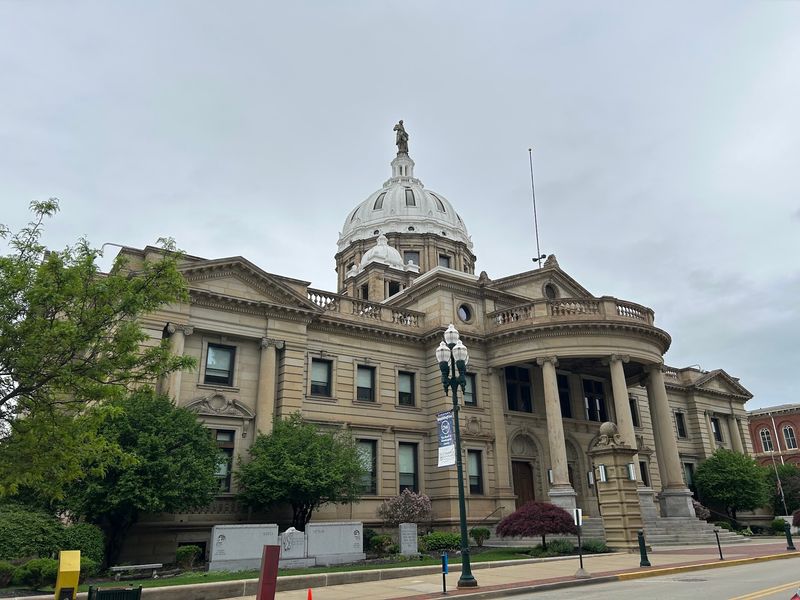
Pittsburgh architect Frederick John Osterling had a reputation for grand public buildings, and the Washington County Courthouse completed in 1900 fits that reputation without apology.
Designed in the Beaux-Arts tradition, the building was constructed at a moment when American civic architecture was at its most deliberately imposing. Every element of the exterior communicates ceremony and permanence, which was exactly the message county governments wanted to send at the turn of the 20th century.
The courthouse anchors the center of southwestern Pennsylvania’s Washington with the kind of monumental presence that makes surrounding streets feel organized around it rather than simply near it. It remains an active part of county government today, handling real judicial and administrative business in a building designed to outlast everyone who uses it.
That combination of architectural ambition and continued practical function is what separates working historic courthouses from preserved monuments that have lost their original purpose.
8. Centre County Courthouse, Bellefonte, Pennsylvania
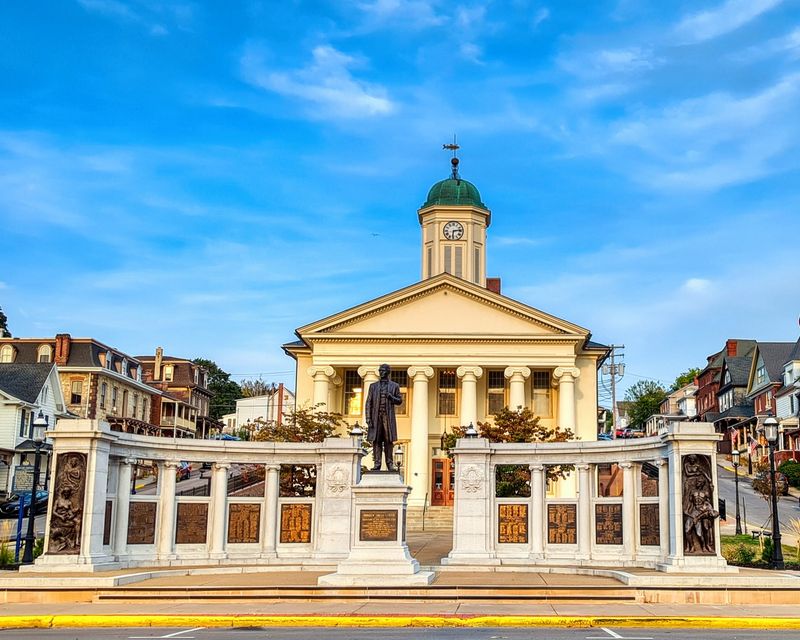
Eight 26-foot Ionic columns announce the Centre County Courthouse long before you reach the Diamond, which is the four-street intersection at the heart of Bellefonte’s historic center.
The original courthouse went up in 1805, making it one of Pennsylvania’s earliest county seats. The impressive columned porch arrived in 1835, and by 1854 and 1855, the main building had been largely rebuilt while keeping that signature portico.
An octagonal cupola with a clock was added in 1855, giving the roofline a finishing touch that still draws the eye upward. The building was added to the National Register of Historic Places in 1976.
Pennsylvania courts recognize it as one of the state’s oldest active judicial centers. Surrounded by Bellefonte’s well-preserved Victorian streetscape, the courthouse sits at the center of a downtown that feels genuinely intact rather than artificially restored.
9. Fayette County Courthouse, Uniontown, Pennsylvania
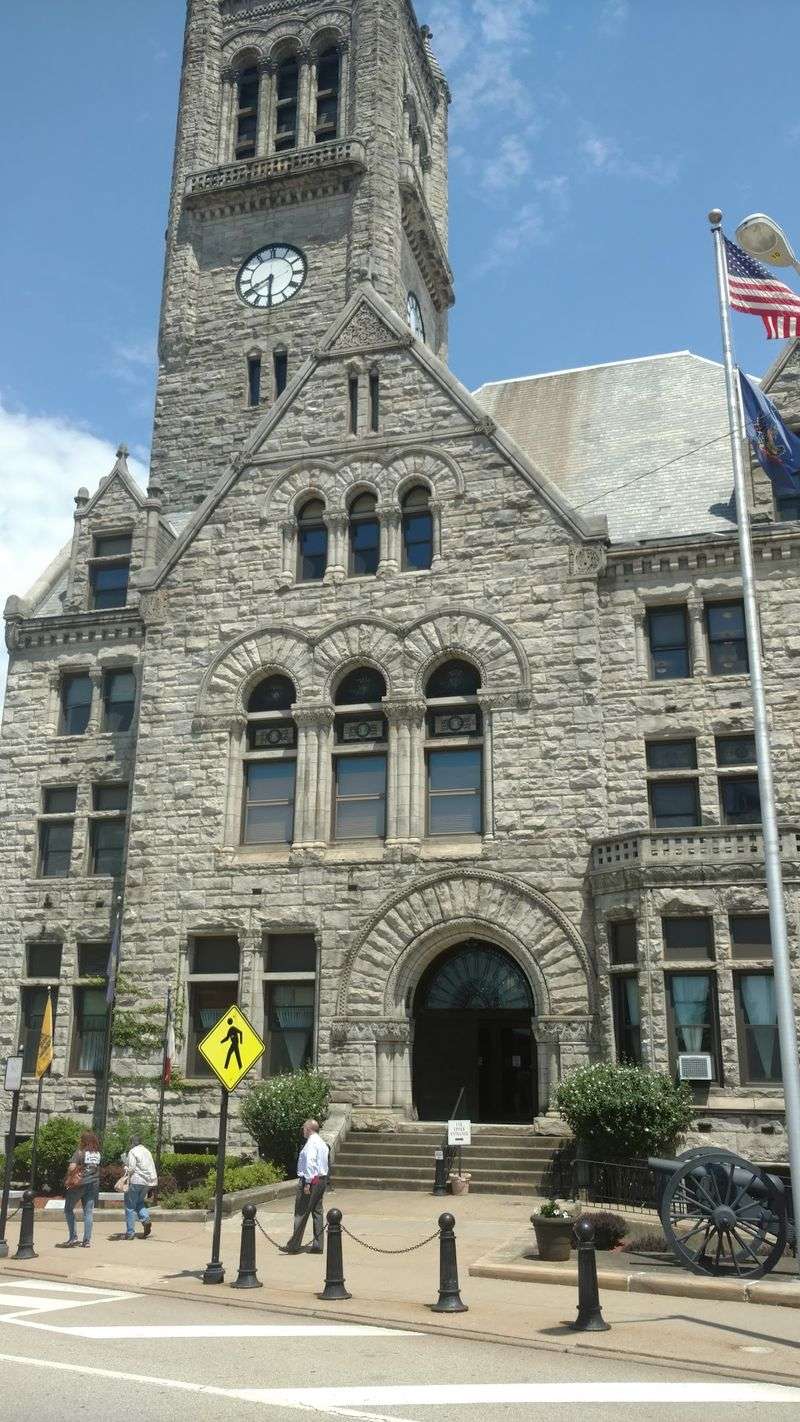
Uniontown’s courthouse does not try to charm you with columns and symmetry. Its stone exterior, heavy arches, and asymmetrical composition give it a more fortress-like presence that stands apart from Pennsylvania’s many Classical Revival courthouses.
That character makes it interesting in its own right, but the building’s most memorable features are actually hidden from the street. The county highlights first-floor murals, skylights, and a stained-glass dome inside Courtroom No. 1 as the interior’s standout elements.
Courthouse tours can be arranged through the county, which is worth knowing before you arrive. Without a tour, most of those interior details remain out of view.
The building occupies a prominent position in downtown Uniontown, where it contributes to a center-city streetscape that reflects southwestern Pennsylvania’s industrial and commercial history. Fayette County’s courthouse is the kind of building that rewards visitors willing to look beyond the exterior.
10. Cambria County Courthouse, Ebensburg, Pennsylvania
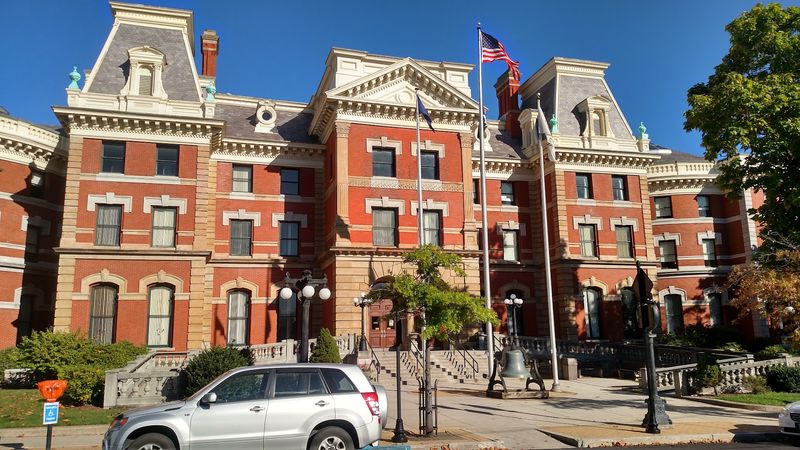
Milton Earl Beebe had a talent for making county seats look more important than their populations might suggest, and his work in Ebensburg is a solid example of that skill.
The original Cambria County Courthouse dates to 1880 through 1882, and its mansard roof and stone detailing give it a French Renaissance Revival character that was fashionable for civic buildings of that decade. The exterior presents a confident, well-composed facade that fits the role of a county’s central public building.
A later expansion added a three-story rotunda capped by stained glass, which brings an unexpected amount of visual interest to the interior. Visitors who only glance at the outside miss the building’s most striking feature.
Combined with Ebensburg’s traditional streets and older commercial district, the courthouse makes the county seat a worthwhile stop for anyone with a genuine interest in Pennsylvania’s 19th-century civic architecture.
11. Wayne County Courthouse, Honesdale, Pennsylvania
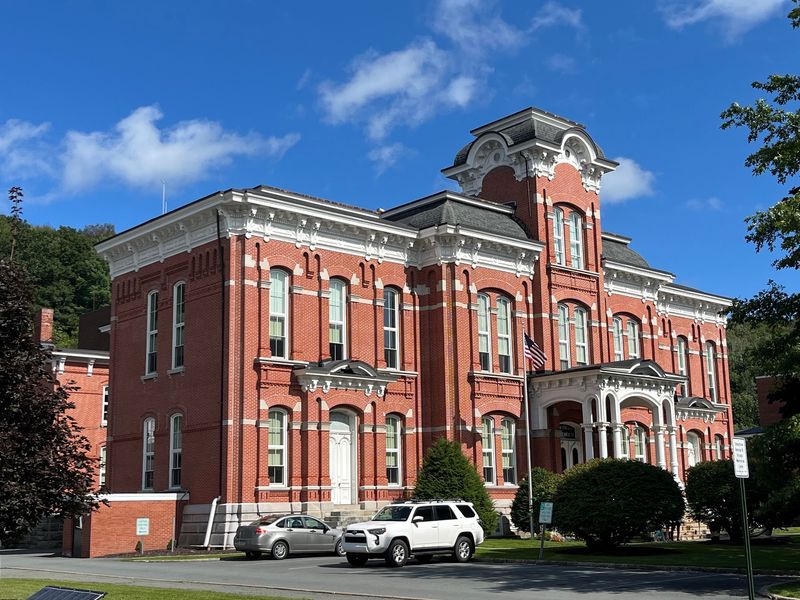
The Wayne County Courthouse has an interesting backstory that goes beyond its architecture: the building’s original design had to be scaled back mid-construction because of public uproar over the projected cost, a controversy that became known locally as the Courthouse Wars.
New York architect J.A. Wood designed the building, which blends Second Empire and Italianate styles.
Construction ran from 1876 to 1880, and the final cost came in at $130,000 despite the budget-driven modifications.
The exterior features red brick and stone, a mansard roof, a prominent central tower, and a columned front porch on Court Street. Inside, original marble fireplaces, decorative iron staircases, and period hallway details remain in place, along with a historic courtroom that retains its original judge’s bench and bar.
Honesdale’s location near the Pocono Mountains draws travelers, and the courthouse adds a layer of 19th-century civic history to a downtown already worth exploring.
12. Clearfield County Courthouse, Clearfield, Pennsylvania
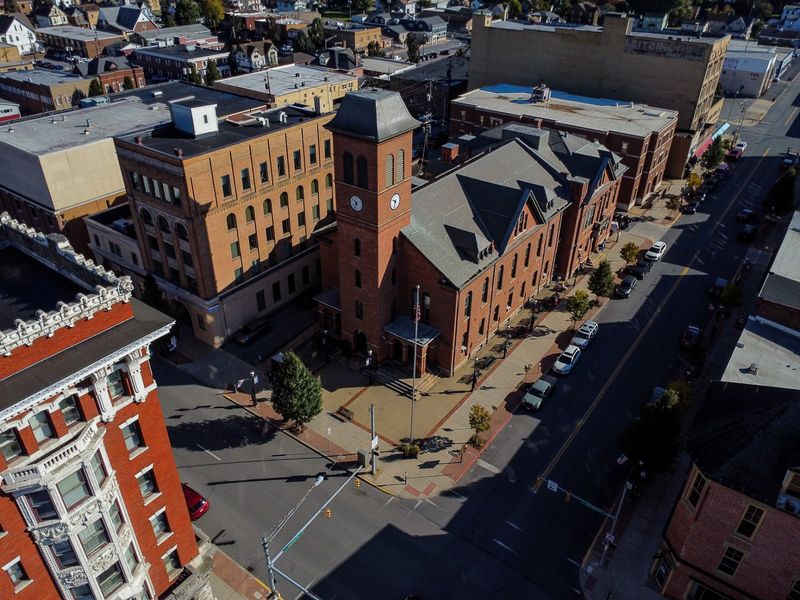
Not every courthouse needs a dome the size of a small planet to make its point. The Clearfield County Courthouse, constructed between 1860 and 1862, keeps things compact and well-proportioned in a way that suits its downtown setting perfectly.
The 2.5-story red brick structure is Italianate in style, with arched windows and brick detailing that give the facade a deliberate rhythm. A square brick clock tower with a bell-shaped roof rises above the street entrance, providing just enough vertical emphasis without overwhelming the surrounding blocks.
An addition completed in 1884 expanded the building while preserving its original character. A modern addition on the east side handles contemporary space requirements.
Considered the oldest public building in Clearfield, the courthouse was listed on the National Register of Historic Places in 1979. It remains the center of all county government business, which means it has been continuously useful for well over 160 years.
13. McKean County Courthouse, Smethport, Pennsylvania
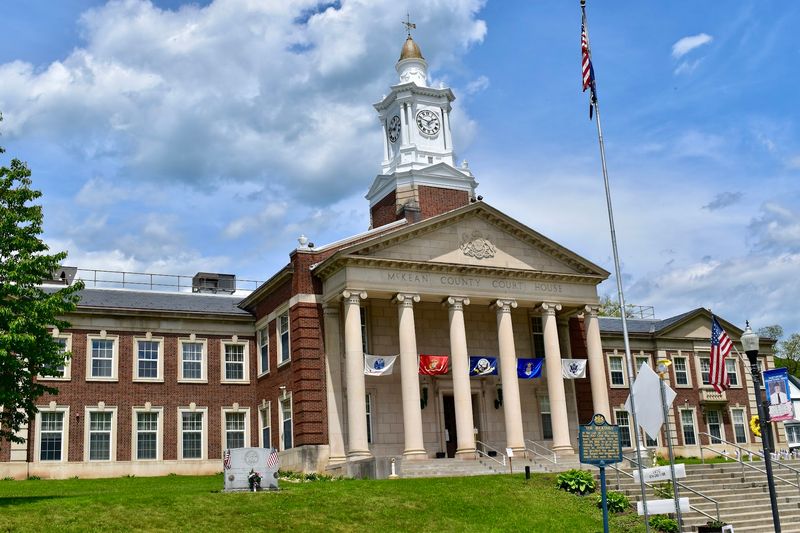
A courthouse does not have to date to the 1800s to look like it belongs in a 19th-century county seat, and Smethport’s McKean County Courthouse makes that case convincingly.
The present central portion was completed in 1942, built to replace sections of the earlier courthouse complex destroyed by a devastating fire in 1940. Despite its mid-20th-century construction date, the architects gave it a deliberately traditional appearance: a six-column Ionic portico, red brick walls, stone details, and a cupola that reads as entirely at home against Smethport’s historic streetscape.
Inside, a rotunda incorporates marble Ionic details that are echoed in wood in the courtroom, creating a consistent formal character throughout the building’s public spaces.
Against Smethport’s collection of older buildings and tree-lined streets, the courthouse looks as though it has always been there. That kind of architectural continuity is harder to achieve than it might appear.
14. Wyoming County Courthouse, Tunkhannock, Pennsylvania
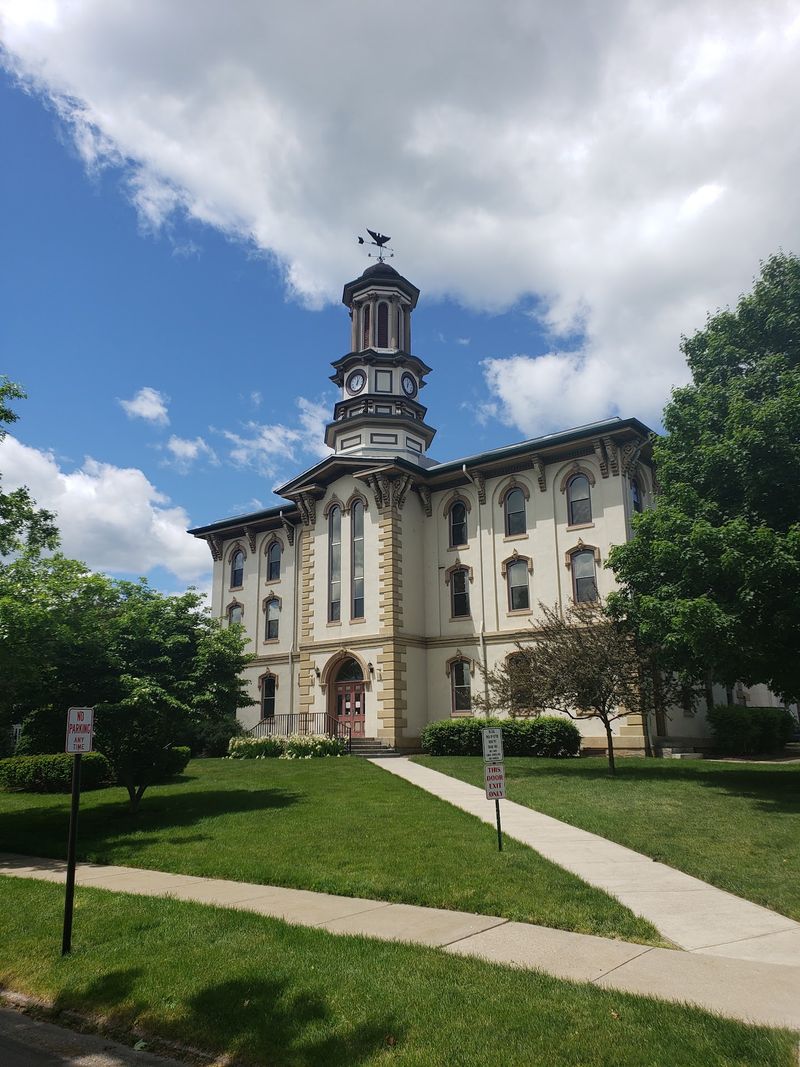
Architect D.H. Nott designed the Wyoming County Courthouse in the Italianate Tuscan Villa style, which gives Tunkhannock’s county seat a distinctive tall central tower that rises above Putnam Street in a way that is hard to miss from the surrounding blocks.
The building’s history involves multiple transformations. An original 1843 structure was completely rebuilt in 1870 with a third story added, then covered with stucco and painted, giving it the light-colored exterior that defines its current appearance.
Decorative brackets, arched openings, contrasting trim, and corner quoins contribute to its layered visual character.
A federal public works project added space in 1938, and a larger addition followed in 1991 and 1992. The County Court of Common Pleas courtroom remains on the second story.
The courthouse is a featured stop on the Historic Tunkhannock Walking Tour, which makes it easy to combine with a broader exploration of one of northeastern Pennsylvania’s most appealing small county seats.
Share this story