Every July, a meadow tucked into the North Carolina High Country transforms into one of the most vivid Scottish celebrations in the country. The Grandfather Mountain Highland Games bring bagpipes, kilts, caber tosses, and clan banners to MacRae Meadows in Linville, turning an ordinary mountain getaway into a four-day cultural event unlike anything else in the region. You do not need Scottish ancestry or a clan membership card to enjoy it, just a willingness to spend a weekend surrounded by something genuinely spectacular.
MacRae Meadows is the festival’s mountain-sized stage
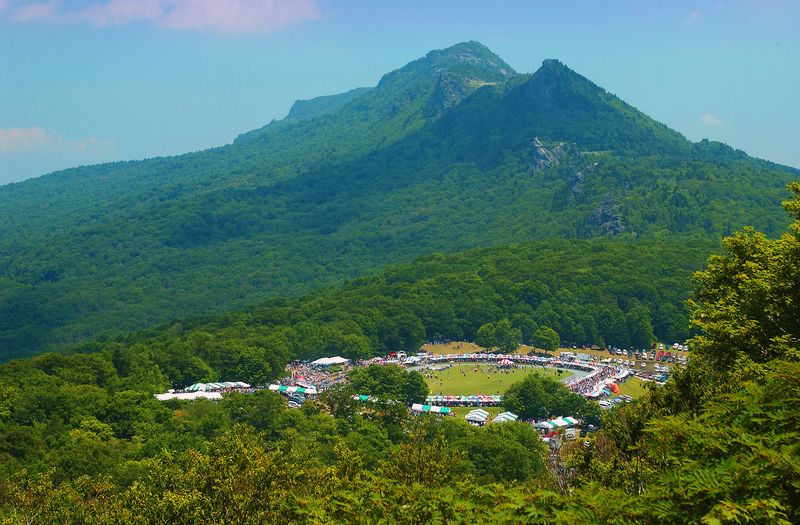
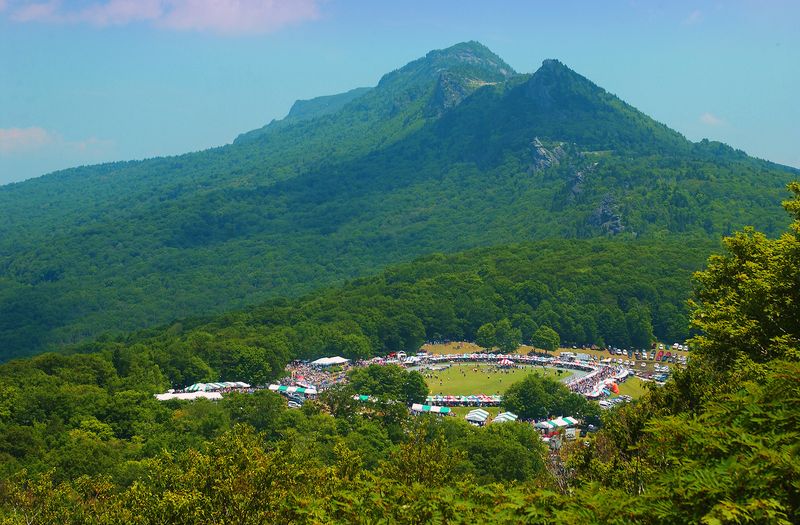
MacRae Meadows sits in a broad, grassy bowl near Linville in the Blue Ridge Mountains of Western North Carolina, and every July it becomes the home of the Grandfather Mountain Highland Games. The name conjures images of bagpipes echoing across entire ridgelines, and the atmosphere genuinely earns that feeling, but the games themselves are concentrated at a single site. The official maps and transportation page makes clear that MacRae Meadows is the primary festival ground, not a roaming event spread across the mountain range or up to the Grandfather Mountain summit attraction nearby.
That distinction matters for planning, but it does not shrink the experience. The meadow holds a full athletics field, a performance stage, clan society tents, vendor rows, camping areas, and enough open ground that the sound of massed pipes carries far beyond the crowds. Visitors standing at the edge of the field can watch a caber toss with a wall of mountains behind the athletes, a backdrop that no stadium could replicate.
The festival’s roots go back to 1956, when co-founders Agnes MacRae Morton and Donald MacDonald organized what would grow into one of the most recognized Highland gatherings in North America. The festival’s own history page documents that origin, grounding the event as a modern celebration rather than an unbroken survival of ancient tradition. Visit North Carolina describes it as the largest gathering of Scottish clans in the United States, a superlative worth noting with the understanding that such rankings reflect promotional descriptions rather than independently verified attendance data.
What is verifiable is the scale of what happens at that meadow every second full weekend in July. The general visitor information page frames the event as family-friendly and culturally immersive, a place where the mountain setting amplifies rather than competes with the Scottish programming filling every corner of the field.
Thursday through Sunday builds a festival, not just a spectacle
One of the easiest ways to underestimate the Grandfather Mountain Highland Games is to think of it as a single afternoon of athletic competitions. The 2026 schedule ran Thursday, July 9 through Sunday, July 12, and each day carried its own distinct programming rather than repeating the same lineup.
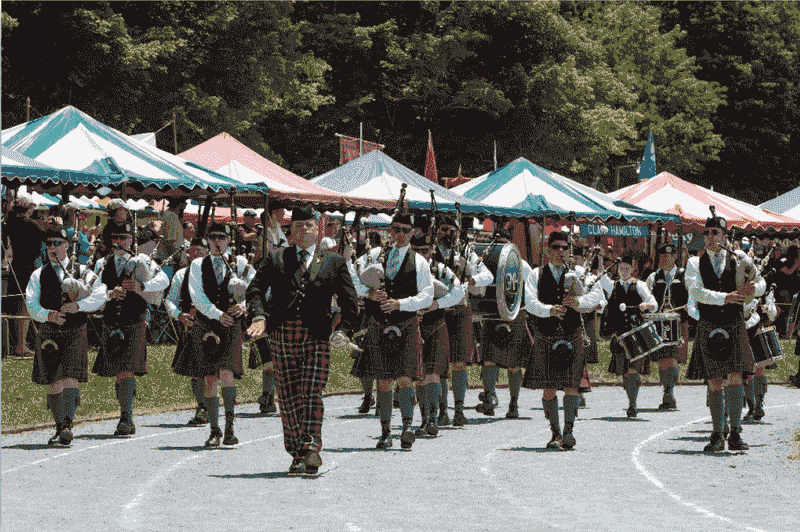
Thursday opens the festival with early-arriving energy: piping and drumming competitions begin drawing competitors and serious enthusiasts who want the full four-day experience. Friday and Saturday carry the heaviest athletics program, including the events most visitors associate with Highland Games, alongside piping competitions, massed pipe and drum bands, and Highland dancing that fills the field with color and precision. Celtic music performances and Gaelic cultural activities run through the weekend, giving the event a depth that goes well beyond what any single afternoon could hold.
Clan societies set up tents across the grounds, hosting programming that ranges from genealogy help to cultural talks and demonstrations. Sheepdog demonstrations bring a working-farm dimension that younger visitors often find as compelling as the athletic events. Vendors offer Scottish goods, food, and crafts, and children’s events including a junior caber toss and youth wrestling keep families engaged even during the longer competition stretches.
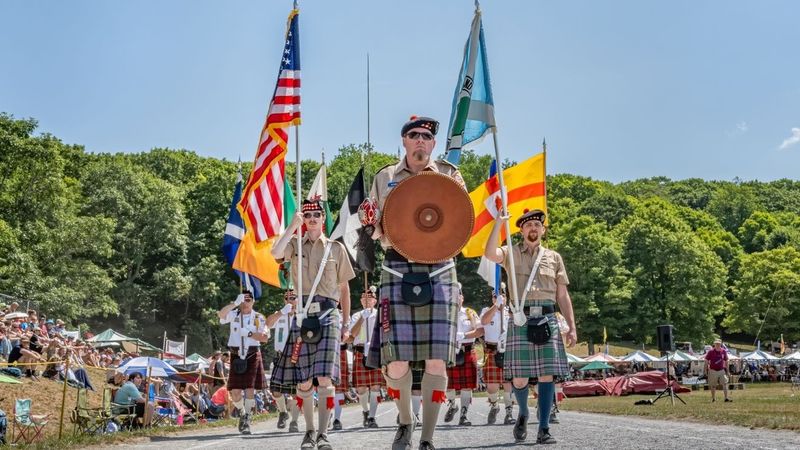
Sunday shifts the mood toward something ceremonial. The Parade of Tartans closes the weekend with a procession that draws participants from across the grounds, and the energy of that final morning feels different from the athletic intensity of Saturday. The 2026 schedule is a useful reference point, but the specific times and programming for any given year can change. Checking the official Grandfather Mountain Highland Games site before attending is the only reliable way to confirm what Thursday’s opening program includes and whether any new events have been added or shifted for the edition you plan to attend.
Why the caber toss is about control, not distance
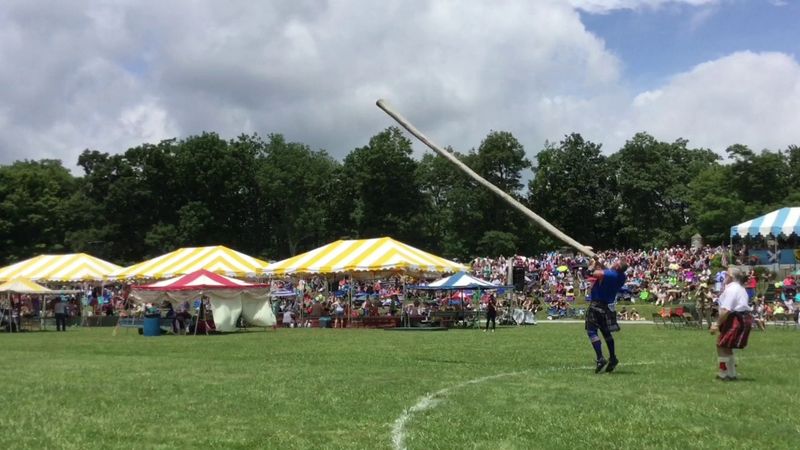
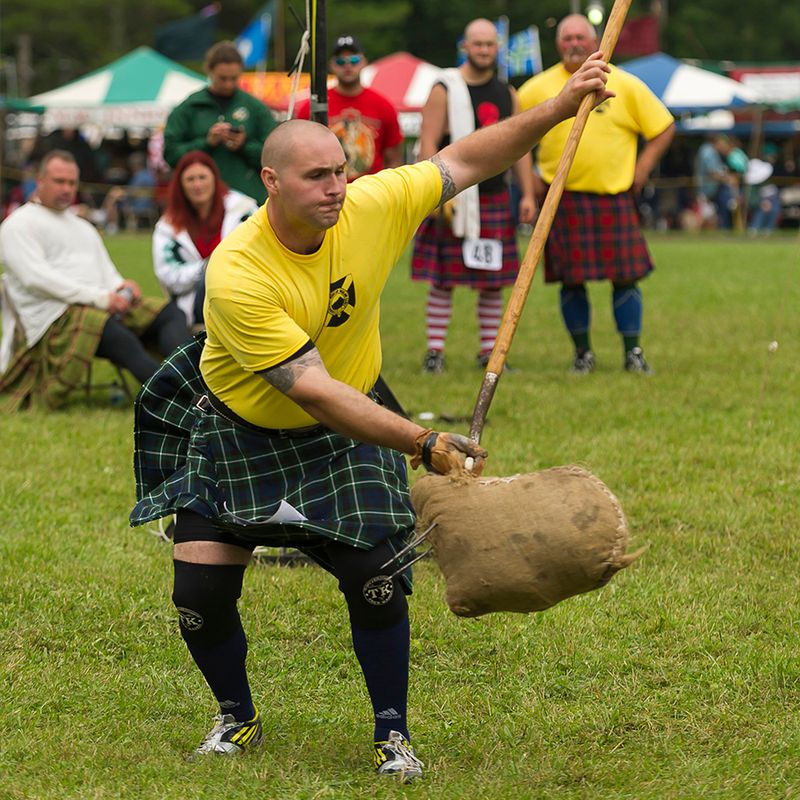
Most first-time spectators assume the caber toss works like a javelin throw, where the winner sends the log the farthest. The actual goal is almost the opposite. A competitor lifts a heavy tapered pole, runs forward to build momentum, and then heaves it upward so that the thick end strikes the ground and the pole flips end over end away from the thrower.
What the judges watch is not how far it travels but how cleanly it lands. Scottish Games athletics guidance describes the ideal result as a 12 o’clock landing, meaning the pole falls directly away from the athlete in a straight line after completing its rotation. A toss that drifts to 11 or 1 o’clock scores lower, and a caber that fails to complete the full turn is scored by the angle it reached before falling. The event rewards technique and timing over raw power, which is why a perfectly executed toss from a smaller competitor can outscore a mightier throw that lands at an angle.
The Foundation for Scottish Athletics and Scottish Athletics heavy-events rules both note that caber dimensions and weights are not fixed across all competitions. The pole used in one division or one event may differ significantly from what another organization uses, so the specific caber at MacRae Meadows may not match exactly what you read about in a general Highland-games reference.
For the 2026 festival, the professional caber toss was scheduled for 1:15 p.m. on Saturday, July 11. The official schedule listed it as a featured afternoon event, making it one of the clearest anchors for planning a Saturday visit. Arriving before that window gives you time to watch earlier heavy-athletics rounds and understand the scoring before the professional field takes the field.
Clans, tartans, and the Parade of Tartans carry the heritage story
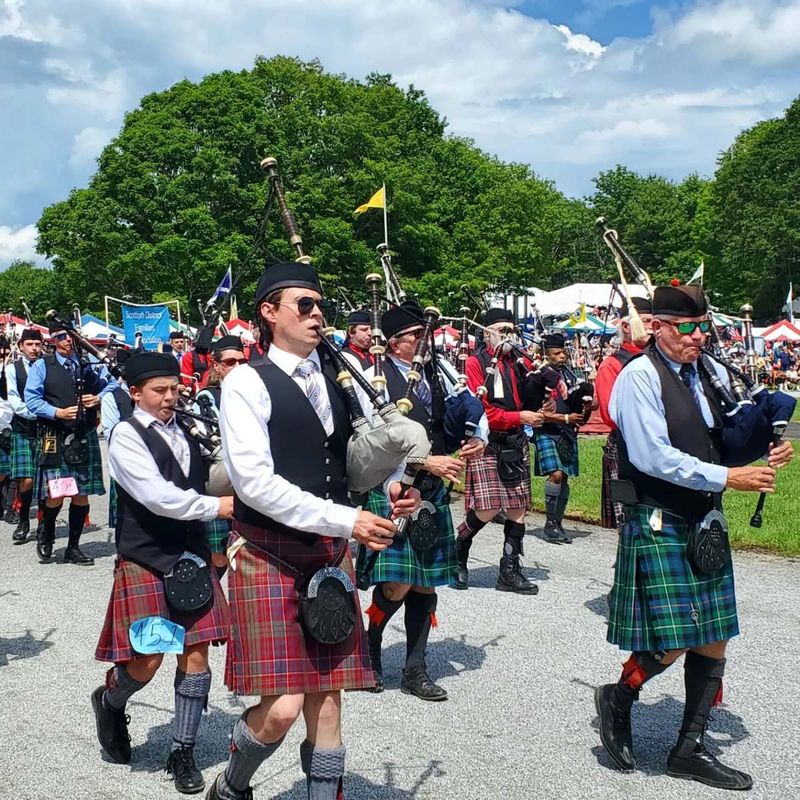
Walk the grounds on any day of the festival and the clan society tents form a kind of open-air village of Scottish identity. Each tent represents a family name or affiliated society, staffed by members who answer questions, share genealogy resources, and welcome anyone curious enough to stop. You do not need to carry that surname or prove any ancestry to walk in and ask questions; the tents are as much about cultural education as they are about family reunion.
The visual centerpiece of the entire weekend arrives on Sunday morning. The official Parade of Tartans page describes the procession as including more than 1,000 marchers representing more than 100 clans and societies. Watching that many people move across MacRae Meadows in coordinated tartan patterns is the kind of image that stays with visitors long after the weekend ends.
Tartan itself has a more layered history than the common shorthand of one surname, one pattern suggests. Scotland’s official tartan resource describes a long and evolving tradition that includes organizational tartans, regional designs, and patterns created in recent centuries alongside the older family associations. At the games, you will see all of that variety at once, from ancient clan colors to tartans adopted by American societies with Scottish heritage connections.
North Carolina’s tie to Scottish culture is genuine and deep, though it is worth placing it geographically. NCpedia’s record of Scottish settlers documents large Highland migrations into the Cape Fear region during the 18th century, concentrated especially around present-day Fayetteville and surrounding counties. Gaelic speakers persisted in the state into the 19th century, and Highland Games have played a continuing role in preserving that heritage. The Grandfather Mountain festival is not a direct continuation of old High Country settlement, but it draws on a real and substantial statewide connection to Scottish culture that gives the gathering something more than a costume party atmosphere.
Highland dancing adds another layer to the weekend’s cultural programming. Competitors range from young children in their first competitive season to experienced adult dancers, and watching the full range of skill levels across a single afternoon shows how thoroughly the tradition passes from generation to generation.
A smart visit starts with the schedule, not the gate
Arriving at MacRae Meadows without a plan means spending the first hour figuring out what just happened and what you missed. The four-day format gives visitors a genuine choice about how to build their time, and that choice is easier when you make it before you leave home.
Start by identifying your primary anchor. Saturday draws the largest crowds because it carries both the full heavy-athletics program and the professional caber toss, scheduled in 2026 for 1:15 p.m. If watching elite athletes throw heavy implements in front of a mountain backdrop is your main reason for coming, Saturday is the day to protect. If the communal spectacle of the Parade of Tartans matters more, Sunday morning is non-negotiable.
Piping and drumming enthusiasts often find that Friday’s competition schedule suits them better than the busier Saturday, when athletics and music compete for attention across the field simultaneously.
Thursday programming rewards early arrivers who want the grounds before peak crowds arrive. Competitors and serious pipe and drum enthusiasts fill the early festival days with energy that is different from the Saturday peak, and the atmosphere is more relaxed for families who want to explore clan tents and vendor areas without navigating a full-capacity crowd.
Once you have picked your anchor event, build the surrounding hours with secondary programming. A family with younger children might anchor on the junior caber event and sheepdog demonstration, then catch a massed band performance before heading out before the late-afternoon rush. A couple focused on culture might pair the clan tent circuit with a Gaelic programming session and close the day with Celtic music.
The official schedule page is the only reliable source for specific times, and checking the Grandfather Mountain Highland Games site close to your visit date confirms whether any programming has shifted from a prior year’s example. Treat the 2026 schedule as a structural guide, not a guaranteed template.
The practical details shape the getaway
Admission for the 2026 festival was listed at $25 for Thursday, $35 for Friday, $40 for Saturday, and $30 for Sunday for visitors ages 13 and older. A four-day pass ran $85 for adults. Children ages 5 through 12 paid $10 per day or $30 for all four days. The official ticket pricing page is the authoritative source for current rates, and those numbers should be confirmed before any future visit because prices can and do change between festival years.
Getting to the meadow is where many first-time visitors run into their first surprise. Parking directly at MacRae Meadows is extremely limited and generally requires a pre-arranged hangtag. The maps and transportation page directs most visitors to off-site parking lots, and the shuttle bus schedule and parking locations document outlines where those lots are and how frequently buses run. Planning for shuttle time adds 20 to 30 minutes to your morning arrival estimate, and leaving before peak departure hours in the late afternoon saves significant waiting.
Camping at the festival is available but works differently from booking a campsite at a nearby state park. The camping page explains that on-site camping requires a separate camping arrangement plus a four-day adult ticket. For 2026, campers had to arrive by noon on Wednesday, July 8, the day before the festival opened, and sites were assigned on a first-come, first-served basis. Anyone planning to camp should read the current year’s camping instructions carefully rather than assuming the same rules apply.
The general information page lists several rules that affect families in particular. Pets are not permitted at the Highland Games, even leashed ones. Private golf carts and bicycles are also prohibited on the festival grounds. These restrictions apply specifically to the games at MacRae Meadows; the separate Grandfather Mountain attraction nearby operates under its own policies.
Families traveling with pets will need to arrange appropriate care before arriving, and anyone hoping to use a personal cart for mobility should contact the festival organizers directly to ask about available accommodations.
Mountain weather decides what belongs in your day pack
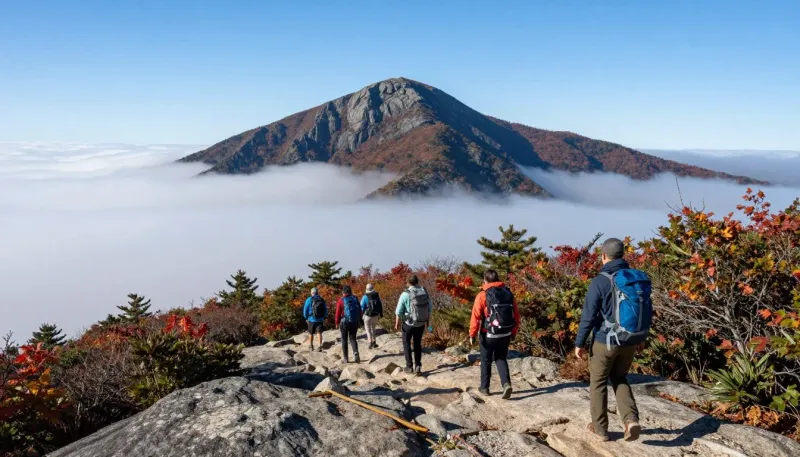
A warm, sunny forecast for Boone or Blowing Rock does not necessarily describe what you will find at MacRae Meadows. Grandfather Mountain’s official weather page states that temperatures there run roughly 10 to 15 degrees cooler than in the surrounding foothills, and that high winds are a regular feature of the mountain environment. A July afternoon that feels like T-shirt weather in Morganton can turn into a wind-driven rain event at elevation with very little warning.
Packing for that variability is straightforward once you accept that the mountain will not cooperate with a single-layer outfit. Bring a rain jacket or poncho even if the morning looks clear. A light fleece or long-sleeved layer handles the wind chill during massed band performances when you are standing still for extended periods. Sturdy, closed-toe shoes matter more than sandals because the meadow terrain includes uneven ground, and wet grass after a brief shower becomes slippery quickly.
Carry water even if food and drink vendors are on site; hydration at altitude in summer sun, even cooler sun, adds up faster than expected.
If you plan to add a visit to the Grandfather Mountain attraction, which operates as a separate ticketed destination from the Highland Games, treat that outing as its own planning task. The attraction’s hiking tips page specifically advises visitors to avoid exposed ridges and the Mile High Swinging Bridge area when thunder is present, to check weather and closure information before heading up, and to supervise children carefully around ledges and rugged terrain. The visitor information page for the attraction covers hours and access details separately from anything the Highland Games publishes.
Combining both experiences in a single day is possible but requires honest time management. The games themselves can fill an entire day without rushing, and adding a summit visit on the same afternoon means monitoring the sky carefully and being willing to turn back if conditions change. A safer approach is to schedule the summit for a different day, so neither experience gets cut short by weather or fatigue.
The payoff is a weekend that feels bigger than a single event
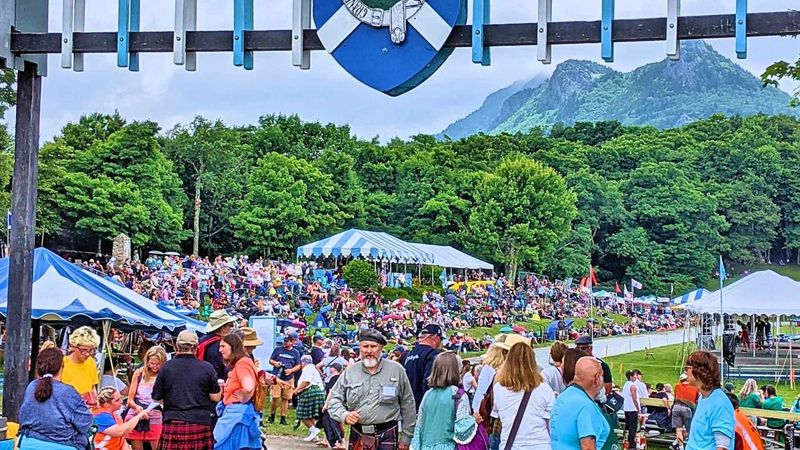
By Sunday afternoon, after four days of pipes, athletics, dancing, and clan society conversations, most visitors leave MacRae Meadows with a sense that they experienced something genuinely concentrated. The heavy-events field delivers the physical spectacle: cabers rotating end over end, stones arcing through mountain air, athletes competing in a setting that would look theatrical if it were not completely real.
The sound dimension is its own reward. A massed pipe and drum band performing in an open mountain meadow produces a volume and resonance that recorded music cannot replicate, and hearing it while watching kilts move across green grass with peaks in the background is the kind of sensory combination that earns the trip its reputation.
None of it requires a Scottish surname or a family tartan to enjoy. The festival welcomes spectators, families, cultural learners, and competitors equally, and the clan tent circuit is as accessible to a curious visitor from Raleigh as it is to someone tracing a MacDonald line back to Argyll. The four-day program is built for people who want to stay long enough to let the culture settle in rather than check a single item off a list.
A quick Saturday stop for one caber toss is better than nothing, but the Grandfather Mountain Highland Games reward the visitors who plan around the full span. The meadow earns its mountain reputation not by filling every hill, but by filling four days with enough sound, color, and community that the drive home feels shorter than the weekend deserved.
Share this story