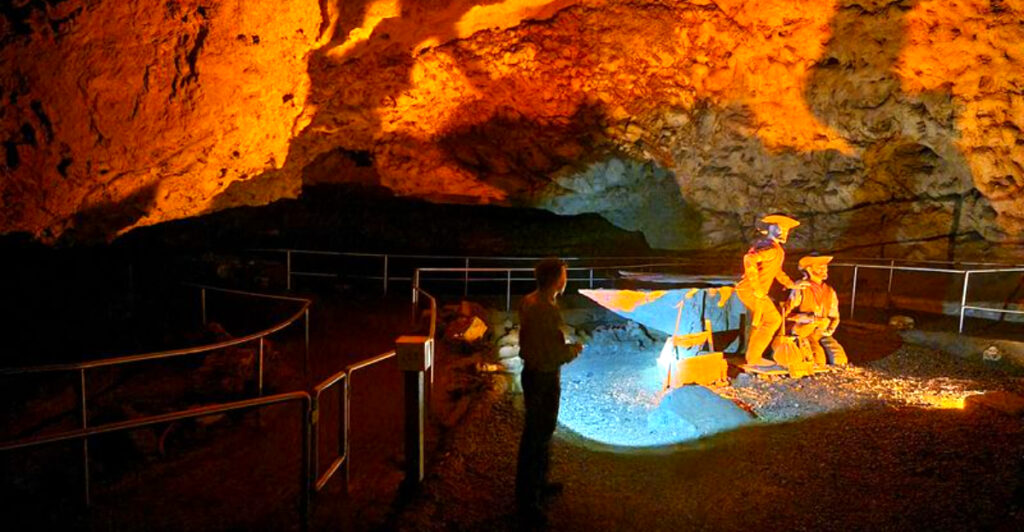
Beneath the Missouri Ozarks is a 4.6-mile cave system where some chambers rise as high as a seven-story building. Guided tours pass underground pools, massive stone formations, and unusual mineral structures that resemble everything from curtains to clusters of grapes.
But geology is only half the story. Parts of these caverns were once mined for an ingredient used to make gunpowder, and local legend says Jesse James and his gang later used the underground passages to hide stolen goods and escape pursuing lawmen.
There is even a 300-foot underground ballroom where people once gathered to dance. Today, it is part of a 1.25-mile tour that reveals just how many unexpected stories are hiding beneath this stretch of Missouri.
A Hidden World Beneath the Ozarks: Location and First Impressions
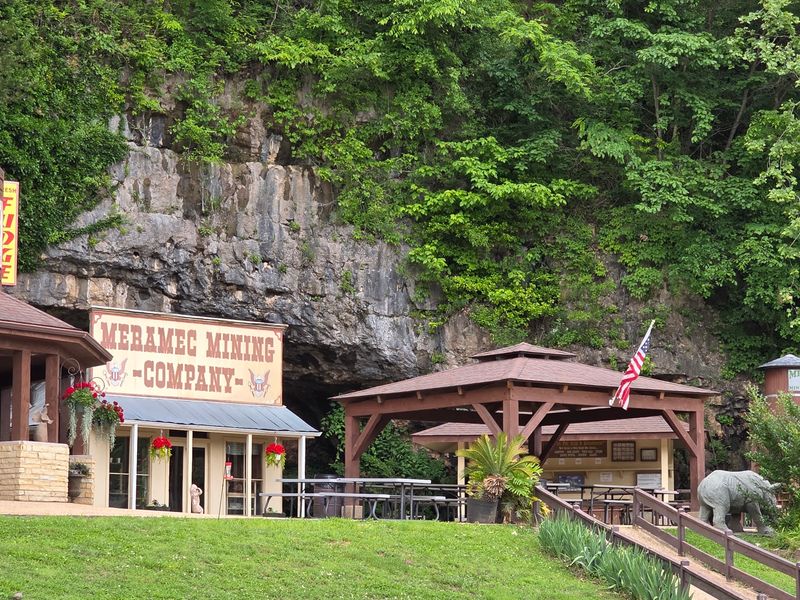
Old barn signs painted along historic Route 66 have been pointing curious travelers toward this underground marvel for decades, and the moment you arrive, it is clear the hype is fully earned. Meramec Caverns sits at 1135 Highway W, Sullivan, Missouri 63080, conveniently accessible from Interstate 44 at Exit 230, roughly 65 miles southwest of St. Louis.
The grounds feel like a classic slice of Americana, unhurried and welcoming, with a gift shop, restaurant, and ice cream bar all visible before you even approach the cave entrance. The surrounding landscape of wooded Ozark hills and the nearby Meramec River gives the property a naturally scenic backdrop that sets the mood beautifully.
Even before descending underground, there is a palpable sense of anticipation in the air. The cave entrance is unassuming from the outside, which only makes the reveal inside all the more dramatic. First-time visitors and returning guests alike tend to pause at that threshold, already sensing that something remarkable is about to unfold.
Millions of Years in the Making: The Geology Behind the Grandeur
Long before Jesse James ever set foot in Missouri, water was already doing extraordinary work beneath the Ozarks. Over millions of years, slightly acidic groundwater percolated through thick beds of limestone and dolomite, slowly dissolving the rock and carving out an intricate labyrinth of passages and chambers.
The result is a cave system that stretches 4.6 miles, with certain chambers reaching heights equivalent to a seven-story building. The constant interior temperature holds steady between 58 and 60 degrees Fahrenheit year-round, a natural byproduct of the earth’s insulating properties rather than any artificial system.
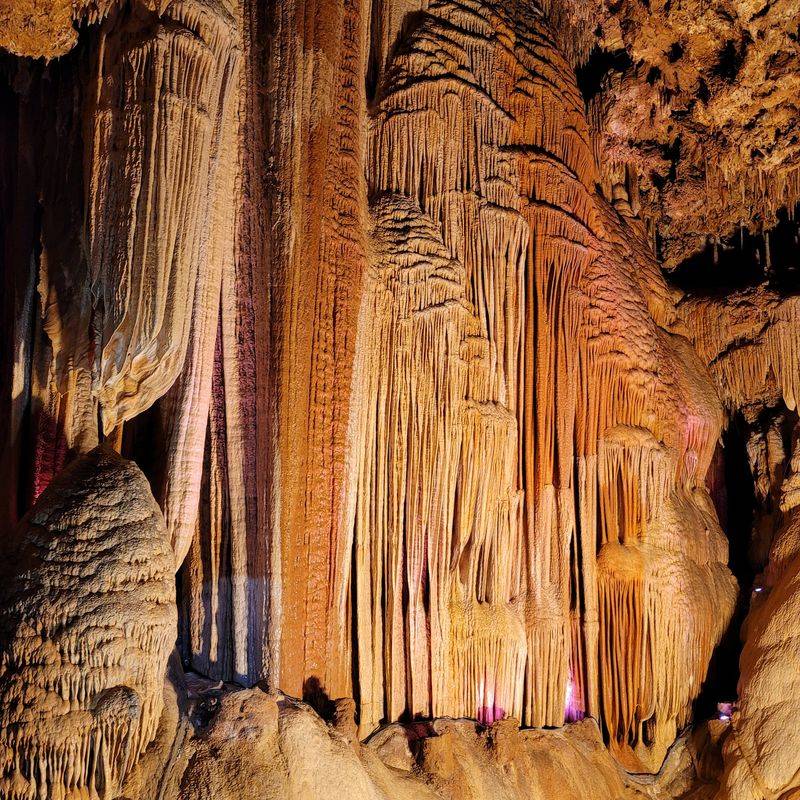
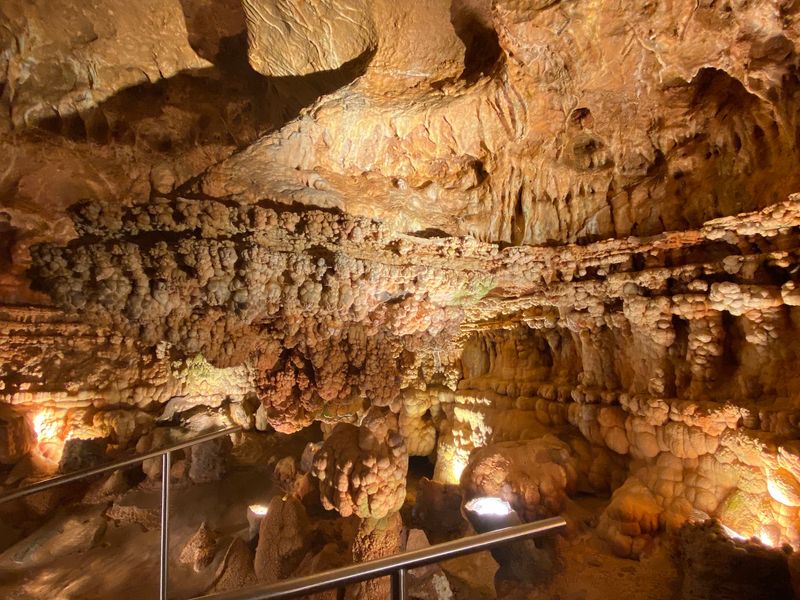
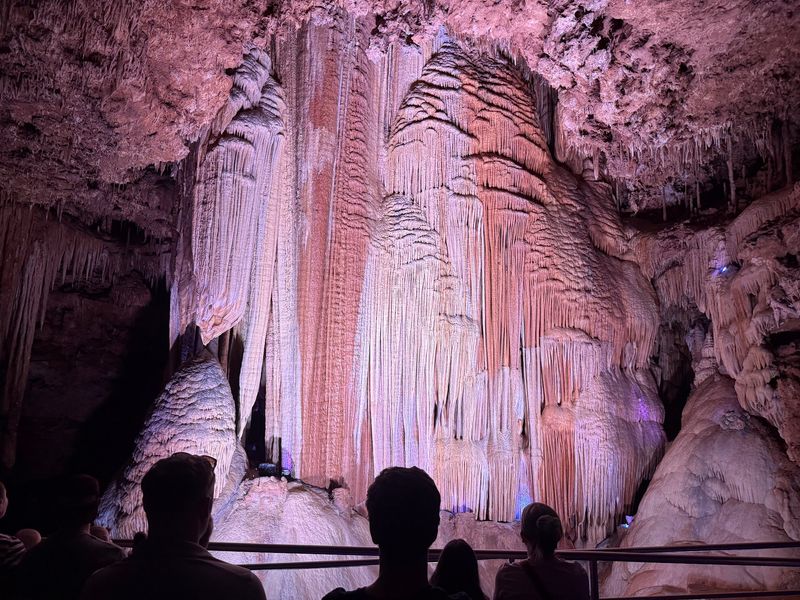
Every surface inside is decorated with speleothems, the scientific umbrella term for stalactites, stalagmites, columns, flowstone, and draperies. Each formation grew one mineral deposit at a time, drip by patient drip, creating shapes that range from delicate translucent needles to massive stone pillars. The sheer patience required to build this underground cathedral, measured in geological time rather than human lifetimes, gives every formation a quiet, almost sacred weight.
Saltpeter, Gunpowder, and the Cave’s Industrial Past
Most caves have a geology story. Meramec Caverns also has a gunpowder story, and that combination is part of what makes it so fascinating. French explorers first documented the cave in 1720 and quickly identified its rich deposits of saltpeter, a naturally occurring potassium nitrate that was a critical ingredient in manufacturing gunpowder.
Mining operations began almost immediately and continued through 1742. Spanish miners later used the cave as a base for lead extraction, adding another industrial chapter to its already layered history. When the Civil War arrived, the cave’s saltpeter deposits became strategically valuable once again, with Union troops actively mining the cave for munitions production.
Inside the caverns today, an 1860s iron boat weighing 400 pounds is on display, once used to transport gunpowder downriver to Union forces by steam engine. This tangible artifact connects the cave’s ancient geology to a very specific and dramatic moment in American history, reminding visitors that this underground world was not always a place of quiet wonder. It was once a working factory hidden beneath the earth.
Jesse James and the Outlaw Legends That Still Echo Here
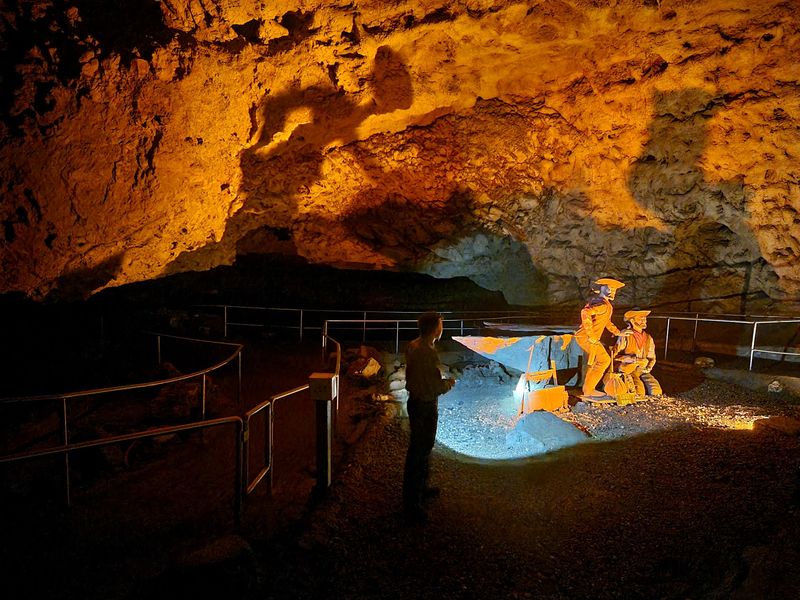
Few stories attached to a natural landmark are as thrilling as the Jesse James connection at Meramec Caverns. During the Civil War, Jesse and Frank James, then Confederate guerrillas, reportedly snuck into the cave and destroyed a Union-held saltpeter operation, making their first dramatic impression on the place.
Legend holds that the brothers returned to the caverns repeatedly until around 1870, using its vast chambers to store stolen goods and evade pursuing posses. One particularly vivid tale describes the James gang escaping capture by slipping through a water-filled passage and disappearing into the cave’s deeper sections when lawmen closed in.
A spot inside the cave is still pointed out as “Loot Rock,” where the gang allegedly divided their spoils after robberies. In 1941, during a severe drought that revealed a previously hidden lower chamber, founder Lester Dill reportedly discovered artifacts including a lantern, rifle parts, and a strongbox linked to the Gadshill train robbery. Whether every detail is historically airtight or not, the stories add a layer of rebellious romance that few caves anywhere can match.
The Formations That Stop You Cold: Rare and Remarkable Structures
Not every cave has formations that genuinely make you stop mid-step and stare with your mouth open. Meramec Caverns has several. The “Wine Room” section features clusters of delicate mineral growths nicknamed “popcorn” and “grapes” because of their uncanny resemblance to the real thing, tiny rounded nodules blooming directly from the cave walls.
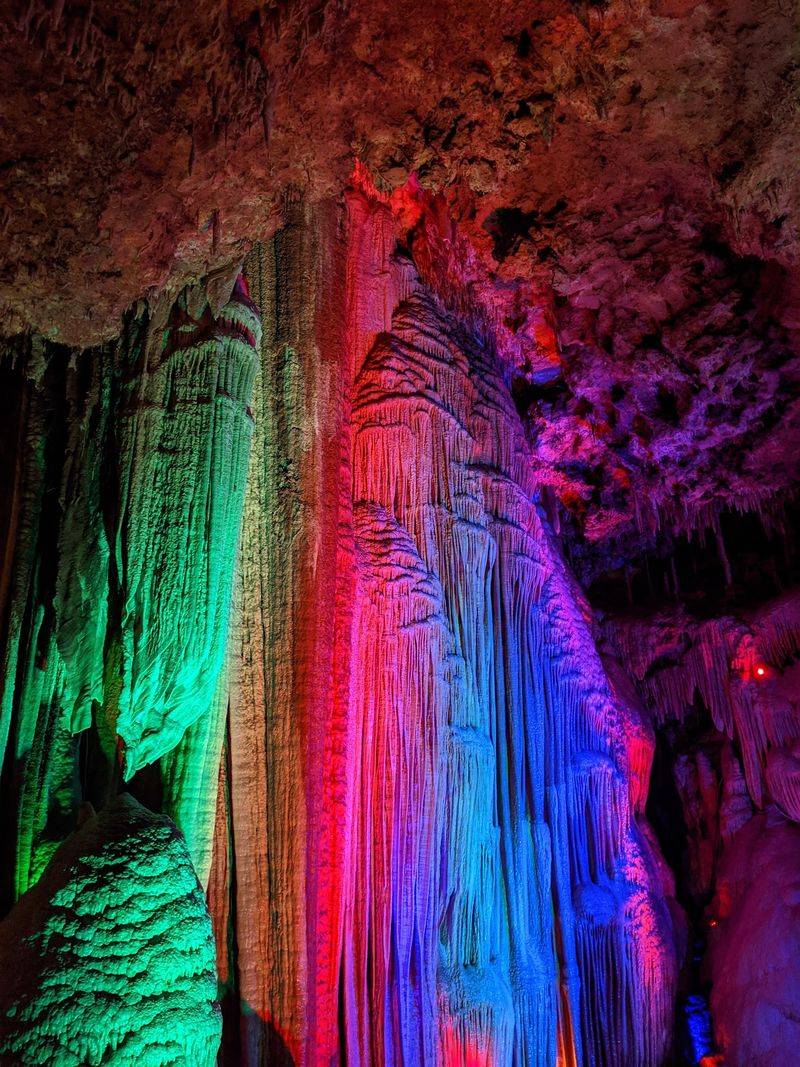
The “Mirror Room” is another showstopper, where still underground pools reflect the ceiling formations so perfectly that the boundary between rock and reflection becomes genuinely disorienting. The “Stage Curtain” formation is a sweeping drapery of stone that billows and folds like heavy fabric, its subtle mineral color shifts catching the light in ways that feel almost theatrical.
Perhaps the most extraordinary structure on the tour is the “Wine Table,” described by geologists as an exceptionally rare formation created entirely underwater. There is reportedly nothing else quite like it in any other cave open to the public. That single detail alone is enough to justify the drive, the ticket price, and every step of the 1.25-mile tour route through these passages.
The Ballroom: Where Geology Meets Good Times
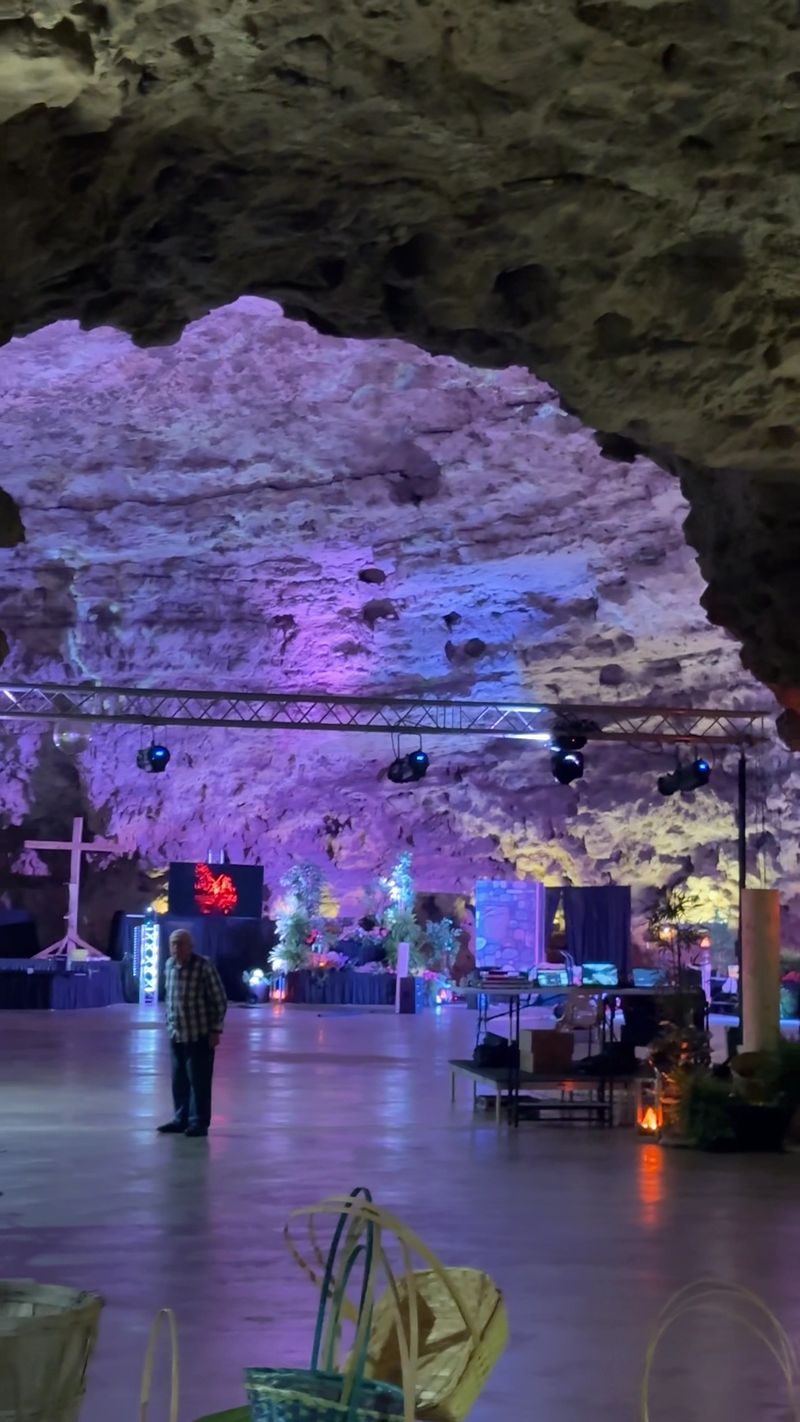
There is something genuinely delightful about the fact that one of the most impressive chambers inside an ancient cave was once used as a dance floor. The Meramec Caverns Ballroom stretches roughly 300 feet long by 50 feet wide, making it one of the largest underground rooms in the cave system and one of the most unexpected social spaces imaginable.
Local residents gathered here for dances and community events in the early 20th century, filling the cave with music, laughter, and the glow of early electric lights. Today, the space still hosts events, and a disco ball now hangs from the cave ceiling, which is honestly one of the most surreal and charming details you will encounter anywhere underground.
The Ballroom also serves as the setting for the tour’s grand finale, a patriotic light show that projects color and imagery across the cave walls and ceiling. Opinions on the show vary, but the sheer spectacle of watching lights play across ancient limestone formations in a room this size is undeniably memorable. It is the kind of ending that lingers with you long after you resurface.
Lester Dill and the Man Who Built an Icon
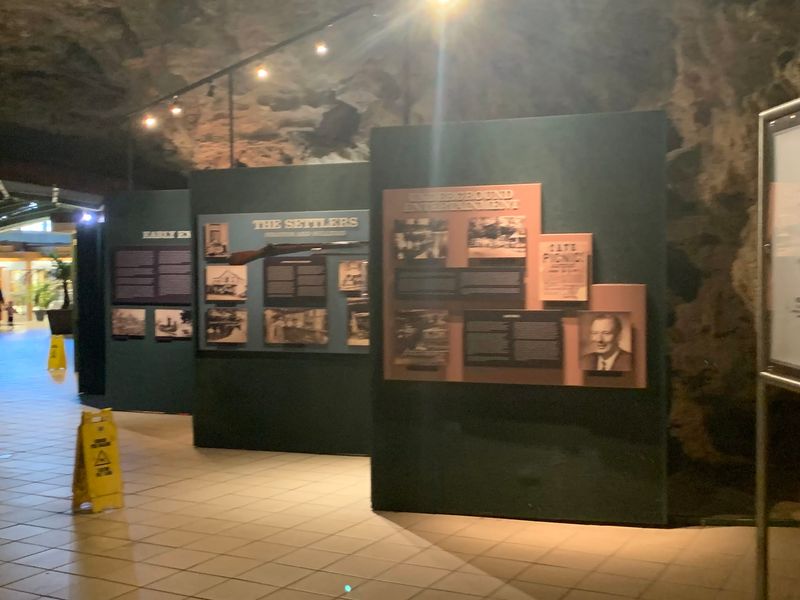
Behind every great attraction there is usually a great promoter, and Meramec Caverns had one of the best. Lester Dill, a local businessman with a flair for showmanship and a genuine love of the cave, opened Meramec Caverns to the public in 1933 and spent the following decades turning it into one of the most recognized roadside attractions in the American Midwest.
His marketing instincts were sharp and ahead of their time. Dill is widely credited with inventing the concept of the bumper sticker, originally called a “bumper sign.” He employed teams of young men, known as “Bumper Sign Boys,” who would attach small cave advertisements to visitors’ cars as a free souvenir and a rolling billboard all at once.
Barn signs promoting the caverns appeared along highways for hundreds of miles, becoming iconic landmarks in their own right along Route 66. Dill also leaned enthusiastically into the Jesse James legend, helping cement those outlaw stories as a central part of the cave’s identity. His vision transformed a remarkable natural feature into a beloved American institution, one that still draws well over 100,000 visitors per year.
Route 66 Royalty: Why This Cave Became a Road Trip Legend
Route 66 gave America its road trip mythology, and Meramec Caverns gave Route 66 one of its most enduring stops. Established in 1926, the Mother Road stretched 2,448 miles from Chicago to Los Angeles, and for generations of families loading up the station wagon and heading west, the painted barn signs for Meramec Caverns were as familiar as Burma-Shave rhymes and roadside diners.
The cave sits just off the original Route 66 corridor near Stanton, Missouri, close enough to the highway that pulling over felt less like a detour and more like an obvious decision. Lester Dill understood the power of the road trip mindset and positioned his cave perfectly within it, making a stop feel almost obligatory for any serious traveler.
Even today, that classic road trip energy is alive on the property. The signage, the gift shop stocked with retro souvenirs, and the unhurried pace of the guided tours all carry the spirit of an era when discovery was the whole point of driving. Visiting Meramec Caverns still feels like completing a rite of passage that generations of American travelers started long before you arrived.
What the Guided Tour Actually Looks Like From Start to Finish
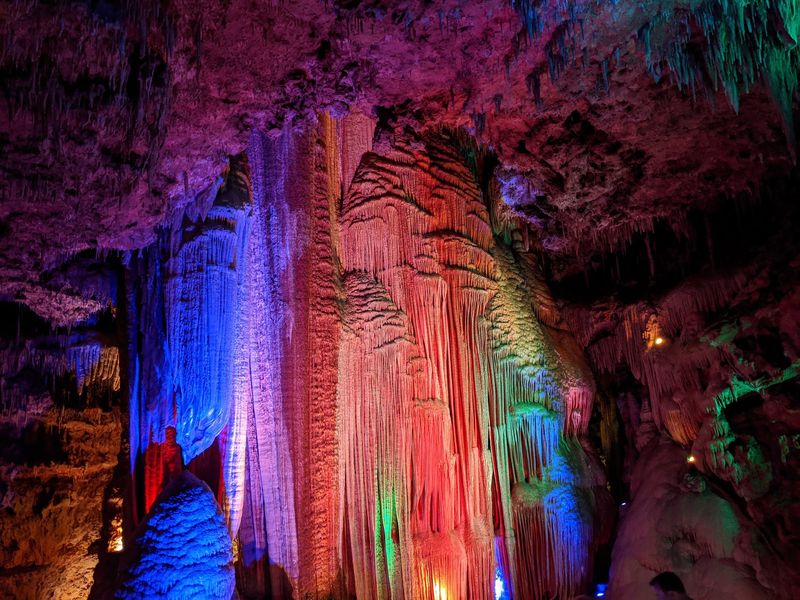
Tours at Meramec Caverns depart every 20 to 30 minutes starting at 9:00 AM, which means the wait is rarely long. Each guided tour covers 1.25 miles of well-lit, paved pathways and lasts approximately one hour and twenty minutes, striking a pace that feels thorough without being exhausting.
The guides are knowledgeable and genuinely entertaining, mixing geological facts with outlaw legends and the occasional cave joke. Groups tend to be a manageable size, and the pacing allows plenty of time to pause, look up, look down, and absorb the details of each chamber before moving on to the next.
The tour covers both a lower and an upper level, with 58 steps leading to the final room. The first roughly 50 minutes of the route is accessible for wheelchairs with assistance, though the stairs in the latter portion present a real challenge. Comfortable, sturdy shoes are strongly recommended since the cave floor can be uneven and occasionally damp in spots. The tour wraps up with the patriotic light show in the Ballroom, a fittingly dramatic close to an already impressive underground journey.
Above-Ground Thrills: Ziplines, River Floats, and More
The cave tour is the centerpiece, but the property around Meramec Caverns offers a surprisingly full lineup of outdoor activities that can easily stretch a half-day visit into a full one. The Caveman Zipline is the most exhilarating option, featuring four ziplines and three swinging bridges with speeds reaching up to 50 miles per hour above the Meramec River valley.
For something more relaxed, the Meramec River itself offers guided float trips covering a six-mile stretch by canoe, kayak, or raft. The journey typically takes three to five hours, winding through forested banks with frequent wildlife sightings and plenty of calm stretches for simply drifting and enjoying the scenery.
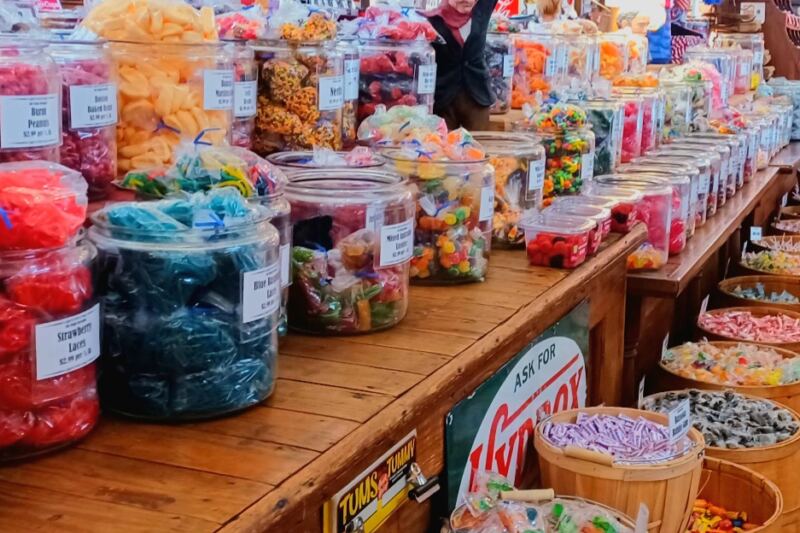
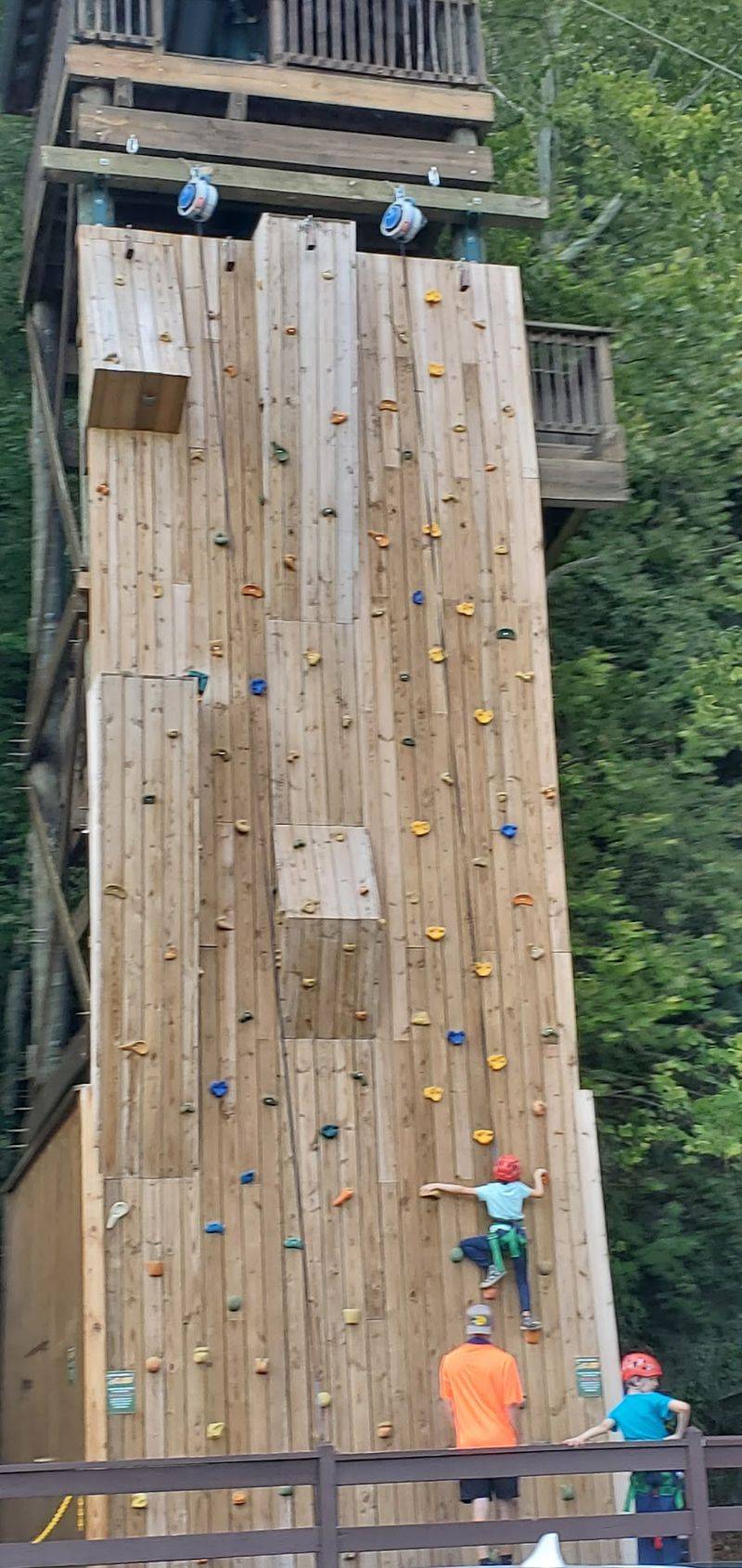
A 40-foot climbing wall with four difficulty levels operates during summer months for those who want a physical challenge above ground after spending time below it. The on-site amenities round out the experience nicely: a restaurant, ice cream bar, fudge shop, candy store, gift shop, gemstone mining activity for kids, a motel, and a full campground with both primitive and full-hookup river-front sites. There is genuinely something here for every type of traveler.
Practical Tips, Pricing, and Making the Most of Your Visit
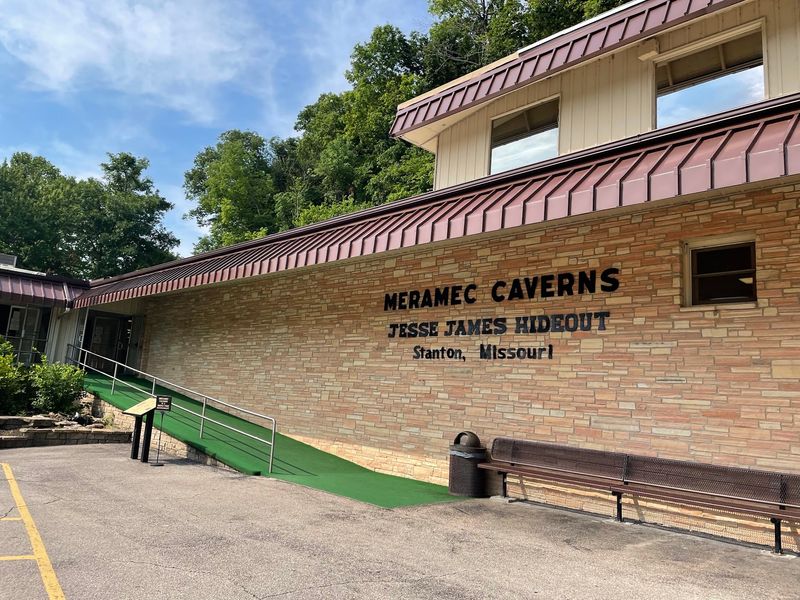
A few practical details can make the difference between a good visit and a great one at Meramec Caverns. The cave operates year-round with the exception of Thanksgiving and Christmas, making it a viable destination across all four seasons. Summer brings the longest hours and the busiest crowds, while spring and fall offer a quieter, more relaxed pace.
Tickets for the cave tour run just over $30 per adult, with pricing for children available on the website at americascave.com. The river boat tour adds a small additional fee and is worth considering as a complement to the underground experience. Dogs are welcome on the property, and free kennels are provided on-site so pets can rest comfortably while their owners explore the cave.
Strollers are not permitted inside the cave, so plan accordingly if traveling with very young children. A light jacket or sweatshirt is genuinely useful regardless of the season outside, since 58 degrees underground feels noticeably cool after a few minutes. Booking tickets in advance online is possible and recommended during peak summer weekends, when tour groups fill up faster than you might expect.
Share this story