India is home to some of the most breathtaking statues and sculptures in the world, ranging from ancient rock-cut masterpieces to towering modern monuments. These incredible works of art tell stories of gods, heroes, philosophers, and warriors who shaped Indian history and culture.
Whether carved from a single block of granite thousands of years ago or built with modern engineering, each sculpture has its own fascinating story. Get ready to explore fifteen remarkable statues and sculptures that make India one of the most artistically rich countries on the planet.
Statue of Unity, Gujarat
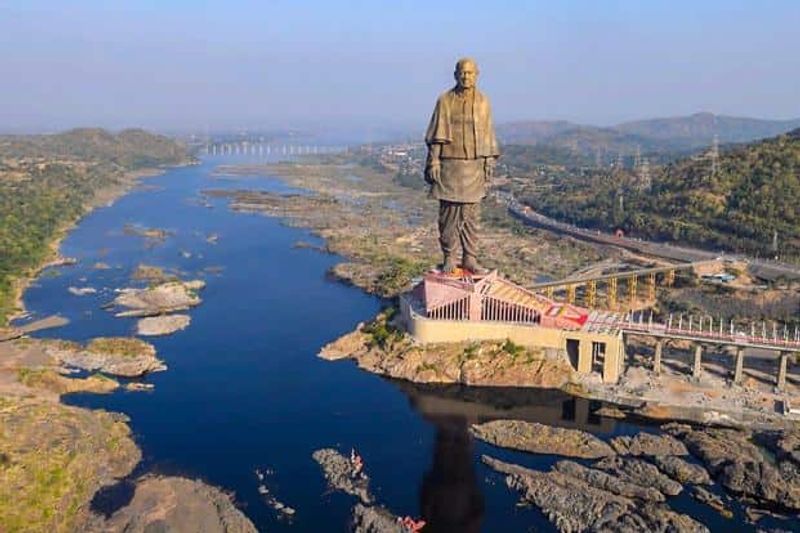
Standing taller than the Eiffel Tower, the Statue of Unity is simply the biggest statue on Earth. At 182 meters above the Narmada River near Kevadia, Gujarat, this colossal figure honors Sardar Vallabhbhai Patel, the man who united India’s hundreds of princely states into one nation.
The height of 182 meters was chosen specifically to match the 182 seats in Gujarat’s state assembly.
Sculptor Ram V. Sutar studied existing portraits and photographs of Patel carefully before designing the monument.
Engineers built tuned mass dampers inside the structure to protect it from earthquakes and powerful winds. Construction started in October 2013 and wrapped up in time for the inauguration on October 31, 2018, Patel’s 143rd birthday.
A viewing gallery sits 153 meters up inside the statue, offering visitors a stunning panoramic view of the Sardar Sarovar Dam and the surrounding valley. Thousands of tourists visit every week, making it one of India’s most popular modern attractions.
The sheer scale of the project used around 70,000 tons of cement and 18,500 tons of reinforced steel.
Statue of Equality, Telangana
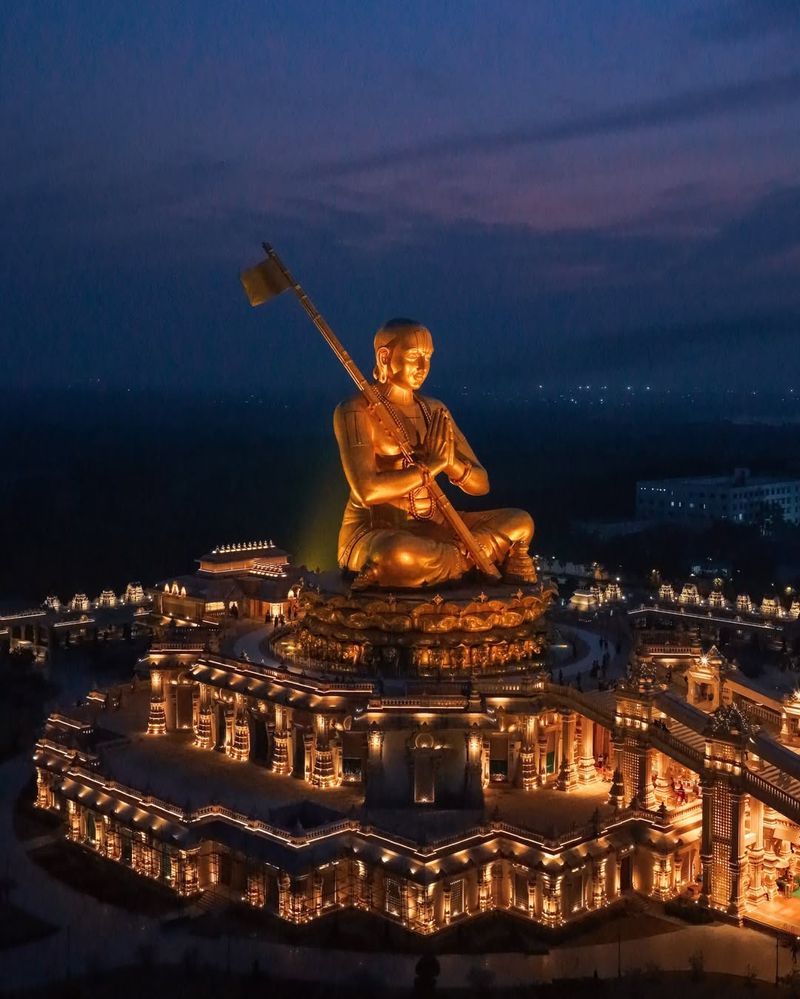
Imagine a seated philosopher so large that his lap could comfortably fit a school bus. The Statue of Equality in Hyderabad depicts the 11th-century Vaishnava saint and philosopher Ramanujacharya, rising 216 feet and making it one of the world’s tallest seated metallic statues.
Inaugurated in February 2022, the monument celebrates 1,000 years since Ramanuja’s birth.
The figure is crafted from a five-metal alloy called panchaloha, a traditional blend used in South Indian religious sculpture. Surrounding the main statue, visitors can explore replicas of 108 Divya Desams, the sacred Vishnu temples associated with Sri Vaishnavism.
This turns the entire complex into a kind of spiritual journey rather than just a single monument.
The name itself carries a deeper meaning than sheer size. Ramanuja was famous for challenging caste-based discrimination and teaching that spiritual liberation is open to everyone regardless of social background.
That philosophy of equality is baked right into the monument’s title, giving it cultural weight that goes far beyond impressive engineering. The complex also houses a digital museum, a meditation hall, and beautifully landscaped gardens.
Thiruvalluvar Statue, Tamil Nadu
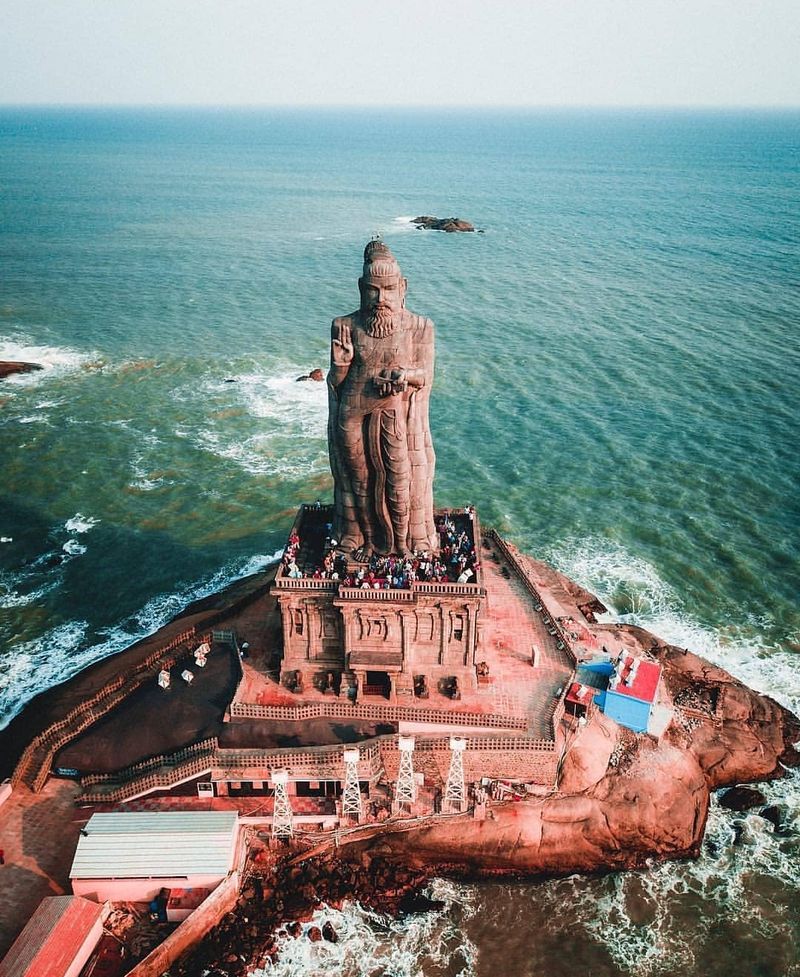
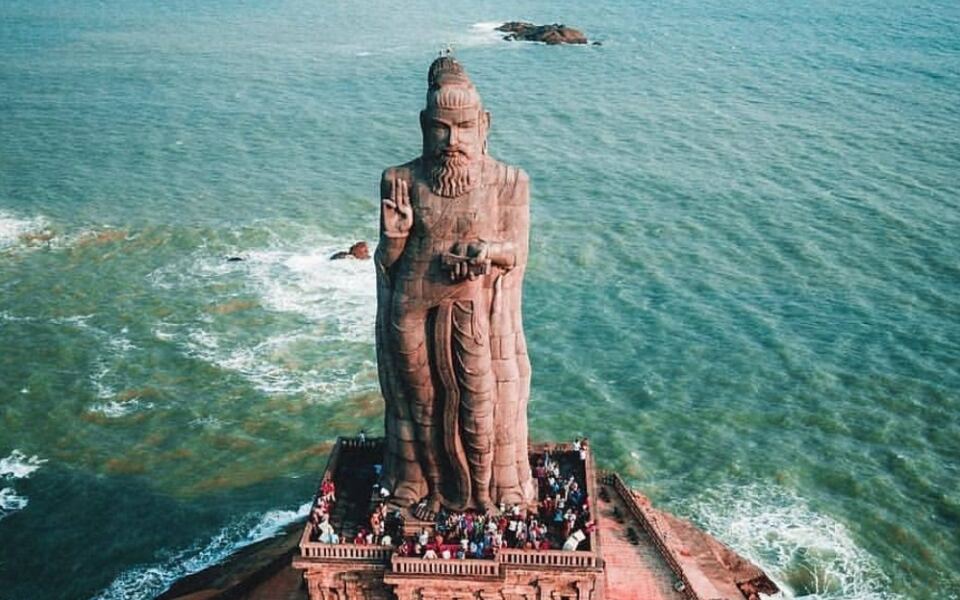
Every measurement of this statue is a secret message about a poem. The Thiruvalluvar Statue near Kanniyakumari encodes the structure of the ancient Tamil text Tirukkural directly into its dimensions.
The full monument stands 133 feet tall, matching the Tirukkural’s 133 chapters, while the 95-foot figure stands on a 38-foot pedestal representing the 38 chapters on virtue.
Sculptor V. Ganapathi Sthapathi led hundreds of craftsmen to bring the project to life, and the statue was inaugurated on January 1, 2000, welcoming the new millennium in style.
Its location on a rocky islet about 400 meters offshore places it at the very tip of peninsular India, where three bodies of water meet: the Bay of Bengal, the Arabian Sea, and the Indian Ocean.
Visitors reach the statue by ferry, and the boat ride itself offers a spectacular view of the figure rising from the sea. On clear days, the nearby Vivekananda Rock Memorial is also visible, creating a dramatic pairing of two iconic landmarks.
Thiruvalluvar’s Tirukkural covers ethics, politics, and love across 1,330 couplets, and this statue ensures that his legacy stands as tall as his wisdom.
Murudeshwar Shiva, Karnataka
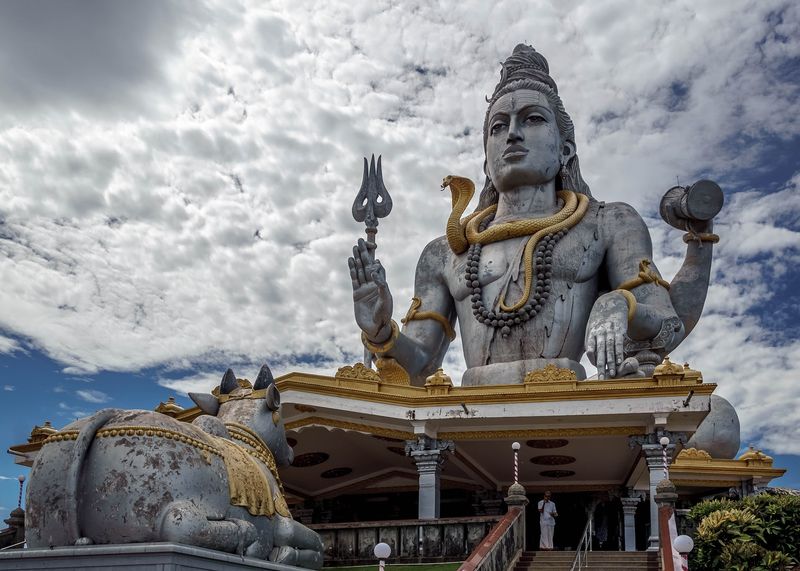
Few statues in India enjoy a backdrop as dramatic as the Murudeshwar Shiva’s. Perched on Kanduka Hill with the Arabian Sea wrapping around three sides of the temple complex, this silver-colored giant rises about 123 feet and commands attention from every angle.
Karnataka Tourism connects the site to the Ramayana, where Ravana is said to have attempted to carry the Atmalinga through this very area.
Behind the Shiva statue, the Raja Gopuram towers at roughly 249 feet, and visitors can take an elevator to the top for sweeping views of the coastline and the statue below. That combination of enormous deity and towering gopuram creates a skyline unlike anything else along India’s western coast.
Sunset here is particularly special, as the fading light catches the silver surface of the statue against the open horizon.
The temple below the statue is an active place of worship, drawing pilgrims and tourists in equal numbers throughout the year. Nearby Netrani Island has become popular with scuba divers and snorkelers, adding an adventurous dimension to a visit.
Murudeshwar manages to be simultaneously a spiritual landmark, an architectural spectacle, and a gateway to some of Karnataka’s best coastal scenery.
Adiyogi Shiva, Tamil Nadu
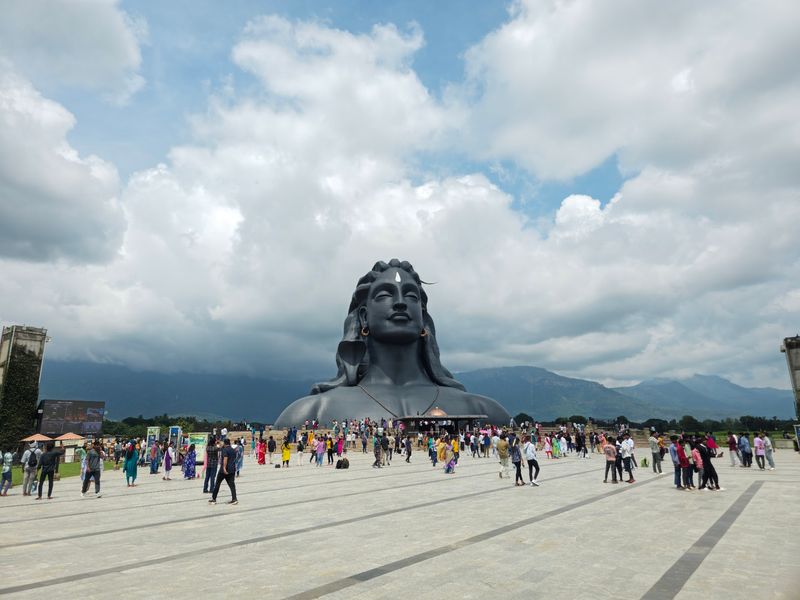
Most statues show a deity from head to toe, but Adiyogi breaks that rule entirely and is more powerful for it. At the Isha Yoga Center outside Coimbatore, this 112-foot black steel bust of Shiva presents just the head and upper torso, creating an almost cinematic sense of presence.
The number 112 is deliberate, referencing 112 paths or possibilities within the yogic tradition.
Designed under the guidance of Sadhguru Jaggi Vasudev, the sculpture is a thoroughly modern creation rather than a replica of ancient temple art. Its dark metallic surface contrasts sharply with the open landscape at the base of the Velliangiri Mountains, making the figure look almost as if it has emerged from the earth itself.
Incredible India describes it as the world’s largest bust sculpture of Lord Shiva.
The Isha Yoga Center draws visitors from across the globe who come for meditation programs, yoga courses, and cultural events. The Adiyogi statue serves as the visual centerpiece of the entire campus and is especially striking when lit up after dark.
It is a fascinating example of how ancient religious imagery can be reinterpreted through contemporary art and engineering without losing its spiritual punch.
Gommateshwara Bahubali, Karnataka
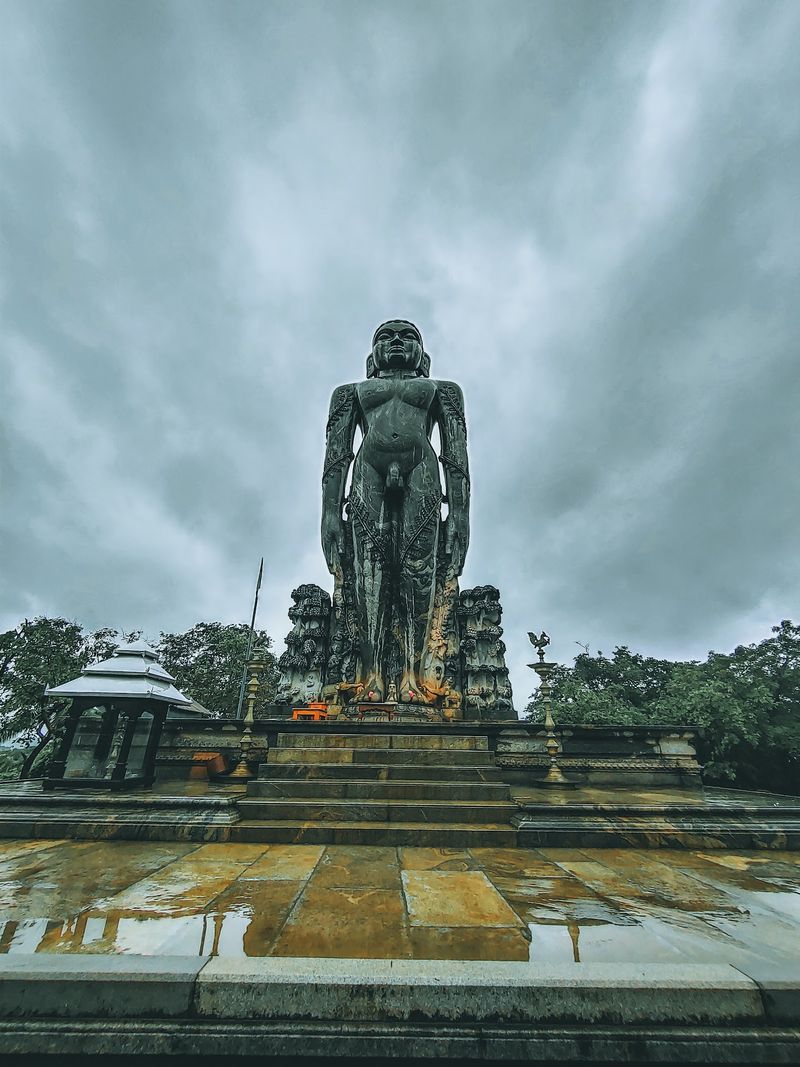
Carved from a single block of granite over a thousand years ago, this towering nude figure has been inspiring pilgrims for longer than most countries have existed. The Gommateshwara Bahubali statue at Shravanabelagola stands roughly 57 to 58 feet tall on Vindhyagiri Hill, and Karnataka’s tourism board identifies it as the world’s largest monolithic statue of its kind.
The image represents Bahubali, a Jain figure whose total stillness in meditation became the ultimate symbol of renunciation.
Vines are carved climbing up his legs, reinforcing the tradition that he stood in meditation so long without moving that plants grew around him. His expression is calm and utterly detached, which is exactly the point.
The sculpture does not try to impress through action or drama but through absolute stillness, which is arguably more powerful.
Every twelve years or so, Shravanabelagola hosts the Mahamastakabhisheka, one of the largest Jain religious gatherings in the world. During this ceremony, the colossal figure is anointed with milk, saffron, water, and other sacred substances poured from scaffolding above.
Hundreds of thousands of devotees attend, turning this ancient carved stone into a living center of faith. The site has been a pilgrimage destination for more than two thousand years.
Buddha of Hussain Sagar, Telangana
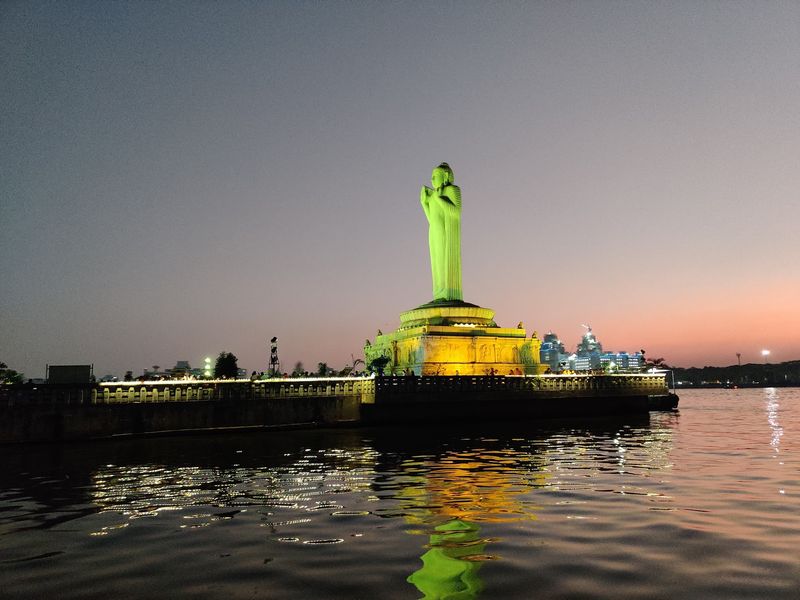
Hyderabad has a lake, and in the middle of that lake stands a Buddha carved from a single block of white granite weighing more than 400 tons. The Buddha of Hussain Sagar rises about 18 meters on Gibraltar Rock, surrounded by water on all sides, creating one of the most visually striking lakeside monuments in India.
Telangana Tourism describes it as a monolithic sculpture accessible only by boat from the shore.
That boat ride is part of the experience. As visitors approach across the water, the white figure grows steadily larger against the open sky, and the city of Hyderabad and Secunderabad spreads around the lake behind it.
After dark, the statue is illuminated and becomes a glowing landmark visible from much of the surrounding shoreline.
The sculpture was installed in the late 20th century and has since become one of the most recognized symbols of the twin cities. The installation itself was reportedly a dramatic event: the statue toppled into the lake during an early attempt to place it on the rock platform and had to be raised from the water before being successfully installed.
That backstory adds a layer of hard-won triumph to what is now a serene and peaceful landmark.
Great Buddha of Bodh Gaya, Bihar
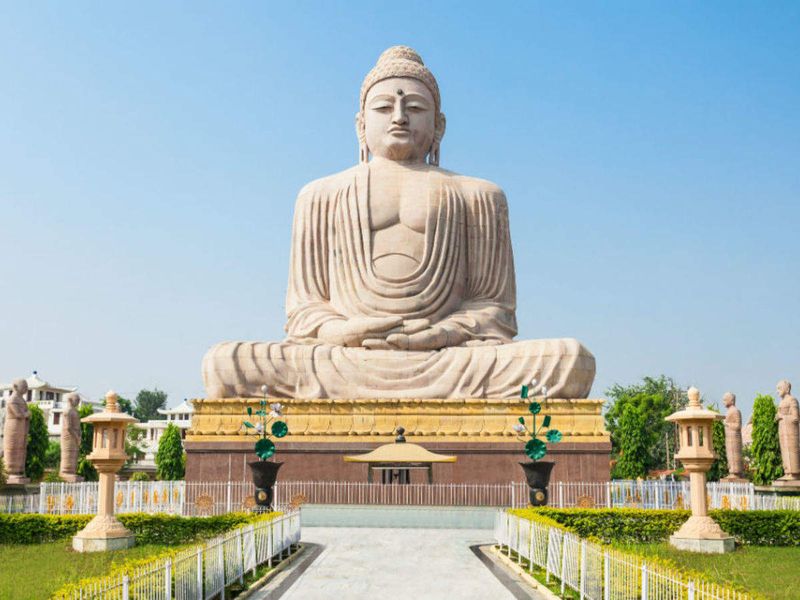
Bodh Gaya is one of the holiest places in Buddhism, the spot where Siddhartha Gautama is believed to have attained enlightenment under the Bodhi tree. Rising 80 feet nearby, the Great Buddha adds a modern monument to an ancient sacred landscape.
Built from sandstone blocks and red granite, the seated figure is shown in deep meditation, surrounded by smaller sculptures of disciples arranged around the base.
The foundation was laid in 1982, and the project took several years to complete. On November 18, 1989, the 14th Dalai Lama personally consecrated the completed statue, drawing an enormous crowd of Buddhist pilgrims and practitioners.
That consecration ceremony connected the new monument directly to living Buddhist tradition rather than leaving it as purely a tourist attraction.
The contrast between the ancient Mahabodhi Temple, a UNESCO World Heritage Site, and this newer monument is genuinely thought-provoking. One dates back over 1,500 years; the other is barely four decades old.
Yet both draw millions of visitors and pilgrims from countries including Japan, Thailand, Sri Lanka, and Tibet. Bodh Gaya has effectively become an international city of Buddhism, and the Great Buddha statue plays a significant role in that global identity.
Hanuman at Jakhu Temple, Himachal Pradesh
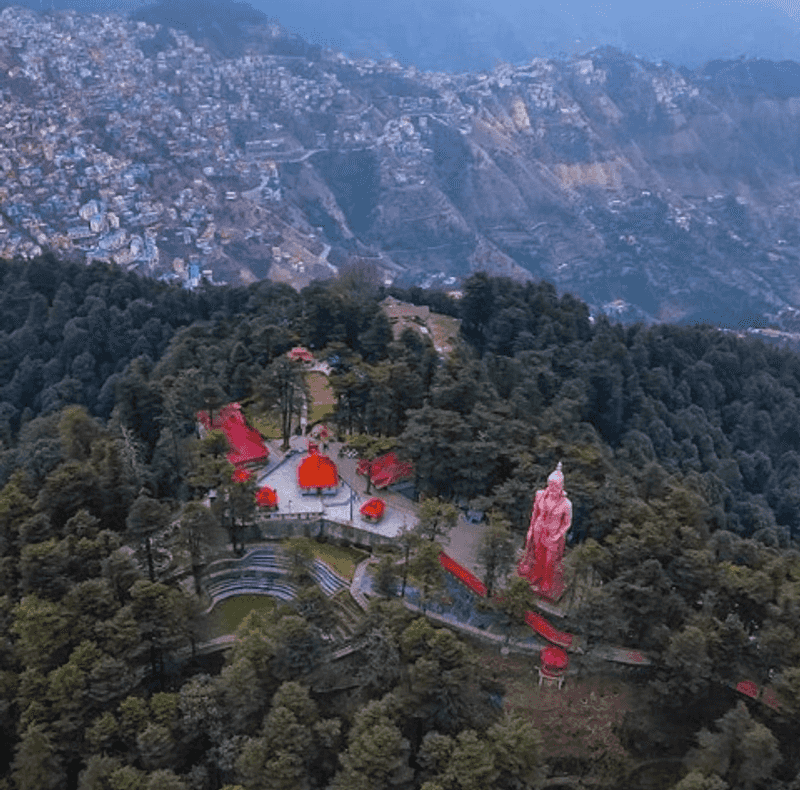
Jakhu Hill already had the advantage of being the highest point in Shimla at roughly 2,450 meters above sea level, and then someone went ahead and put a 108-foot Hanuman statue on top of it. The result is a landmark visible from almost everywhere in the city, a bright orange giant peering over the pine trees and colonial-era buildings below.
Incredible India connects the temple here with the Ramayana tradition that Hanuman paused on this hill while searching for the medicinal Sanjeevani herb.
Visitors can hike up through the forest or take a cable car, and both options come with the bonus of encountering Jakhu’s famously bold monkeys, who are not shy about investigating bags or snacks. The temple at the summit is one of Shimla’s oldest, and the atmosphere combines genuine religious devotion with the buzz of curious tourists arriving from below.
From the base of the statue, the views stretch across Shimla’s ridgeline and out toward the surrounding Himalayan foothills. The 108-foot height carries symbolic weight in Hindu tradition, as 108 is considered a sacred number.
That detail transforms what might otherwise seem like a straightforward modern monument into something with deeper spiritual reasoning behind every inch of its construction.
Arjuna’s Penance, Tamil Nadu
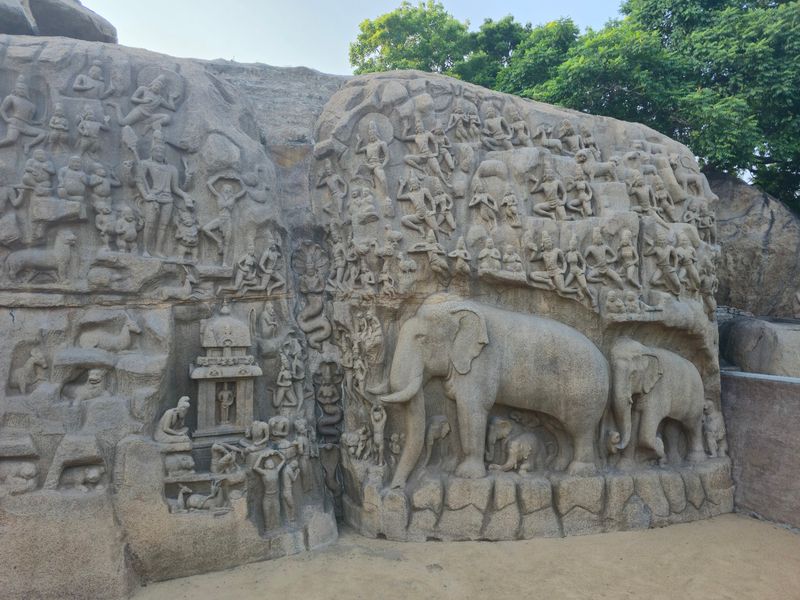
This is not a statue you look up at from below. Arjuna’s Penance at Mamallapuram spreads across two enormous granite rock faces at roughly 100 feet wide and 43 feet high, making it one of the largest open-air bas-reliefs anywhere in the world.
Carved during the 7th century by Pallava craftsmen, the scene is packed with gods, ascetics, elephants, monkeys, mythical serpents, and celestial beings arranged around a natural vertical cleft in the rock.
Scholars still debate what the central narrative actually depicts. One interpretation links the scene to Arjuna’s penance from the Mahabharata, while another connects it to the legend of Bhagiratha bringing the sacred Ganges River down to Earth.
The ambiguity is part of what makes the carving endlessly fascinating to art historians and casual visitors alike.
Mamallapuram itself is a UNESCO World Heritage Site and contains one of the most remarkable concentrations of Pallava-era stone carving anywhere in South India. Rock-cut caves, monolithic shrines called rathas, and the famous Shore Temple all share the landscape with this enormous relief.
Arjuna’s Penance stands out even among that extraordinary company because of its sheer scale and the extraordinary energy packed into every carved surface.
Lakshmi Narasimha of Hampi, Karnataka
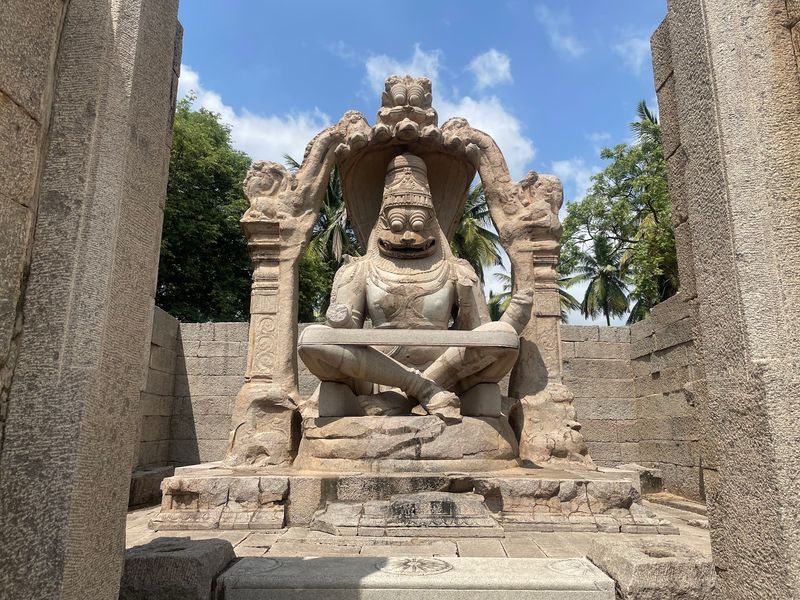
Half man, half lion, and entirely unforgettable: the Lakshmi Narasimha statue at Hampi is one of the most visually intense sculptures in India. Carved from a single rock and rising 6.7 meters, the figure depicts Vishnu in his fierce Narasimha avatar, seated cross-legged on the coiled body of the serpent Adishesha, whose seven hoods fan out dramatically above the deity’s head.
The protruding eyes and broad chest earned the sculpture its other name: Ugra Narasimha, meaning the fierce one.
The statue originally showed Lakshmi seated beside Narasimha, but after the fall of the Vijayanagara Empire in the 16th century, the monument suffered significant damage. Only faint traces of Lakshmi’s figure remain on the left side of the sculpture today.
Rather than diminishing the statue’s power, that historical damage has become part of its story, a physical record of the empire’s violent collapse.
Hampi itself is a UNESCO World Heritage Site spread across a surreal landscape of giant boulders, ruined temples, and ancient market streets. The Lakshmi Narasimha statue sits in an open enclosure near the Krishnadeva Raya canal and is one of the first major monuments visitors encounter when exploring the site.
Its raw scale and fierce expression make it one of Hampi’s most photographed landmarks.
Lion Capital of Ashoka, Uttar Pradesh
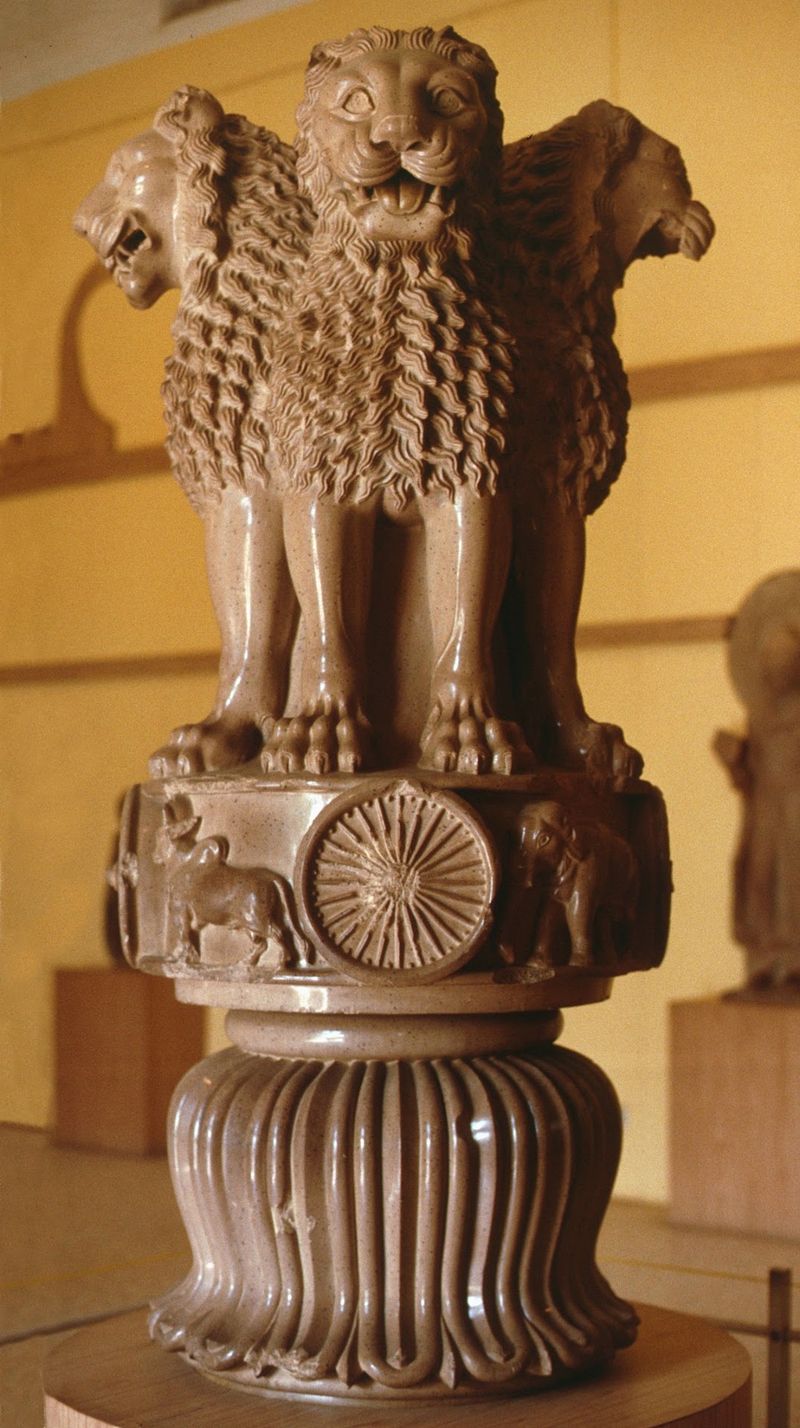
Small in size but enormous in meaning, the Lion Capital of Ashoka punches far above its weight in terms of historical importance. Created in the 3rd century B.C. for a pillar erected at Sarnath, the sandstone sculpture shows four lions standing back-to-back above an abacus decorated with a horse, bull, elephant, and lion, all separated by spinning Dharma wheels.
The polished surface has a glassy quality that is a hallmark of Mauryan stonework.
Sarnath is the place where the Buddha gave his first teaching after attaining enlightenment, making the site deeply significant in Buddhist history. Emperor Ashoka erected pillars across his empire after converting to Buddhism, and the Sarnath capital is the finest surviving example.
Today it is preserved in the Sarnath Museum, just steps from the ancient site where it originally stood.
In 1950, independent India chose an adaptation of this very sculpture as its national emblem. The Dharma wheel from its abacus also appears at the center of India’s national flag.
A 3rd-century carved stone therefore sits at the visual heart of a 21st-century republic, quietly connecting Mauryan imperial art, Buddhist history, and modern Indian identity in a way no other sculpture in the country can claim.
Didarganj Yakshi, Bihar
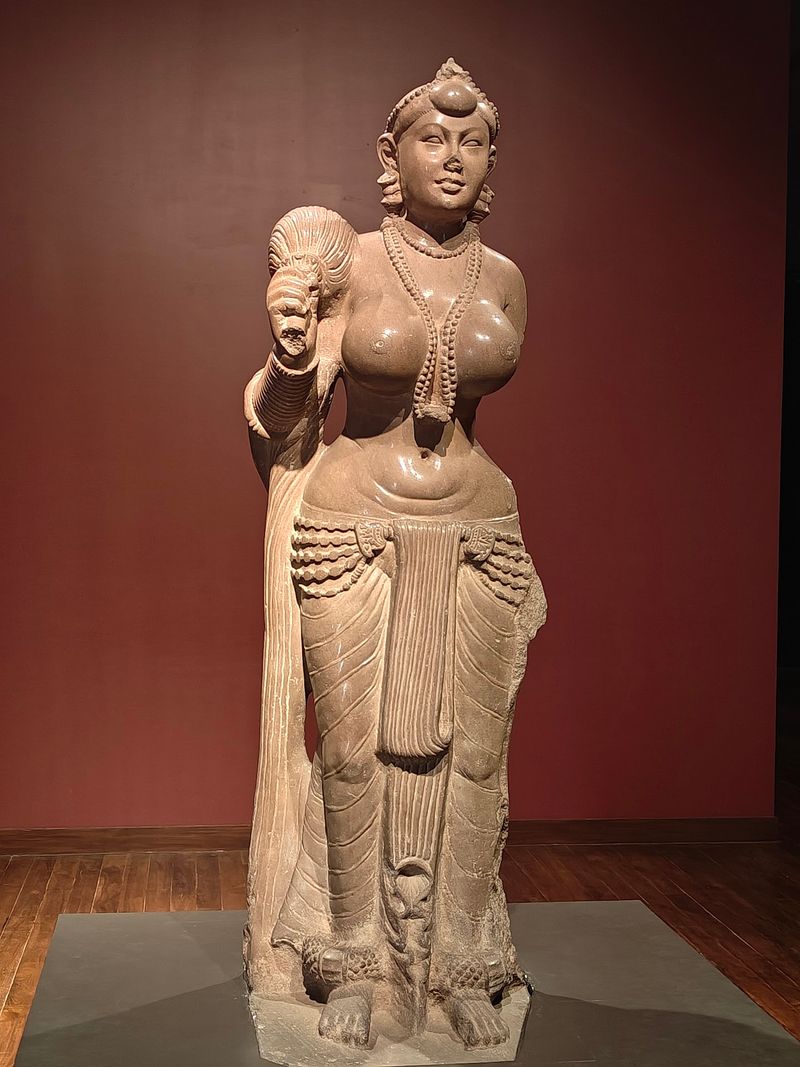
Run your eyes across this sculpture and you might wonder how ancient craftsmen polished sandstone to look almost like glass. The Didarganj Yakshi, discovered near Patna and now housed in the Patna Museum, is celebrated for exactly that quality: a surface so finely finished it appears to reflect light like a mirror.
The female figure holds a fly whisk and is adorned with elaborate jewelry rendered in careful detail across her arms, waist, and neck.
Incredible India’s museum material places the sculpture at around the 3rd century B.C. and associates it with the Mauryan period, though scholars have debated its precise dating for decades. That ongoing discussion has only added to its mystique.
What everyone agrees on is the extraordinary craftsmanship: the modeling of the body, the weight of the jewelry, and the overall sense of physical presence are all exceptional for any era.
The Yakshi tradition in Indian art depicts female nature spirits associated with fertility and abundance. This particular example is considered one of the finest figurative sculptures from ancient eastern India and is among the signature pieces of Bihar’s rich archaeological heritage.
Seeing it in person at the Patna Museum, even without knowing its full backstory, tends to stop visitors in their tracks.
Monolithic Nandi at Lepakshi, Andhra Pradesh
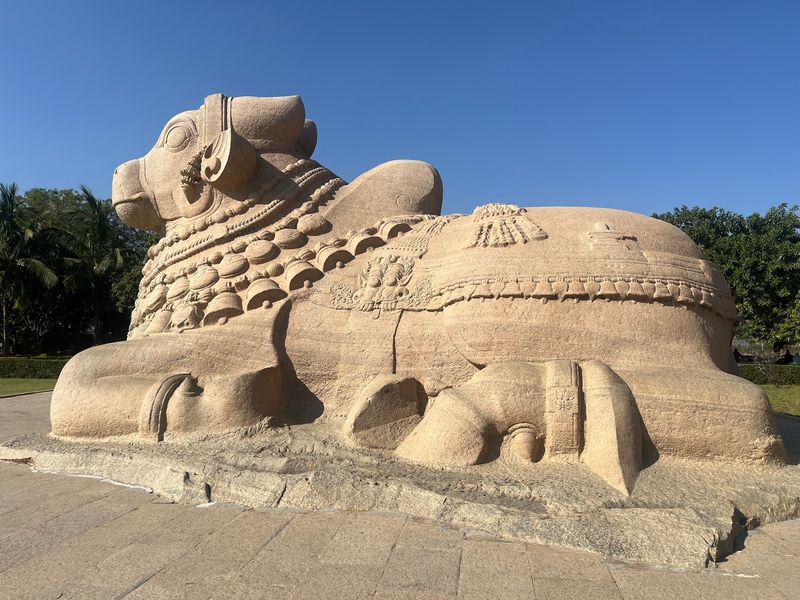
Lepakshi’s Nandi proves that a seated animal can be just as commanding as any towering deity. Carved from a single block of granite, this enormous bull measures roughly 15 feet high and 27 feet long, earning its reputation as India’s largest monolithic Nandi.
Every surface of the sculpture is covered with carefully carved necklaces, bells, and ornamental patterns that soften the raw mass of the stone and reward close inspection.
The Nandi faces toward the Veerabhadra Temple complex, fulfilling its traditional role as Shiva’s devoted vehicle and guardian. The temple itself is famous for its vivid Vijayanagara-period murals and for a remarkable architectural oddity: a pillar that appears to hang without touching the ground, which has puzzled and delighted visitors for centuries.
The Nandi sculpture belongs to this broader atmosphere of artistic ambition that defines Lepakshi.
Reaching Lepakshi from Bangalore takes roughly two to three hours by road, and the journey is well worth it for anyone interested in medieval South Indian art. The village is compact but extraordinarily rich in stone carving, wall painting, and architectural detail.
Standing beside the Nandi and realizing that a single granite boulder was shaped into this level of refinement by hand makes the entire trip feel like time travel into the Vijayanagara era.
Shiva Sculptures of Elephanta, Maharashtra
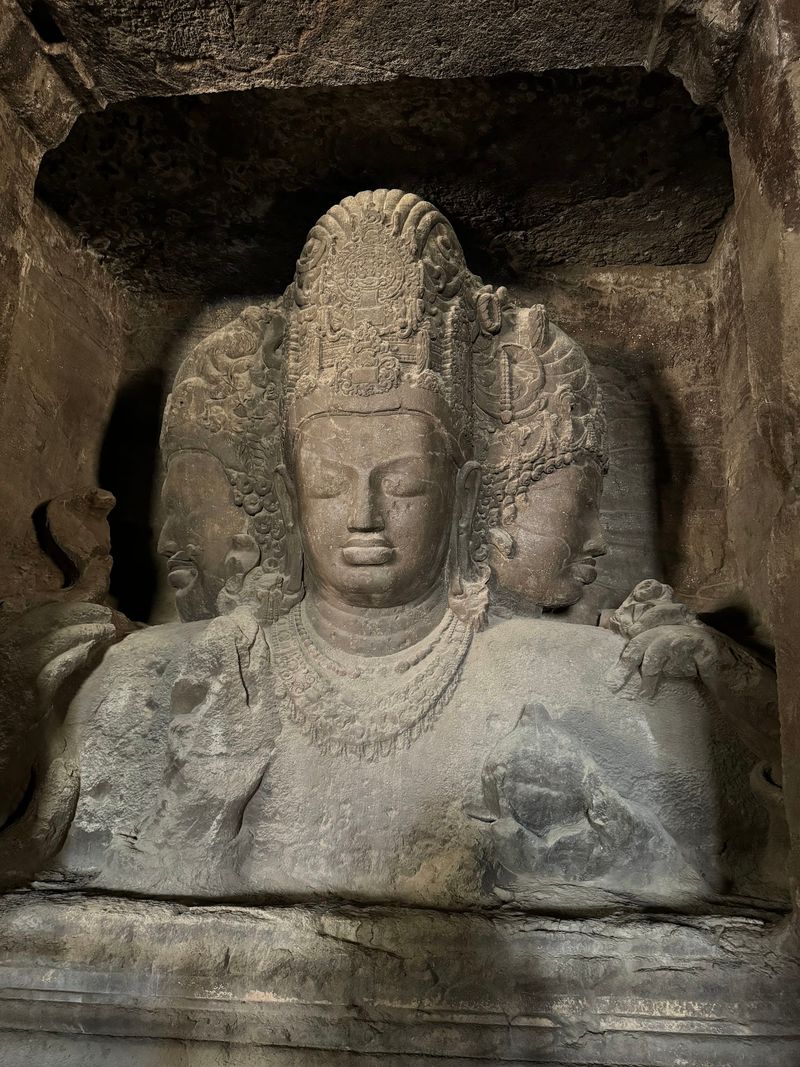
Carved directly into a basalt island in Mumbai Harbour, the Elephanta Caves do not separate sculpture from architecture because here they are the same thing. The cave temples date from roughly the 5th to 7th centuries and contain an extraordinary program of rock-cut reliefs devoted to Shiva in multiple forms: Nataraja the cosmic dancer, Ardhanarishvara the half-male half-female deity, and others.
The star of the collection is the three-faced Trimurti, also called Sadashiva, whose serene central face is flanked by two dramatically different profiles.
The central face radiates calm and cosmic authority, while the side faces convey fierce power and tender compassion. Together they represent different aspects of Shiva’s nature, and the contrast is intentional and deeply thought out.
Art historians consider the Trimurti one of the finest achievements of early medieval Indian sculpture anywhere in the subcontinent.
Elephanta Island is reached by ferry from the Gateway of India in Mumbai, and the boat ride across the harbour is a pleasure in itself. The caves are a UNESCO World Heritage Site, and despite centuries of damage including some inflicted by Portuguese soldiers in the 16th century, the surviving sculptures retain an extraordinary sense of power and refinement.
Visiting Elephanta feels less like touring a museum and more like stepping inside a work of art.
Share this story