Most ancient buildings end up as ruins behind a rope barrier, but a handful never got the memo. These structures have been continuously used for centuries, sometimes millennia, serving as churches, lighthouses, bridges, theaters, and even lived-in neighborhoods.
They were built so well, and adapted so cleverly, that the modern world simply kept using them. From Roman amphitheaters ringing with opera to a monastery that has never once closed its doors, these fourteen places prove that good architecture never really retires.
Pantheon, Rome, Italy
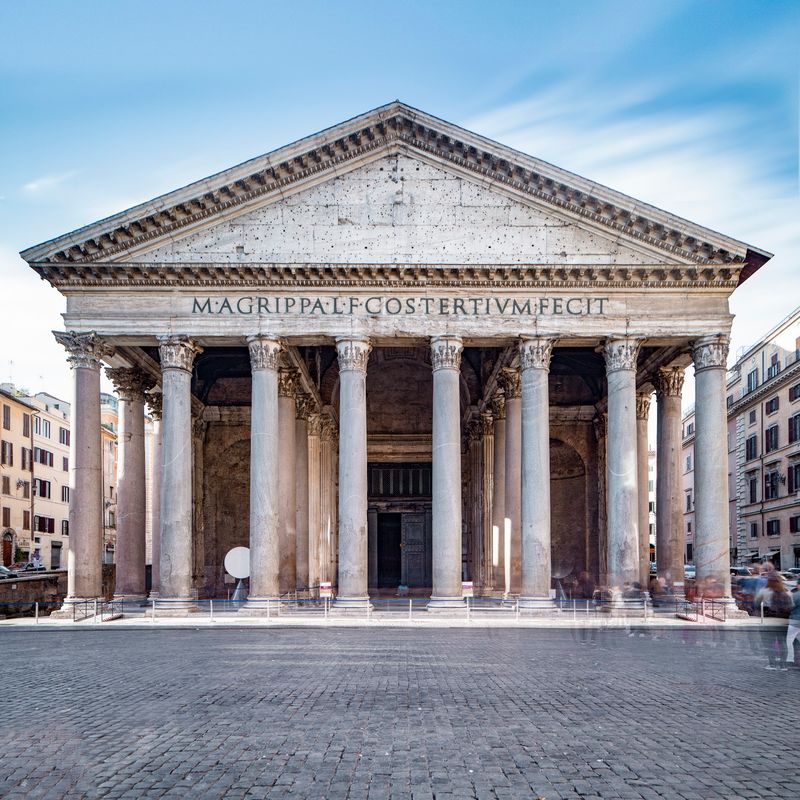
Walk through the Pantheon’s bronze doors and you are standing inside a building that has been in continuous use for nearly 1,900 years. Emperor Hadrian completed the current structure in the second century A.D., and its unreinforced concrete dome still spans a jaw-dropping 43.3 meters.
The circular oculus at the top, nine meters wide, is the only source of natural light and also the only opening in the roof.
In 609 A.D., Pope Boniface IV consecrated the building as a Christian church, a move that almost certainly saved it from being stripped for materials like so many other Roman monuments. That conversion meant the Pantheon never stopped being used for worship.
Mass is still celebrated there regularly today.
Visitors from around the world crowd the piazza outside, but this is not a museum. The building functions as an active Catholic parish, which makes it uniquely alive among ancient Roman structures.
Tombs inside include those of the Renaissance painter Raphael and two Italian kings. Few buildings on Earth have served so many generations so faithfully without ever becoming a ruin.
Tower of Hercules, A Coruna, Spain
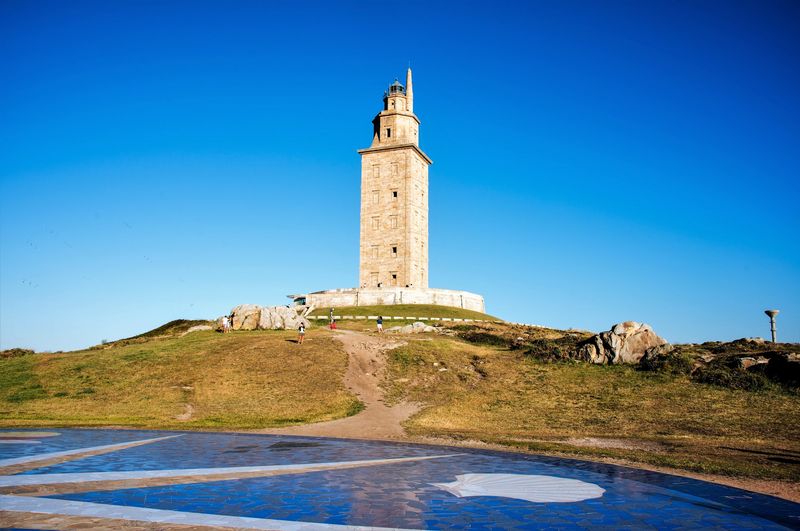
Imagine a lighthouse so old that Roman sailors once looked up at its flame to find their way home. The Tower of Hercules in A Coruna, Spain, was built around the late first or early second century A.D., making it the oldest lighthouse in the world that is still fully operational.
Its Roman core remains intact inside an exterior that was redesigned during the late 18th century.
UNESCO recognized it as a World Heritage Site in 2009, partly because no other fully preserved Roman lighthouse anywhere continues to do its original job. Modern navigation technology now lives inside those ancient walls, but the mission has not changed at all.
Ships approaching the northwestern Atlantic coast of Spain still use the tower as a reference point.
The surrounding park features Celtic rock carvings and a small rose garden, giving the site a layered cultural identity that stretches from pre-Roman times to the present. Climbing to the top rewards visitors with sweeping ocean views.
The tower stands as proof that when ancient engineers got something right, the world simply never bothered to replace it.
Arena di Verona, Verona, Italy
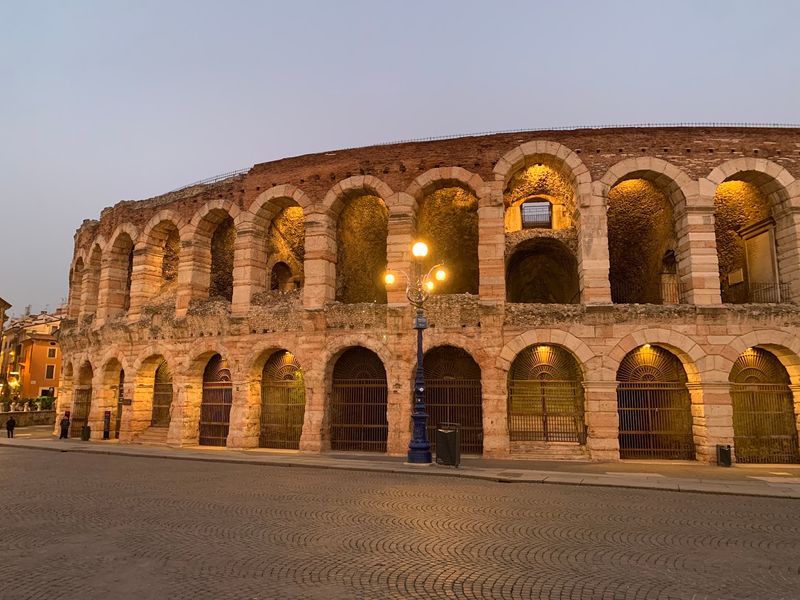
On summer evenings in Verona, thousands of people carry candles into a Roman amphitheater and wait for the first notes of an opera to fill the ancient air. The Arena di Verona was built in the first century A.D. for gladiatorial spectacles, but since 1913 it has hosted one of the world’s most beloved open-air opera festivals.
That year, a production of Aida marked the centenary of Giuseppe Verdi’s birth, and the tradition has rolled on ever since.
The seating capacity reaches roughly 15,000 people, making it one of the largest opera venues anywhere on the planet. The sheer scale of the space allows for elaborate, visually stunning stage designs that indoor theaters simply cannot match.
Productions regularly feature elephants, horses, and massive set pieces that would be impossible to stage elsewhere.
The stone that Roman workers cut and stacked nearly two millennia ago now vibrates with soprano voices and orchestral crescendos every summer. The 2026 Arena di Verona Opera Festival continued that tradition without missing a beat.
Few places so effortlessly blur the line between living history and living art, making every performance feel like something genuinely extraordinary.
Pula Arena, Pula, Croatia
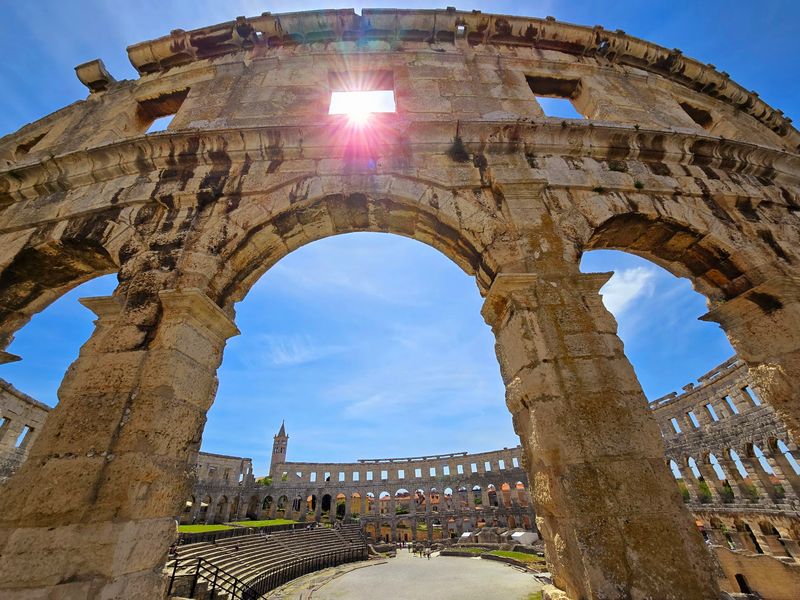
Most Roman amphitheaters are missing large chunks of their outer walls, which is exactly what makes Pula’s arena so startling. Built primarily during the first century A.D., the elliptical structure preserves all four of its exterior towers and nearly all of its outer wall, a level of completeness that is genuinely rare among surviving Roman monuments.
Standing outside it feels less like visiting a ruin and more like approaching a building that is simply very, very old.
Originally designed for gladiatorial contests and public spectacles, the arena now hosts a packed calendar of concerts, film screenings, and cultural festivals throughout the year. The basic geometry of the space has not changed at all: performers work the central floor while audiences surround them in tiered seating.
That arrangement worked brilliantly for Roman crowds, and it still works brilliantly today.
One of the most popular events is the Pula Film Festival, which has been held inside the arena since 1954. Watching a movie under the stars inside a 2,000-year-old amphitheater is the kind of experience that is almost impossible to describe without sounding like you are exaggerating.
Pula’s arena earns its reputation as one of Croatia’s most impressive ancient sites still in active, enthusiastic use.
Ancient Theatre of Orange, Orange, France
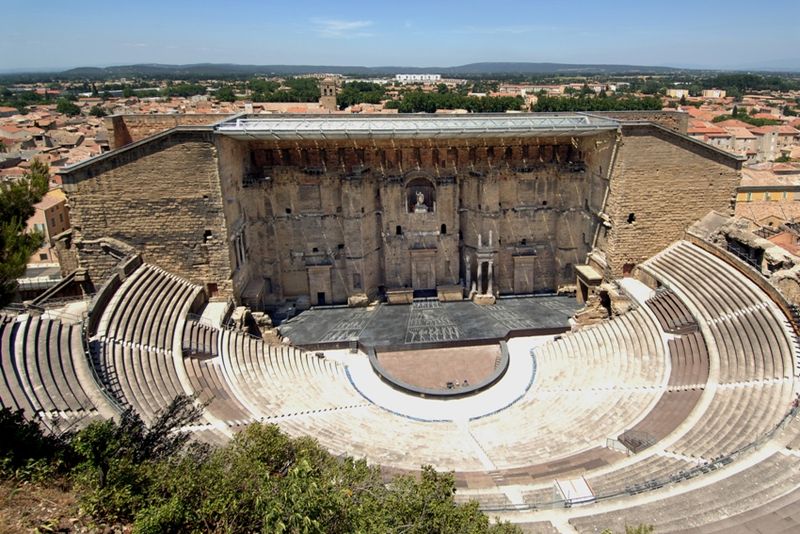
The stage wall at Orange is so enormous that the Roman emperor Augustus reportedly called it the finest wall in his empire. Built during his reign in the first century A.D., the facade rises more than 30 meters and stretches across the back of the theater like a stone cliff face.
That wall is the reason the theater still works so well for live performances today, because it acts as a natural sound reflector that carries voices clearly to every seat.
The Choregies d’Orange, a classical music and opera festival with roots stretching into the 19th century, regularly fills the ancient auditorium with audiences of around 8,000 people. Singers performing in front of that towering Roman backdrop are framed by the same architecture that once hosted theatrical performances during antiquity.
The visual effect is genuinely stunning and unlike anything a modern concert hall can replicate.
UNESCO added the theater to its World Heritage list in 1981, recognizing both its architectural significance and its continued cultural role. The seating is carved into a natural hillside, which helped preserve the structure over the centuries.
Orange is a small city, but its theater gives it a cultural footprint far larger than its size would suggest.
Arena of Nimes, Nimes, France
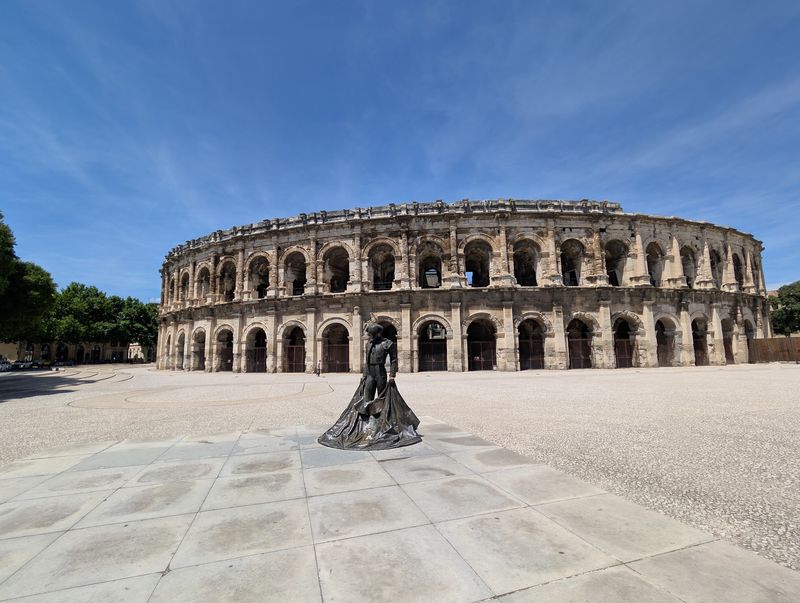
Nimes has been doing something clever with its Roman amphitheater for centuries: finding new uses for it whenever the old ones stopped working. Built around the end of the first century A.D., the arena originally hosted gladiatorial contests and animal hunts for Roman crowds.
During the Middle Ages, local people moved inside the walls and essentially turned the amphitheater into a fortified village, complete with houses and a church tucked between the ancient arches.
Today the arena has returned to large-scale public entertainment in a big way. The Festival de Nimes packs the venue with contemporary concerts every summer, while traditional bullfighting events continue to draw passionate crowds.
In 2026 alone, dozens of concerts were scheduled across the summer season, proving that the ancient venue has lost none of its crowd-pulling appeal.
The two levels of arched stonework that frame the elliptical arena are remarkably well preserved, giving visitors a clear sense of what a Roman amphitheater looked like when it was new. A retractable roof structure has been added to allow year-round events, which means the arena now hosts everything from rock concerts to ice skating shows.
Ancient bones, very modern fun.
Aspendos Theatre, Aspendos, Turkey
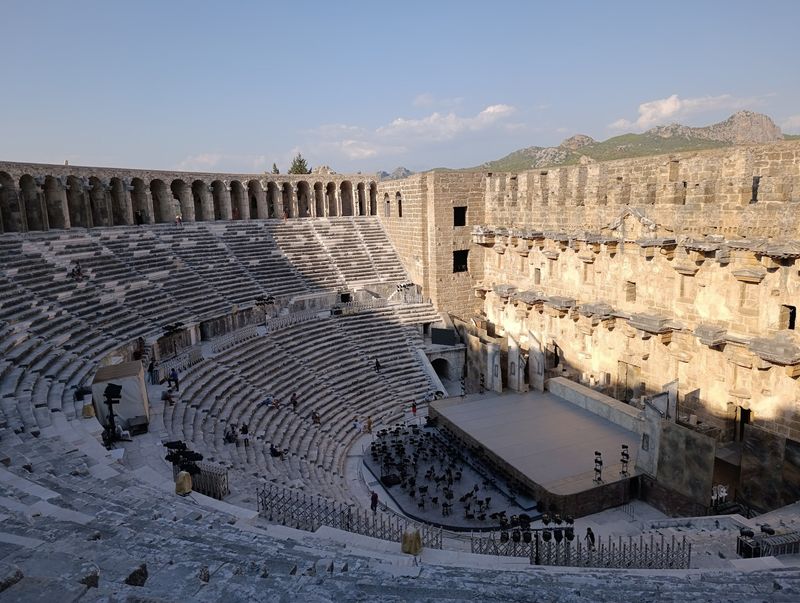
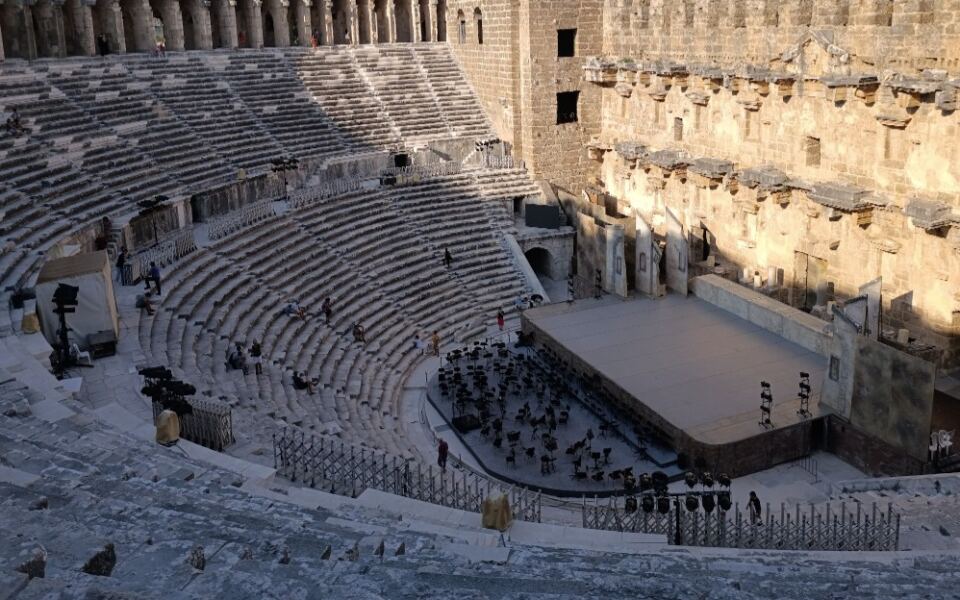
Acoustics engineers who visit Aspendos sometimes leave shaking their heads in quiet admiration. The Roman theater built here during the second century A.D. produces such clean, natural sound that a whisper on the stage floor can reportedly be heard in the back rows without any amplification whatsoever.
Roman engineers achieved this through careful geometry, the angle of the seating, and the two-story stage building that acts as a giant sound reflector behind the performers.
The theater’s survival owes a debt to the Seljuks, who recognized its value and repaired it rather than letting it fall apart. They even used the stage building as a caravanserai, a roadside inn for traveling merchants, which kept the structure maintained and occupied through the medieval period.
That practical reuse helped preserve what might otherwise have become a pile of stones.
Today, concerts and cultural performances periodically bring audiences back into the ancient seating. The Aspendos International Opera and Ballet Festival has used the theater as its primary stage, placing modern performers inside one of antiquity’s most perfectly preserved venues.
Sitting in those stone seats while music fills the air is one of those rare travel experiences that genuinely connects the present to the ancient past.
Diocletian’s Palace, Split, Croatia
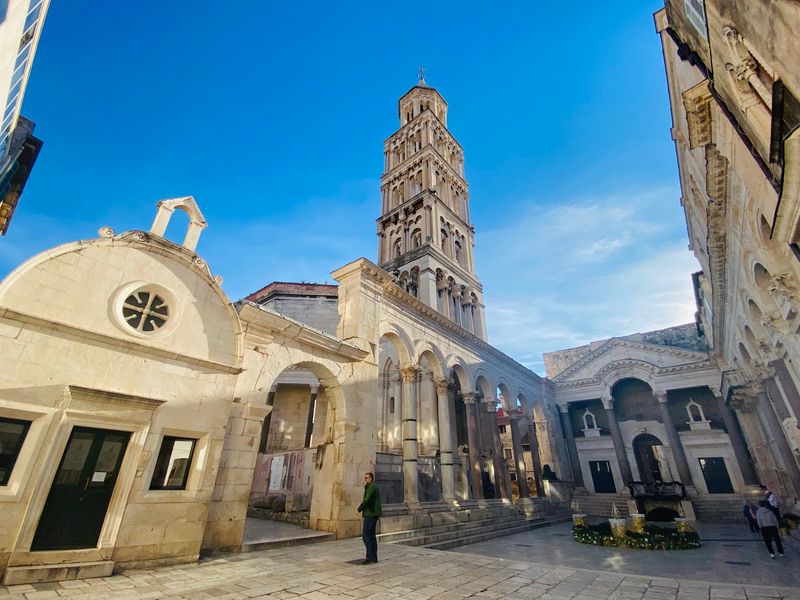
Diocletian’s Palace is the only entry on this list where the ancient structure is quite literally someone’s apartment building. Emperor Diocletian had the enormous fortified complex built around 295 to 305 A.D. as his retirement home, combining imperial luxury with military-grade defensive walls.
When imperial power collapsed and Diocletian’s successors stopped caring about the place, local people did something wonderfully practical: they moved in.
Over the following centuries, residents carved up the grand halls, built houses inside the colonnades, constructed churches in the courtyards, and turned the emperor’s mausoleum into a cathedral. The palace walls became the walls of a living neighborhood.
Streets, squares, restaurants, and apartments now occupy spaces that were once imperial reception rooms and guard barracks.
Today, around 3,000 people live and work within the ancient footprint, making it one of the most densely inhabited ancient monuments anywhere in the world. You do not enter Diocletian’s Palace through a museum gate because there is no single entrance.
You simply walk into the old city of Split and realize, gradually, that the ancient walls are everywhere around you. It is history you can eat dinner inside, which is a genuinely remarkable thing.
Roman Bridge of Cordoba, Cordoba, Spain
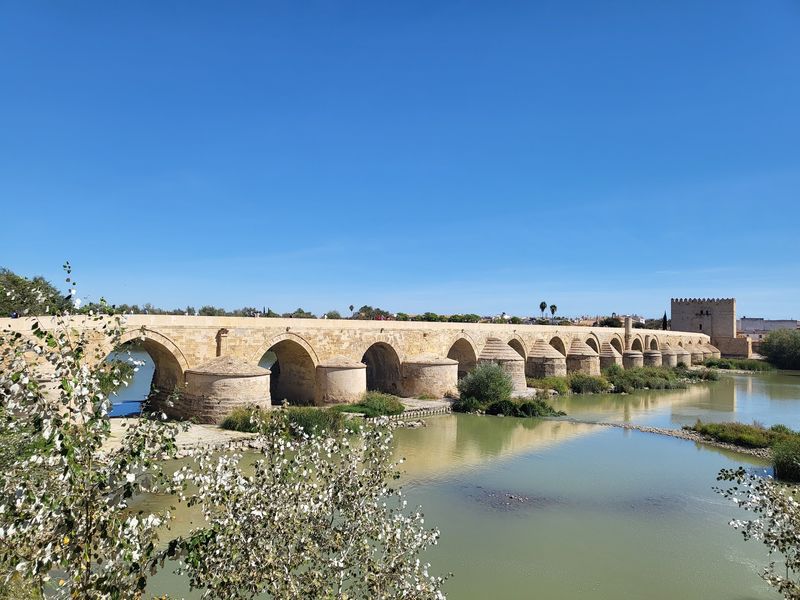
For more than 2,000 years, people have been crossing the Guadalquivir River at Cordoba on essentially the same bridge. The original Roman crossing was probably built during the first century B.C., when the city was an important hub in Roman Hispania.
Sixteen stone arches carry the approximately 247-meter span across the river, connecting the historic city center to the southern bank where the Calahorra Tower stands guard.
Almost every century since has left its mark on the bridge through repairs, rebuilding, and modification, so the masonry visible today reflects a long accumulation of work rather than purely Roman craftsmanship. Medieval reconstruction accounts for much of what visitors walk across today.
Still, the bridge follows the same line, crosses the same river at the same point, and serves the same basic purpose that Roman engineers originally intended.
Modern vehicles are no longer permitted on the bridge, which has been reserved for pedestrians, making it a pleasant and popular riverside walk. At dusk, the stone arches glow golden against the water and the Mezquita-Catedral rises dramatically in the background.
Locals use it daily as a practical shortcut, completely unfazed by the fact that they are strolling across ancient history on their way to grab coffee.
Alcantara Bridge, Alcantara, Spain
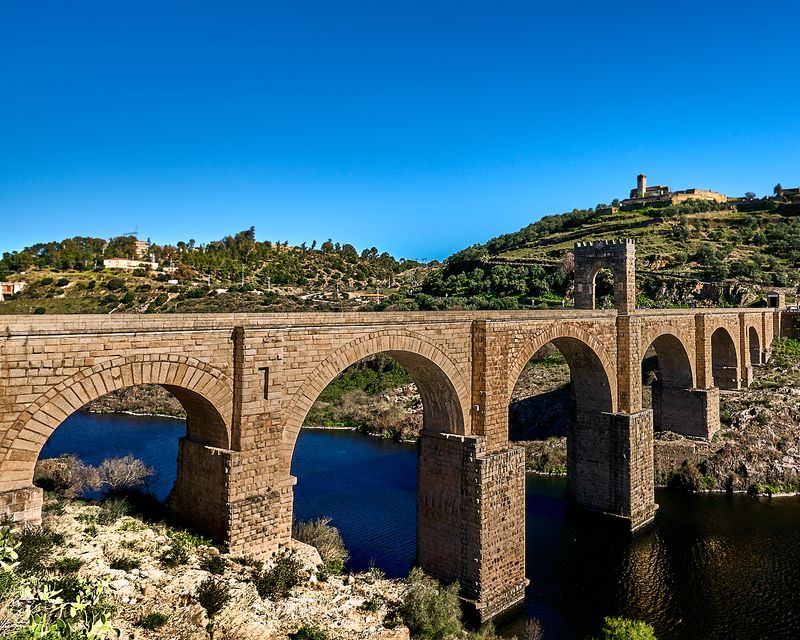
There is an inscription associated with the Alcantara Bridge that has become one of the most quoted pieces of ancient engineering confidence ever written. Roughly translated, it reads: “I built a bridge that will last forever.” The engineer Caius Julius Lacer, who designed the structure for Emperor Trajan in the early second century A.D., was not far wrong.
Six massive granite arches spanning the Tagus River gorge are still standing, still usable, and still genuinely impressive after nearly 1,900 years.
The bridge has survived a remarkable amount of deliberate damage. Medieval armies destroyed portions of it during various conflicts, and repairs and reconstruction have inevitably altered parts of the original fabric.
A small Roman temple and a triumphal arch built over the roadway near the center of the bridge still stand, giving the crossing an almost ceremonial quality that purely functional modern bridges rarely achieve.
Traffic continued to cross the Alcantara Bridge into the modern era, which is an astonishing lifespan for any piece of infrastructure. The surrounding Tagus gorge is now a protected natural area, and the bridge serves as both a transport link and a dramatic centerpiece of the landscape.
Lacer built something worth boasting about, and history proved him right.
Hagia Sophia, Istanbul, Turkey
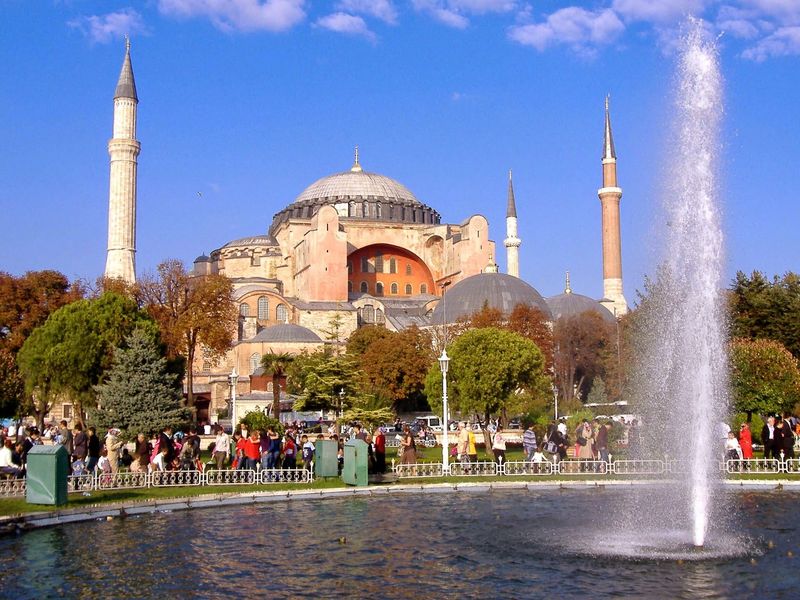
The architects who designed Hagia Sophia reportedly used geometry that was not fully understood by mathematicians until centuries later. Completed in 537 A.D. under Byzantine Emperor Justinian I, the building’s central dome rises about 55.6 meters above the floor and appears to float without visible support, an illusion created by a ring of windows at its base that floods the interior with light.
The construction took only five years, which remains one of history’s most impressive building achievements.
The building has changed religious identity more than once. It served as Constantinople’s primary Christian cathedral for nearly a thousand years before becoming a mosque after the Ottoman conquest in 1453.
In 1935, the Turkish government converted it into a secular museum. Then in 2020, Turkey redesignated it as a mosque, and Islamic worship resumed inside the ancient walls.
Visitors can still enter the building outside of prayer times and stand beneath that extraordinary dome, which continues to astonish architects and engineers who study it. The mosaics, the marble columns, and the sheer scale of the interior have survived political upheaval, earthquakes, and changing empires.
Hagia Sophia has outlasted every government that ever claimed ownership of it, which says something rather pointed about the durability of great architecture.
Church of the Nativity, Bethlehem, Palestine
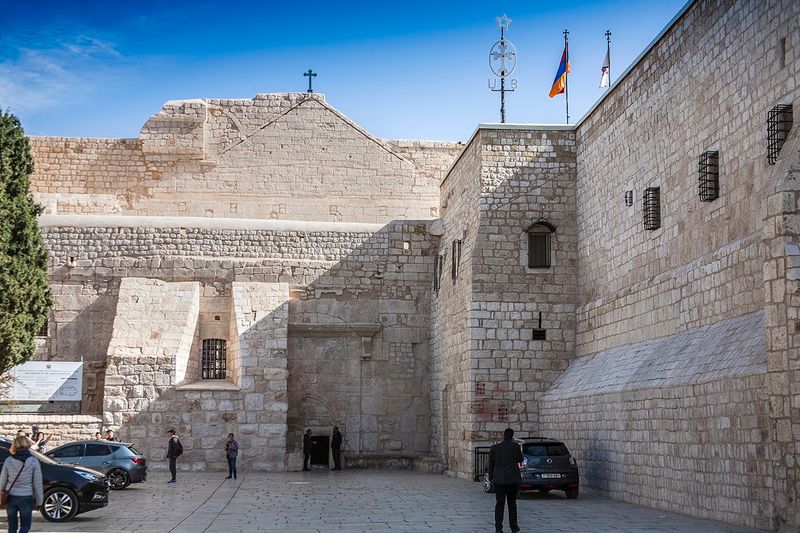
The entrance to the Church of the Nativity is so small that every visitor, regardless of height, must bow to get through it. That tiny doorway, known as the Door of Humility, was deliberately narrowed during the medieval period to prevent horsemen from riding inside.
It is a wonderfully human detail in a building with an almost overwhelming history stretching back to the fourth century A.D.
Emperor Constantine sponsored the original church above the grotto traditionally identified as the birthplace of Jesus, with the first structure dedicated in the fourth century. Much of what stands today reflects a major rebuilding under Emperor Justinian in the sixth century, though earlier floor mosaics and architectural elements survive beneath the current floor.
The site has been in continuous religious use for approximately 1,700 years.
Three Christian communities, the Greek Orthodox, Armenian Apostolic, and Roman Catholic churches, share the complex under longstanding historical arrangements that are sometimes tense but have held together for centuries. Pilgrims queue daily to descend into the Grotto of the Nativity, touch the silver star marking the traditional birthplace, and offer prayers.
UNESCO recognized the site as a World Heritage property in 2012. Few places carry quite this much accumulated spiritual weight in a single square of ancient stone.
Saint Catherine’s Monastery, Sinai, Egypt
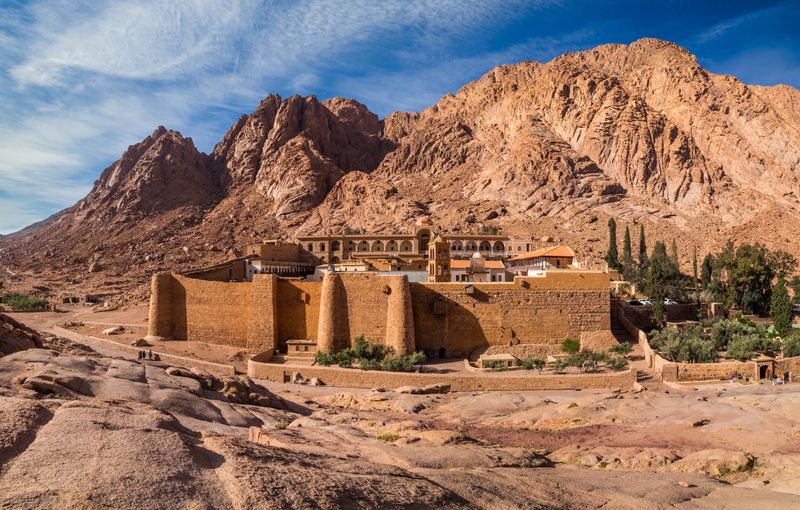
Saint Catherine’s Monastery has been continuously occupied by the same religious community since Emperor Justinian ordered it built in the sixth century A.D. No abandonment, no long gap, no revival after centuries of disuse.
The Greek Orthodox monks who live there today are the direct institutional successors of the community Justinian’s builders established, making this one of the most unbroken examples of continuous human habitation in an ancient structure anywhere on Earth.
UNESCO describes it as the oldest Christian monastery still being used for its original function without interruption. The fortified walls rise dramatically at the foot of Mount Sinai, where the Book of Exodus places the burning bush.
A living bush on the grounds is traditionally identified with that biblical account, and monks have been tending it, and the monastery, for roughly 1,500 years.
The library at Saint Catherine’s holds one of the most important collections of early Christian manuscripts in the world, second only to the Vatican. The Codex Sinaiticus, one of the oldest complete manuscripts of the Christian Bible, was discovered here in the 19th century.
The monastery is remote, austere, and genuinely ancient in a way that feels completely different from a preserved monument. It simply never stopped being exactly what it was built to be.
Mahabodhi Temple, Bodh Gaya, India
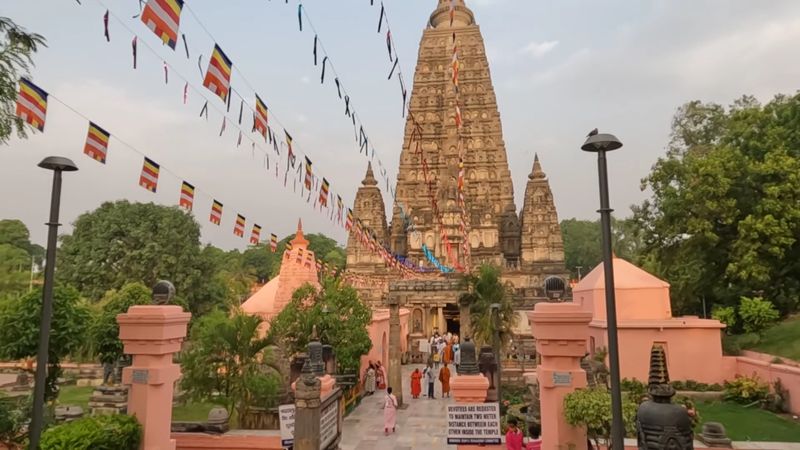
Bodh Gaya is arguably the most important place in Buddhism, and the Mahabodhi Temple at its center has been drawing pilgrims for over 2,000 years. Emperor Ashoka established an early sanctuary here in the third century B.C. to mark the spot where Buddhist tradition holds that Siddhartha Gautama sat beneath a fig tree and attained enlightenment.
The main brick temple standing today dates largely from the fifth or sixth century A.D., making it one of the oldest surviving monumental brick temples in India.
The approximately 50-meter tower rises above the sacred Bodhi Tree, a descendant of the original tree under which the Buddha is said to have meditated. The Vajrasana, or Diamond Throne, sits nearby marking the precise spot of enlightenment according to tradition.
Monks, nuns, and laypeople from Tibet, Thailand, Japan, Sri Lanka, and dozens of other countries gather here daily to meditate, chant, circumambulate the temple, and offer flowers and incense.
UNESCO added the Mahabodhi Temple Complex to its World Heritage list in 2002. The site experienced periods of neglect and underwent significant restoration over the centuries, but worship never permanently stopped.
Walking the circumambulation path around the ancient tower at dawn, surrounded by quietly chanting pilgrims from across Asia, is one of the most quietly powerful experiences the ancient world has left us.
Share this story