There is a place in central Pennsylvania where the ridgelines stretch for miles, the trails chew through your boot soles, and the silence is so complete you can actually hear your own thoughts. Just minutes from a busy university town, more than 96,000 acres of mountain forest wait with rocky pathways, ancient bogs, and panoramic overlooks that stop you cold.
What makes this place even more remarkable is its backstory: not long ago, these ridges were nearly stripped bare, left hollow by iron furnaces and relentless logging. Conservation turned things around in a way that feels almost unbelievable when you stand beneath a towering hemlock today.
This forest rewards the curious, the adventurous, and anyone who simply needs a long, quiet walk with a view worth earning. Whether you are a seasoned mountain biker chasing technical singletrack or a first-time hiker looking for a peaceful afternoon, the trails, vistas, and wild corners of this place have something waiting specifically for you.
A Wild Forest Just Minutes from State College

Most people driving through State College, Pennsylvania have no idea that one of the most expansive wild forests in the eastern United States begins just a few minutes down the road. Rothrock State Forest covers over 96,000 acres across Centre, Huntingdon, and Mifflin counties, with more than 80 percent forming one unbroken tract of 80,449 acres.
The forest sits within Pennsylvania’s Ridge and Valley province, a landscape shaped by parallel sandstone ridges and cold mountain streams that carve through the valleys below. The district office is located at 181 Rothrock Lane, Huntingdon, PA 16652, at the intersection of state routes 26 and 22, making it a useful starting point for planning a visit.
The rugged topography here belongs to the broader Appalachian Mountain chain, and every ridgeline tells that story clearly. Rocky, steep, and beautifully raw, this forest feels genuinely wild in a way that surprises first-time visitors who expected something tamer given its proximity to Penn State University.
The Man Behind the Forest’s Name and Legacy

Few forests carry a name with as much weight as this one. Rothrock State Forest honors Dr. Joseph Trimble Rothrock, a Mifflin County native who became Pennsylvania’s first forestry commissioner in 1895 and earned the title “Father of Forestry” in the commonwealth.
By the mid-to-late 1800s, the ridges now covered in oak and hickory had been almost completely stripped bare. Timber was harvested relentlessly to produce charcoal for iron furnaces at Greenwood, Monroe, and Pennsylvania Furnace, leaving the landscape hollow and eroded.
Dr. Rothrock pushed the state to buy back those depleted lands from lumber and iron companies. In 1903 alone, he helped secure roughly 35,000 acres from the Greenwood Iron Works in Huntingdon County.
Then, during the Great Depression, six Civilian Conservation Corps camps operated here from 1933 to 1942, with workers building roads, trails, and picnic areas that visitors still use today, transforming bare ridges into the thriving second-growth forest you walk through now.
Nearly 300 Miles of Trails That Mean Business

Nearly 300 miles of trails wind through this forest, and calling some of them “challenging” is an understatement worth taking seriously. The Mid State Trail, often described as the wildest trail in Pennsylvania, passes through Rothrock for roughly 42 to 56 miles of seriously rocky, demanding terrain that requires honest self-assessment before you lace up.
The Standing Stone Trail adds another 16 miles here, connecting to Greenwood Furnace State Park and including the famous Thousand Steps hike with significant elevation gain throughout. For a more approachable outing, the Jackson Trail leads to David’s Vista on a relatively flat 0.7-mile path, while the Bear Meadows Loop offers a satisfying 4.3-mile route around a unique wetland.
The Indian Steps trail up Tussey Mountain earns its name with a genuinely rugged scramble that rewards patience with sweeping views at the top. No matter which trail you choose, sturdy boots with ankle support are not optional here, they are a requirement you will thank yourself for later.
Overlooks That Make the Climb Feel Worth Every Step

Jo Hays Vista sits atop Tussey Mountain along PA Route 26 at the Centre and Huntingdon County line, and it is the kind of view that makes you stop mid-sentence and just look. From here, the Nittany Valley spreads out in front of you, with Mount Nittany visible in the distance and the State College area laid out below like a map.
Rothrock State Forest contains eleven officially designated scenic vistas, and Jo Hays is the most accessible, reachable by car for visitors of all mobility levels. Other named overlooks include Harry’s Valley Vista, Canoe Mountain Vista, Colerain Road Vista, Stone Mountain Hawk Watch, Indian Wells Overlook, and the dramatically named Throne Room.
Many of these viewpoints are reachable by car along roads like Colerain, Pennsylvania Furnace, and Wampler, making an auto tour a genuinely rewarding option, especially during October when fall foliage turns the ridges into something that looks almost too vivid to be real.
Bear Meadows: A Boreal Bog That Has No Business Being Here

Bear Meadows Natural Area is one of those places that makes you double-check your location, because nothing about it looks like central Pennsylvania. This National Natural Landmark protects a boreal bog ecosystem more typical of Canada or Siberia, with black spruce, red spruce, balsam fir, eastern hemlock, and highbush blueberries thriving at elevation in Centre County.
The bog covers approximately 890 acres and has been forming for thousands of years, making it one of the most ecologically significant spots in the entire state. A 3.5-mile hiking trail encircles the marsh, with observation platforms positioned to maximize wildlife and plant viewing while keeping foot traffic from damaging the fragile ecosystem.
Penn State botany students have studied this living classroom for generations, and it is easy to understand why the place commands that kind of attention. Songbirds fill the canopy with sound in spring, and the quiet here has a particular quality, layered and unhurried, that stays with you long after you have driven back to town.
Alan Seeger and the Old-Growth Survivors

Deep in Huntingdon County, Alan Seeger Natural Area preserves something genuinely rare: a 390-acre stand of old-growth white pine and eastern hemlock that the loggers of the 1800s never reached. Some of these trees measure up to 12 feet in circumference, and standing next to one of them recalibrates your sense of scale in a way that is hard to put into words.
A loop trail winds through the area along the banks of Standing Stone Creek, passing through dense rhododendron thickets that bloom with pink and white flowers in early summer. The combination of ancient canopy, rushing water, and flowering understory creates an atmosphere that feels completely removed from the modern world.
Detweiler Run Natural Area, nearby in the same county, offers a similar experience across 463 acres of old-growth white pine and hemlock with its own thick rhododendron understory. These two preserves together represent what the broader forest looked like before the iron industry arrived, and they are worth every step of the trails that lead to them.
Mountain Biking Terrain That Draws Riders from Across the State

Rothrock State Forest has a reputation in the mountain biking world that reaches well beyond Pennsylvania’s borders. The trails here are built around technical terrain, sizable rock gardens, demanding singletrack, and descents that test even experienced riders in ways that flat trail systems simply cannot replicate.
The forest hosts two International Mountain Biking Association Epic Routes: the 36-mile Rothrock Trail Mix and the 27-mile Cooper’s Gap Epic. Major events like the Wilderness 101, a 101-mile race, and the Trans-Sylvania Mountain Bike Epic, a seven-day stage race, draw competitors from across the country.
In 2005, the Single Speed World Championship was held here.
Popular riding areas cluster around Shingletown Gap and Coopers Gap, where the density of trail options keeps riders busy for full weekends. Beginners are not entirely left out, as the forest’s extensive network of gravel and dirt access roads provides a far more forgiving introduction to riding in the mountains, with scenery that more than compensates for the reduced technical difficulty.
Camping, Fishing, and Everything Else the Forest Offers

Beyond the trails, Rothrock State Forest opens up into a surprisingly broad menu of outdoor activities for visitors who want to stay longer or explore differently. Eight designated motorized drive-up camping areas come equipped with picnic tables and fire rings, while primitive backpacking sites are scattered throughout the backcountry for those who prefer a more remote stay.
The forest’s mountain streams hold populations of wild trout, and fishing here has a long, loyal following among anglers who prefer cold, clear water over crowded recreational lakes. Canoeing and kayaking are permitted on suitable waterways, and Raystown Lake Reservoir in the southwestern portion of the forest covers 8,300 acres for boating and additional fishing opportunities.
Horseback riding is allowed on most state forest roads and trails, though it is restricted in natural areas and on the Mid State and Standing Stone trails. When winter arrives and snow blankets the ridges, cross-country skiing, snowshoeing, and snowmobiling on designated routes give the forest an entirely different personality worth experiencing on its own terms.
How the Seasons Completely Change the Experience

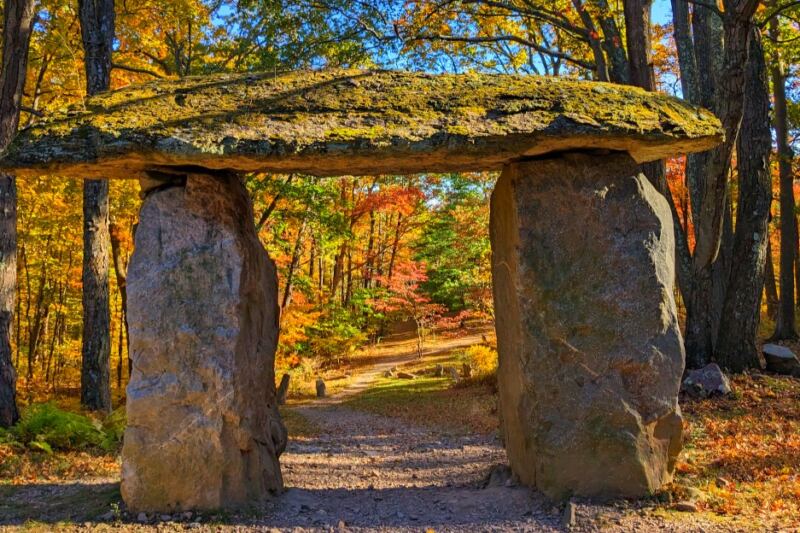
October is the month that makes Rothrock State Forest look like it belongs on a postcard. The hardwood ridges ignite with red, orange, and yellow as the oak and hickory canopy turns, and the views from the named overlooks become genuinely breathtaking in a way that photographs struggle to capture accurately.
Early June brings a different kind of color, when mountain laurel blooms across the slopes in pink and white clusters that line the trails for stretches at a time. Spring also delivers comfortable hiking temperatures, emerging wildflowers, and the return of songbirds to the forest canopy, making it one of the more underrated seasons for a visit.
Summer days run warm and humid at lower elevations, but the higher ridgelines cool down noticeably in the evenings, making camping a genuinely comfortable experience. Winter transforms the landscape entirely, quieting everything under a layer of snow and opening the forest to a different set of activities that feel almost meditative compared to the busy summer trail traffic.
Practical Tips for Getting the Most Out of Your Visit

The Purple Lizard Rothrock Map is the resource most experienced visitors swear by, and for good reason. It clearly marks road surfaces as paved, well-maintained dirt, or high-clearance four-wheel-drive, labels points of interest, and covers trail networks in a way that the standard DCNR map does not fully match.
Copies are available at outdoor shops in the State College area, including Appalachian Outdoors and Freeze Thaw Cycles.
Cell service disappears quickly in many parts of the forest, so downloading maps and weather forecasts before you leave town is a practical step that saves real frustration later. Sturdy hiking boots with ankle support are strongly recommended on rocky trails, and trekking poles make a measurable difference on steep ascents and descents throughout the forest.
During hunting seasons, generally running from October through February and again in April and May, all visitors and their pets should wear blaze orange for visibility. The Musser Gap Parking Area and trailheads near Tussey Mountain Ski Area offer convenient access points just minutes from State College, making a half-day visit entirely realistic even on a busy weekend.
Share this story