Oregon’s history isn’t locked away in dusty archives. It’s carved into stone columns, etched onto trail markers, and standing quietly in places where some of the most powerful moments in the state’s past actually happened.
From the windswept coast to the high desert, monuments across Oregon tell stories of migration, war, survival, and discovery. Get ready to explore ten landmarks that are far more fascinating than they might first appear.
The Astoria Column, Astoria
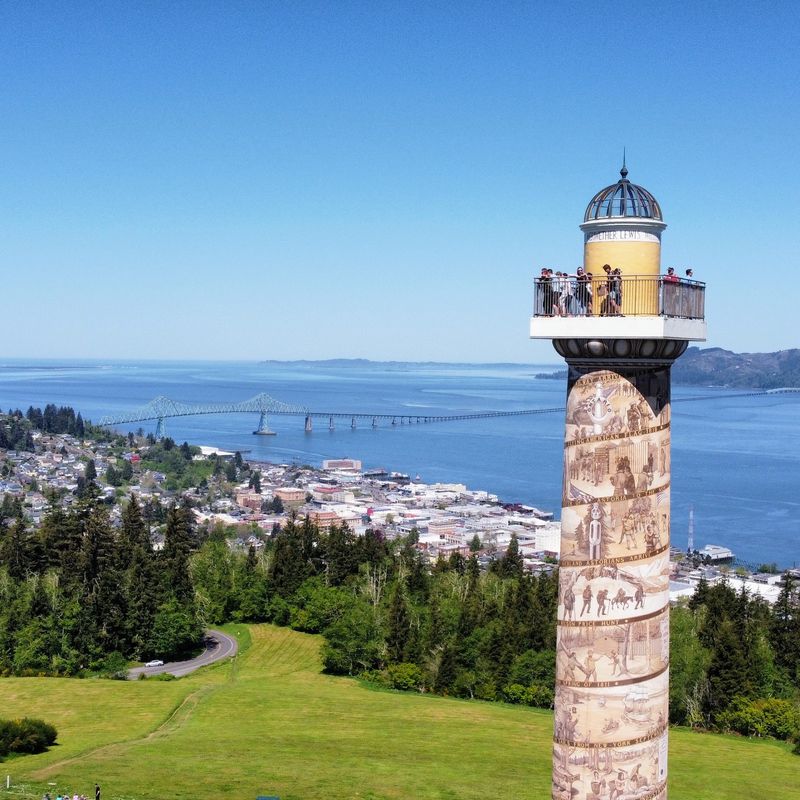
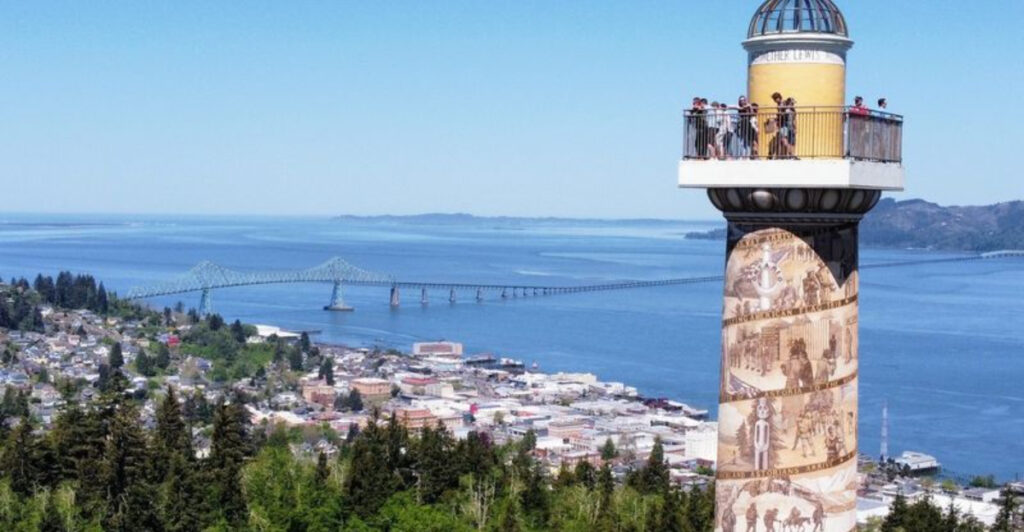
Standing 125 feet tall on Coxcomb Hill, the Astoria Column looks like something that escaped from ancient Rome and decided Oregon was a perfectly good place to settle down. Completed in 1926, it features a spiraling frieze painted directly onto its exterior, telling the story of exploration and settlement in the Pacific Northwest.
The design was directly inspired by Rome’s famous Trajan’s Column.
Brave visitors who climb all 164 steps of the interior spiral staircase are rewarded with sweeping views of the Columbia River, surrounding mountain ranges, and on clear days, the Pacific Ocean. That alone makes the climb worth every step.
What makes this monument genuinely thought-provoking is what the frieze doesn’t show. The Indigenous peoples of the Columbia River region had thriving cultures here for thousands of years before European explorers arrived.
Visiting with that context in mind transforms the experience from a simple sightseeing stop into something far richer and more meaningful.
Oregon Trail Centennial Obelisk, Baker City
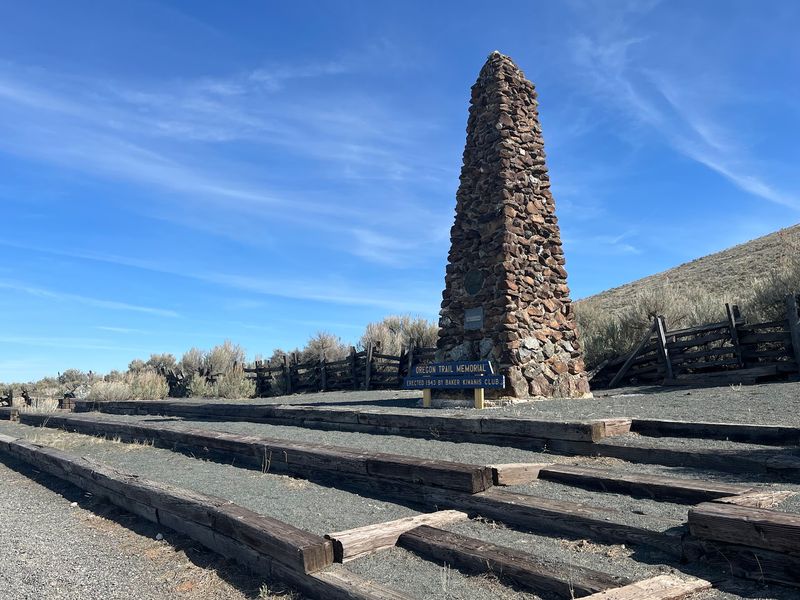
Few places in Oregon put you closer to the raw spirit of the Oregon Trail than the area around Baker City. The Centennial Obelisk standing nearby honors one of the largest overland migrations in American history, a journey that began drawing tens of thousands of emigrants westward starting in the 1840s.
Those travelers covered roughly 2,000 miles on foot and by wagon, crossing rivers, deserts, and mountain ranges without any guarantee of survival. The odds were genuinely brutal.
Disease, exhaustion, and unpredictable weather claimed thousands of lives along the route.
What makes this location special is that the past isn’t abstract here. Actual wagon ruts carved into the earth by those heavy wooden wheels are still visible in the region, pressed so deeply into the ground that 180 years of weather haven’t erased them.
Standing near those ruts while looking at the obelisk makes the scale of that migration feel immediate and personal. Baker City also sits near the outstanding National Historic Oregon Trail Interpretive Center, which brings the whole story to life with exhibits, artifacts, and living history demonstrations.
Oregon Trail Monument, Meacham
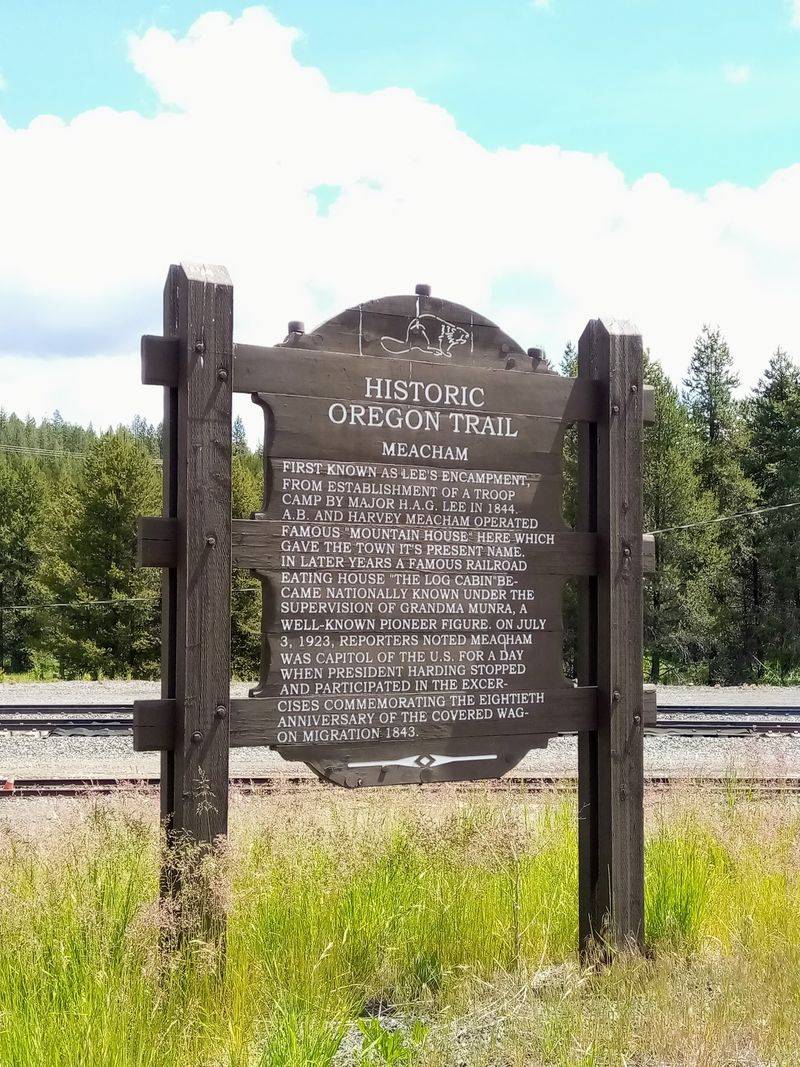
Crossing the Blue Mountains was one of the most dreaded sections of the entire Oregon Trail, and Meacham sits right in the middle of that difficult stretch. Emigrants arriving here had already walked more than 1,500 miles and were running low on food, patience, and healthy oxen.
The mountains ahead didn’t care about any of that.
Steep terrain, unpredictable weather, and exhausted livestock made this segment genuinely dangerous. Wagons had to be lowered down sharp descents using ropes, and animals that collapsed from exhaustion were sometimes simply left behind.
The monument at Meacham offers a quiet acknowledgment of everything travelers endured here.
Today the area feels peaceful, shaded by tall pines and surprisingly beautiful. That contrast between the scenery’s beauty and the suffering that happened here is striking.
The National Park Service has worked to preserve historic trail segments throughout Oregon, and some original traces of the route survive in this region. Stopping at the Meacham monument isn’t just a history lesson.
It’s a chance to stand in the same landscape where thousands of families made some of the hardest decisions of their lives.
Oregon Trail Marker at the Deschutes River Crossing, Wasco
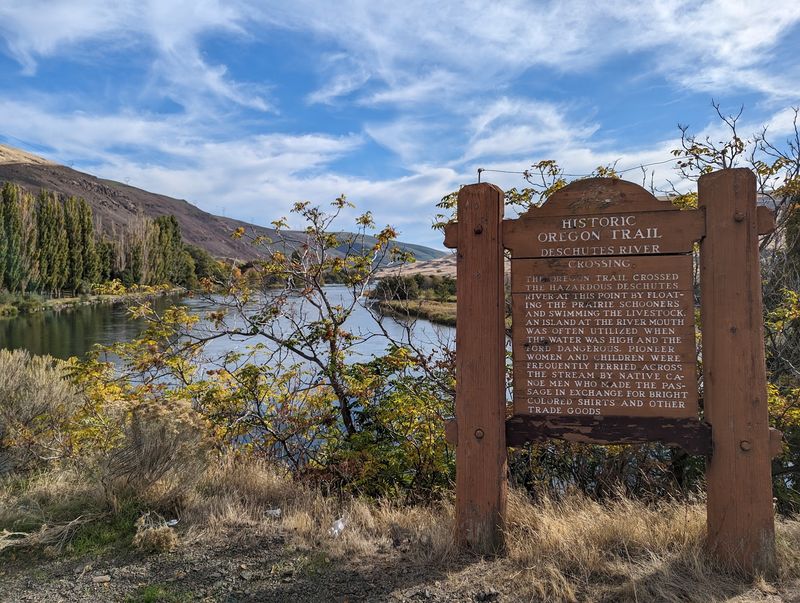
Rivers terrified Oregon Trail emigrants more than almost anything else on the journey. The Deschutes River crossing near Wasco was one of those heart-in-your-throat moments, where families loaded with everything they owned had to figure out how to get wagons, children, and livestock safely to the other side.
The Deschutes runs fast and cold, and the crossing point here came near the end of an already grueling trip. By this stage, travelers were within reach of the Columbia River and the final push toward the Willamette Valley.
That proximity to the finish line made every remaining obstacle feel even more cruel.
The trail marker here is modest, but its location does a lot of the storytelling. The landscape surrounding it is stark and wide open, offering a real sense of how exposed and vulnerable those wagon trains must have felt moving through unfamiliar territory.
More than 2,000 miles of Oregon Trail routes, ruts, and traces collectively preserve evidence of that westward migration across multiple states. Visiting this crossing point connects you to one small but significant moment in that enormous story.
Oregon Trail 1845 Historic Marker, Rhododendron
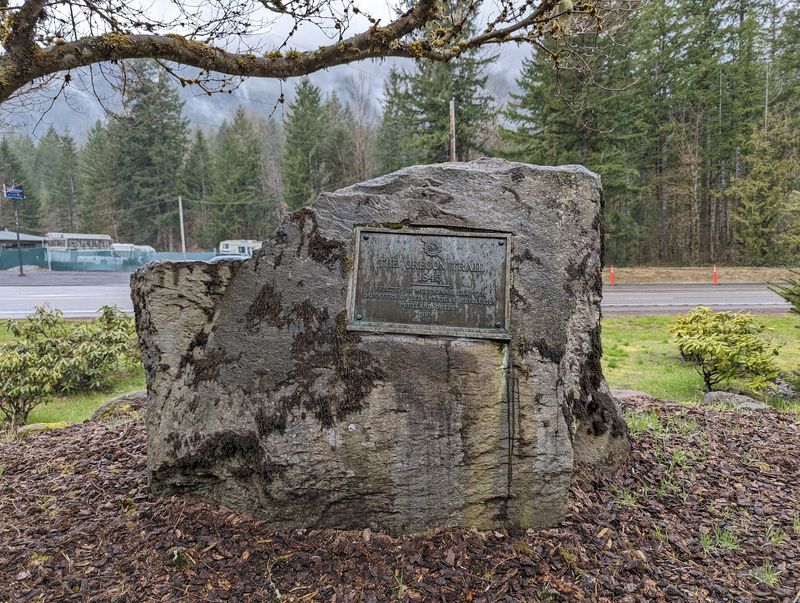
Mount Hood looms over this marker like a giant reminder of exactly how hard the final stretch of the Oregon Trail really was. The year 1845 was a turning point for the journey, because that was when Samuel Barlow and his party blazed a new overland route across the Cascade Range, offering emigrants an alternative to the terrifying raft journey down the Columbia River.
The Barlow Road, as it became known, wasn’t exactly a gentle stroll through the forest. The route climbed steeply through dense timber, over rocky ridges, and past the flanks of an active volcano.
Wagons had to be dragged and lowered through sections that barely qualified as a road by any generous definition.
Still, thousands of emigrants chose it over the Columbia River option, which had already claimed lives and belongings. The marker near Rhododendron places visitors surprisingly close to the actual historic route, and sections of the Barlow Road are still accessible today.
Standing here with Mount Hood in view makes it easy to appreciate the combination of desperation and determination that drove those travelers forward through such demanding terrain.
Battleship Oregon Memorial, Portland
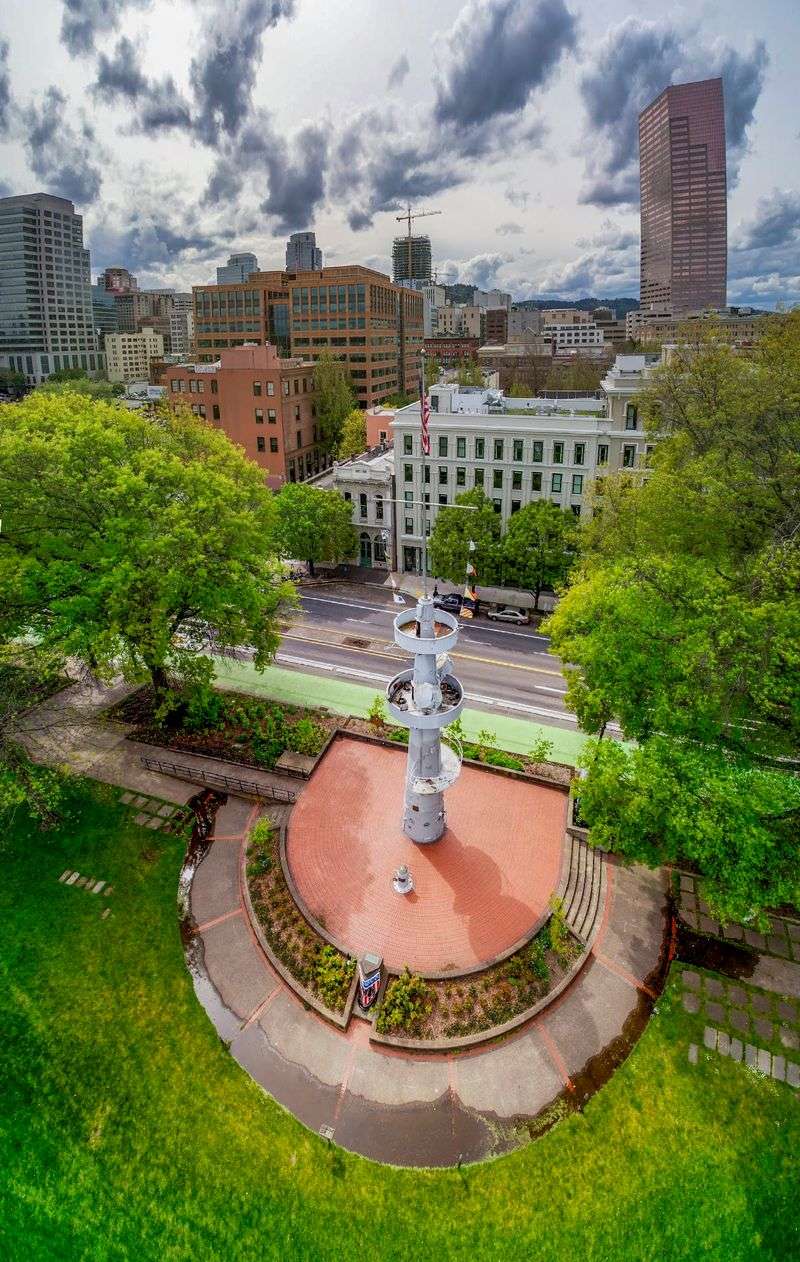
Most people walking along Portland’s waterfront walk right past this memorial without a second glance, which is a shame because the story attached to it is genuinely extraordinary. The USS Oregon was a battleship that became a national sensation in 1898 when it raced 14,000 miles from San Francisco, around the tip of South America, all the way to Florida to join the fleet during the Spanish-American War.
The voyage took 68 days and gripped the entire country as newspapers tracked the ship’s progress in real time. The USS Oregon arrived just in time to play a key role in the Battle of Santiago de Cuba, cementing its reputation as one of the most famous American warships of its era.
The ship itself was eventually scrapped, but its mast was saved and brought to Portland as a permanent memorial. It’s a surprisingly tangible connection to a moment when the United States was asserting itself as a serious naval power on the world stage.
Oregon’s name riding on that hull during such a dramatic voyage made the connection between the state and the ship feel genuinely personal to residents at the time.
Oregon World War II Memorial, Salem
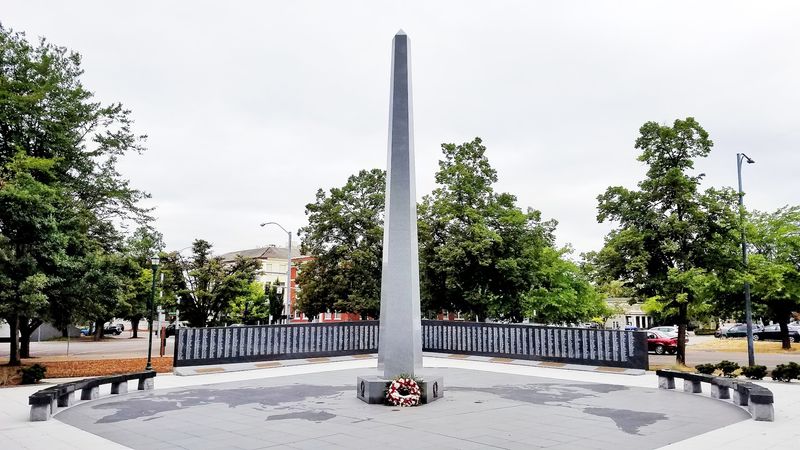
War memorials can sometimes feel distant and abstract, but the Oregon World War II Memorial on the Capitol grounds in Salem works hard to keep the focus on real people. Oregon sent tens of thousands of its residents into military service during the conflict, and the names and stories behind those numbers deserve more than a passing glance.
The war changed Oregon in ways that went far beyond the battlefield. Shipyards in Portland and the surrounding region roared to life, producing vessels at a pace that stunned the country.
Workers flooded into the state from across the nation, transforming communities almost overnight and reshaping Oregon’s demographics in ways that lasted for generations.
The Kaiser Shipyards in particular became a symbol of wartime industrial output, with workers completing ships in record time using assembly-line methods that revolutionized shipbuilding. The memorial in Salem acknowledges both the military sacrifice and the enormous civilian effort that supported it.
Visiting on a quiet afternoon, with the Capitol dome rising nearby, gives the experience a weight that feels appropriate for the scale of what Oregon contributed to that global conflict.
Vietnam Veterans of Oregon Memorial, Portland
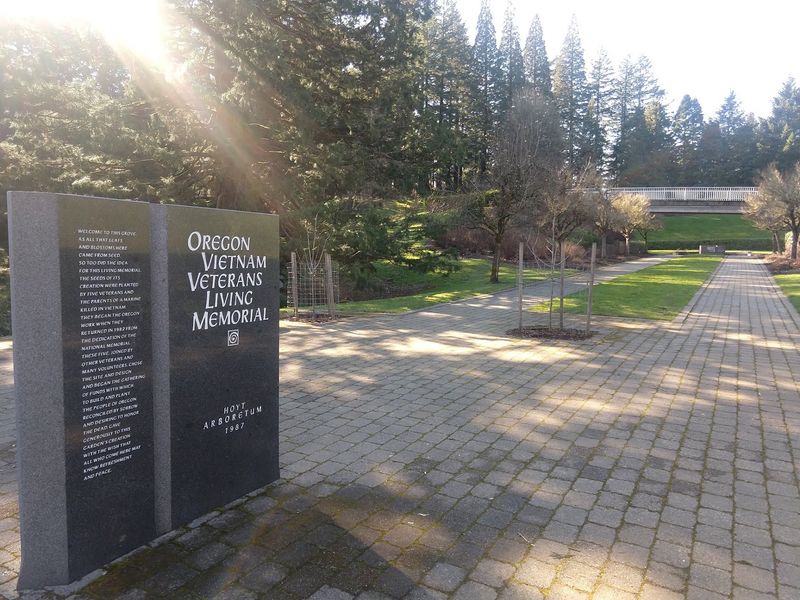
Washington Park is one of Portland’s most beloved green spaces, full of rose gardens and quiet trails, which makes the Vietnam Veterans of Oregon Memorial tucked within it feel all the more powerful by contrast. The setting is genuinely peaceful, and that tranquility sits in sharp tension with the turbulent history the memorial represents.
Vietnam was a conflict that divided American society in ways that took decades to even begin healing. Oregon families sent their sons and daughters into a war that was deeply controversial at home, and many veterans returned to a reception that ranged from indifferent to outright hostile.
The memorial acknowledges that complicated reality without flinching.
Rather than functioning as a traditional triumphant war monument, the site encourages reflection on individual lives and the communities that were changed by the conflict. The names of Oregonians who died in Vietnam are recorded here, each one representing a story that deserves to be remembered.
Spending time at this memorial feels less like a history lesson and more like an act of acknowledgment, a quiet recognition that these experiences shaped Oregon in ways that are still being understood today.
Oregon Holocaust Memorial, Portland
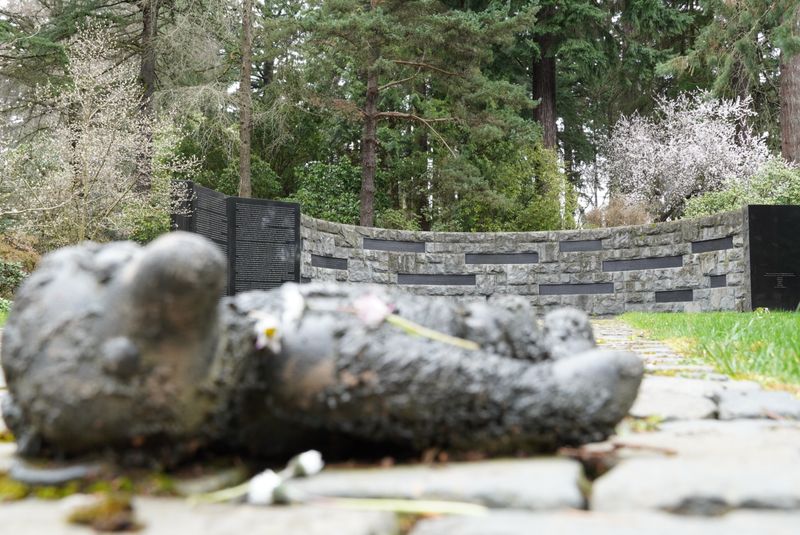
Also situated in Washington Park, the Oregon Holocaust Memorial is one of the most emotionally affecting public spaces in the entire state. Bronze sculptures scattered across the site depict everyday objects: shoes, eyeglasses, a child’s toy.
These are the kinds of possessions people carried with them until they no longer could, abruptly abandoned as millions of Jewish people and others were persecuted and murdered by the Nazi regime.
What makes this memorial specifically Oregonian is its connection to survivors who eventually built new lives in the Pacific Northwest. The Holocaust is a global tragedy, but it became local history through the individuals who escaped, rebuilt, and chose Oregon as their home.
Their stories are woven into the memorial’s design and interpretive elements.
Visiting this site asks something of you. It invites you to slow down, look carefully at the sculpted objects, and think about the human beings who once held them.
That’s a harder thing to do than simply reading a historical plaque, and it’s also more meaningful. The memorial stands as proof that history’s most devastating chapters can find a home in unexpected places, carried forward by the people who survived them.
Willamette Stone, Portland
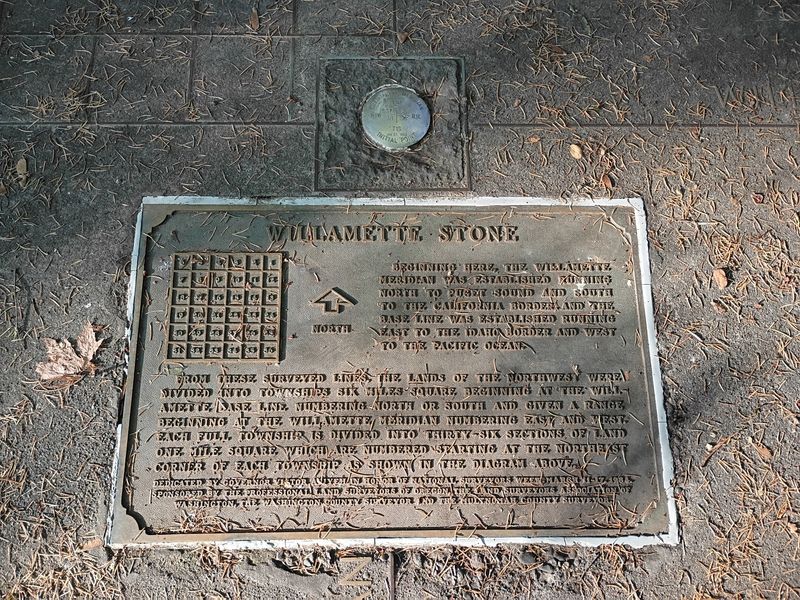
Looks can be deceiving, and the Willamette Stone is living proof of that. From the outside, it’s a modest little marker sitting on a forested hillside in northwest Portland, the kind of thing most hikers walk past without giving it a second thought.
But this unassuming stone quietly holds one of the most important positions in Pacific Northwest history.
Established in 1851, the Willamette Stone marks the origin point of the Willamette Meridian and Baseline, the surveying system that became the foundation for mapping Oregon and Washington. Every property boundary, township line, and land survey throughout the two-state region ultimately traces back to this exact location.
The phrase “point of beginning” takes on a very literal meaning here.
Before this survey system existed, land ownership in Oregon was a chaotic tangle of claims and disputes. The Willamette Meridian brought order to that chaos and made it possible to establish clear legal boundaries across millions of acres.
Real estate transactions, government land grants, and homestead claims all depended on this system. For a stone that barely reaches knee height, the Willamette Stone has had an outsized influence on the shape of the entire Pacific Northwest.
Share this story