Some cities wear their history on the outside, quite literally. These are places where ancient stone walls still wrap around entire neighborhoods, and you can actually walk on top of them, above the rooftops, looking out over centuries of human life below.
From a medieval German town frozen in time to a Chinese fortress city you could spend half a day circling, each of these destinations offers something genuinely rare: the chance to understand a city’s past by walking its outer edge. Whether you are planning an international trip or just building a travel wish list, these 12 walled cities are worth knowing about.
Each one is real, open to visitors, and delivers a perspective on history that no museum exhibit can quite replicate.
Dubrovnik City Walls, Dubrovnik, Croatia
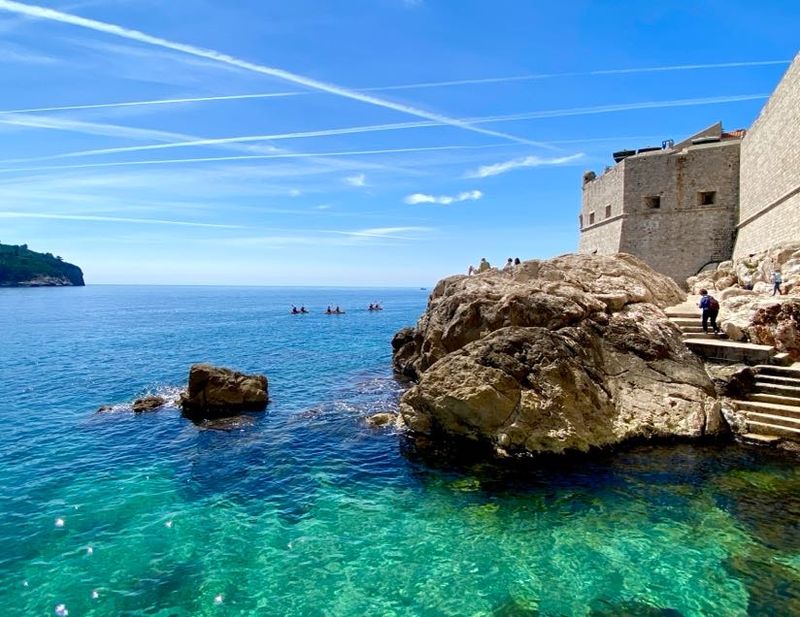
Few city walks in the world match the visual drama of Dubrovnik’s limestone circuit. The nearly two-kilometer route traces the edge of the old town, placing walkers high above tightly packed terracotta rooftops with the blue Adriatic stretching out to the horizon.
The path follows a one-way system, so there is no doubling back or traffic confusion. Along the way, you pass major defensive landmarks including Minčeta Tower, Fort Bokar, and St. John’s Fortress, each with its own architectural character and view angle.
The walls are a ticketed attraction with access points at several locations, including the well-known entrance near Pile Gate. During Croatia’s hottest summer months, early morning visits are noticeably more comfortable.
The exposed route has limited shade and includes plenty of stairs, so proper footwear and a water bottle are both practical necessities rather than optional suggestions.
York City Walls, York, England
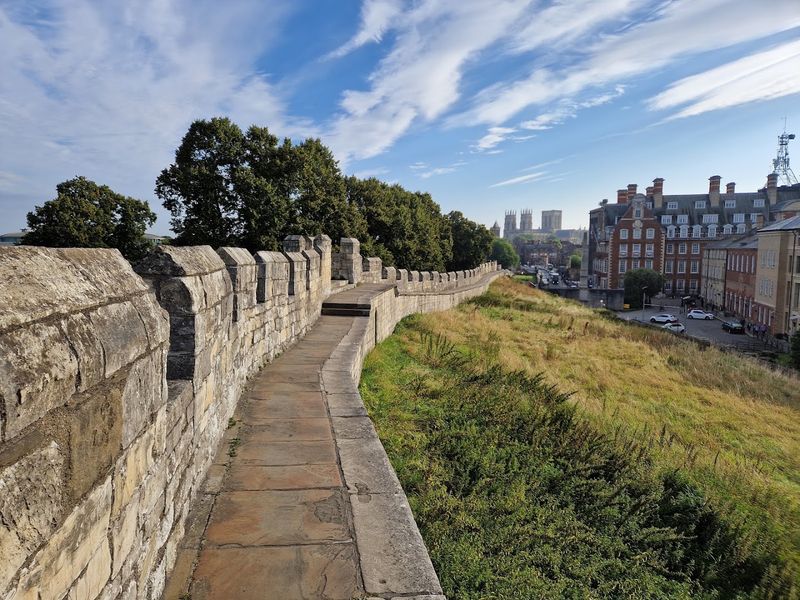
York holds a remarkable record as the home of England’s longest surviving medieval town-wall circuit. The roughly 3.4-kilometer route carries walkers through nearly 2,000 years of urban history, from Roman origins through Viking occupation and into the medieval era.
The route is free to walk and generally open from around 8 a.m. until dusk, though closures happen during snow, ice, or unsafe weather conditions. Along the way, four fortified gateways called bars mark the path: Bootham Bar, Monk Bar, Walmgate Bar, and Micklegate Bar.
Views from the elevated walkway open toward York Minster, historic gardens, railway infrastructure, and the streets of the old city below. Short street-level sections connect gaps where original walls no longer stand, but the overall experience remains continuous and well-signed.
It is one of the best free heritage walks available anywhere in northern England.
Chester City Walls, Chester, England
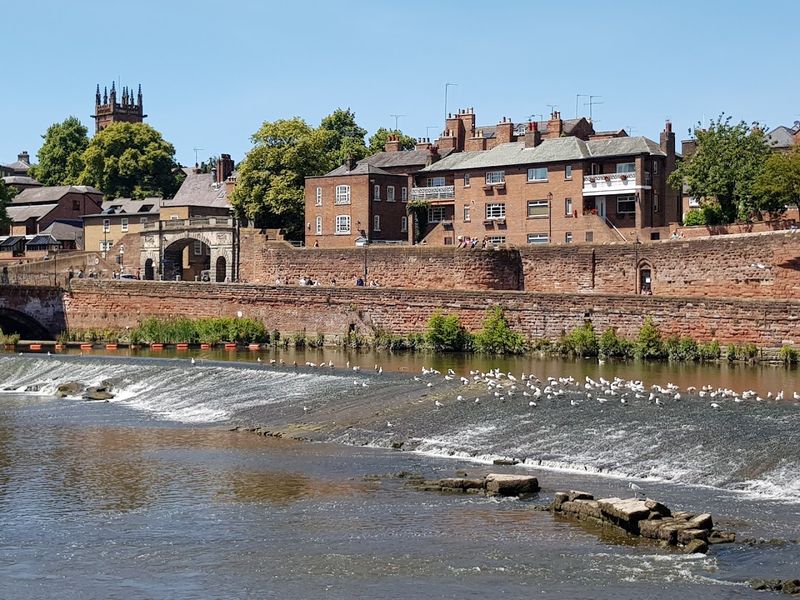
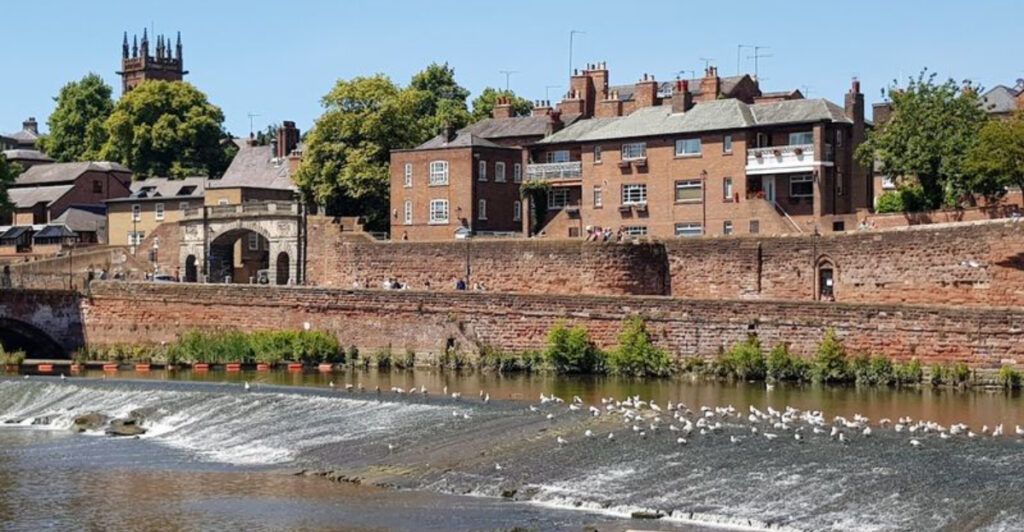
Chester’s city-wall circuit stands out as one of Britain’s most complete, and it starts wherever you happen to find the nearest staircase. The most recognizable entry point is near the Eastgate Clock, a Victorian landmark that has appeared on countless postcards.
The approximately two-mile route layers different eras of construction into a single continuous walk. It begins with the Roman fortress of Deva, moves through medieval expansions, and includes later repairs that kept the circuit largely intact over the centuries.
From the elevated path, walkers can see Chester Cathedral, the Roman Gardens, the River Dee curving past the racecourse, and surviving sections of the Roman amphitheater. The uninterrupted circuit typically takes around 60 to 90 minutes before any sightseeing stops are added.
Chester is also compact enough that the walls genuinely frame the entire city, giving visitors a strong sense of its original scale and layout.
Derry City Walls, Derry, Northern Ireland
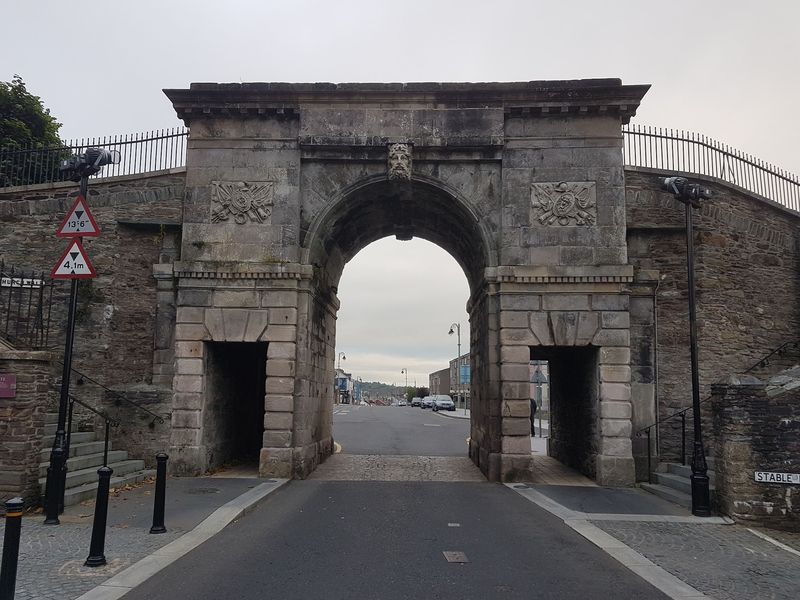
Derry’s walls were built between 1613 and 1618, making them one of the last complete sets of city walls constructed in Europe. What sets them apart is that they have never been breached, a fact that still carries meaning for the people who live here.
The 1.5-kilometer circuit is free to walk and takes visitors across several bastions while passing historic gates that once controlled entry into the settlement. Original cannons remain positioned along parts of the fortifications, giving the route a tangible military character that photographs cannot fully capture.
Views from the walls contrast the compact old city with modern neighborhoods, church towers, and the Bogside below. The walls are also deeply connected to the Siege of Derry and the city’s more recent political history, which several local guided tours explore in detail.
Walking independently works well, but a knowledgeable guide adds significant context to what you are seeing.
Walls of Lucca, Lucca, Italy
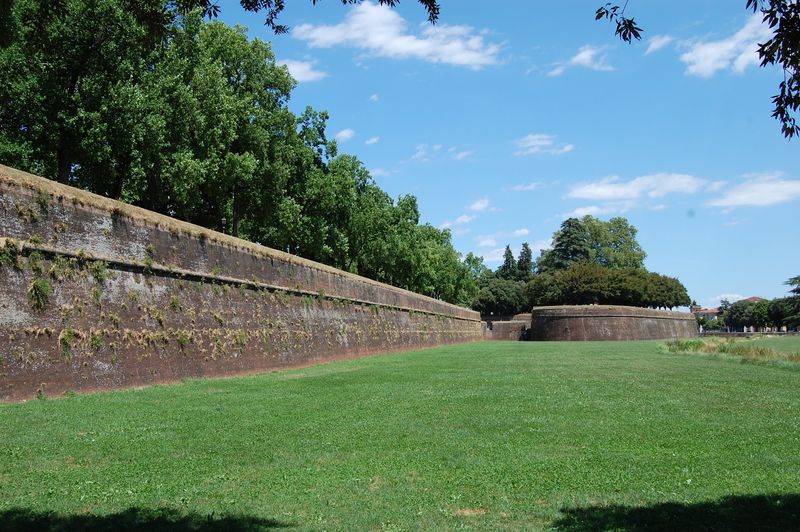
Lucca’s walls are unlike any other fortification on this list. Instead of narrow battlements with steep drops, they have been transformed into a broad, tree-lined public park that completely encircles the historic Tuscan city.
The 4.2-kilometer promenade is flat, wide, and shared by walkers, runners, local families, and cyclists. Mature trees line much of the route, providing shade that most exposed city-wall circuits simply cannot offer.
Grassy bastions create natural rest areas where visitors can pause and look out over the landscape in both directions.
Views alternate between church domes and medieval towers inside the city and lawns, residential neighborhoods, and distant mountains beyond the walls. The defensive structure itself dates mainly from the 16th and 17th centuries, but later generations converted it into public green space rather than letting it fall into disuse.
Lucca’s walls are among Italy’s most distinctive urban parks and one of the most enjoyable free attractions in Tuscany.
Walls of Ávila, Ávila, Spain
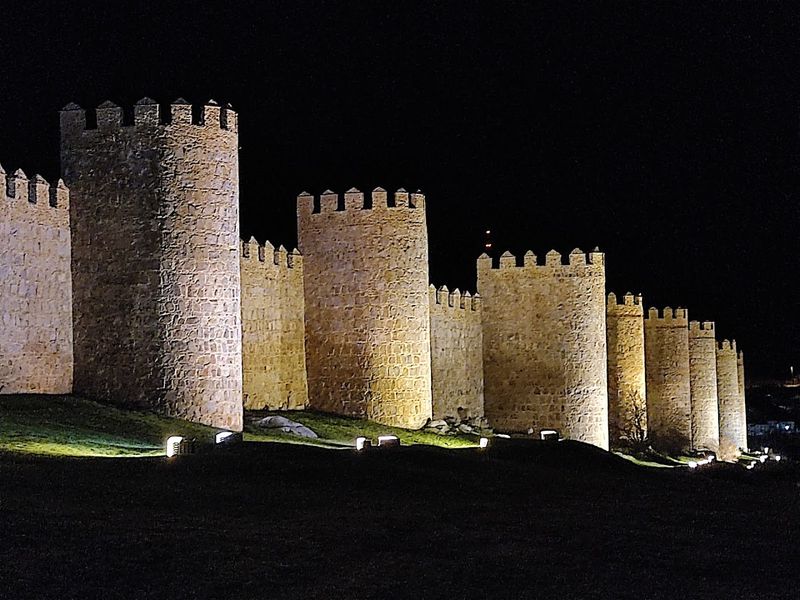
Standing outside Ávila’s walls and looking up is genuinely impressive. The fortifications rise approximately 12 meters in places, stretch across an irregular circuit, and include around 88 semicircular towers, creating one of Spain’s most recognizable medieval skylines.
Ticketed sections of the wall-top walkway are accessible, but the complete perimeter is not entirely open from above. To circle the full old city, visitors combine the rampart sections with streets and exterior paths running alongside the walls.
This mixed approach still delivers a strong sense of the city’s scale and defensive design.
Highlights along the route include Ávila Cathedral’s fortified apse, which is built directly into the eastern wall, the Puerta del Alcázar gateway, quieter western sections, and broad views across the Castilian plateau. Ávila sits at over 1,100 meters above sea level, so the surrounding landscape has an open, windswept quality that reinforces the walls’ commanding presence in all directions.
Ramparts of Aigues-Mortes, Aigues-Mortes, France
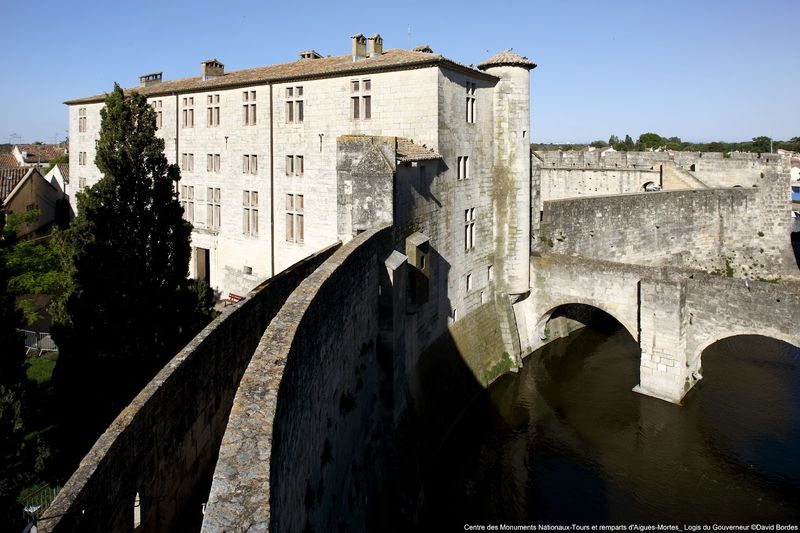
Aigues-Mortes looks like it was placed in the middle of the Camargue wetlands by someone who wanted to build the most dramatic walled town possible. The rectangular enclosure rises sharply from completely flat terrain, making the fortifications visible from a considerable distance in every direction.
Visitors can walk approximately 1,640 meters along the ramparts in a full elevated circuit around the medieval town. The route passes defensive towers and gateways while overlooking tiled rooftops, canals, and the colorful salt ponds that still operate in the surrounding landscape.
Admission covers both the rampart walk and the massive Constance Tower, which served at various points as a lookout post, lighthouse, and prison. The monument is a managed, ticketed attraction with posted operating hours, and the complete visit typically takes longer when tower access and viewpoints are factored in.
The combination of flat wetland scenery and intact medieval architecture makes Aigues-Mortes genuinely unlike any other stop in southern France.
Rothenburg Town Walls, Rothenburg ob der Tauber, Germany
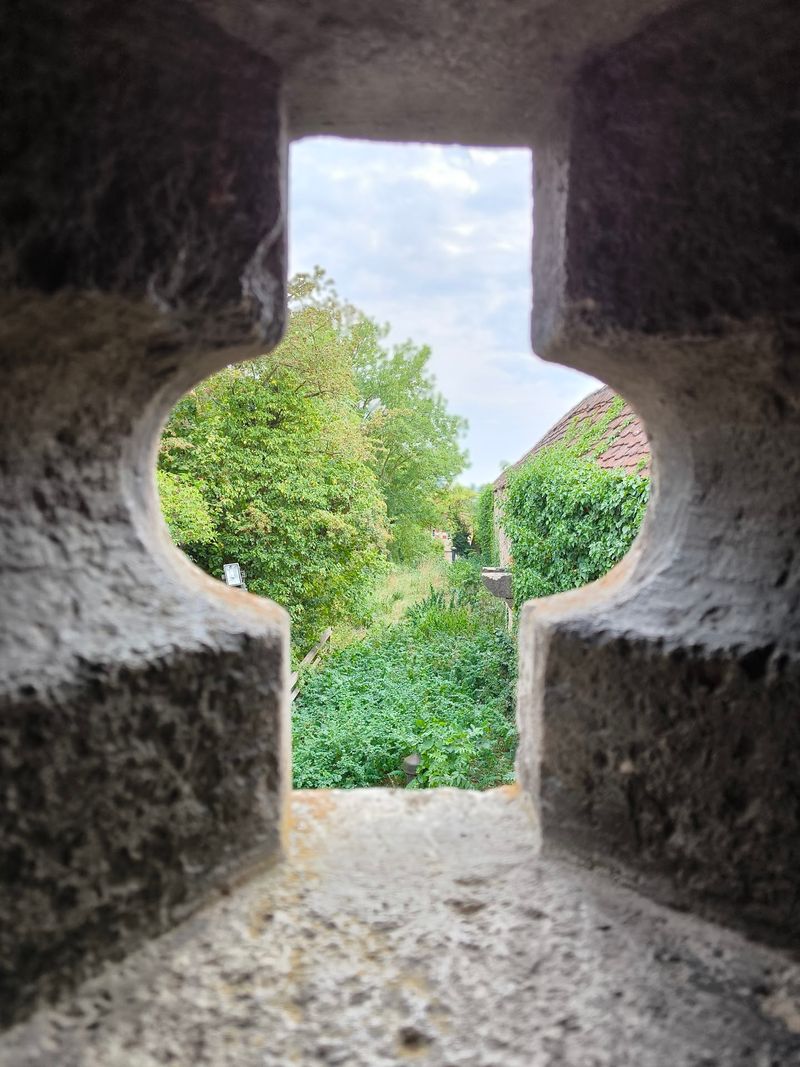
Rothenburg ob der Tauber is often described as Germany’s best-preserved medieval town, and the wall circuit is a big reason why. The fortified perimeter connects 42 towers and gateways, giving the old center a continuous defensive boundary that survived while so many others were demolished over the centuries.
What makes the route particularly interesting is the covered wall walk, where timber roofs shelter narrow stone and wooden pathways along significant portions of the circuit. Walking through these covered sections feels noticeably different from an open rampart, especially on a gray or rainy day.
Where the elevated walkway is interrupted, the route continues beside the walls, allowing a complete circuit of the historic center. Key landmarks include Klingentor, Rödertor, Galgentor, and the elaborate fortifications at Spitaltor.
The wall walk itself is free, while individual museums and towers may have separate entry requirements. Rothenburg rewards slow walkers who stop frequently to look back at the town from outside its own boundaries.
Xi’an City Wall, Xi’an, China
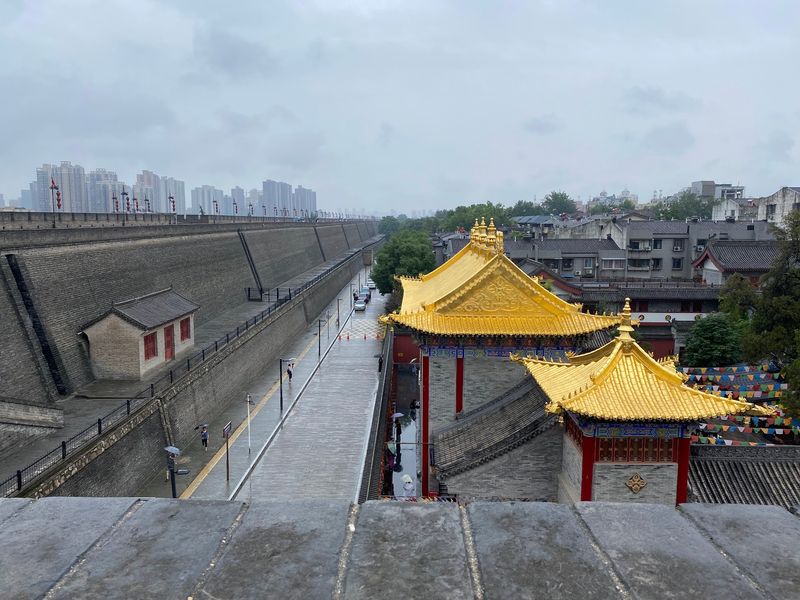
Xi’an’s city wall is not a short stroll. The rectangular fortification measures approximately 13.7 kilometers around, which means a complete circuit on foot is a genuine half-day commitment rather than a quick sightseeing loop.
The broad wall top connects four principal gates and numerous watchtowers, offering views of both the traditional city center and the sprawling modern city that has grown up around it. Visitors who prefer not to walk the full distance can rent bicycles or use sightseeing vehicles, though rental operations and permitted routes can change seasonally.
The South Gate is the most commonly used entrance and one of the most architecturally elaborate sections of the entire complex. Foreign visitors should carry their passports when collecting or validating admission tickets, as this is a practical requirement at the site.
Xi’an’s wall is one of the most complete large-scale urban fortifications anywhere in the world, and its sheer size gives it a presence that smaller circuits simply cannot replicate.
Pingyao Ancient City Wall, Pingyao, China
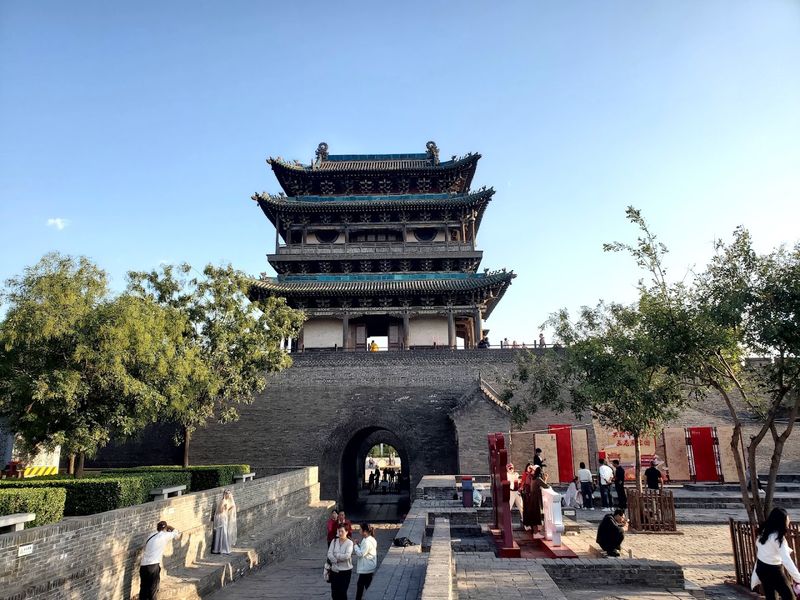
Pingyao is one of China’s most intact ancient towns, and the walls that enclose it tell a significant part of why. The roughly 6.4-kilometer perimeter dates from the Ming dynasty and is traditionally described as resembling a tortoise, with gates positioned to represent its head, limbs, and tail.
Climbing onto the walls as part of the ancient-city admission pass reveals the full street plan of Pingyao below: a dense grid of merchant houses, temples, traditional banks, government buildings, and narrow lanes laid out with deliberate order.
Walking the complete circuit provides a much broader sense of the city’s original design than staying at street level in the commercial center. Pingyao also carries historical importance as a center for the financial institutions that helped develop China’s early banking and remittance systems.
The combination of intact urban fabric and accessible fortifications makes Pingyao a UNESCO World Heritage Site that rewards more than a single afternoon of exploration.
Óbidos Town Walls, Óbidos, Portugal
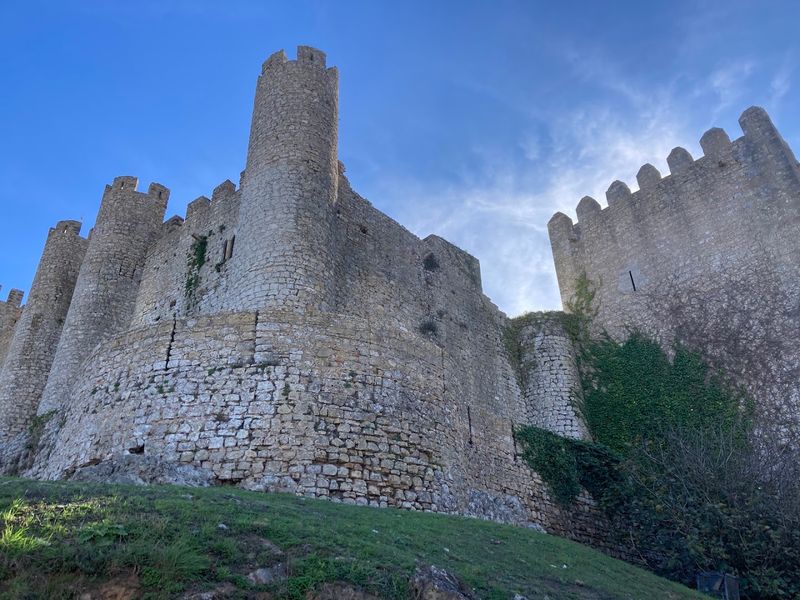
Óbidos is the kind of small Portuguese town that appears on travel lists constantly, but the wall walk is where things get genuinely interesting. The fortifications are remarkably intact, enclosing a compact hilltop center of whitewashed houses, tiled roofs, and narrow cobbled streets.
Visitors can walk most of the perimeter for free, beginning from several steep staircases inside the old town. The experience is atmospheric but less developed than many ticketed rampart attractions, which means fewer guardrails, uneven stone surfaces, and sections with meaningful drops on either side of the path.
Near the castle at the top of the town, walkers may need to descend and cross in front of the building rather than continuing along the wall top. Sturdy footwear is not a casual recommendation here.
Wet stones, narrow ledges, and exposed sections make careful attention essential, especially for families traveling with young children or anyone uncomfortable with heights. Dry weather makes a real difference on this route.
Cité de Carcassonne, Carcassonne, France
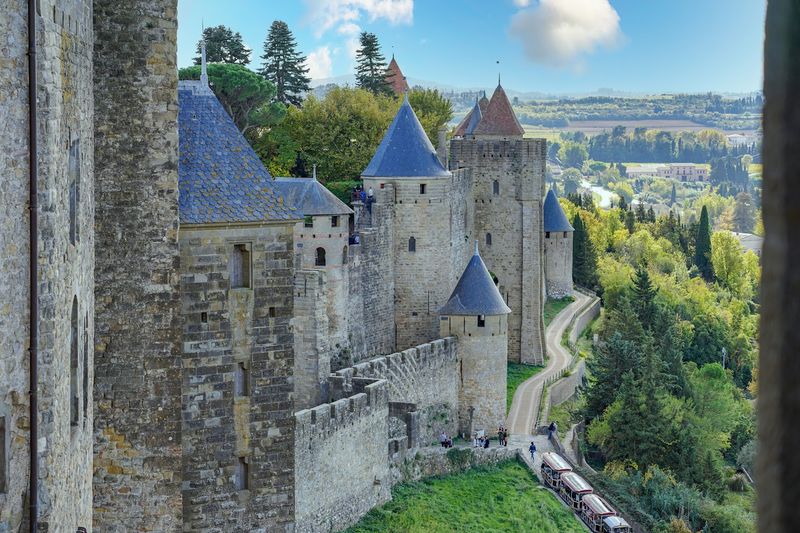
Carcassonne’s citadel is one of the most visually striking fortified settlements in all of Europe. Two concentric rings of walls, punctuated by dozens of towers with pointed roofs, create a silhouette that looks more like an illustration than a real place when seen from a distance.
Visitors can explore the citadel through a combination of outer paths, the open space between the two defensive rings, and ticketed rampart sections connected to the Château Comtal. Entry to the enclosed medieval streets is generally free, while the castle and managed ramparts require admission.
The route reveals a layered history of Roman foundations, medieval additions, and 19th-century restoration work. Views from the walls extend toward the modern lower city and the surrounding countryside, with the Pyrenees visible on clear days.
The official monument publishes current schedules and ticket information online, and visiting outside peak summer months generally means shorter lines and a more relaxed experience throughout the site.
Share this story