Some buildings are so massive they seem to belong to a different world entirely. The largest churches on Earth were built over centuries, funded by empires, inspired by miracles, and shaped by some of history’s greatest architects and engineers.
Each one tells a story that goes far beyond stone and stained glass. From a medieval cathedral in Spain to a modern marvel in West Africa, these 12 churches are among the most extraordinary structures humans have ever built.
St. Peter’s Basilica, Vatican City
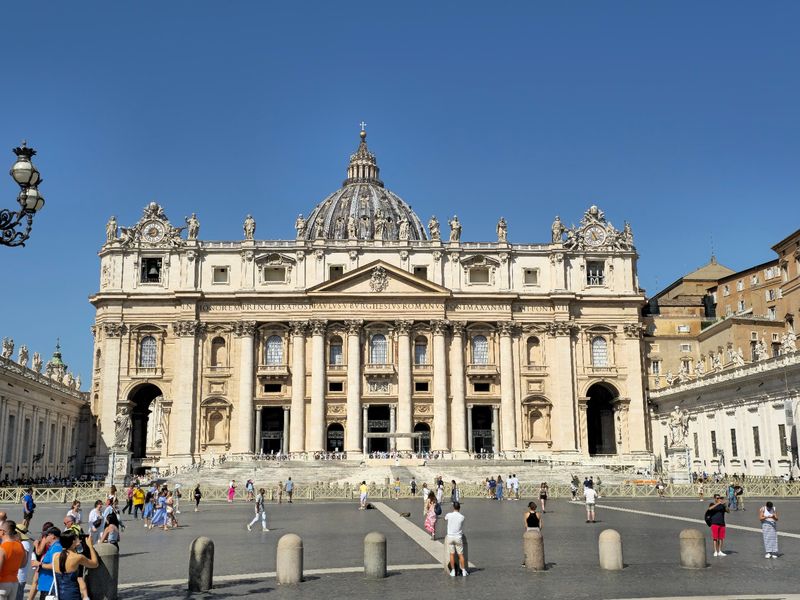
Standing over the traditional burial site of Saint Peter himself, this basilica carries the weight of nearly two thousand years of Christian history beneath its marble floors. Construction began in 1506, replacing an earlier church that Emperor Constantine had built in the 4th century.
Architects including Bramante, Michelangelo, and Carlo Maderno each left their mark on the building across more than a century of construction.
The main floor covers roughly 22,000 square meters, and the building stretches about 187 meters from end to end. Michelangelo designed the iconic dome, which Giacomo della Porta completed using around 800 workers between 1588 and 1590.
The dome rises approximately 136 meters above the ground.
Gian Lorenzo Bernini later added the towering bronze baldachin above the papal altar, a structure so large it took nine years to build. The piazza outside, also designed by Bernini, can hold more than 300,000 people.
St. Peter’s is not technically a cathedral, since the Pope’s official seat is at St. John Lateran, but it remains the spiritual heart of the Catholic world and one of the most visited buildings on the planet.
Mosque-Cathedral of Cordoba, Spain
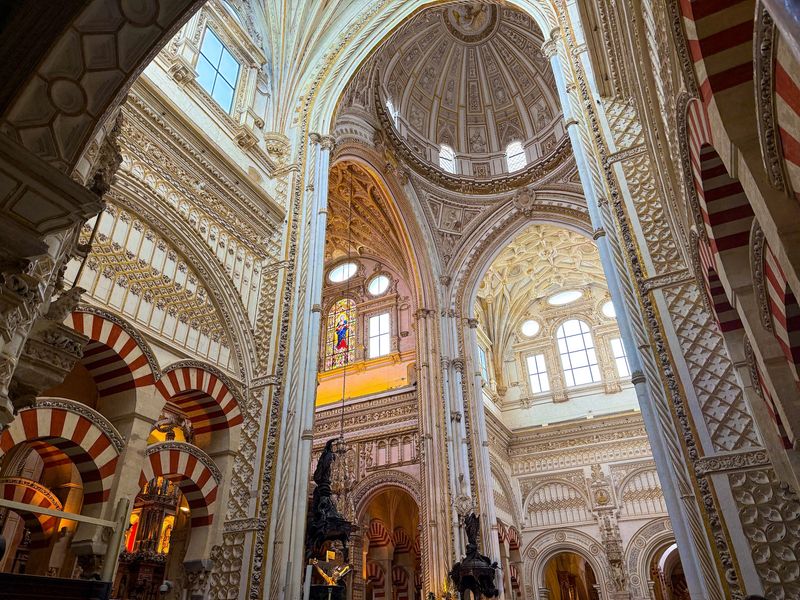
Walk inside the Mosque-Cathedral of Cordoba and you will immediately notice something unusual: hundreds of red-and-white striped arches stretch in every direction, interrupted by a full Renaissance cathedral nave sitting right in the middle of it all. That architectural collision is not a mistake.
It is 1,200 years of history compressed into a single building.
The Great Mosque was founded in 785 and expanded repeatedly as Cordoba grew into one of medieval Europe’s most important and sophisticated cities. When Christian forces captured the city in 1236, the mosque was consecrated as a cathedral rather than torn down.
Centuries later, a Renaissance nave and transept were inserted directly into the ancient prayer hall.
The full complex covers roughly 23,400 square meters when the courtyard is included, with commonly cited interior measurements around 13,000 square meters. The mosque’s original minaret was transformed into a bell tower, and the former ablution courtyard became the Patio de los Naranjos, planted with orange trees.
Few buildings anywhere on Earth contain such a layered record of different civilizations sharing the same physical space across such a long span of time.
Basilica of the National Shrine of Our Lady of Aparecida, Brazil
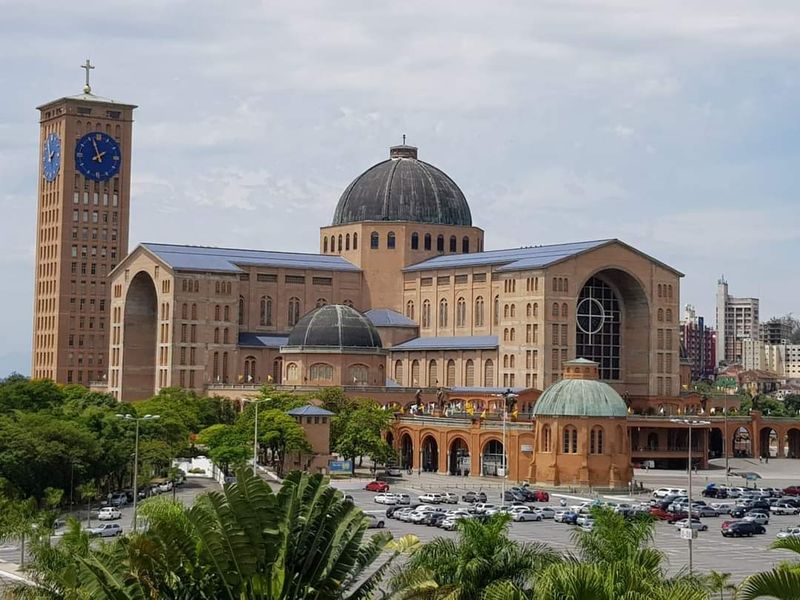
The whole thing started with three fishermen and a small clay statue pulled from a river. In 1717, those fishermen reportedly recovered a broken image of the Virgin Mary from the Paraiba do Sul River in Brazil, and the devotion that followed eventually grew into one of the largest pilgrimage movements in the world.
Today, millions of people visit Aparecida every year to honor Our Lady of Aparecida, the patron saint of Brazil.
The sheer number of pilgrims made a bigger church absolutely necessary. Construction of the present basilica began in 1955, and the resulting building is organized around a central dome with four broad arms radiating outward.
Its interior covers roughly 12,000 square meters, placing it comfortably among the largest church interiors on Earth.
On major feast days, particularly the Feast of Our Lady of Aparecida on October 12, the basilica functions less like a church and more like a small city. Crowds of tens of thousands fill the nave, the surrounding plazas, and every available space.
The original clay statue, only about 36 centimeters tall, still sits at the center of all this extraordinary attention, displayed in a special chapel within the massive complex.
Milan Cathedral, Italy
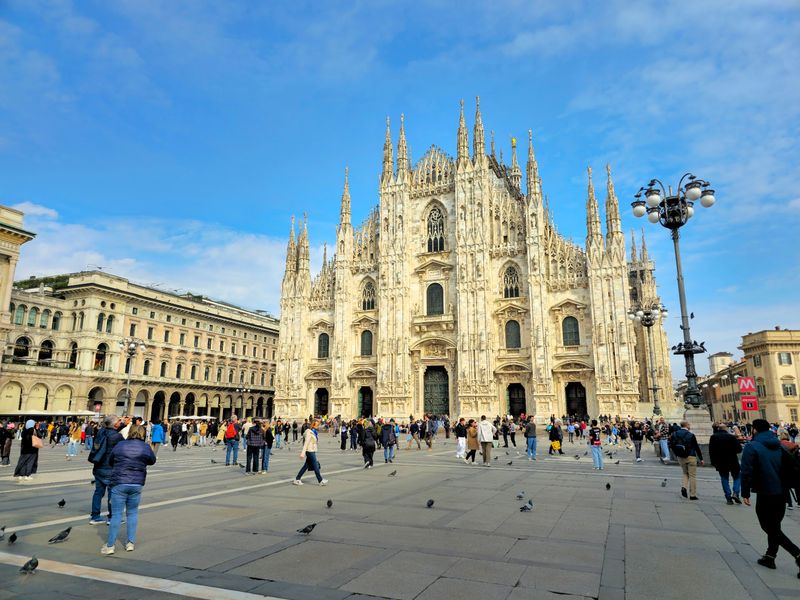
Milan Cathedral is one of those buildings that makes you stop and count the spires, then lose count, then start over. There are 135 of them, bristling above a forest of flying buttresses, statues, and carved marble that took craftsmen centuries to complete.
The cathedral is genuinely overwhelming in the best possible way.
Construction began in 1386 under the patronage of Gian Galeazzo Visconti, who made an unusual choice for northern Italy: pale Candoglia marble instead of brick, and an international Gothic style instead of the local Romanesque tradition. Architects and engineers were recruited from across Europe, and the project became a continental collaboration almost immediately.
The building spreads across approximately 11,700 square meters.
Work continued for roughly six centuries, meaning Napoleon Bonaparte was present for part of it. He ordered the facade completed in time for his coronation as King of Italy in 1805.
The institution responsible for maintaining the cathedral, the Veneranda Fabbrica del Duomo, was established in 1387 and still operates today. Visitors can climb to the rooftop terraces and walk among the pinnacles, getting close enough to examine the thousands of individual sculptures that most people only see from far below.
Seville Cathedral, Spain
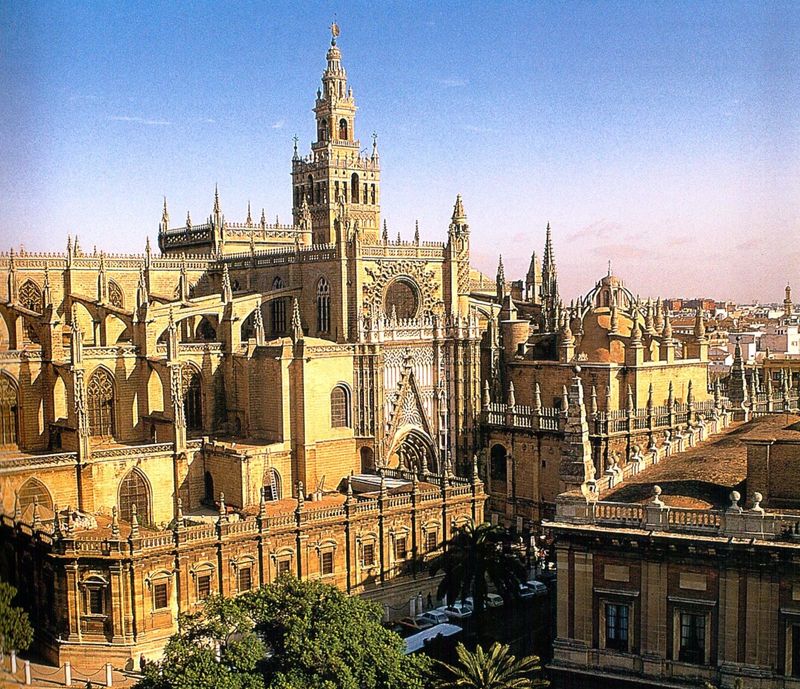
When the cathedral chapter of Seville decided in 1401 to build a new church, they reportedly said they wanted it so large that future generations would think they were mad. They were not exaggerating.
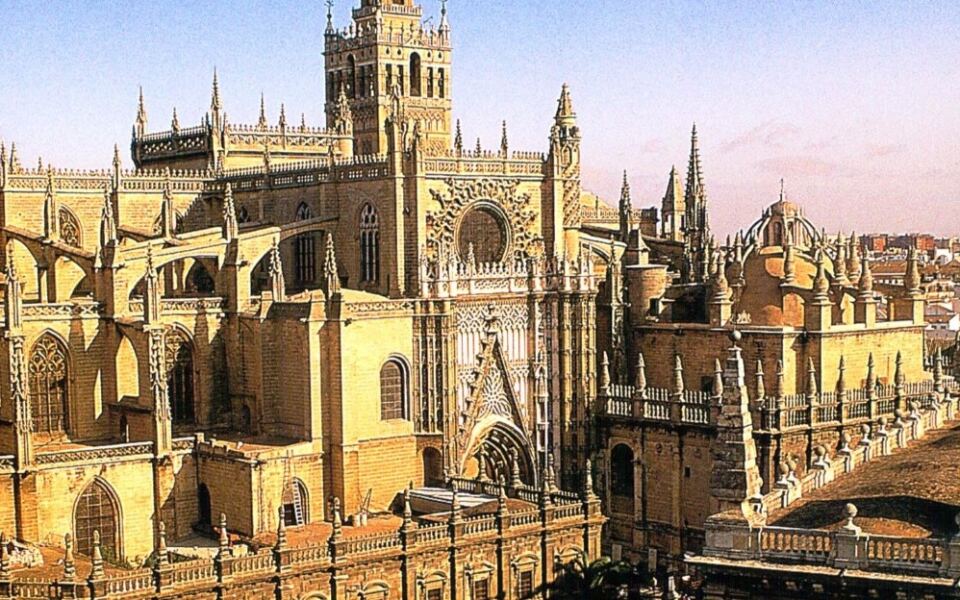
Seville Cathedral is officially recognized as the world’s largest Gothic cathedral, covering about 23,500 square meters overall, with the Gothic section measuring roughly 126 by 83 meters.
The building rose on the site of the city’s former Almohad Great Mosque, which had served as a cathedral since Christian forces captured Seville in 1248. Rather than erasing the mosque entirely, the builders kept two key elements.
The mosque’s minaret became the famous Giralda bell tower, and the former courtyard survived as the fragrant Patio de los Naranjos, still planted with orange trees today.
Inside, the cathedral contains a carved and gilded high altarpiece that took nearly a century to complete and remains one of the largest altarpieces in existence. Christopher Columbus is also buried here, his tomb carried by four royal figures representing the kingdoms of Castile, Leon, Aragon, and Navarre.
For a building that started as an act of civic one-upmanship, Seville Cathedral turned out surprisingly well.
Cathedral of St. John the Divine, New York
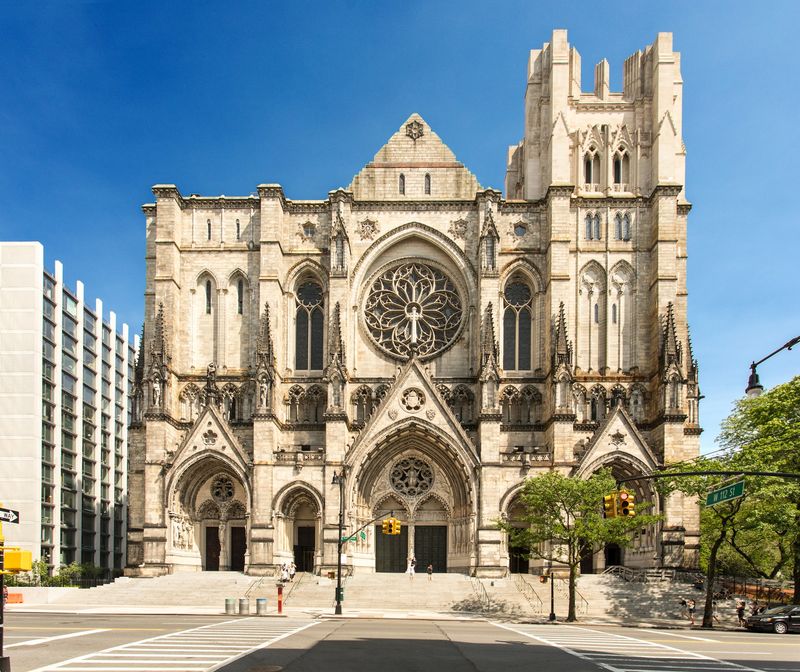
One of the world’s largest cathedrals has been under construction for over 130 years and is still not finished. That is not a criticism.
It is just the remarkable reality of St. John the Divine in New York City, where the phrase “work in progress” has lasted longer than most countries have existed.
Construction began in 1892 with a Romanesque-Byzantine design, but the concept shifted toward Gothic Revival architecture before the walls were very high. Financial problems, two world wars, and changing priorities repeatedly halted progress.
The planned towers and portions of the transept remain incomplete, giving the building an ongoing, unresolved quality that makes it genuinely unlike any other major cathedral.
Even unfinished, the numbers are staggering. The cathedral stretches about 183 meters from end to end and contains roughly 11,200 square meters of floor space.
Its crossing dome, built in just 15 weeks in 1909 using Guastavino tile construction, was originally designed as a temporary structure until a proper stone tower could replace it. More than a century later, that temporary dome is still there, which may be the most New York thing about the entire building.
Basilica of Our Lady of Lichen, Poland
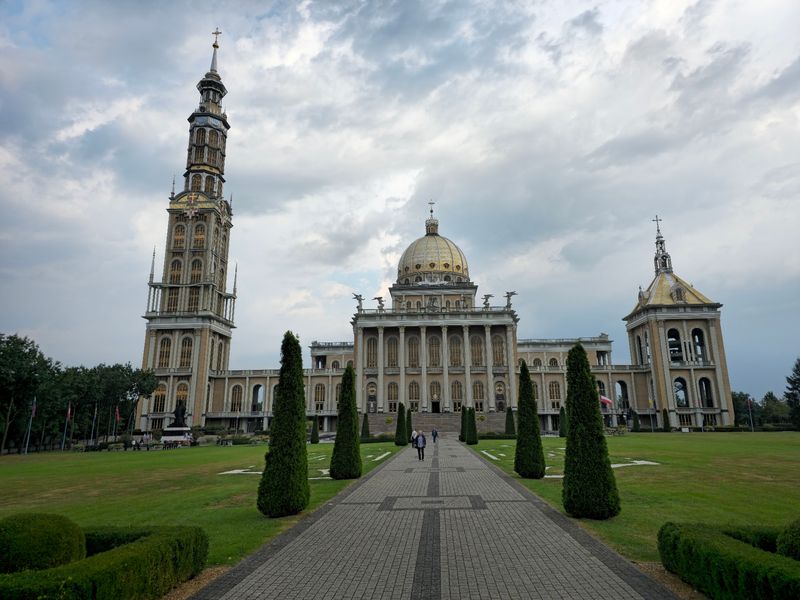
Poland’s largest church was not built over centuries by medieval guilds and stone carvers. It was built in the 1990s, and it is enormous.
The Basilica of Our Lady of Lichen rose from a pilgrimage site associated with 19th-century apparitions near the village of Lichen Stary, where devotion to a particular image of the Virgin Mary had drawn visitors for generations.
As pilgrim numbers grew through the 20th century, the existing sanctuary became completely inadequate. Construction of the new basilica began in the 1990s, and the finished building covers just over 10,000 square meters of interior space, making it one of the largest church interiors in Europe.
Its architectural style deliberately references classical and monumental forms rather than Gothic or Baroque precedents.
A vast central dome dominates the skyline, accompanied by long colonnades and a tower that rises dramatically above the surrounding Polish countryside. The building holds up to 7,000 worshippers at a time.
Critics have debated its architectural merits since the day it opened, but the pilgrims keep coming in enormous numbers regardless. Lichen proves that the age of monumental pilgrimage architecture never really ended.
It just switched from medieval stone to modern concrete.
Liverpool Cathedral, England
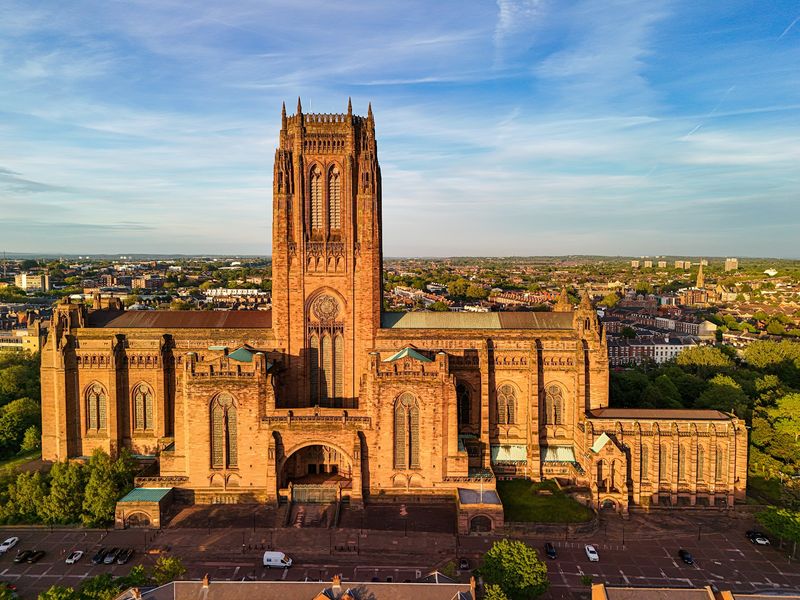
Giles Gilbert Scott was just 22 years old when he won the competition to design Liverpool Cathedral in 1903. He had never built a major building before.
The cathedral committee was so nervous about his youth that they assigned him a supervising architect. Scott outlived that supervisor, continued refining the design for decades, and died in 1960 with the cathedral still unfinished.
It was completed in 1978.
Built from warm red sandstone, Liverpool Cathedral describes itself as the largest cathedral in Britain and is frequently listed among the five largest cathedrals in the world. Commonly published measurements give it around 9,687 square meters of interior floor area.
Construction spanned two world wars and more than seven decades of shifting architectural fashion, yet the building maintains a remarkably coherent character throughout.
Scott interpreted Gothic architecture through a 20th-century engineering lens, creating exceptionally broad interior spaces and a massive central tower that dominates the Liverpool skyline. The tower houses one of the heaviest and highest peals of bells in the world.
Scott also designed the iconic red British telephone box during roughly the same period, which means one man is responsible for two of England’s most recognizable structures at entirely different scales.
Basilica of the Most Holy Trinity, Fatima, Portugal
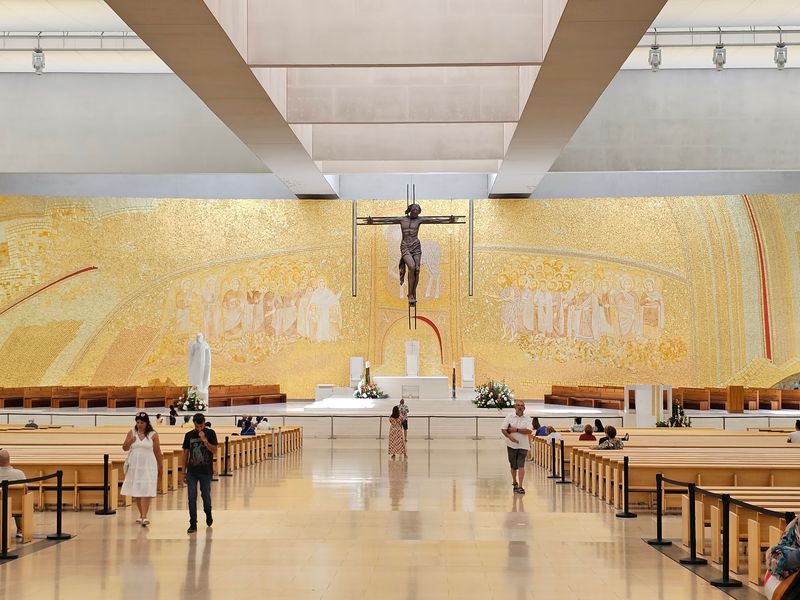
Fatima is one of Catholicism’s most important pilgrimage destinations, drawing millions of visitors each year to the site where three shepherd children reportedly witnessed Marian apparitions in 1917. For decades, pilgrims crowded into an earlier basilica that simply could not hold them all.
The solution was a second, much larger church built right next to it.
Plans for the new basilica emerged in 1973, and an international design competition followed in 1997. Greek architect Alexandros Tombazis won with a proposal that broke completely from traditional church forms.
The first stone was laid in 2004, and the basilica was dedicated on October 12, 2007, the 90th anniversary of the final apparition at Fatima.
The building is a vast circular structure 125 meters in diameter, without a single interior column blocking the congregation’s view. It contains 8,633 seats and relies on two enormous structural beams, each 182.5 meters long, to support the roof without columns.
The restrained, almost severe modern design startled some traditionalists, but its engineering achievement is genuinely impressive. Quiet and unornamented, the Basilica of the Most Holy Trinity uses space and light rather than decoration to create a sense of scale and reverence.
Florence Cathedral, Italy
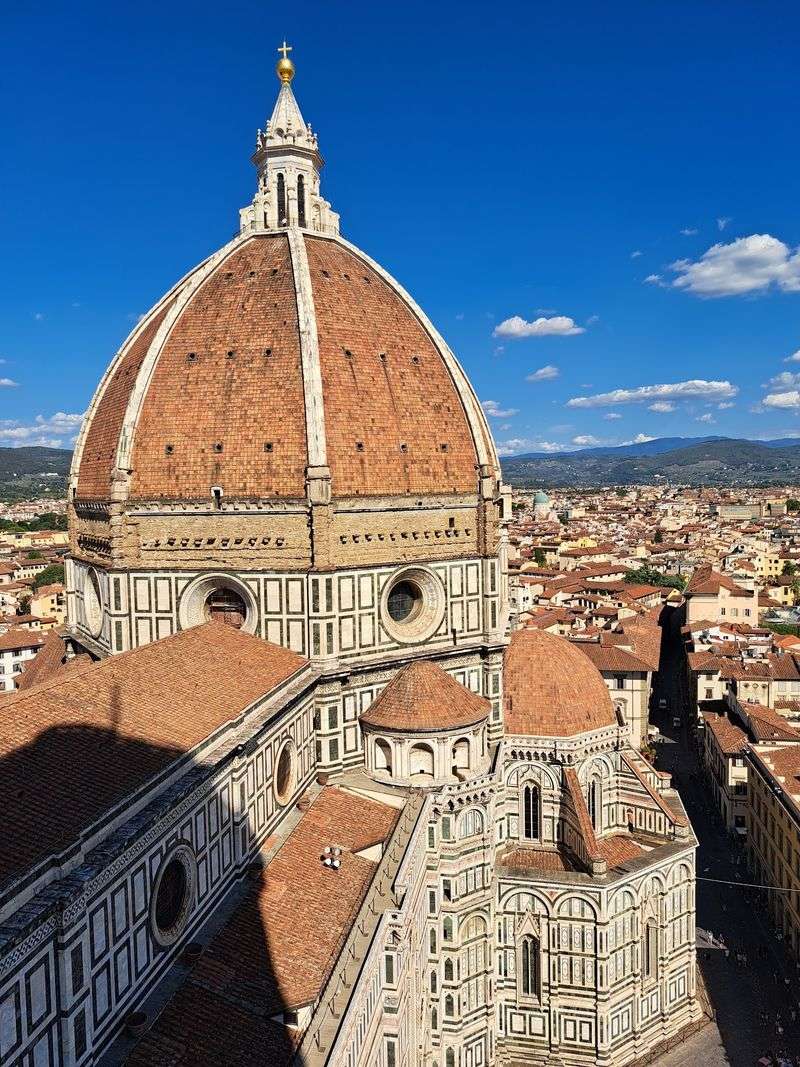
For decades, Florence had a cathedral with a hole in the roof. Not literally, but the design called for a dome over an enormous octagonal crossing, and nobody could figure out how to build it.
Medieval construction techniques required massive wooden frameworks to support arches while they were being built, and the crossing at Florence was simply too wide for any available timber to span. The problem sat unsolved for generations.
Filippo Brunelleschi cracked it in the 15th century with an ingenious double-shell masonry dome that rose without conventional centering by using a herringbone brick pattern and progressively tilting courses. The dome took 16 years to complete and remains one of the greatest engineering achievements of the Renaissance.
It still has no internal supports of any kind.
The cathedral itself covers roughly 8,200 square meters and stretches 153 meters in length, with the transept extending 90 meters across. Construction began in 1296, meaning the building took nearly 150 years to reach the point where Brunelleschi’s problem even needed solving.
The marble exterior in green, white, and pink panels gives the building a surprisingly colorful appearance for such a serious engineering landmark. The dome’s interior fresco of the Last Judgment covers 3,600 square meters of curved surface.
Ulm Minster, Germany
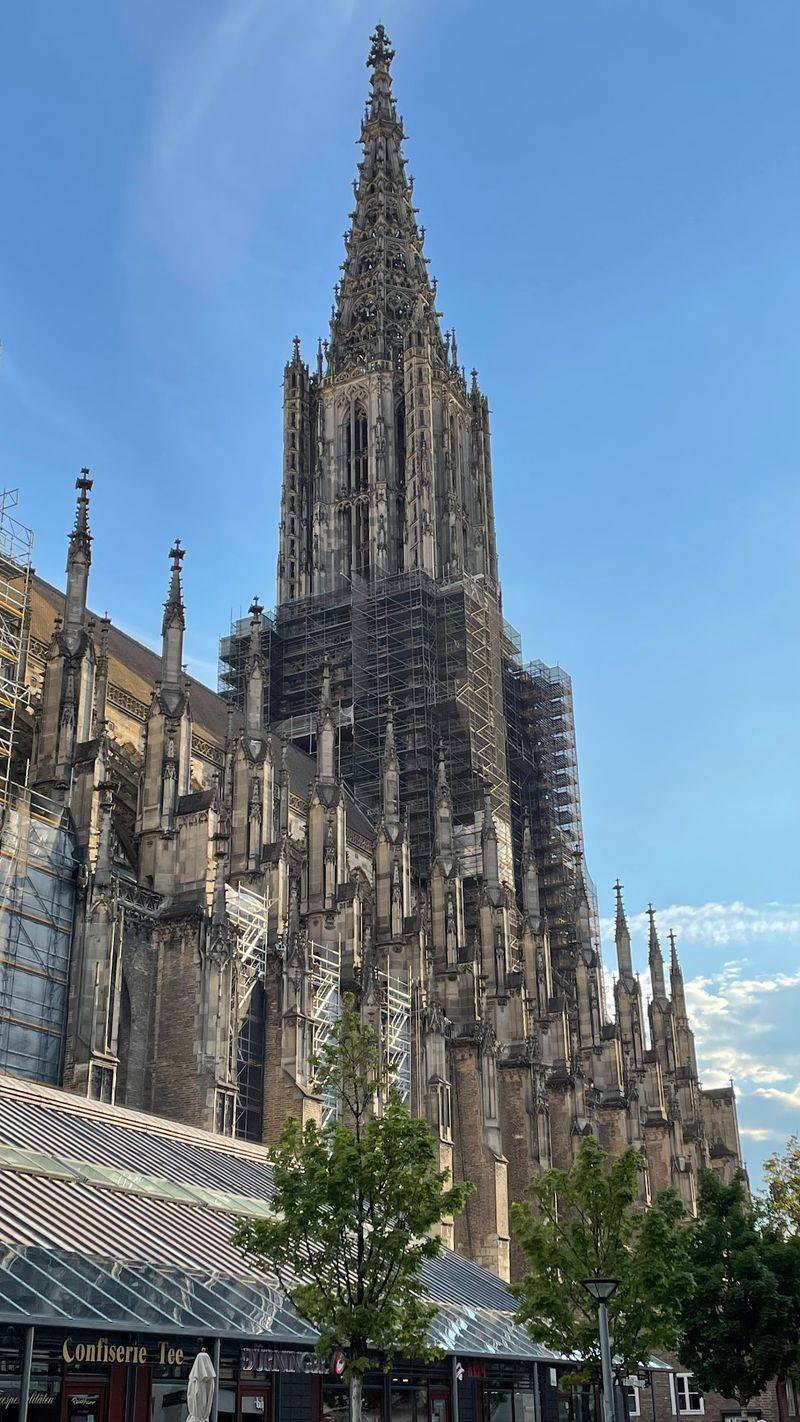
The citizens of Ulm built their own church. No bishop ordered it, no king funded it, and no religious order managed it.
The residents of this German city on the Danube decided in 1377 that they needed a new parish church, partly because the old one sat outside the city walls and attending services during wartime meant risking your life. So they laid the foundation stone themselves and started building.
Work progressed steadily for a while, then slowed, then stopped almost entirely for centuries before resuming in the 19th century. The spire was not completed until 1890, more than 500 years after the first stone was laid.
When it was finished, it stood 161.53 meters tall, making Ulm Minster the tallest church in the world. The building covers about 8,260 square meters of floor space.
Ulm held that height record for well over a century. Then in 2025, the Sagrada Familia in Barcelona surpassed it as its central tower was completed.
Ulm lost the record, but the building itself remains extraordinary: a medieval civic project of staggering ambition, built by ordinary townspeople who simply decided they wanted something magnificent and then spent five centuries making it happen.
Basilica of Our Lady of Peace, Cote d’Ivoire
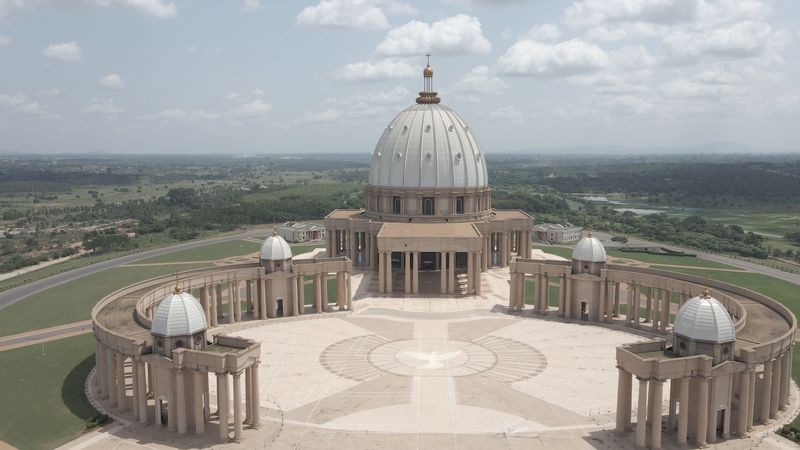
Every other church on this list took decades or centuries to build. This one took 36 months.
The Basilica of Our Lady of Peace in Yamoussoukro, Cote d’Ivoire, was commissioned by President Felix Houphouet-Boigny and constructed between 1986 and 1989 at extraordinary speed and expense. Architect Pierre Fakhoury designed it with clear visual references to St. Peter’s Basilica, including a dome roughly 90 meters in diameter.
Guinness World Records recognizes it as the largest church in the world, using a total-area measurement of approximately 30,000 square meters that includes the esplanade and surrounding complex. The structure itself reaches 158 meters including its cross.
Some 8,000 square meters of stained glass panels decorate the building, produced in France and installed at remarkable pace during construction.
The basilica provides 7,000 seats under the Guinness criteria and can accommodate up to 18,000 worshippers including standing room. Pope John Paul II consecrated it in 1990 on the condition that a hospital for the poor be built nearby.
That hospital was eventually constructed. The whole project remains one of the most audacious acts of religious architecture in modern history, rising fully formed from the tropical savanna in just three years.
Share this story