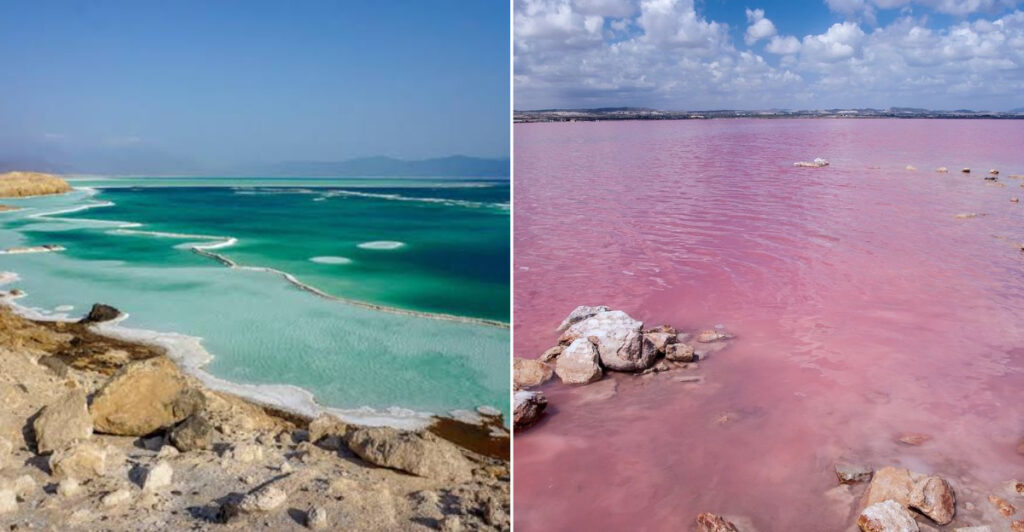
Some lakes look like they belong on another planet entirely. From bubblegum pink water in Australia to rust-red lagoons high in the Bolivian mountains, salt lakes around the world produce colors and formations that most people never expect to find in nature.
High salinity, specialized microorganisms, minerals, and sunlight all work together to create these extraordinary landscapes. Whether you are a photographer chasing a perfect reflection, a traveler looking for something genuinely different, or just someone who enjoys knowing these places exist, this list covers twelve salt lakes and salt flats that are worth knowing about.
Hutt Lagoon, Western Australia, Australia
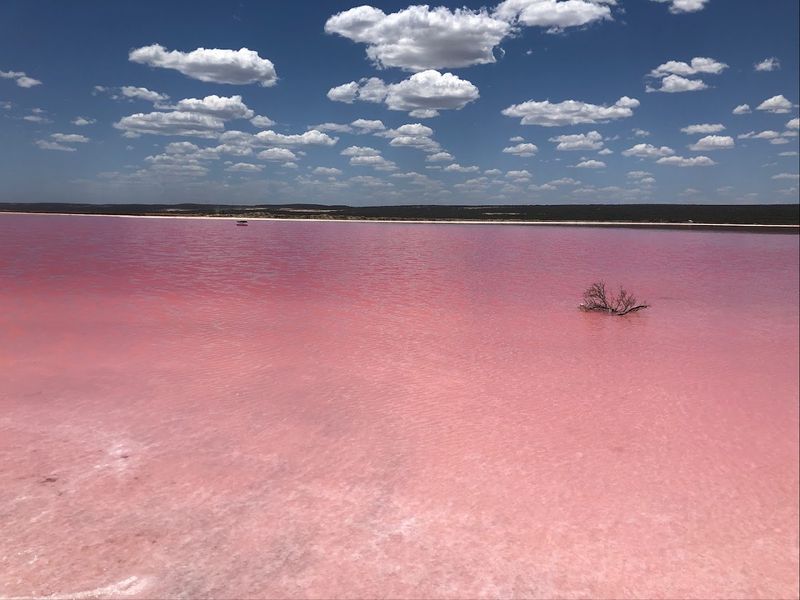
Not every remarkable natural landscape requires a remote expedition to reach. Hutt Lagoon, located near Port Gregory in Western Australia, is one of the more accessible examples of a naturally colored salt lake, and its surface can shift between bubblegum pink, soft lilac, and deep red depending on the season, sunlight, and water levels.
The intense colors are connected to the lagoon’s extremely high salinity and the presence of salt-tolerant microorganisms that produce vivid pigments. Several roadside viewing areas along Port Gregory Road give visitors a ground-level perspective without requiring special permits or off-road travel.
Scenic flights departing from Geraldton and Kalbarri offer the strongest visual contrast, showing the colored water alongside the pale shoreline and the blue Indian Ocean below. Tourism Western Australia recommends visiting on a clear day around midmorning or near sunset, though the color intensity can vary considerably from one visit to the next.
Lake MacDonnell, South Australia, Australia
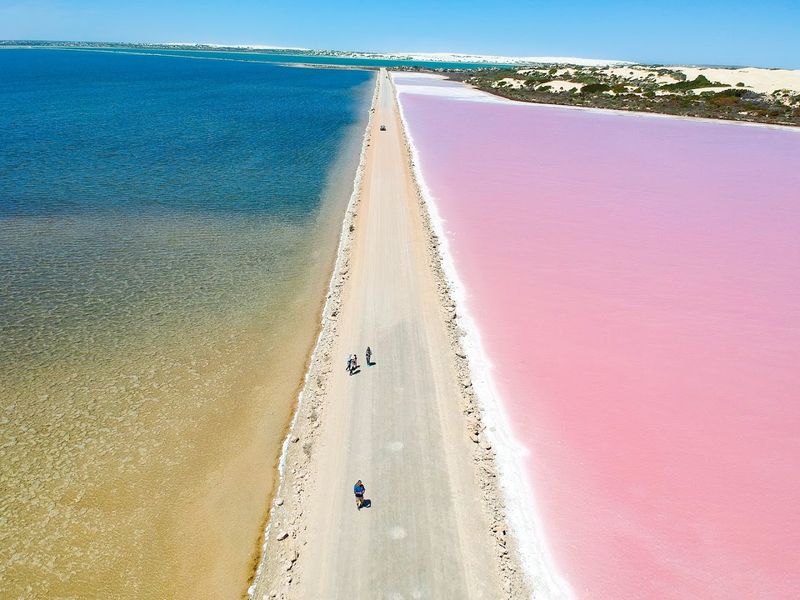
A single narrow causeway splits Lake MacDonnell into two visually different worlds. Under favorable conditions, travelers standing on the road can see salmon-pink water on one side and blue-green water on the other, which is one of the more unusual roadside views in South Australia.
The pink coloration is linked to salt-loving algae and bacteria that release red pigments as salinity rises. A separate section farther along the route is commonly referred to as Blue Lake, adding another visual contrast to the stop.
South Australia’s tourism authority is clear that Lake MacDonnell is not permanently pink. Water levels, seasonal weather, and light conditions all influence whether the color appears vivid or barely noticeable on any given day.
The lake sits about nine miles south of Penong on the road toward Point Sinclair, and the official attraction listing currently identifies it as open to visitors. Early morning light tends to bring out the most contrast between the two sides.
Lake Hillier, Western Australia, Australia
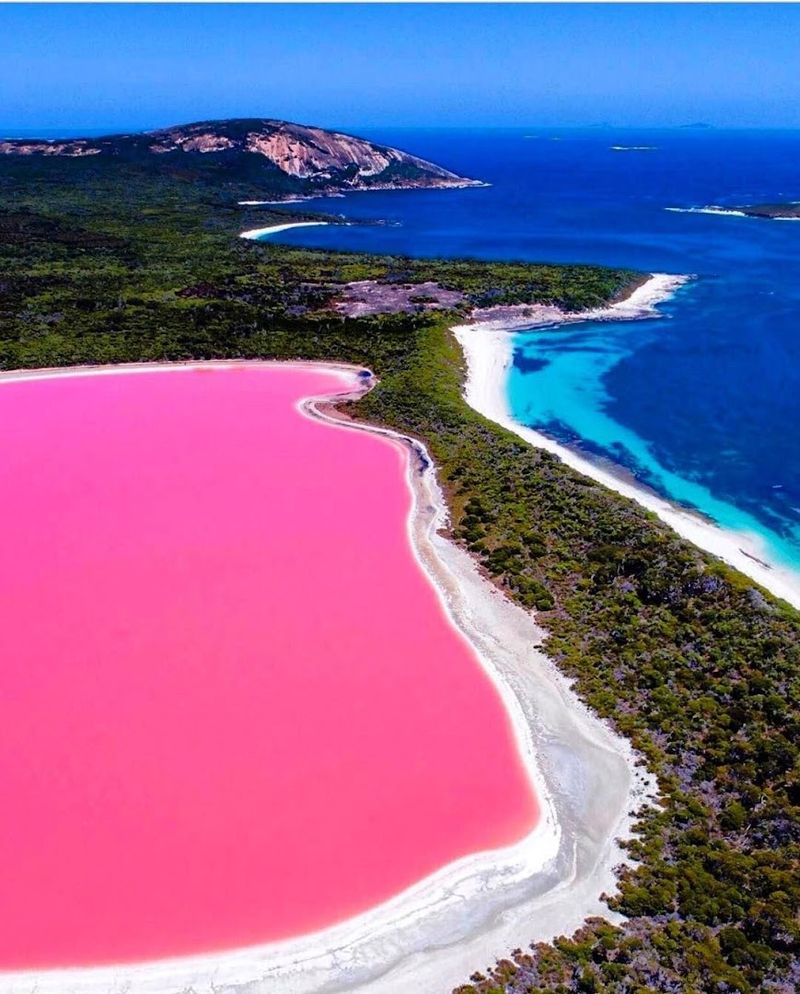
Lake Hillier became one of the most shared natural images on the internet largely because of older aerial photographs showing brilliantly pink water pressed between dark green forest and the blue Southern Ocean. The lake sits on Middle Island, roughly seven miles off the coast near Esperance, and its roughly footprint-shaped outline made it instantly recognizable from the air.
Modern travelers should know that Tourism Western Australia now states the lake is no longer the vivid bubblegum pink seen in many of those widely circulated older images. Natural changes have altered its appearance, and the intense color cannot be guaranteed.
Lake Hillier remains promoted as part of the Esperance region, primarily through scenic flight experiences that give passengers a bird’s-eye view of the island’s remote landscape. Visitors should approach the experience expecting a genuinely wild and isolated coastal environment rather than the dramatically edited pink that still dominates many online searches.
The setting itself remains striking regardless of water color.
Lake Tyrrell, Victoria, Australia
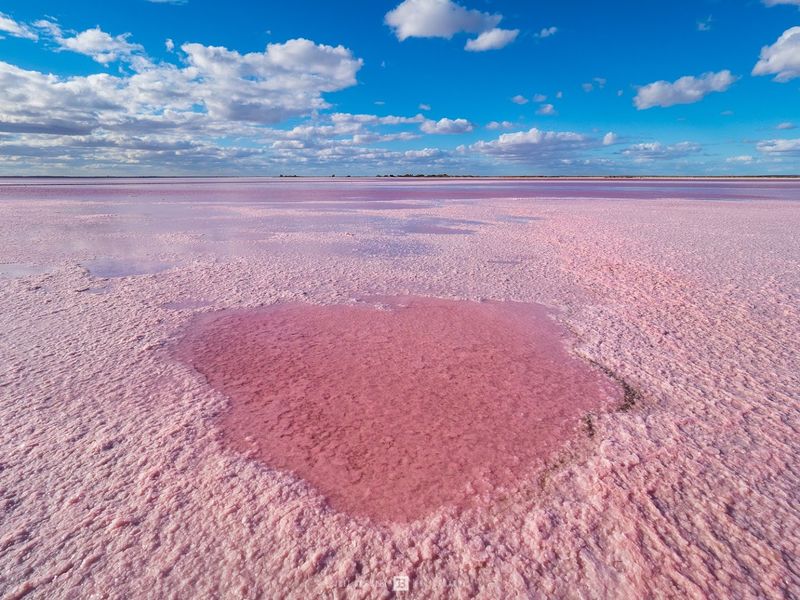
Victoria’s largest salt lake has been sitting in the flat Mallee landscape for an estimated 120,000 years, which gives it a quiet kind of permanence that most destinations cannot claim. Lake Tyrrell, located near the small town of Sea Lake, is not primarily known for vivid color the way some of Australia’s pink lakes are.
Its most remarkable feature is what happens when a thin layer of water covers the salt bed.
Under calm conditions, the reflective surface becomes an almost perfect natural mirror, reproducing sunsets, clouds, and star fields with unusual clarity. Photographers and dark-sky enthusiasts visit specifically for those conditions, particularly during winter when the night sky over the Mallee is especially clear.
During drier periods, the lake presents a different kind of spectacle, with pale salt crusts and wide expanses of textured ground stretching to the horizon. Official tourism listings continue to promote Lake Tyrrell for sunset photography and star navigation experiences, both of which are available without any admission fee.
Great Salt Lake, Utah, United States
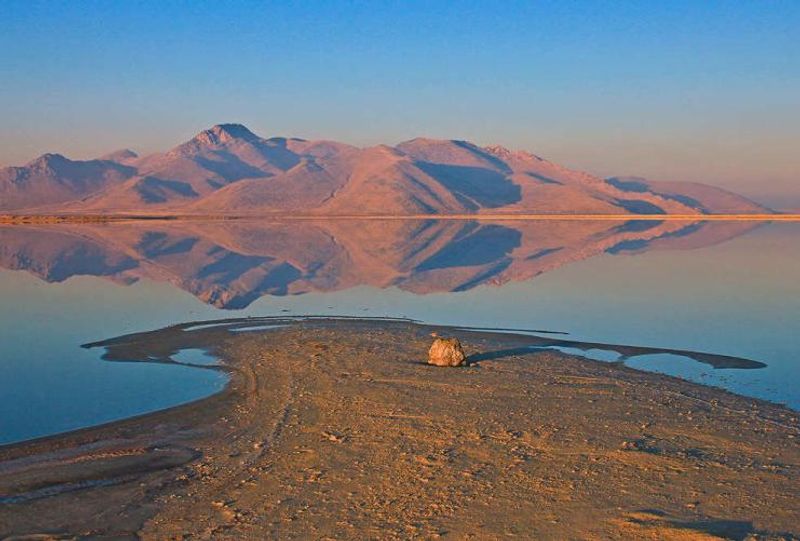
Great Salt Lake can look like two completely different bodies of water depending on which side of a railroad causeway you are viewing. The causeway limits the flow of fresher water into the northern arm, pushing salinity so high that salt-tolerant bacteria and algae can tint the water pink or reddish.
The southern arm, which receives more freshwater inflow, typically stays blue-green.
Shorelines and exposed rocks near the northern section can become coated in white salt deposits, adding another layer of visual contrast to the landscape. Spiral Jetty, the famous earthwork sculpture created by Robert Smithson in 1970, provides public access to the remote northern shore, though reaching it requires a long drive over gravel and dirt roads.
Great Salt Lake State Park’s conditions page listed day use, the campground, and the lake surface as open as of late July 2026, while noting that water levels remain low. The low water has actually increased salinity in some sections, which can intensify the pink coloration in the northern arm.
Salar de Uyuni, Potosi and Oruro, Bolivia
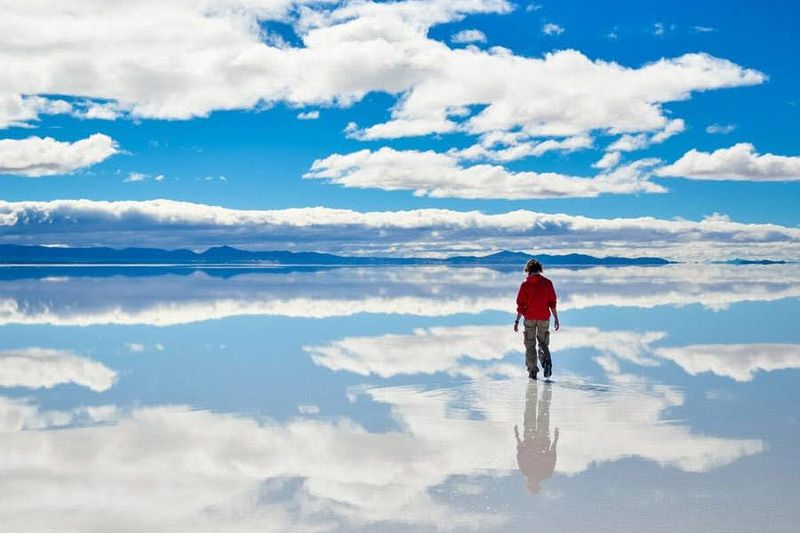
Salar de Uyuni is not a lake in the traditional sense, but its origins and appearance place it firmly in any conversation about extraordinary salt-water landscapes. Covering roughly 4,000 square miles across the Bolivian Altiplano, it formed from the remnants of ancient lakes that slowly dried over thousands of years, leaving behind the world’s largest salt flat.
The dry season reveals a brilliant white surface marked by repeating hexagonal and polygonal salt patterns that stretch in every direction without interruption. When seasonal rains arrive, a thin layer of water covers the flat and creates one of nature’s most disorienting illusions, making the boundary between sky and ground almost impossible to identify.
Tours from the town of Uyuni continue operating in 2026, with single-day excursions covering the main salt flat and multi-day expeditions traveling deeper into the surrounding high-altitude desert. The site sits at approximately 11,995 feet above sea level, so altitude preparation is a practical consideration before visiting.
Laguna Colorada, Potosi, Bolivia
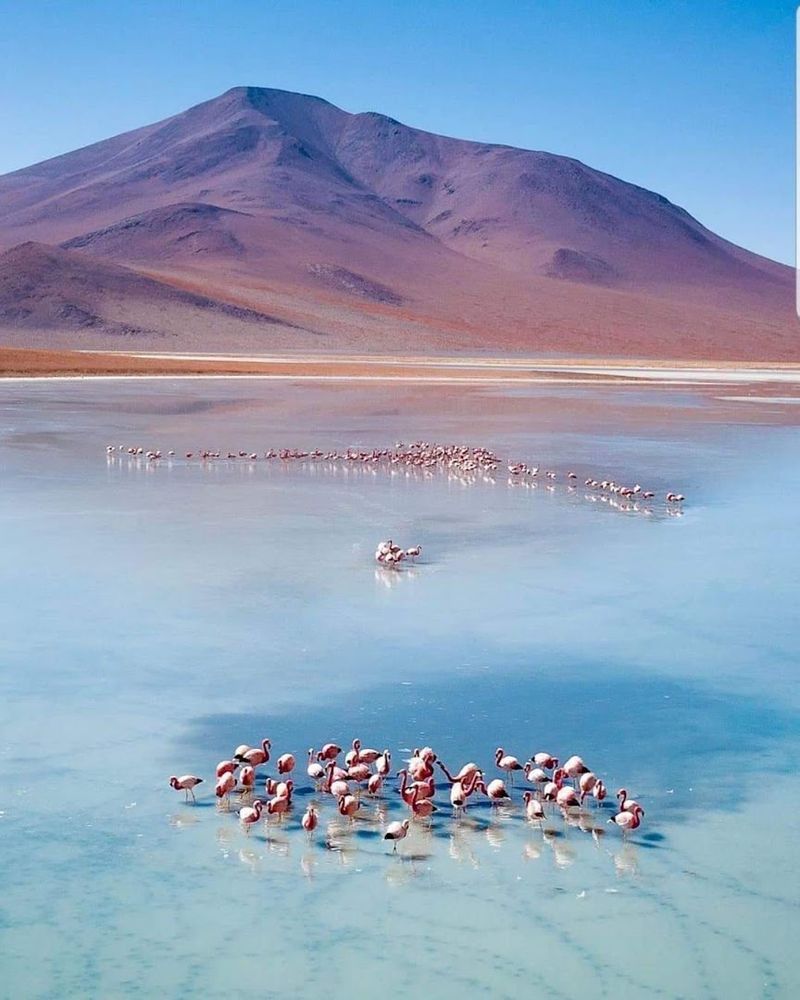
Sitting at over 14,000 feet above sea level inside the Eduardo Avaroa Andean Fauna National Reserve, Laguna Colorada earns its name honestly. The shallow water can shift between rust-red, deep crimson, and burnt orange depending on the time of day, season, and the concentration of algae and mineral-rich sediments suspended in it.
White borax deposits form irregular patches and small islands across the lakebed, creating a sharp contrast against the colored water. Flamingos regularly gather here to feed, which adds yet another layer of unexpected pink to an already vivid scene.
Three species of flamingo have been documented at the lagoon, making it a notable wildlife destination as well as a photographic one.
Bolivia’s protected-area service continues to manage the reserve and operate a tourism program in 2026. Laguna Colorada is most commonly reached on guided multi-day expeditions departing from Uyuni, traveling through remote desert terrain, geyser fields, and other colored lagoons along the way.
Warm layers are essential regardless of the season.
Laguna Rosa de Torrevieja, Alicante, Spain
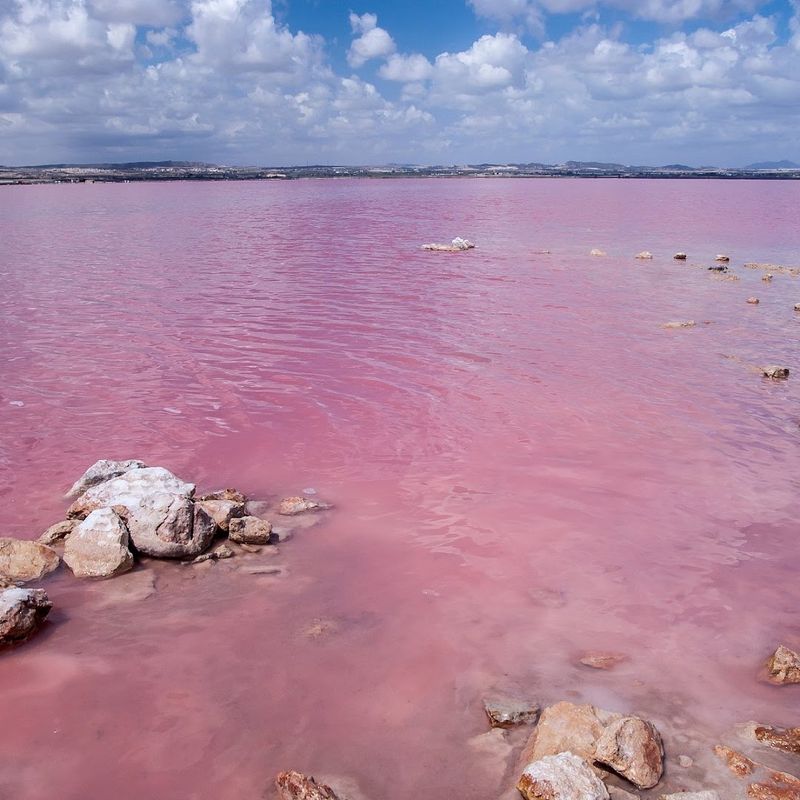
Spain has its own version of a pink salt lake, and it sits within a protected natural park on the southeastern coast near the city of Torrevieja in Alicante province. The park contains two connected lagoons with strikingly different appearances.
Laguna de La Mata typically holds green water, while the larger Torrevieja lagoon can develop a notable pink tone that becomes especially vivid during the warmer summer months.
Salt-tolerant bacteria release pigments that contribute to the color, while brine shrimp and flamingos are regular parts of the surrounding ecosystem. The area also carries a long history of commercial salt production that continues today, giving the landscape both natural and industrial character.
Visitors can explore the park using walking and cycling routes, bird observatories, and the on-site visitor center. Bathing is prohibited in both lagoons, so the pink water is experienced from approved paths and designated viewing areas rather than from within the water itself.
Entry to the natural park is free.
Lake Tuz, Central Anatolia, Turkiye
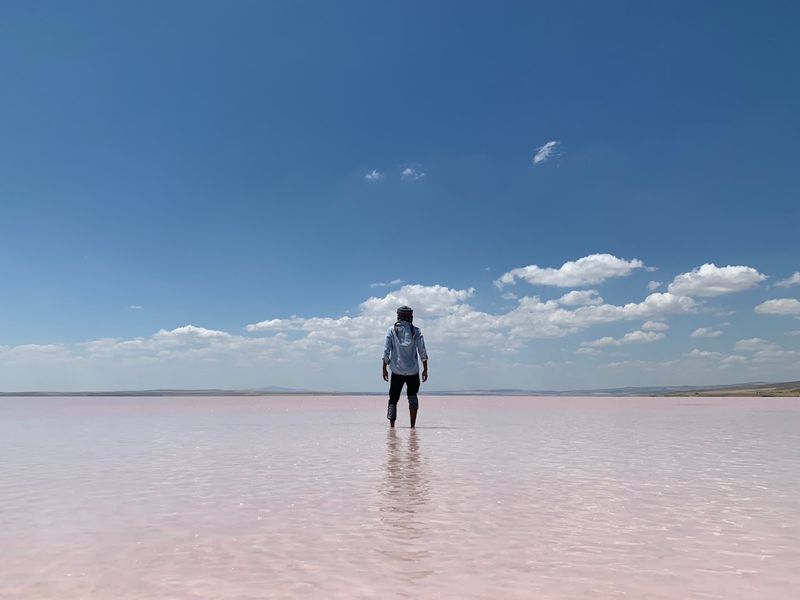
For most of the year, Lake Tuz looks like a pale, unremarkable body of shallow water spreading across the Central Anatolian steppe. Then summer arrives, and the transformation is hard to ignore.
As temperatures climb and evaporation accelerates, the water retreats and leaves behind a salt layer that can average nearly one foot in thickness, producing a surface that resembles a snow-covered plain in the middle of a landlocked plateau.
The lake does not stop there. When salinity peaks during the hottest periods, salt-loving algae can develop in concentrated patches, tinting portions of the remaining water red or pink.
Recent photographs published in July 2026 documented those red and pink tones returning to Lake Tuz during the summer heat, confirming that the phenomenon continues to occur.
Official tourism sources identify Lake Tuz as one of the country’s most extraordinary natural landscapes and note that it ranks as the second-largest lake in Türkiye after Lake Van. Access is possible from several surrounding towns.
Chott El Djerid, Southern Tunisia
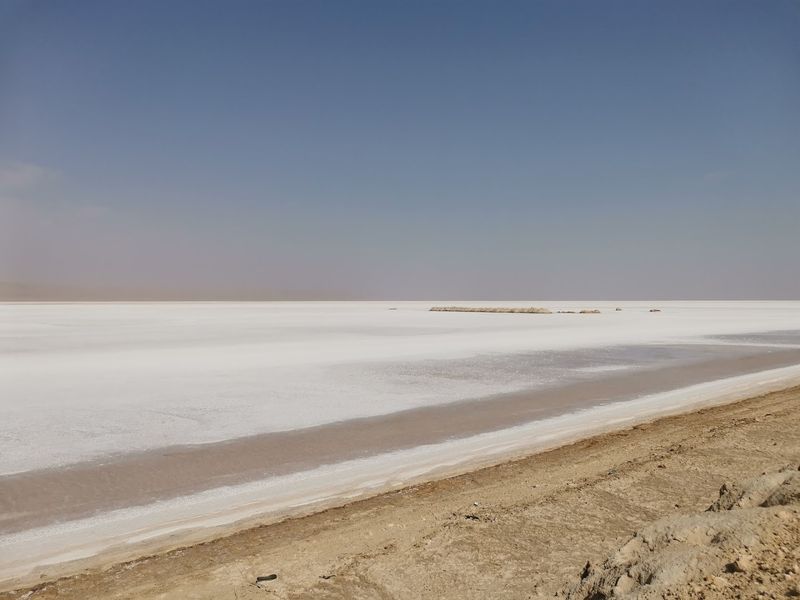
Chott El Djerid stretches across the Tunisian Sahara as one of the largest salt lakes in the Sahara region, though calling it a lake during most of the year requires some imagination. Heat and evaporation reduce it to a wide, glittering white crust for much of the time, while shallow pools and drainage channels can take on green, purple, reddish, or metallic tones depending on mineral content and water depth.
The lake’s most famous feature may not be its color at all. Mirages form regularly over the flat surface, bending light in ways that make distant objects appear to float above the horizon or reflect upside down in water that is not actually there.
It is the kind of visual effect that makes you question what you are actually seeing.
A paved road crosses the lake directly, giving travelers a close look at the crystalline surface without the risk of driving onto unstable salt. Tunisia’s official tourism portal promotes Chott El Djerid alongside nearby dunes, oases, and desert villages as part of the Douz and Sahara region.
Lake Assal, Djibouti
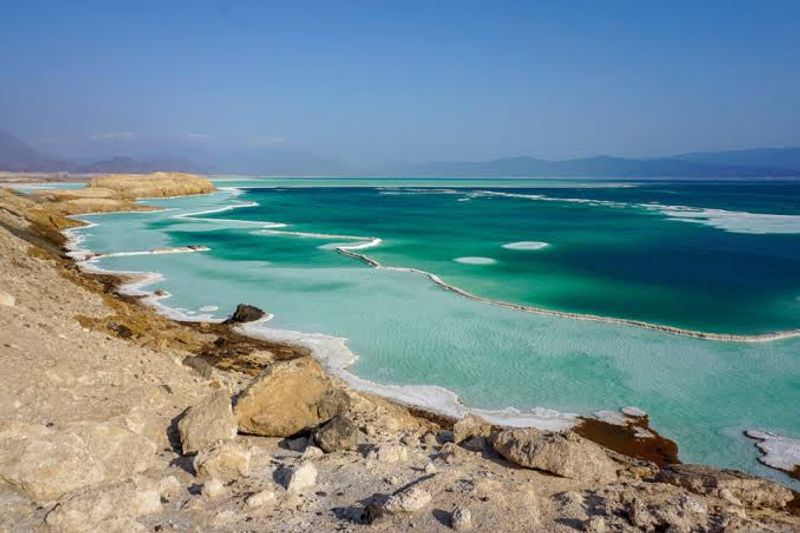
Few lakes on Earth pack as many extreme contrasts into one view as Lake Assal. Turquoise and emerald water sits surrounded by brilliant white salt, black lava fields, and barren ocher mountains, all under the kind of sky that only appears in genuinely remote desert regions.
Located more than 500 feet below sea level, it holds the distinction of being the lowest point on the African continent.
Evaporation over centuries has created an enormous solid salt area along one side of the lake, with thick crusts, crystalline edges, and sculpted formations that build up as water draws down. The salt layer in some sections is dense enough to walk on, though visitors are advised to follow local guidance on where that is safe.
Djibouti’s national tourism agency actively promotes Lake Assal as one of the country’s top natural attractions and organizes trips from Djibouti City, approximately a 90-minute drive away. The extreme desert heat makes water preparation and local guidance genuinely important parts of planning any visit.
Hidden Lagoons of Baltinache, Antofagasta Region, Chile
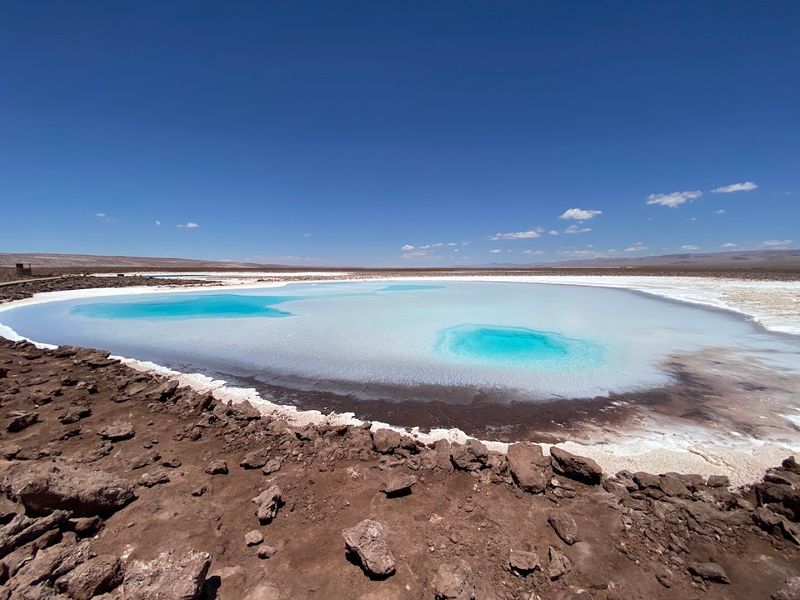
Seven turquoise pools sitting quietly in the middle of the Atacama Desert is not something most people expect to find, but that is exactly what the Hidden Lagoons of Baltinache offer. The clear blue water, pale salt edges, and surrounding dry desert terrain create a color combination that feels almost artificially arranged, yet it is entirely natural.
The pools carry an extremely high salt concentration, which means visitors can float in the designated bathing areas with very little effort. Not all seven pools are open for swimming.
Official guidance specifies that only certain designated pools may be used, while the remaining ones are protected to preserve their delicate mineral formations and shoreline shapes.
Reaching the lagoons from San Pedro de Atacama requires traveling along a gravel road, so Chile’s tourism authority recommends using an appropriate vehicle or booking through a registered local tour operator. The lagoons remain actively promoted as a visitor experience in 2026, and early morning visits tend to offer the clearest water color before afternoon winds pick up.
Share this story