Some buildings are impressive on their own. Others become truly unforgettable because of where they stand.
Across Asia and beyond, sacred temples rise from volcanic plains, cling to rocky cliffs, emerge from ancient forests, and anchor the ruins of entire lost civilizations. These 13 remarkable temples show how powerfully a surrounding landscape can shape the way we experience architecture, history, and the human desire to connect with something greater.
Borobudur, Indonesia
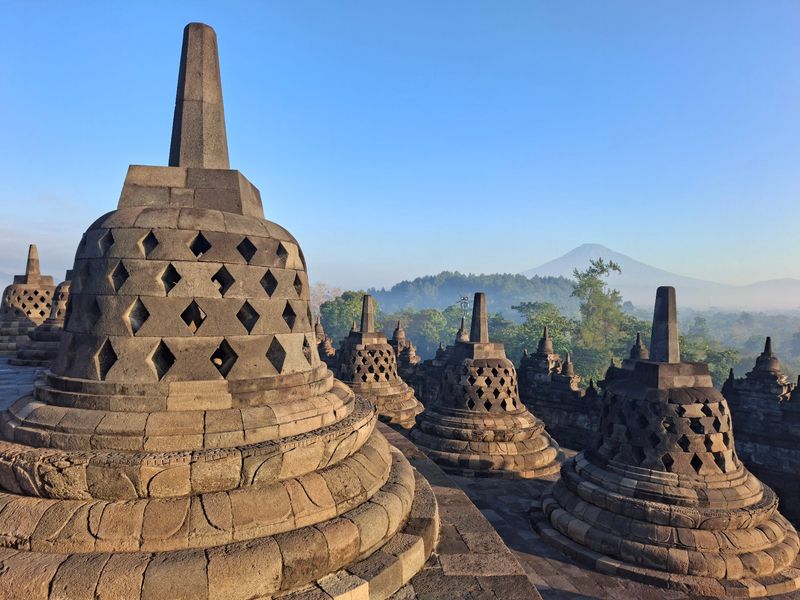
Borobudur does not look like a temple from a distance. It looks like a mountain that someone decided to carve into something even more impressive.
Rising from the lush Kedu Plain of central Java, this enormous stepped pyramid of terraces was built during the eighth and ninth centuries and remains one of the greatest Buddhist monuments ever constructed.
The design is intentional. UNESCO describes Borobudur as a deliberate combination of stupa, temple, and mountain, with the structure itself representing a sacred cosmic mountain.
Dozens of bell-shaped stupas crown the upper terraces, each originally containing a seated Buddha. Walking the levels from base to summit replicates a symbolic journey toward enlightenment.
Tropical vegetation presses close on all sides, and volcanic peaks occasionally appear through the haze on clear mornings. The site was abandoned for centuries, swallowed by jungle and volcanic ash, before major restoration efforts brought it back into public life.
Nearby temples Mendut and Pawon sit on a precise east-west axis with Borobudur, suggesting the entire valley was once organized around a single grand religious vision.
Angkor Wat, Cambodia
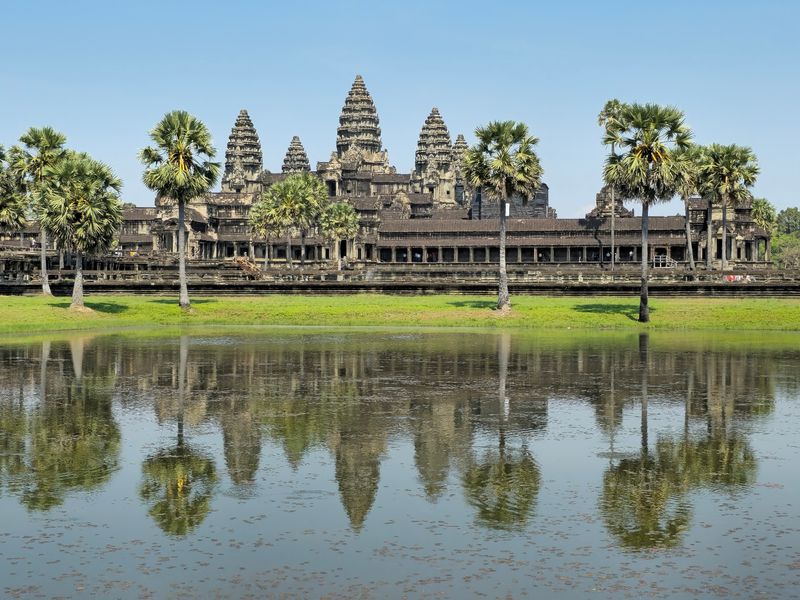
Angkor Wat is technically just one temple inside a much larger archaeological landscape, but calling it “one temple” is a bit like calling the Pacific Ocean a puddle. The wider Angkor complex covers roughly 400 square kilometers and contains temples, reservoirs, roads, and the ruins of successive Khmer capitals dating from the ninth to the 15th centuries.
The jungle surrounding many of the monuments is not just scenery. It is part of the story.
Ancient waterworks reveal how carefully the Khmer Empire managed the landscape around their cities, and trees have been slowly reclaiming stone towers for centuries. Ta Prohm, where roots wrap around carved walls, makes this relationship between nature and architecture impossible to ignore.
Angkor Wat itself was conceived on a staggering scale, with concentric galleries and five towers representing Mount Meru, the sacred mountain of Hindu cosmology. Nearby Bayon, Preah Khan, and Ta Prohm each offer completely different atmospheres within the same landscape.
Visiting Angkor is less about seeing one great building and more about spending time inside the remains of an entire civilization.
Kiyomizu-dera, Kyoto, Japan
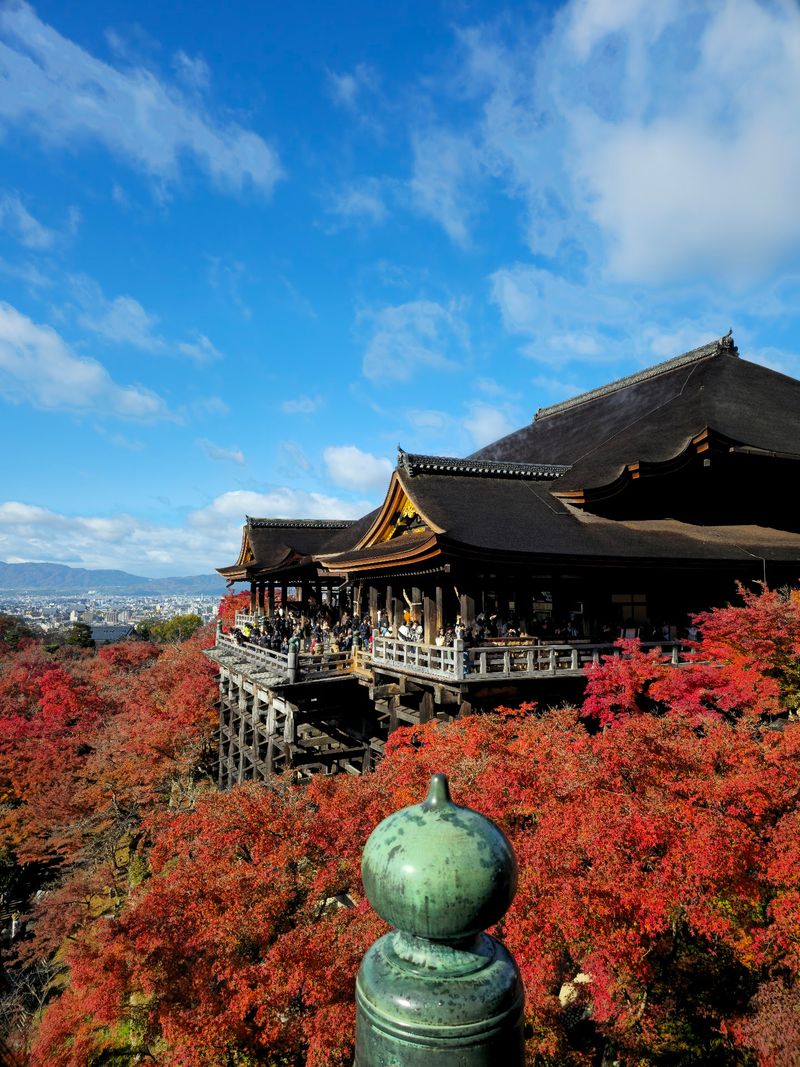
Kiyomizu-dera pulls off a trick that most buildings never manage: it makes the landscape part of the architecture. The temple’s famous wooden stage extends from the main hall over a steep forested hillside, supported by 139 wooden pillars without a single nail.
Standing on it feels less like visiting a historic building and more like stepping into a painting.
The site is one of 17 components of UNESCO’s Historic Monuments of Ancient Kyoto, representing over a thousand years of Japanese religious and architectural tradition. Seasonal changes transform it completely.
Cherry blossoms arrive in spring, dense green canopy fills summer, and Japanese maples turn the hillside brilliant red and orange in autumn. Each season brings a different crowd and a different mood.
From the terrace, visitors look across the treetops toward the city of Kyoto below, connecting a hillside religious site with the ancient urban landscape it has overlooked for centuries. The temple is dedicated to Kannon, the bodhisattva of compassion, and a spring inside the complex gives the site its name.
Kiyomizu means “pure water,” and pilgrims have been drinking from it for well over a thousand years.
Bulguksa Temple, Gyeongju, South Korea
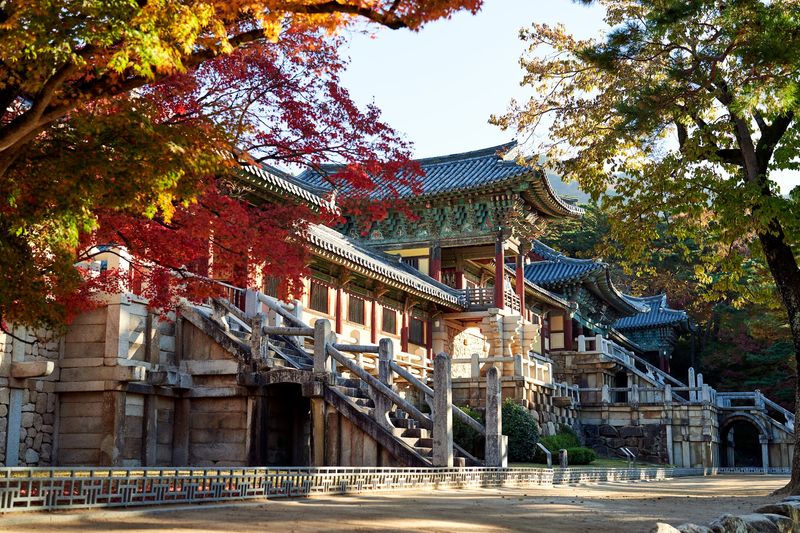
Tucked into the forested slopes of Mount Tohamsan, Bulguksa has the kind of quiet confidence that comes from being extraordinary for over a thousand years. Built near Gyeongju, the former capital of the Silla kingdom, the temple was substantially reconstructed in 751 CE and represents one of Korea’s finest surviving expressions of Silla Buddhist culture and craftsmanship.
Stone staircases, bridges, and pagodas from the original construction survived the destruction that the Imjin War brought in the late 16th century, when Japanese forces burned much of the wooden complex. The Cheongungyo and Baegungyo bridges, leading to the main hall, are among the oldest stone bridges in Korea.
They were not built purely for function. They were designed to mark the symbolic crossing from the ordinary world into sacred space.
A short distance up the same mountain, Seokguram Grotto contains a breathtaking granite Buddha surrounded by carved bodhisattvas and guardians. Together, Bulguksa and Seokguram were among Korea’s first UNESCO World Heritage sites, recognized in 1995.
The mountain setting is not background decoration but a deliberate part of the religious design, placing sacred spaces within a natural landscape considered spiritually significant.
Paro Taktsang, Bhutan
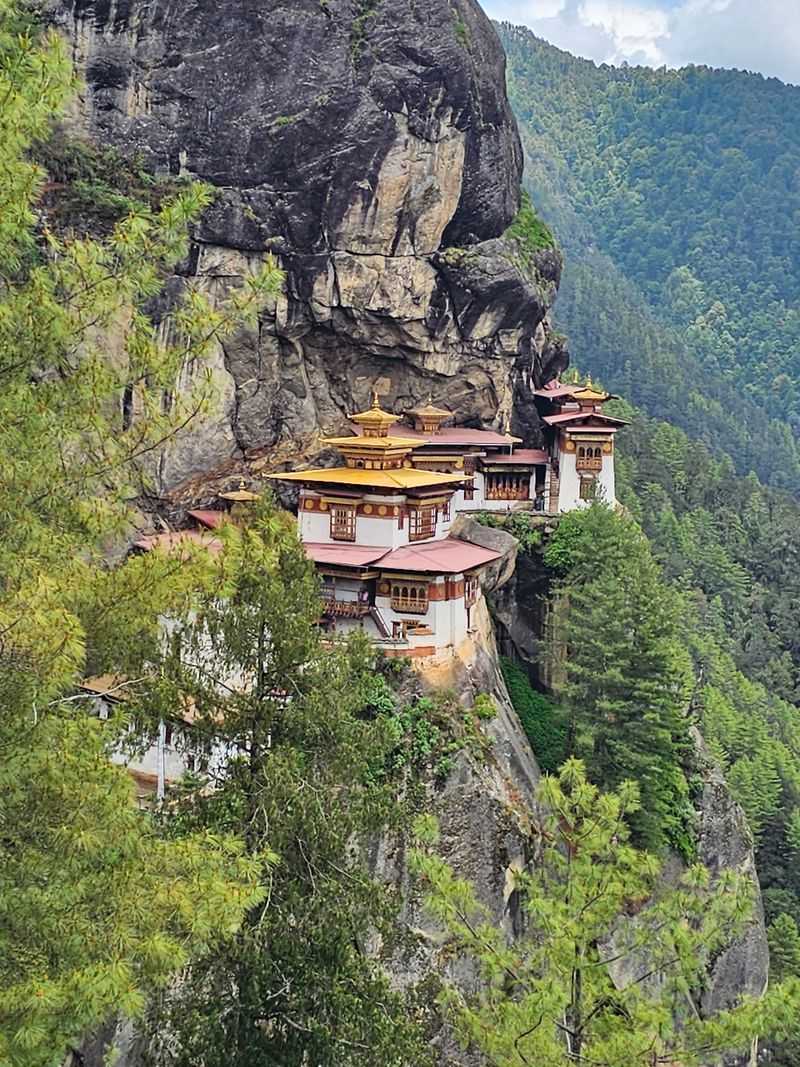
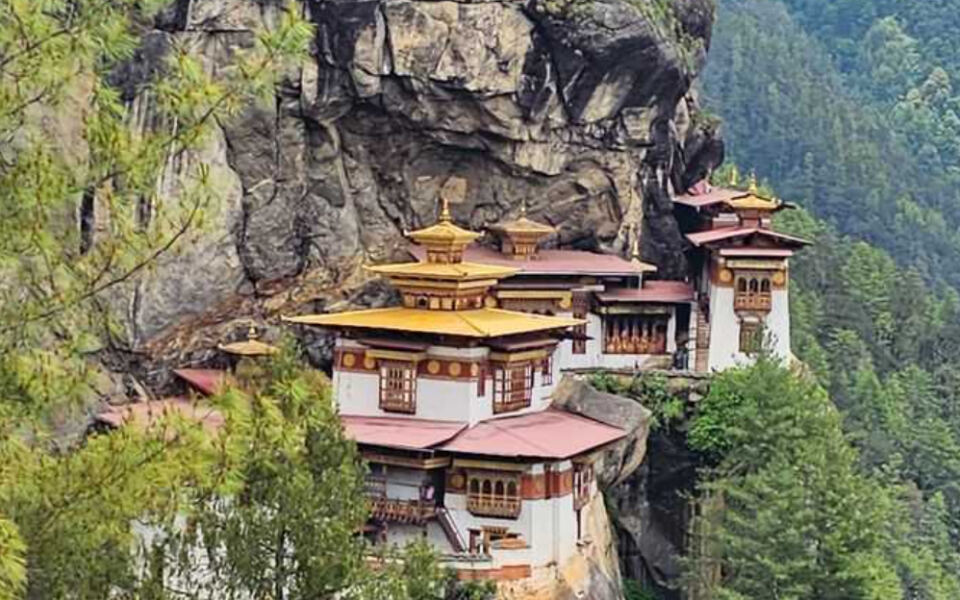
Gravity seems to have made an exception for Tiger’s Nest. Paro Taktsang clings to a vertical cliff above Bhutan’s Paro Valley at around 3,120 meters, looking less like something built and more like something that grew out of the rock itself.
The whitewashed walls and gilded rooftops practically dare you to explain how they got there.
Buddhist tradition says Guru Rinpoche flew to this spot on the back of a tigress in the eighth century and meditated inside a cave hidden within the complex. Whether you take that literally or not, the setting gives the story a lot of credibility.
The hike through pine forest to reach the monastery is part of the experience, with the famous viewpoint appearing almost like a reward for the climb.
The present structures have been rebuilt and restored after fires, but the overall effect remains extraordinary. Mist drifts across the valley below while prayer flags flutter above sheer drops.
Few religious sites in the world ask visitors to work this hard for the view, and even fewer deliver this completely on the promise.
Prambanan, Indonesia
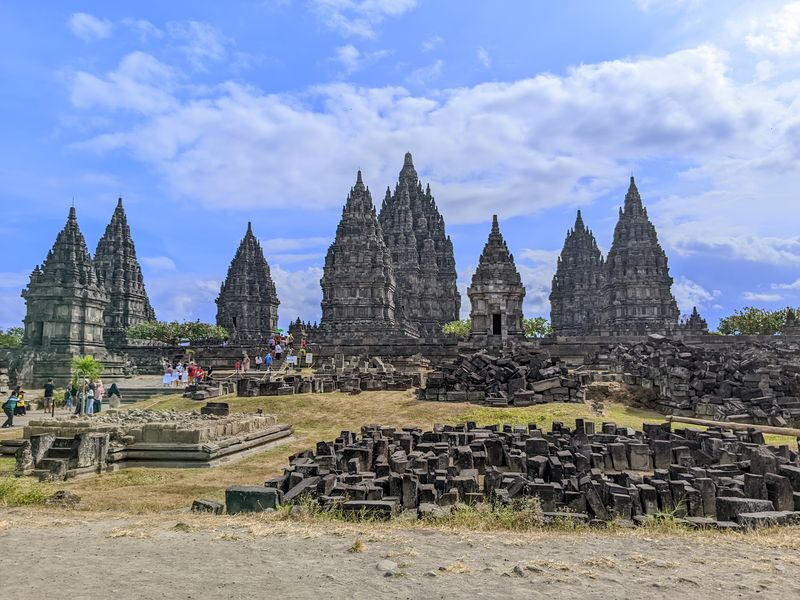
Sharp, tall, and almost aggressive in their vertical energy, the towers of Prambanan look like they are competing to reach the sky first. Rising from the flat plains of central Java, this vast Hindu temple complex contains hundreds of stone structures, with the three main towers dedicated to Shiva, Vishnu, and Brahma towering above the rest.
Nothing about Prambanan is subtle.
UNESCO identifies it as Indonesia’s largest temple compound dedicated to Shiva and notes that reliefs carved along the gallery walls illustrate episodes from the Ramayana epic. These carved panels are detailed enough to tell the entire story in stone, and walking around the main temples feels like reading a comic strip carved by people who clearly took their art very seriously.
The wider archaeological park holds more than 500 temple structures or their remains, including the Buddhist Sewu complex nearby. Earthquakes and volcanic eruptions have damaged buildings repeatedly over the centuries, and restoration work continues today.
The combination of reconstructed towers, ruined structures, open plains, and distant volcanic peaks gives the landscape a dramatic, almost cinematic quality. Prambanan and Borobudur together make central Java one of the world’s greatest concentrations of ancient religious architecture.
Mount Emei Temples, China
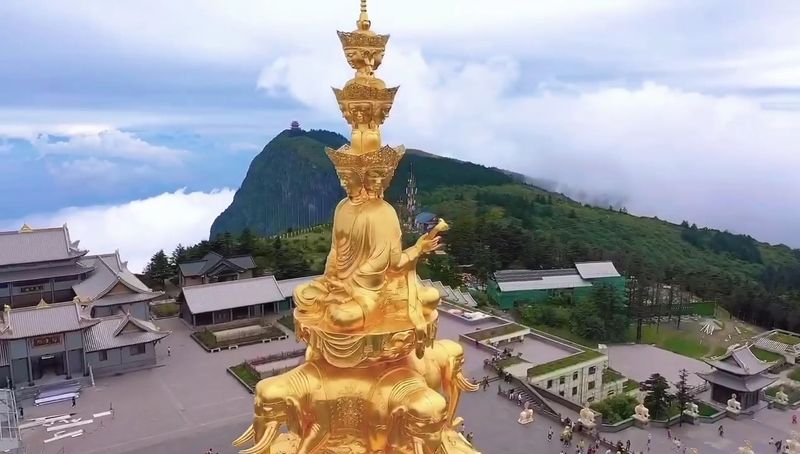
Mount Emei is the kind of place where the forest itself feels sacred, and that is not an accident. UNESCO records more than 30 temples distributed across the mountain, with religious use dating back to what is believed to be China’s first Buddhist temple, established here in the first century CE.
The mountain has been spiritually significant for so long that the trees are practically veterans.
The vegetation shifts dramatically as you climb. Subtropical forest at lower elevations gives way to temperate woodland, then subalpine conifers near the summit, with some individual trees exceeding a thousand years in age.
Religious structures were deliberately positioned to follow the mountain’s natural terrain rather than reshape it, which gives the entire site an organic quality rare in monumental sacred architecture.
The World Heritage property also includes the 71-meter Leshan Giant Buddha, carved directly into a cliff face at the confluence of three rivers about 30 kilometers away. The Buddha is the largest stone-carved Buddha in the world and was completed in 803 CE after nearly 90 years of work.
Together, Mount Emei and Leshan present Buddhism not as something placed on a landscape but as something that grew from it.
Kailasa Temple at Ellora, India
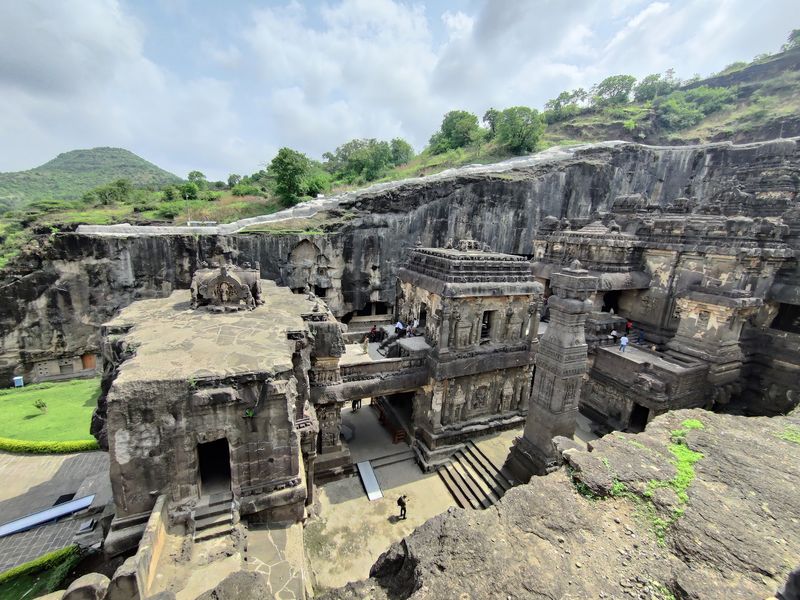
Most temples are built up. Kailasa Temple was built down.
Workers at Ellora in Maharashtra did not stack stones to create this extraordinary structure. They carved it from above, excavating downward into solid volcanic rock to reveal courtyards, columns, shrines, elephants, and a towering central sanctuary.
The result is the largest monolithic temple at Ellora and one of the most astonishing engineering achievements of the ancient world.
The complex forms Cave 16 within Ellora’s group of 34 Buddhist, Hindu, and Jain monuments, created between roughly the sixth and 12th centuries. UNESCO recognizes it as an outstanding example of rock-cut architecture, and the sheer quantity of sculptural detail is almost overwhelming.
Panels depicting scenes from Hindu epics cover surfaces throughout the complex, and the surrounding cliff walls make the excavation process visually obvious and genuinely mind-bending.
Estimates suggest that builders removed approximately 200,000 tons of rock to create Kailasa, working without modern machinery and relying on precise planning from the very first cut. A mistake early in the process could not be undone.
The fact that the finished structure is this detailed and this coherent says something remarkable about the skill and confidence of the people who made it.
Rangiri Dambulla Cave Temple, Sri Lanka
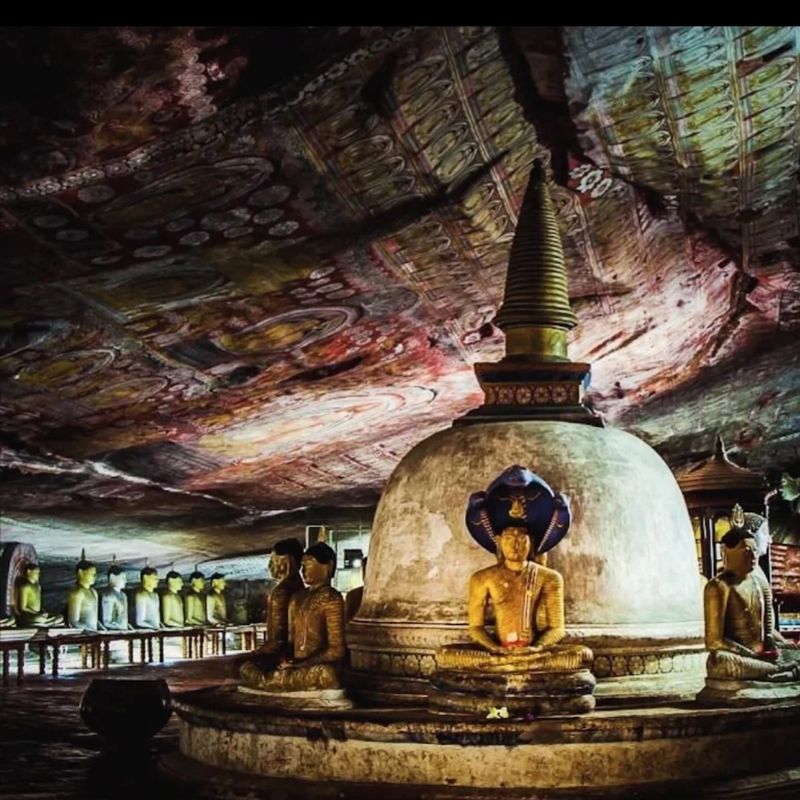
Dambulla’s temples did not need to be built because the mountain provided them ready-made. Natural caves high above Sri Lanka’s central plains have sheltered Buddhist monks since at least the third century BCE, making this one of the oldest continuously used religious sites in Asia.
The rock itself was the first architect.
Five main cave sanctuaries contain 157 statues and approximately 2,100 square meters of mural paintings, according to UNESCO. The painted ceilings and walls cover nearly every available surface, depicting scenes from the Buddha’s life and surrounding figures with intricate geometric patterns.
Rather than constructing a grand exterior temple, generations of patrons poured their energy and resources into transforming the cave interiors into something extraordinary.
The elevated position adds a practical spiritual dimension. Pilgrims climb toward the shrines while views open over forests, rice paddies, and distant countryside, creating a physical sense of rising above the everyday world before entering the sacred caves.
Dambulla remains a living religious site, not simply a museum. Monks still occupy parts of the complex, incense burns at the shrines, and the sound of chanting occasionally drifts through the stone passages alongside the smell of fresh flowers left as offerings.
My Son Sanctuary, Vietnam
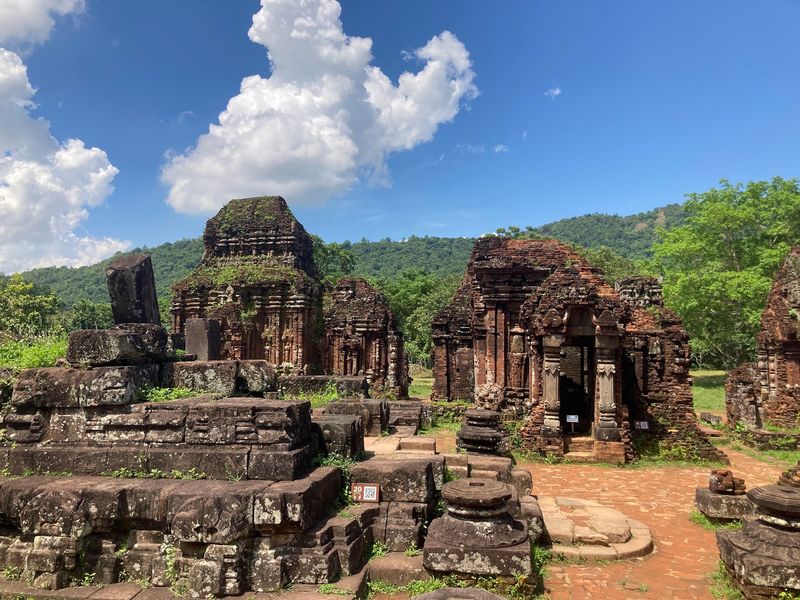
Hidden inside a valley ringed by mountains in central Vietnam, My Son looks like a place that the jungle has been slowly trying to reclaim for centuries. The remains of the ancient Champa kingdom’s religious center sit surrounded by dense vegetation and forested hills, giving the site an atmosphere that is equal parts mysterious and melancholy.
Between the fourth and 13th centuries, Cham rulers built groups of brick Hindu tower-temples here, drawing on Indian religious traditions while developing a distinctive architectural style all their own. UNESCO records 71 standing monuments across eight groups, though warfare during the 20th century caused devastating damage to many structures.
The brick towers that survive are covered in carved sandstone reliefs depicting Hindu deities, mythological scenes, and decorative patterns of remarkable sophistication.
The temples were designed to represent Mount Meru, the sacred mountain of Hindu cosmology, which makes their setting inside an actual mountain valley feel particularly fitting. Carved inscriptions in ancient Cham script and Sanskrit document centuries of royal patronage and religious dedication.
My Son is not a complete or perfectly preserved site, but the combination of surviving architecture, jungle setting, mountain backdrop, and layered history makes it one of Southeast Asia’s most genuinely haunting places.
Mahabodhi Temple, Bodh Gaya, India
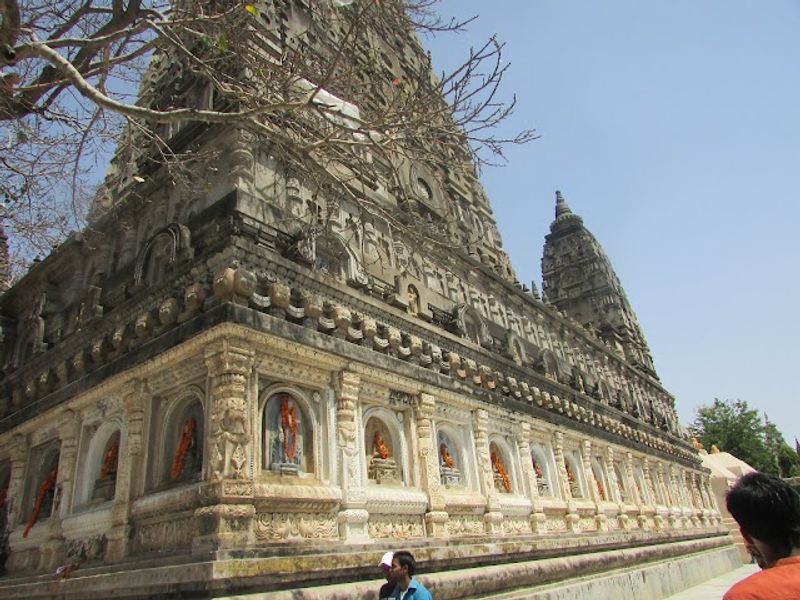
If one spot on Earth can claim to have changed the course of world history, Bodh Gaya makes a strong case. The Mahabodhi Temple marks the place where, according to Buddhist tradition, Siddhartha Gautama sat beneath a fig tree and attained enlightenment, becoming the Buddha.
That single event set in motion a religious tradition now followed by hundreds of millions of people worldwide.
Emperor Ashoka established an early shrine here in the third century BCE, and the present brick temple largely dates from the fifth or sixth century CE. UNESCO considers it one of the earliest surviving major Buddhist temples built entirely in brick in India.
The central tower rises about 50 meters, surrounded by smaller stupas, stone railings, and meditation walkways. The sacred Bodhi Tree growing beside the temple is considered a direct descendant of the original tree.
Unlike remote mountain sanctuaries, Mahabodhi sits at the center of a living pilgrimage city where religious activity continues around the clock. Monks in robes from Tibet, Thailand, Sri Lanka, Japan, and dozens of other countries pray side by side.
The mix of ancient architecture, sacred landscape, and ongoing human devotion gives Bodh Gaya an energy that purely archaeological sites rarely match.
Ananda Temple and the Temples of Bagan, Myanmar
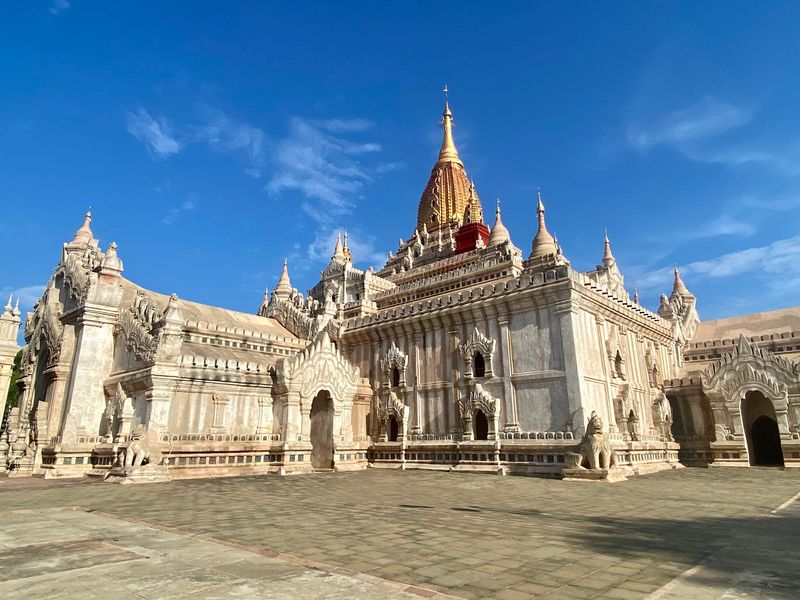
Bagan is not really a temple. It is an entire sacred city, and it stretches in every direction as far as you can see.
UNESCO records 3,595 monuments across the site, including temples, stupas, monasteries, murals, and sculptures. Most were built between the 11th and 13th centuries when Bagan served as the capital of a powerful Buddhist kingdom, and the sheer density of structures is unlike anywhere else on the planet.
Ananda Temple stands among the most celebrated of these monuments, with its distinctive white-washed spire and four massive standing Buddha figures facing the cardinal directions. But Ananda’s real power comes from context.
Seeing it rise above a plain dotted with hundreds of other brick towers puts its scale and ambition into sharp perspective. No single temple tells the full story of Bagan.
The landscape does.
Dawn mist rolls in from the Ayeyarwady River most mornings, softening the silhouettes of towers across the plain into something that looks almost dreamlike. Hot air balloons drift above the site at sunrise, which has become one of the most photographed travel experiences in Asia.
Bagan was damaged by a major earthquake in 2016, and restoration continues, but the essential character of the landscape remains extraordinary and deeply moving.
Baalbek Temple Complex, Lebanon
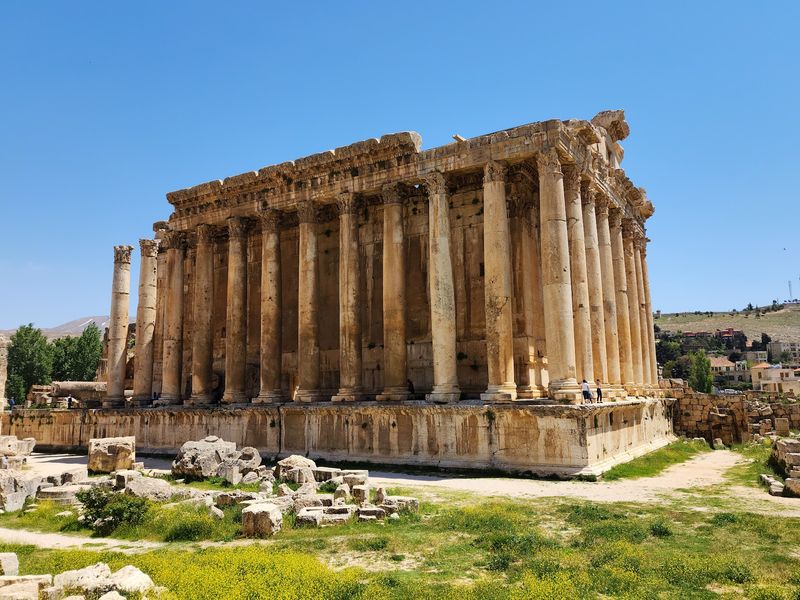
The Romans built big everywhere they went, but at Baalbek they seemed determined to outdo themselves. Situated in Lebanon’s Bekaa Valley at roughly 1,150 meters elevation near the Anti-Lebanon mountain range, Baalbek became one of the ancient Roman world’s greatest religious centers, and the scale of what they left behind is still staggering two thousand years later.
The Temple of Jupiter once featured columns approximately 20 meters tall, making it one of the largest temples ever constructed in the Roman Empire. Only six of those columns remain standing, but each one is massive enough to make the loss of the rest feel genuinely tragic.
The Temple of Bacchus, far better preserved, still displays monumental gateways, richly carved ceilings, and detailed stone reliefs that rank among the finest examples of Roman decorative architecture anywhere.
The Roman sanctuary was built above earlier Phoenician and Hellenistic religious remains, and the site incorporates some of the largest stone blocks ever quarried by human hands. Some monoliths in the foundation weigh hundreds of tons.
The combination of colossal architecture, layered history stretching from ancient Phoenicia through Rome and beyond, and the rugged mountain backdrop gives Baalbek a presence that few ancient sites can match.
Share this story