Spain is home to some of the most dramatic castles in the world, and each one carries a story that goes far beyond stone and mortar. These fortresses were built by kings, nobles, and military orders who shaped the course of European history.
From hilltop strongholds that guarded ancient frontiers to lavish royal palaces that witnessed betrayal and rebellion, the castles of Spain offer a window into centuries of power, conflict, and ambition. Get ready to explore 13 remarkable fortresses and the extraordinary stories hiding behind their walls.
Alcázar of Segovia
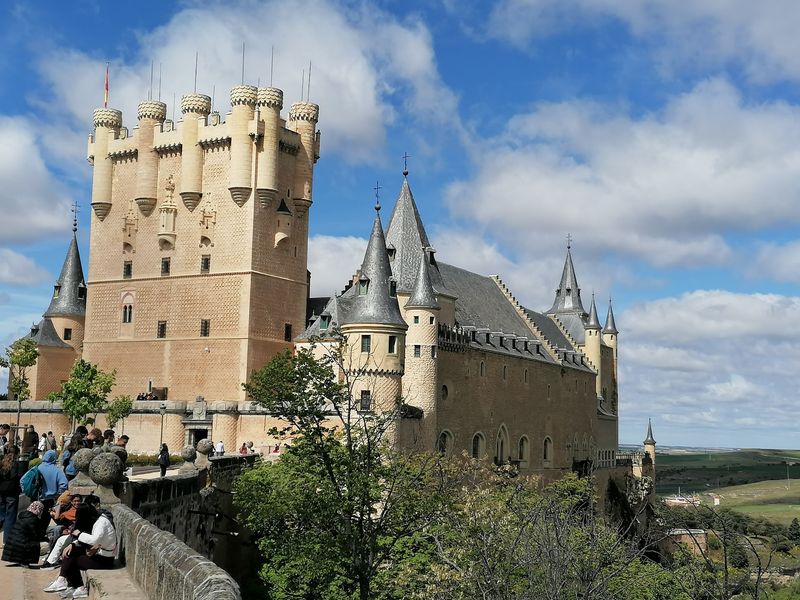
Perched on a rocky spur like something out of a storybook, the Alcázar of Segovia is one of Spain’s most recognizable landmarks. The earliest written reference to this fortress dates to the 12th century, and over the following centuries it evolved from a military outpost into a royal residence under kings like Alfonso VIII, John II, and Henry IV.
Each ruler left his mark on the structure, adding Gothic details, towers, and royal chambers that transformed its character entirely.
The castle’s story did not end with the Middle Ages. In 1764, Charles III converted the fortress into the Royal College of Artillery, giving this ancient stronghold a very modern military purpose.
Hidden passageways reportedly snake beneath the building, connecting to the river and possibly to other royal buildings in the city.
Today the Alcázar draws visitors from around the world, and it is widely believed to have inspired the design of Disney’s Cinderella Castle. Whether or not that legend holds up, standing at the base of its towers and looking up makes the comparison feel entirely reasonable.
Few castles in Spain match this one for sheer dramatic impact.
Loarre Castle
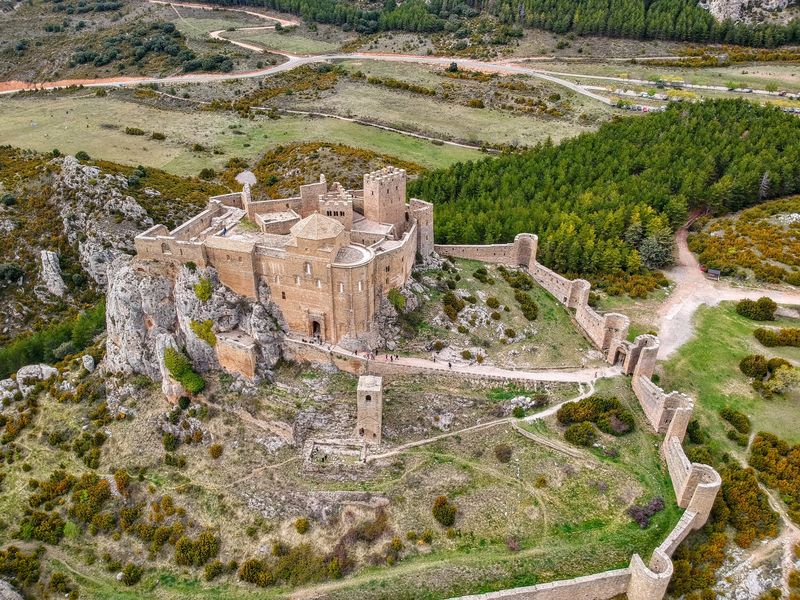
Loarre Castle looks as though it grew directly out of the rock beneath it, and that impression is not entirely wrong. King Sancho Ramírez I of Aragón ordered its construction in the late 11th century on the foundations of an earlier fortification, choosing this dramatic hilltop position to control a key frontier zone during the Christian push southward from the Pyrenees.
The castle’s irregular plan, steep terrain, and double ring of walls made it one of the toughest fortresses to approach in all of medieval Iberia.
What makes Loarre especially fascinating is the shift in its identity over time. The military stronghold eventually became an Augustinian monastery, and the complex still contains the Romanesque Church of Santa María, complete with carved stone capitals and barrel-vaulted ceilings.
Military muscle and spiritual purpose existed side by side within the same walls.
Spain’s official tourism authority calls Loarre the country’s most important Romanesque fortress, and a visit makes it easy to understand why. The isolated position above the Hoya de Huesca, the rough-cut stone, and the sheer scale of the complex communicate exactly what its 11th-century builders intended: a statement of power that no enemy could ignore.
Gormaz Castle
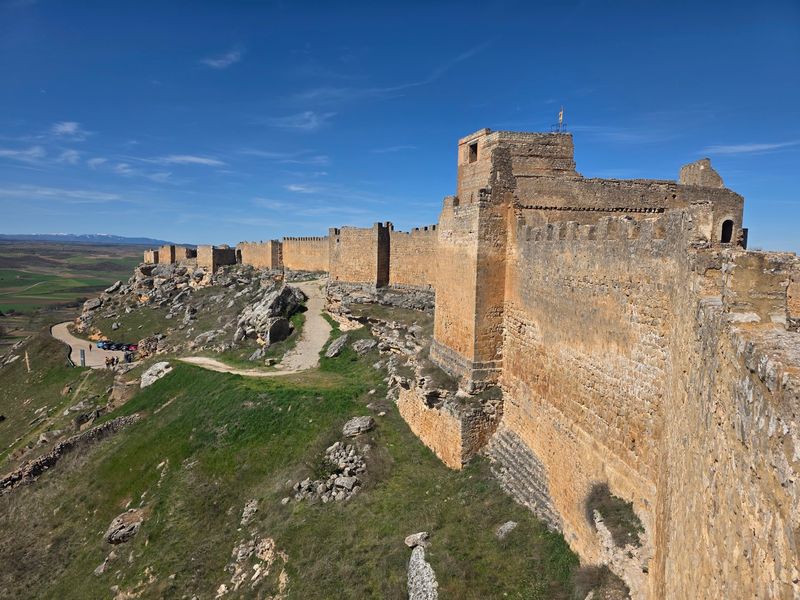
At nearly 400 meters long, Gormaz Castle is not just impressive, it is almost unbelievably large. Built during the caliphal period of the 10th century, it was designed to guard the Duero River against Christian advances from the north and became one of the most strategically vital fortresses in medieval Spain.
Spain’s tourism authority describes it as the longest fortification in Europe, a claim that becomes very easy to believe when you actually stand before its walls.
The internal layout was surprisingly organized for a frontier fortress. Separate zones handled military and residential functions, and the complex included cisterns, an underground reservoir, an armory, and numerous towers arranged along the ridge.
This was not just a wall. It was a functioning military city.
After the fortress passed into Christian hands, it earned a second layer of fame. Rodrigo Díaz de Vivar, the legendary warrior known as El Cid, became associated with Gormaz during this period, and the castle appears in the Cantar de Mio Cid, one of the oldest and most celebrated works in Spanish literature.
Gormaz therefore carries the history of both sides of medieval Spain’s most defining cultural and military frontier within a single set of crumbling but still commanding walls.
Coca Castle
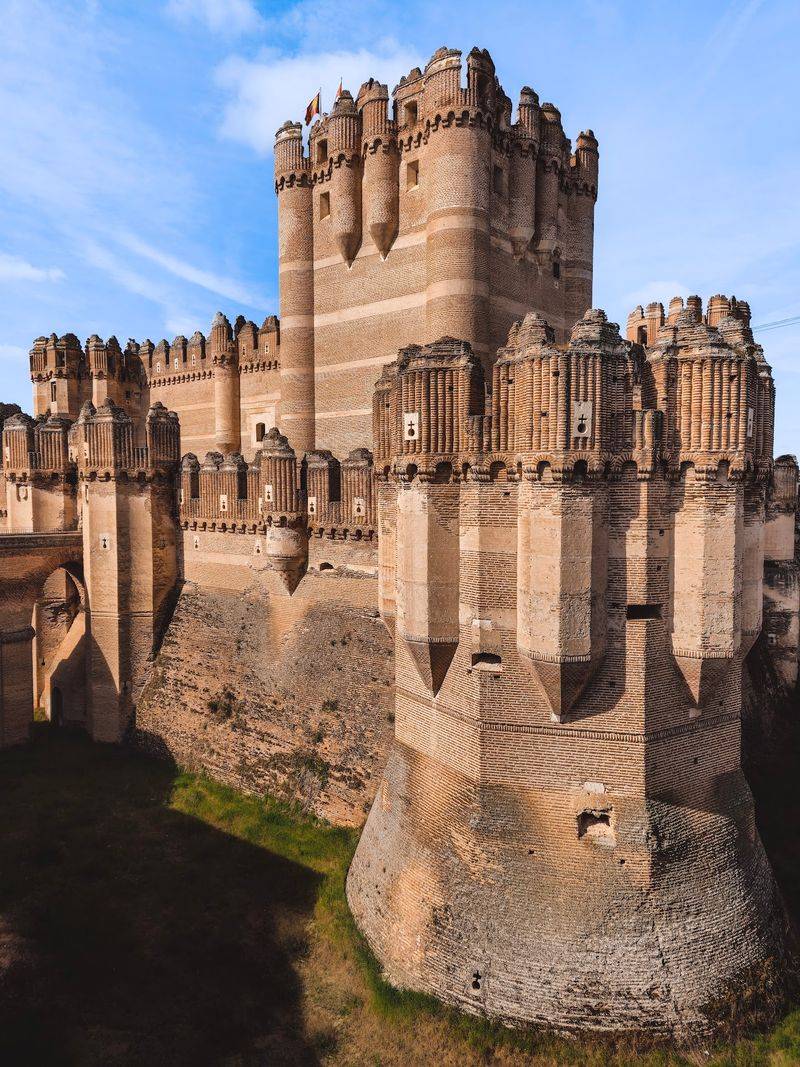
Coca Castle immediately breaks every expectation a visitor might carry about what a Spanish medieval fortress should look like. Built largely from warm-toned brick in the late 15th century, it blends Western military design with Mudéjar decorative traditions that trace their roots to Islamic craftsmanship.
Archbishop Alonso de Fonseca commissioned the structure, and the result is a building that feels as much like an art installation as a fortification.
The deep moat, polygonal towers, and richly patterned brickwork serve both practical and symbolic purposes. Coca was built to intimidate rivals and impress guests in equal measure.
Spain’s official tourism authority notes that despite its serious military defenses, the lavish interior was designed for aristocratic living rather than purely military use. This was a fortress for someone who wanted enemies to know they could not win and friends to know they were welcome.
Coca also played a role in the Revolt of the Comuneros, the early-16th-century uprising against Charles V. The castle remained loyal to the crown during the conflict, reinforcing its reputation as a symbol of established power.
Today its extraordinary brickwork stands as one of the finest examples of Mudéjar military architecture anywhere in Europe, drawing architects and historians alongside curious tourists.
Castle of La Mota
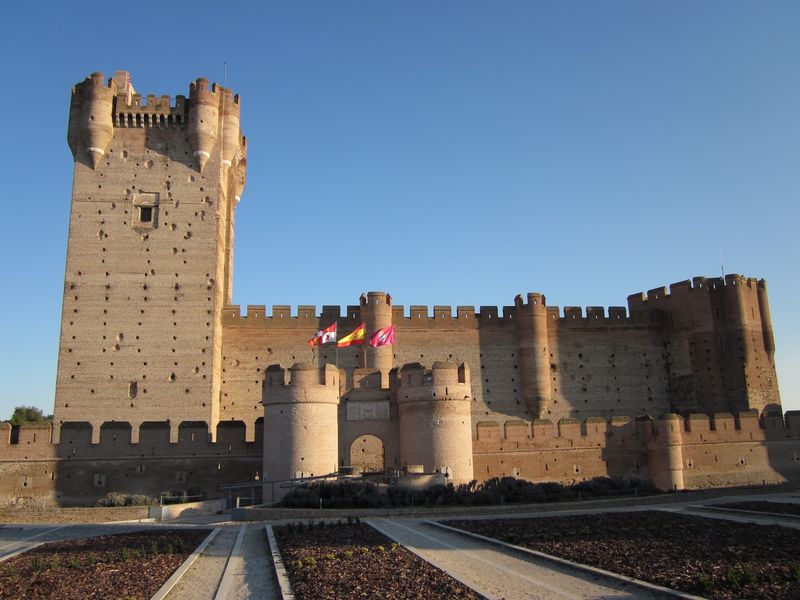
Few castles in Spain carry as many layers of political drama as La Mota at Medina del Campo. Its massive keep, trapezoidal plan, and artillery defenses reflect a transitional moment when castle builders were adapting fast to the realities of gunpowder warfare.
Under Henry IV, the fortress served as a Royal Archive and artillery arsenal, making it both a keeper of secrets and a supplier of destruction.
The political storms that swept through La Mota are hard to overstate. The castle became a target during the Revolt of the Comuneros and later served as a prison for high-profile political figures during the 16th and 17th centuries.
Juana of Castile, historically known as Juana la Loca, spent time within its walls, adding a layer of tragic royal history to the fortress’s already complicated biography.
What makes La Mota so compelling is the range of functions it performed across different eras. Archive, arsenal, royal residence, prison, military stronghold.
Few buildings of any kind have served so many different masters with so many different agendas. Today the castle stands as a powerful reminder that in medieval and early modern Castile, controlling a fortress often meant controlling the fate of an entire kingdom.
Castle-Palace of Olite
Olite was never just a fortress. It was a statement about what a kingdom could achieve when it had money, ambition, and a king with exceptionally good taste.
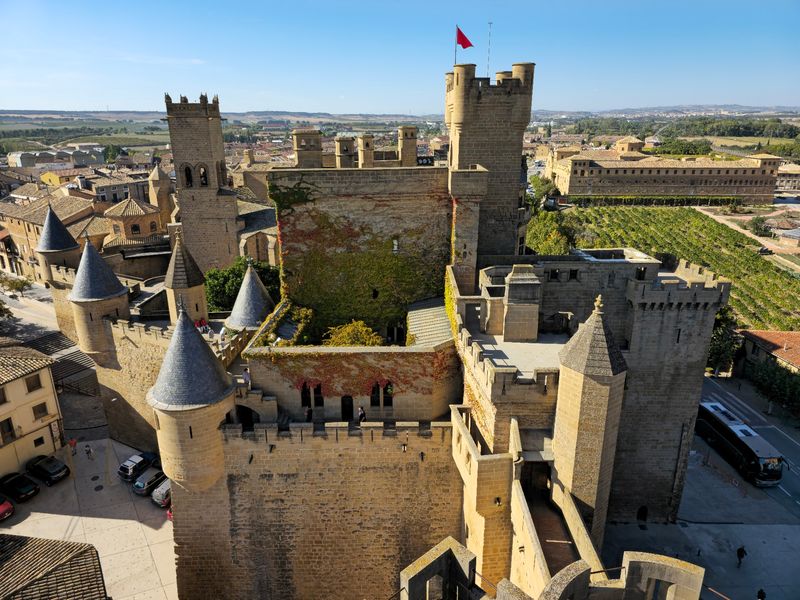
The Castle-Palace of Olite became the preferred residence of the kings and queens of Navarre, reaching its peak splendor under Charles III the Noble in the late 14th and early 15th centuries. Towers, galleries, hanging gardens, and richly decorated royal chambers made it one of the most extraordinary royal complexes anywhere in medieval Iberia.
The palace fell on hard times after Navarre was absorbed into Castile during the 16th century. Without a royal court to sustain it, the complex slipped into long decline.
Spain’s official tourism site notes that much of what visitors see today is the result of extensive reconstruction begun in the 20th century, which means the current skyline is partly a modern interpretation of a medieval original.
Even so, Olite rewards a visit in a way that purely ruined castles cannot. Walking through its restored towers and courtyards gives a genuine sense of the scale and ambition behind the original project.
For a small kingdom that history sometimes overlooks, Navarre built itself a capital that could rival anything in Europe, and Olite still carries that spirit today.
Templar Castle of Ponferrada
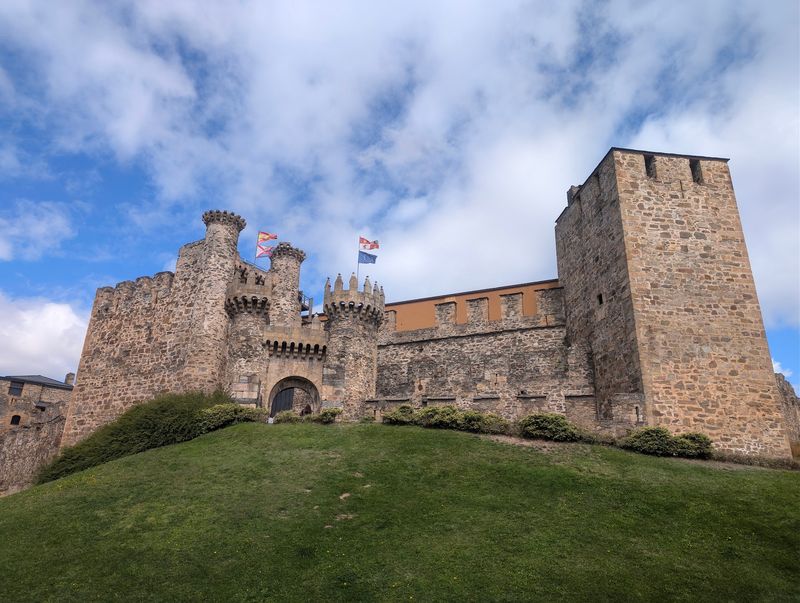
The Knights Templar were not in the habit of doing anything on a small scale, and their castle at Ponferrada is no exception. The order took possession of the site in the early 12th century and set about transforming an existing fortification into a powerful stronghold that served a dual purpose: protecting the surrounding territory and providing a safe haven for pilgrims traveling the Camino de Santiago toward the city of Santiago de Compostela.
The history of the site runs even deeper than the Templars. Spain’s tourism authority notes that the hill was occupied first as an Iron Age hill fort and later as a Roman citadel, meaning the medieval castle was built on top of centuries of earlier human presence.
The eventual Templar fortress developed an irregular plan with substantial towers, a moat, and a defended entrance complex that made it a formidable structure by any standard.
One of its most intriguing traditions holds that the original 12 towers were arranged to reflect the forms of the constellations, lending a mystical dimension to what was also a very practical military project. Whether that story is fully accurate or not, it captures something real about the Templars: they were warriors who also thought in symbols, and Ponferrada carries both sides of that identity.
Castle of Almodovar del Rio
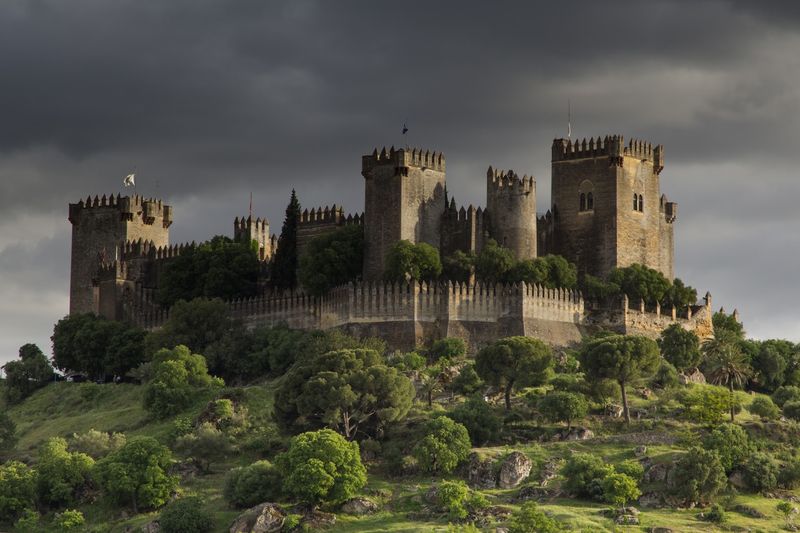
Sitting high above the Guadalquivir Valley near Cordoba, the Castle of Almodovar del Rio has been watching over this stretch of Andalusia for more than 1,200 years. Spain’s official tourism site dates the original Muslim fortress to around 740 AD, placing its construction firmly in the early decades after the Islamic conquest of the Iberian Peninsula.
From that commanding hilltop, whoever held Almodovar controlled movement through one of southern Spain’s most important river valleys.
After Christian forces captured the area, the castle passed into royal Castilian hands and became a residence for Pedro I of Castile, a king whose historical reputation splits sharply depending on who is telling the story. His supporters called him Pedro the Just.
His enemies preferred Pedro the Cruel. Either way, his association with Almodovar gives the fortress a distinctly dramatic flavor.
The castle changed hands again in 1629 when Philip IV sold it to a private buyer, and its present appearance owes a great deal to a major reconstruction begun in 1902 by the 12th Count of Torralva. That reconstruction has made Almodovar one of the most visually striking castles in Andalusia, its white towers rising sharply against the blue southern sky in a way that makes it almost impossible not to stop and stare.
Belmonte Castle
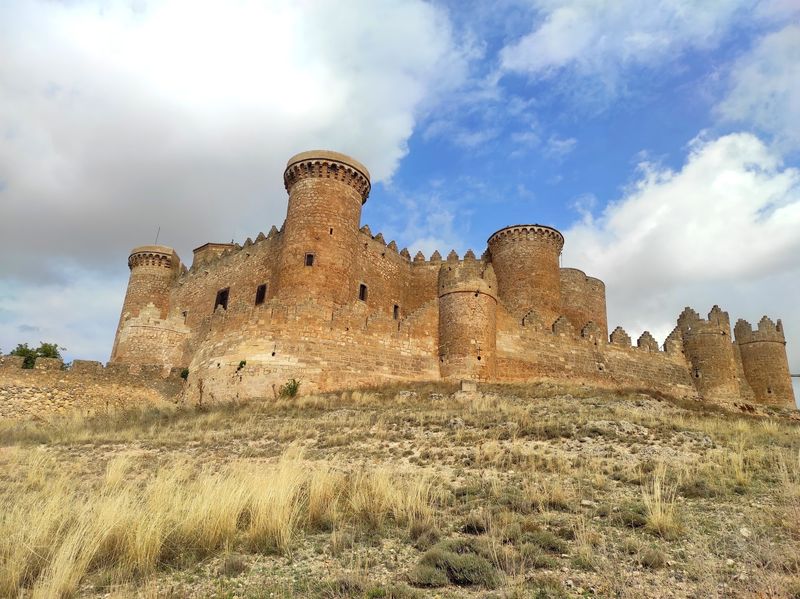
Belmonte Castle was built by one of the most powerful and politically ruthless nobles in 15th-century Castile. Juan Pacheco, Marquis of Villena, commissioned the fortress and hired Master Hanequin of Brussels to design it, resulting in a striking Gothic-Mudéjar structure arranged around a triangular courtyard within a six-pointed defensive perimeter.
That unusual geometric plan makes Belmonte visually distinctive among Spanish castles, standing out even in a country full of impressive fortifications.
The political story attached to Belmonte is equally compelling. The castle became one of the refuges associated with Juana la Beltraneja, whose disputed claim to the Castilian throne triggered a succession crisis after Henry IV’s death.
The conflict that followed eventually ended with Isabella I securing the crown, setting in motion the dynastic chain that would produce the Catholic Monarchs and reshape the entire course of Spanish and world history.
Beyond the politics, Belmonte preserves remarkable interior details that reward a close look. Mudéjar ceilings, Gothic stone reliefs, and elaborate plasterwork survive alongside the military architecture, reminding visitors that this was always meant to be a residence for someone of enormous wealth and ambition.
Belmonte is the kind of castle that makes history feel genuinely close and surprisingly personal.
Manzanares el Real Castle
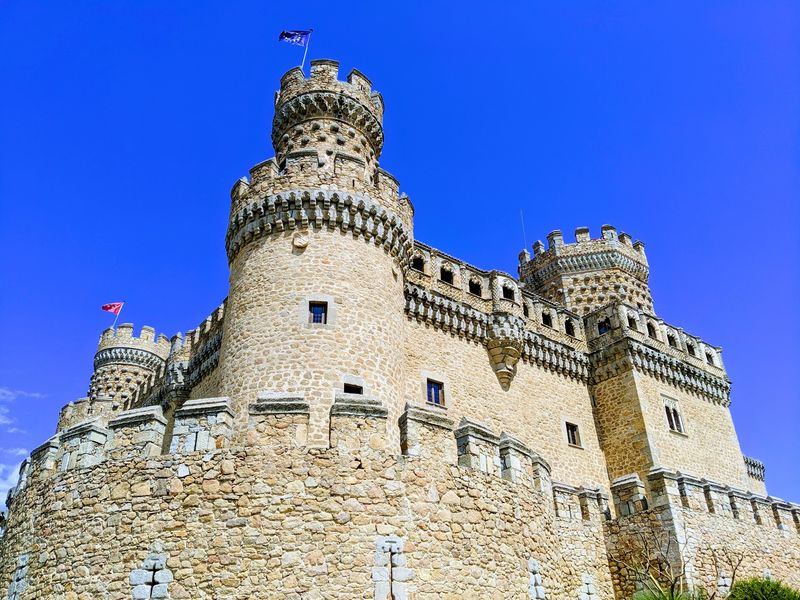
Built in the shadow of the Sierra de Guadarrama just north of Madrid, Manzanares el Real Castle was never primarily about warfare. Inigo Lopez de Mendoza, the first Marquis of Santillana and one of the most celebrated literary and political figures of 15th-century Castile, commissioned it as a statement of family prestige.
The result is a building that balances military seriousness with aristocratic elegance in a way that feels genuinely ahead of its time.
The castle was constructed partly over an earlier Romanesque-Mudéjar hermitage, and remains of that older structure are still preserved inside the complex. That detail alone is worth pausing over.
Beneath a 15th-century noble residence lies the ghost of an earlier religious building, layering centuries of human use into a single site. The surrounding barbican also contains arrow slits carved with the cross of the Holy Sepulchre of Jerusalem, connecting this Madrid-region fortress to the broader world of medieval Christian symbolism.
Today Manzanares el Real is considered one of the best-preserved castles in the entire Madrid region, and its combination of round corner towers, a polygonal keep, and an elegant Gothic gallery gives it a visual sophistication that surprises many first-time visitors. It is a castle that rewards slow exploration rather than a quick glance from the car window.
Bellver Castle
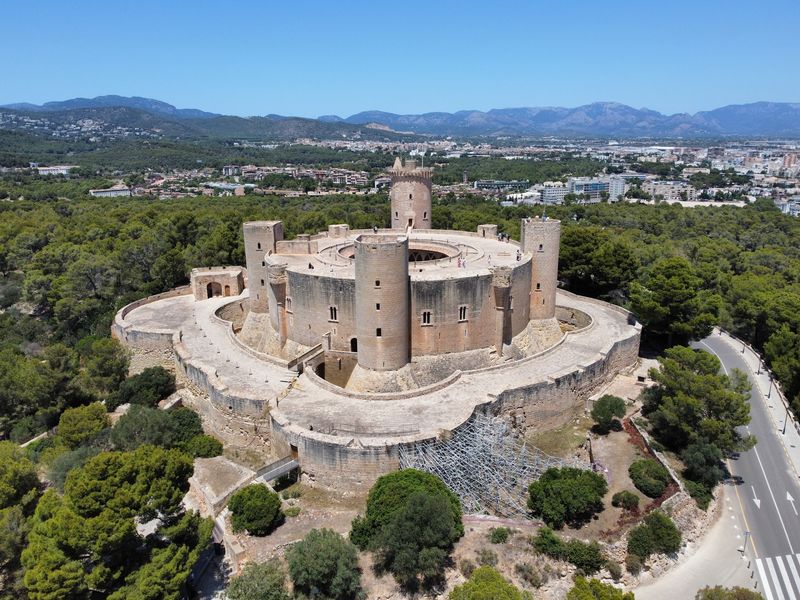
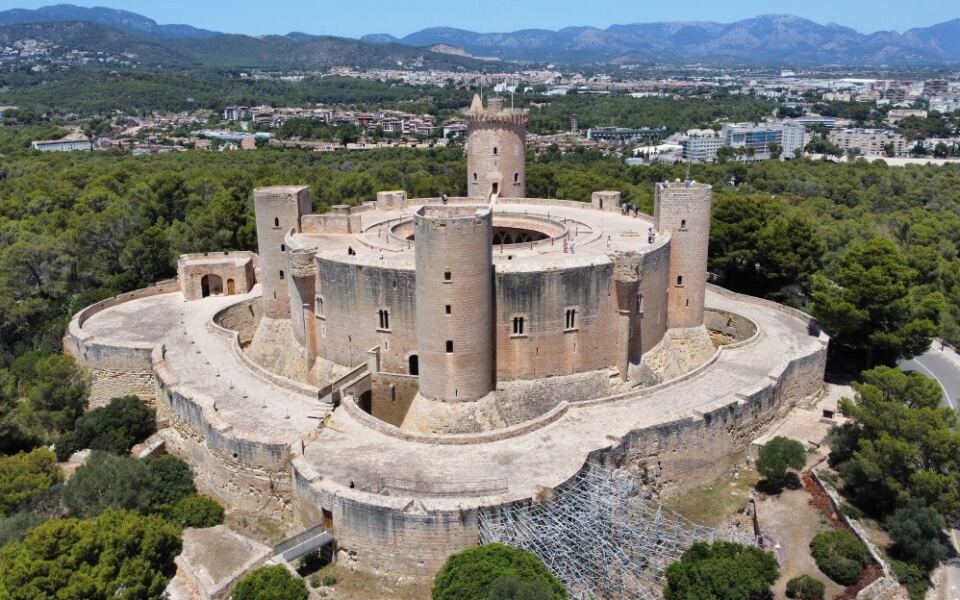
Circular castles are rare anywhere in Europe, which makes Bellver Castle on the island of Mallorca something genuinely unusual. King James II of Mallorca ordered its construction as a royal residence in the early 14th century, and the architect designed the entire complex around a perfectly round courtyard, with three towers attached to the main ring and a separate cylindrical keep rising nearby.
The geometric precision of the design gives Bellver an almost modern quality that catches visitors off guard.
The castle’s peaceful hilltop setting above Palma Bay masks a more turbulent history. Over the centuries, Bellver shifted from royal palace to military fortress to prison, housing political prisoners during several periods of conflict and instability.
In the 19th century, the site was even used as a mint, one of the more unexpected chapters in any castle’s biography.
That ability to reinvent itself across different eras is what makes Bellver such a rich historical subject. A building that starts as a royal home, becomes a place of confinement, briefly turns into a money-making facility, and eventually opens its doors as a museum has clearly lived several very different lives.
Few castles anywhere in Spain offer such a clear illustration of how medieval structures survived by constantly adapting to whatever the present moment demanded of them.
Penafiel Castle
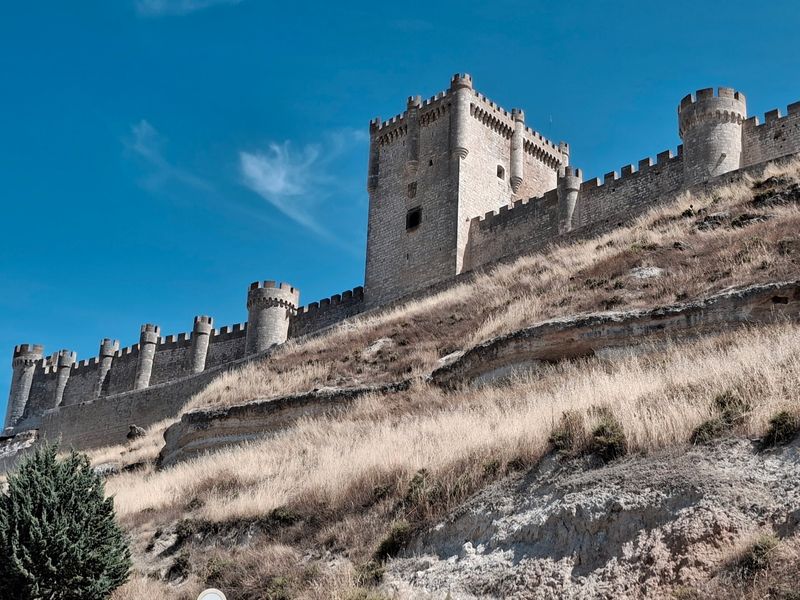
Stretched across a narrow ridge like a stone ship sailing above the Duero wine country, Penafiel Castle has one of the most distinctive silhouettes of any fortress in Spain. The earliest fortifications on this ridge date to around the 9th or 10th century, but the structure visible today reflects major rebuilding completed by the mid-15th century.
The result is a fortress extending more than 200 meters from end to end, with a 30-meter keep rising between two long parallel courtyards.
The site’s strategic logic is immediately obvious from below. Whoever held Penafiel controlled the routes through a region that changed hands repeatedly during the medieval frontier period, and the elongated ridge plan meant defenders could cover an enormous stretch of ground from a single fortified position.
It is a castle built around geography rather than against it.
Today the former southern courtyard and military areas house the Provincial Wine Museum, a fitting modern use for a fortress sitting at the heart of one of Spain’s most celebrated wine-producing landscapes. The Ribera del Duero wine region stretches out in every direction below the castle walls, and the combination of medieval stone above and carefully tended vineyards below gives Penafiel a character that is hard to find anywhere else in Castile.
Cardona Castle
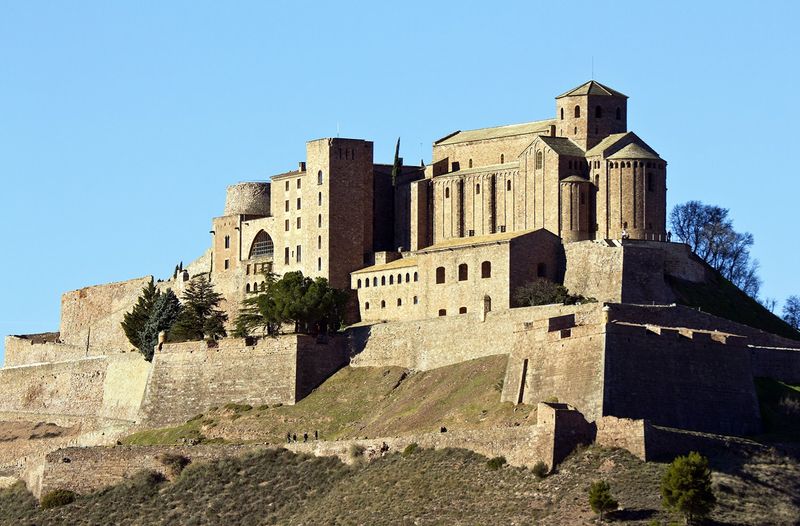
Cardona Castle commands its hilltop above central Catalonia with the quiet confidence of a place that has been in charge for a very long time. The site’s history traces back to around the 8th and 9th centuries, making it one of the oldest continuously occupied fortified positions in the region.
Over the following centuries it grew into a combined fortress, palace, and religious center closely associated with one of Catalonia’s most powerful noble families, the Cardona dynasty.
The castle’s strategic value was not purely military. The surrounding territory sat near extensive salt deposits that generated significant wealth for whoever controlled the area, and that wealth funded repeated rounds of construction and military improvement.
Salt might sound like an unlikely source of political power, but in the medieval world it was genuinely precious, and Cardona’s position near those deposits made it worth fighting over across multiple generations.
Spain’s official tourism authority highlights the Romanesque architecture preserved within the complex, particularly the collegiate church of Sant Vicenc, as one of the finest examples of Catalan Romanesque style. Today part of the castle operates as a Parador hotel, allowing guests to spend the night within walls shaped by more than a thousand years of Catalan history.
Few places in Spain offer a more atmospheric place to sleep.
Share this story