Around the world, enormous statues of Jesus Christ stand on mountaintops, hilltops, and coastlines, watching over cities and communities below. These massive monuments were built for many different reasons, from celebrating peace and survival to honoring religious traditions and local promises.
Some rise over 40 meters tall, while others are famous not for their height but for their stunning locations or fascinating histories. Get ready to explore 14 of the most impressive Christ statues on the planet.
Cristo Protetor, Brazil
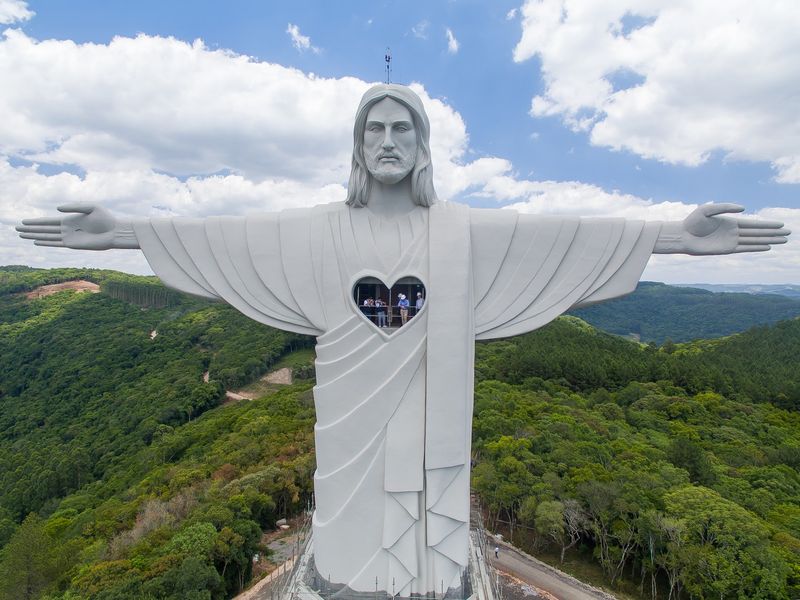
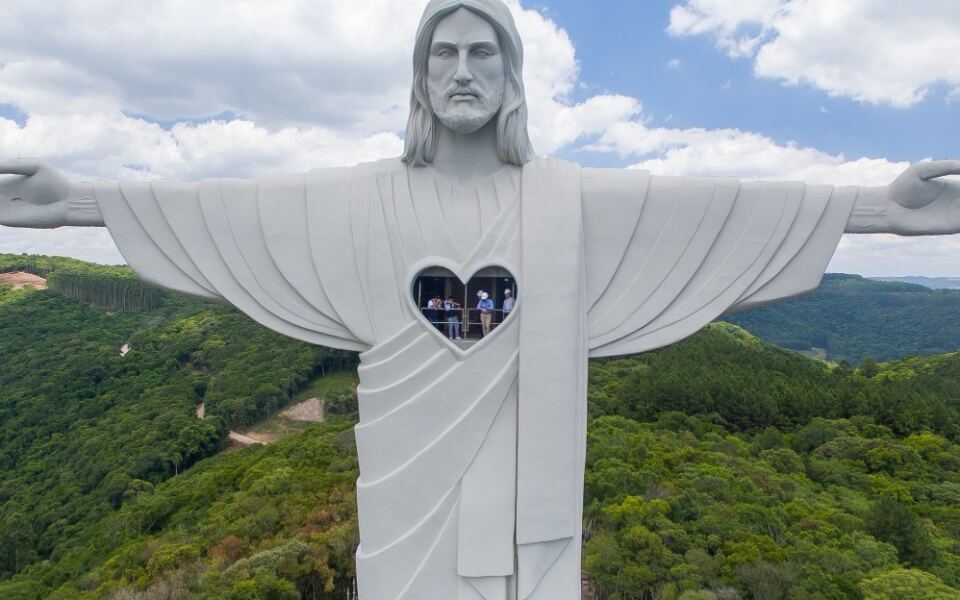
Brazil just one-upped itself. Encantado, a small city in Rio Grande do Sul state, is home to Cristo Protetor, a steel-and-reinforced-concrete giant that actually stands taller than the world-famous Christ the Redeemer in Rio.
The figure alone measures 37.5 meters, with a six-meter pedestal underneath, bringing the total to 43.5 meters. Its outstretched arms span an incredible 39 meters.
What makes this project especially remarkable is how it was funded. Instead of government money, the monument was built almost entirely through community donations and local fundraising, which took years of effort.
Construction started in June 2019 and wrapped up in April 2022, though the full tourism complex did not officially open until April 6, 2025.
Visitors do not have to climb stairs to enjoy the view. An elevator inside the statue carries guests up to a viewing platform inside the chest area, where they can look out over the surrounding landscape.
The whole structure weighs roughly 1,712 tons, making it one of the heaviest Christ monuments ever built. For a relatively small Brazilian city, pulling off a project this ambitious is genuinely impressive.
Cristo Rey, Belalcazar, Colombia
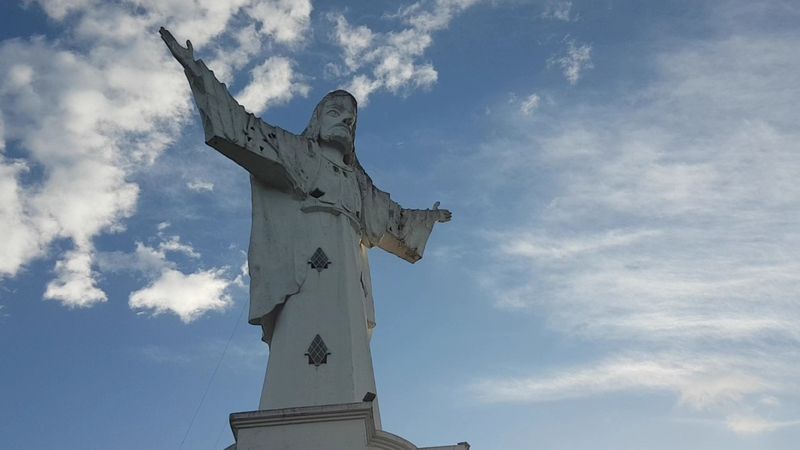
Most travelers passing through Colombia’s coffee region never realize they are driving past one of the tallest Christ monuments on the continent. The Cristo Rey of Belalcazar, in the department of Caldas, reaches 45.5 meters when you include its pedestal, though the figure itself measures about 37 meters.
That makes it one of the largest Christ statues anywhere in the world.
Construction began in 1948 and finished in 1954, a period when Colombia was suffering through La Violencia, a brutal stretch of political conflict that claimed tens of thousands of lives. The Caldas government built the monument as a symbol of peace, which adds a layer of meaning that is easy to feel when you stand at the top and look out over the Cauca and Risaralda river valleys.
The interior of the statue is genuinely surprising. Visitors can climb spiral staircases inside the structure all the way up toward the head, peering through openings in the concrete as they go.
Not many monumental statues let you explore their insides like this. The combination of dramatic landscape, historical weight, and architectural access makes Belalcazar’s Cristo Rey one of the most underrated religious monuments in South America.
Christ the King, Swiebodzin, Poland
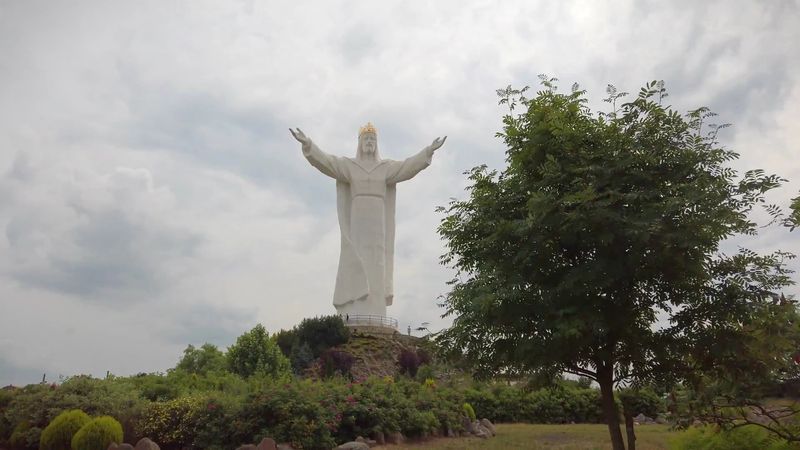
That golden crown sitting on top of the Swiebodzin statue is not a decoration added later. It was always part of the plan, and it immediately sets this Polish monument apart from nearly every other Christ statue in the world.
The crown itself stands about two meters tall, perched above a 33-meter figure, while the earthen mound and base bring the full installation to roughly 48 meters.
The project has deep roots in local faith. In 2000, the parish and municipality of Swiebodzin were formally entrusted to Christ the King, and construction began in 2005 under the leadership of parish priest Sylwester Zawadzki.
Community volunteers played a major role in getting the work done, which gave the whole effort a grassroots energy that official government projects rarely have.
The statue was consecrated on November 21, 2010, the Feast of Christ the King, making the timing feel intentional and ceremonial. Its arms stretch about 26 meters from fingertip to fingertip, creating a wide, welcoming silhouette visible from a long distance across the flat Polish landscape.
For a country with deep Catholic traditions, this monument represents a bold, modern expression of faith that locals take genuine pride in.
Cristo de la Concordia, Bolivia
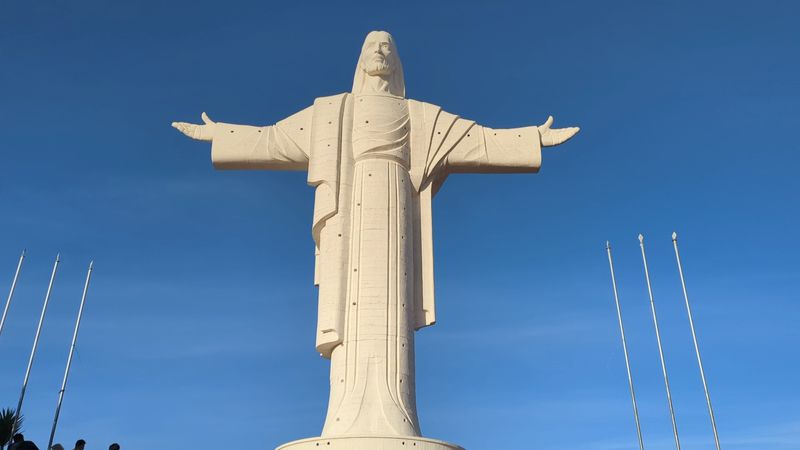
Standing on Cerro San Pedro with arms wide open above one of Bolivia’s largest cities, the Cristo de la Concordia has a name that says exactly what it was built to represent: harmony. The reinforced-concrete figure rises 34.2 meters and stretches about six meters across its body, making it one of the most substantial Christ statues in South America.
The monument was inspired by Pope John Paul II’s visit to Bolivia, and its designers wanted it to carry forward his message of peace, understanding, and social unity. Brothers Walter and Cesar Terrazas are credited with the design and construction.
The name Cristo de la Concordia was chosen to reflect the geographic, political, and social togetherness of Cochabamba and its reputation for welcoming visitors.
One of the most interesting things about visiting this statue is how the hill amplifies everything. From the city below, the figure already looks enormous, but climbing Cerro San Pedro makes it feel even more towering.
The hillside setting means the statue is visible from many parts of Cochabamba, turning it into a constant visual anchor for the city. Few monuments manage to feel both protective and genuinely inviting at the same time, but this one pulls it off.
Christ the King, Vung Tau, Vietnam
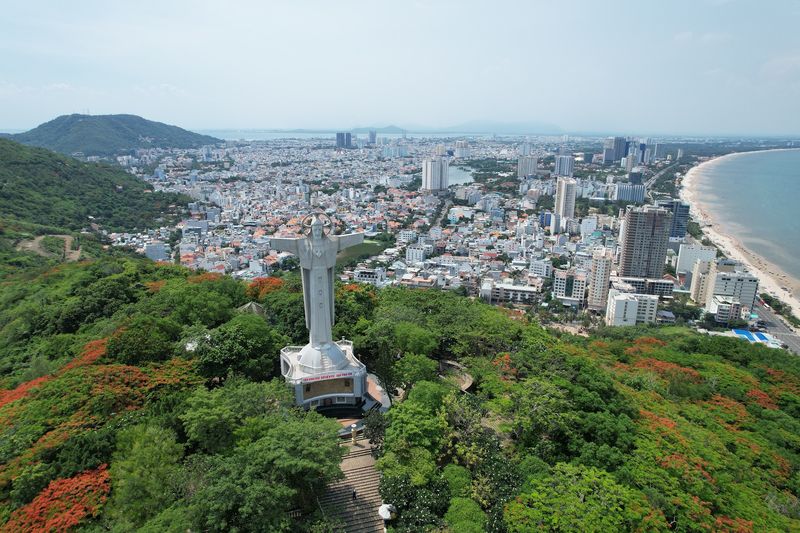
Climbing Vung Tau’s Christ the King is not exactly a casual afternoon stroll. Before visitors even reach the statue, they must tackle hundreds of outdoor steps up Nui Nho, which translates to Small Mountain, along the southern Vietnamese coast.
Once inside, another 133-step interior staircase winds upward to viewing areas near the shoulders of the 32-meter figure.
Construction on the statue began during the 1970s, but years of interruption delayed its completion until 1994. The arms stretch approximately 18.4 meters across, and the coastal setting makes the whole experience dramatic in a way that inland statues simply cannot replicate.
Standing at shoulder level, visitors look out across Vung Tau city, the surrounding sea, and the horizon in a view that feels genuinely panoramic.
In 2012, the statue received recognition for holding an Asian record, which brought additional attention to a monument that many international travelers overlook entirely. Vietnam is not the first country that comes to mind when people think of massive Christ statues, which makes discovering this one feel like stumbling onto a genuine secret.
The combination of physical effort required to reach it and the reward at the top makes Vung Tau’s Christ the King one of the most memorable stops on any visit to southern Vietnam.
Christ the Redeemer, Rio de Janeiro, Brazil
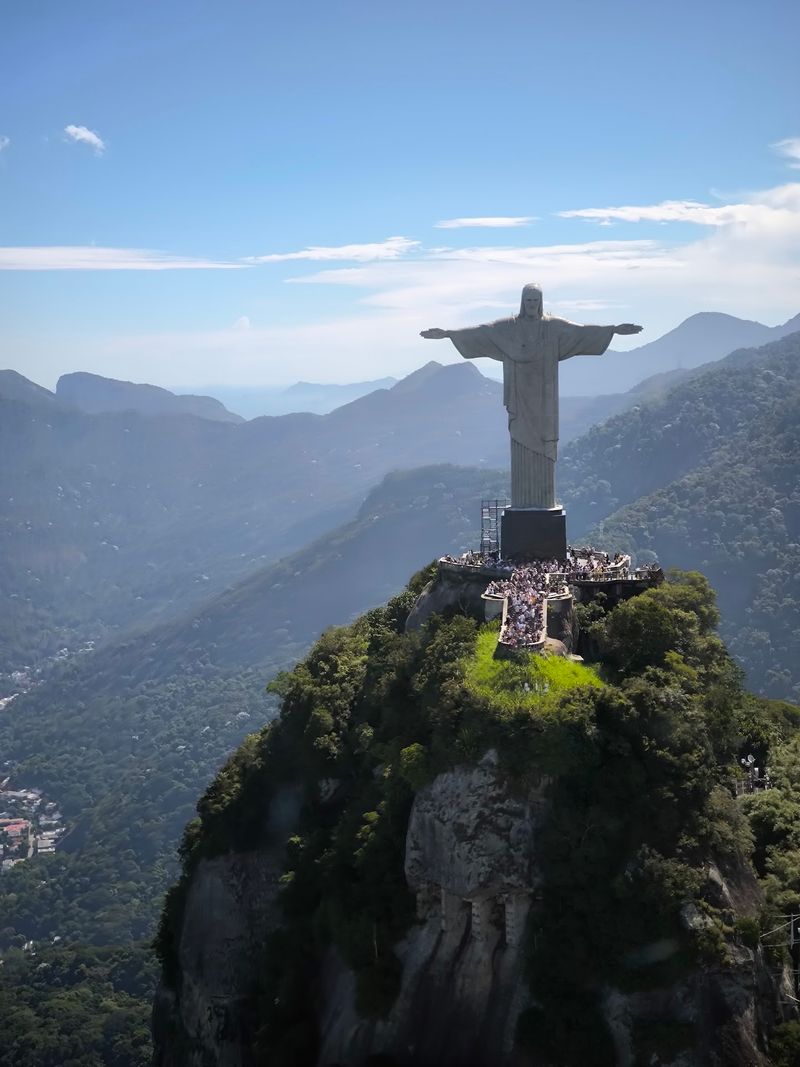
Few images in the world are as instantly recognizable as this one. Christ the Redeemer stretches its arms 28 meters wide above Corcovado Mountain, looking out over Guanabara Bay, Sugarloaf Mountain, and the sprawling neighborhoods of Rio de Janeiro below.
Completed in 1931, the Art Deco figure stands 30 meters tall on an eight-meter pedestal, placing it roughly 709 meters above sea level.
The materials used to build it were chosen carefully. Reinforced concrete forms the core structure, while thousands of small soapstone tiles cover the surface, selected for their durability in Rio’s humid, lightning-prone environment.
Engineers and artists from Brazil and France collaborated on the project over nearly a decade, and the result became one of the most visited monuments on the planet.
Newer statues have surpassed its dimensions, but none have replaced its cultural weight. The way the figure integrates with Rio’s dramatic mountain landscape creates something that raw measurements cannot capture.
Seeing it emerge from a cloud bank on a misty morning is the kind of experience that sticks with people for years. As the benchmark against which almost every other Christ monument gets compared, the Redeemer earns that status not just through fame but through genuine architectural and scenic brilliance.
Christ Blessing, Manado, Indonesia
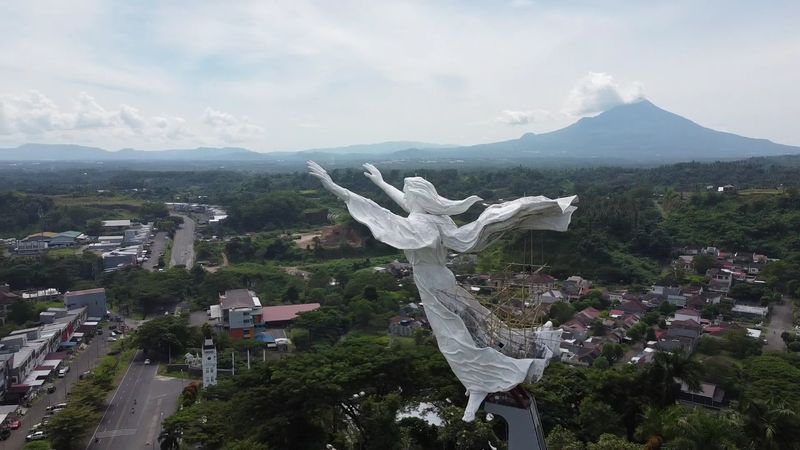
Tilted forward at about 35 degrees, Manado’s Christ Blessing does not just stand over the city. It leans toward it, creating the striking visual impression that the figure is floating or reaching down from the sky.
That forward tilt is what separates this statue from almost every other monumental Christ figure in the world, and it makes the monument instantly memorable.
The 30-meter figure sits atop a roughly 20-meter supporting structure in the CitraLand area of Manado, North Sulawesi. Building something this large at an angle required serious engineering.
Indonesia’s official tourism organization notes the statue incorporates about 25 tons of metal fiber and 35 tons of steel, giving it the structural strength to hold that dramatic forward position without any visible support cables.
Both raised hands face north in a gesture meant to represent blessing, peace, and welcome, which fits naturally into the cultural context of North Sulawesi, a region with a strong Christian heritage within Indonesia’s majority-Muslim national identity. The monument has become one of Manado’s most recognizable landmarks, drawing visitors who often describe their first glimpse of the forward-leaning figure as genuinely startling.
Sometimes a little architectural surprise is exactly what makes a monument unforgettable.
Cristo Rei, Portugal
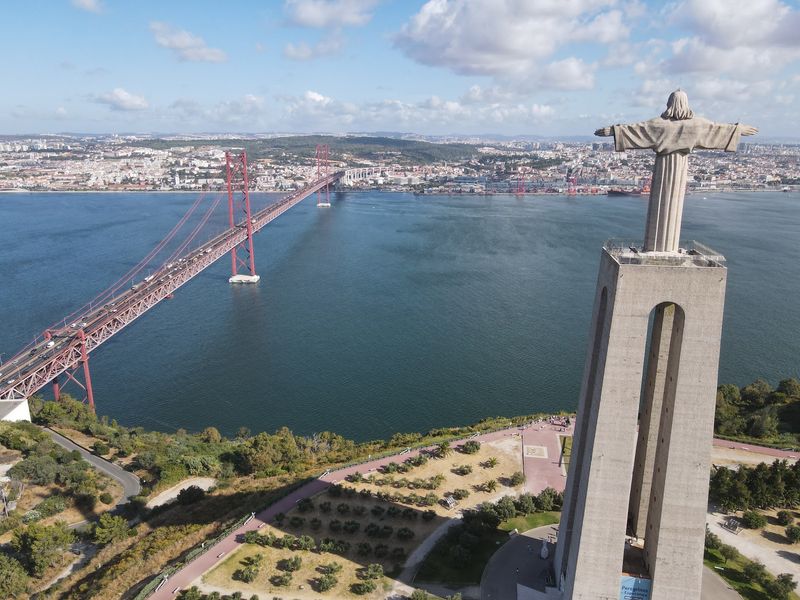
Portugal’s Cristo Rei has one of the most dramatic urban backdrops of any monument on this list. Standing on the southern bank of the Tagus River in Almada, the 28-meter figure looks directly across at Lisbon and the iconic 25 de Abril Bridge.
Its pedestal, however, does most of the heavy lifting in terms of height: at 82 meters tall, the base alone towers over most buildings in the area, bringing the full monument to roughly 110 meters.
The story behind its construction is rooted in wartime anxiety. In 1940, Portugal’s Catholic bishops made a vow to build a monument to the Sacred Heart of Jesus if the country was spared from World War II.
Portugal remained neutral throughout the conflict, fundraising began, and architect Antonio Lino designed the towering pedestal structure. The monument was finally inaugurated in 1959, nearly two decades after that original vow.
Cristo Rei was openly inspired by Rio de Janeiro’s Christ the Redeemer, but it developed its own personality through the four-pier pedestal design and its riverside urban setting. Taking the elevator to the top platform offers one of the best views of Lisbon available anywhere, with the city’s red rooftops, the Tagus, and the bridge all spread out below in a scene that feels almost unreal.
Cristo Rei, Timor-Leste
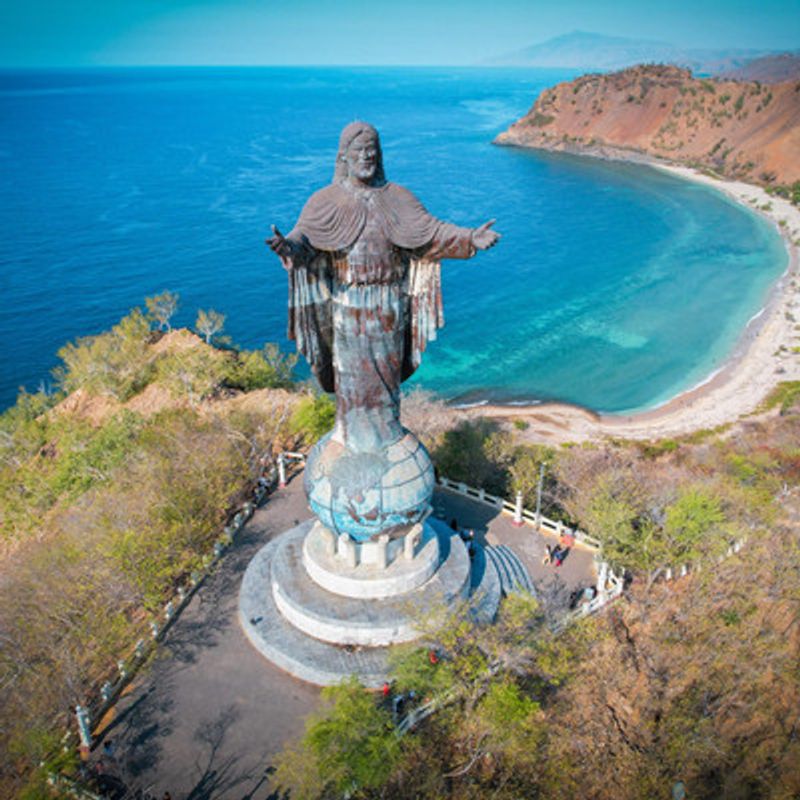
Perched on a globe at the tip of Cape Fatucama, Timor-Leste’s Cristo Rei watches over the Bay of Dili with arms stretched wide. The 27-meter figure was unveiled in 1996, while East Timor was still under Indonesian rule, which gives the monument a complicated political backstory.
It predates the country’s restoration of independence in 2002 by six years, making it a landmark that has witnessed one of the most dramatic national transformations of the modern era.
Today, Timor-Leste’s official tourism organization describes it as Dili’s most recognizable landmark, which is easy to believe given its prominent headland location. Getting there requires climbing more than 500 steps from the coast, passing all 14 Stations of the Cross along the way.
The climb is both a physical workout and a quiet pilgrimage, depending on how you approach it.
From the top, the views across Dili, the surrounding beaches, and Atauro Island are genuinely spectacular. The combination of ocean, mountains, and city spread below makes the effort feel completely worthwhile.
Many visitors describe the walk as one of the best things to do in the Timorese capital, and the statue’s layered history adds a dimension of meaning that purely decorative monuments rarely achieve. It is a small country’s big statement.
Cristo Rey, Cali, Colombia
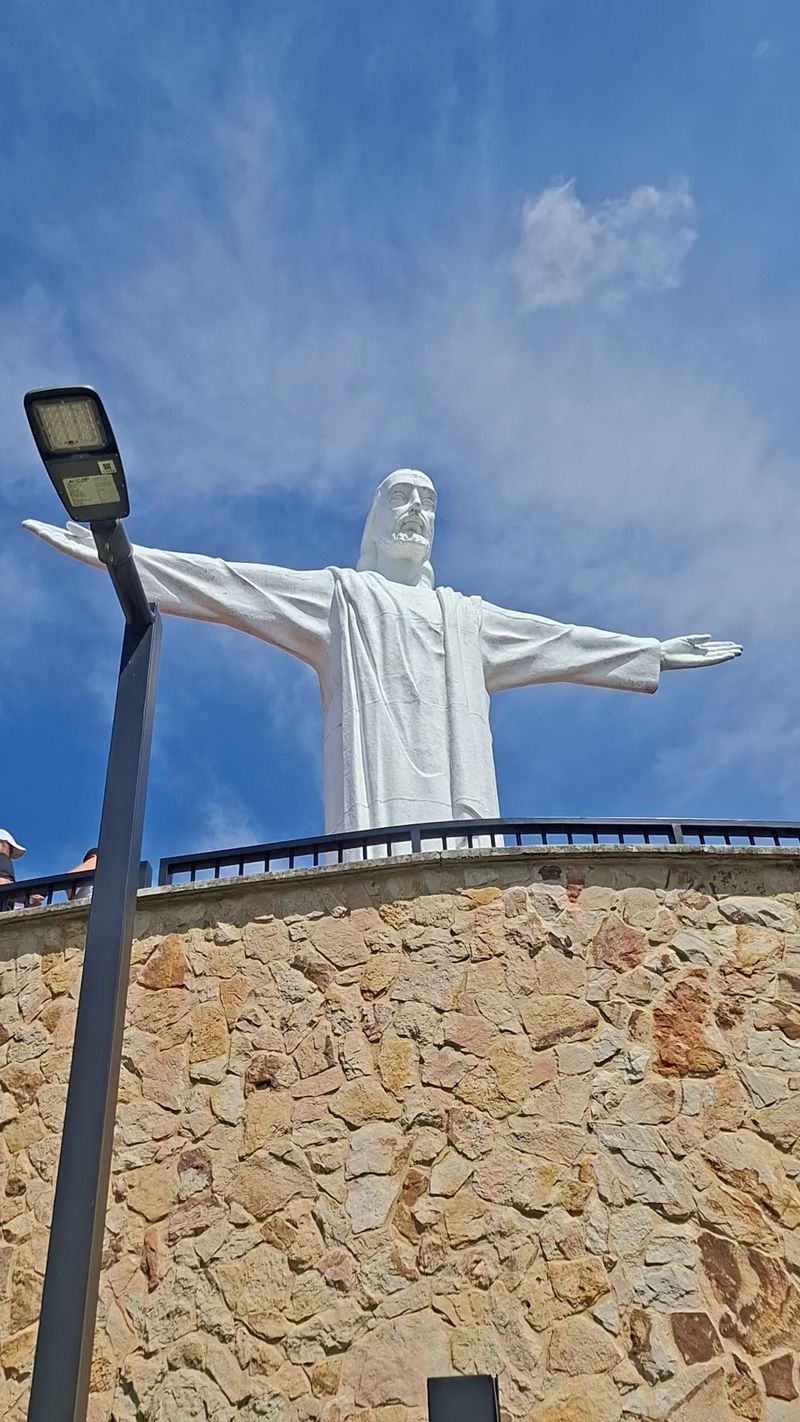
High above Cali on Cerro de los Cristales, the white figure of Cristo Rey has been watching over the Valle del Cauca since 1953. The monument stands 26 meters tall, weighs approximately 464 tons, and sits at roughly 1,474 meters above sea level, which means the air up there is noticeably cooler than in the city below.
On a clear day, the views across Cali and the surrounding valley are the kind that make you forget you were supposed to be somewhere else.
The statue has an interesting creative history. Colombian sculptor Gerardo Navia was involved in the early stages, but Italian sculptor Alideo Tazzioli completed the work.
The monument was created to commemorate peace following Colombia’s War of a Thousand Days, a civil conflict that had scarred the country deeply. That historical connection gives the hilltop figure a weight that goes beyond its impressive physical dimensions.
Cali’s Cristo Rey has since become one of the city’s most visited viewpoints, attracting both religious pilgrims and curious travelers looking for the best panoramic perspective on a city famous for salsa, food, and energy. The contrast between the quiet mountaintop monument and the vibrant, noisy city stretching out below it is one of those contrasts that travel tends to deliver at its very best.
Cristo Rey, Pachuca, Mexico
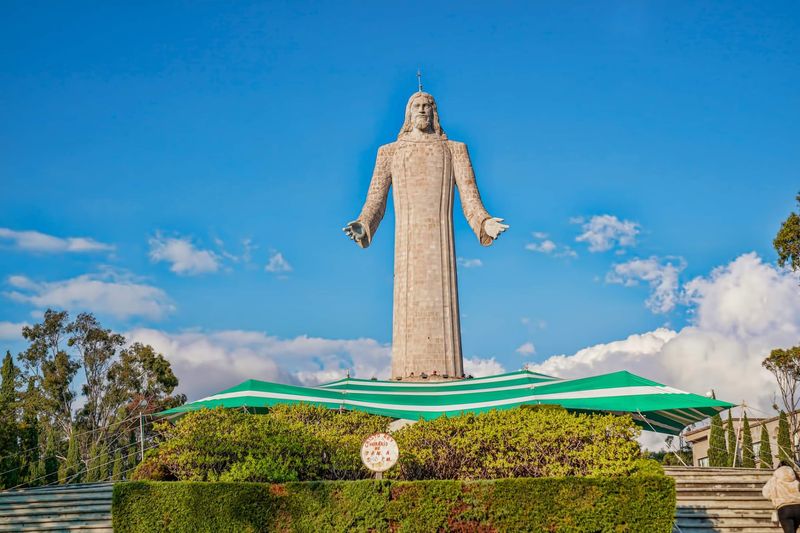
A promise made underground turned into a monument that now stands 33 meters tall above an entire city. According to the Comarca Minera Geopark, miners trapped after a catastrophic elevator accident at the Paricutin mine made a vow: if they survived, they would build a monument to Christ.
Decades later, that promise helped inspire the creation of Cristo Rey on Cerro de Santa Apolonia above Pachuca.
The total height of 33 meters was chosen deliberately, referencing the traditional belief that Jesus was 33 years old at the time of his death. The statue itself accounts for 23 meters, with a 10-meter base underneath.
Work began in the late 1980s, and the completed monument was inaugurated in 1996, finally fulfilling a vow that had been waiting for years to become reality.
The setting ties directly into Pachuca’s identity as a mining city. The surrounding hills are dotted with old mining infrastructure, and standing at the base of Cristo Rey, you can feel that industrial history pressing in from all sides.
Pachuca is already an interesting destination for its role in Mexican mining culture, and having a monument with this kind of origin story sitting above it adds another layer that history enthusiasts will genuinely appreciate. Stories born underground rarely end up this tall.
Cristo de las Noas, Mexico
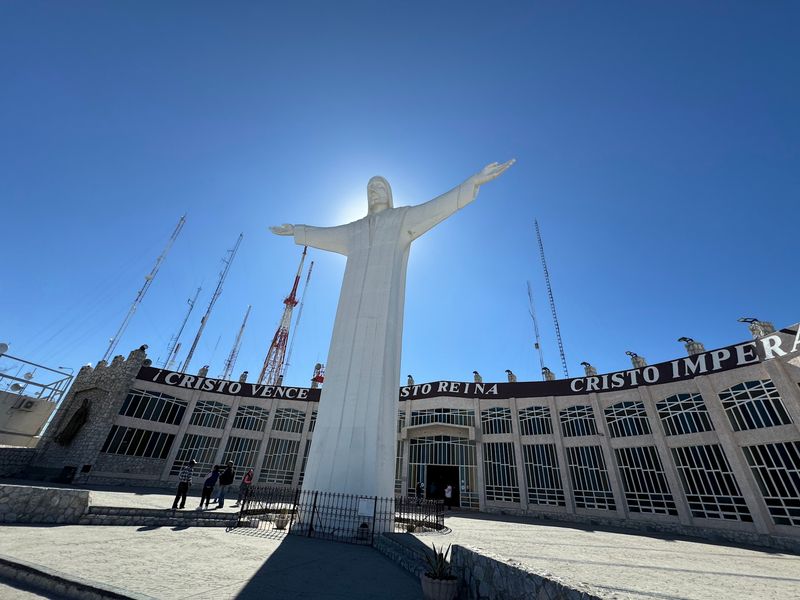
Not every massive Christ statue overlooks a tropical bay or a lush green valley. Torreon’s Cristo de las Noas rises above a dry, sun-baked desert landscape in Coahuila, and that arid setting gives it a visual personality unlike almost any other monument on this list.
The hill itself is named for the noa, a desert agave plant that once grew abundantly across the region.
The reinforced-concrete figure stands 21.8 meters tall and weighs approximately 580 tons, according to Torreon’s municipal tourism department. Sculptor Vladimir Alvarado designed the work with Christ’s arms extended outward in a protective gesture over the city and the broader Comarca Lagunera area below.
The statue is not a standalone sculpture but part of a larger religious and tourism complex built around the hilltop site.
Seeing how dramatically the desert backdrop changes the feel of an otherwise familiar monumental form is one of the quiet surprises this statue offers. Strip away the lush hillsides and ocean views that frame many of its counterparts, and you get something starker and more austere, which suits the landscape perfectly.
The Comarca Lagunera is an agricultural and industrial region that does not always make travel lists, but Cristo de las Noas gives curious visitors a genuinely compelling reason to stop and look up.
Cristo del Otero, Spain
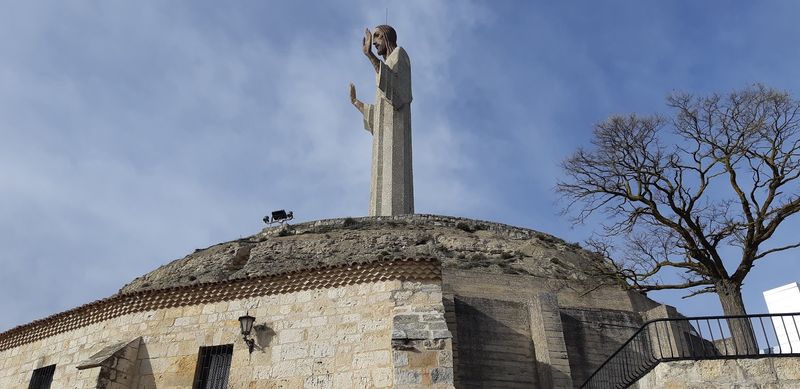
Completed in 1931, the same year Rio’s Christ the Redeemer was inaugurated on the other side of the Atlantic, Palencia’s Cristo del Otero is one of the earliest monumental Christ figures of the modern era. Sculptor Victorio Macho designed the 21-meter figure, which weighs approximately 392 tons.
Despite being less famous than its Brazilian counterpart, this Spanish statue has a creative identity all its own.
Macho gave his Christ strongly simplified lines influenced by Art Deco and Cubism, the dominant artistic movements of the time. The result looks noticeably different from the flowing robes and naturalistic proportions of Rio’s monument.
Construction moved quickly: the first stone was laid in June 1930, and the finished statue was unveiled just eight months later, a pace that would be difficult to match with modern construction schedules.
Macho considered Cristo del Otero one of his finest works, and after his death, his ashes were placed in a crypt at the base of the hilltop monument, making the site both a landmark and a personal memorial. Palencia is a quiet Castilian city that rarely tops Spanish travel itineraries, but this hilltop figure rewards visitors who seek it out with both artistic interest and a sweeping view across the flat meseta landscape surrounding the city.
Christ of the Ozarks, Arkansas, USA
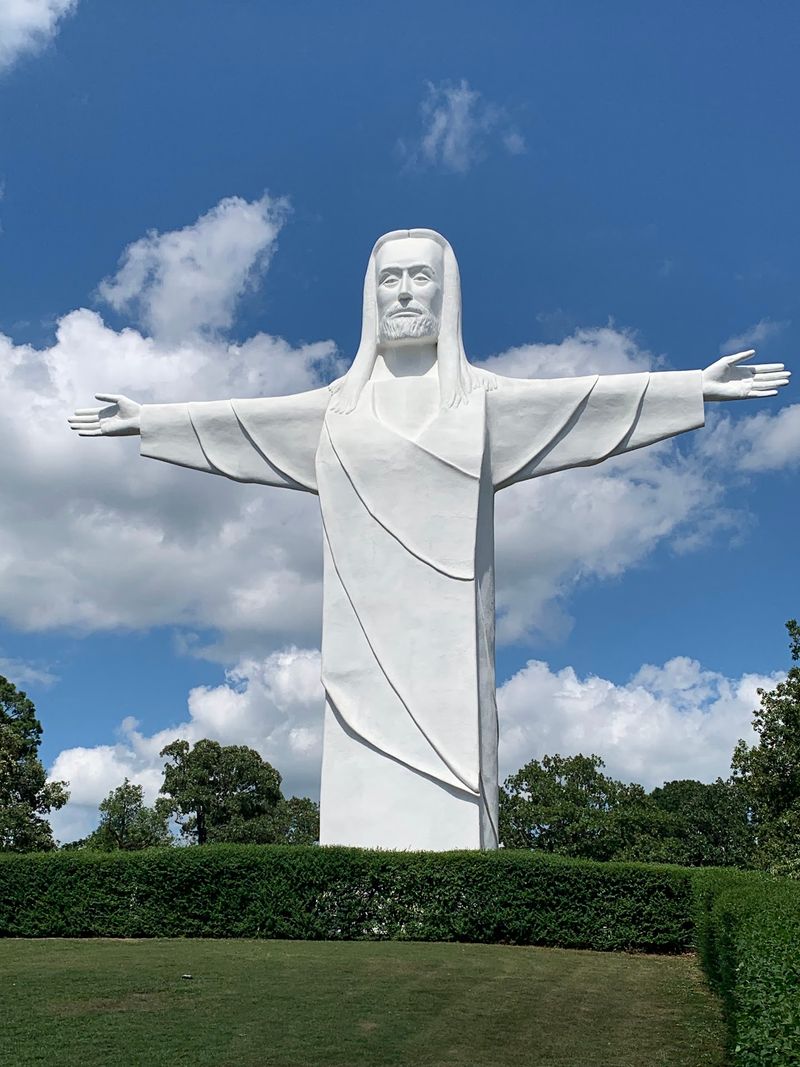
Seven stories of white concrete rising out of the Arkansas woods is not something most people expect to find in the Ozark Mountains. The Christ of the Ozarks stands 67 feet tall, about 20.4 meters, on Magnetic Mountain above Eureka Springs, with a 65-foot arm span that makes it look wider than it is tall from certain angles.
It is the kind of monument that surprises first-time visitors who were not expecting anything this large this far off the usual tourist trail.
Sculptor Emmet Sullivan created the figure, bringing some impressive credentials to the project. He had previously worked as an apprentice under one of the sculptors who carved Mount Rushmore, which explains the ambition behind a statue of this scale.
The statue was completed and dedicated in 1966, built around a steel framework covered in layers of white mortar. The foundation alone required about 340 tons of concrete anchored directly into the mountain rock below.
The finished structure weighs more than two million pounds, which is a number that takes a moment to fully register. Unlike many monumental statues around the world that charge admission, this site remains open to visitors free of charge.
That accessibility, combined with the unexpected setting deep in the Ozarks, makes it one of the most genuinely surprising religious monuments in the entire United States.
Share this story