Some buildings do more than just stand the test of time. The world’s greatest churches carry centuries of history, art, and human devotion within their walls, domes, and stained glass windows.
From a cave carved out of solid rock in Ethiopia to a gleaming golden basilica floating above Venice’s canals, these sacred spaces have inspired awe for generations. Get ready to travel through nearly two thousand years of breathtaking architecture and remarkable stories.
Church of the Nativity, Bethlehem
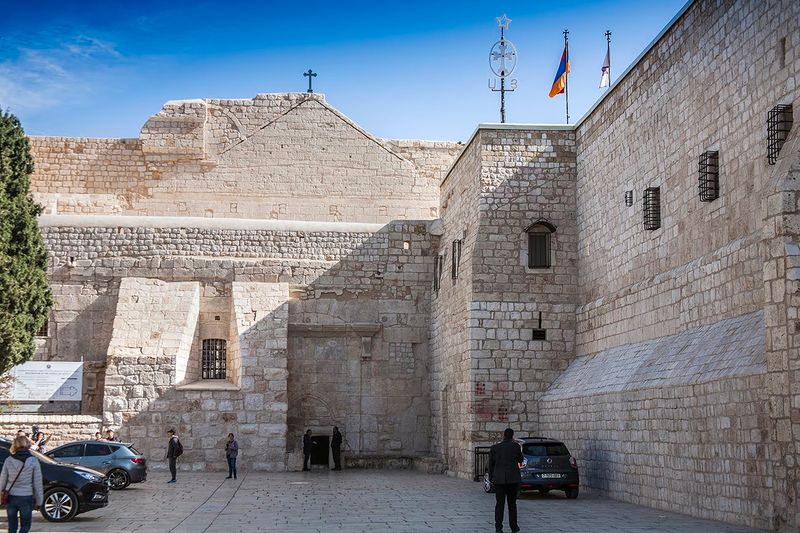
Few doorways in the world carry as much weight as the tiny, low entrance to the Church of the Nativity. Visitors must physically bow their heads to pass through the Door of Humility, a feature added centuries ago to prevent horsemen from riding inside.
That small act of bending down feels surprisingly meaningful before stepping into one of Christianity’s oldest continuously used places of worship.
A church was first completed here in AD 339, built over the grotto traditionally recognized as the birthplace of Jesus. Much of what visitors see today dates from a major sixth-century reconstruction ordered by Emperor Justinian.
Ancient marble columns line the nave, hanging lamps glow softly overhead, and patches of restored Byzantine mosaics peek through the worn plaster on the walls.
The grotto below the main church is the heart of the pilgrimage experience. A silver star embedded in the marble floor marks the spot traditionally associated with the Nativity.
Several Christian communities, including Greek Orthodox, Armenian Apostolic, and Roman Catholic groups, share responsibility for the church under long-established arrangements that are sometimes fiercely guarded. UNESCO added the site to its World Heritage List in 2012.
Church of the Holy Sepulchre, Jerusalem
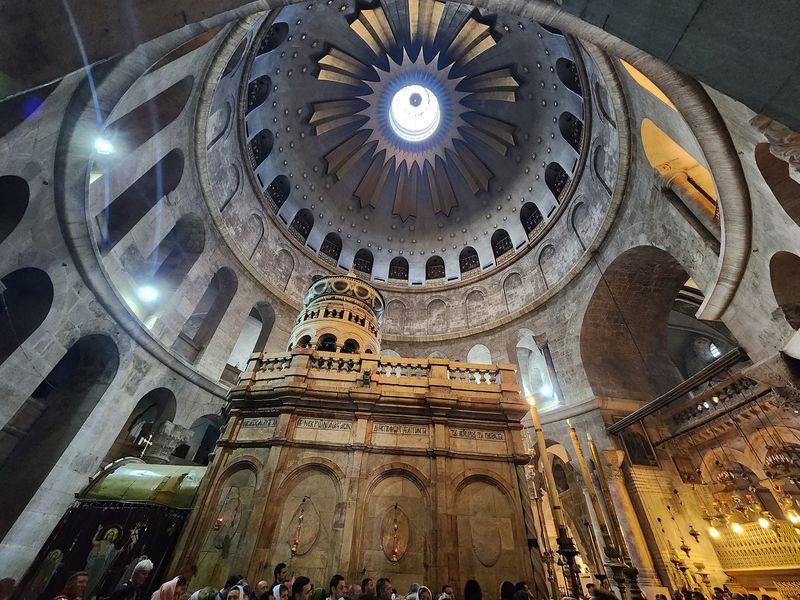
Walking into the Church of the Holy Sepulchre feels like stepping through layers of history so thick you can almost touch them. The air smells of incense and candle wax, and the low lighting makes the golden lamps and mosaic surfaces glow in a way that is genuinely hard to describe.
Pilgrims from dozens of countries press quietly through its corridors every single day.
The first church complex on this site was dedicated in the fourth century under Emperor Constantine, making it one of Christianity’s earliest major monuments. Destruction and rebuilding changed its appearance dramatically over the centuries, but the locations it commemorates have remained constant.
The church surrounds the sites traditionally connected with the crucifixion, burial, and resurrection of Jesus.
Inside, the layout is a maze of chapels, stone stairways, and sacred shrines, each maintained by a different Christian denomination. The massive Resurrection rotunda, known as the Anastasis, shelters the Edicule, a small marble shrine encasing the traditional tomb.
Greek Orthodox, Roman Catholic, Armenian, Coptic, Ethiopian, and Syriac Christian communities all share portions of the building under an arrangement called the Status Quo, which has governed access for centuries.
Etchmiadzin Cathedral, Armenia
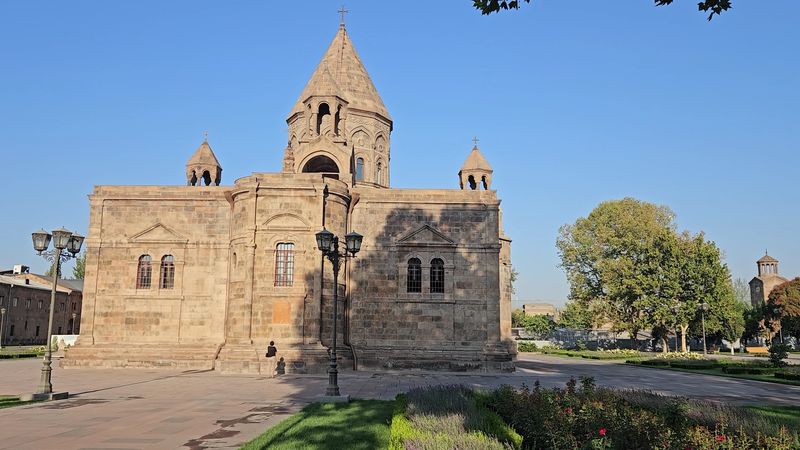
Armenia holds a record that most people overlook in history class: it was the first country in the world to adopt Christianity as its official state religion, back in 301 AD. Etchmiadzin Cathedral stands as the living symbol of that remarkable decision.
For over 1,700 years, it has served as the spiritual headquarters of the Armenian Apostolic Church.
Tradition dates the original foundation of the cathedral to the early fourth century, with the name Etchmiadzin meaning “the place where the Only Begotten descended” in Armenian. The core of the current structure largely reflects rebuilding completed during the fifth century, though subsequent centuries added chapels, a bell tower, and other features.
Its conical dome and warm stone walls give the building a quietly powerful silhouette.
UNESCO recognized the Etchmiadzin complex as a World Heritage Site in 2000, specifically praising how it illustrates the development of Armenia’s highly influential central-domed church architecture. The cathedral’s treasury holds some of Christianity’s most venerated relics, including a fragment of the lance traditionally believed to have pierced Jesus at the crucifixion.
Pilgrims travel from across the Armenian diaspora to visit, making it a deeply personal as well as architectural landmark.
Hagia Sophia, Istanbul
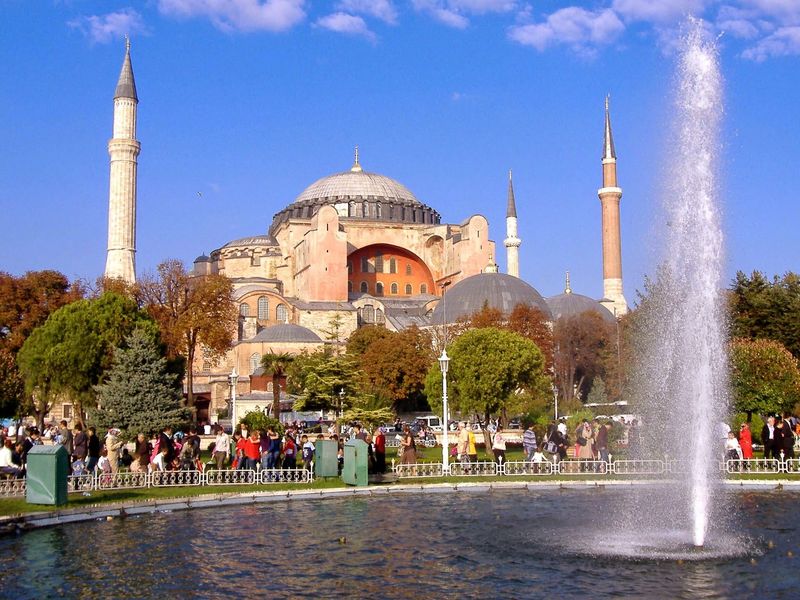
When Emperor Justinian first saw the completed Hagia Sophia in 537 AD, he reportedly looked up at its enormous dome and said, “Solomon, I have surpassed thee.” Whether or not those were his exact words, the feeling behind them makes sense. The dome appeared to float above the interior without visible support, a feat of engineering that left even experienced architects speechless for centuries.
Hagia Sophia transformed the history of architecture. Its massive central dome, pierced by forty arched windows that flood the interior with light, became a direct model for Byzantine churches, Ottoman mosques, and grand civic buildings across multiple continents.
The sheer scale of the interior, combined with its warm marble surfaces and glittering mosaics, creates an atmosphere unlike any other building on Earth.
The building has served as an imperial Byzantine cathedral, a mosque after the Ottoman conquest of 1453, a museum from 1934 to 2020, and once again a functioning mosque today. Byzantine mosaics depicting emperors, empresses, and sacred figures survive alongside enormous Ottoman calligraphy medallions, creating a layered visual record of two great civilizations.
Visitors of all backgrounds continue to arrive daily, drawn by a building that has never stopped being extraordinary.
Basilica of San Vitale, Ravenna, Italy
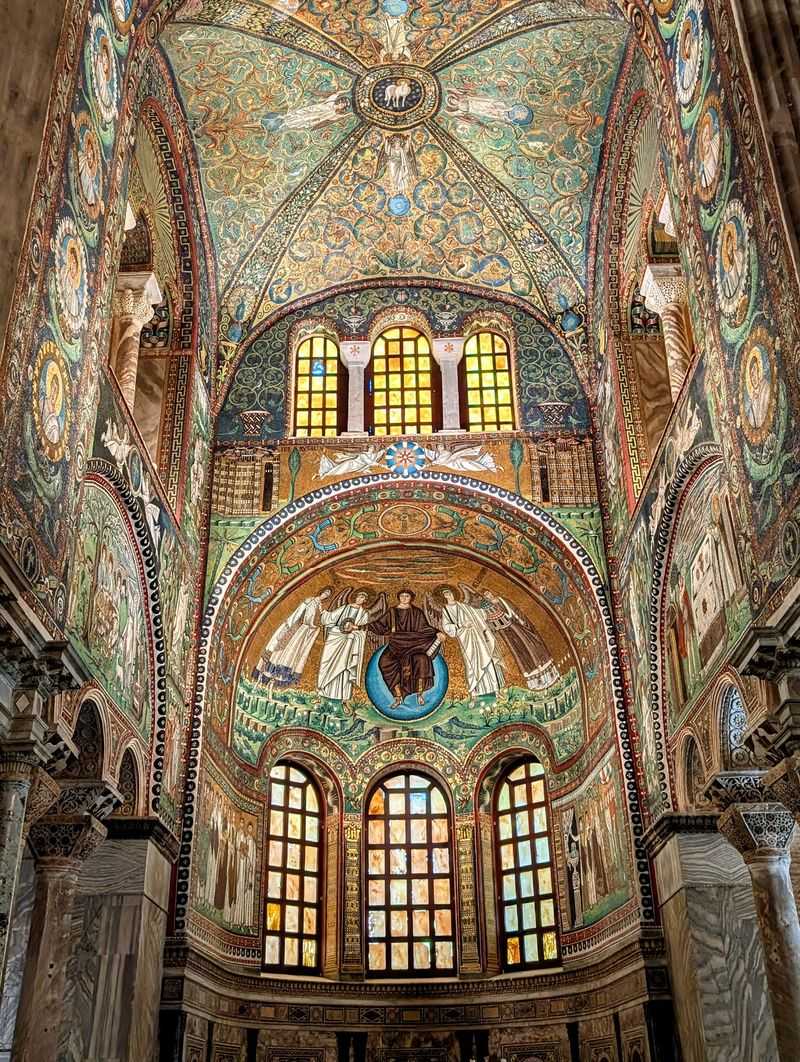
From the outside, the Basilica of San Vitale looks almost ordinary. Its plain brick walls and octagonal shape give little hint of what is waiting on the other side of the entrance.
Stepping inside is one of those rare moments in travel where your jaw drops before your brain has time to catch up.
Completed in 547 AD during the reign of Emperor Justinian, San Vitale is considered one of the finest surviving examples of early Byzantine architecture in all of Western Europe. Every surface seems to compete for attention.
Ceilings, arches, and walls are covered in mosaics made from glass and gold tiles that catch the light and shift color as you move through the space. Green, gold, purple, and ivory shimmer together in scenes of biblical events and imperial ceremony.
The most famous mosaics show Emperor Justinian and Empress Theodora in full court regalia, surrounded by their attendants. These portraits are remarkable for their detail, color, and the way they blend religious and political authority into a single image.
UNESCO included San Vitale as part of the Early Christian Monuments of Ravenna World Heritage Site, calling it one of the highest achievements of Byzantine art and architecture. The building has been in continuous use for nearly 1,500 years.
Aachen Cathedral, Germany
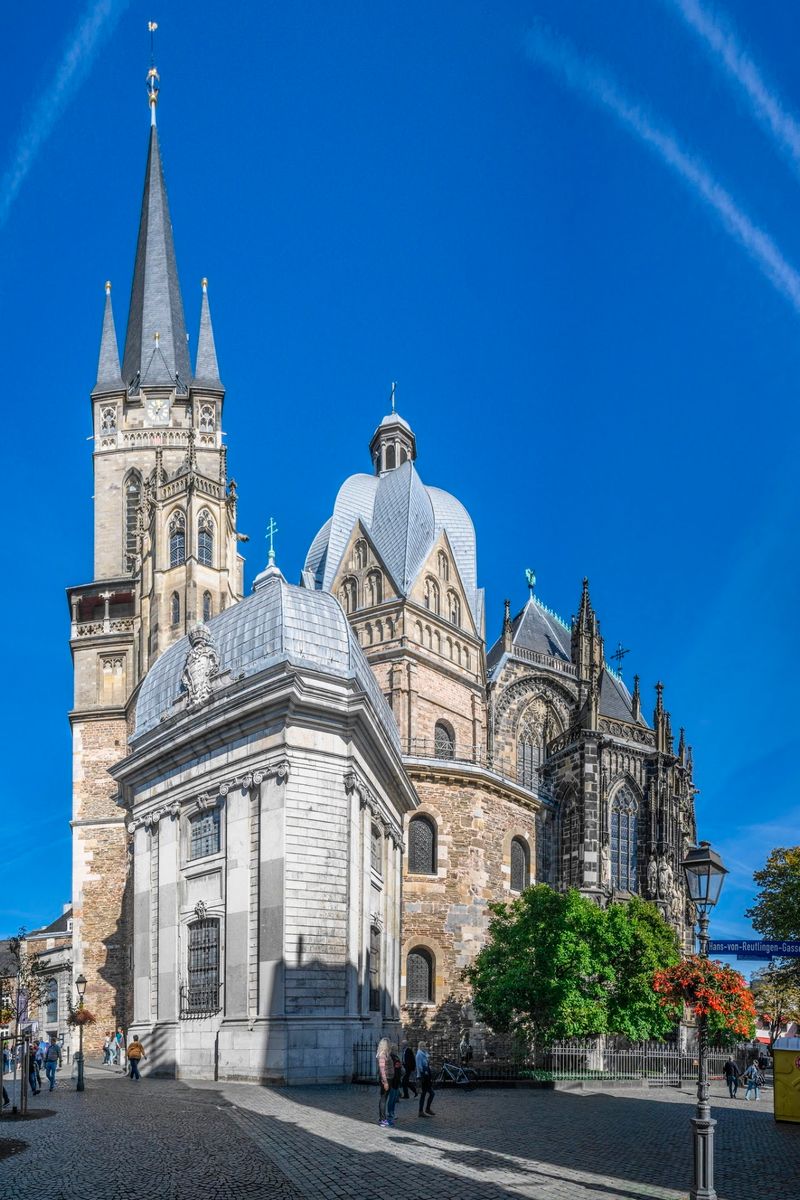
Charlemagne was arguably the most powerful ruler in early medieval Europe, and he wanted a chapel that would prove it. Around 793 AD, he ordered construction of his Palatine Chapel at Aachen, a building designed to rival the great churches of Rome and Constantinople.
It became the heart of what would eventually grow into Aachen Cathedral, Germany’s oldest cathedral and a UNESCO World Heritage Site since 1978.
The original octagonal chapel, completed around 813, is a masterpiece of Carolingian architecture. Marble columns reportedly brought from Rome and Ravenna support soaring galleries, and a glittering golden mosaic covers the interior of the cupola.
A massive bronze chandelier, added in the 12th century and still hanging today, casts warm light across the polished stone floors and carved bronze railings below.
For centuries after Charlemagne’s death, Aachen Cathedral served as the coronation church for German kings. Thirty Holy Roman Emperors were crowned here between 936 and 1531, giving the building an extraordinary political legacy that rivals its artistic one.
Charlemagne’s throne, a plain marble seat assembled from ancient stone slabs, still sits in the upper gallery. His golden reliquary shrine, one of the largest surviving medieval gold artworks in existence, is kept in the cathedral treasury.
St. Mark’s Basilica, Venice
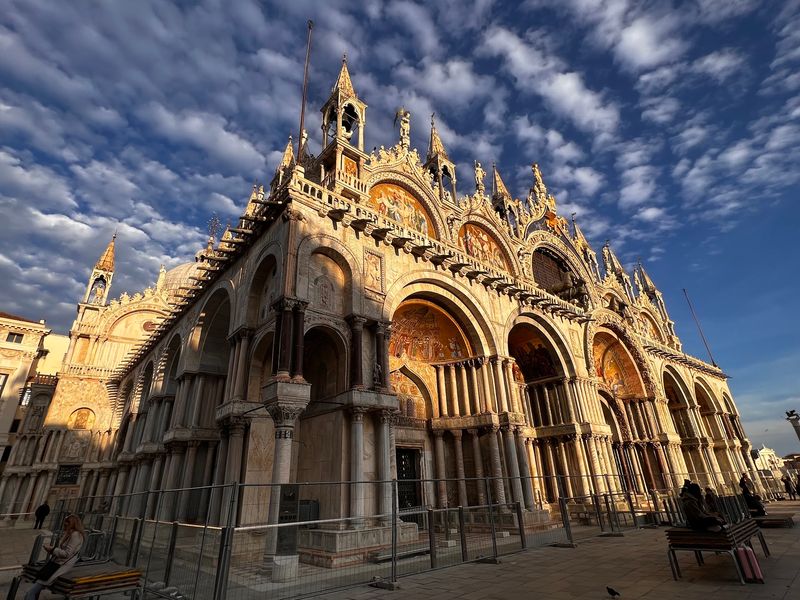
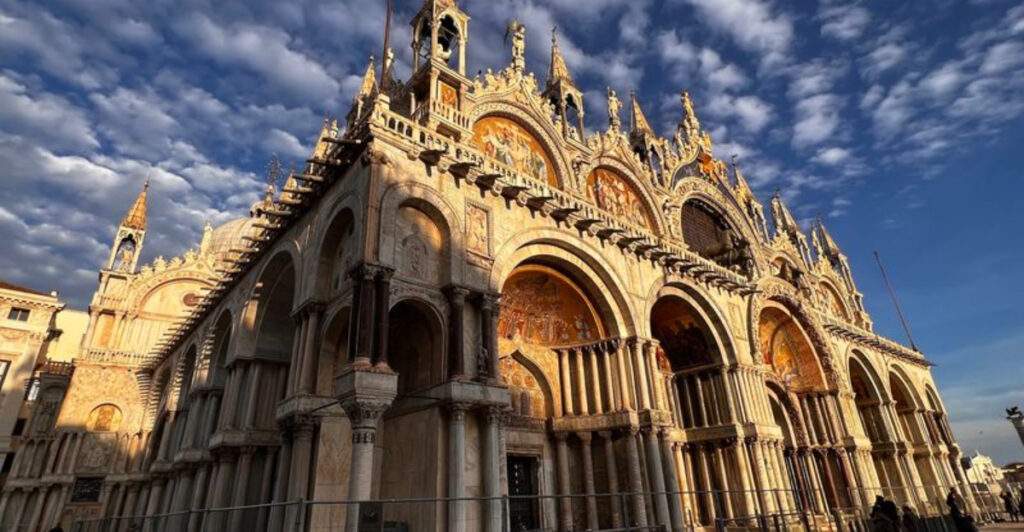
There is a reason St. Mark’s Basilica is sometimes called the “Church of Gold.” Step inside and look up, and you will understand immediately. Roughly 8,000 square meters of golden mosaics cover the vaults, domes, and arches overhead, producing a warm, shimmering glow that makes the entire interior feel like the inside of a treasure chest.
The present basilica was largely constructed during the 11th century, replacing earlier churches built to house the relics of Saint Mark the Evangelist. Venetian merchants had controversially smuggled those relics out of Alexandria in 828 AD, hiding them under layers of pork and cabbage to discourage inspection by Muslim customs officials.
The story is equal parts daring heist and medieval devotion.
The basilica’s five domes and cross-shaped plan reflect the strong Byzantine influence that shaped Venice’s artistic identity for centuries. Its facade is a layered collage of marble panels, ancient columns, bronze horses, and carved reliefs, many of them looted from Constantinople during the Fourth Crusade of 1204.
The interior holds the Pala d’Oro, a stunning gold altarpiece encrusted with enamel panels and over 2,000 precious gems. Few buildings in the world carry such a complicated and colorful history within their walls.
Chartres Cathedral, France
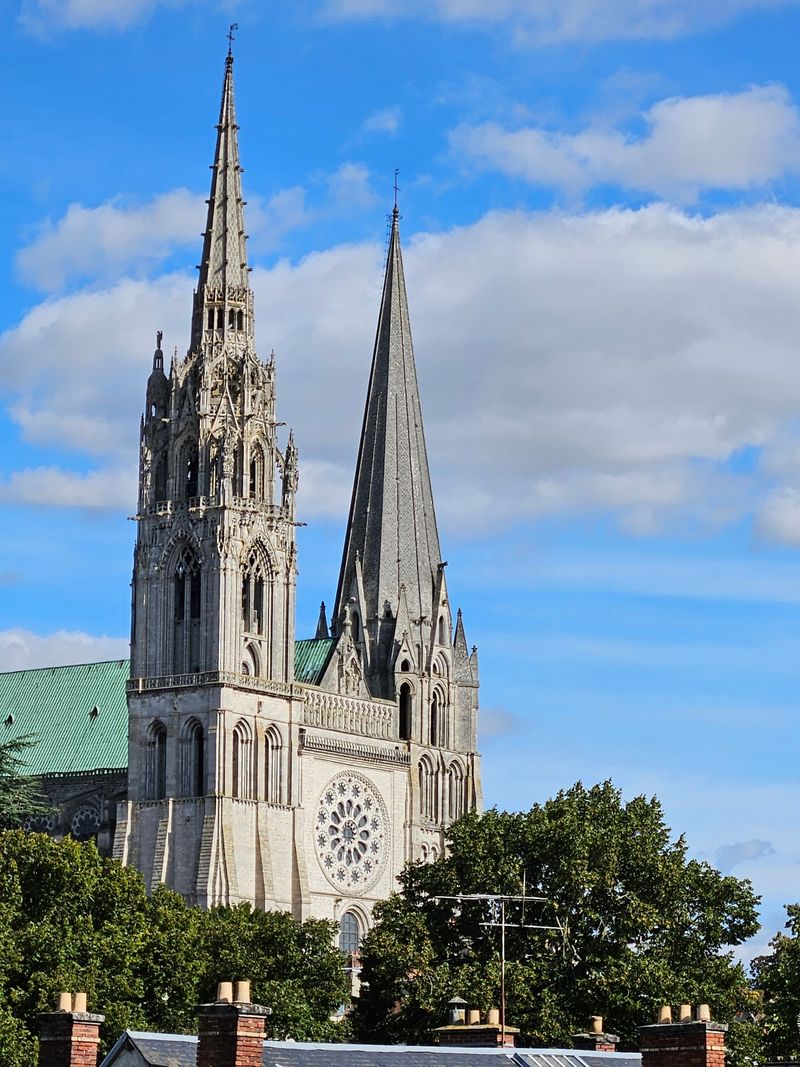
The two spires of Chartres Cathedral are famously mismatched, and that is not a flaw. One spire is plain and early Gothic, completed in the 12th century.
The other is elaborate and Flamboyant Gothic, finished about 350 years later. Together, they create a silhouette that tells the story of medieval architecture all by itself, without a single word of explanation needed.
Construction at Chartres began in earnest after a devastating fire in 1194 destroyed most of an earlier cathedral, leaving only the new west facade and its towers standing. The rebuilding effort that followed was remarkably fast by medieval standards, and the result is considered one of the most unified and complete examples of French Gothic architecture anywhere in the world.
UNESCO granted it World Heritage status in 1979.
The cathedral’s collection of medieval stained glass is unmatched in scale and preservation. Over 150 original windows survive, covering more than 2,600 square meters of glass.
The deep, luminous blue associated with several windows, sometimes called “Chartres blue,” has fascinated artists and scientists for centuries and its precise formula remains debated. The stone labyrinth embedded in the nave floor, roughly 13 meters in diameter, was walked by pilgrims as a symbolic journey and is still intact today.
Notre-Dame de Paris, France
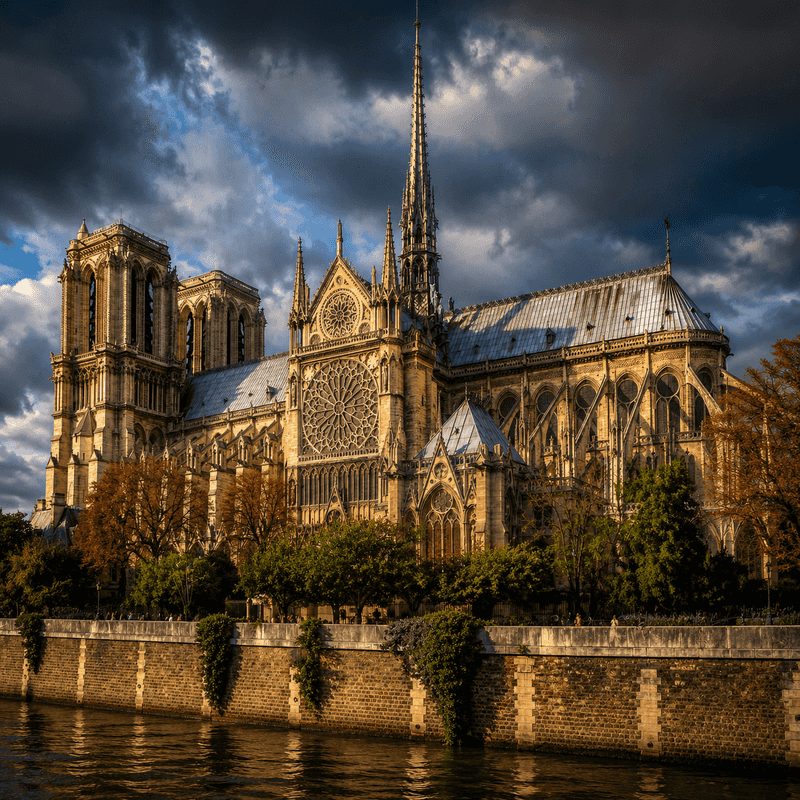
On the evening of April 15, 2019, millions of people around the world watched in horror as Notre-Dame de Paris burned. The cathedral’s medieval spire collapsed in a shower of sparks, and for a few terrifying hours, it looked like the entire structure might be lost.
The fact that it survived, and reopened fully restored in December 2024, feels almost as miraculous as the building itself.
Construction of Notre-Dame began in 1163 and continued for nearly two centuries, with each generation of builders adding to and refining the design. Its pointed arches, ribbed stone vaults, enormous rose windows, and elaborate flying buttresses helped define what the world thinks of when it imagines a Gothic cathedral.
Millions of visitors arrived every year before the fire, making it one of the most visited monuments in Europe.
The restoration effort that followed the 2019 fire was one of the largest and most ambitious conservation projects in modern history. Craftspeople, architects, historians, and engineers from across France and beyond worked to rebuild the roof, reconstruct the spire, restore the interior stonework, and return the liturgical spaces to full function.
The reopened cathedral is widely described as more beautiful and better understood than at any point in the past century.
Church of Saint George, Lalibela, Ethiopia
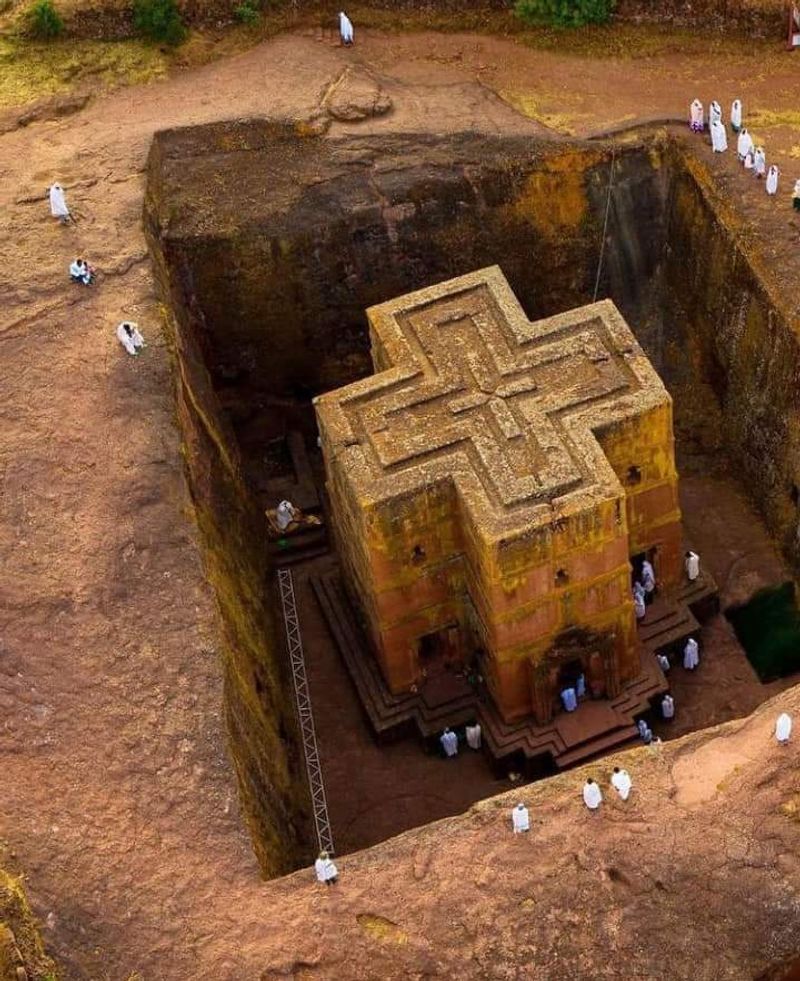
Imagine a church that you do not look up at, but down into. The Church of Saint George in Lalibela, Ethiopia is carved entirely from solid volcanic rock and descends into the earth rather than rising above it.
Its cross-shaped roof sits at ground level, and the church itself stands inside a deep excavated courtyard, visible only once you peer over the edge.
King Lalibela commissioned the complex of 11 rock-hewn churches in the 12th and 13th centuries as a symbolic New Jerusalem for Ethiopian Christians who could not make the journey to the Holy Land. Tunnels, trenches, caves, and ceremonial passages connect the churches into an underground sacred landscape that took generations to carve.
Saint George, the most visually striking of the group, is believed to have been among the last completed.
The church is still actively used for Ethiopian Orthodox Christian worship and pilgrimage. During major festivals like Timkat, the Ethiopian celebration of Epiphany, thousands of white-robed worshippers fill the surrounding courtyards and cliff ledges in a scene that has changed little for centuries.
UNESCO recognized the Lalibela churches as a World Heritage Site in 1978, noting their unique combination of engineering skill, religious purpose, and artistic ambition carved from living stone.
Boyana Church, Bulgaria
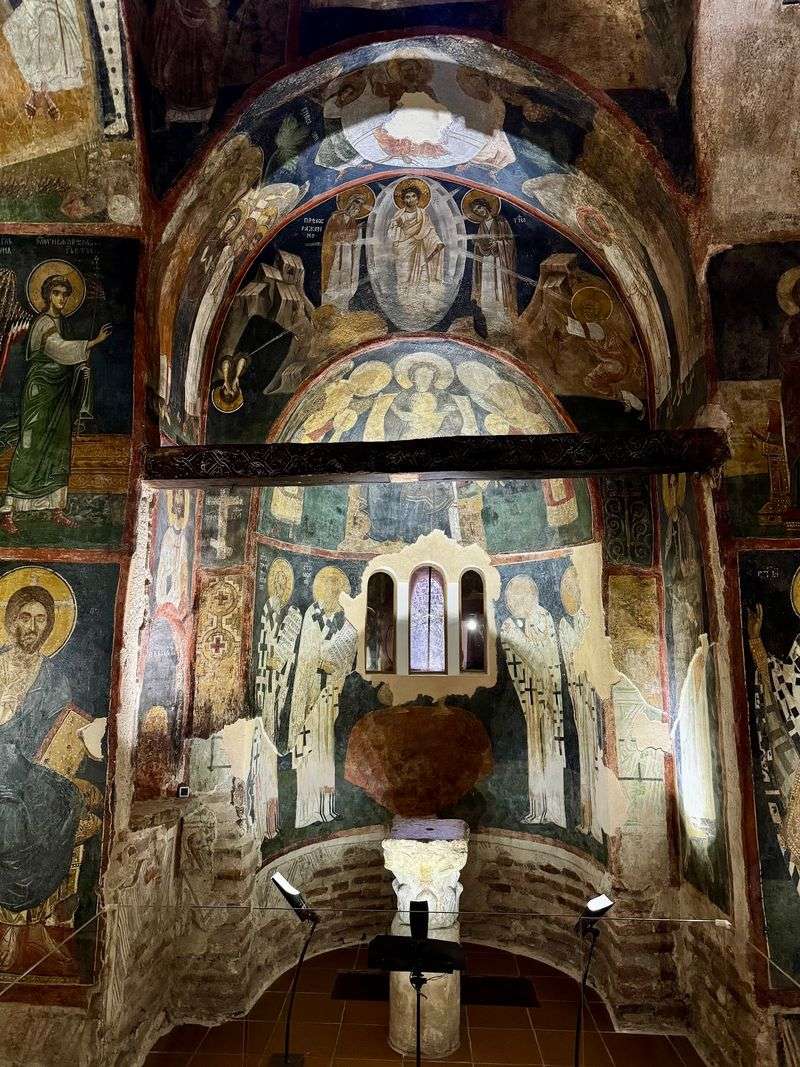
Most visitors to Sofia, Bulgaria head straight to the city center without realizing that one of Europe’s most extraordinary medieval treasures is sitting quietly in the forested hills just outside town. Boyana Church looks modest from the outside, a small stone building tucked beneath trees.
But the frescoes painted on its interior walls in 1259 are nothing short of revolutionary.
The oldest section of the church dates from the 10th century, and a two-story addition was completed in the 13th century. That 13th-century extension is where the famous frescoes are found, painted by an unknown artist of remarkable skill.
The faces depicted in these paintings show genuine individual personality, emotional depth, and physical realism that would not become common in Western European art for another century or more.
UNESCO added Boyana Church to its World Heritage List in 1979, recognizing it as one of the most complete and carefully preserved examples of Eastern European medieval art in existence. Because the frescoes are so fragile, visitor numbers are strictly limited and timed, meaning the church stays quiet and intimate even during peak tourist season.
Seeing those expressive, almost modern-looking faces staring back at you from 800-year-old plaster is genuinely unsettling in the best possible way.
Monreale Cathedral, Sicily
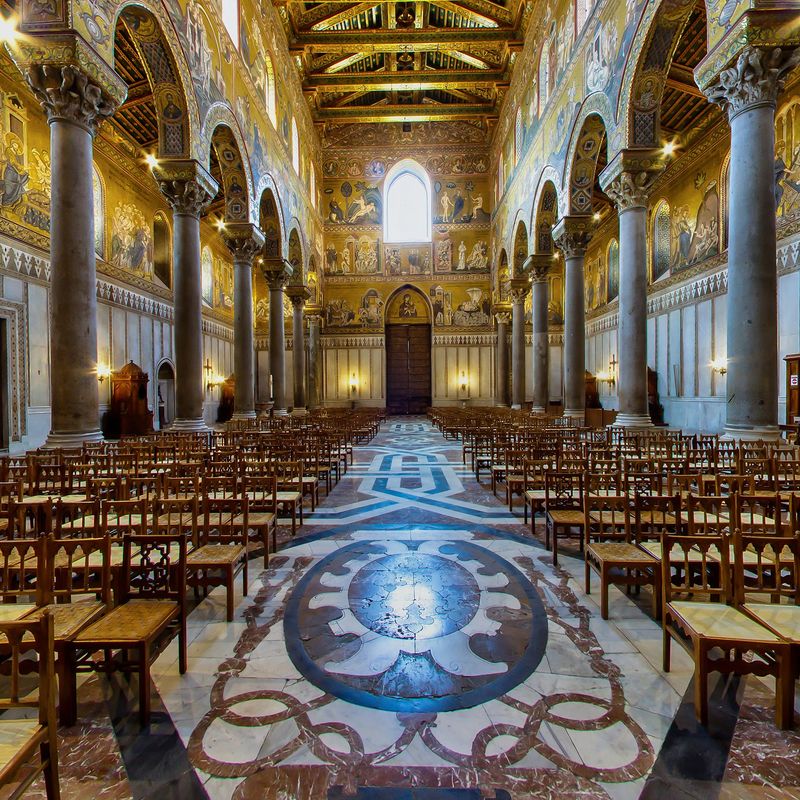
The apse of Monreale Cathedral is dominated by a single image so large and so intensely golden that it stops visitors in their tracks the moment they enter. Christ Pantocrator, meaning Christ the Almighty, stares down from the curved wall with an expression that somehow manages to feel both stern and compassionate at the same time.
The mosaic measures roughly 13 meters tall.
Built during the Norman kingdom of Sicily in the late 12th century, Monreale Cathedral is one of history’s most spectacular artistic collaborations. Norman rulers, Byzantine mosaic artists, Arab craftsmen, and Italian architects all contributed to a building that blends four distinct traditions into a seamless and dazzling whole.
The result is a church that belongs fully to no single culture and beautifully to all of them.
The interior holds over 6,000 square meters of golden mosaics depicting scenes from both the Old and New Testaments in remarkable detail and color. Outside, the adjoining cloister is equally impressive, featuring 228 paired columns decorated with carved capitals and inlaid mosaic patterns, each column slightly different from the next.
UNESCO recognized Monreale Cathedral as a World Heritage Site in 2015 as part of the Arab-Norman Palermo designation. It is one of the most rewarding cathedral visits anywhere in the Mediterranean.
St. Peter’s Basilica, Vatican City
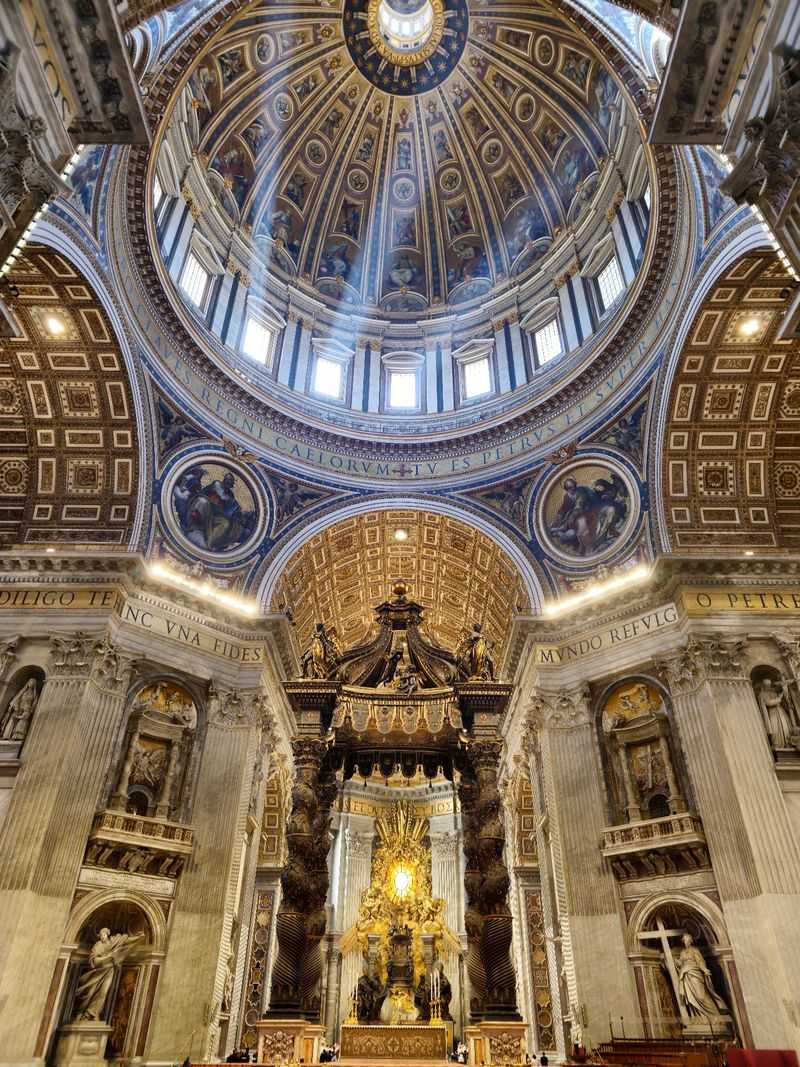
Standing beneath Michelangelo’s dome inside St. Peter’s Basilica and tilting your head back to look straight up is one of those experiences that makes your knees feel slightly unreliable. The dome soars 136 meters above the floor, and the interior is so vast that scale becomes genuinely difficult to judge.
Statues that look life-size from a distance turn out to be several meters tall up close.
The current basilica was built between the 16th and early 17th centuries, replacing a fourth-century church that Emperor Constantine had constructed over the traditional tomb of Saint Peter. Major architects including Bramante, Raphael, Michelangelo, and Bernini all contributed to the design across more than a century of construction.
The result is a building that represents the ambitions, rivalries, and artistic brilliance of the Renaissance and Baroque periods at their absolute peak.
Bernini’s baldachin, the enormous bronze canopy standing over the papal altar, rises 29 meters high and is itself one of the largest bronze structures ever cast. Michelangelo’s Pieta, carved when the artist was just 24 years old, sits behind glass in a side chapel and draws crowds every hour of the day.
With roughly 7 million visitors per year, St. Peter’s is consistently among the most visited buildings on the planet.
Borgund Stave Church, Norway
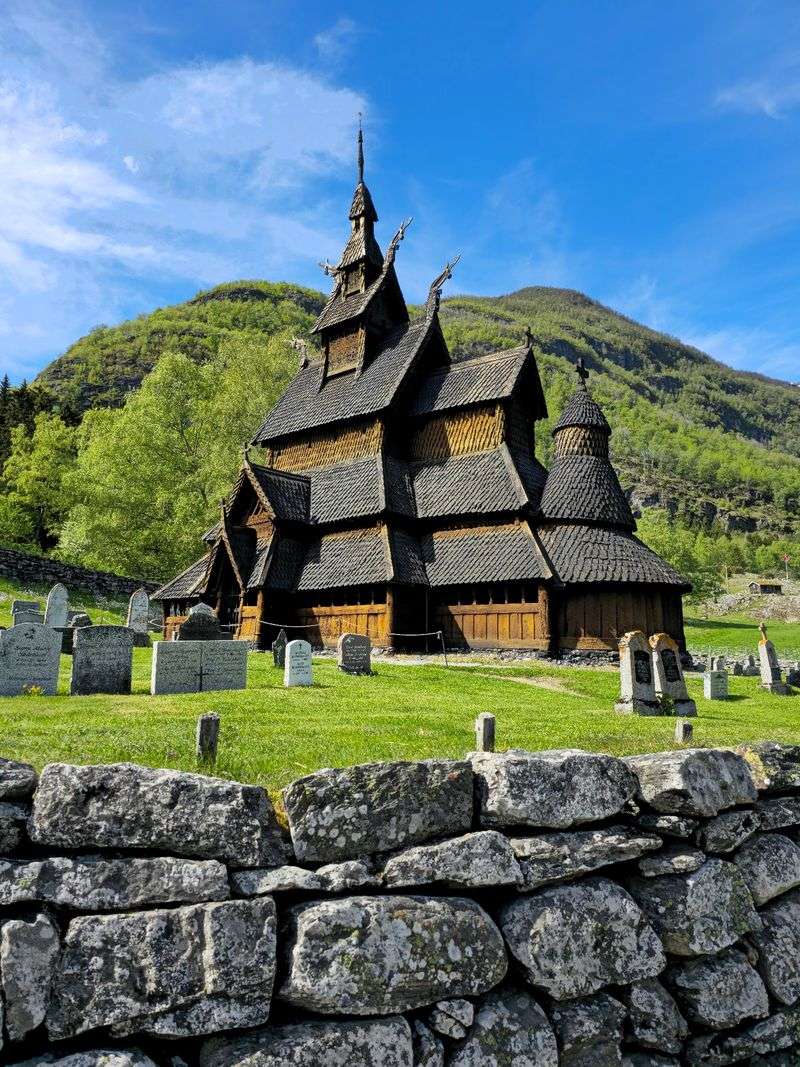
Carved dragon heads perch at the tips of Borgund Stave Church’s rooflines, keeping watch over the Norwegian valley below just as they have since the 12th century. The combination of Christian crosses and Norse dragon carvings on the same building is not a contradiction.
It is a snapshot of a culture in transition, caught between two belief systems and somehow making both look magnificent.
Built around 1180 AD, Borgund is one of Norway’s best-preserved stave churches and widely considered the finest surviving example of its type. Stave construction uses vertical wooden posts called staves as the structural framework, a technique developed by Scandinavian builders who mastered woodworking the way other cultures mastered stone.
The dark, tarred timber walls have protected the structure from centuries of harsh Norwegian winters.
The multiple layered rooflines are not just decorative. Each successive roof level sheds rain and snow away from the walls below, creating a practical and visually striking cascade of steep angles.
The interior is small, dark, and smells faintly of old wood, with no electricity and almost no decoration beyond carved portal details. That simplicity, paired with the dramatic exterior silhouette, makes Borgund feel more authentically medieval than many far grander churches.
A small museum nearby provides helpful historical context.
Basilica of Santa Maria Maggiore, Rome
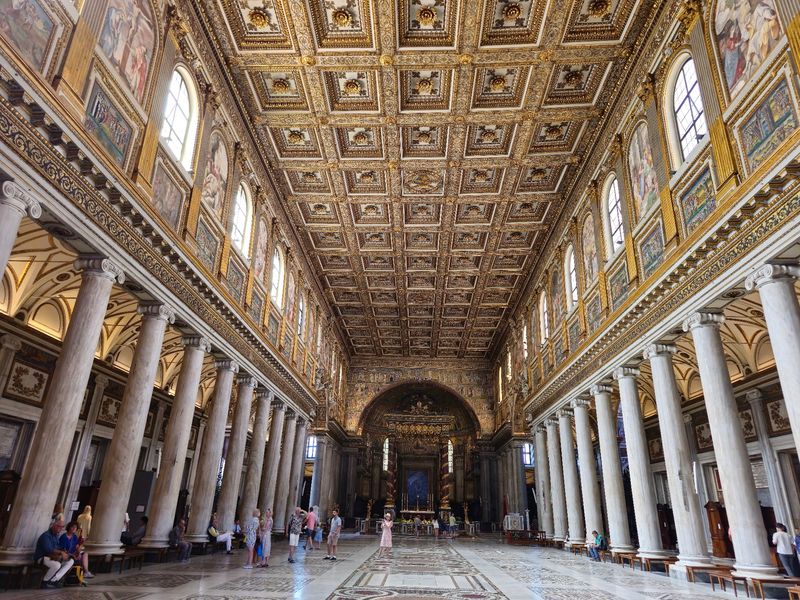
Gold covers the ceiling of Santa Maria Maggiore, and not just any gold. According to tradition, the gilding was made using the first gold brought back from the Americas by Christopher Columbus, a gift from the Spanish monarchs Ferdinand and Isabella to Pope Alexander VI.
Whether the story is entirely accurate or slightly embellished over centuries, the ceiling is undeniably spectacular.
Santa Maria Maggiore traces its origins to the fifth century, making it one of Rome’s oldest surviving churches. Its broad early Christian basilica plan, with a long central nave flanked by columns, has remained largely intact beneath the medieval, Renaissance, and Baroque additions layered on top across 1,600 years.
The mosaics lining the nave walls and the triumphal arch date from the original fifth-century construction and are among the oldest surviving Christian mosaics in Rome.
The basilica is one of Rome’s four major papal basilicas, alongside St. Peter’s, St. John Lateran, and St. Paul Outside the Walls. Each of the four holds special significance in Catholic tradition, and Santa Maria Maggiore is particularly associated with Marian devotion.
Its Borghese and Sistine chapels, built during the late 16th and early 17th centuries, are lavishly decorated with colored marble, frescoes, and sculptural programs that rival any chapel in the city. The building never stopped being used or improved.
Share this story