Europe is home to some of the most breathtaking castles ever built, and each one tells a story that stretches back hundreds of years. From rocky hilltops in Scotland to island fortresses in Lithuania, these stone giants have survived wars, royal dramas, and centuries of weather.
Some were built to intimidate enemies, others to show off royal wealth, and a few were constructed simply because a king had a big dream and an even bigger budget. Whatever their origin, these 15 castles are the kind of places that make history feel alive and real.
Neuschwanstein Castle, Bavaria, Germany
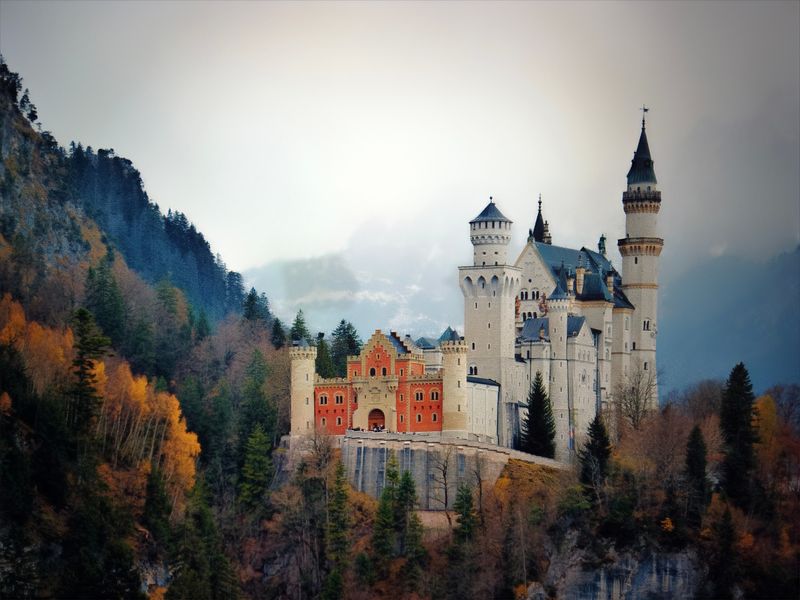
King Ludwig II of Bavaria did not build Neuschwanstein to defend anything. He built it because he wanted a world that matched his imagination, and he had the royal budget to make it happen.
Construction began in 1869, inspired by medieval legends, Wagnerian opera, and Ludwig’s deep love of romantic architecture. The palace sits above the Pöllat Gorge with the Bavarian Alps rising dramatically behind it.
Inside, richly decorated halls reference knights, mythology, and poetry in ways that feel more theatrical stage set than royal home.
In 2025, UNESCO added Neuschwanstein to its World Heritage List, recognizing it as an extraordinary 19th-century “total work of art” that blends architecture, craftsmanship, and theatrical design into one spectacular whole.
The most famous view comes from the Marienbrücke bridge, where the entire castle appears framed against the mountains. Standing beneath the towers with the forest below and the Alps above, it becomes clear that Ludwig was not building a castle.
He was building a dream, and somehow it worked.
Edinburgh Castle, Scotland
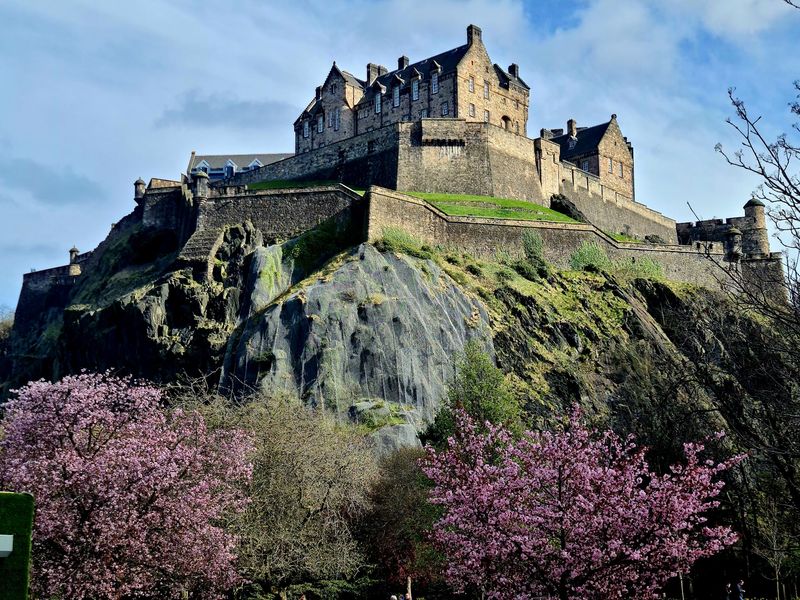
Few buildings on Earth have the nerve to dominate an entire capital city, but Edinburgh Castle pulls it off without breaking a sweat. The fortress sits on Castle Rock, an ancient volcanic formation that shoots straight up above the medieval streets below.
People have been fortifying this rock for thousands of years, and it is easy to understand why. The position gives whoever holds it a commanding view over everything for miles around.
Edinburgh Castle’s official history describes it as one of Europe’s oldest fortified places and the most besieged site in Britain, having survived countless attacks across the centuries.
Inside, visitors find the Honours of Scotland, regarded as Britain’s oldest crown jewels, along with centuries of royal and military history packed into a surprisingly compact space. The Great Hall, St Margaret’s Chapel, and the Scottish National War Memorial all sit within the same walls.
Walk uphill through the cobblestone Old Town and the castle grows larger with every step until the walls seem to swallow the skyline. Then enter, reach the battlements, and the whole city spreads out below like a reward for the climb.
Pena Palace, Sintra, Portugal
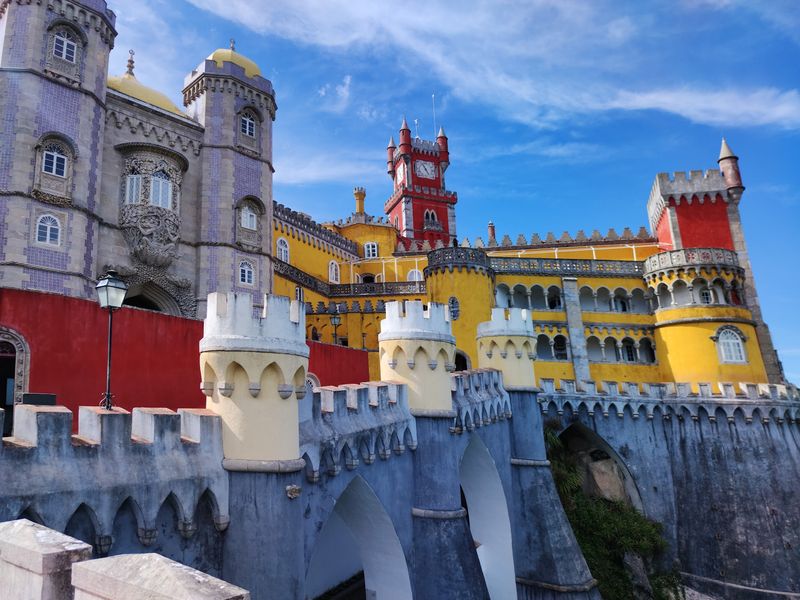
Pena Palace looks like someone took five different architectural styles, threw them at a hilltop, and somehow ended up with something brilliant. The colors alone, vivid red, yellow, and terracotta, make it instantly recognizable from the valleys below Sintra.
King Ferdinand II purchased the ruined remains of a 16th-century monastery in 1838 and transformed the site into a royal retreat that combined Moorish arches, Manueline stonework, Gothic towers, and Renaissance terraces into one deliberately eclectic whole. Even the surrounding park was part of the design, with winding forest paths, exotic plants, hidden pavilions, and surprise viewpoints spread across roughly 85 hectares.
UNESCO recognized the palace as part of Sintra’s Cultural Landscape in 1995, acknowledging the way the entire hill, buildings and gardens together, functions as a single artistic statement.
The geography adds something no architect could plan. Sintra sits close to the Atlantic, where mist rolls in from the coast and wraps around the hilltop without warning.
On sunny days Pena looks theatrical. On foggy mornings it looks genuinely mysterious, which might actually be the better version.
Prague Castle, Prague, Czechia
Calling Prague Castle a castle is a bit like calling the Vatican a church. Technically accurate, completely inadequate.
The complex covers roughly 45 hectares and contains palaces, churches, gardens, courtyards, defensive walls, and enough history to fill a library.
Founded in the ninth century, Prague Castle grew continuously for over a thousand years as Bohemian kings, Holy Roman emperors, and later Czech presidents added their own chapters to the story. The architectural variety is staggering.
Romanesque chapels sit alongside Gothic cathedrals, Renaissance halls, and Baroque palaces, all compressed into one enormous hilltop compound.
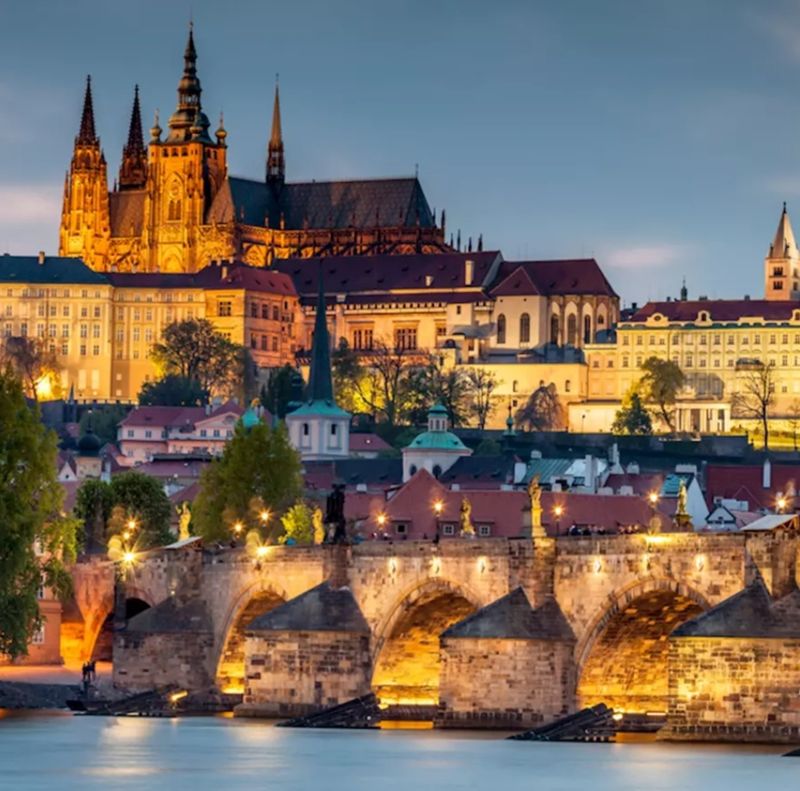
St. Vitus Cathedral provides the visual anchor, its Gothic spires visible from almost anywhere in the city. Inside the Old Royal Palace, Vladislav Hall’s soaring late-Gothic vaulting once hosted coronations, tournaments, and state ceremonies.
UNESCO includes the castle within Prague’s World Heritage-listed historic center.
The best moment arrives after leaving. Walk downhill toward the Malá Strana neighborhood and turn around.
Only from a distance does the full scale of the complex become obvious, stretched wide across the ridge above a city of copper rooftops and baroque domes.
Chateau de Chambord, Loire Valley, France
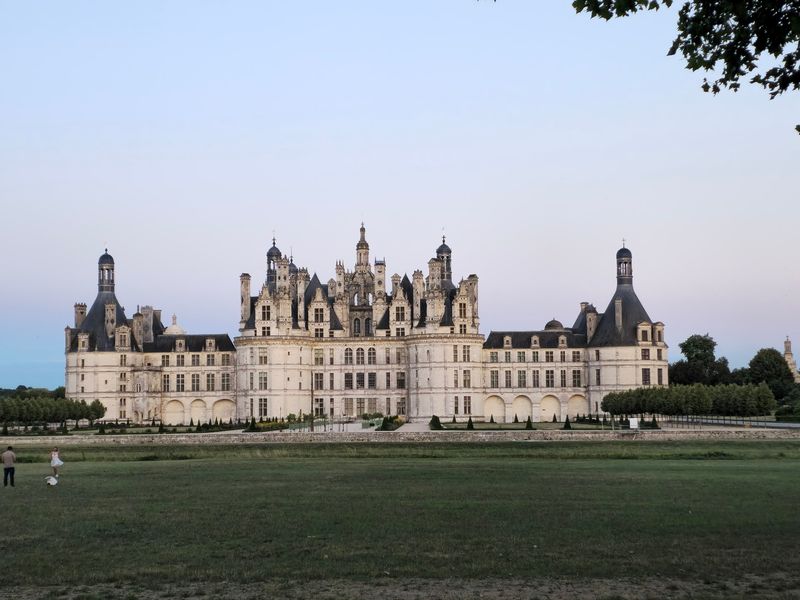
Chambord is what happens when a Renaissance king decides that restraint is for other people. King Francois I ordered construction in 1519, and the result is one of the largest and most architecturally eccentric royal buildings in France.
The numbers alone are impressive. The chateau contains 440 rooms, 365 fireplaces, and 84 staircases.
But the most famous feature is not a number. At the heart of the building sits a double-helix staircase, where two spiral staircases wind around the same central core so that two people can use them simultaneously without ever meeting.
The design has long been associated with Leonardo da Vinci’s influence, though the precise authorship remains a matter of debate.
Walk up to the rooftop terraces and an entirely different architectural world appears. Chimneys, lanterns, dormers, stair turrets, and decorative stonework create a skyline so elaborate it looks almost like a second building sitting on top of the first.
Chambord was never meant to be cozy or intimate. It was built to overwhelm visiting rulers and ambassadors with the sheer scale of French royal ambition.
On that particular goal, it has not aged a day.
Alcazar of Segovia, Spain
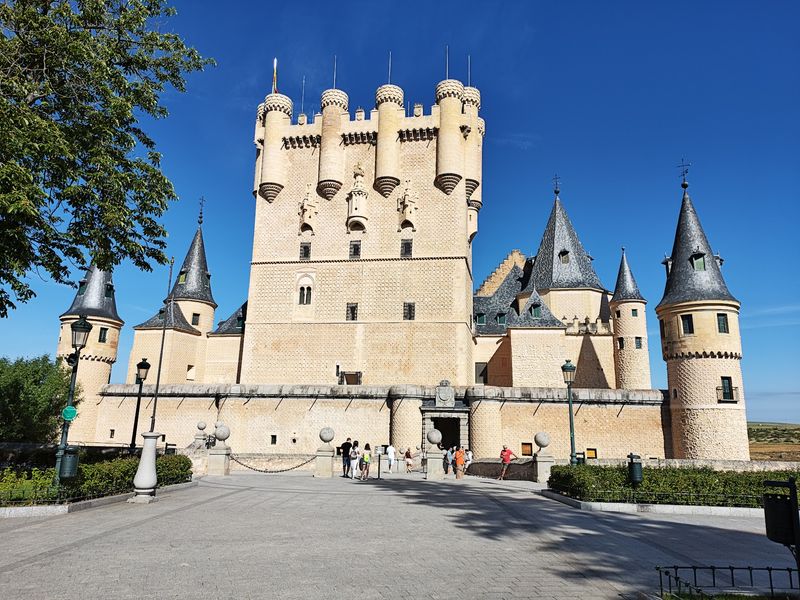
The Alcazar of Segovia has one of the most enviable real estate positions in medieval Europe. It rises from a narrow rocky ridge where the Eresma and Clamores rivers meet, giving whoever held it a commanding view over the surrounding Castilian plains in every direction.
The castle served at different times as a royal residence, military fortress, state prison, and royal artillery college. Its dramatic exterior, with pointed towers, steep slate roofs, and stone battlements, developed largely during the reigns of John II and Henry IV in the 15th century.
The silhouette is so striking that some historians believe it partly inspired the design of Cinderella’s castle at Disneyland.
Inside, the rooms tell a more serious story through ceremonial halls, carved wooden ceilings, suits of armor, royal portraits, and views that remind visitors exactly why rulers valued this ridge so highly.
Segovia itself multiplies the experience. The city also contains one of the best-preserved Roman aqueducts in the world and a well-kept medieval center.
Arriving by train from Madrid and walking uphill through the aqueduct’s shadow toward the castle gives the day a natural dramatic arc that is hard to beat.
Eltz Castle, Germany
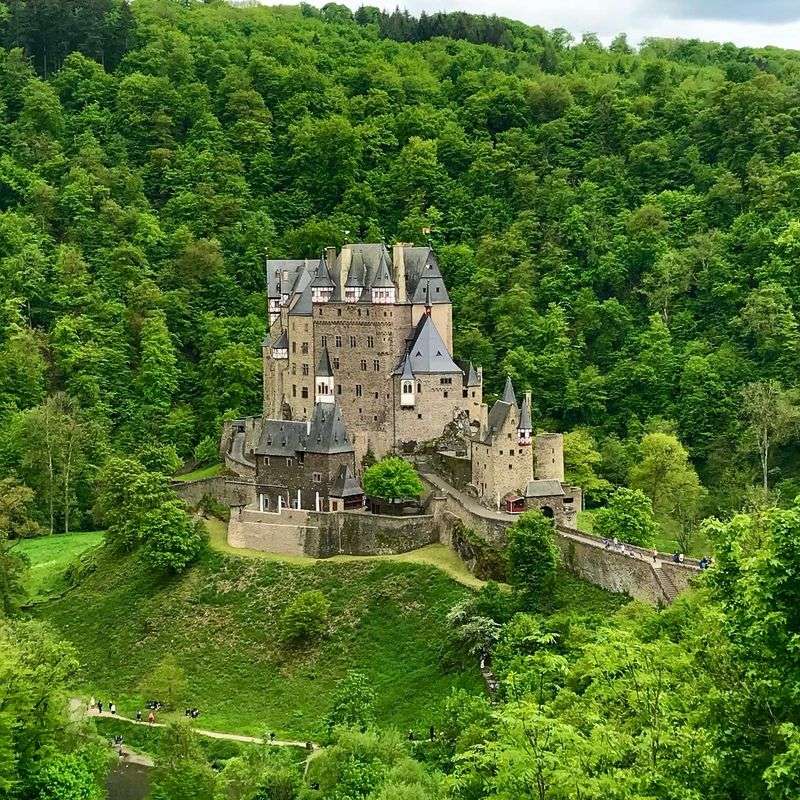
Eltz Castle appears around a bend in a forested valley like something from a storybook, except that it has been standing here since the 12th century and has never once been destroyed. That last detail is remarkable given how many German castles were demolished, burned, or blown up over the centuries.
The castle’s documented history begins in 1157, and what makes Eltz genuinely unusual is that different branches of the Eltz family shared the building for generations, each adding their own tower or wing upward as space on the rock ran out. The result is a cluster of towers and half-timbered upper floors that look almost organically grown rather than planned.
Because the castle was never destroyed, the interiors contain authentic historic furnishings, weapons, silverware, artwork, and family objects rather than modern reconstructions of what medieval life might have looked like. The treasury holds an impressive collection of medieval artifacts.
The approach matters here. You walk through forest rather than through a town, and the castle appears almost suddenly above the trees with the Eltzbach stream curving below.
Visiting Eltz feels less like touring a monument and more like stumbling across one.
Hohenzollern Castle, Germany
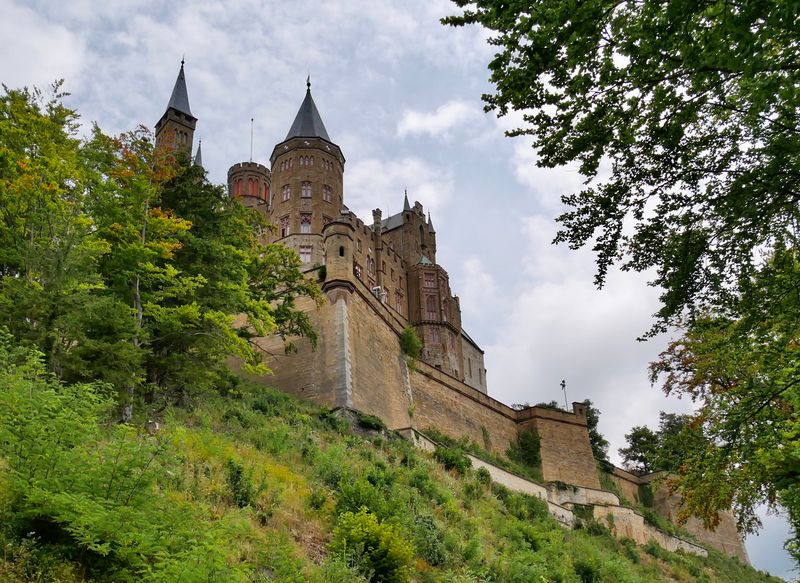
On clear mornings, Hohenzollern Castle appears to float above the Swabian countryside, its towers and battlements emerging from the treeline of Mount Hohenzollern like a vision someone forgot to finish dreaming. On cloudy days, the mountain base disappears entirely and the castle genuinely seems suspended in the sky.
The current building is actually the third major structure on this site. After earlier fortifications declined, Prussian King Friedrich Wilhelm IV ordered the ancestral seat of the Hohenzollern dynasty rebuilt from scratch.
Construction of the present neo-Gothic complex began in 1850, and it was inaugurated in 1867. The king reportedly described the project as a childhood dream fulfilled.
That personal motivation explains why the result feels both romanticized and deeply intentional. Ramparts, towers, chapels, royal apartments, and a treasury full of dynastic artifacts create an idealized version of medieval grandeur rather than a purely functional fortress.
The Hohenzollern family produced Prussian kings and German emperors, so the historical weight behind the theatrical setting is genuinely substantial.
Visiting on a misty morning is strongly recommended. The effect of the castle emerging gradually from the cloud cover as you climb is one of the better theatrical moments Germany’s castle circuit has to offer.
Trakai Island Castle, Lithuania
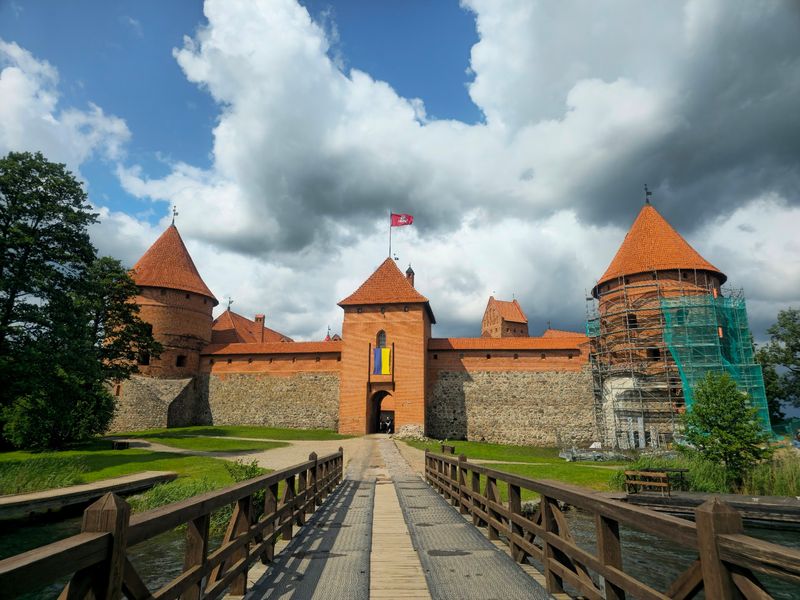
Trakai Island Castle might have the most photogenic setting of any fortress in Northern Europe. The red-brick Gothic complex sits on an island in Lake Galve, surrounded entirely by water, forest, and smaller islands.
There are no roads to it. You cross a wooden footbridge or arrive by boat.
Construction began in the second half of the 14th century and was largely completed under Grand Duke Vytautas in the early 15th century. The castle served as both a military fortress and a grand-ducal residence, and it was never captured during its primary period of active defense.
After the Teutonic Order’s defeat at the Battle of Grunwald in 1410, Trakai’s military importance faded and it became more of a ceremonial palace.
Centuries of neglect left much of the complex in ruins. A major restoration project eventually returned it to an appearance inspired by its 15th-century form, complete with brick towers, ducal palace rooms, and courtyard exhibitions.
Winter transforms the experience completely. When snow covers the rooftops and the lake freezes solid, Trakai looks even more surreal than it does in summer.
The silence on a cold January morning, broken only by wind across the ice, is something most visitors remember for years.
Bojnice Castle, Slovakia
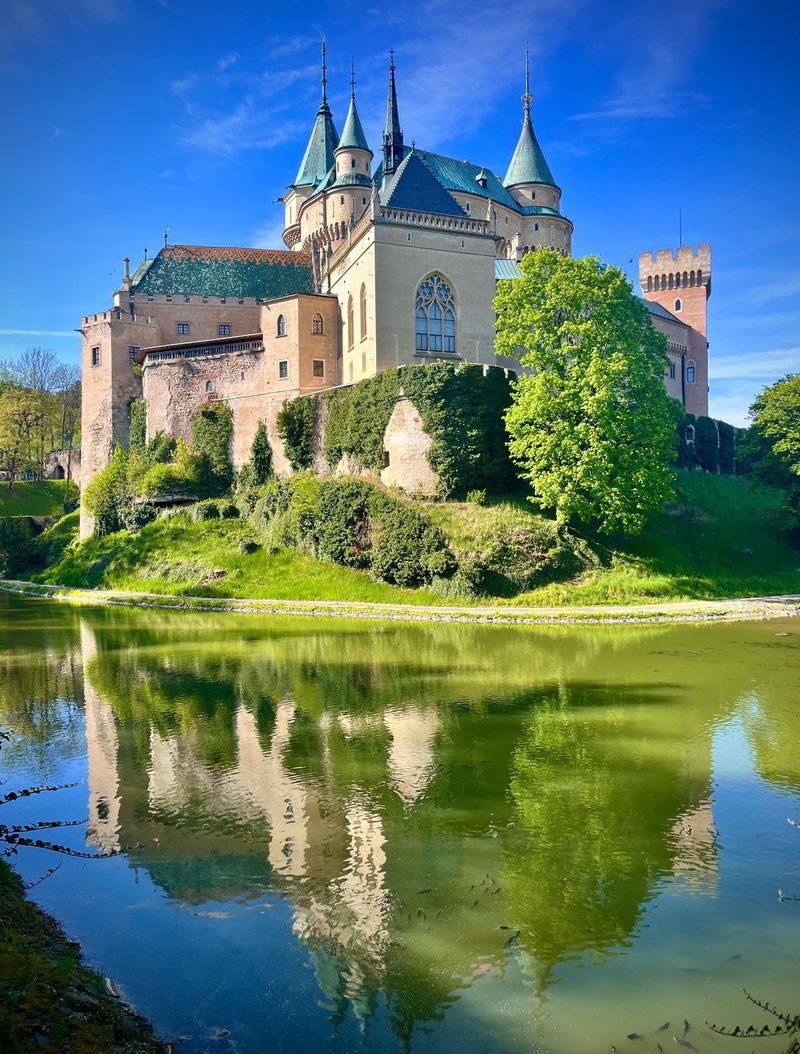
Slovakia’s most visited castle looks like it was designed specifically to appear in a fairy tale, which is either a coincidence or the entire point. Bojnice’s pale towers, steep roofs, and wooded parkland create exactly the kind of silhouette that makes visitors reach for a camera before they have even parked.
The site has a long history that predates its romantic appearance by centuries. Slovakia’s official tourism authority traces a medieval castle here to the 11th century, with powerful Hungarian noble families controlling the estate over the years.
The romantic exterior that visitors see today dates largely from a sweeping late-19th-century reconstruction commissioned by Count Jan Palfi, who was inspired by the chateaux of France’s Loire Valley.
Palfi was also a serious collector, and the interiors reflect that. The rooms contain historic furnishings and artworks, including the celebrated Bojnice altarpiece associated with the 14th-century Florentine painter Nardo di Cione.
There is also a natural cave beneath the castle complex, which adds an unexpected underground dimension to the visit.
Bojnice holds an annual International Festival of Ghosts and Spirits each spring, which may be the most cheerfully committed castle event in Central Europe. Even without the costumes, the atmosphere is hard to resist.
Conwy Castle, Wales
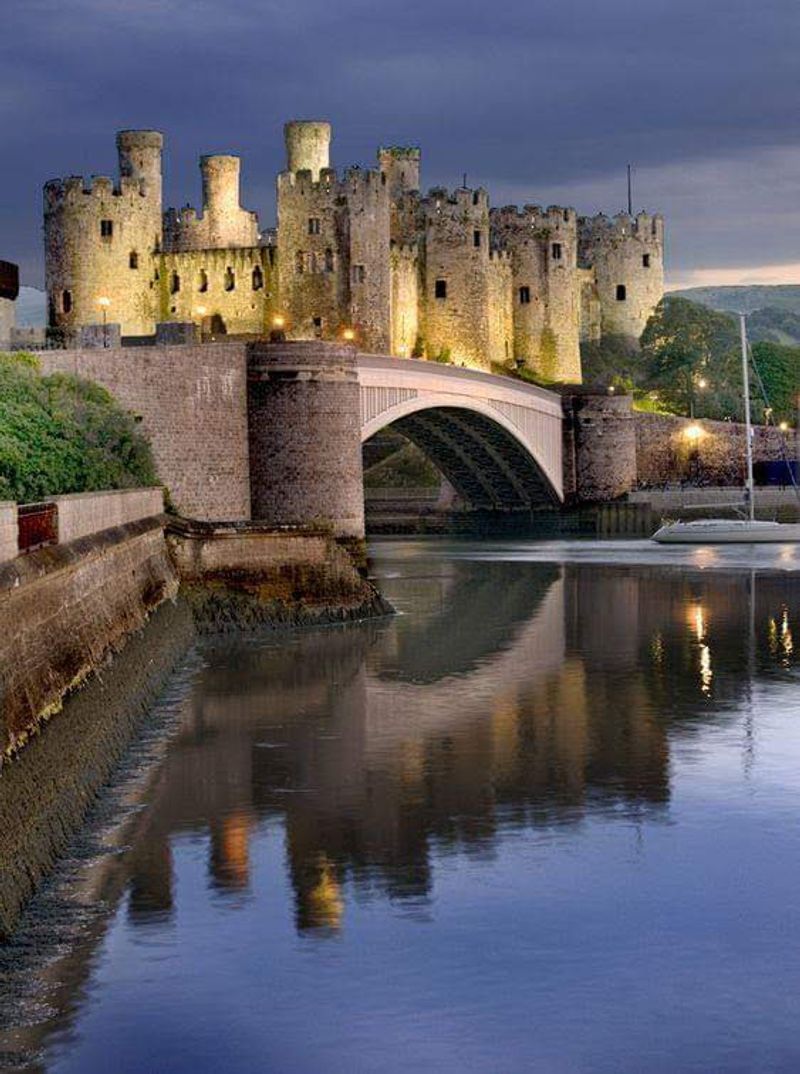
Conwy Castle was not built to charm anyone. It was built to control a Welsh river crossing and make very clear who was in charge, and after more than 700 years the walls are still making that point with considerable conviction.
King Edward I ordered its construction during his campaigns in Wales in the late 13th century. UNESCO considers Conwy and the other Edwardian castles of Gwynedd among the finest surviving examples of late-13th- and early-14th-century military architecture anywhere in Europe.
The fortress remains remarkably intact. Eight massive circular towers anchor the stone enclosure beside the River Conwy, and much of the medieval town wall that once surrounded the settlement below still stands.
Climbing the towers and walking the battlements rewards visitors with views across the river, the harbor, Snowdonia’s mountains, and the rooftops of one of Britain’s best-preserved fortified medieval towns.
What makes Conwy particularly satisfying is that the castle was never conceived as a standalone building. It was designed together with the town walls as a single integrated defensive system, and visitors can still read that logic clearly.
Understanding how the whole thing worked together makes Conwy feel less like a museum piece and more like a piece of medieval military strategy you can walk through.
Miramare Castle, Trieste, Italy
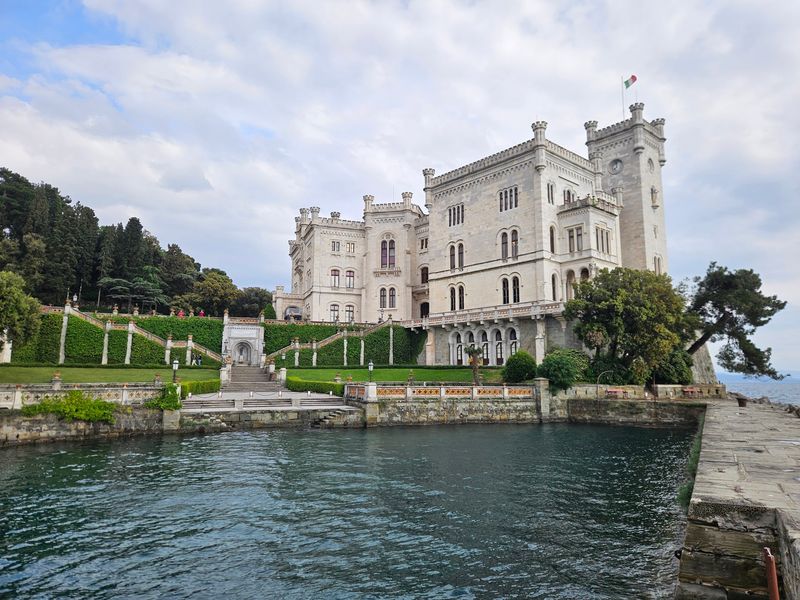
Miramare proves that a castle does not need a mountain or a medieval moat to create an unforgettable impression. This 19th-century white palace sits on a rocky point directly above the Adriatic, with terraced gardens on one side and open sea on the other.
Archduke Maximilian of Habsburg fell in love with the Grignano promontory near Trieste and commissioned the residence in 1856. He and his wife Charlotte of Belgium moved into part of the building in 1860, and the architecture deliberately mixes Gothic, Renaissance, and medieval references in the eclectic style fashionable among 19th-century European royalty.
The interiors were designed around Maximilian’s fascination with the sea, with rooms themed around naval life and maritime exploration.
His story adds a layer of melancholy that the beautiful setting cannot entirely mask. Maximilian left Miramare to become Emperor of Mexico and was executed there in 1867.
The peaceful seaside palace he created as a personal retreat therefore became permanently linked to one of the more tragic royal stories of the 19th century.
Walking the garden terraces above the Adriatic on a calm afternoon, with the Gulf of Trieste spread below, it is easy to understand why Maximilian never wanted to leave in the first place.
Carcassonne Castle and Ramparts, France
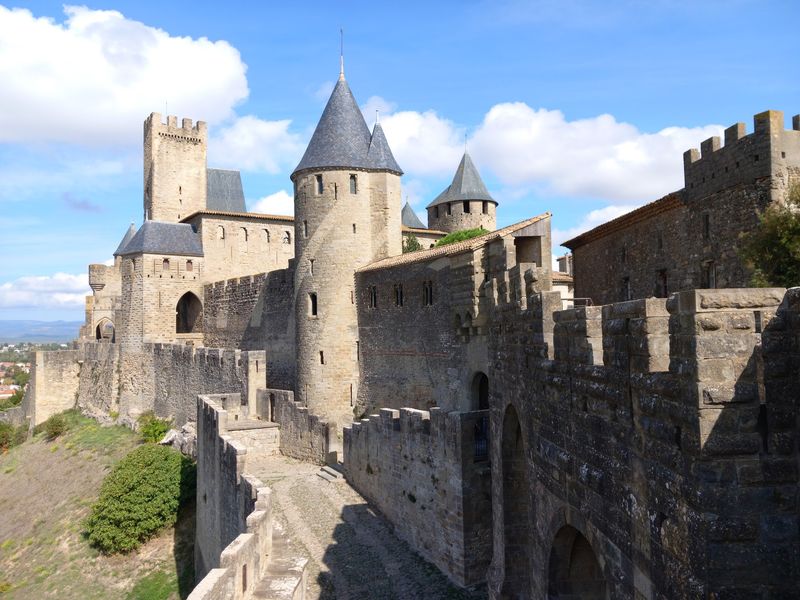
Carcassonne does not give you a castle with some walls around it. It gives you an entire fortified medieval city, complete with streets, churches, a castle at its center, and enough defensive stonework to make any attacking army reconsider its plans.
The Cite de Carcassonne rises above southern France behind double walls studded with towers, accumulated across roughly 2,500 years of military history. Roman foundations, Visigoth construction, medieval fortification, and major 19th-century restoration led by architect Eugene Viollet-le-Duc all contributed layers to what visitors see today.
The Centre des Monuments Nationaux describes the site as representing around 1,000 years of military architecture within that longer span of history.
At the heart of the Cite sits the Chateau Comtal, the castle within the city. Walking the ramparts between the inner and outer walls provides sweeping views over the Pyrenees, surrounding vineyards, and the modern city below.
Carcassonne can feel almost too cinematic, and that is partly because it has appeared in films and television productions. But the real achievement is that the entire defensive system, walls, gates, towers, castle, and settlement, still reads as one coherent structure.
Few places in Europe let you understand medieval military urbanism this clearly and this dramatically.
Sigmaringen Castle, Germany
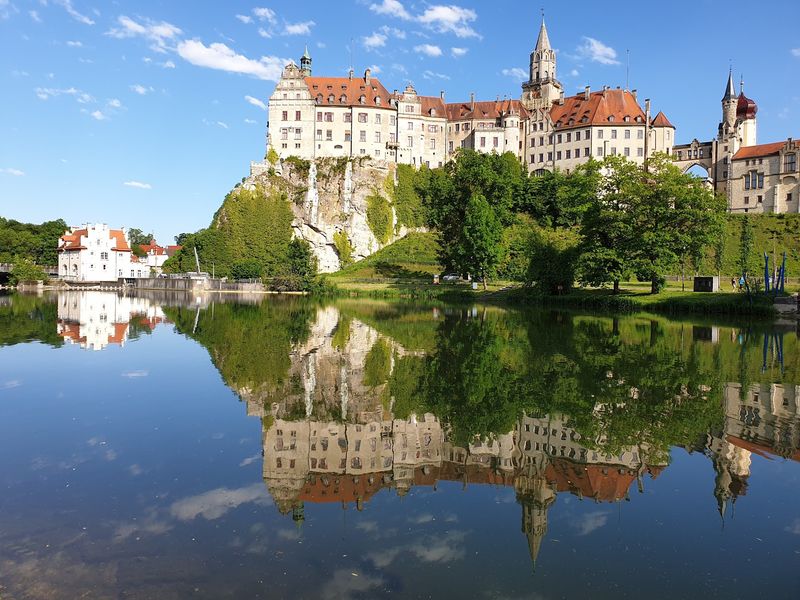
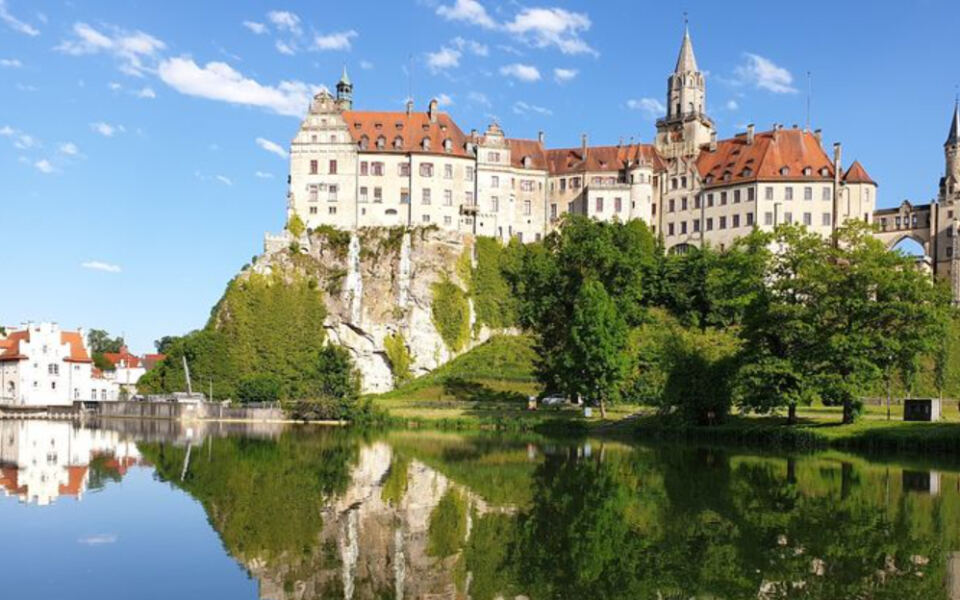
Sigmaringen Castle has a secret that most tourists heading straight to Neuschwanstein never discover: it is one of Germany’s most spectacular riverside fortresses, and it has been accumulating history since the 11th century.
The enormous residence rises directly from a limestone cliff above the Danube, and the first documented mention of a castle on this site dates to 1077. Medieval components trace back to around 1200, and the building grew steadily outward and upward through Renaissance, Baroque, neo-Gothic, and historicist phases as the centuries passed.
The result is a facade that does not look like any single architectural period because it genuinely is not one.
The Hohenzollern-Sigmaringen family has been associated with the site for centuries and still owns the castle today. Visitors can tour historical collections reflecting more than nine centuries of noble heritage, including weapons, armor, artwork, and furniture spread across rooms that span multiple architectural eras.
The cliff setting above the Danube provides the kind of dramatic exterior view that rewards lingering. From the town below, the castle appears to grow directly from the rock itself, towers and turrets stacked upward with no obvious boundary between stone cliff and stone wall.
Sigmaringen is a genuinely spectacular castle that simply gets overlooked because its neighbors are so famous.
Wartburg Castle, Eisenach, Germany
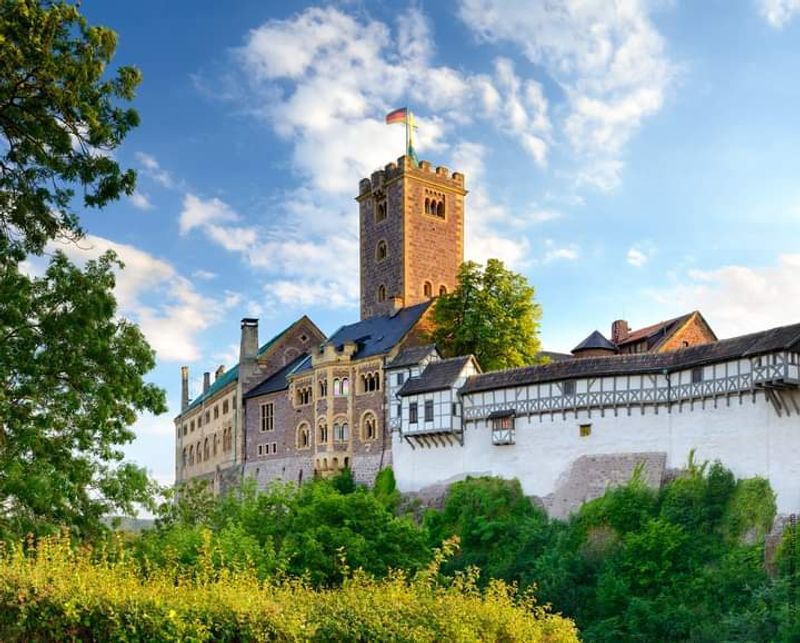
Some castles are famous for how they look. Wartburg is famous for what happened inside its walls, and the list of events is genuinely extraordinary for a single building on a forested German ridge.
UNESCO recognizes Wartburg as a World Heritage Site and describes it as an exceptional monument connected to major developments in European history. The most significant chapter involves Martin Luther, who took refuge here in 1521 after being declared an outlaw following the Diet of Worms.
During his stay, Luther translated the New Testament into German, a project that shaped both the Protestant Reformation and the development of the German written language.
But Luther was not the beginning of Wartburg’s story. The castle had already been associated with medieval landgraves, court culture, and Saint Elizabeth of Hungary centuries earlier.
In the 19th century it became a powerful symbol of German national identity, hosting a famous student gathering in 1817 that called for German unity.
The Romanesque Palas, the oldest surviving section, remains one of the best-preserved examples of secular Romanesque architecture in Germany. Walking through it, and through the room where Luther worked, connects visitors to moments that genuinely changed the course of Western history.
That is not something every castle can honestly claim.
Share this story