Bridges start as solutions to a simple problem: how do you get from one side to the other? But sometimes, the answer turns out to be so stunning that people travel thousands of miles just to see it.
From ancient stone arches draped in history to futuristic steel spirals glowing at night, some bridges are far more than a way to cross a river. These 16 bridges prove that engineering and beauty are not opposites at all.
Golden Gate Bridge, San Francisco, United States
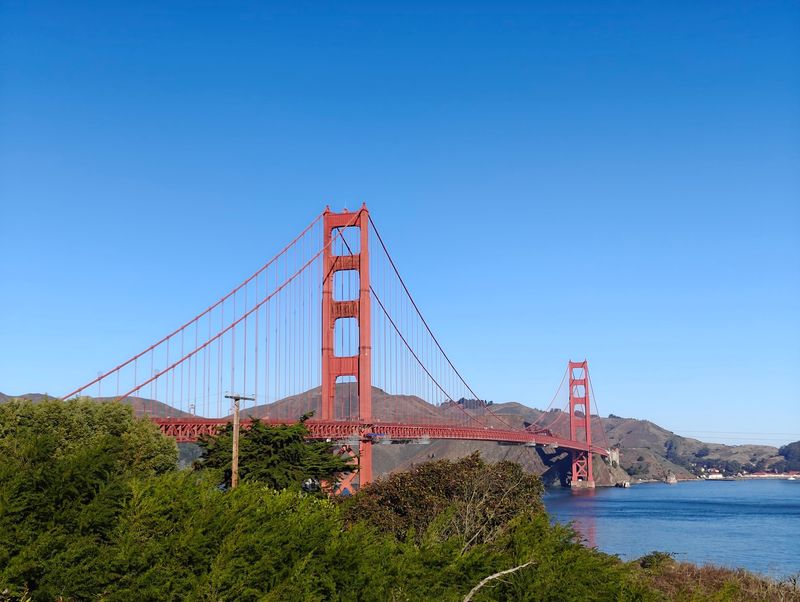
San Francisco got extraordinarily lucky when its most important transportation project also became one of the world’s most recognizable pieces of public art. The Golden Gate Bridge opened in 1937, and its 4,200-foot main span was the longest suspension bridge span on the planet at the time.
Its towers were record-setting too, rising high above the narrow entrance to San Francisco Bay.
The color is not an accident. That warm International Orange shade was chosen specifically to stand out against blue water, green-brown headlands, white fog, and the constantly shifting California light.
Blending in was never the plan.
Fog adds something unexpected. On certain mornings, only the tops of the towers poke above the clouds, making the bridge look like it floats between two worlds.
Pedestrians can walk across it, cyclists have dedicated access, and viewpoints on both the San Francisco and Marin sides offer completely different perspectives. Fort Point makes the towers feel enormous.
Battery Spencer turns the entire bridge into part of the landscape. Few structures in the world reward this much exploring from this many angles.
Tower Bridge, London, England
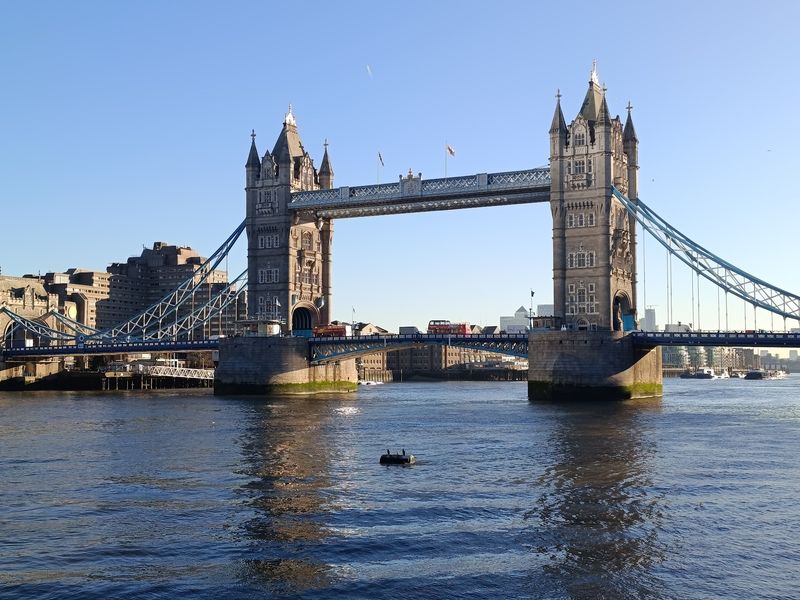
Tower Bridge looks like it was built in the Middle Ages. It was actually completed in 1894, making it a masterpiece of Victorian engineering dressed up in Gothic costume.
Beneath those dramatic stone towers sits a steel skeleton and a pair of enormous movable bascules, designed so tall ships could still reach the busy Pool of London without waiting for low tide.
That combination of theatrical appearance and serious function is exactly what makes it so memorable. Two massive towers rise from the Thames.
Blue suspension elements frame the roadway. High-level walkways connect the towers above passing vessels.
And when large ships need to pass, the roadway still splits open and rises.
The bridge was deliberately designed to complement the nearby Tower of London rather than look purely industrial. Visitors can now walk through the high-level glass-floored galleries and stare straight down at traffic and river water below.
From a Thames boat, the scale becomes genuinely impressive. And when the bascules lift against the London skyline, it delivers a useful reminder that this famous landmark is not just decoration.
It still works, every single time.
Charles Bridge, Prague, Czechia
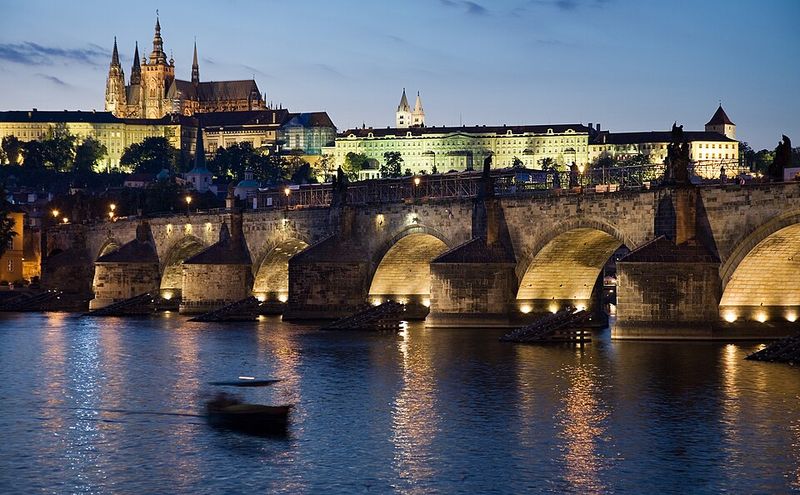
Arrive at Charles Bridge around sunrise and you will understand immediately why photographers set their alarms for 5am. Mist hangs above the Vltava.
Prague Castle looms beyond the river. Thirty baroque statues line the bridge’s edges like silent stone sentinels, and Gothic towers frame both approaches.
It is atmospheric in a way that no filter can fully replicate.
Construction began in 1357 under King Charles IV, replacing an earlier crossing destroyed by flooding. The bridge was completed in the early 15th century and remains Prague’s oldest surviving bridge today.
For centuries it was the only way to cross the Vltava on foot, which explains why so much of the city’s history unfolded right here.
Midday visits are a different experience entirely. The bridge fills with tourists, street musicians, and souvenir vendors, which is lively but not exactly serene.
Come at dusk instead, when gas lamps begin to glow and the statues take on long shadows. Prague City Tourism notes that nighttime gives the bridge an especially atmospheric quality.
That is an understatement worth testing for yourself.
Rialto Bridge, Venice, Italy
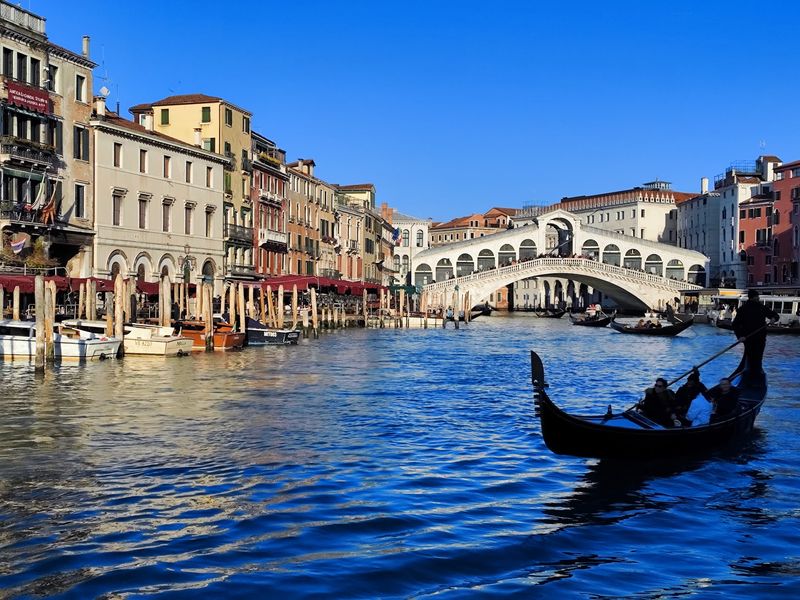
Venice has around 400 bridges, but one of them somehow became the gravitational center of the entire city. The Rialto Bridge spans the Grand Canal in a single broad stone arch, and it has been doing so since construction wrapped up in 1591.
Architect Antonio da Ponte won a design competition that included proposals from Michelangelo and Palladio, which is either impressive or slightly intimidating depending on how you look at it.
The design is genuinely unusual. Two rows of shops climb across the bridge beneath a central arcade, incorporating 24 small businesses into the structure itself.
Thousands of timber piles driven into the lagoon floor support the whole thing. None of that engineering feels heavy when you see it from a gondola or a vaporetto gliding beneath the arch.
From the water, pale stone appears almost weightless above the canal while palazzi, striped mooring poles, and boat traffic fill the frame around it. Cross to the central opening and Venice unfolds in both directions along its most famous waterway.
The Rialto is crowded. It is photographed constantly.
And it remains completely magnificent anyway, which is genuinely hard to pull off.
Sydney Harbour Bridge, Sydney, Australia
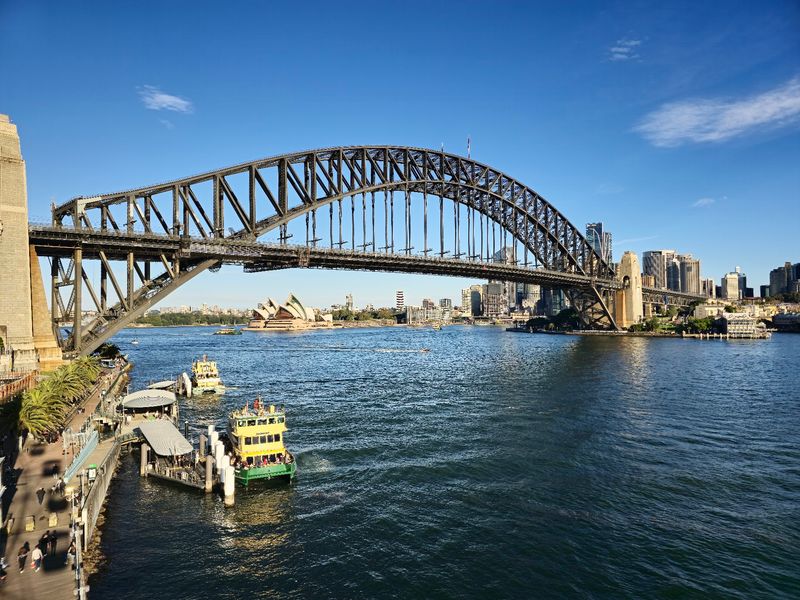
Locals call it the Coathanger. That nickname is technically accurate and perhaps slightly unfair to one of Australia’s most defining landmarks.
Completed in 1932, the Sydney Harbour Bridge uses around 53,000 tonnes of steel and rises 134 meters above the harbor. Its arch spans 503 meters, and the NSW Government identifies it as the tallest steel arch bridge in the world.
What makes it genuinely beautiful is the setting. One side frames the unmistakable sails of the Sydney Opera House.
The other opens toward one of the world’s great natural harbors, full of ferries, sailboats, and sparkling water. The bridge is industrial in character but the surroundings transform it into something spectacular.
Unlike many monumental bridges that you simply admire from a distance, this one practically invites you onto every level. Pedestrians can walk across it.
Cyclists use it. Trains and vehicles pass over it daily.
And BridgeClimb takes adventurous visitors up onto the arch itself, where the views stretch across the Opera House, Circular Quay, harbor islands, and the full city skyline. From up there, Sydney stops looking like a city and starts looking like a postcard that somehow became real.
Stari Most, Mostar, Bosnia and Herzegovina
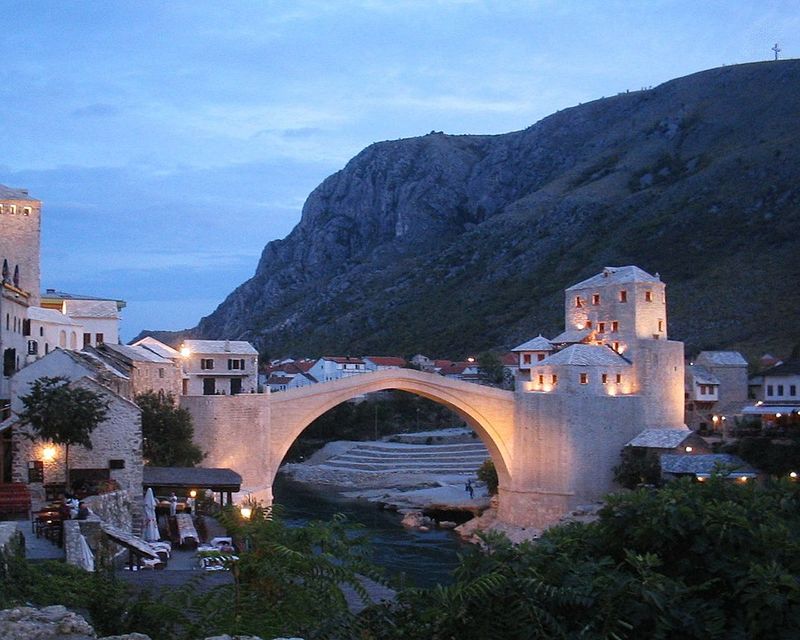
Few bridges in the world carry as much weight as Stari Most, and not just the physical kind. The original bridge was completed in 1566 by Mimar Hajruddin, a pupil of the legendary Ottoman architect Sinan.
One pale stone arch rose sharply above the emerald Neretva River, spanning roughly 27 meters and sitting about 20 meters above the summer waterline. It was extraordinary from the beginning.
Then history intervened. The bridge was destroyed during the conflict in 1993, collapsing into the Neretva in an act that shocked the world.
Its loss became an international symbol of cultural destruction. A UNESCO-supported reconstruction followed, using traditional building methods and stone from the same local quarry connected to the original structure.
The rebuilt bridge opened in 2004, and the entire Old Bridge area was inscribed as a UNESCO World Heritage Site in 2005.
UNESCO now describes Stari Most and Mostar’s restored historic center as symbols of reconciliation and international cooperation. Standing on that single pale arch above the green river today, surrounded by minarets and stone buildings, the beauty is obvious.
But knowing what the bridge survived makes it feel like something far more significant than architecture.
Millau Viaduct, France
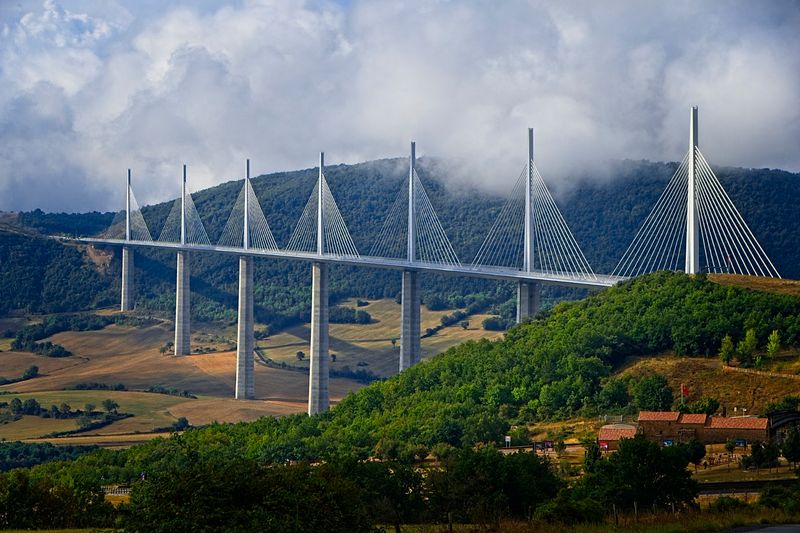
Millau Viaduct has a talent for disappearing. When low cloud settles into the Tarn Valley, the bridge appears to hover above the mist with its seven slender piers hidden below the surface.
That visual trick is partly a result of deliberate design choices made by French engineer Michel Virlogeux and British architect Norman Foster, who wanted something slender rather than massive.
The numbers are genuinely staggering. The cable-stayed bridge stretches 2,460 meters across the valley.
Its roadway sits around 270 meters above the Tarn River. The highest point of the entire structure reaches 343 meters, making it taller than the Eiffel Tower.
It opened in December 2004 after roughly 13 years of study and just three years of actual construction.
What makes Millau remarkable beyond its records is the relationship between the bridge and the landscape. A motorway viaduct could easily dominate and overwhelm the surrounding countryside.
Instead, the thin white deck and delicate mast-and-cable profile complement the valley rather than bulldozing it. Driving across feels surprisingly calm for something so high.
Millau proves that enormous modern infrastructure does not have to choose between efficiency and elegance. It can, against all odds, be both.
Ponte Vecchio, Florence, Italy
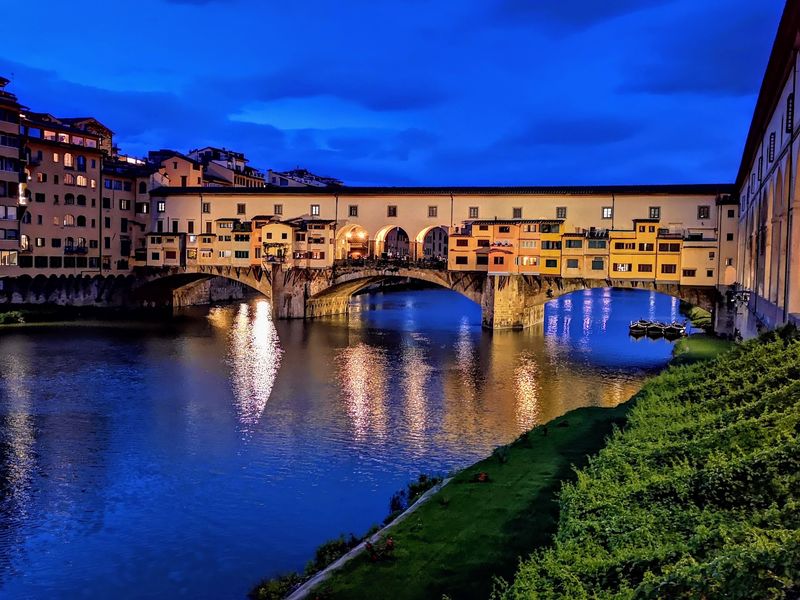
Ponte Vecchio does not look like a bridge. It looks like a street that somehow wandered out over the Arno River and decided to stay.
Irregular buildings in yellow, ochre, and faded orange lean over the water on both sides, their foundations planted directly in the river. From the riverbank, the whole structure appears almost casually stacked together, as if it grew rather than was built.
The current structure dates largely to 1345, rebuilt after a catastrophic flood destroyed the earlier crossing. Shops were incorporated into the design from the start, which is why the bridge still has businesses running across its full length today.
Butchers and fishmongers originally occupied those spaces. In 1593, they were replaced by goldsmiths, beginning a jewelry tradition still visible in the glittering shop windows every morning.
Running above the shops is the Vasari Corridor, built in 1565 so the Medici rulers could move privately between their two main palaces without mixing with the general public. During World War II, retreating German forces destroyed other Florentine bridges but left Ponte Vecchio standing.
At sunset, its reflection shimmers in the Arno below. Few bridges feel more like a living, breathing part of the city around them.
Luis I Bridge, Porto, Portugal
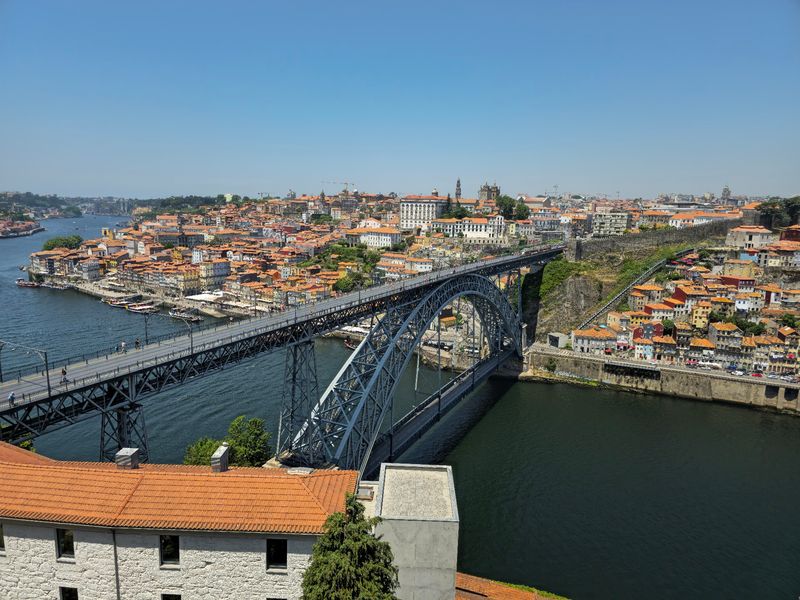
Porto is a city of steep hills, terracotta rooftops, and layers of history stacked one on top of another. Its most famous bridge had to be remarkable just to hold its own against all of that.
Engineer Theophile Seyrig delivered exactly that when the Luis I Bridge opened in 1886, crossing the Douro between Porto and Vila Nova de Gaia on a giant iron arch that was considered one of the great engineering achievements of its era.
The bridge has two separate decks, which makes it unusually versatile. The lower level carries road traffic and pedestrians close to the water.
The upper level is where the real experience happens. Metro trains cross alongside walkers high above the Douro, with Porto’s colorful Ribeira district climbing one riverbank and the famous port-wine lodges of Gaia covering the other.
Walk across around sunset and the scene becomes hard to describe without sounding like a travel brochure. Boats move far below.
Terracotta rooftops spread across the hills in every direction. Church towers rise beyond stacked facades.
The Douro catches the evening light and turns it gold. Visit Porto specifically lists the Luis I Bridge among the city’s essential viewpoints, which raises an interesting point.
Sometimes the best viewpoint is also the thing everyone came to photograph.
Pont Alexandre III, Paris, France
Paris has 37 bridges crossing the Seine. Most of them are elegant.
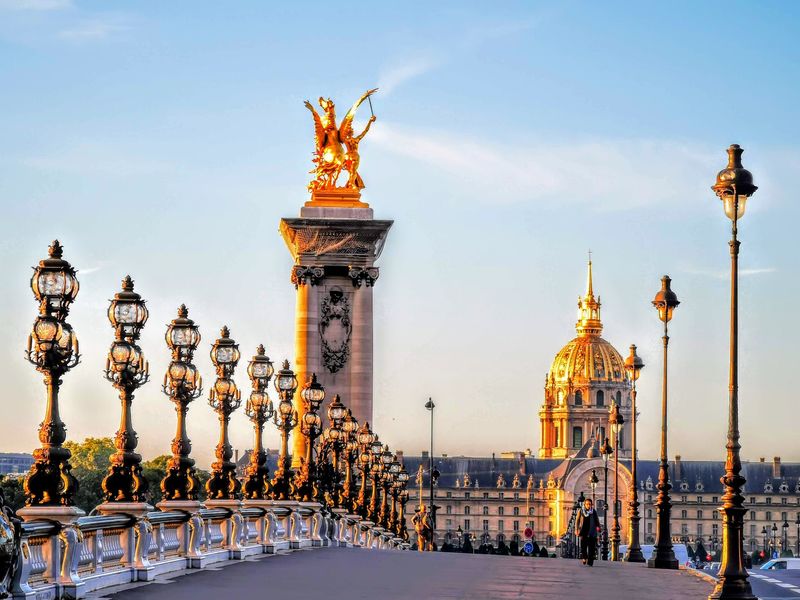
Pont Alexandre III is something else entirely. Opened for the 1900 Universal Exhibition, the bridge connects the Invalides with the Grand Palais and Petit Palais in a single low-slung span decorated with gilded bronze statues, ornate lamps, sculpted cherubs, and more decorative detail per square meter than almost any structure in the city.
Four 17-meter pylons anchor its corners, each topped with gilded winged horses representing arts, sciences, commerce, and industry. Paris tourism counts 22 sculptures and 32 bronze candelabra across the roughly 160-meter span.
The low profile was deliberately designed to preserve views along the river rather than interrupt them, which turns out to be a brilliant decision.
Stand near the center of the bridge and the Eiffel Tower appears downstream. Domes, monumental exhibition halls, riverboats, and classical facades fill the surrounding cityscape in every direction.
The whole composition feels almost staged, like a set designer arranged Paris specifically around this one crossing. Most bridges connect two riverbanks.
Pont Alexandre III manages to connect roughly half the postcard views in the entire city without breaking a sweat.
Forth Bridge, Scotland
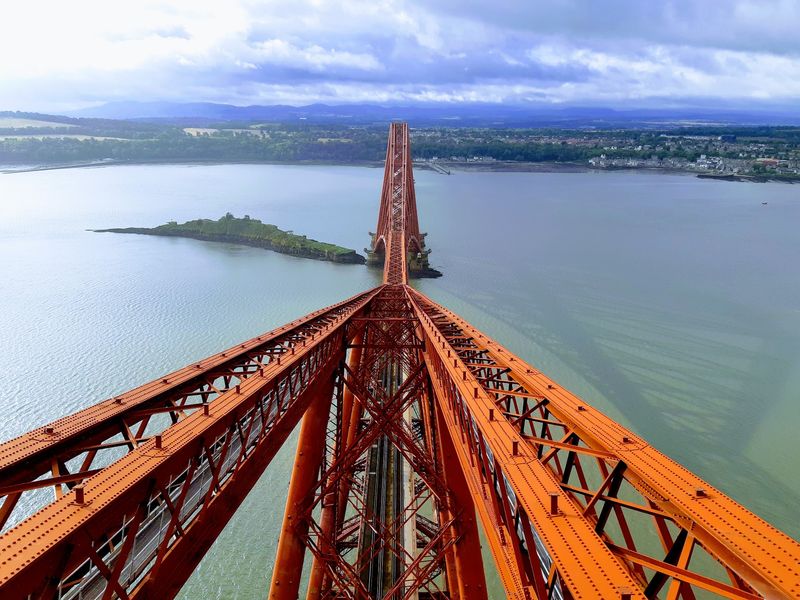
The Forth Bridge hides absolutely nothing. Its structural logic is the architecture, laid out in enormous red steel for anyone to read from miles away.
Three massive double-cantilever towers rise roughly 110 meters above their foundations, connected by suspended spans and creating a repeating geometric rhythm that becomes genuinely hypnotic the longer you stare at it.
The bridge opened in 1890 across Scotland’s Firth of Forth, becoming one of the earliest great multi-span cantilever bridges ever built. Around 54,000 tonnes of steel went into the structure.
Its spans were the longest in the world at completion. UNESCO inscribed it as a World Heritage Site in 2015, describing its exposed structural elements and industrial aesthetic as an extraordinary milestone in bridge engineering history.
What adds something extra to the Forth Bridge’s appeal is the fact that it still carries trains today. More than 135 years after opening, it continues its original purpose without interruption.
This is not a preserved industrial monument sitting behind a fence. It is a working railway bridge that happens to be a UNESCO landmark.
Against the waters of the Forth in low Scottish light, all that massive red steel becomes something surprisingly close to beautiful.
Akashi Kaikyo Bridge, Japan
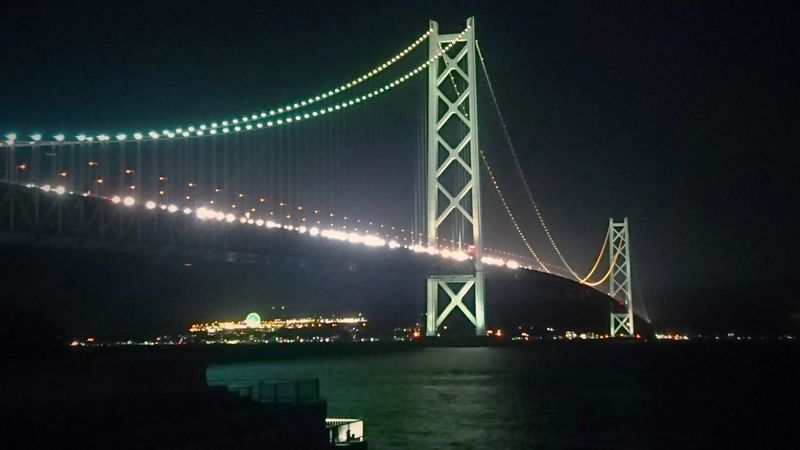
Japan’s nickname for the Akashi Kaikyo Bridge is the Pearl Bridge. After dark, that name makes complete sense.
More than 1,600 lights illuminate the cables and towers in shifting patterns visible across the bay, turning an enormous piece of engineering into something that genuinely earns a poetic nickname. During the day the bridge is impressive.
After dark it becomes spectacular.
The numbers behind it are almost difficult to believe. The bridge stretches 3,911 meters between Kobe and Awaji Island, with a central span of 1,991 meters.
Japan’s tourism authority describes it as one of the world’s largest suspension bridges. It crosses the Akashi Strait, one of the busiest and most storm-prone shipping channels in the region, which explains why the engineering had to be so extreme.
Special Bridge World tours allow visitors to climb roughly 300 meters to the top of one of the towers. From up there, ships on the water below look like toys.
Osaka Bay, the Seto Inland Sea, Kobe, and Awaji Island spread out in every direction. Engineering on this scale could easily have produced something brutally utilitarian.
Japan built something elegant enough to deserve a name borrowed from jewelry.
Kintaikyo Bridge, Iwakuni, Japan
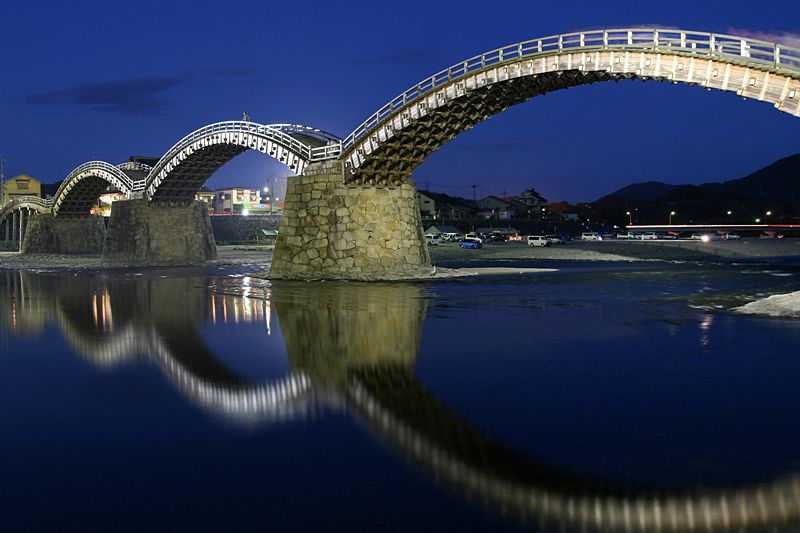
Forget record-breaking spans and towering steel. Kintaikyo Bridge makes its case with pure proportion.
Five extraordinarily graceful wooden arches cross the Nishiki River in Iwakuni, built from cypress, chestnut, zelkova, pine, and oak, supported on stone masonry piers. Japan’s national tourism organization considers it one of the country’s great scenic bridges, and it is not hard to understand why the moment you see it.
The bridge’s beauty shifts dramatically with the seasons, which is part of what makes it so beloved. Cherry blossoms frame the arches in spring, creating a scene that looks almost too composed to be real.
Summer turns the surrounding hills an intense deep green. Autumn brings red and gold foliage.
Winter snow can transform the five dark wooden curves into something delicate and spare against a white riverbank.
Iwakuni Castle sits on the forested hill beyond, completing a composition that has attracted painters and photographers for generations. Japan’s national tourism organization notes that the bridge inspired artists including Hokusai.
Kintaikyo quietly proves something worth remembering in an era of mega-bridges: a crossing does not need to be enormous to become unforgettable. Getting the proportions exactly right can be more than enough.
Juscelino Kubitschek Bridge, Brasilia, Brazil
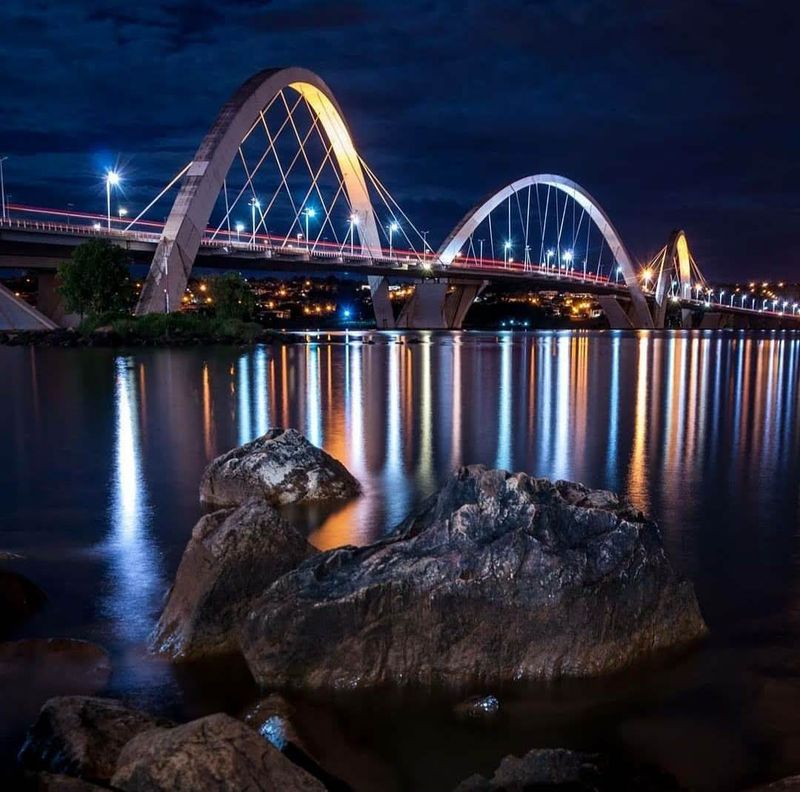
Brasilia was built as a bold experiment in modernist urban planning, inaugurated in 1960 as a brand-new capital city designed from scratch. The Juscelino Kubitschek Bridge fits that tradition perfectly.
Three sweeping asymmetrical steel arches leap repeatedly over the roadway as it crosses Lake Paranoa, creating a design that looks kinetic even when standing completely still.
Brazil’s national tourism authority says architect Alexandre Chan drew inspiration from the image of a stone skipping across water. Once you hear that, the design becomes almost impossible to see any other way.
Three giant loops appear to bounce across the lake surface in sequence, which is a genuinely unusual idea for a bridge and an even more unusual idea that actually worked.
Visit Brasil specifically recommends stopping to take in the bridge and highlights sunset from its walkways as a standout experience. At that hour, the lake catches the sky’s colors and the arches cast long shadows across the water.
Brasilia already feels like a city imagined rather than inherited, full of futurist architecture and grand spatial gestures. This bridge makes that impression even stronger, adding one more piece of evidence that the people who designed this city were not thinking small.
Helix Bridge, Singapore
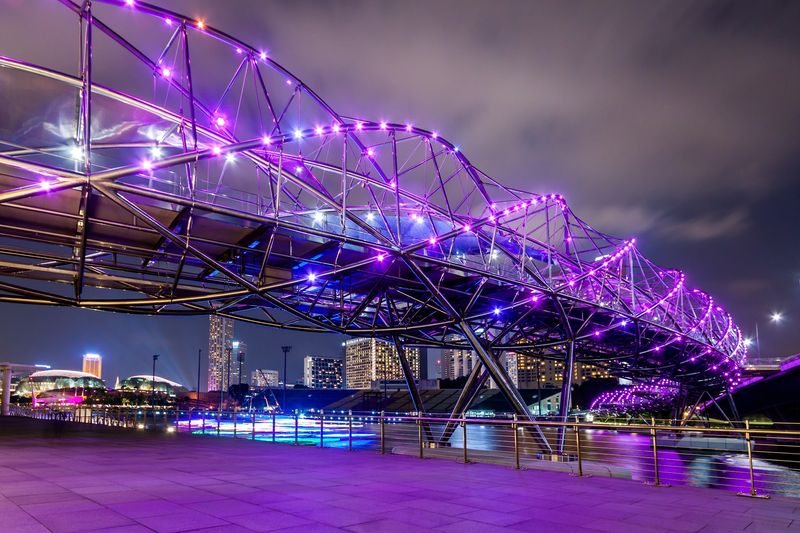
Someone in Singapore looked at Marina Bay and asked what a pedestrian bridge might look like if it was designed to resemble DNA. The answer opened in 2010, and it turns out the answer is genuinely stunning.
The 280-meter Helix Bridge uses spiraling tubular steel forms arranged into a double-helix structure, and Singapore’s National Heritage Board describes it as a world-first design symbolizing life and continuity.
The futuristic appearance suits its surroundings almost suspiciously well. Marina Bay Sands rises nearby.
The ArtScience Museum curves along the waterfront. Gardens by the Bay glows across the basin.
At night, lights integrated into the bridge’s twisting steel structure activate, turning a pedestrian connection into a glowing centerpiece of Singapore’s evening skyline. The effect is somewhere between science fiction and architecture.
The bridge also forms part of a larger continuous waterfront route linking the major Marina Bay attractions, so crossing it is both practical and visually rewarding. Many historic bridges become beautiful because cities grow gracefully around them over centuries.
Helix Bridge represents the opposite approach entirely. The city and the bridge were both designed simultaneously to look like a vision of the future, and somehow they both delivered on that promise.
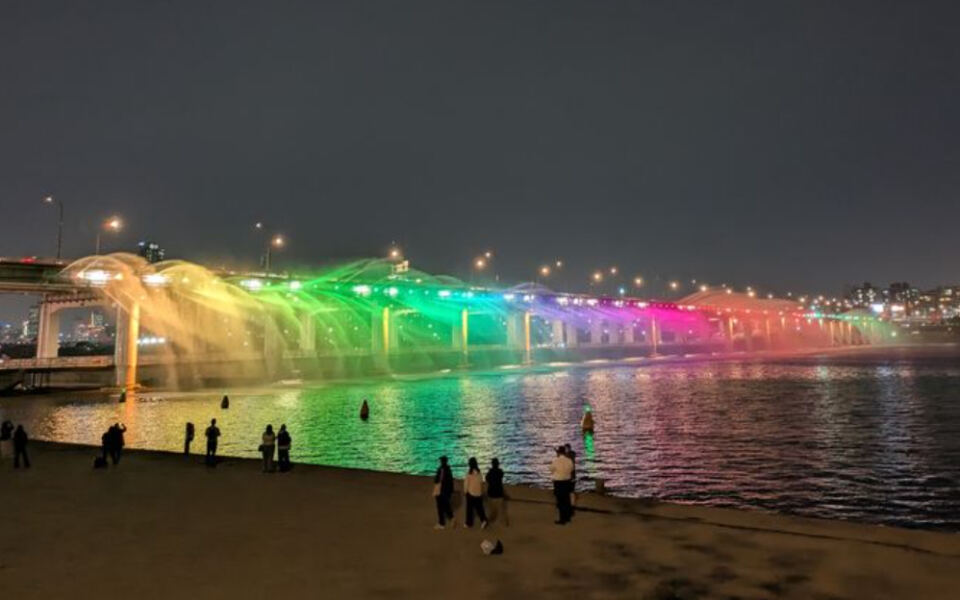
Banpo Bridge, Seoul, South Korea
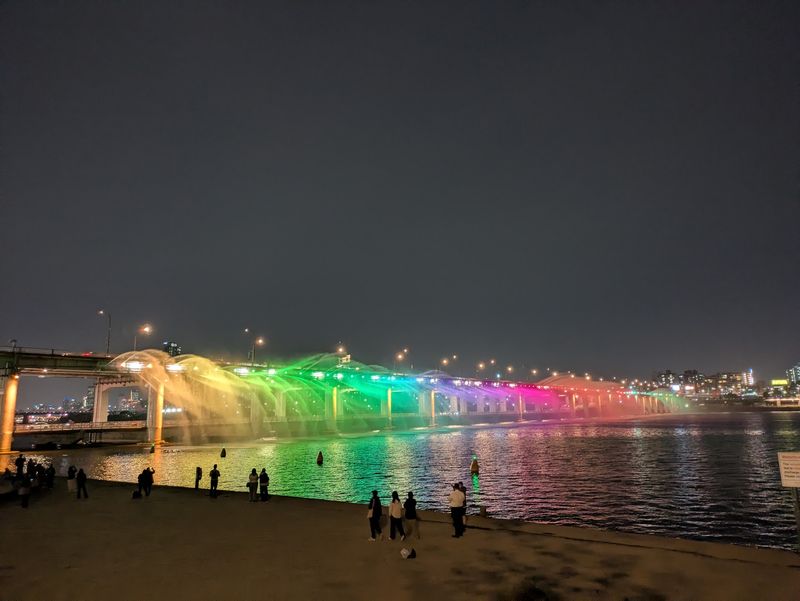
During the day, Banpo Bridge looks like a perfectly ordinary river crossing. Wait until evening and the entire thing transforms into something that belongs in a science fiction film.
Along both sides of the bridge sits the Moonlight Rainbow Fountain, where hundreds of illuminated water jets spray outward toward the Han River while synchronized colors and music turn the structure into an enormous kinetic light installation.
Visit Korea describes the water falling approximately 20 meters toward the river, lit by around 200 lights. The fountain generally runs from April through October, subject to weather conditions.
The scale earned it an official record. Korea’s tourism organization says the installation stretches along a 1,140-meter span and was registered by Guinness World Records as the world’s longest bridge fountain back in 2008.
Banpo Bridge raises an interesting question about what bridge beauty actually means. Stone, steel, and engineering are not the only ingredients.
Sometimes the structure becomes a stage, and the real spectacle is what happens on top of it. At sunset, Seoul’s skyline starts lighting up beyond the Han River.
Then the fountain begins. Suddenly water, color, music, city reflections, and moving light all become part of the bridge itself, and ordinary turns into unforgettable.
Share this story