Somewhere in rural Nebraska, beneath a quiet stretch of prairie sky, lies a place that stopped time twelve million years ago. A catastrophic volcanic eruption, originating nearly a thousand miles away, buried an entire watering hole full of ancient animals in a thick blanket of ash, preserving them so perfectly that scientists can still read the story of their final days.
Rhinos, three-toed horses, camels, and giant tortoises all rest exactly where they fell, their bones articulated, their postures eerily lifelike. This is not a reconstructed exhibit or a dramatized display.
Real paleontologists work here every season, carefully brushing away ash to reveal creatures that have never seen daylight since the Miocene epoch. The site has earned the nickname the Pompeii of prehistoric animals, and that reputation is fully deserved.
Keep reading to discover what makes this corner of Nebraska one of the most astonishing places on the entire planet.
Where Ancient Secrets Sleep Beneath the Prairie Sky
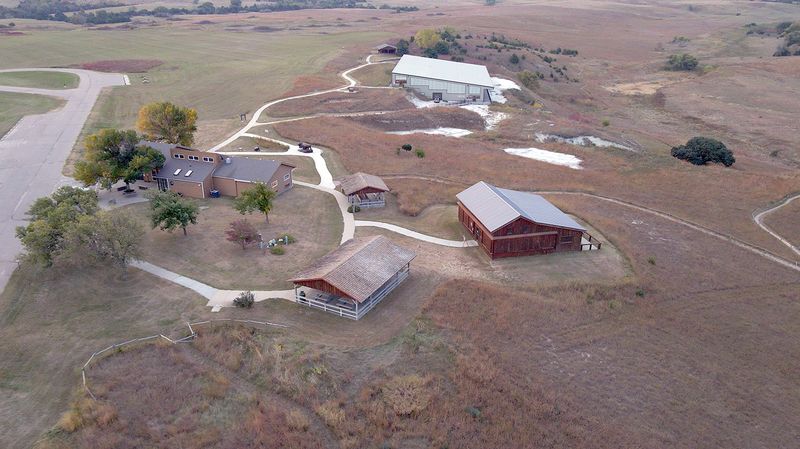
My first glimpse of this place came after a long drive through fields of corn and grazing cattle in Antelope County, Nebraska. Nothing about the surrounding landscape hints at the extraordinary world buried beneath it.
Ashfall Fossil Beds State Historical Park sits at 86930 517th Ave, Royal, Nebraska 68773, and encompasses 360 acres of rolling prairie that doubles as a designated National Natural Landmark.
The park earned that federal distinction because it preserves one of the most complete and scientifically significant fossil deposits ever discovered anywhere on Earth. Its remote location has actually worked in its favor, keeping the experience authentic rather than over-commercialized.
A visit here runs Tuesday through Saturday from 9:30 AM to 4:30 PM, with Sunday hours starting at 12:30 PM, and the park is closed on Mondays. You can reach the staff at 402-893-2000 or explore more details at ashfall.unl.edu before planning your trip.
The quietness of the surrounding landscape makes the discoveries inside feel even more startling.
When Idaho’s Fury Reached Nebraska’s Plains
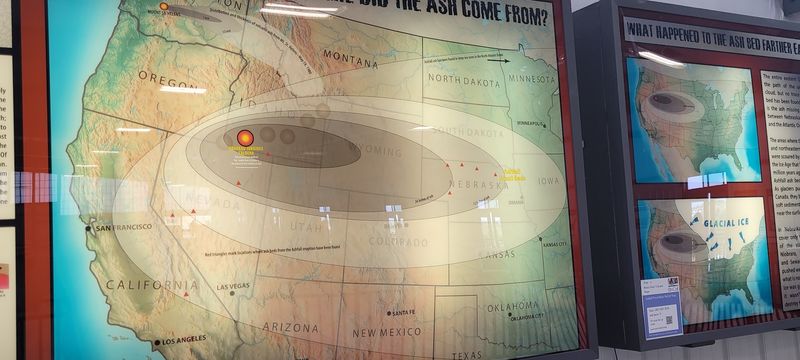
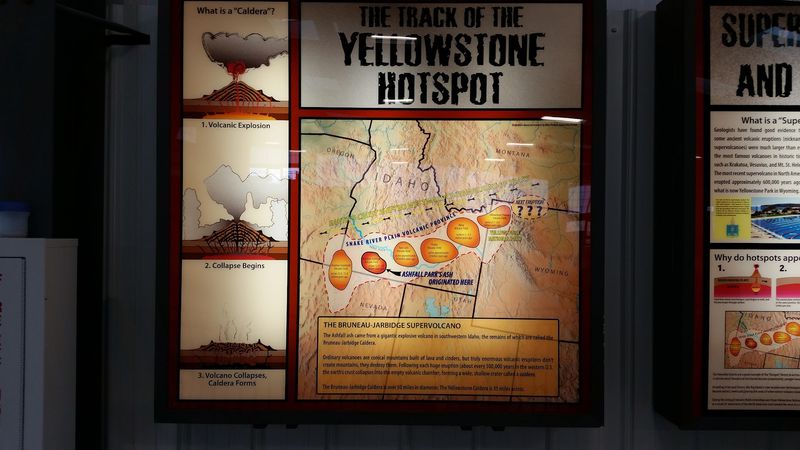
The event that created Ashfall had nothing to do with Nebraska at all. Roughly twelve million years ago, a supervolcano located in what is now Idaho erupted with a force estimated to be a thousand times greater than the 1980 eruption of Mount St. Helens.
That staggering release of energy sent massive quantities of volcanic ash drifting eastward across the continent on prevailing winds.
By the time the ash reached northeastern Nebraska, it was still dense enough to accumulate to depths of eight to ten feet in the natural depression that served as a local watering hole. This geological quirk transformed a widespread regional ashfall into a concentrated burial event of rare precision.
The ash itself was composed of microscopic glass shards, fragments of bubbles that burst during the eruption. Those tiny particles were breathed deeply into the lungs of every animal seeking water at the site.
The same supervolcanic system still fuels the geothermal activity we see at Yellowstone National Park today, which adds a quietly unsettling dimension to the whole story.
The Tragic Allure of an Ancient Oasis
Twelve million years ago, this corner of Nebraska looked nothing like the temperate plains we know today. The landscape was a subtropical savanna, warmer and lusher, something closer to modern Central America than the American Midwest.
Animals gathered at a natural watering hole here, drawn by the promise of hydration in an otherwise dry season.
Evidence for this ancient warmth is preserved in the fossils themselves. Giant tortoise remains confirm temperatures that never dipped to freezing.
Subtropical grass seeds recovered from inside the teeth of fossilized rhinos point to a diet and climate far removed from today’s Nebraska.
That same watering hole, so vital to the animals that depended on it, became their collective tomb. As ash rained down, the creatures kept returning to drink, unknowingly inhaling the glass-laden particles with every breath.
The natural depression collected far more ash than the surrounding landscape, creating the thick burial layer that would preserve these animals with extraordinary completeness for millions of years.
Their reliance on water sealed their fate and, paradoxically, ensured their survival in the fossil record.
A Time Capsule Like No Other: The Preservation Marvel
Most fossil sites yield fragments, scattered pieces that require significant scientific interpretation to reconstruct. Ashfall is different in a way that genuinely stops you in your tracks.
The deposit here is classified as a lagerstatte, a geological term reserved for sites with exceptional, three-dimensional fossil preservation rather than flattened impressions or isolated bones.
Hundreds of complete skeletons have been uncovered here, many still fully articulated, meaning the bones remain connected in their natural order, exactly as they were in life. Some specimens preserve unborn young still inside their mothers.
Others retain evidence of stomach contents, offering direct clues about diet.
The volcanic ash, when combined with groundwater, created an alkaline chemical environment that rapidly mineralized the bones before decay could take hold. Unlike fossils subjected to millions of years of geological compression, these animals maintained their natural three-dimensional form.
That quality of preservation is what sets Ashfall apart from nearly every other fossil site in the world, and it is why paleontologists continue to treat this location as one of the most scientifically valuable deposits ever found.
The Cast of Characters: Meet Ashfall’s Prehistoric Residents
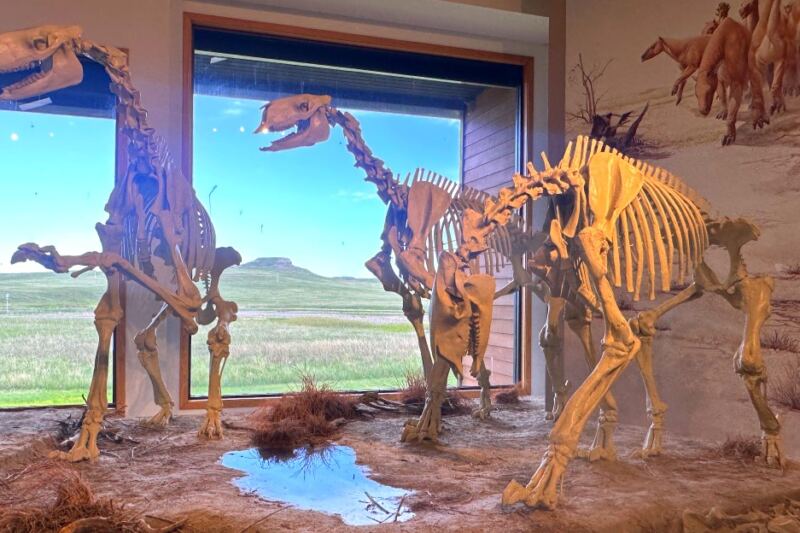
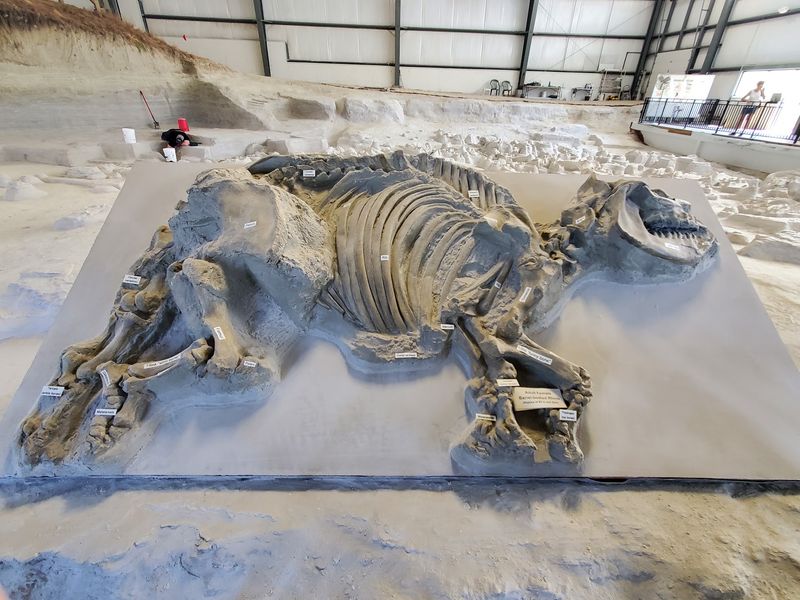
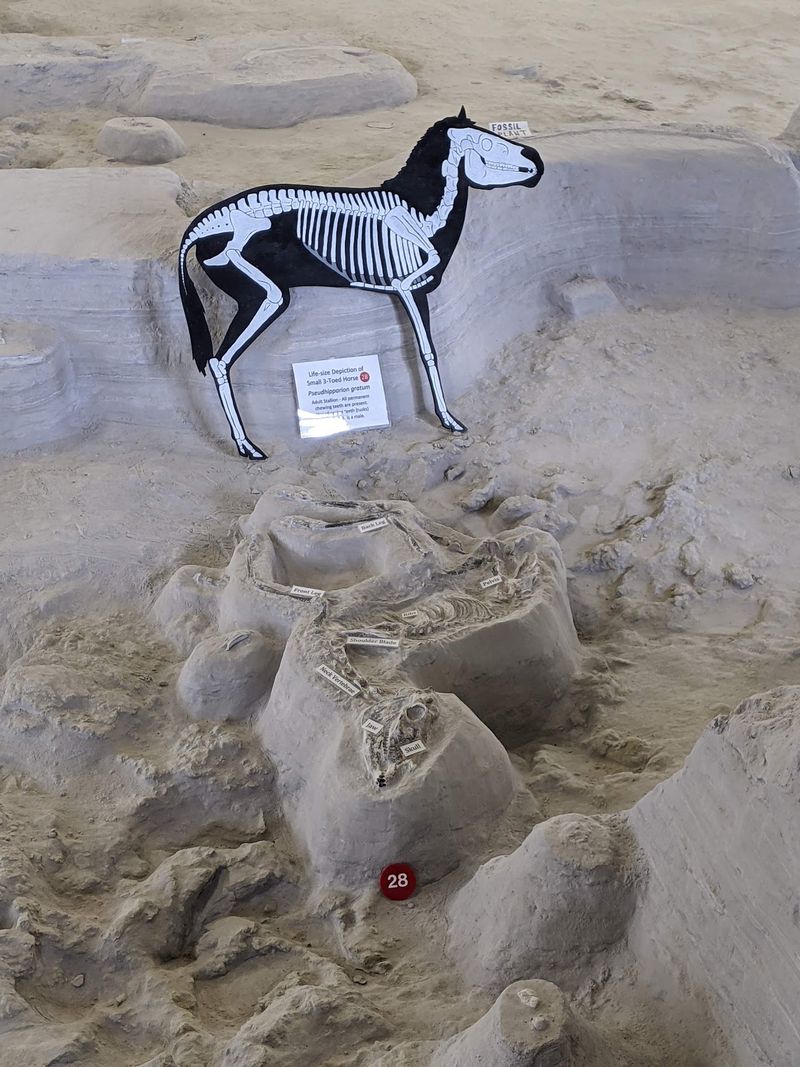
The variety of species unearthed at this single site is remarkable by any paleontological standard. The most abundant resident is Teleoceras major, a barrel-bodied, short-legged rhinoceros that resembled a modern hippopotamus far more than any rhino alive today.
Over a hundred skeletons of this stout creature have been excavated, providing researchers with an unusually rich sample for population studies.
The ancient savanna also hosted multiple species of three-toed and one-toed horses, llama-like camels, giraffe-necked camels, and saber-toothed deer. Forty crane skeletons have been recovered, some with preserved feathers and identifiable gut contents.
Hawks, vultures, and other bird species round out the aerial community.
Giant tortoises roamed the grasslands, confirming the subtropical climate, while lizards and early dog relatives occupied smaller ecological niches. This menagerie, preserved together in a single deposit, functions like a biological census of an entire ancient ecosystem.
Seeing their bones arranged exactly as they fell gives the site an intimacy that no reconstructed museum diorama could ever fully replicate.
The Grim Reaper in a Cloud of Ash: A Unique Demise
The way these animals perished is one of the most forensically detailed stories in the entire fossil record. This was not a sudden, instantaneous end.
The volcanic ash fell gradually, and the animals continued to seek water even as it accumulated, inhaling the microscopic glass shards with every breath until their lungs could no longer function.
Many of the larger mammal bones display patches of rough, frothy bone growth known as hypertrophic osteopathy, a condition linked to severe lung damage and organ disease. This same condition appears in modern animals suffering comparable respiratory ailments, giving scientists a direct clinical bridge between ancient and contemporary biology.
The excavation reveals a layered chronology of the event. Birds and smaller animals, with their more fragile respiratory systems, succumbed first and are found in the lowest ash layers, sometimes with bones broken from being trampled.
Horses and camels followed. The robust rhinos, capable of enduring the longest, are found highest in the deposit.
This sequence lets researchers reconstruct the disaster week by week with chilling accuracy, a narrative written entirely in bone.
The Hubbard Rhino Barn: Where the Past Comes Alive
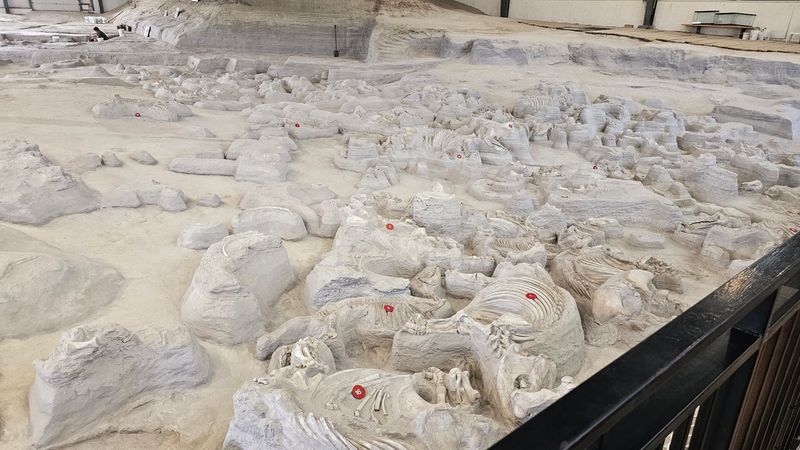
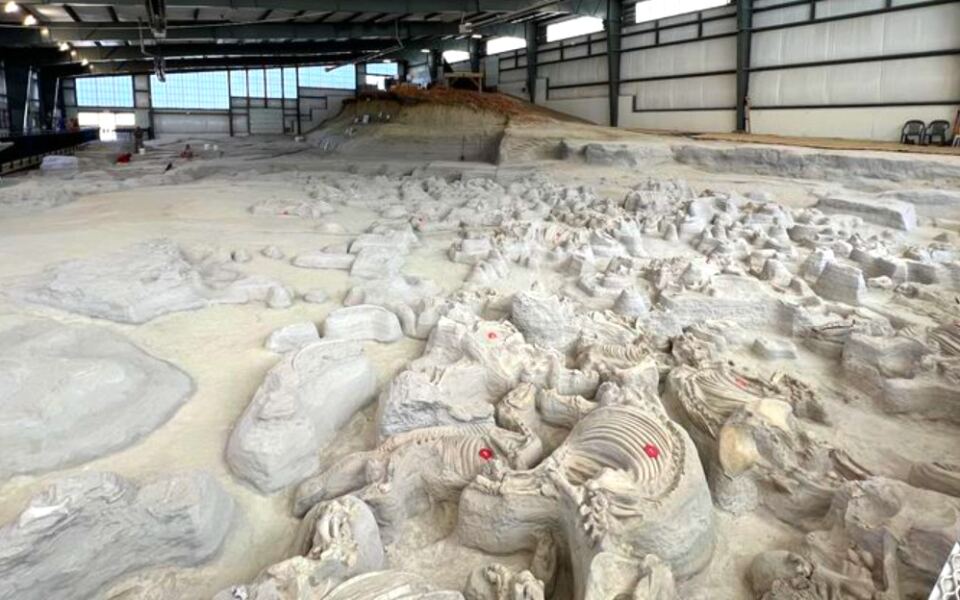
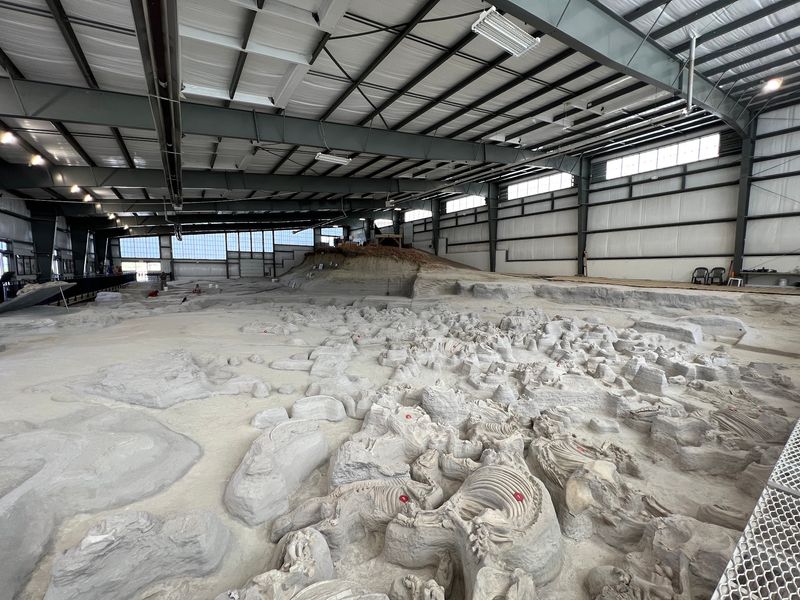
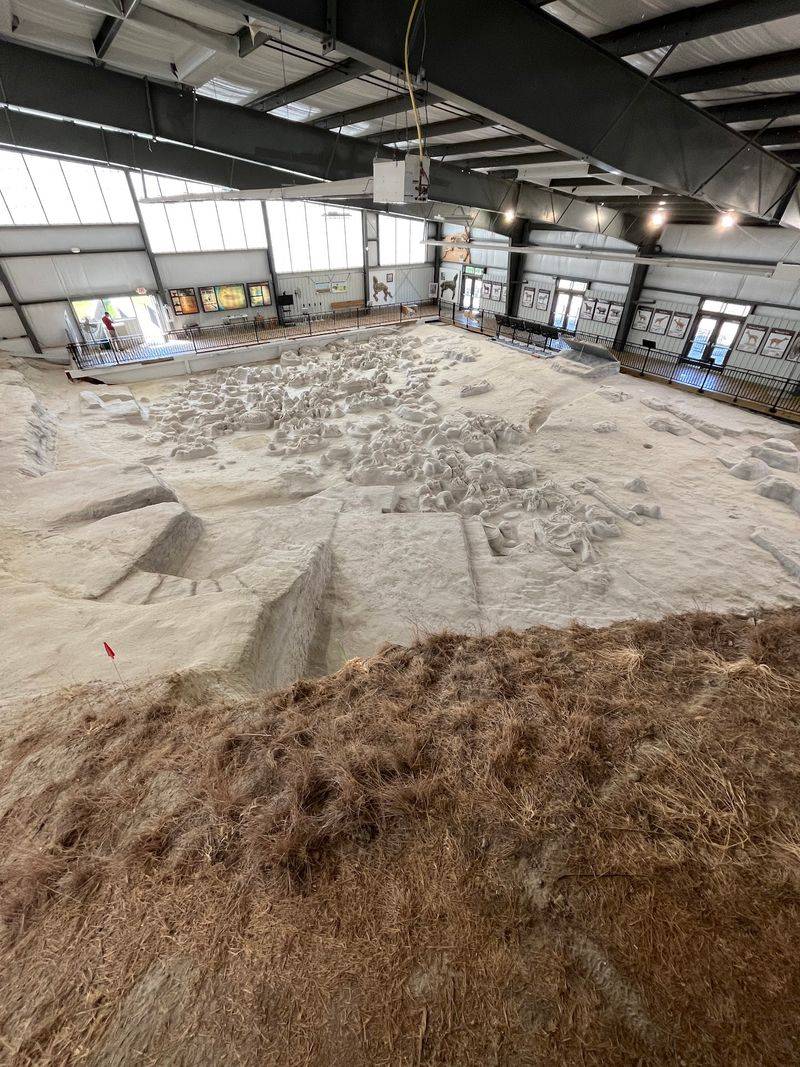
The crown jewel of any visit to Ashfall is the Hubbard Rhino Barn, a large climate-controlled structure built directly over a portion of the main excavation site. Elevated boardwalks guide visitors through the interior, allowing you to look down at dozens of complete skeletons of rhinos, horses, and camels arranged exactly as they were discovered, undisturbed in the ash bed.
The experience is genuinely hard to describe without sounding like you’re exaggerating. You are standing just a few feet above animals that have not moved in twelve million years, their bones still articulated, their postures suggesting rest rather than catastrophe.
Among the most poignant specimens is a pregnant rhino with her unborn calf preserved inside her, a detail that lands with quiet emotional weight.
Active paleontologists and university interns often work inside the barn during peak season, particularly in July and August, and they are typically happy to explain what they are currently uncovering.
Beyond the Bones: A Day of Discovery and Delight
The fossil beds themselves could easily fill an entire visit, but the park offers a broader experience worth taking your time with. The air-conditioned Visitor Center houses interpretive displays that walk you through the complete narrative, from the volcanic eruption in ancient Idaho to the painstaking excavation work happening today.
It is a smart place to start, especially if you are visiting with younger travelers who benefit from context before seeing the bones.
Adjacent to the exhibits, the Working Visible Lab lets you watch student research interns prepare actual museum specimens, carefully removing ash matrix to reveal bone surfaces with fine tools. Their enthusiasm for the work is contagious, and most are happy to answer questions mid-task.
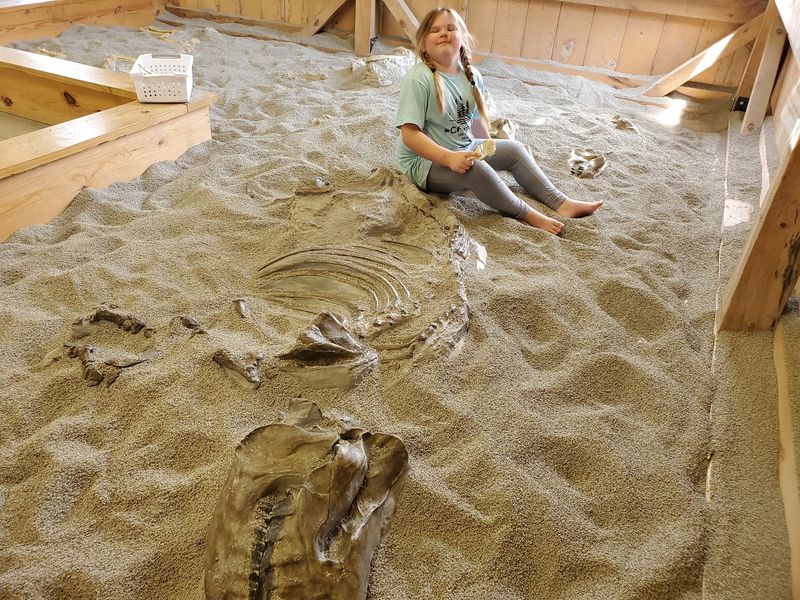
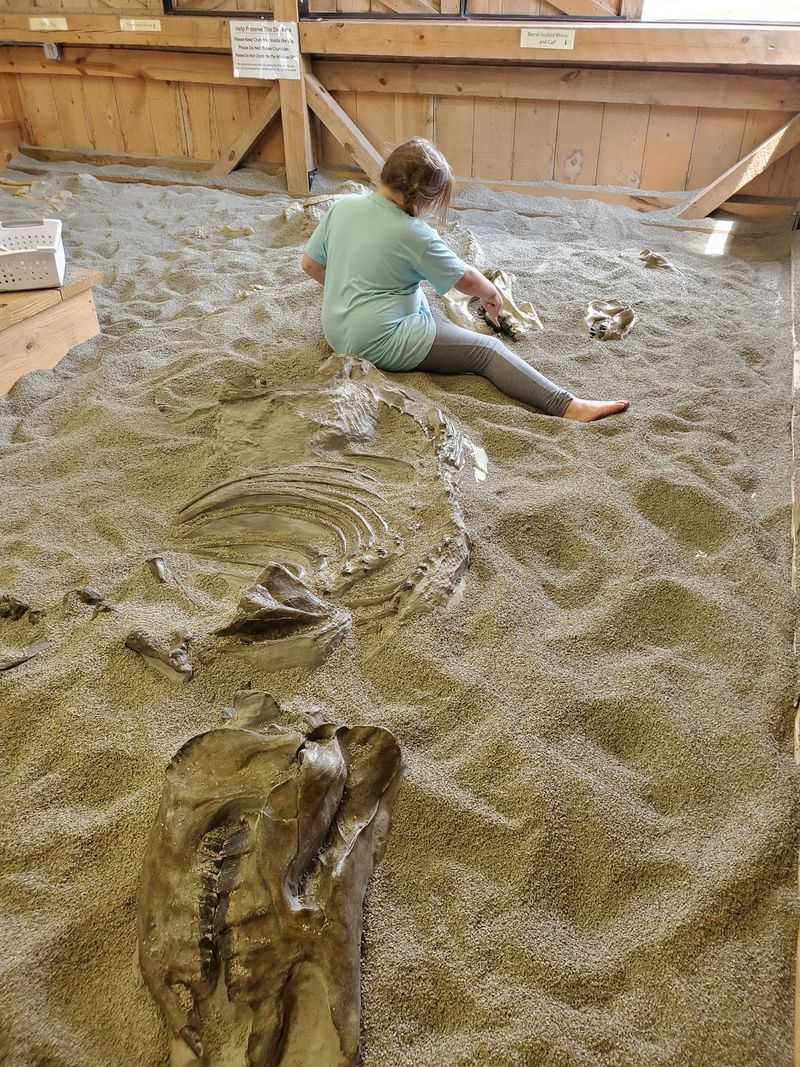
A hands-on dig area in the Heritage Center lets visitors try their hand at excavating replica fossils from a mock ash bed, a particularly satisfying activity for kids. Several nature trails wind through the surrounding 360 acres of prairie, offering gentle walks with watchable wildlife signs and sweeping views of the Verdigre Creek Valley.
The trails provide a refreshing counterpoint to the intensity of the fossil barn.
Navigating the Ancient Past: Essential Visitor Insights
A little advance planning goes a long way at Ashfall. The park is open Tuesday through Saturday from 9:30 AM to 4:30 PM and on Sundays from 12:30 PM to 4:30 PM, with Mondays closed.
Current admission is around ten dollars per person, with young children typically entering free. Checking the website at ashfall.unl.edu before your visit is worthwhile, as seasonal hours and fees can shift.
The best time to visit for active fossil excavation is July and August, when university interns are on-site conducting fieldwork. Cooler morning hours are ideal for exploring the outdoor areas and nature trails, particularly during summer.
Sturdy shoes are recommended, as terrain near the dig site can be uneven.
Parking is free and conveniently placed near the Visitor Center. Service animals are welcome throughout the park, including inside all buildings.
Other pets are permitted in outdoor areas only and must remain on a six-foot leash.
Bringing your own water is a smart move on warmer days, since the Hubbard Rhino Barn is climate controlled but the trails are fully exposed to the Nebraska sun.
Forever Unfolding: Ashfall as a Living Laboratory
What separates Ashfall from a static museum is the fact that the story is still being written. Active excavation continues every season, with paleontologists and university interns uncovering new specimens and refining the scientific narrative of the Miocene epoch in North America.
Staff have mentioned that the current dig site is expected to keep yielding discoveries for another ten to fifteen years, after which a new dig area nearby will be opened.
Keeping many skeletons in situ rather than removing them to a laboratory allows researchers to study the animals within their original geological context, something that provides data unavailable from isolated specimens. The layered ash deposit still holds secrets about the sequence of the ashfall, the behavior of the animals, and the precise chemistry of the preservation environment.
Ashfall holds National Natural Landmark status, a recognition that underscores its global scientific importance. Returning visitors often comment on how the site looks noticeably different from one year to the next, with new bones visible and the excavation boundary steadily advancing.
That sense of ongoing discovery gives the park an energy that purely static exhibits simply cannot match.
From Discovery to Landmark: The Park’s Journey
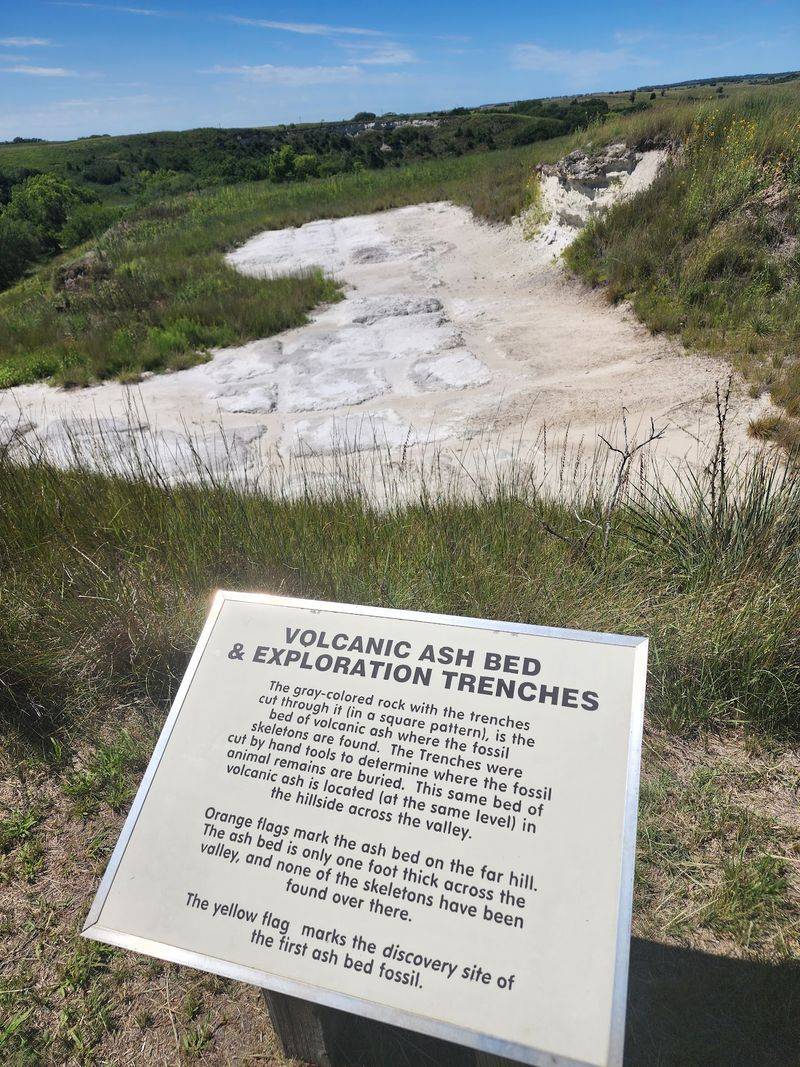
The origin story of Ashfall as a public destination begins with a single skull. In 1971, paleontologist Michael Voorhies spotted the skull of a juvenile rhinoceros eroding out of a rain-cut gully on a Nebraska farm.
That initial find hinted at something far larger, and years of excavation supported by organizations including the National Geographic Society confirmed that an entire ancient watering hole lay preserved beneath the surface.
The Nebraska Game and Parks Foundation acquired the site in 1986, and Ashfall Fossil Beds State Historical Park was officially established in 1991. The construction of the Hubbard Rhino Barn in 2009 marked a turning point, allowing the public to view fossils in place rather than only in prepared displays, which transformed the visitor experience entirely.
Today the park carries a 4.8-star rating across hundreds of visitor reviews and draws paleontology enthusiasts, families, and curious travelers from across the country. Its journey from a chance discovery in a rain-washed gully to a globally recognized research and education destination is a reminder that some of the world’s most significant stories are found by people willing to look closely at what the earth reveals after a storm.
Share this story