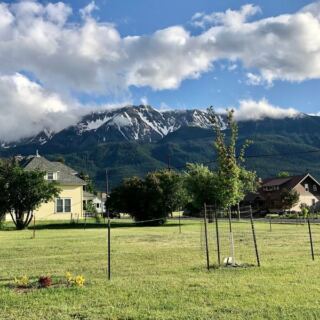
Most people drive through Okarche, Oklahoma without a second glance, assuming the small farming town holds little more than grain silos and open sky. Holy Trinity Catholic Church proves that assumption spectacularly wrong.
Tucked along Missouri Avenue, this prairie chapel shelters stained glass windows and Italian woodwork so refined they genuinely belong in a European cathedral conversation. Once you learn the full story of this place, including its connection to America’s first Catholic martyr, the drive out to Canadian County becomes one of the most rewarding detours in the entire state.
A Prairie Town with an Unlikely Treasure
Okarche sits in Canadian County, roughly 35 miles northwest of Oklahoma City, where the land flattens out and the horizon stretches wide in every direction. The town is modest by any measure, the kind of place most road-trippers pass through without slowing down.
Holy Trinity Catholic Church, located at 211 Missouri Ave, Okarche, OK 73762, changes that calculation entirely.
The church has served this small German-Catholic farming community since the late 19th century. Its congregation was built largely by immigrant families who arrived with deep faith and a determination to build something lasting on the Oklahoma plains.
What they created was far beyond a simple country chapel.
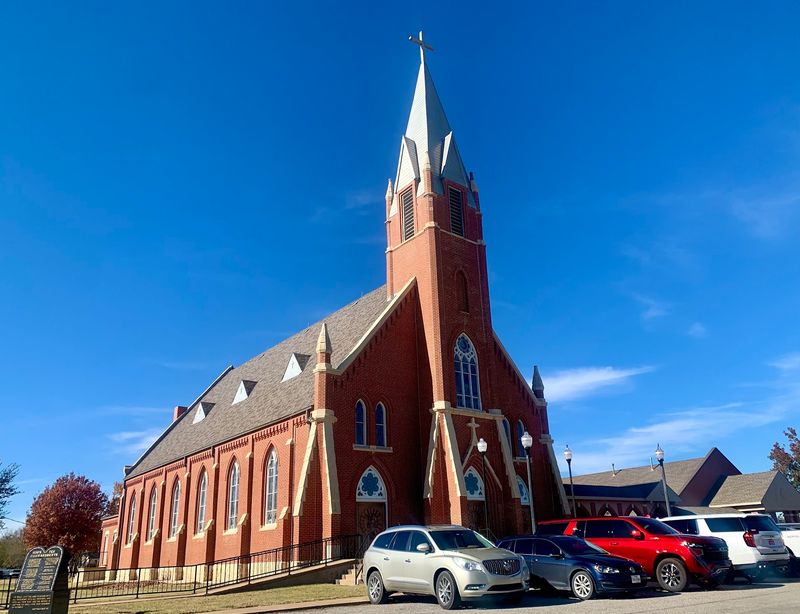
From the outside, the red-brick structure commands quiet respect. It does not shout for attention the way a roadside attraction might.
The building earns its reputation through what waits inside, and the moment you cross the threshold, it becomes immediately clear why people regularly make the drive from across Oklahoma just to stand here. The church carries a 4.5-star rating on Google, drawn from visitors who consistently describe it as beautiful and deeply moving.
The German-Catholic Roots Behind the Architecture
The congregation at Holy Trinity traces its origins to the waves of German Catholic settlers who homesteaded central Oklahoma following the Land Run of 1889. These were farming families who came with almost nothing but a strong sense of community and an equally strong sense of how a proper Catholic church should look and feel.
Rather than settling for a bare-bones prairie building, the community pooled resources and imported craftsmanship that reflected the faith traditions of their European homeland. The result was a church interior that stands apart from nearly every other rural Oklahoma house of worship.
Visitors who know their European church history sometimes stop mid-aisle and simply stare. The attention to detail in the woodwork, the proportions of the nave, and the quality of the decorative elements all point to a congregation that refused to compromise on beauty even when resources were stretched thin.
That commitment to excellence, passed down through generations of Okarche families, is exactly what preserved the church’s original character through decades when many American parishes were modernizing their interiors. One reviewer noted with appreciation that the faithful resisted pressure to update the space in a 1970s renovation wave.
Stained Glass That Stops You Cold
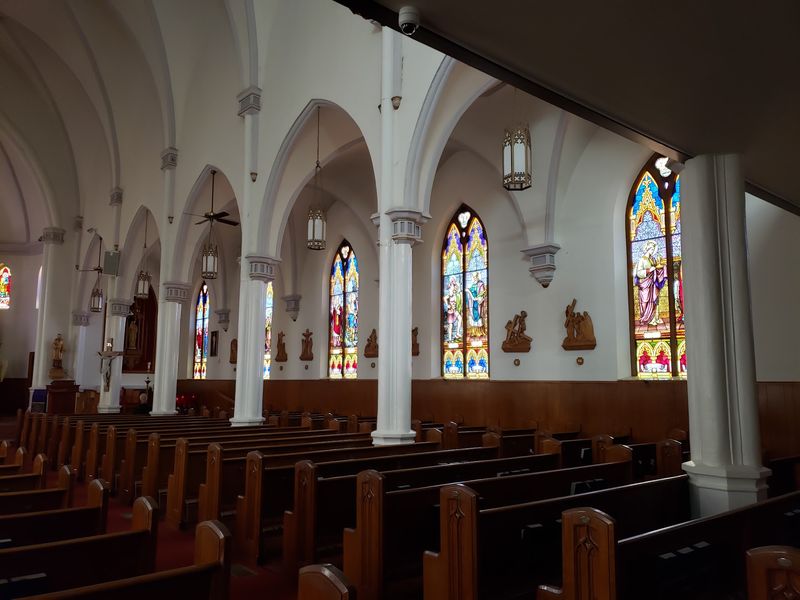
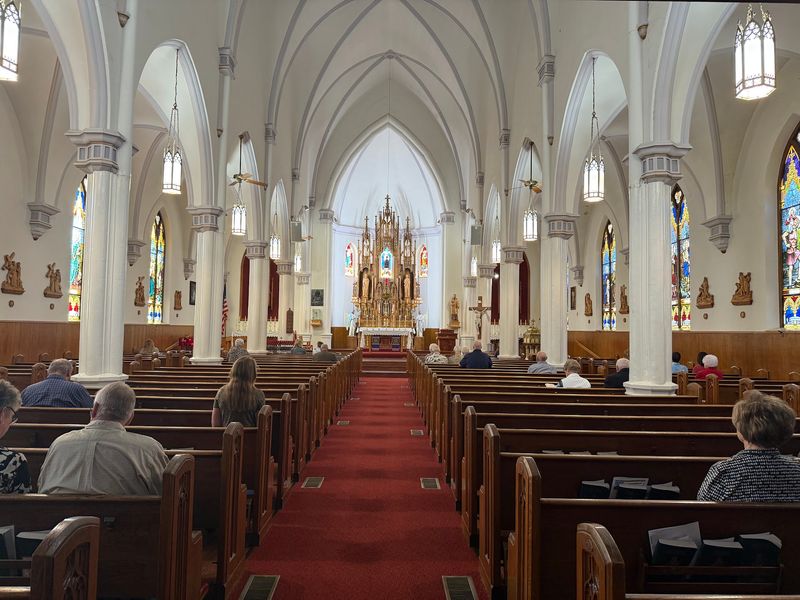
No single feature draws more admiration than the stained glass windows lining the nave of Holy Trinity. Sunlight filters through panels of deep cobalt, amber, and crimson, throwing pools of color across the wooden pews and stone floor in a way that feels almost theatrical.
The windows depict traditional religious scenes rendered with a level of artistry that genuinely rivals what you might find in a mid-sized European cathedral. The figures are detailed, the color transitions are smooth, and the leading work is precise.
These are not mass-produced windows. Each panel carries the kind of craftsmanship that takes a skilled artisan considerable time to produce.
Morning visits offer the most dramatic light, when the eastern windows catch the early sun and the interior glows with an almost amber warmth. Afternoon shifts the palette cooler and bluer as western light takes over.
Either way, the effect is genuinely arresting. People who visit on an overcast day sometimes return specifically to see the windows in full sun, because the difference is remarkable.
The glass alone justifies the drive from Oklahoma City, and most visitors say so without any prompting.
The Italian Woodwork Worth a Closer Look
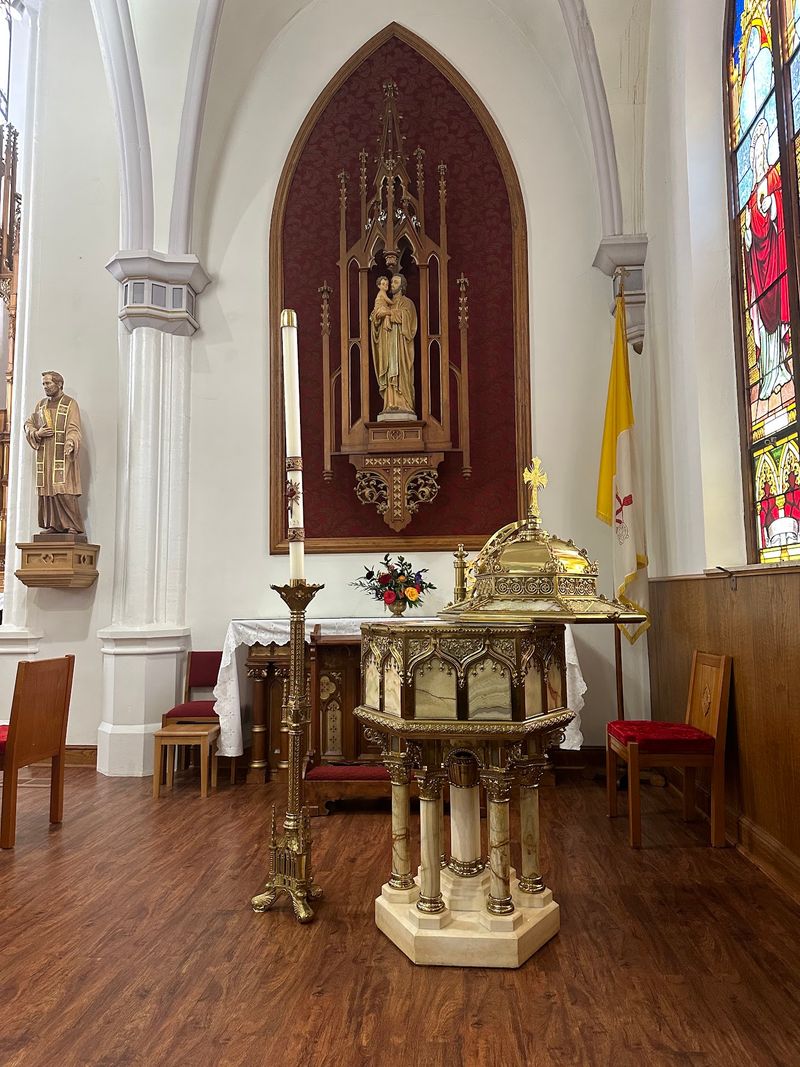
Beyond the glass, the woodwork at Holy Trinity draws its own admiring crowd. Reviewers specifically call out the Italian craftsmanship as a standout feature, and once you see it up close, the praise makes complete sense.
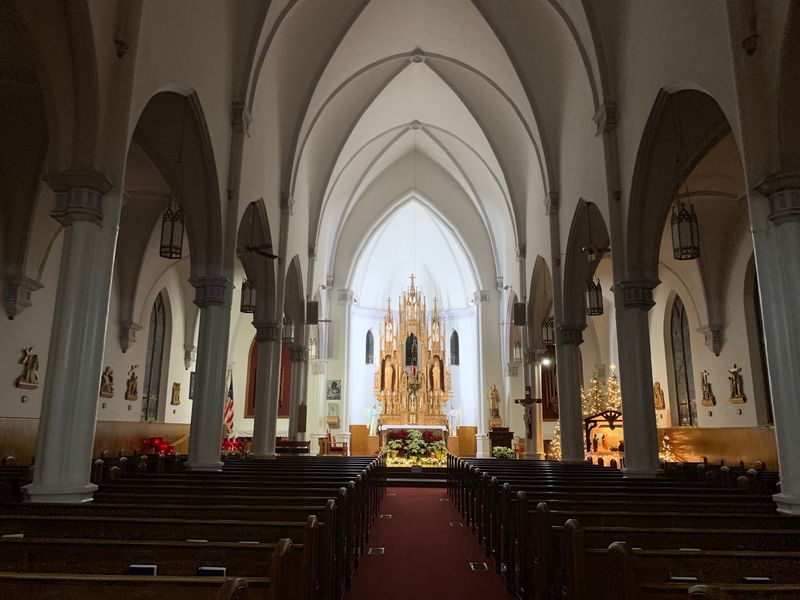
The altar area features carved wooden elements with a level of detail that speaks to old-world training. The columns, trim work, and decorative panels carry a consistency of style suggesting they were designed and executed as a unified commission rather than assembled piecemeal over time.
The warmth of the aged wood against the light streaming through the stained glass creates a layered visual richness that photographs struggle to fully capture.
Running your eye along the woodwork from pew to altar, you notice how each carved element builds on the last, creating a sense of architectural narrative that pulls your gaze forward toward the sanctuary. It is the kind of interior design that rewards slow, deliberate looking rather than a quick walk-through.
Many visitors find themselves circling back to details they nearly missed on the first pass, which is part of what makes Holy Trinity the kind of place people return to rather than simply check off a list.
Blessed Stanley Rother, Oklahoma’s Most Remarkable Son
Holy Trinity is the home parish of Blessed Stanley Rother, widely recognized as America’s first Catholic martyr and a figure on the path toward sainthood. Rother was born in 1935 on a farm near Okarche, grew up in this congregation, and was ordained a Catholic priest before eventually serving as a missionary in Guatemala.
He remained with his Guatemalan parish community during a period of intense political violence in the early 1980s, refusing to abandon the people he served even after his name appeared on a list of targets. He was killed in 1981 and was beatified by Pope Francis in 2017 in Oklahoma City, the first beatification ceremony ever held on American soil.
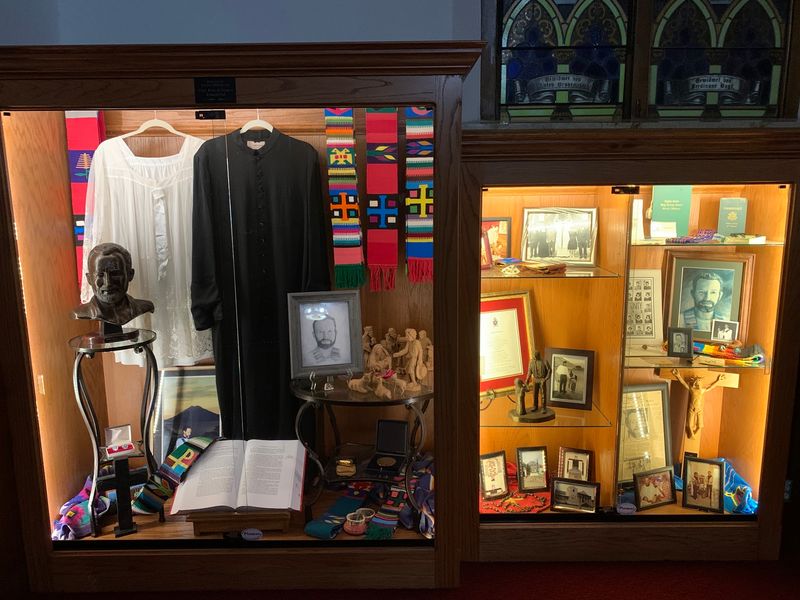
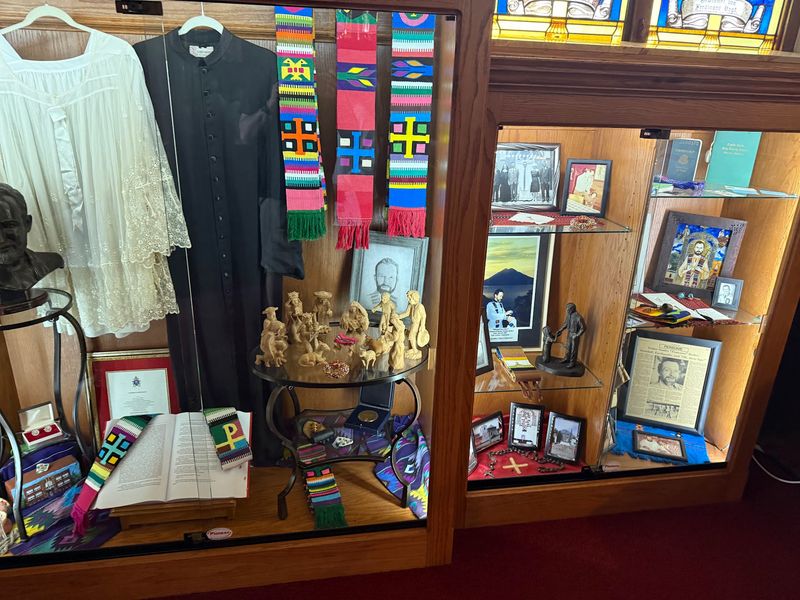
The church honors his memory in a meaningful way. His vestments and personal religious items are displayed on-site, giving visitors a tangible connection to his story.
A gift shop offers materials related to his life and legacy. For many visitors, learning about Father Rother transforms a trip to see beautiful architecture into something far more profound.
His story is remarkable by any standard, and this is the place where it all began.
The Gift Shop and Rother Memorial Materials
A dedicated gift shop at Holy Trinity gives visitors a place to take a piece of the story home with them. The shop carries books, pamphlets, and religious items connected to Blessed Stanley Rother’s life, mission work, and beatification.
For anyone arriving with only a vague knowledge of Rother’s story, the materials available here provide excellent context.
The shop is modest in size but thoughtfully stocked for the audience it serves. Pilgrims who travel specifically to honor Rother’s memory often spend considerable time browsing the available titles, many of which are not easy to find elsewhere.
First-time visitors who stumble upon the church while road-tripping frequently leave with reading material that keeps Okarche on their minds long after they have driven away.
The presence of the gift shop also signals that Holy Trinity takes its role as a pilgrimage destination seriously. The parish clearly understands that many of its visitors come from outside the immediate community and has made genuine efforts to serve that wider audience well.
Whether you arrive as a devoted Catholic, a history enthusiast, or simply a curious traveler, the shop offers something worth pausing over before you head back to the car.
Atmosphere Inside the Walls
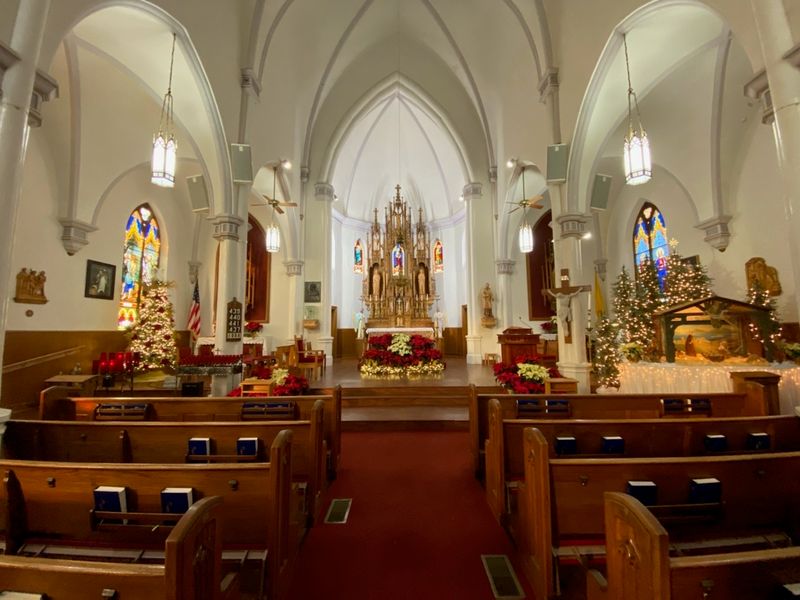
Quiet is the first thing you notice when the door closes behind you. The thick brick walls absorb the wind and traffic noise of small-town Oklahoma, leaving a hush that feels almost deliberate.
The interior carries the kind of reverent stillness that takes decades to accumulate and cannot be manufactured from scratch.
The proportions of the nave feel generous without being overwhelming. The ceiling height draws the eye upward in that classic Gothic-influenced way, while the rows of wooden pews ground the space and give it warmth.
Light from the stained glass shifts slowly across the floor as the sun moves, turning the experience of sitting quietly inside into something almost meditative.
Christmas is reportedly the most special time to visit, when the interior decorations layer additional warmth over the already rich baseline. Regular parishioners describe the church as a place of genuine comfort, and that feeling communicates itself even to first-time visitors who have no personal history here.
The atmosphere is one of those rare qualities that no renovation or modernization effort could have easily replicated, which makes the congregation’s decision to preserve the original interior feel all the more fortunate for everyone who walks through the door today.
Who Makes the Drive and Why
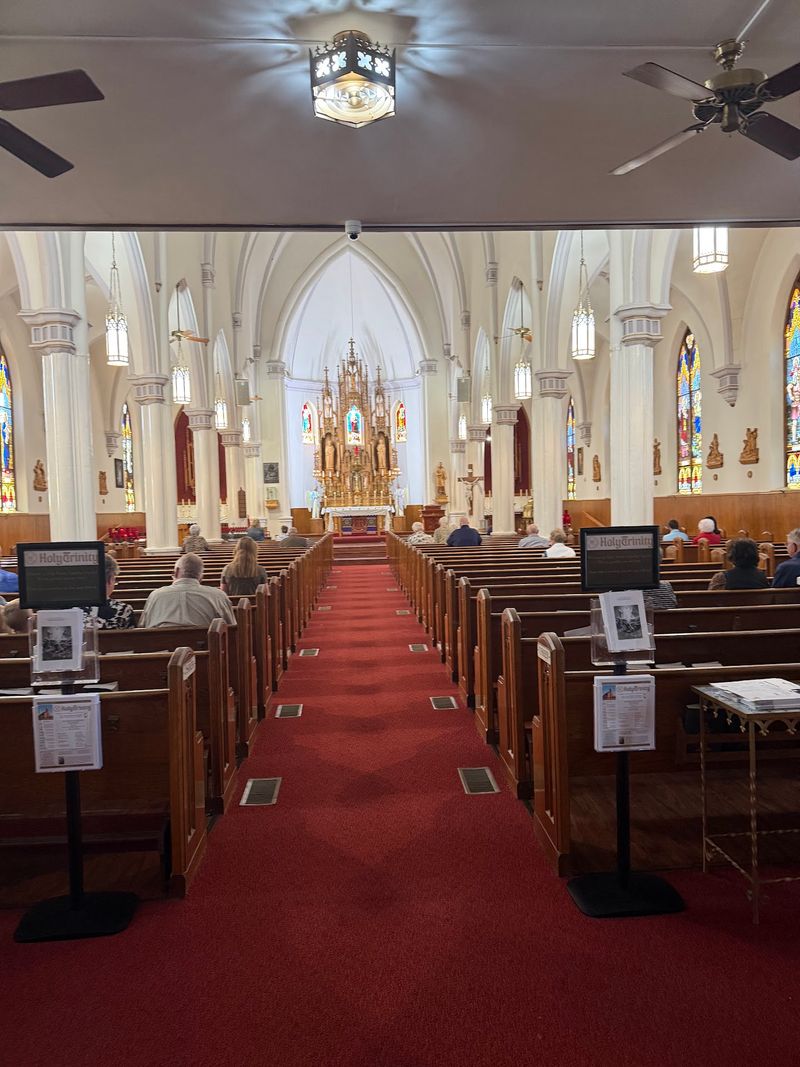
Holy Trinity draws a genuinely mixed crowd for a church in a town of fewer than 1,500 people. Catholic pilgrims arrive from across the country specifically to visit the home parish of Blessed Stanley Rother, treating the stop as part of a broader faith journey.
Architecture enthusiasts come chasing the stained glass and Italian woodwork after reading about the church online.
Oklahoma road-trippers heading northwest from Oklahoma City often add the detour after discovering that something this ornate exists only 35 miles from the city. History buffs interested in the German-Catholic settlement of the Oklahoma Territory find the building and its community story well worth the drive.
Couples have held weddings here, drawn by the beauty of the space and the sense of occasion it provides.
The church also attracts people who simply want a quiet place to sit and think, away from the noise of city life. Whatever brings a visitor through the door, the experience tends to be consistent.
People leave having seen something genuinely unexpected, and many find themselves recommending Holy Trinity to friends and family before they have even made it back to the highway. The word-of-mouth reputation this place carries is entirely earned.
Planning Your Visit to Okarche
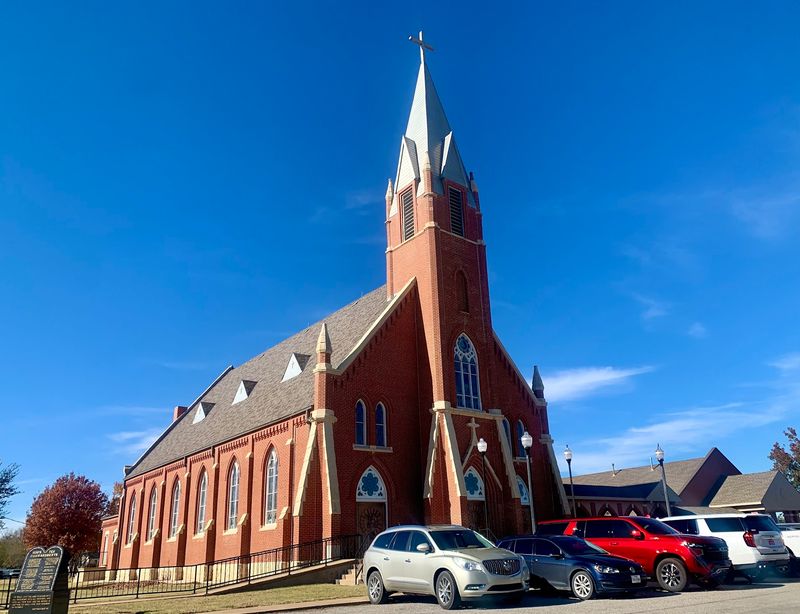
Holy Trinity Catholic Church is open Monday through Friday from 8:30 AM to 4:00 PM. The church is closed on Saturdays and Sundays for general visiting, though weekend Mass services are held for the parish community.
Planning a weekday visit gives you the best chance to explore the interior at your own pace.
The address is 211 Missouri Ave, Okarche, OK 73762. From Oklahoma City, the drive runs roughly 35 miles northwest via US-270 or nearby routes, making it an easy half-day trip.
The town of Okarche is small, so finding the church once you arrive is straightforward. Street parking is available in the area around the building.
For questions about visiting hours, special events, or the Blessed Stanley Rother exhibit, the parish can be reached at 405-263-7930, and the church website at holytrinityok.org carries additional information. There is no admission fee to visit.
The gift shop operates during the same weekday hours as the church. Given how little it costs and how much there is to see, Holy Trinity ranks as one of the most rewarding low-effort detours in central Oklahoma, the kind of hidden gem that makes regional road-tripping genuinely worthwhile.
Share this story