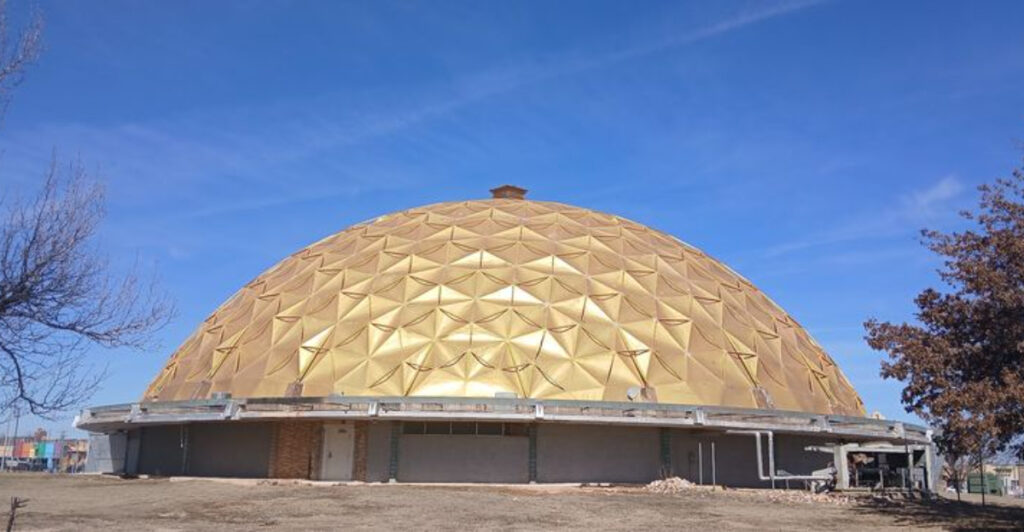
There is a building in Oklahoma City that stops people mid-drive, not because it is the tallest or the fanciest, but because it looks like it landed from a different era entirely. A glowing, golden bubble sitting on a busy Route 66 corner, it was once a working bank and is now one of the most photographed architectural oddities in the state.
Built in 1958, it holds a record most people never expect to find in the middle of Oklahoma: it was the fifth geodesic dome ever constructed in the world. What makes it even more remarkable is that every curve and glimmer comes from 625 individual aluminum panels fitted together with almost mathematical precision.
Keep reading, because this story is far more fascinating than it looks from the road.
The Address and Setting on Route 66
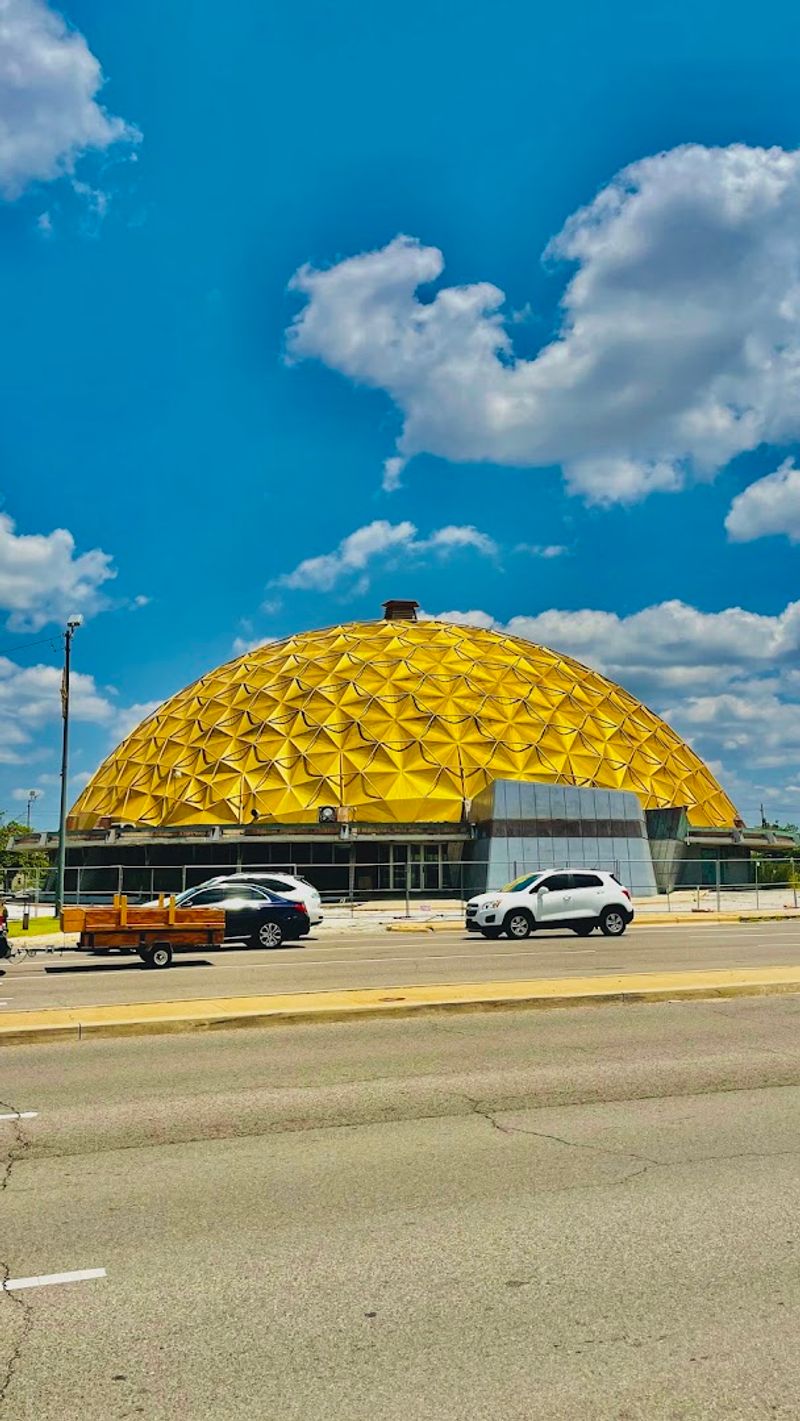
Right on the corner of NW 23rd Street and North Classen Boulevard, the Gold Dome Bank Building sits at 1112 NW 23rd St, Oklahoma City, OK 73106, and it commands attention the moment you spot it from down the block.
This stretch of NW 23rd Street is a historic section of Route 66, one of America’s most celebrated road corridors, and the dome fits right into that tradition of roadside architecture designed to make drivers slow down and stare.
The surrounding commercial district has shifted over the decades, with small businesses and storefronts cycling in and out around it, but the dome has remained a constant and unmistakable presence on this busy urban corner.
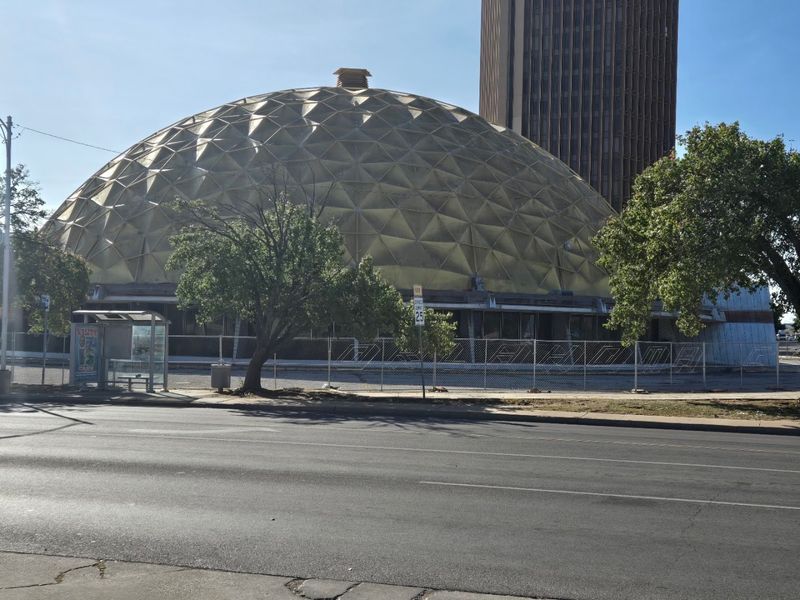
A chain-link fence currently surrounds the property, so visitors cannot walk right up to the building, but the view from across the street is genuinely impressive and worth pulling over for.
The best photo angle comes from the opposite sidewalk, where the full curve of the dome is visible against the Oklahoma sky, catching sunlight in a way that makes the gold panels shimmer with a warmth that photographs beautifully at almost any time of day.
The Record-Breaking Status as the World’s Fifth Geodesic Dome
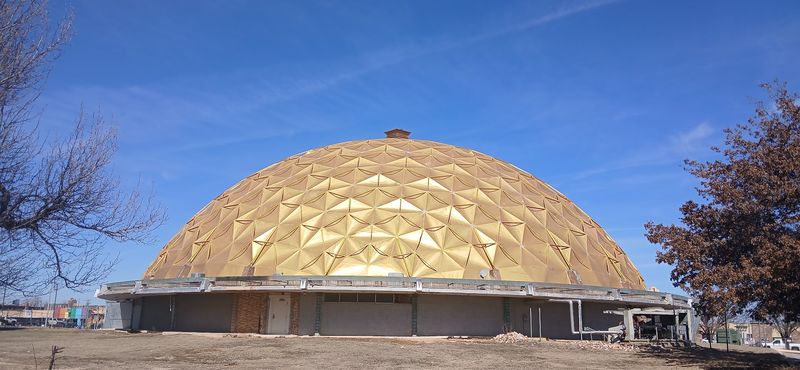
Not every building in a mid-sized American city can claim a world record, but this one quietly holds a remarkable distinction that most passersby never realize.
When the Gold Dome was completed in 1958, it became the fifth geodesic dome ever constructed anywhere on the planet, a fact that places it in genuinely rare architectural company.
Geodesic domes were a relatively new concept at the time, pioneered by the visionary designer and theorist Buckminster Fuller, whose ideas about efficient structural geometry were just beginning to influence the architecture world in a serious way.
Fuller’s geodesic designs were celebrated for their ability to enclose large spaces using minimal materials, distributing structural stress evenly across the entire curved surface rather than concentrating it at specific load-bearing points.
Being the fifth dome ever built in this style means Oklahoma City got in on the concept almost at the very beginning, before geodesic structures became more widely known or replicated.
That historical timing gives the building a significance that goes well beyond its eye-catching appearance, making it a genuine piece of world architectural history hiding in plain sight on a Route 66 corner.
625 Aluminum Panels and the Engineering Behind the Shine
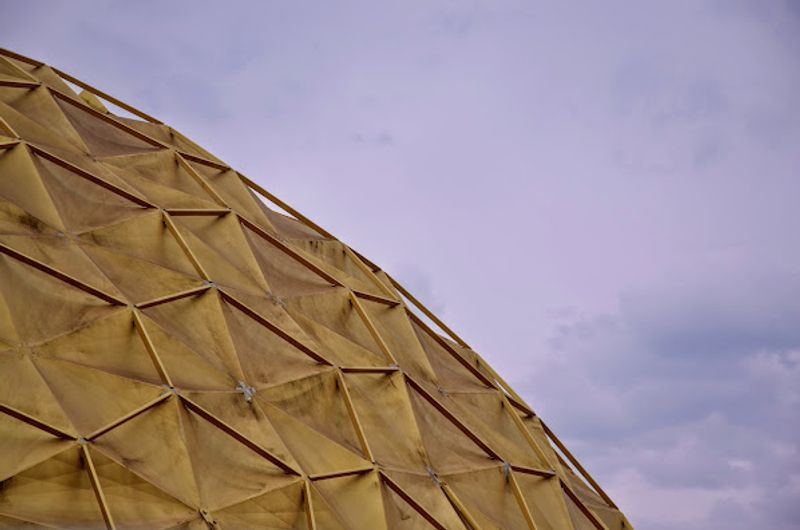
The golden glow that makes this building so visually striking is not paint or a trick of lighting; it comes from 625 individual gold anodized aluminum panels fitted together across the dome’s curved surface.
Anodizing is an electrochemical process that thickens the natural oxide layer on aluminum, making it more durable and allowing it to hold color without peeling or fading the way paint eventually does.
Each of those 625 panels had to be shaped and fitted with precision so that the overall dome would hold its structural integrity while also creating the smooth, continuous curve that makes it look almost seamless from a distance.
The number 625 is not arbitrary; geodesic domes are built using specific geometric formulas that determine how many panels are needed to create the correct spherical approximation at a given size and frequency.
From up close, you can actually see the individual panel edges where they meet, giving the surface a subtle texture that photographs beautifully in afternoon light when the sun hits the dome at an angle.
That shimmer is what earned it the nickname that stuck: the Gold Dome, a name so perfectly descriptive that it became the building’s identity almost immediately after it opened.
Life as a Bank in 1958
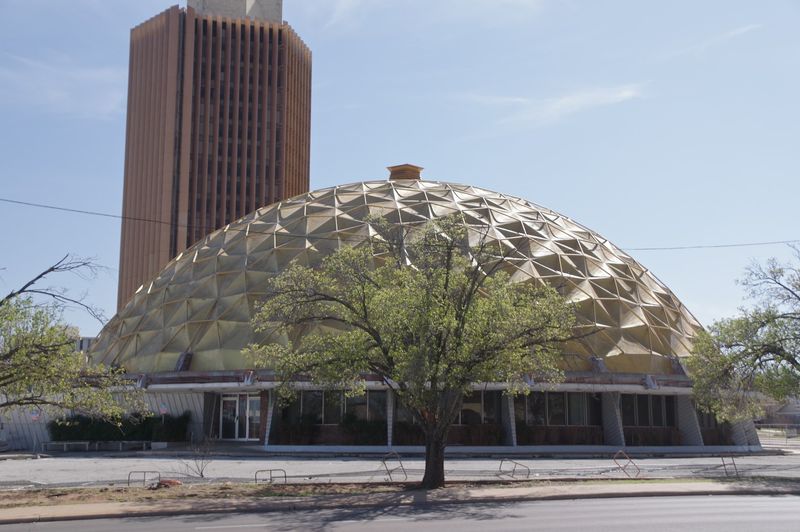
When the Gold Dome opened its doors in 1958, it was not a museum or a curiosity; it was a fully functioning bank, and customers would have walked through those doors to make deposits, apply for loans, and handle the ordinary business of daily financial life.
The choice to house a bank inside such a dramatically unconventional structure was itself a bold statement, suggesting that the institution inside was forward-thinking, modern, and not afraid to stand out from the competition on a busy commercial street.
Mid-century America had a real appetite for futuristic design in commercial buildings, and banks in particular often used striking architecture to project stability mixed with ambition, a visual message that said both “we are established” and “we are ahead of our time.”
The interior of the dome would have felt genuinely different from any other bank in Oklahoma City, with the curved ceiling overhead creating a spatial experience that no conventional rectangular building could replicate.
That original banking function gave the building a practical purpose that grounded its experimental design in everyday life, which is part of what makes its story so appealing: it was never meant to be just a showpiece.
The Buckminster Fuller Connection
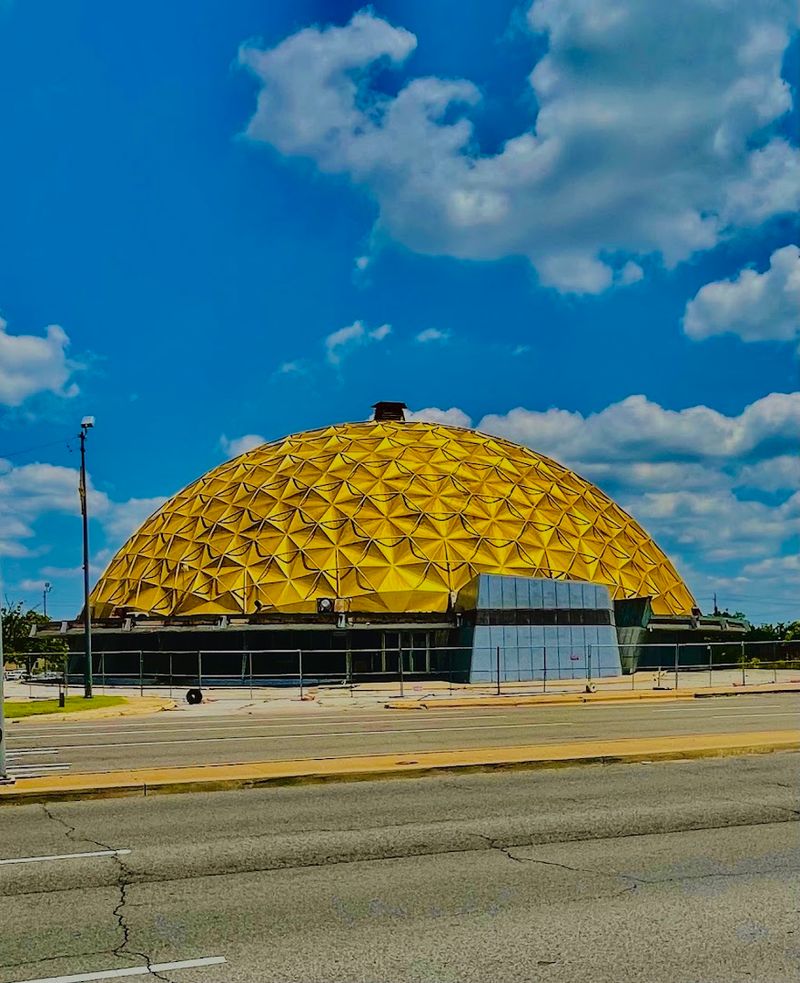
The intellectual DNA of the Gold Dome traces back to one of the twentieth century’s most original thinkers, a man named R. Buckminster Fuller, whose ideas about geometry and structural efficiency changed the way architects thought about building.
Fuller did not invent the dome shape, but he developed and popularized the geodesic version, which uses a network of triangles arranged across a spherical surface to create a structure that is both incredibly strong and surprisingly lightweight for its size.
His geodesic patent was granted in 1954, just four years before the Oklahoma City dome was completed, which means this building was built almost immediately after the concept had received formal recognition as a viable architectural approach.
Fuller’s influence extended far beyond architecture into philosophy, environmental thinking, and systems theory, and he became something of a cultural icon in the mid-twentieth century, celebrated by designers, engineers, and counterculture thinkers alike.
Having a building connected to his legacy sitting on a Route 66 corner in Oklahoma City is the kind of detail that rewards curious travelers who take the time to look past the shiny surface and ask how something this unusual ended up here in the first place.
Its Role as a Route 66 Landmark
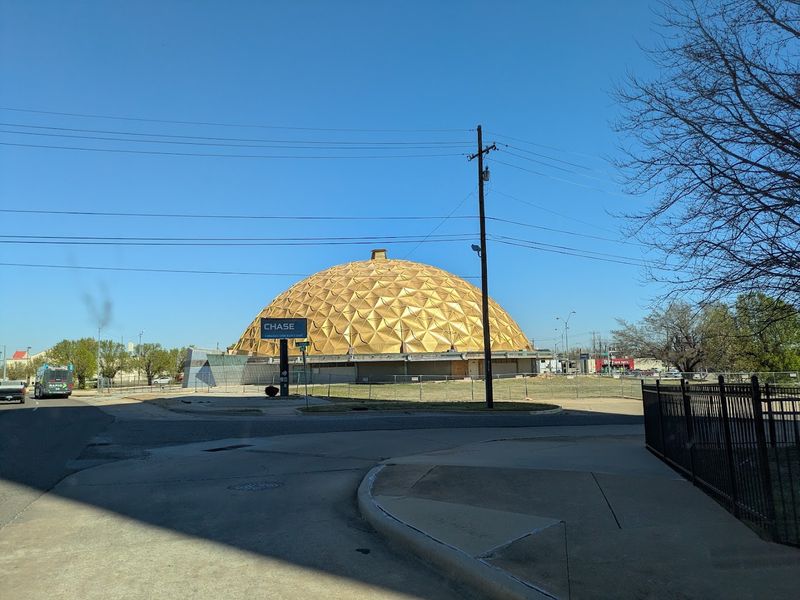
Route 66 has always been as much about the journey as the destination, and the roadside landmarks along its length are a huge part of what gives the highway its legendary character.
The Gold Dome sits on a section of NW 23rd Street in Oklahoma City that was part of the original Route 66 alignment, placing it squarely in the tradition of eye-catching structures built to catch the attention of travelers moving through the state.
Route 66 enthusiasts who make dedicated trips along the historic highway often include this dome on their must-see list, and it appears in numerous Route 66 guidebooks and travel blogs as one of Oklahoma City’s most photogenic stops.
The highway has a long history of unusual architecture, from wigwam motels to giant statues, and the Gold Dome fits naturally into that tradition of buildings designed to make you hit the brakes and reach for your camera.
Even for travelers who are not specifically chasing Route 66 history, the dome is the kind of unexpected visual that makes a road trip feel worthwhile, a reminder that genuinely surprising things are still out there waiting to be discovered on American roads.
The Building’s Changing Uses Over the Decades
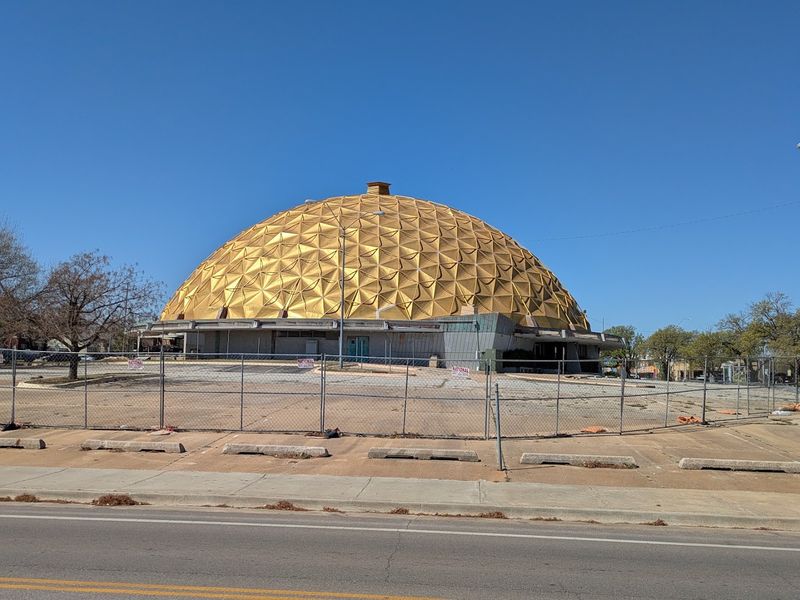
A building as unusual as this one does not stay frozen in time, and the Gold Dome has moved through several different chapters since it first opened as a bank in 1958.
Over the following decades, the dome changed hands and functions more than once, serving various commercial purposes as the neighborhood around it evolved and the original banking tenant eventually moved on.
At different points in its history, the building housed a variety of businesses that took advantage of its distinctive interior space, which offers a circular floor plan under that soaring curved ceiling.
By the time the twenty-first century arrived, the building had fallen into a less active state, and it has been listed for sale in recent years, sitting behind a chain-link fence while its future remains uncertain.
The current condition gives the building a slightly melancholy atmosphere up close, with visible signs of wear that come from decades of Oklahoma weather and the natural aging of a structure that has not had consistent active use.
That tension between its remarkable history and its uncertain present is part of what makes a visit feel meaningful, because you are seeing a genuine piece of architectural history at a genuinely pivotal moment in its story.
What Visitors Actually See Today
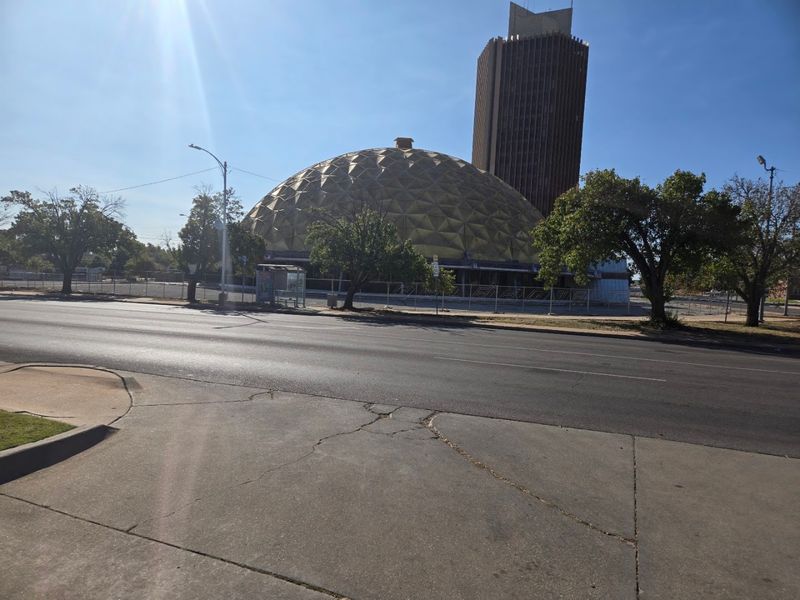
The experience of visiting the Gold Dome today is primarily a visual one, since the chain-link fence that surrounds the property keeps visitors at a respectful distance from the building itself.
The best approach is to park nearby and walk to the opposite sidewalk, where you get a clear, unobstructed view of the full dome rising above the fence line, with the gold panels catching whatever light the Oklahoma sky is offering that day.
Morning light hits the east-facing panels with particular warmth, while afternoon sun creates a more dramatic glitter effect across the whole surface, so the time of day you visit genuinely affects how impressive the dome looks in person.
The surrounding streetscape is active enough that you will have cars passing and urban activity around you, which actually adds to the experience by reminding you that this extraordinary structure exists in the middle of everyday city life.
Most visitors spend between ten and twenty minutes here, enough time to walk around the perimeter fence, take photos from several angles, and appreciate the scale and geometry of the dome before continuing down Route 66.
Short as that visit might be, the Gold Dome is the kind of sight that stays with you, because there is genuinely nothing else quite like it anywhere on the highway.
The Architecture and Geometry Up Close
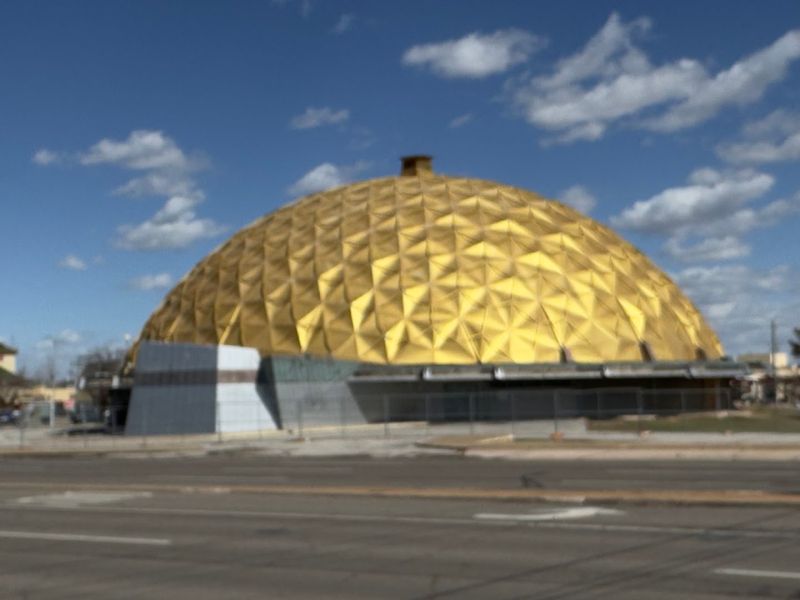
The geometry of a geodesic dome is one of those things that is easy to admire without fully understanding, but getting close enough to see the individual panels gives you a real appreciation for the mathematical thinking behind the design.
The dome’s surface is divided into a pattern of triangular and near-hexagonal shapes, each panel a slightly different size depending on its position on the sphere, all calculated to create a surface that curves smoothly in every direction simultaneously.
That kind of three-dimensional geometry was genuinely difficult to execute in 1958, before computer-aided design existed, which means the engineers and builders who assembled this structure did it with hand calculations and physical models.
The gold anodized finish on each panel gives the surface a slightly warm, almost amber quality in certain lighting conditions, different from the brighter yellow-gold you might expect from the name.
At certain angles, the panels reflect the sky and the surrounding buildings, giving the dome a slightly mirrored quality that changes its appearance depending on where you stand and what direction you are looking from.
That visual variability is part of what makes the building so rewarding to photograph from multiple positions, because each angle reveals something slightly different about how the geometry and the light interact.
Why This Dome Deserves a Spot on Your Oklahoma Road Trip
Some roadside stops justify themselves immediately, and the Gold Dome is one of those places that earns its place on a road trip itinerary with almost no effort at all.
The combination of genuine world-record history, striking visual design, and Route 66 significance puts this building in a category that very few stops along the highway can match, even if the current visit is limited to an exterior viewing from across the street.
Oklahoma City has plenty of attractions that require tickets, reservations, and significant time commitments, but the Gold Dome asks nothing of you except a brief detour and a few minutes of your attention.
The fact that it is open in the sense of being publicly viewable around the clock means you can add it to your itinerary without worrying about hours or crowds or entry fees.
Travelers who pass through and skip it often report wishing they had stopped, because photographs simply do not fully capture the oddness and charm of seeing this glowing golden bubble in the middle of an ordinary city block.
The Gold Dome is a reminder that American roads still hold genuinely surprising things, and that sometimes the most memorable stop on a long drive is the one you almost did not bother to make.
Share this story