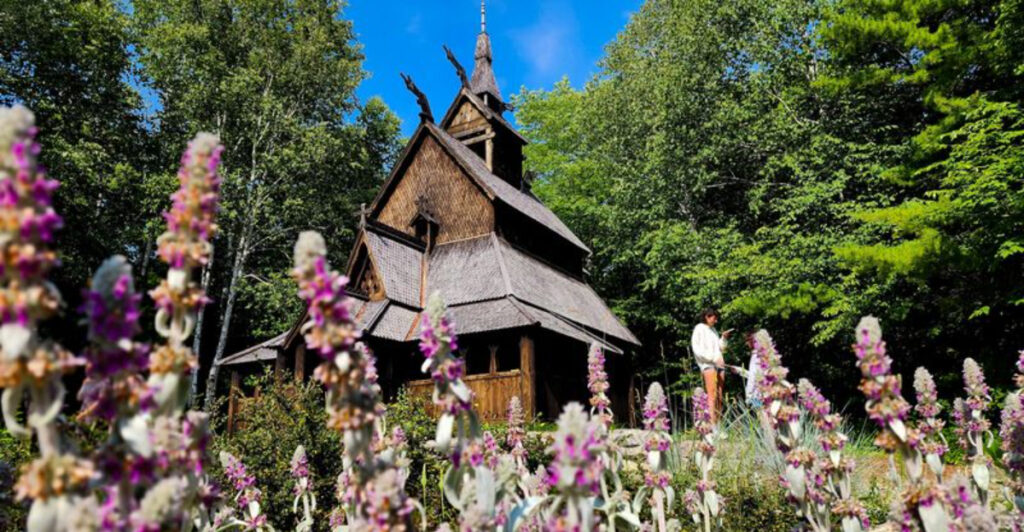
Tucked into a wooded stretch of Washington Island, Wisconsin, there is a structure that looks like it was lifted straight from a Norse village and dropped into the Great Lakes region. This church is a hand-crafted reproduction of a medieval Norwegian stave church, built in the 1990s with traditional joinery techniques and zero nails.
It sits quietly off Town Line Road, surrounded by tall evergreens, a rock labyrinth, and a winding prayer path that draws people from across the country. What makes this place so compelling is not just the architecture but the story behind why it exists here at all, on a remote island in Door County that has deep Scandinavian roots.
The Norwegian Roots Behind the Design
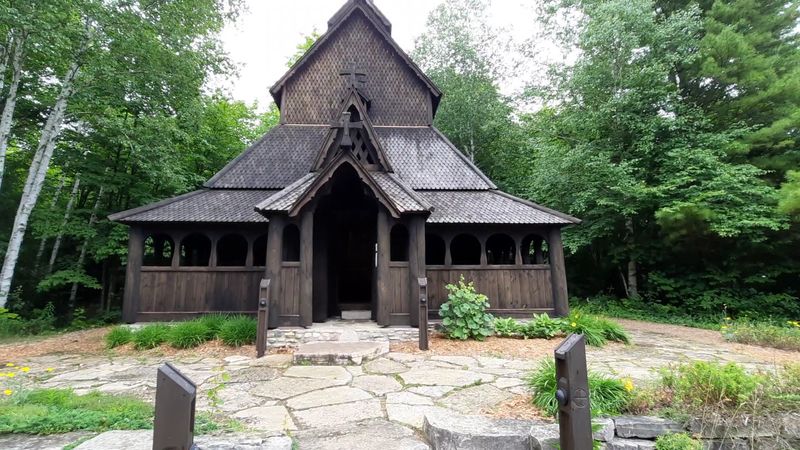
Stave churches are among the oldest surviving wooden structures in the world, with origins in medieval Norway dating back to the 11th and 12th centuries. They get their name from the vertical load-bearing posts, called staves, that form the structural core of the building.
At the time these churches were constructed in Scandinavia, builders used no metal fasteners. Instead, they relied on carefully cut and fitted timber joints that locked together through tension and weight.
The Washington Island Stavkirke follows the same construction philosophy, which is part of what makes it so remarkable as a modern reproduction.
Norway once had over 1,000 stave churches, but fewer than 30 original structures still stand today. Building one in Wisconsin was not just an architectural project.
It was a deliberate act of cultural preservation, honoring the heritage of the Scandinavian families who settled Washington Island generations ago.
Built Without a Single Nail
One of the most talked-about facts about the Stavkirke is that its construction used no nails. Every joint, beam, and connection was achieved through traditional woodworking techniques, the same methods used by Norwegian craftsmen over a thousand years ago.
This kind of joinery requires a level of skill that is genuinely rare in modern construction. The builders had to plan each connection point with precision, ensuring that the structure would hold together through Wisconsin winters and humid summers without the help of metal hardware.
The result is a building that feels both ancient and alive, where the wood itself carries the structural logic. Visitors who know nothing about carpentry still notice something different about the way the church is put together.
There is a coherence to the construction that you can see from every angle, inside and out, which is a testament to the craftsmanship invested in every detail.
What the Exterior Actually Looks Like
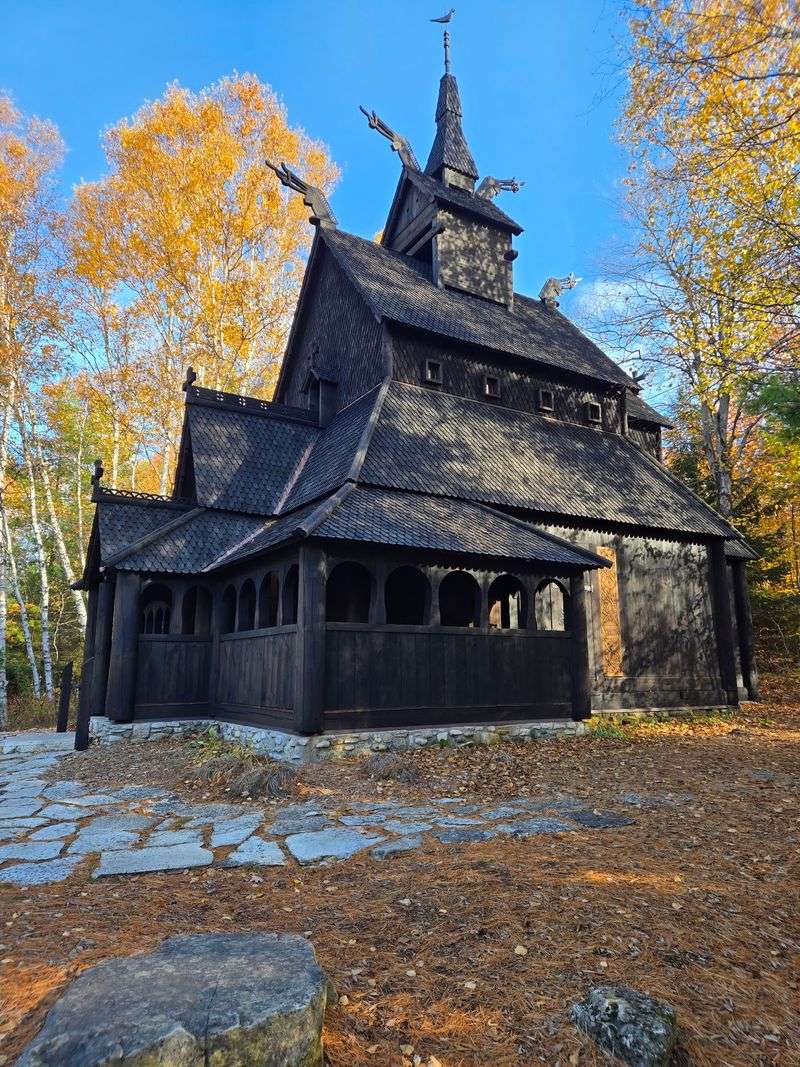
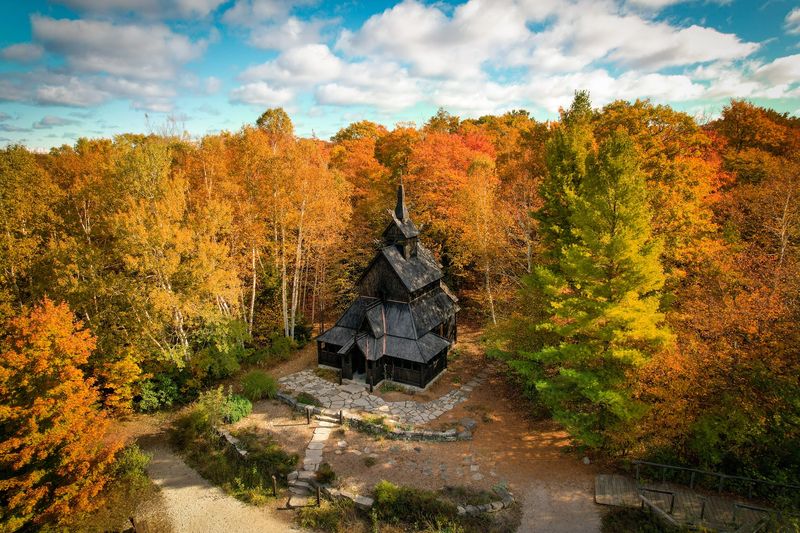
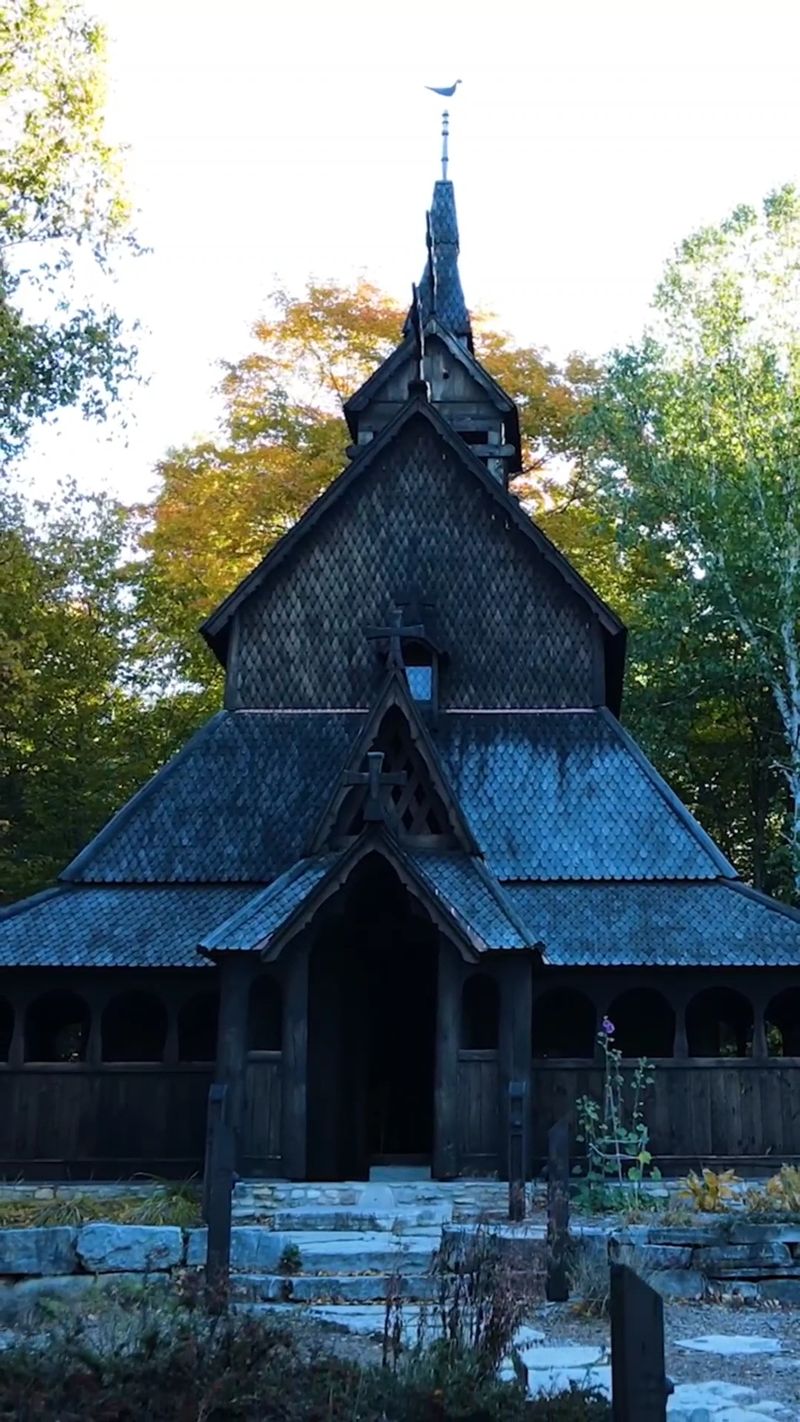
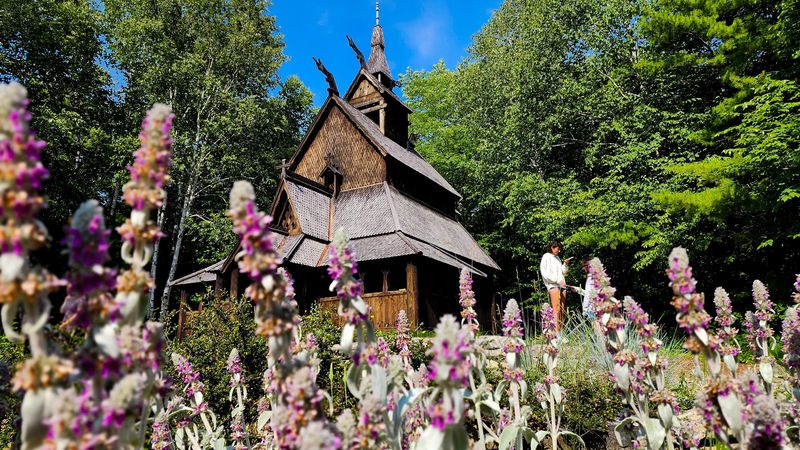
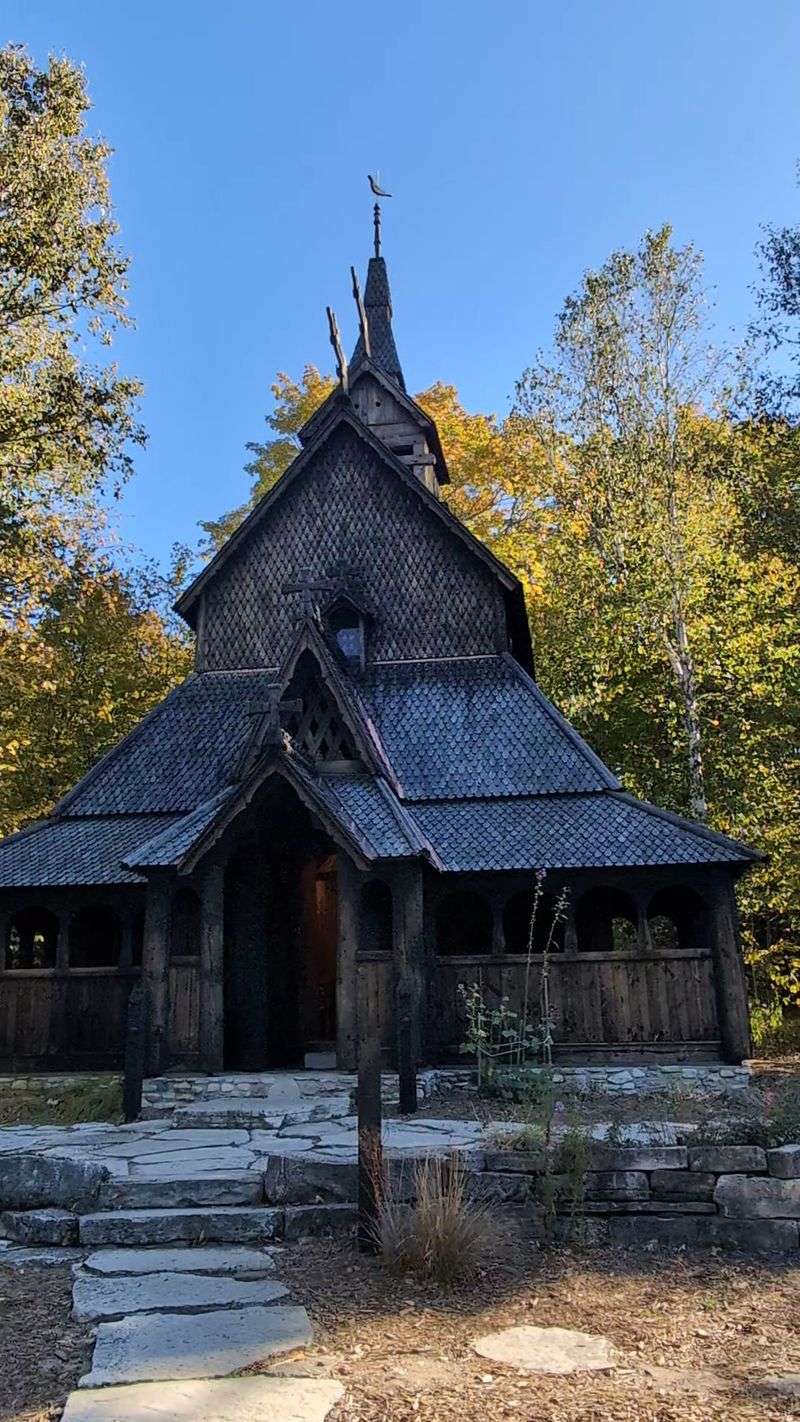
The outside of the Stavkirke is striking in a way that photographs rarely capture fully. The wood has darkened over the years, giving the structure a deep, almost charcoal appearance that contrasts sharply with the green of the surrounding forest.
The roofline is steep and layered, a defining feature of traditional stave church design, with multiple tiered levels rising toward a central spire. At the peaks, carved details reference the dragon-head ornamentation found on original Norwegian churches, a nod to the pre-Christian artistic traditions that were folded into early Scandinavian Christian architecture.
The overall silhouette is compact but vertical, drawing the eye upward in a way that feels intentional and commanding. The structure is not large by any standard measure, but its proportions and detailing give it a presence that feels much bigger than its footprint.
First-time visitors frequently describe being caught off guard by how striking it is up close.
Inside the Church Walls
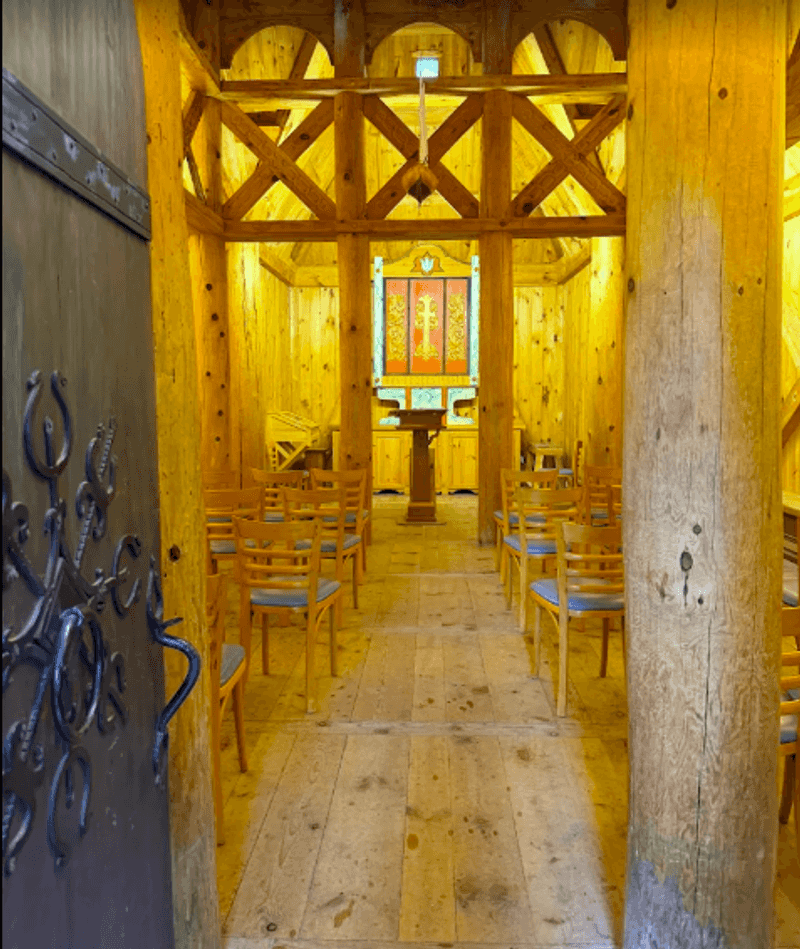
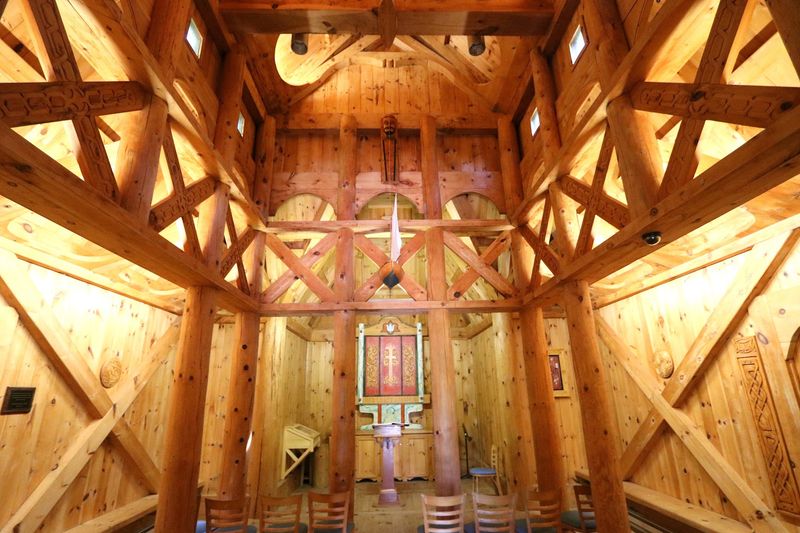
The interior of the Stavkirke is where the craftsmanship becomes most apparent. Carved wooden details cover the walls and structural elements, each one shaped by hand to reflect traditional Scandinavian motifs and faith-based imagery.
The space is modest in size but rich in detail. Wooden chairs line the interior, and the ceiling draws the eye upward along the vertical stave columns that give the building its name.
Natural light filters in through small windows, keeping the atmosphere subdued and focused.
The church can be rented for private ceremonies, including weddings, which gives the space a living function beyond its role as a historical landmark. Being inside the Stavkirke tends to quiet people down in a way that larger, more elaborate churches sometimes do not.
The simplicity of the materials and the closeness of the carved wood create an environment that feels deliberately human in scale, which adds to its overall impact on anyone who steps through the door.
The Prayer Path Through the Woods
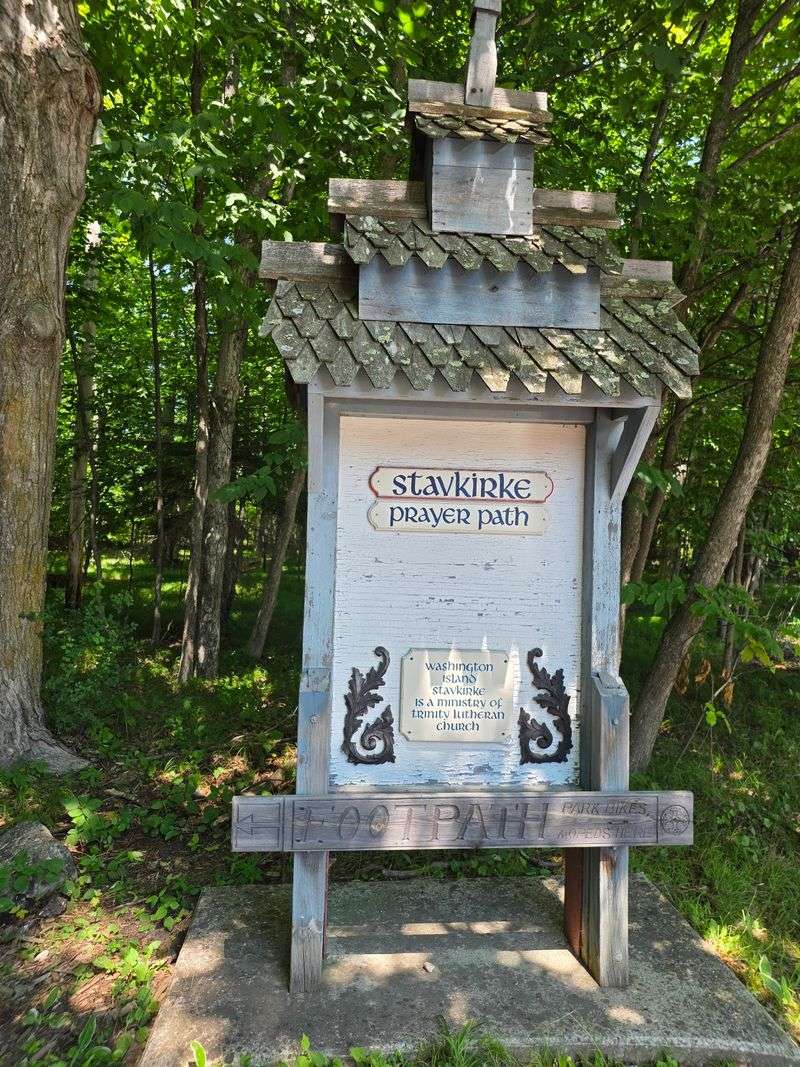
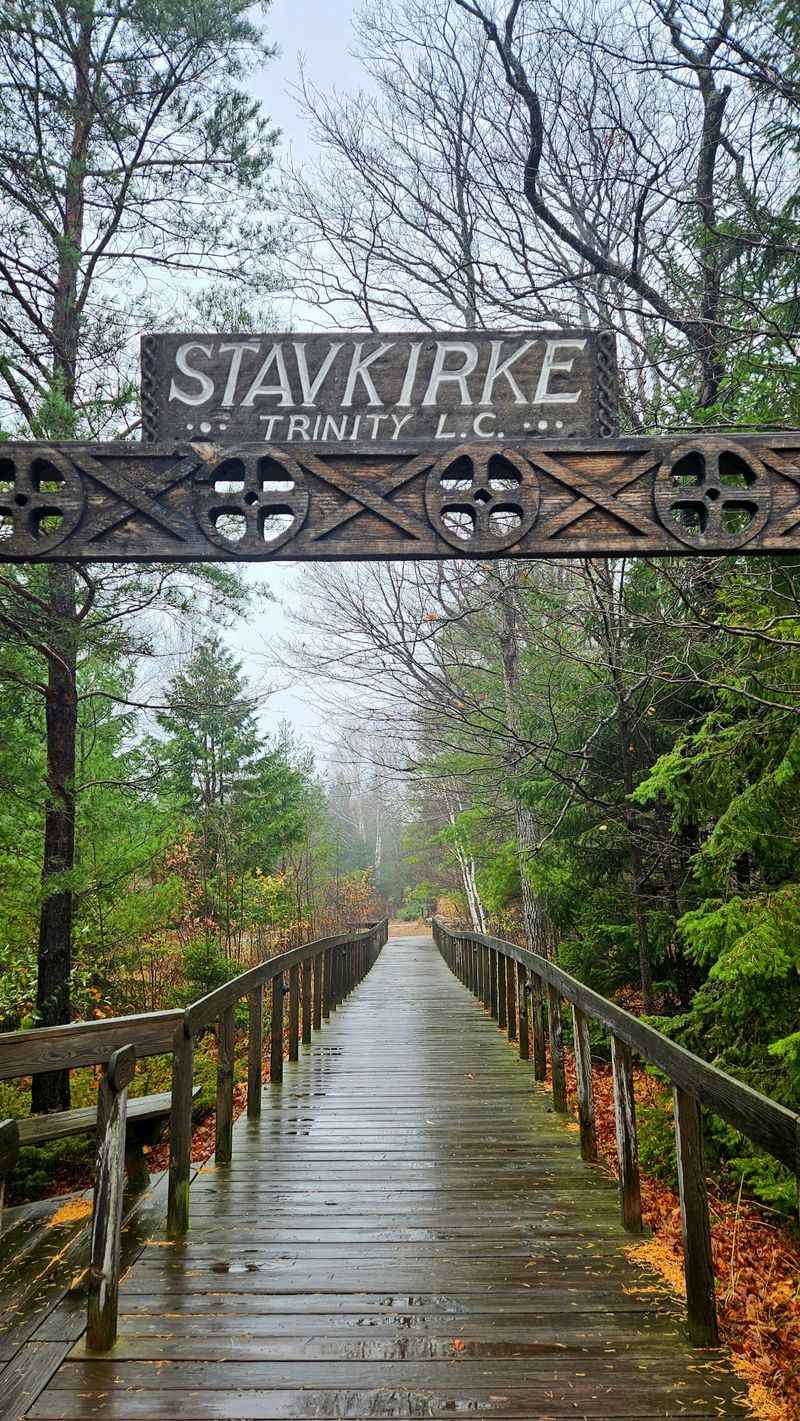
Beyond the church itself, the surrounding grounds offer a quiet walking experience that many visitors find just as meaningful as the building. A wooded prayer path winds through the trees behind the Stavkirke, providing a short but genuinely pleasant route through the forest.
The path is not long, and it is manageable for most fitness levels, including older adults. In spring, wild daffodils have been known to carpet the forest floor along the trail, adding unexpected color to the green and brown of the woodland setting.
The trail is maintained as part of the overall church property and reflects the same level of care that goes into the building itself. For those who want a few minutes of quiet movement before or after visiting the church, the path provides exactly that.
The combination of the walk and the architecture gives the whole site a rhythm that feels complete rather than rushed, which is a rare quality in a roadside landmark.
The Rock Labyrinth on the Grounds
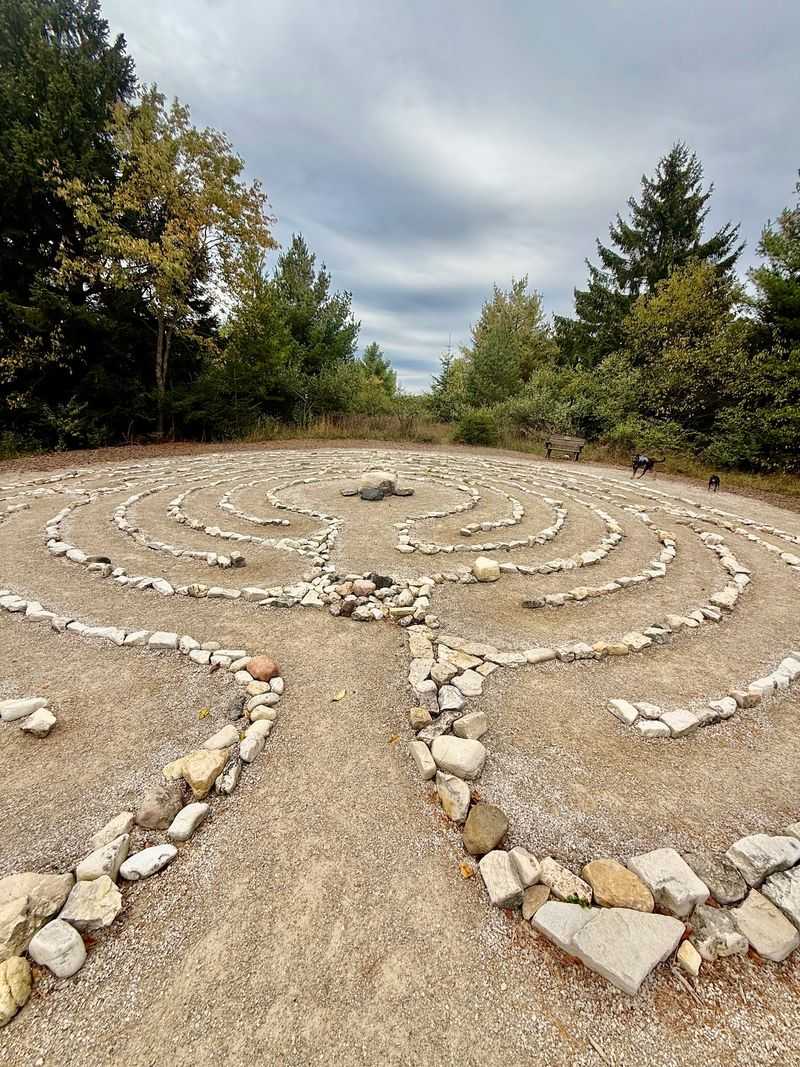
A rock labyrinth on the Stavkirke grounds adds another layer to what the site has to offer. Unlike a maze, a labyrinth has a single winding path that leads to the center and back out again, used historically as a tool for walking meditation and prayer.
The one at the Stavkirke is set into the natural landscape of the property, constructed from stones arranged in the traditional circular pattern. Visitors who engage with it often find the slow, deliberate walking pace a useful shift from the speed of everyday travel.
Labyrinths have been used in Christian contemplative practice for centuries, and their presence here connects the Stavkirke to a broader tradition of sacred outdoor spaces. The rock labyrinth is free to use and open at all hours, just like the rest of the property.
It is a small addition in terms of size, but for those who take the time to walk it, it tends to leave a lasting impression.
Washington Island and Its Scandinavian Heritage
The Stavkirke does not exist in a cultural vacuum. Washington Island has one of the highest concentrations of Icelandic descent in the United States, and Scandinavian heritage runs deep through the community’s history, traditions, and local identity.
Early settlers from Iceland and Norway arrived on the island in the 19th century, drawn by fishing opportunities and the promise of land. Their descendants still live on the island today, and the Stavkirke stands as a physical expression of that unbroken connection to a northern European past.
Understanding that context changes how the church reads as a landmark. It is not a novelty built for tourism, though tourists certainly enjoy it.
It is a community statement about who the people of Washington Island are and where they come from. That distinction matters, and it gives the site a weight and authenticity that a purely decorative reproduction would never carry.
The heritage behind it is very much alive.
When and How to Visit the Island
Getting to Washington Island requires a ferry ride from Northport Pier at the tip of the Door County Peninsula. The ferry runs regularly throughout the year, though schedules vary by season, and summer months bring the heaviest traffic.
The crossing takes about 30 minutes and offers a clear view of the open water between the mainland and the island. Visitors can bring their vehicles aboard, which makes getting around the island much easier once you arrive.
The Stavkirke is located on Town Line Road and is straightforward to find once you are on the island.
Visiting on a weekday, particularly early in the morning or later in the afternoon, tends to result in a quieter experience at the church. The site is open around the clock every day of the year, so there is genuine flexibility in timing a visit.
Parking is available near the entrance, and the walkway from the lot to the church is designed for easy access.
Free to Visit, Priceless to Experience
Admission to the Stavkirke costs nothing. The site is free to visit at any time, which makes it one of the more generous cultural landmarks in the entire Great Lakes region.
There are no tickets, no timed entry windows, and no fees for walking the prayer path or the labyrinth.
That open-access policy reflects the community spirit behind the site. Trinity Lutheran Church maintains the property not as a revenue source but as a gift to the public and a point of pride for Washington Island.
The result is a landmark that genuinely welcomes everyone, regardless of background or budget.
For travelers already making the trip to Door County or Washington Island, adding the Stavkirke to an itinerary requires almost no extra planning. It is right off the road, clearly accessible, and rewarding in a way that does not require a long time commitment.
A short stop here tends to become one of the most memorable parts of any Washington Island visit.
Why This Place Stays With You
There is something about the Stavkirke that people carry with them long after leaving the island. It is not the most elaborate building in Wisconsin, and it is certainly not the largest.
But the combination of its craftsmanship, its setting, its cultural depth, and its open accessibility creates an experience that feels genuinely rare.
The fact that it was built in the 1990s using centuries-old techniques, by people committed to honoring their heritage, gives it a story worth knowing. The dark wood against the green forest, the carved details at every turn, the quiet of the labyrinth, and the winding path through the trees all work together to create a place that rewards attention.
Washington Island itself is worth the ferry ride for many reasons, but the Stavkirke stands out as a destination with real staying power. It is the kind of place that earns a second visit, which says more about its quality than any rating ever could.
Where Exactly the Stavkirke Stands
Finding the Stavkirke is part of the experience. The church sits at Town Line Rd, Washington, WI 54246, on Washington Island, which is only accessible by ferry from the tip of the Door County Peninsula.
The island itself is a small, tight-knit community with a proud Scandinavian heritage, and the Stavkirke fits naturally into that identity. A wooden ramp leads from the parking area to the church entrance, making the site accessible to a wide range of visitors including seniors and those with limited mobility.
The grounds are open 24 hours a day, seven days a week, and there is no admission fee. The church is connected to Trinity Lutheran Church, which maintains the property with obvious care.
Visiting on a weekday tends to mean fewer people around, giving the site a quieter, more reflective quality that many find worth planning around.
Share this story