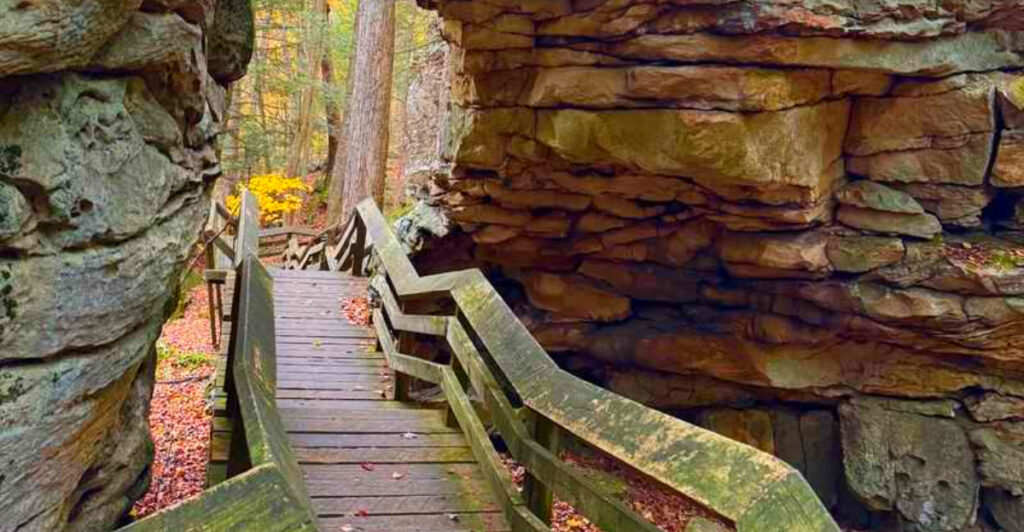
High in the West Virginia mountains, a wooden boardwalk disappears between towering sandstone walls, mossy boulders, narrow passages, and shadowy crevices formed from rock roughly 300 million years old. The entire journey is only about half a mile, but the landscape feels worlds removed from an ordinary forest trail.
Then there’s something even stranger hiding between the rocks: pockets of air that remain remarkably cold during summer, with ice and snow reportedly lingering in the deepest crevices as late as July.
It’s a short walk through one of West Virginia’s most unusual landscapes—and the story behind this natural stone maze only gets stranger.
A Stone City Hidden on a Mountain Ridge
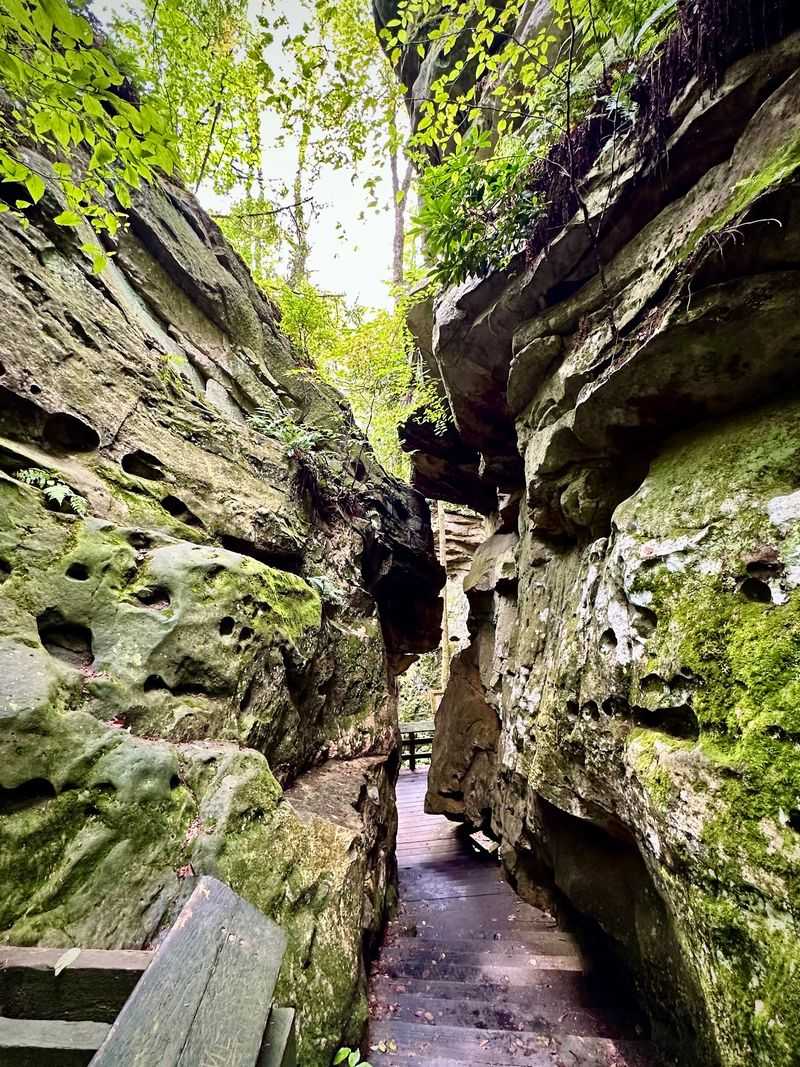
Most people drive past Droop Mountain without ever suspecting what is hiding on its eastern summit. Beartown State Park, located along Beartown Road in Renick, WV 24966, sits within a 110-acre natural area straddling northern Greenbrier County and a small portion of Pocahontas County. The park can be reached by phone at (304) 799-4087 and is open daily from 7 a.m. to 10 p.m.
The moment you arrive, the landscape shifts in a way that feels almost theatrical. Towering sandstone boulders crowd together in tight clusters, separated by narrow passages and deep crevices that seem to go on forever. The formations are so densely packed and so regularly shaped that early visitors compared the area to a miniature town carved entirely from stone.
That comparison gave the park its evocative name, and once you see it in person, the nickname makes perfect sense. The sheer density and scale of the formations here set it apart from anything else in the Mountain State.
300 Million Years Written in Sandstone
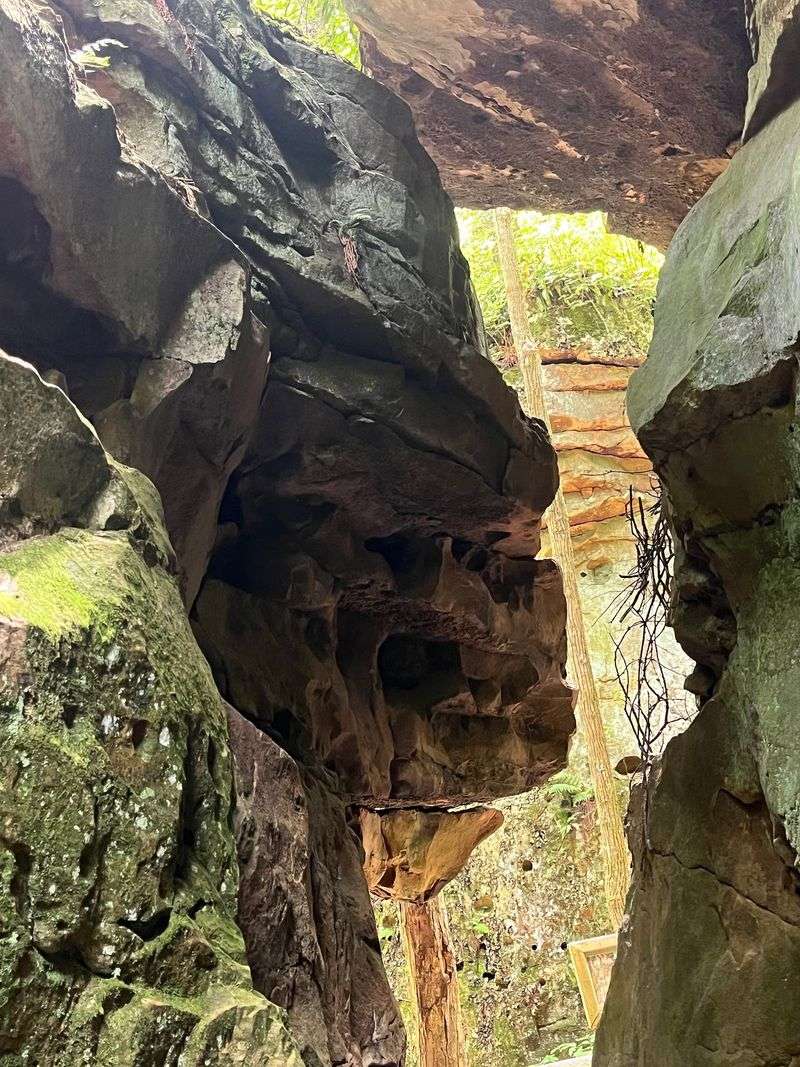
The rocks at this park are not just old; they are Pennsylvanian-age old, formed during the Paleozoic Era roughly 300 million years ago. The specific rock type is Droop Sandstone, also called Pottsville Sandstone, a hard, durable material that once capped the mountain and resisted erosion far better than the softer shale layers beneath it.
As those underlying shale layers gradually wore away over countless millennia, the sandstone above began to fracture and slump. The fractures followed predictable fault lines, producing the roughly cubic shapes and clean vertical walls that give the formations their surprisingly geometric appearance. Geologists call this process differential weathering, and the results here are extraordinary.
You can see the layering in the rock faces up close, horizontal bands that record ancient shifts in sediment and pressure. Running your hand along the stone, you feel the gritty texture of compressed sand grains from a world that existed long before any human set foot on this continent. The geology here is genuinely jaw-dropping.
The Boardwalk That Makes It All Possible
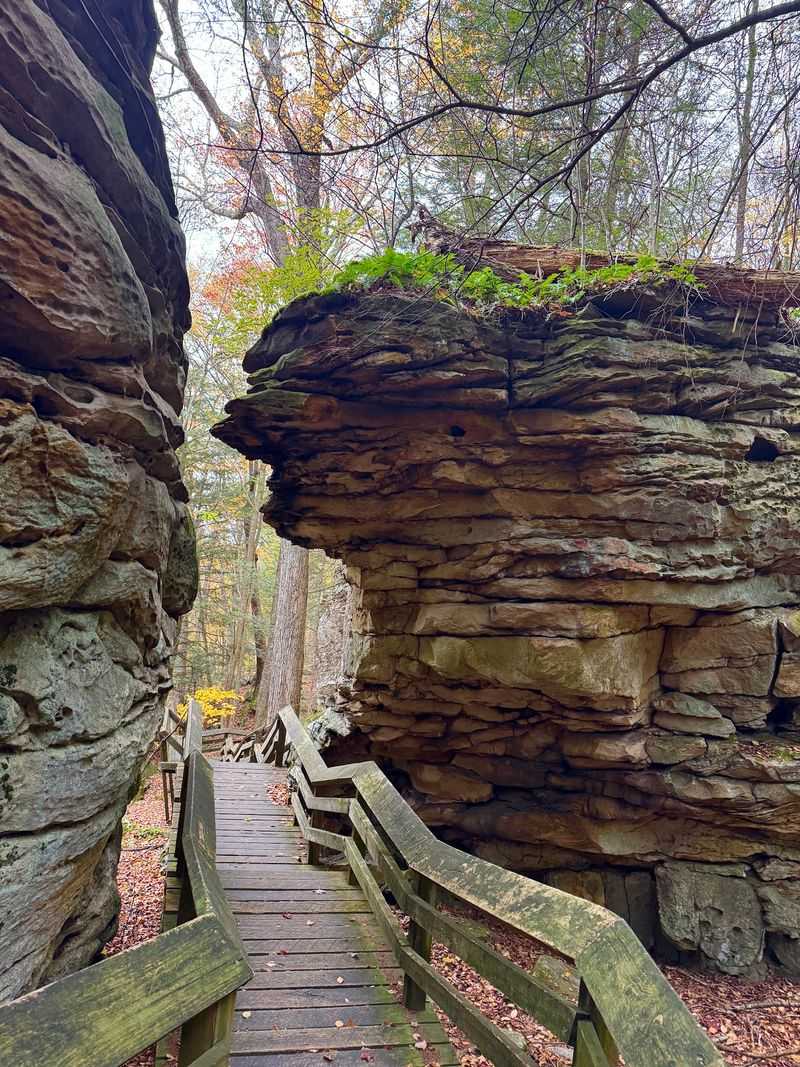
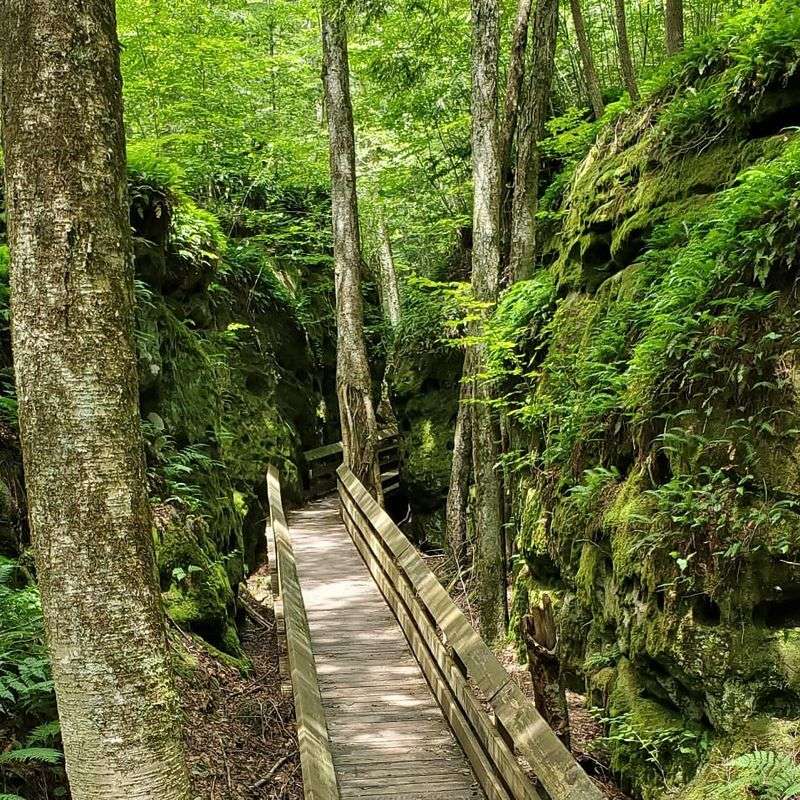
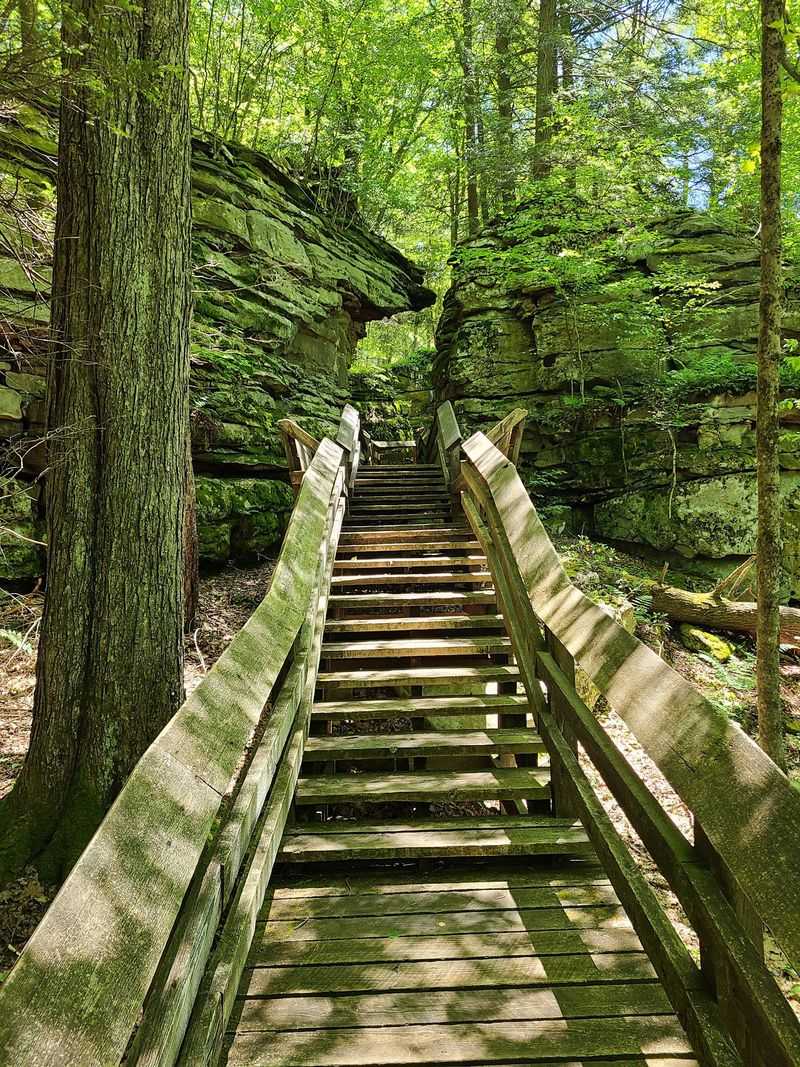
A half-mile loop boardwalk serves as the backbone of the entire park experience, and it is genuinely well-designed. The wooden path winds intimately between the rock formations, dipping into crevices and rising up alongside overhanging cliffs in a way that feels more like exploration than a simple nature walk.
The boardwalk is one-directional, which keeps foot traffic flowing smoothly and prevents that awkward shuffle when two groups meet head-on in a narrow passage. Several sections include stairs that follow the natural topography, adding a gentle rise and fall to the journey without making it physically demanding. A separate wheelchair-accessible path branches off from a second parking area nearby and leads to a scenic overlook.
Informative signs are posted throughout the trail, explaining the geology, plant life, and ecological significance of specific features along the way. Benches are placed at strategic points for anyone who wants to slow down and soak it all in. The whole loop takes about 20 to 45 minutes depending on your pace, and every minute feels worthwhile.
Why Bears and Boulders Share the Same Name
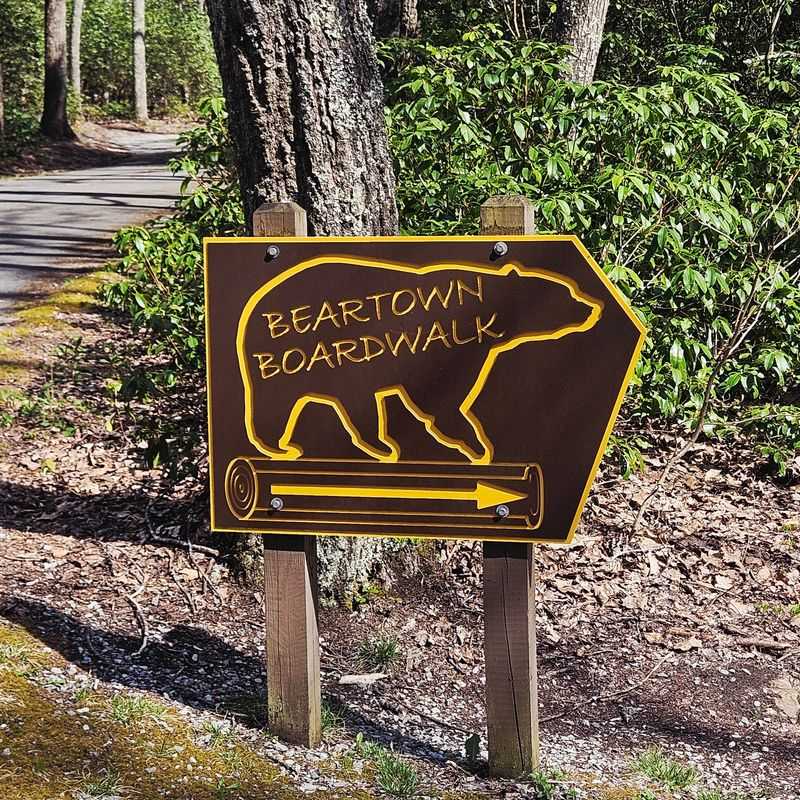
The name Beartown has two layers of meaning, and both are rooted in the real character of this place. Black bears historically used the deep, sheltered crevices within the rock formations as winter dens. The cool, dark recesses created by the tightly packed boulders offered ideal conditions for hibernation, and local residents observed this behavior regularly enough to name the area after it.
The second layer of the name comes from the formations themselves. Viewed from above, the deep narrow passages between the boulders form a surprisingly regular grid-like pattern, resembling the streets and alleys of a small, uninhabited town. Early settlers looked at this stone labyrinth and saw a community of sorts, just one with no doors, no windows, and no residents other than wildlife.
Both meanings stack together perfectly, a town made of rock that also happens to be prime bear real estate. No bear sightings are guaranteed on your visit, but the knowledge that the park earned its name honestly adds a satisfying layer of intrigue to every shadowy crevice you peer into.
The Surprising Story Behind Its Preservation
Beartown became a state park in 1970 through a collaboration between the Nature Conservancy and a deeply personal act of generosity. Mrs. Edwin G. Polan donated the land in memory of her son, Ronald Keith Neal, a local soldier who lost his life during the Vietnam War. That gift transformed a remarkable natural area into a lasting public memorial.
Since its acquisition, the park has been managed with a deliberate philosophy of minimal development. There are no concession stands, no sprawling visitor centers, and no manicured lawns. The focus has always been on letting the landscape speak for itself, which is why the park retains such a profound sense of wildness even today.
That restraint in development is part of what makes a visit here feel so different from more commercialized outdoor destinations. You are not surrounded by infrastructure; you are surrounded by ancient stone and living forest. The boardwalk exists to protect the fragile terrain underfoot, not to impose a human presence on the landscape. The result is a place that feels genuinely untouched.
A Living Green World Tucked Between the Rocks
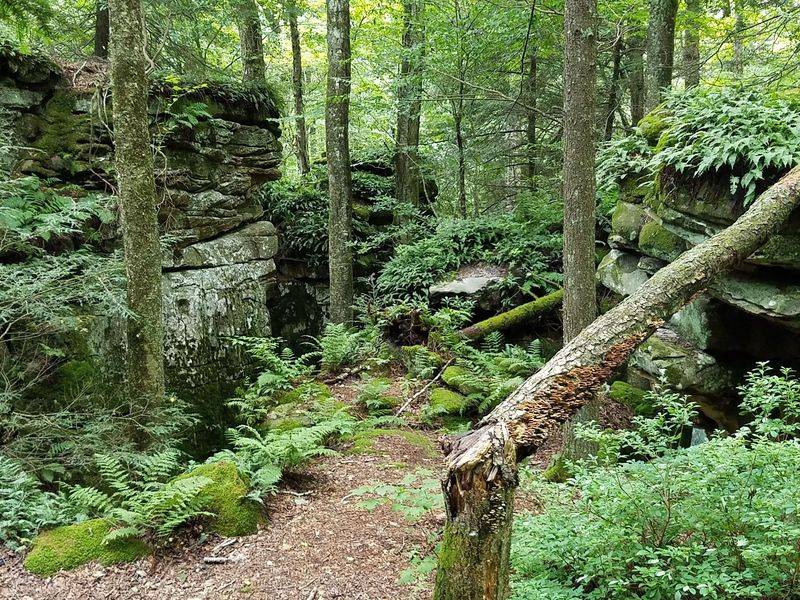
The plant life at this park is as remarkable as the geology. Ancient hemlock trees stretch upward above the rock formations, creating a dense canopy that filters sunlight into soft, shifting patterns on the forest floor below. Beneath those hemlocks, a rich layer of ferns, mosses, and lichens covers nearly every available surface.
Rock-cap ferns are particularly abundant, clinging to the sandstone faces with a tenacity that seems almost stubborn. Their bright green color against the gray stone creates a visual contrast that photographers absolutely love. The consistently cool and moist microclimate created by the rock formations supports plant species that would struggle to survive in the warmer, drier conditions of the surrounding hillsides.
Birdwatchers will find plenty to keep them busy as well. Warblers are frequently spotted flitting through the canopy, and the dense undergrowth provides cover for a variety of other species. Deer, bobcats, and smaller mammals also call this ecosystem home, making the park a rewarding destination for anyone who enjoys watching the natural world go about its business undisturbed.
The Cool Air That Defies the Calendar
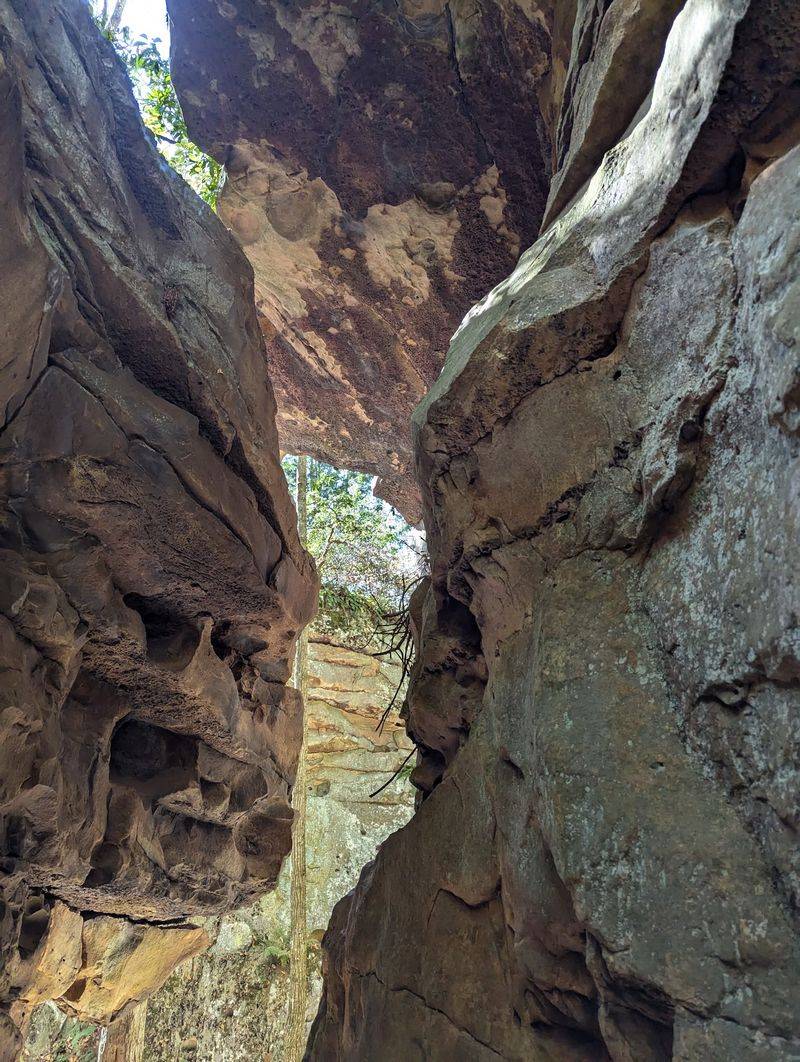
One of the most genuinely surprising features of this park is its persistent coolness. Even on hot summer days, the air inside the deeper crevices feels noticeably chilly, almost refrigerator-cold in the narrowest passages. This is not a minor detail; it is a defining characteristic of the place that visitors mention repeatedly.
The phenomenon happens because the massive, densely packed rock formations retain cold temperatures deep within their shadowed interiors long after the surrounding landscape has warmed. Ice and snow have been documented lingering in the deepest crevices well into summer, sometimes as late as July. That is a remarkable natural anomaly for a location in the mid-Atlantic region.
Historically, local residents took practical advantage of this built-in refrigeration. The naturally preserved ice was harvested during summer months, and local lore holds that it was used to make ice cream for Fourth of July celebrations. That detail transforms the park from a purely geological curiosity into a place with genuine human history woven into its cold stone walls. The chill you feel walking through is the same chill people felt here generations ago.
Activities and Ways to Explore
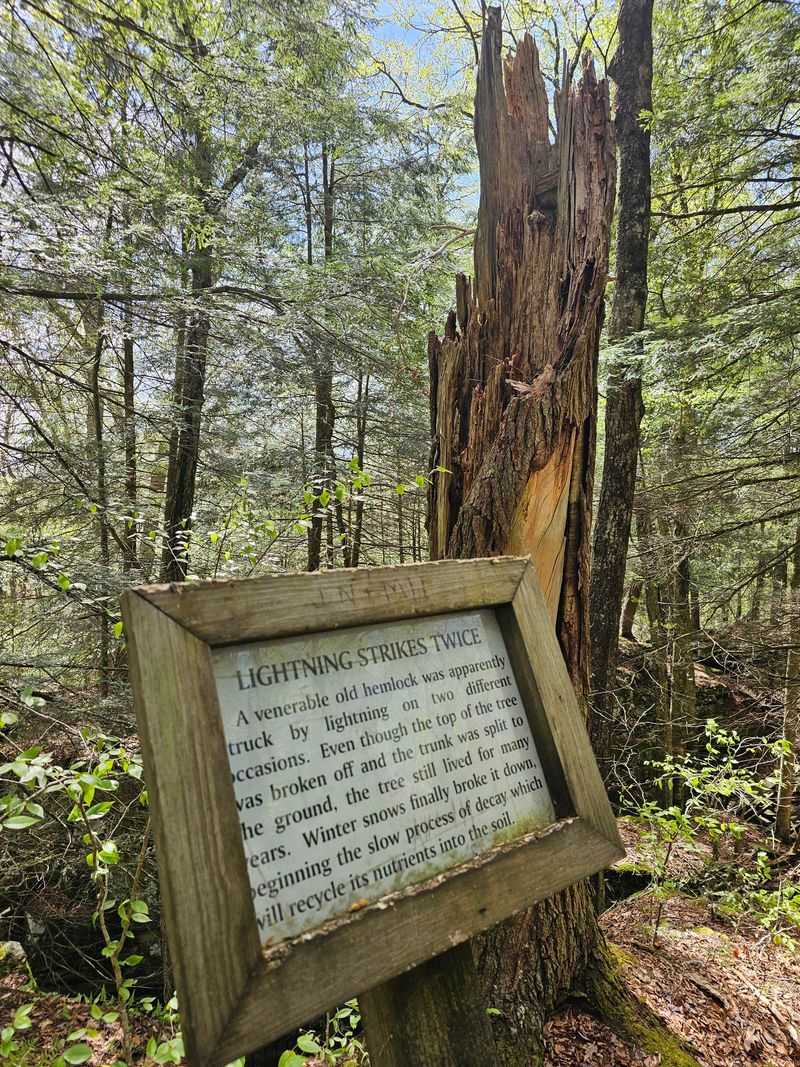
The boardwalk loop is the centerpiece of any visit, but it is worth slowing down and treating it as more than just a walk from point A back to point A. The informative signs posted throughout the trail cover geology, plant identification, and ecological history, and they are genuinely interesting rather than dry or overly technical. Reading each one adds real context to what you are seeing.
Photography is one of the most popular activities here, and for good reason. The interplay of light, shadow, stone, and greenery creates compositions that work well at almost any time of day. Short spur trails branch off the main boardwalk in a few spots, leading to perspectives and viewpoints that the main loop does not offer. Taking those detours is highly recommended.
Picnic tables near the parking area provide a pleasant spot for a meal before or after the walk. Geocaching sites have also been set up within the park for those who enjoy a bit of treasure-hunting alongside their nature appreciation. Dogs are welcome on the trail, which makes this an easy outing for visitors traveling with pets.
What the Atmosphere Actually Feels Like
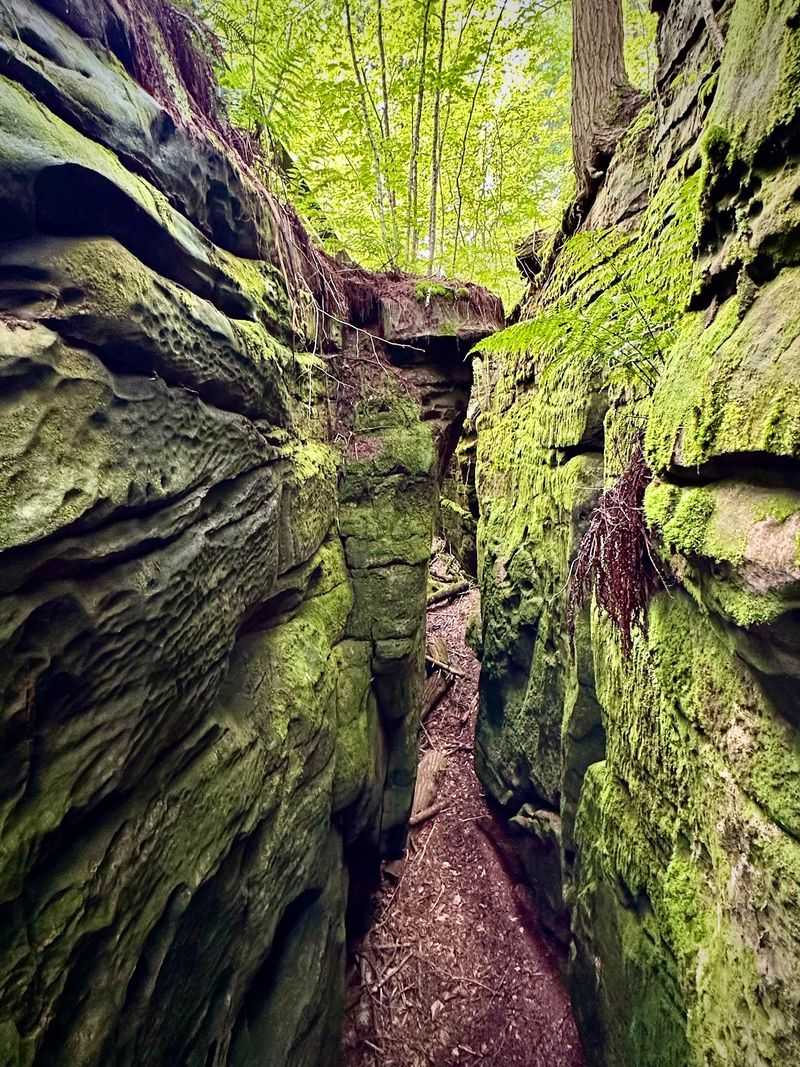
There is a quality to the air inside the rock formations that is hard to describe without sounding dramatic, but here goes: it feels genuinely still. Not quiet in the sense that sound disappears, but still in the sense that time seems to slow down a little. The deep shade, the cool temperature, and the towering stone walls on either side create an atmosphere unlike any standard hiking trail.
Sunlight reaches the boardwalk in dappled patches, creating strong contrasts between bright spots and deep shadow. The effect changes throughout the day as the sun moves, so the formations look different in morning light than they do in the afternoon. Visiting at different times of day is actually worth considering if you have the flexibility.
The sounds of the outside world fade quickly once you are moving between the boulders. What replaces them is a soft rustling of leaves, the occasional birdcall, and the muffled sound of your own footsteps on the wooden planks. The overall effect is genuinely calming, the kind of place that makes people lower their voices without being asked.
Practical Tips Before You Go
Beartown State Park is open daily from 7 a.m. to 10 p.m. during its seasonal operating period, which runs from April through October. Winter closures are typical due to weather conditions, though off-season access may occasionally be arranged. The park entrance is completely free, which makes it one of the best-value outdoor experiences in West Virginia.
Parking is limited to roughly 10 to 15 spaces in the main lot, so arriving early on weekends is a smart move. A second smaller lot near the accessible boardwalk entrance offers a few additional spaces. Restrooms are available at the main parking area, though their condition has been noted as variable by recent visitors.
Footwear matters more here than at most parks. The boardwalk surface becomes very slippery when wet, and the moss on surrounding surfaces adds to the hazard. Sturdy shoes with rubber soles and good traction are strongly recommended. Bringing your own water is essential since the park has no concessions.
The park phone number is (304) 799-4087 for current conditions and updates.
Nearby Adventures Worth Adding to Your Trip
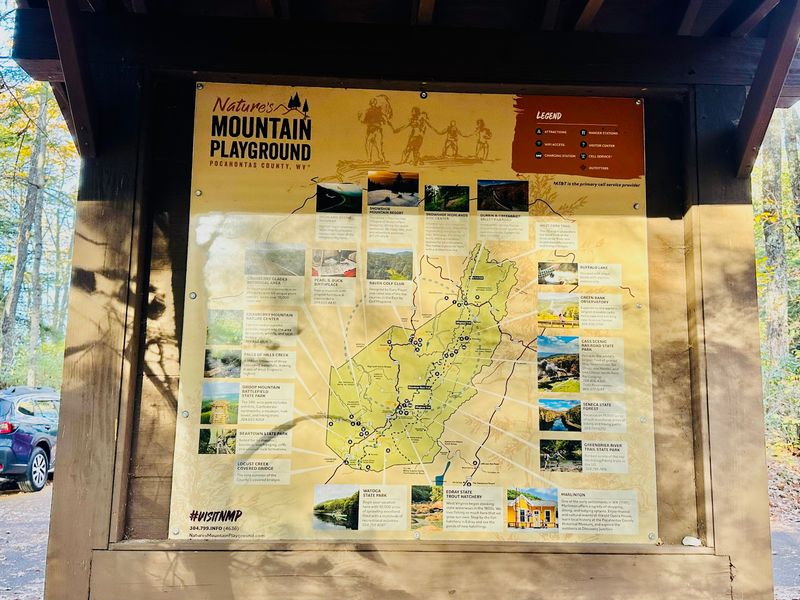
The surrounding region of Greenbrier and Pocahontas County is packed with natural attractions that pair well with a visit to Beartown. Droop Mountain Battlefield State Park sits just five miles away and offers a compelling historical counterpoint to the geological focus of Beartown. Civil War earthworks and forested trails make it a worthwhile stop on the same day.
Watoga State Park, the largest state park in West Virginia, is also close by and provides camping, fishing, and a much longer trail network for those who want to extend their outdoor time in the area. Seneca State Forest is another nearby option with cabin rentals and quiet backcountry access.
For something botanically unique, the Cranberry Glades Botanical Area offers a rare look at a high-altitude bog ecosystem, with boardwalk access through a landscape that feels just as unusual as Beartown in its own way. The Falls of Hills Creek, featuring a series of cascading waterfalls, rounds out the options nicely. This corner of West Virginia rewards those willing to explore beyond the obvious destinations, and Beartown is the perfect starting point for that kind of trip.
Share this story