Kansas has a way of rewarding anyone willing to trade the fast lane for a two-lane highway. The state is bigger and more varied than most people expect, with chalk formations that look like they belong on another planet, prairie landscapes that stretch farther than the eye can track, and historic sites where the past feels genuinely close.
A Sunday drive here does not need a rigid plan or a packed schedule. Some of the best stops are small, free, and surprisingly easy to reach, making it simple to put together a relaxed day on the road.
This list covers 11 places across Kansas that are worth the drive on their own, whether you have an hour to spare or a full afternoon. Each one offers something specific and real, from frontier military history to hand-dug wells to badlands that most people do not even know exist in Kansas.
1. Tallgrass Prairie National Preserve, Strong City, Kansas
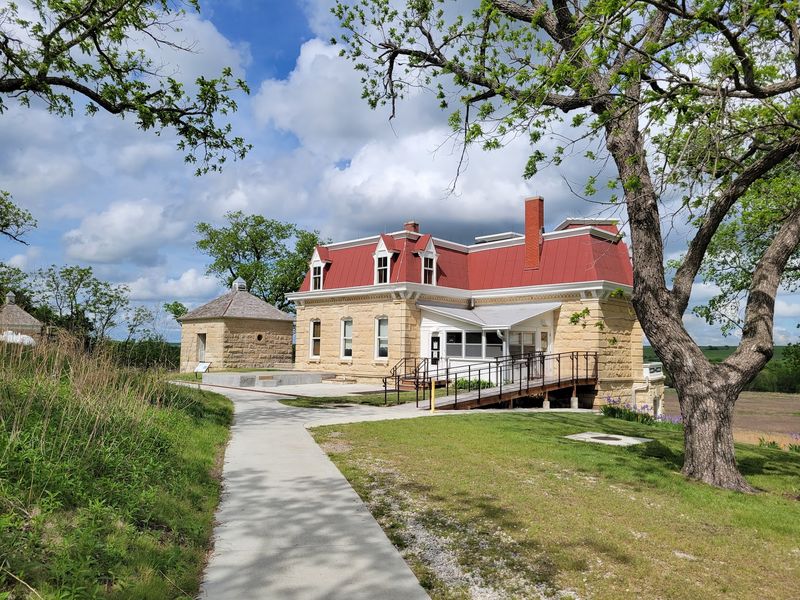
Less than four percent of North America’s original tallgrass prairie still exists, and much of what remains is concentrated right here in the Kansas Flint Hills. The Tallgrass Prairie National Preserve protects nearly 11,000 acres of this increasingly rare landscape, centered around the historic Spring Hill Ranch, established in 1881 by Stephen F.
Jones.
The ranch features an 1880s limestone mansion built in the French Renaissance Second Empire style, a three-story limestone barn, and the Lower Fox Creek one-room schoolhouse. A bison herd of around 100 animals roams the preserve, and visitors can often spot them from the road or trail.
Over 40 miles of trails are accessible around the clock, with self-guided tours available via brochure or cell phone audio. The drive along K-177, part of the Flint Hills National Scenic Byway, rivals the destination itself.
Catch-and-release fishing is also available in three ponds and along Fox Creek with a valid Kansas license.
2. Mushroom Rock State Park, Brookville, Kansas
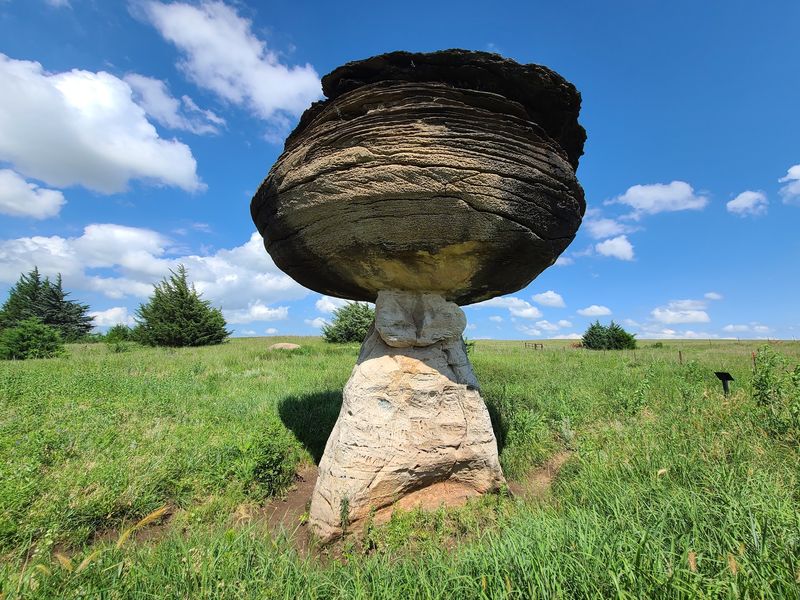
At just five acres, Kansas’s smallest state park manages to be one of its most visually striking. Weathered Dakota sandstone concretions rise from the prairie floor in shapes that genuinely resemble enormous stone mushrooms, with wide elliptical tops balanced on narrower bases.
The largest measures 27 feet in diameter.
These formations date to the Cretaceous Period, roughly 66 to 144 million years ago, when beach sands and marine sediments were deposited in the region. Calcium carbonate acted as a natural cement, creating harder concretions that resisted erosion while the surrounding softer rock wore away over millions of years.
Historically, these distinctive rocks served as meeting places and landmarks for Native American tribes and early pioneers, including figures like Kit Carson and John C. Fremont.
The park sits along the Prairie Trail Scenic Byway, making it a natural short detour on a central Kansas drive. There is no entrance fee, and two short walking trails make it easy to explore.
3. Wilson State Park, Sylvan Grove, Kansas
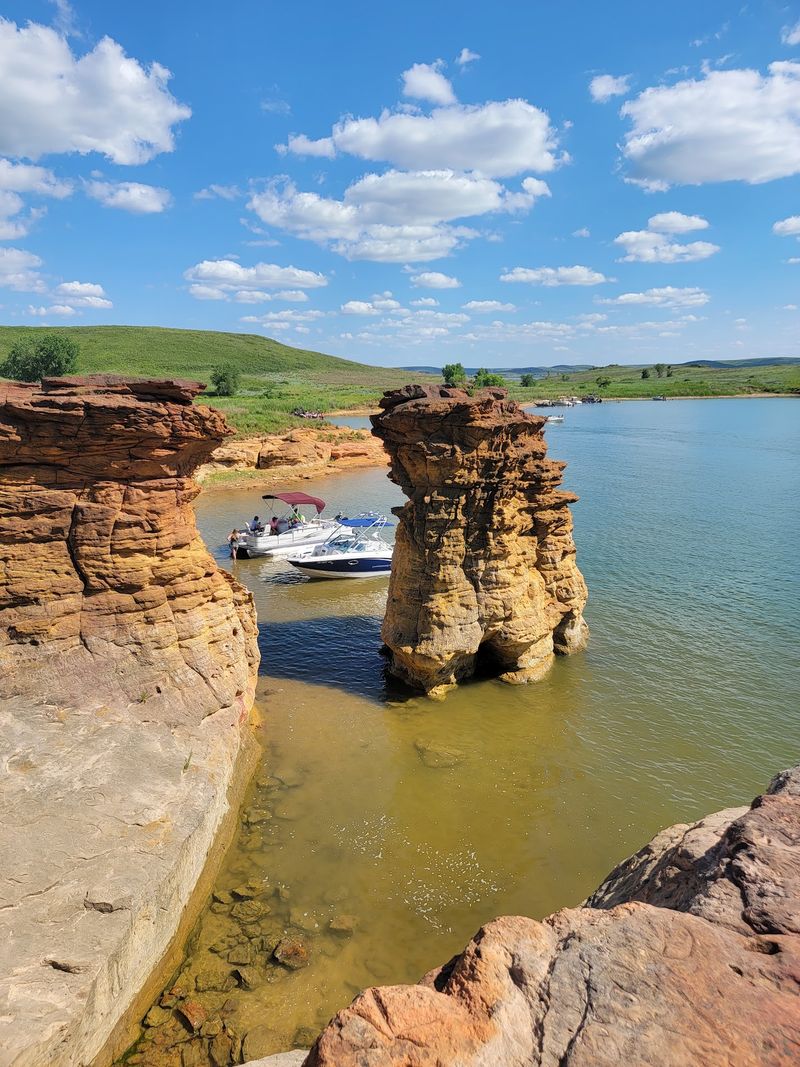
Many who have driven across Kansas name Wilson State Park as the state’s most scenic park, and the view across the reservoir tends to back that claim up quickly. The 945-acre park sits on the south shore of the 9,000-acre Wilson Reservoir, where clear blue water meets rugged limestone bluffs and rolling Smoky Hills terrain.
The park is divided into two areas, Hell Creek and Otoe, each with its own road access and distinct character. The Post Rock Scenic Byway runs nearby, a route historically notable for limestone fence posts that homesteaders crafted in the 1860s when timber was scarce on the Kansas plains.
Hikers can choose from the easy one-mile Cedar Trail or the more adventurous Dakota Trail with reservoir views. Mountain bikers have access to the world-class 25-mile Switchgrass Trail.
Anglers target walleye, white bass, striped bass, and crappie, while modern cabins and utility campsites make it easy to extend a Sunday drive into a weekend.
4. Alcove Spring Park, Blue Rapids, Kansas
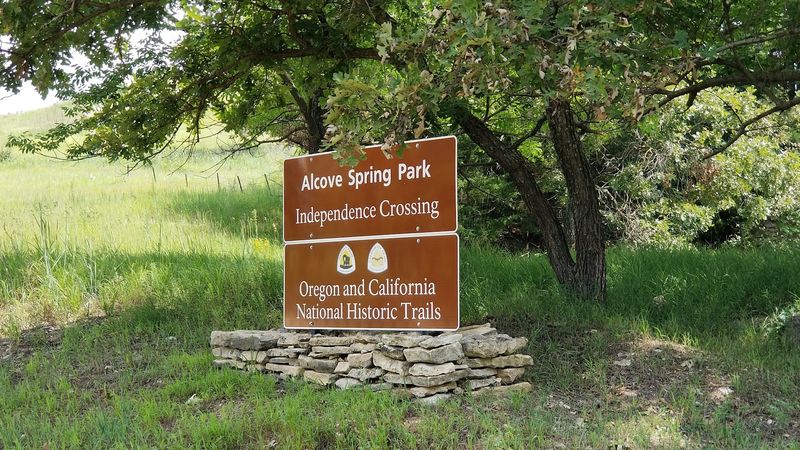
History has a way of feeling abstract until you stand somewhere that emigrants literally carved their names into stone. Alcove Spring Park, near Blue Rapids, served as a critical campsite for travelers on both the Oregon and California Trails, who paused here waiting for the Big Blue River to drop to safe fording levels.
The park is perhaps best known as the site where the Donner Party camped in 1846. It was here that Sarah H.
Keyes, the mother-in-law of James F. Reed, passed away, marking the group’s first recorded loss on their ill-fated journey west.
Some of the emigrant carvings, including dates from 1846, are still visible on the rocks today.
Alcove Spring covers approximately 300 acres of tallgrass prairie, hardwood forest, and scenic overlooks. A short quarter-mile trail leads from the parking area to the spring and its ten-foot waterfall, which flows most reliably in spring.
Visible trail swales from wagon traffic remain across the road from the lot, offering a tangible connection to the past.
5. Little Jerusalem Badlands State Park, Oakley, Kansas
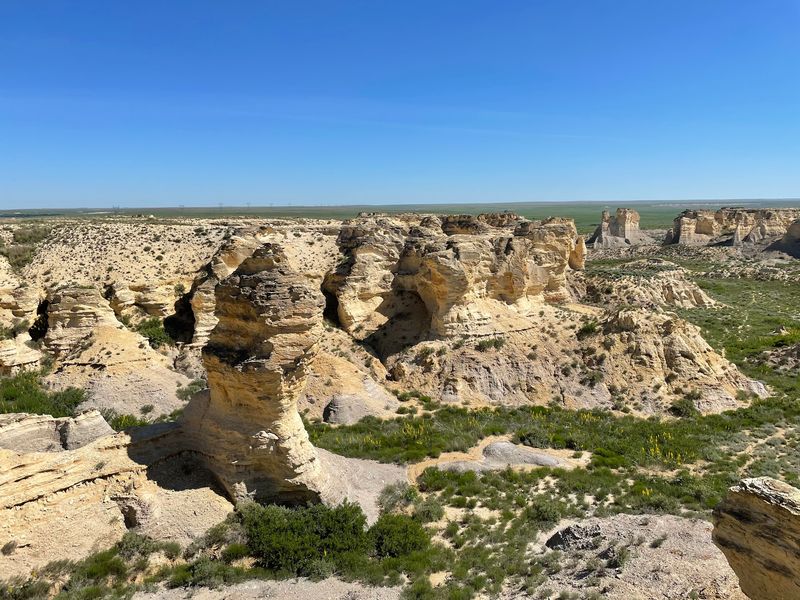
Western Kansas does not always get credit for dramatic scenery, but Little Jerusalem Badlands State Park makes a strong case for a second look. This 332-acre park protects Kansas’s largest exposed expanse of Niobrara Chalk formations, with pinnacles, hoodoos, and steep cliffs reaching over 100 feet above the Smoky Hill River valley.
The chalk originated about 80 to 85 million years ago on the floor of the Western Interior Seaway, a vast inland sea that once covered much of central North America. Early pioneers who saw the pale spires rising from the prairie named the place “Little Jerusalem,” believing the formations resembled the ancient walled city.
The park is co-managed by The Nature Conservancy and the Kansas Department of Wildlife and Parks, and it is home to the world’s largest population of Great Plains wild buckwheat, found exclusively in Kansas chalk bluffs. Two marked trails, including the 1.5-mile Life on the Rocks Trail, allow visitors to explore without disturbing the fragile terrain.
The park is open daily from sunrise to sunset, with a $5 daily vehicle permit required.
6. Monument Rocks, Oakley, Kansas
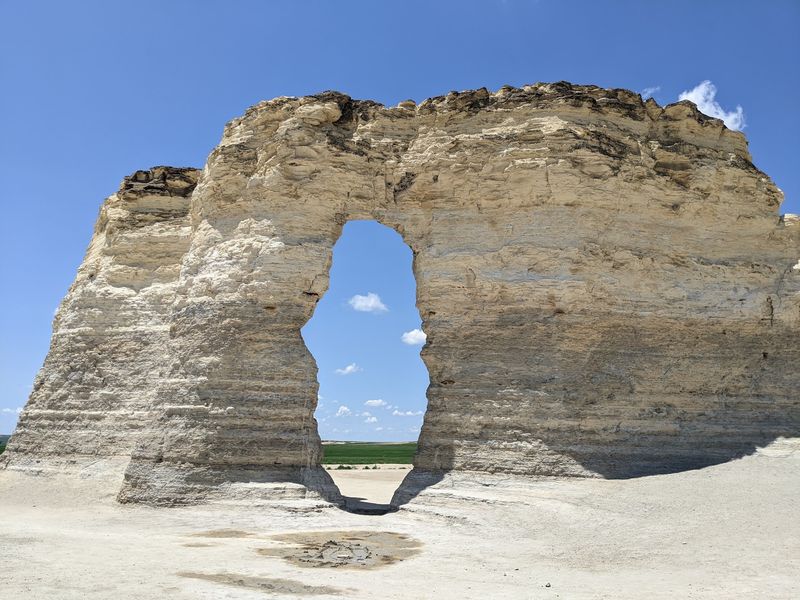
Out on the western Kansas plains, where the road seems to go nowhere in particular, Monument Rocks appears without warning. Also called the Chalk Pyramids, these massive Niobrara formations reach 50 to 70 feet tall and include towers, spires, and a natural arch known as the Keyhole, all rising from otherwise flat, open country.
The chalk accumulated on the floor of the Western Interior Seaway roughly 80 to 87 million years ago, and erosion has been carving it into its current shapes ever since. Monument Rocks holds the distinction of being the first National Natural Landmark designated in Kansas, recognized in 1968 by the Department of the Interior.
In 2006, it was voted one of the 8 Wonders of Kansas.
The site is on private land, but the owners permit public access from dawn until dusk, weather allowing, at no charge. Visitors are expected to follow strict guidelines: no climbing, no fossil collecting, no camping, and no fires.
The approach involves unpaved roads that can become difficult after rain, so checking conditions before heading out is a smart habit.
7. Coronado Heights Castle, Falun, Kansas
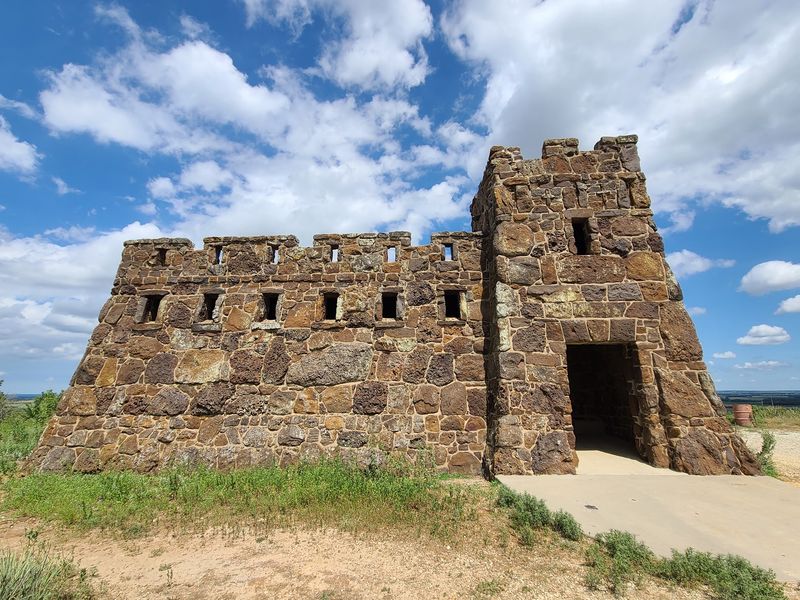
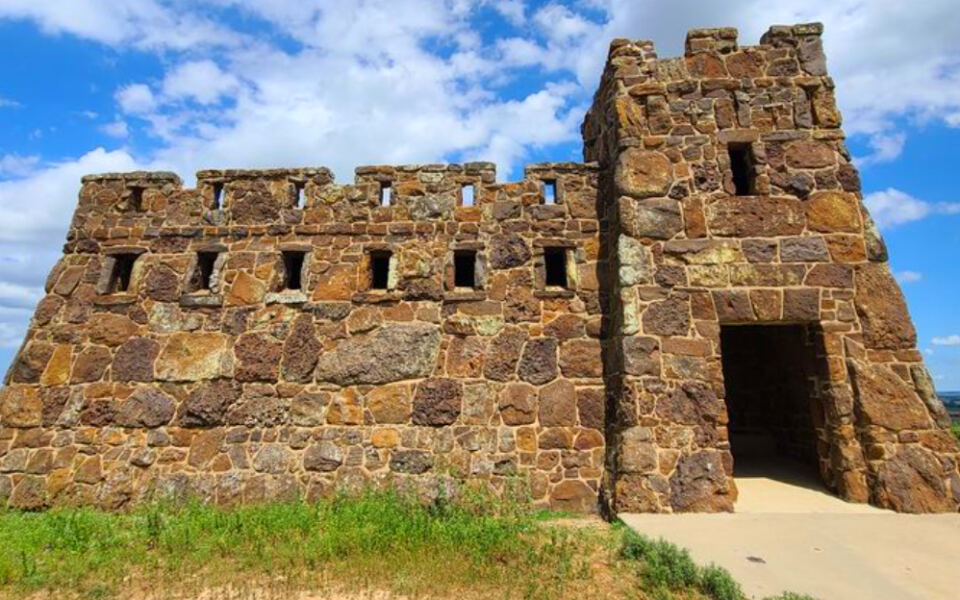
Perched on a 300-foot bluff in the Smoky Hills, this small stone structure commands views that stretch up to 35 miles on a clear day. Built during the Great Depression as a Works Progress Administration project and completed in 1936, the castle-style shelter was constructed entirely from native Dakota sandstone.
The site is named for Spanish explorer Francisco Vasquez de Coronado, who may have surveyed the surrounding prairie from this vantage point in 1541 during his search for the fabled Seven Cities of Gold. Chain mail believed to be from Spanish armor was reportedly discovered near the site in 1915, adding a layer of genuine historical mystery.
Coronado Heights is recognized as one of the 8 Wonders of Kansas Geography and was added to the National Register of Historic Places in 2010. A three-mile winding road leads to the summit, and a mountain bike trail loops around the base.
The park is open daily from 8 AM to 11 PM.
8. Lake Scott State Park, Scott City, Kansas
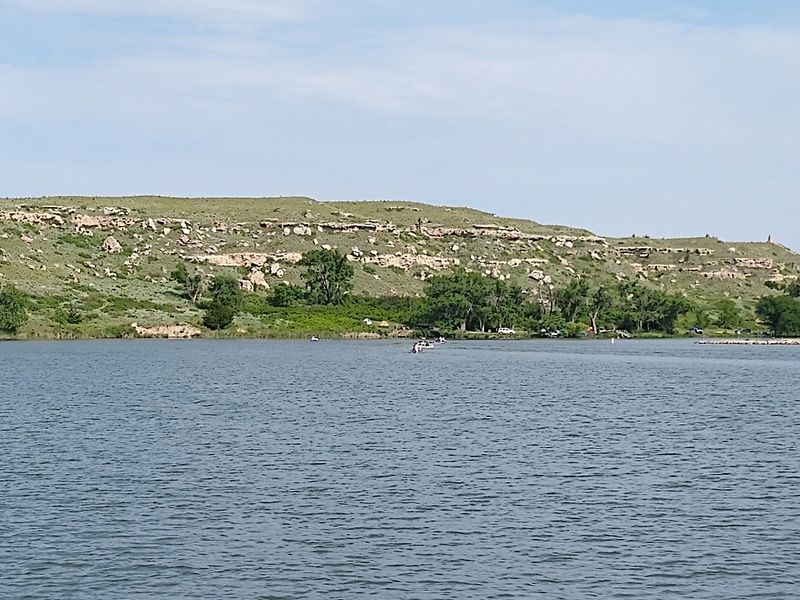
National Geographic named Lake Scott one of America’s 50 must-see state parks, which is a notable endorsement for a destination that most people driving across western Kansas would never guess exists. Tucked into a valley carved through the Ogallala Formation, this 1,150-acre park features a 100-acre spring-fed lake, wooded canyons, and natural springs, including Big Spring, which produces around 400 gallons of water per minute.
The park carries significant cultural history. The El Cuartelejo ruins, a National Historic Landmark, represent the only known Indian pueblo in Kansas and the northernmost pueblo in the United States, built by Taos Indians in 1664.
The preserved Steele Home, a pioneer dwelling from 1888, functions as an onsite museum. Battle Canyon, just south of the park, marks the site of the last Native American battle in Kansas, occurring in 1878.
Recreational options include hiking, fishing, swimming, and paddleboat rentals. The park pairs naturally with nearby Little Jerusalem Badlands for a full and varied day on the road through western Kansas.
9. Chase State Fishing Lake, Cottonwood Falls, Kansas
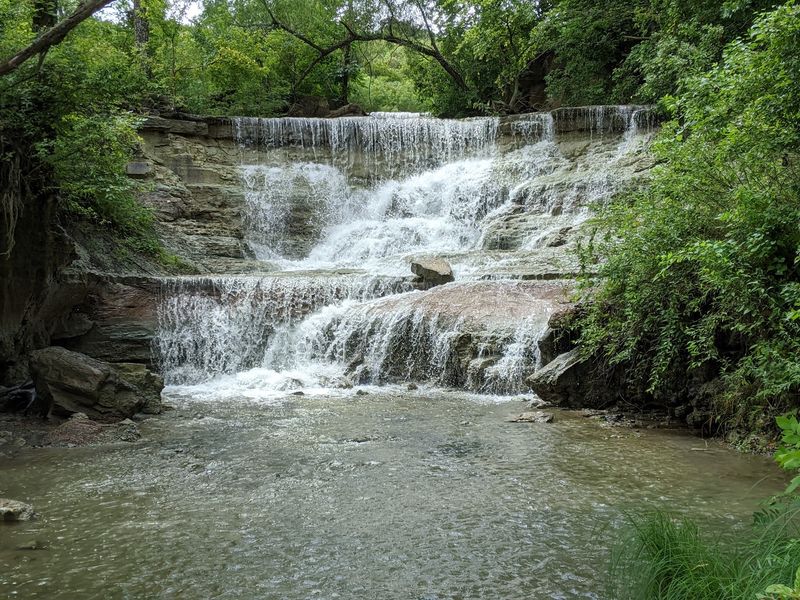
Just 1.5 miles west of Cottonwood Falls, this 109-acre lake sits quietly in the heart of the Flint Hills, surrounded by native grass prairie and rocky Permian limestone shoreline. It is often described as one of Kansas’s prettiest little lakes, a reputation built in part on the 40-foot waterfall that drops over a series of limestone shelves just below the dam.
That waterfall is a genuine rarity in Kansas and is most impressive after spring rains when Prairie Creek is running well. The geology along the lake’s edge dates back 252 to 299 million years, and visitors willing to look closely may find fossils of crinoids and brachiopods along the rocky shore.
Anglers find channel catfish, largemouth bass, saugeye, crappie, and bluegill in the lake. Eight fishing piers and a boat ramp make access straightforward.
Primitive camping is available on a first-come, first-served basis along the north shore, with fire rings, picnic tables, and pit toilets. A short one-mile trail from the dam leads to the waterfall, making it an easy and rewarding stop.
10. Fort Larned National Historic Site, Larned, Kansas
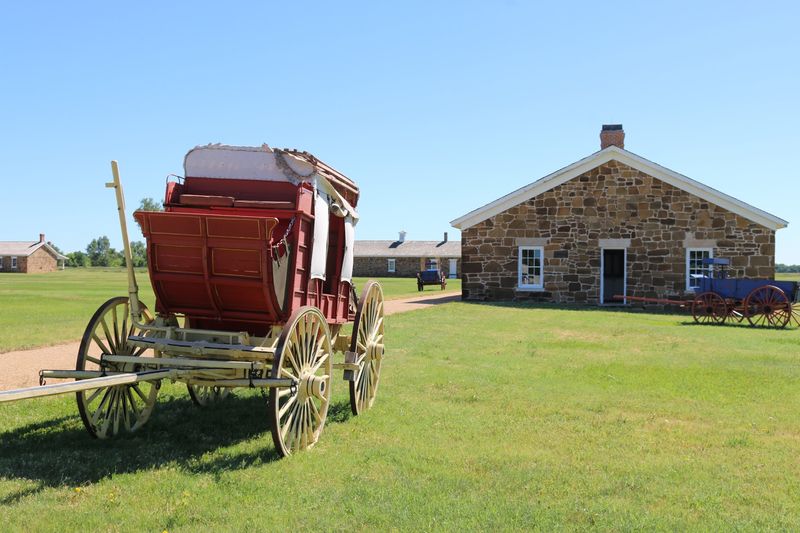
Fort Larned is widely considered the most complete and best-preserved military post of the Indian Wars era along the Santa Fe Trail. All nine of its original sandstone buildings, constructed between 1866 and 1868, still stand today, including barracks, officers’ quarters, a hospital, bakery, blacksmith shop, and commissary.
That kind of intact preservation is rare anywhere in the country.
The fort operated from 1859 to 1878, guarding mail coaches and freight wagons along one of the most significant trade routes of the 19th century. Notable figures including Kit Carson, George A.
Custer, and Philip Sheridan passed through its grounds. From 1867 to 1869, the Tenth Cavalry, one of the African American regiments formed after the Civil War, was stationed here.
Visitors can explore the site daily from 8:30 AM to 4:30 PM, with free admission. Ranger-led guided tours and seasonal living history programs include soldier drills and blacksmith demonstrations.
Preserved Santa Fe Trail ruts are visible a few miles from the fort, and a picnic area at the entrance provides a convenient spot to rest before or after touring.
11. Big Well Museum, Greensburg, Kansas
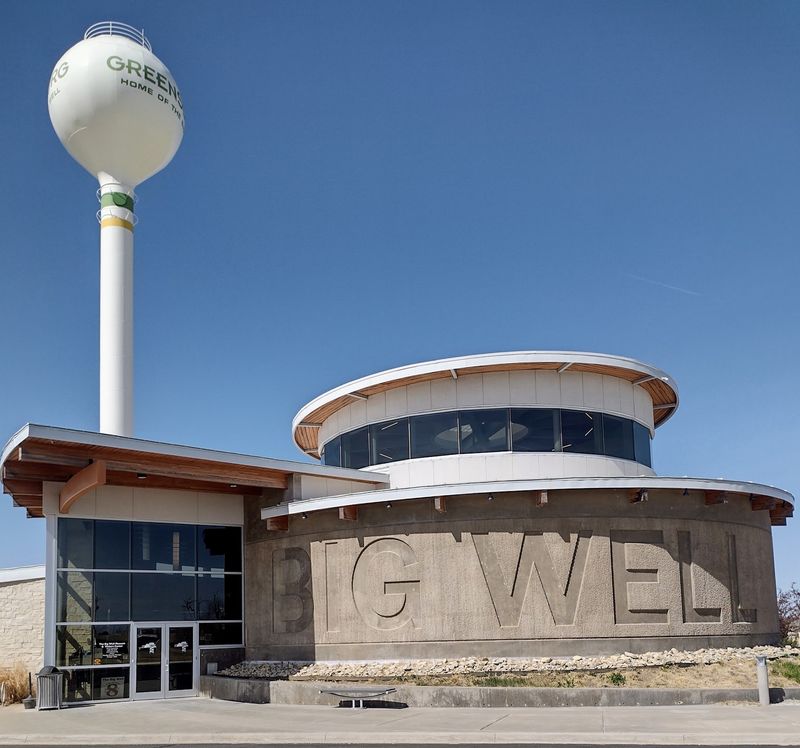
Greensburg’s claim to fame is a well. Not just any well, but a hand-dug cylinder measuring 109 feet deep and 32 feet in diameter, completed in 1888 by teams of up to 30 men working with pickaxes, shovels, ropes, and barrels over nine to ten months.
The casing was built from stones hauled 12 miles from the Medicine River, and the wooden planks used during construction are still visible inside.
The Big Well was designated a National Museum in 1972, listed on the National Register of Historic Places, and named one of the 8 Wonders of Kansas in 2008. The town of Greensburg was devastated by an EF5 tornado in May 2007, which destroyed 90 to 95 percent of the community.
The well and a 1,000-pound pallasite meteorite both survived, and the town rebuilt as a fully sustainable community now powered entirely by wind.
The new museum, reopened in 2012, lets visitors descend 84 steps on a spiral staircase into the well. Sunday hours run from 1 PM to 6 PM.
Admission is $8 for adults, with discounts for seniors and children. Free bicycles and maps for self-guided green tours of the rebuilt town are available at the museum.
Share this story