Kansas brings the Wild West to life through frontier forts, historic cattle towns, outlaw hideouts, and places where legendary showdowns actually happened. Across the state, visitors can follow the stories of cowboys, lawmen, Buffalo Soldiers, railroad pioneers, and settlers who helped shape the American frontier.
These 12 historic stops offer a fascinating look at Kansas during its wildest years. Each provides a memorable reason to hit the road and experience the state’s Old West history firsthand.
1. Old Cowtown Museum, Wichita
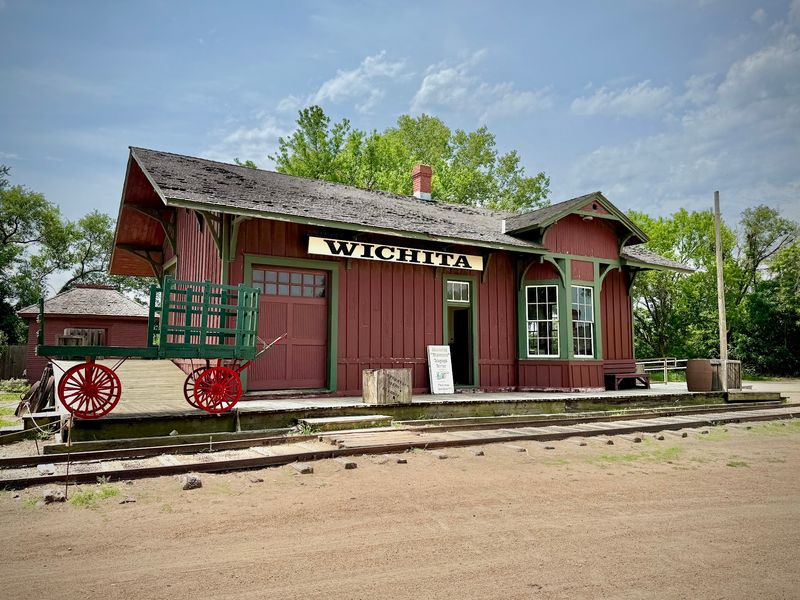
Twenty acres along the Arkansas River in Wichita have been transformed into something remarkable: a fully functioning recreation of an 1865 cattle town, complete with original relocated structures and costumed history interpreters.
Old Cowtown Museum brings together more than 50 historic and reconstructed buildings, including 27 original structures carefully moved from locations across Kansas to preserve their authenticity.
Blacksmiths, printers, and cowboys all make appearances during the regular season from April through October, giving visitors hands-on encounters with the trades and routines that kept a frontier settlement running.
The museum’s collection of over 25,000 authentic artifacts ranges from period furniture and farming tools to clothing and household items, providing concrete detail to every exhibit.
Live longhorn cattle, sheep, and chickens roam the grounds, reinforcing the reality of agricultural and cattle-drive life. Wichita served as a major stop on the Chisholm Trail between 1872 and 1876, and this museum makes that chapter genuinely tangible.
2. Old Abilene Town, Abilene
Abilene did not stumble into fame. In 1867, Illinois stockman Joseph McCoy deliberately chose this modest prairie village as the northern terminus for Texas cattle drives, and within a few years, the town was processing hundreds of thousands of longhorns each season.
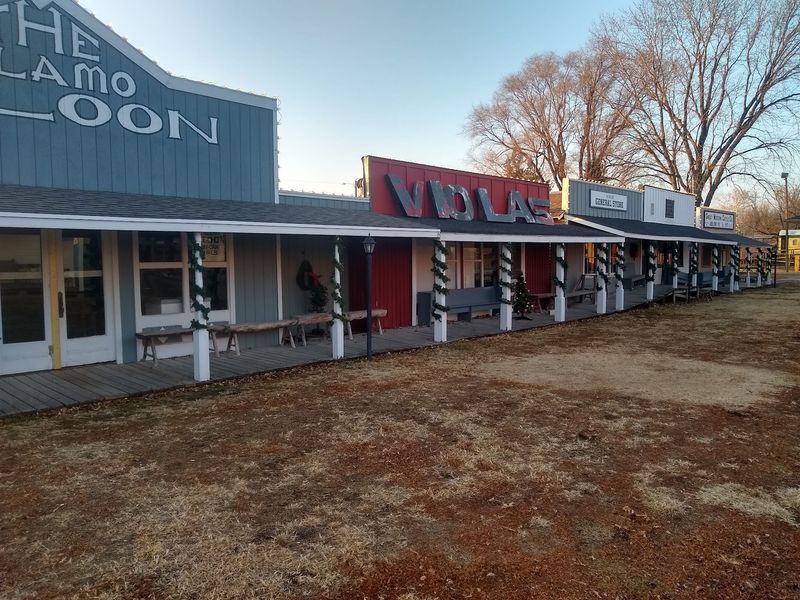
Old Abilene Town recreates that electric era with a collection of historic-style buildings, including the Alamo Saloon and a Merchant’s Hotel, some original and some faithfully reconstructed.
Wild Bill Hickok served as Abilene’s marshal in 1871, and visitors can actually tour his preserved 1871 cabin, which gives a grounded, human-scale perspective on what frontier law enforcement actually looked like.
A detailed miniature replica of the town inside the Great Western Cattle Company adds an interesting overview of how the whole settlement was laid out.
Summer performances bring gunfights and can-can dancers to the streets, and True West Magazine honored the show as its Best Wild West Show in 2021, a well-earned recognition for a genuinely entertaining experience.
3. Fort Larned National Historic Site, Larned
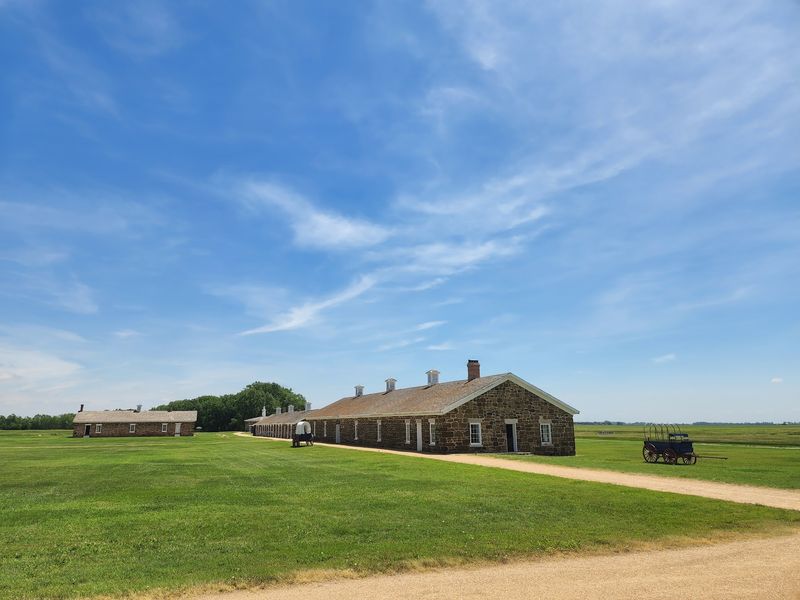
Nine original sandstone buildings still stand at Fort Larned, making it one of the most authentically preserved frontier military posts anywhere in the United States.
Established in 1859, the fort was built to protect travelers, mail carriers, and merchants moving along the Santa Fe Trail, the vital commercial route connecting Missouri to New Mexico. Its buildings were constructed between 1866 and 1868 and have remained largely intact ever since.
The fort served as a crossroads for an unusually diverse group of people. U.S. soldiers, including African American Buffalo Soldiers, mingled with civilian freighters, Indian agents, craftsmen, and Plains Indian delegations who came for treaty negotiations and annuity payments.
Visitors can walk through officers’ quarters, barracks, a guardhouse, a hospital, a bakery, and artisan shops for blacksmiths, carpenters, and saddlers. Each building tells a specific part of the fort’s operational story.
The U.S. Army abandoned Fort Larned in 1878 as the railroad replaced the trail. Guided tours are available and are well worth the time.
4. Fort Hays State Historic Site, Hays
Originally called Fort Fletcher when it opened in October 1865, this western Kansas outpost was renamed Fort Hays in 1866 and quickly became one of the most strategically important military posts on the central plains.
The fort protected Union Pacific Eastern Division railway workers pushing westward and later served as a major supply hub for forts farther south and west during the American Indian Wars.
Some of the most recognizable names in frontier history passed through here. George Armstrong Custer commanded the 7th Cavalry at Fort Hays, while Wild Bill Hickok and Buffalo Bill Cody both served as Army scouts on these grounds.
The 9th and 10th Cavalry regiments, the celebrated Buffalo Soldiers, were also stationed here, adding an important chapter to the site’s already layered history.
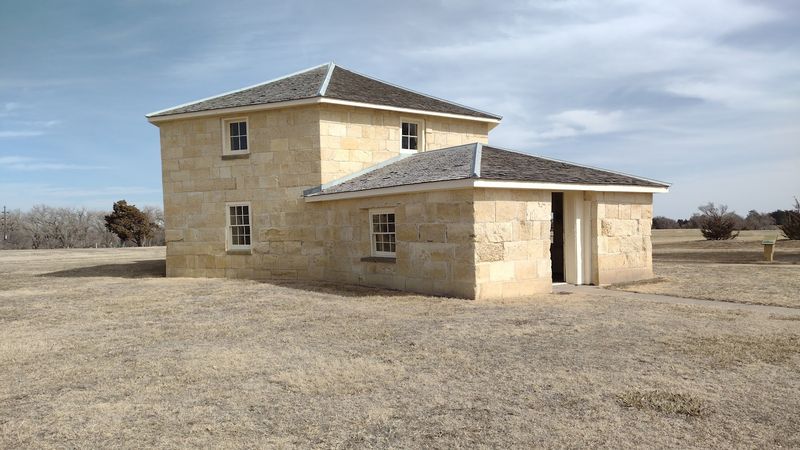
Four original structures survive today: the 1867 blockhouse, the 1872 guardhouse, and two officers’ quarters furnished with period pieces from the 1860s through the 1880s. A modern visitor center provides helpful context for everything you see.
5. Boot Hill Museum, Dodge City
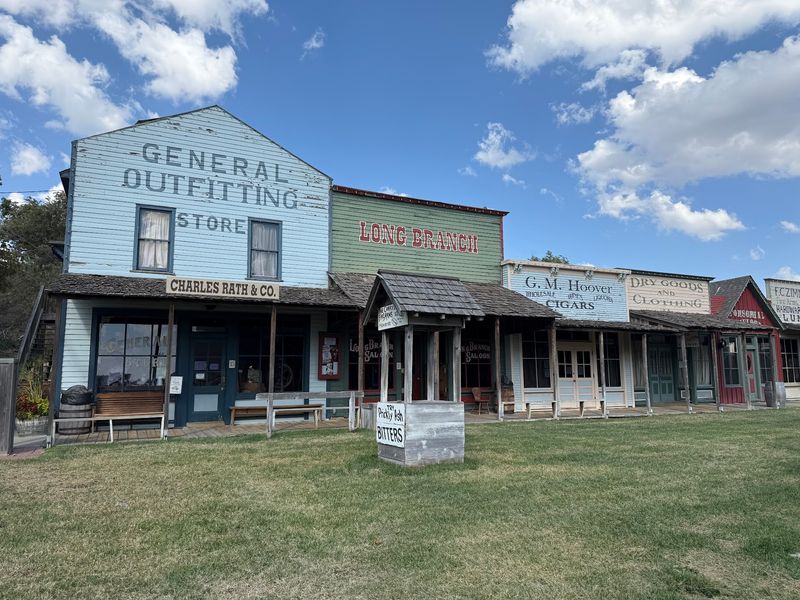
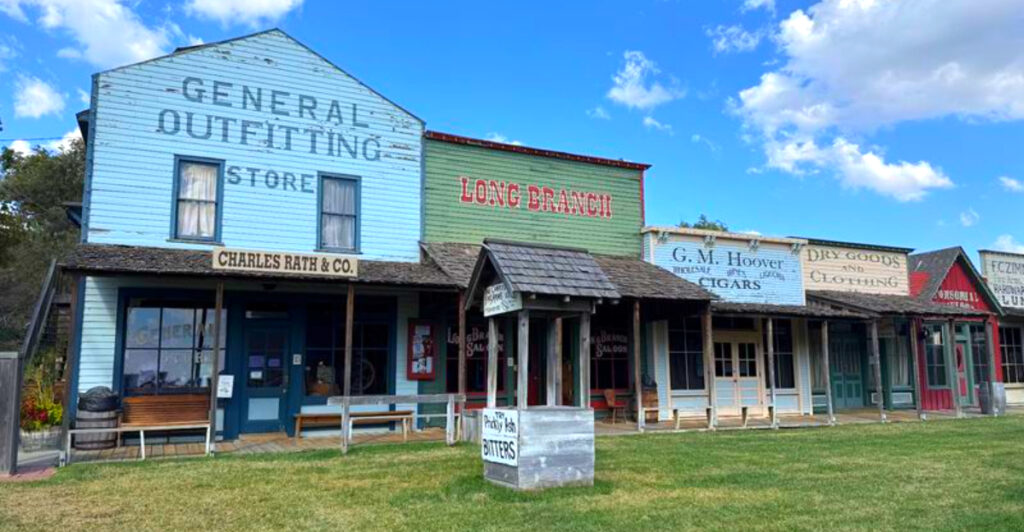
Few places in the American West carry as much legend per square foot as Boot Hill Museum in Dodge City, and the moment you set foot on its recreated Front Street, that reputation makes complete sense.
The museum sits on the original site of the historic Boot Hill Cemetery, where many of Dodge City’s most colorful characters were laid to rest during the cattle-boom years of the 1870s and 1880s.
Visitors can stroll along wooden boardwalks, peer into a recreated Long Branch Saloon featuring an authentic 1881 bar, explore a period jail, and visit a frontier church, all without leaving the property.
Inside, more than 60,000 artifacts, photographs, and documents tell the story of Dodge City from its earliest days through the 1920s. The Kansas Cowboy Hall of Fame and a collection of over 200 original firearms are particular highlights.
Summer brings gunfight reenactments and the Long Branch Variety Show, making this one of Kansas’s most entertaining history stops.
6. Dalton Gang Hideout, Meade
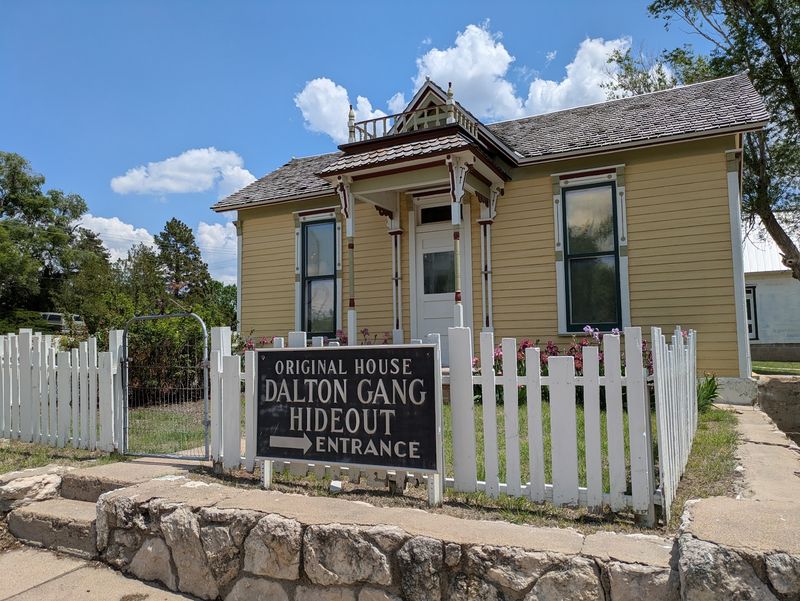
Not every piece of outlaw history involves a dramatic shootout. Sometimes it involves a quiet house, a merchant husband, and a tunnel that kept a secret for years.
The Dalton Gang Hideout in Meade centers on the home built in 1887 for Eva Dalton Whipple, sister to the notorious Dalton brothers. Local legend holds that the house served as a refuge for her outlaw siblings between their bank and train robberies from 1890 to 1892.
The most talked-about feature is a hidden tunnel connecting the house to a nearby stable. New residents only discovered it after Eva and her husband left in 1892. A Works Progress Administration project in 1940 rebuilt the original dirt passage as a 95-foot stone tunnel that visitors can now walk through.
Eva’s home is furnished with period pieces from the late 1800s, and the barn serves as the entrance, housing a gift shop and a loft museum filled with Western memorabilia and outlaw history exhibits.
Gunfight reenactments on the grounds make for a lively visit.
7. Dalton Defenders Museum, Coffeyville
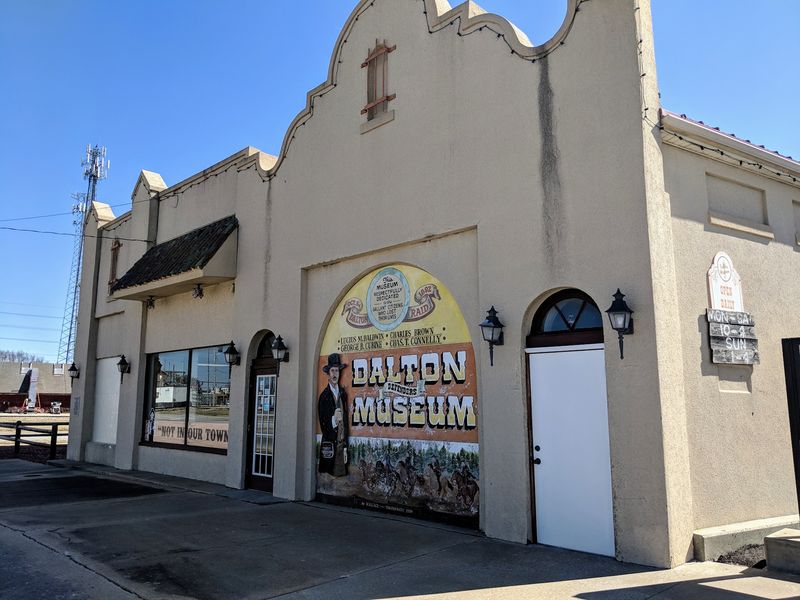
On October 5, 1892, the Dalton Gang attempted something no outlaw crew had pulled off since the Civil War: robbing two banks in the same town at the exact same moment.
Bob, Grat, and Emmett Dalton rode into Coffeyville with three other gang members, wearing disguises. Sharp-eyed townspeople recognized them anyway, and within minutes, armed citizens had pulled weapons from a local hardware store and taken up positions around the banks.
The resulting gun battle lasted roughly 12 to 15 minutes. Four gang members were killed, including Bob and Grat Dalton. Emmett survived despite being hit 23 times. Tragically, four Coffeyville citizens also lost their lives, including Marshal C.T.
Connelly.
The Dalton Defenders Museum, established by the Coffeyville Historical Society in 1963, stands directly across from the Condon Bank, one of the two targeted institutions. Its collection includes guns, saddles, clothing, and feed bags connected to the raid.
“Death Alley,” where several gang members fell, is still identifiable today, with markers helping visitors trace exactly how the confrontation unfolded.
8. Abilene and Smoky Valley Railroad, Abilene
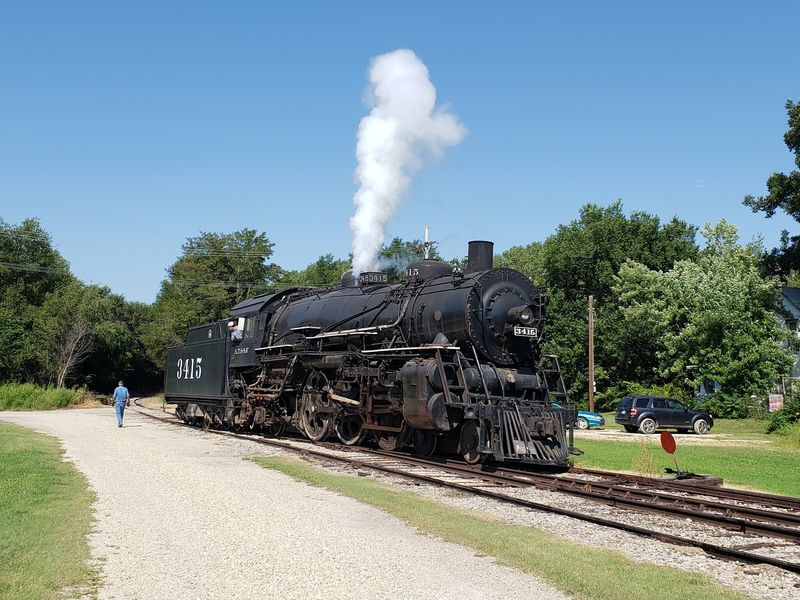
Railroads did not just support Kansas cattle towns. In many cases, they created them. The Abilene and Smoky Valley Railroad makes that connection concrete by operating on tracks first laid in 1886 by the Chicago, Rock Island and Pacific Railroad.
Established by volunteers in 1993, this heritage line functions as Kansas’s official heritage railroad and operates a 10.5-mile round trip between Abilene’s historic 1887 Rock Island Depot and the town of Enterprise.
The fleet includes a 1945 Alco switch engine, a 1940 General Electric center cab model nicknamed “Ike” in honor of President Eisenhower, and the undisputed star of the operation: a 1919 Baldwin steam locomotive, Santa Fe No. 3415.
That steam locomotive was officially designated Kansas’s state steam locomotive in 2024, making it the only operational steam engine in the state. Passengers ride in antique coaches, including a rare 1902 wooden car, while onboard narrators explain how the railroad turned Abilene into the cattle-shipping capital of the post-Civil War era.
Themed rides and dinner trains are also available throughout the year.
9. Historic Santa Fe Depot, Dodge City
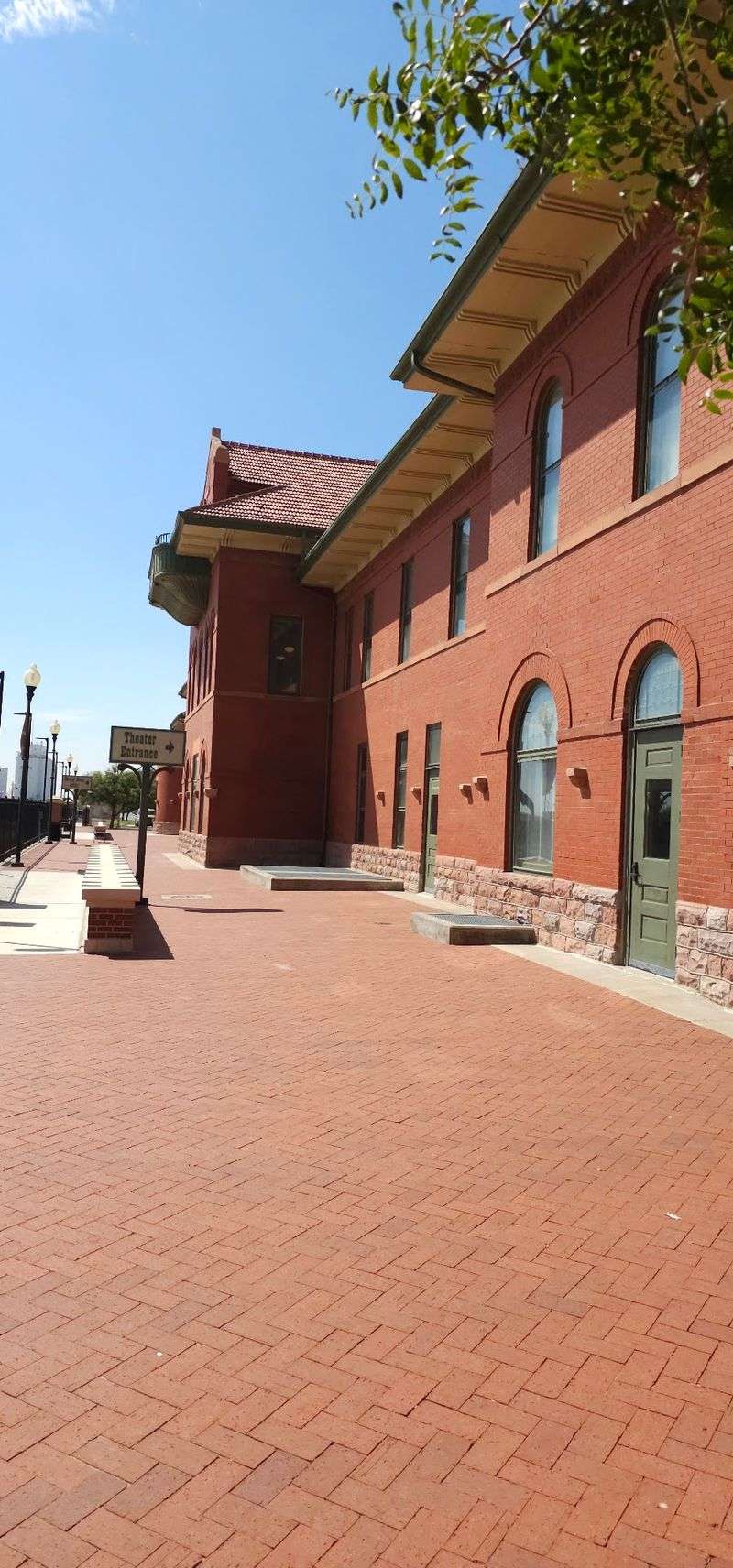
Completed in 1898, the Historic Santa Fe Depot in Dodge City holds the distinction of being the largest depot still standing in Kansas, and its brick facade with arched windows makes a strong case for why railroad architecture deserves more attention.
The Atchison, Topeka and Santa Fe Railroad arrived in Dodge City in September 1872, and its impact was immediate. Buffalo hides moved east by the thousands, followed soon after by millions of Texas longhorns heading to markets in Chicago and beyond.
Dodge City became the world’s largest cattle shipping point between 1883 and 1884, a period when a national financial crisis had halted the Santa Fe’s main construction at Dodge City, making it the primary shipping hub for southern cattle.
The depot originally housed a Fred Harvey Hotel with its “El Vaquero” dining room, which offered travelers a reliable standard of hospitality in an otherwise unpredictable frontier landscape.
Donated to the city in 1996 and listed on the National Register of Historic Places, the depot now operates as a cultural center and home to the Depot Theater, which hosts dinner theater and live performances.
10. Home of Stone, Dodge City
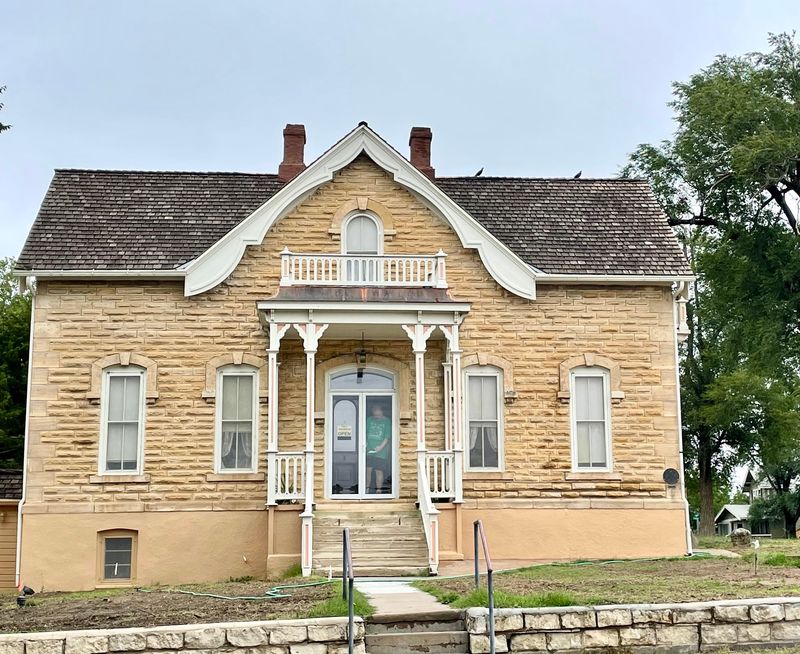
Most visitors come to Dodge City for the gunfights and the cattle drives. The Home of Stone offers something different: a detailed look at what a prosperous frontier family’s life actually looked like once the dust settled.
Built between 1879 and 1881 by German immigrant John Mueller, this limestone residence is the only stone house ever constructed in Dodge City and the oldest building in the city still standing on its original site. Mueller quarried the limestone locally from Sawlog Creek.
Mueller arrived in Dodge City in 1875, built a successful boot shop on Front Street, and eventually expanded into a saloon and three cattle ranches. His wealth funded 18 months of construction, including an elaborate walnut interior and a spiral staircase crafted by artisan William Strubel.
Fortune shifted dramatically in 1886 when a catastrophic blizzard wiped out 75,000 head of his cattle. The Mueller family returned to St. Louis by 1890, and the home passed to Adam and Elizabeth Schmidt, whose family lived there until 1960.
Today, visitors can tour the parlor, basement kitchen, and bedrooms, all furnished with authentic Victorian pieces from both families.
11. Santa Fe Trail Center Museum, Larned
The Santa Fe Trail did not just carry goods. It carried entire ways of life, cultures, and conflicts across more than 800 miles of American landscape, and over half of that route ran directly through Kansas.
Located four miles east of Larned, the Santa Fe Trail Center Museum and Research Library explores the full scope of that story, from prehistoric American Indian cultures to the trail’s active years between 1821 and the 1880s.
Inside, visitors encounter authentic artifacts from the trail era, including trade items, tools, antique furniture, and a full-sized mounted bison named Wally who tends to surprise first-time visitors. A replica 1919 frame-style home with a brick-paved main street and a small movie theater showing vintage films adds an unexpected layer to the experience.
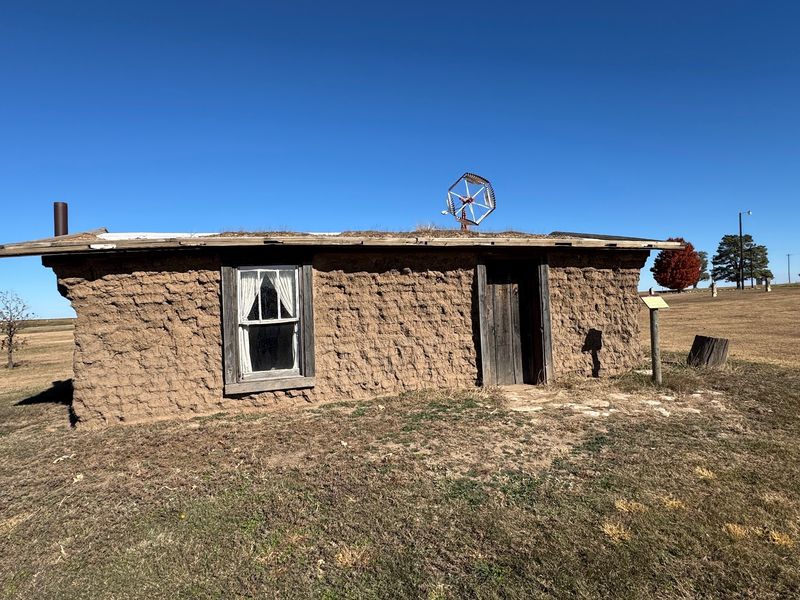
Outside, a sod house and dugout reconstruction give visitors a grounded sense of pioneer living conditions. The historic Frizell Depot allows for simulated train trips and telegraph operations.
The research library holds over 7,000 historic photographs, maps, and primary documents, making it a serious resource for anyone studying the trail’s history in depth.
12. Chisholm Trail Museum, Wellington
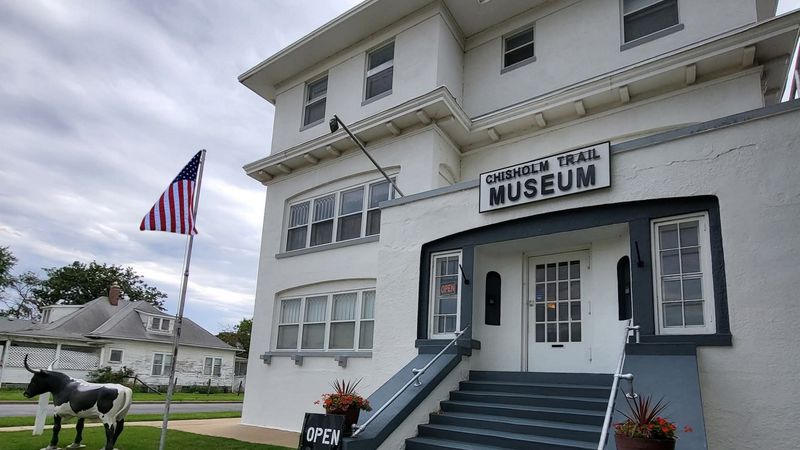
Wellington sits right in the heart of the territory crossed by one of the most famous cattle routes in American history, which makes the Chisholm Trail Museum a fitting home for the region’s frontier story.
Founded in 1963 by a group of local citizens, the museum found its permanent home in 1965 inside the historic Hatcher Hospital building, a three-story structure that is itself a piece of local history worth noting.
The collection spans more than 20,000 artifacts, covering pioneer wagon items, antique furniture, tools, and objects from local businesses that helped shape Sumner County during its formative years.
Exhibits trace the arc of the Chisholm Trail from its post-Civil War origins through its peak years, when Texas drovers pushed millions of longhorns north to Kansas rail yards to meet growing demand for beef in northern markets. Those drives were grueling, multi-week journeys that fundamentally shaped the economic landscape of the central plains.
Specialty exhibits include a Military display and an Old Time Soda Shop, offering lighter moments alongside the heavier historical content. The museum is open seasonally.
Share this story